
七年级英语下册 全册知识要点素材 仁爱版
七年级英语(仁爱版)下册复习教案Unit 5 Our School Life任务形学习目标:1.掌握并能熟练运用表达交通方式的句型。
2.掌握频度副词的表达方式。
3.掌握一般现在是的用法。
Topic 1 How do you usually come to school ?二.重点短语:1. on foot go …on foot = walk ( to )…2. by + 交通工具“乘坐…” by bus / bike / plane / train / subway / ship / boat / car3.take the bus = go …by bus ride a bike = go …by bike take the subway = go …by subway4. on weekdays 在平日5. after school 放学后after class 下课后 after breakfast / lunch / supper早餐 / 午餐 / 晚餐后6. in their free time 在空闲时间7. have a rest 休息一下8. read books 读书11. go swimming 去游泳12. listen to music 听音乐12. watch TV 看电视13. do(one’s) homework 做作业14. go to the zoo / park 去动物园 / 公园 15. once a week 一周一次16. every day 每天17. have classes 上课18.for a little while 一会儿19. go to bed 上床睡觉20. have breakfast / lunch / supper (dinner)吃早餐 / 午餐 / 晚餐22. at the school gate 在校门口 23. come on 快点、加油 24. get up 起床25. talk with / to sb.与某人谈话 26. at school 在学校、在上课27. go to school 去上学 28. and so on ……等等三.语法:表时间频率的副词:never 从来不 seldom 极少 sometimes 有时 often 经常 usually 常常 always 总是1. I never go to school by subway.2. I seldom walk to school.3. Maria sometimes takes the subway home.4. Li Xiang often rides a bike to school.5. We usually go to the park on foot.6. They always go to the zoo by bus.7. How often do you come to the library ? Very often / Twice a week / Once a week / Every day.四. 重要句型1. Happy New Year! The same to you.2. Your new bike looks very nice. Thank you.3. How do you usually come to school ? By bus / car / bike. On foot.4.It’s time for class. = It’s time to have class. 该是上课的时候了。
5. The early bird catches the worm. 笨鸟先飞。
/ 捷足先登。
6. We have no more time. 我们没有更多的时间了。
7. I have four classes in the morning and two in the afternoon.我早上上四节课,下午上两节。
8. She goes to bed at about a quarter to ten. 她九点四十五分睡觉。
Topic 2 He is running on the playground.二.重点短语:1. make cards 制作卡片 2. on the playground 在操场上 3. in the library 在图书馆4. in the gym在体育馆5. on the shelf在书架上(shelves 复数)6. at the Lost and Found 在失物招领处7.clean the room打扫房间8.have a soccer game 举行足球比赛9. have an English class 上英语课 10. write a letter 写信 11. some of his photos= some photos of his 他的一些照片 12. on time 准时/in time及时 14. do better in sth 在某方面做得较好 15.put on 穿、戴上、上演(代词it / them放在中间,名词中间或后面,put it / them on ) 16. show sb. around… 令某人参观……三.语法:现在进行时态主语+ be(is / am / are )+ 动词ing + 其他。
表示正在进行或发生的动作。
常与now = at the moment 现在、 look看、 listen听等连用。
1. I’m looking for my purse.2. They aren’t sleeping at the moment.3. Are you doing your homework ? Yes, I am. No, I’m not.4. Is he / she singing now ? Yes, he / she is. No, he / she isn’t.5. What is your brother doing ? He is running in the gym.四. 重要句型1.Excuse me, may I borrow your story book ? Of course. = Sure. (borrow sth from…从……借回某物……)2. How Long may I keep the book ? Two weeks. ( keep 借用,后面常跟一段时间连用)3.You must return them on time. ( return 归还,return sth to …把……归还给……)4. Thank you. It’s a pleasure. = A pleasure = My pleasure. 别客气。
5. Sorry, I don’t have any. Thank you all the same. 仍然感谢你。
6. See you soon. 回头见.7. What else ? 还有别的什么?( else 其他的、别的,常放在疑问词what/ where / who…和不定代词something/ somebody等的后面)Topic 3 My school life is very interesting.二.重点短语:1. outdoor activity 课外活动 2. easy and interesting 容易又有趣 3. difficult and boring 又难又乏味 4. be friendly to sb.=be kind to sb. 对某人友好 5.between…and… 在……之间… 6.learn…from… 向……学习……/ 从…中学……7. from…to… 从……到……8. in the morning / afternoon / evening 在早上/ 下午/ 晚上9.on Monday 在星期一 on Monday morning在星期一的早上 11. tell sb. about sth 告诉某人关于某事三.语法:一般现在时主语+ 动词原形/ 动词第三人称单数s/es + 其他。
表示经常或习惯性的动作。
常与频率副词:never 从来不 seldom 极少 sometimes 有时 often 经常 usually 常常 always 总是或every day 每天、in the morning / afternoon / evening 在早上/ 下午/ 晚上等连用。
例如:I often do my homework in the evening. I don’t often go shopping on Sunday.Do you usually come to school by car? Yes, I do. No, I don’t. Sometimes she watches TV in the evening. She doe sn’t like Chinese. Does she often take a bus to school ? Yes, she does. No, she doesn’t.四. 重要句型1.What day is it today?It’s Sunday / Monday / Tuesday / Wednesday / Thursday / Friday / Saturday.(在英语国家每周的第一天是星期天而不是星期一)2. What class are they having ? They are having a music class.3. What time does the class begin ? At ten o’clock.4. What do you think of math? = How do you like math ? 你认为数学怎么样?It’s difficult and boring.5. Why (为什么)do you like English ? Because(因为)it’s easy and interesting.7.What subject (学科)do you like best ? I like history best.8. At school, my teachers and classmates are very friendly to me.9. I study Chinese, English, politics, geography and some other subjects.(other 泛指其他的,别的+ 名词复数)10.English is my favorite (最喜欢的)subject. I also like P.E and music.= I like P.E and music , too. (也)11.Can you tell me something about it ?五.词语辨析a few 几个,一些+ 名词复数 a little 一点儿+不可数名词 many 许多+名词复数few几乎没有little 几乎没有much许多、大量的+不可数名词other泛指其他的,别的+ 名词复数 another 泛指又一个、再一个、另一个+ 名词单数 the other 两者中的另一个Unit 6 Our Local AreaTopic1 Is there a sofa in your study?一、学习目标1、掌握单词和重点词组2、掌握there be的各种形式及用法3、能熟练用英语描写房间、家庭、学校等建筑4、熟练掌握方位介词in, on, behind, under, near, next to, in front of二、重点词组On the first floor 美式英语一楼floor地板,此处指“楼房的层”。
(完整版)仁爱版英语七年级下全部知识点总结.doc

七年级下英语知识点总结Unit 5 Topic1㈠短语总结1.在学校大门口 at the school gate2.来学校come to school3. 去学校go to school4. 上课have class / have classes5. 步行on foot6.骑自行车ride a bike/ ride bikes/ by bike / on a bike7.坐公交by bus / take a bus8.坐地铁by subway / take the subway / on the subway9.坐飞机by plane/ take the plane / on the plane10.坐小汽车by car / in a car/ take a car/ drive a car11. 坐轮船by ship12. 坐小船by boat13. 坐火车by train / on the train14. 在我们组in our group15.一群学生a group of students16.我们中的三个人 three of us17.在平日 on weekdays18.在周末 on the weekends / at weekends19.起床 get up20.睡觉 go to bed21.早起 get up early22.回家 go home23.到家 get home24.去动物园 go to the zoo25.去公园 go to the park26.看电影 see a movie / film27.看电视 watch TV28.在晚上 in the evening / at night29.帮助父母 help parents30.做某人的家庭作业 do one’s ( my/ her/ his/ your/ their)homework31.在学校 at school32.知道 ,了解 know about / learn about33.校园生活 school life34.一个美国学生 an American student35.在美国 in America / in the U.S.A.36.许多学生 many students/ a lot of students/ lots of students37.很少 very few38.吃午饭 have lunch39.出去吃饭 eat out40.在校期 on school days41.休息一会 have a short rest/ break42.午后 after lunch43.在某人的余 in one’s ( my/ his/ her/ their⋯)free/ spare time44.打球 play basketball45.踢足球 play soccer / football46.琴 play the piano47.吉他 play the guitar48.拉二胡 play erhu49.去游泳 go swimming / go for a swim50.去划船 go boating51.球 a ball game / ball games52.一年四次 four times a year53.听音 listen to music54.read books55.看 read newspapers56.看医生 see a doctor57.去 go to the library58.一周两次 twice a week59.朋友 meet friends60.每天 every day61.在七点半 at half past seven62.一小会 for a little while / for a short time63.晚后 after supper64.吃 have dinner65.吃早 have breakfast㈡重要句型1.I usually come to school by subway.同句 : I usually take the subway to school.划部分提 : How do you usually come to school?似的有:go to school by bike=go to schoolon a bike= ride a bike to school=ride to schoolgo home by bus=go home on a bus=take a bus home2.How do you usually/ often⋯?你通常 /常怎⋯?3.It ’stime for class.=It’s time to have class. =It’s time for having class.4.What about you? =How about you?5.How often ⋯? 率,回答可以用率副: always, usually, often,sometimes, seldom, never, every day ,every +其他名或表示率的短回答表示率的短:次数 +位e.g. : once a day / twice a week / three times a month6.The early bird catches the work. ( ) 笨先7.Work / Study must come first. 工作 / 学必放在第一位!8. Classes begin at eight. =Class begins at eight.提问:What time does the class begin? / What time do the classes begin?㈢重要单词的用法1.look (感官动词 ) 看起来,后面加形容词His mother looks very young.They look very cute.Her dress looks very nice.You look very cool in this coat.2. by 介词by 后面直接加表示交通工具的名词,中间不用任何词修饰,如: by bike by +动词 ing 形式,表示通过某种方式People show love to their mothers by giving cards.You can be a good student by working hard.3.over (形容词 ) School/ Class is over.4.begin现在分词 : beginning 过去式 : beganbegin to do sth , begin doing sthHe begins to write a letter. =He begins writing a letter.如果 begin 本身为分词,只能用begin to do sthHe is beginning to run.5.listen to 听(动作), hear 听见 (结果 )6.always 反义词 never7.本话题涉及的时态为一般现在时,句中常有频率副词或表示频率的短语,如果主语为三单,动词一定要用三单!(四)易错题1.You new watch ______ (look) very nice!2.Here ______(be) some news.3.Oh, come on! It’s time_____ going to school.4.They usually go to school on ________(feet).5.In my class, forty of _______(we) go to school by bike.6.The early bird ______ (catch) the worm.7.Kangkang often _____ (ride) a bike to the park.8.What time _____ (be)school over?9.Work must come ______(once).10.It ’stime ____you to get up.11.We often _____ books in the morning.12.Jill ’s friend like ______(study) in our school.13.Mr. Wang teaches ______(we) English. _____ of us like him.14.How about ______(go) out with me?15.Most students go to school _____ the school bus.16._______ do you go shopping with your mother?A. How soonB. How farC. How oftenD. How much17. What time do you usually get up _____ weekdays?18. He ______ busy, so he has no time to play with us.A. is alwaysB. seldom isC. always isD. often is19.The last class______(finish) at twelve o’clock.20.Let’s go______(boat).21.It’stime to have breakfast. 同(义句 )______________________________________________________.22.Michael often rides a bike to school. 同(义句 )______________________________________________________.23.I always go to work on foot. (对划线部分提问 )______________________________________________________.24.My mother goes shopping twice a week. 对(划线部分提问 )______________________________________________________.25.Mary always reads books in the library. 反(义句 )______________________________________________________.26.He usually does his homework at school.否(定句 )______________________________________________________.27.They often go to school by bus in the morning. 对(划线部分提问 ) ______________________________________________________.28.Jane seldom watches TV on weekdays改.(为一般疑问句 )______________________________________________________.29.He usually has lunch at home. 对(划线部分提问 )______________________________________________________.30.Li Ping often goes to work on foot. (同义句 )______________________________________________________.31.几乎没有学生乘地铁去学校。
(完整版)仁爱英语七年级下册重要知识点和语法点归纳,推荐文档
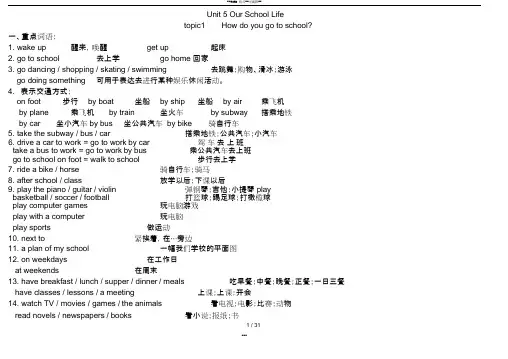
Unit 5 Our School Lifetopic1 How do you go to school?一、重点词语:1. wake up 醒来,唤醒get up 起床2. go to school 去上学go home 回家3. go dancing / shopping / skating / swimming 去跳舞;购物、滑冰;游泳go doing something 可用于表达去进行某种娱乐休闲活动。
4. 表示交通方式:on foot 步行by boat 坐船by ship 坐船by air 乘飞机by plane 乘飞机by train 坐火车by subway 搭乘地铁by car 坐小汽车by bus 坐公共汽车by bike 骑自行车5. take the subway / bus / car 搭乘地铁;公共汽车;小汽车6. drive a car to work = go to work by car 驾车去上班take a bus to work = go to work by bus 乘公共汽车去上班go to school on foot = walk to school 步行去上学7. ride a bike / horse 骑自行车;骑马8. after school / class 放学以后;下课以后9. play the piano / guitar / violin 弹钢琴;吉他;小提琴playbasketball / soccer / football 打篮球;踢足球;打橄榄球play computer games 玩电脑游戏play with a computer 玩电脑play sports 做运动10. next to 紧挨着,在⋯旁边11. a plan of my school 一幅我们学校的平面图12. on weekdays 在工作日at weekends 在周末13. have breakfast / lunch / supper / dinner / meals 吃早餐;中餐;晚餐;正餐;一日三餐have classes / lessons / a meeting 上课;上课;开会14. watch TV / movies / games / the animals 看电视;电影;比赛;动物read novels / newspapers / books 看小说;报纸;书1 / 31---15. wash one ’s face / clothes 洗脸;衣服16. 反义词:up –down, early –late 近义词:quickly –fastget up early 早起be late for 迟到17. the first / second / third / fourth day 第一;二;三;四天18. clean the house 打扫房子19. 表示建筑物(尤其学校建筑物):on the playground 在操场at school / home / table 在学校;家里;桌旁in a computer room / teachers ’ office / classroom building / gym / library / lab / canteen在电脑室;教师办公室;教学楼;体操馆;图书馆;实验室;食堂20. around six o ’clock = at about six o ’clock 大约在六点21. 频率副词:never, seldom, sometimes, often, usually, always二、重点句型:1. It ’s time to get up. 该起床的时候了。
(完整版)(仁爱版)英语七年级下册知识点归纳

(仁爱版)英语七年级下册知识点归纳Unit 5 Topic1重点语法一般现在时(常与频度副词never, seldom, sometimes, often,usually, always等连用)重点句型—How do you usually come to school?—I usually come to school by subway.—How often do you go to the library?—Once/Twice/Three times a week/Very often/Every day/Sedom重点详解1.I always come to school by bus.by+交通工具名称,表示使用某种交通方式,中间不加限定词,如果交通工具前有a, the, my 等限定词,就不能用by,而是用in或是on.on the train=by train on his bike=by bike in my car=by car.巧辩异同on foot 与walk on foot “走路”,是介词短语,不能作谓语,只作方式状语,位于句末。
walk “走路”,是动词,可以作谓语。
go to…on foot= walk to I often go to school on foot. =I often walk to school.同样,go to….by bike = ride a bike to go to…. by car = drive a car to go to … by plane = fly to go to… by bus = take a bus to2 .Come on! It’s time for class. come on “快点,加油,来吧”。
It’s time for sth. “该做某事了”,与It’s time to do sth.意思一样。
3 .look的短语look the same看起来一样look like看起来像……look for寻找look after 照顾4 .do my homework at school 在学校做作业do one’s homework 做家庭作业(注意:one’s 要随主语的变化而变化,常用形容词性物主代词my, your, their, our, his, her等)。
(完整版)仁爱版七年级英语下册知识点总结
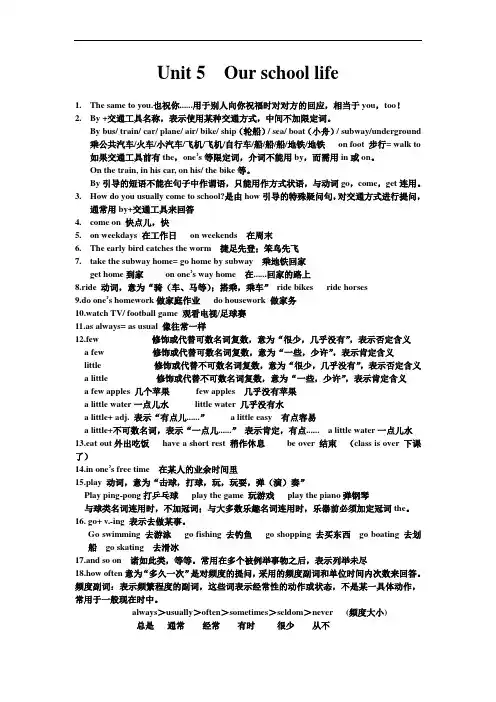
Unit 5 Our school life1.The same to you.也祝你......用于别人向你祝福时对对方的回应,相当于you,too!2.By +交通工具名称,表示使用某种交通方式,中间不加限定词。
By bus/ train/ car/ plane/ air/ bike/ ship(轮船)/ sea/ boat(小舟)/ subway/underground 乘公共汽车/火车/小汽车/飞机/飞机/自行车/船/船/船/地铁/地铁on foot 步行= walk to 如果交通工具前有the,one’s等限定词,介词不能用by,而需用in或on。
On the train, in his car, on his/ the bike等。
By引导的短语不能在句子中作谓语,只能用作方式状语,与动词go,come,get连用。
3.How do you usually come to school?是由how引导的特殊疑问句,对交通方式进行提问,通常用by+交通工具来回答e on 快点儿,快5.on weekdays 在工作日on weekends 在周末6.The early bird catches the worm 捷足先登;笨鸟先飞7.take the subway home= go home by subway 乘地铁回家get home到家on one’s way home 在......回家的路上8.ride 动词,意为“骑(车、马等);搭乘,乘车”ride bikes ride horses9.do one’s homework做家庭作业do housework 做家务10.watch TV/ football game 观看电视/足球赛11.as always= as usual 像往常一样12.few 修饰或代替可数名词复数,意为“很少,几乎没有”,表示否定含义a few 修饰或代替可数名词复数,意为“一些,少许”,表示肯定含义little 修饰或代替不可数名词复数,意为“很少,几乎没有”,表示否定含义a little 修饰或代替不可数名词复数,意为“一些,少许”,表示肯定含义a few apples 几个苹果few apples 几乎没有苹果a little water一点儿水little water 几乎没有水a little+ adj. 表示“有点儿......” a little easy 有点容易a little+不可数名词,表示“一点儿......”表示肯定,有点...... a little water一点儿水13.eat out外出吃饭have a short rest 稍作休息be over 结束(class is over 下课了)14.in one’s free time 在某人的业余时间里15.play 动词,意为“击球,打球,玩,玩耍,弹(演)奏”Play ping-pong打乒乓球play the game 玩游戏play the piano弹钢琴与球类名词连用时,不加冠词;与大多数乐趣名词连用时,乐器前必须加定冠词the。
(完整word)(仁爱版)英语七年级下册知识点归纳与总结,推荐文档

第1页(仁爱版)英语七年级下册知识点归纳Unit 5 Topicl重点语法一般现在时(常与频度副词 _________ n ever __ , __ seldom ___ ,___ s ometimes ___ , __ o ften __ , ____ usually., ___ always ____ 等连用)重点句型一How do you usually come to school?—I usually come to school by subway.—How ofte n do you go to the library?—__once ___ (—次)/ twice ___ (两次)/ _three ____ times ___ (三次)a weekVery ofte n/Every day/Seldom重点详解1.I always come to school by bus.by+交通工具名称,表示使用某种交通方式,中间不加限定词,如果交通工具前有_a/an __ , __the_,形物代—等限定词,就不能用by,而是用___ i n_或是__on_ on the train=__by__ train on his bike=__by__ bike in my car=_by __ car.Eg: I go to school by bike. (on my bike)Ps:之前说的take+a/an/the+交单,但是这是一个动词词组,不能和By+交单对等互换。
系动词包含Be句子结构:1主谓宾:I love you。
2主谓:Igo。
3 主系表:you are beautiful。
巧辩异同on foot与walk on foot走路”是介词短语,不能作谓语,只作方式状语,位于句末。
walk走路”是动词,可以作谓语。
go to …on foot= walk to I often go to school on foot. =I often ______ school.同样,go to ….by bike = ride/__take__ a bike togo to ….by car = drive/_take __ a car togo to …by pla ne = fly to/__take ___ a ____ plane ___ to__go to … by bus = __ t ake_ a bus to2 .Come on! It ' time for class. come on 意思是__ ___ , ____ , ____ ”It' time __for__ sth=It ' time __to ____ do__ sth.=It ' time for doing sth.It' time for dinner= It 'time to eat dinner= It' time for eat ing dinner.3 .look 的短语look __the _____ same_看起来一样look __like_看起来像.....look __for__ 寻找look __after__ 照顾4 .do my homework at school 在学校做作业do one 's homework 做家庭作业(注意:one's 要随主语的变化而变化,常用形容词性物主代词__my__, __your__, __his__ ,__her__, _its___, __our__ ,__your__,their 等)。
仁爱版七年级英语下册知识点总结(全册)

仁爱版七年级英语下册知识点总结(全册)仁爱版七年级英语下册知识点总结(全册)Unit 5 Topic1 重点短语1.on foot go …on foot = walk ( to )…2.at the school gate在学校大门口3.on weekdays在平日 ,在工作日4. on weekends=on the weekend在周末5.after school 放学后6.after class 下课后7.after breakfast / lunch / supper早餐/ 午餐/ 晚餐后8.in ones free time在某人空闲时间9.have a rest 休息一下10.read books 读书11.go swimming 去游泳12.listen to music 听音乐13.watch TV 看电视14.do(one’s)homework 做作业15.go to the zoo / park 去动物园/ 公园16.once a week 一周一次17.every day 每天18.have classes 上课19.for a little while 一会儿20.go to bed 上床睡觉/doc/3c4073325.htmle on 快点,加油,来吧22.get up 起床23.talk with / to sb.与某人谈话24.at school 在学校、在上课25.go to school 去上学26.and so on ……等等重点句型1.Happy New Year! The same to you.2.Your new bike looks very nice. Thank you.2.How do you usually come to school? —I usually come to school by subway.3.How often do you go to the library? —Once/Twice/Three times a week/Very often/Every day/Sedom4.The early bird catches the work. (谚语) 笨鸟先飞5.Classes begin at eight. =Class begins at eight. What time does the class begin? / What time do theclasses begin?6.We have no more time. 我们没有更多的时间了。
(仁爱版)英语七下各单元知识点归纳.doc
英语七卑怨下册各单无応识点归他Unit 5 Topicl重点语法一般现在时(常与频度副词never, seldom, sometimes, often,usually,always等连用)重点句型一How do you usually come to school?一I usually come to school by subway.一How often do you go to the library?一Once/Twice/Three times a week/Very often/Every day/Sedom重点详解1.1 always come to school by bus.by+交通工具名称,表示使用某种交通方式,中间不加限定词,如果交通工具前有a, the, my等限定词,就不能用by,而是用in或是on.on the train=by train on his bike=by bike in my car=by car.巧辩异同on foot与walk on foot "走路",是介词短语,不能作谓语,只作方式状语,位于句末。
walk“走路”,是动词,可以作谓语。
go to...on foot= walk to I often go to school on foot. =1 often walk to school.同样,go to....by bike = ride a bike to go to.... by car = drive a car togo to ... by plane = fly to go to... by bus = take a bus toe on! Ifs time for class. come on "快点,加油,来吧"。
It's time for sth."该做某事了",与It's time to do sth.意思一样。
仁爱版英语七年级下全部知识点总结
七年级下英语知识点总结Unit 5 Topic1㈠短语总结1.在学校大门口 at the school gate2.来学校 come to school3.去学校 go to school4.上课have class / haveclasses5.步行 on foot6.骑自行车 ride a bike/ ride bikes/by bike / on a bike7.坐公交 by bus / take a bus8.坐地铁 by subway / take thesubway / on the subway9.坐飞机 by plane/ take the plane/ on the plane10.坐小汽车 by car / in a car/ takea car/ drive a car11.坐轮船 by ship 12.坐小船 by boat13.坐火车 by train / on the train14.在我们组 in our group15.一群学生 a group of students16.我们中的三个人 three of us17.在平日 on weekdays18.在周末on the weekends / atweekends19.起床 get up20.睡觉 go to bed21.早起 get up early22.回家 go home23.到家 get home24.去动物园 go to the zoo25.去公园 go to the park26.看电影 see a movie / film27.看电视 watch TV28.在晚上 in the evening / at night29.帮助父母 help parents30.做某人的家庭作业 do one’s ( my/her/ his/ your/ their)homework31.在学校 at school32.知道,了解 know about / learn about33.校园生活 school life34.一个美国学生 an American student35.在美国 in America / in the 许多学生many students/ a lot of students/ lots of students36.很少 very few37.吃午饭 have lunch38.出去吃饭 eat out39.在校期间 on school days40.休息一会 have a short rest/ break41.午饭后 after lunch 42.在某人的业余时间in one’s ( my/his/ her/ their…)free/ spare time43.打篮球 play basketball44.踢足球play soccer / football45.弹钢琴 play the piano46.弹吉他play the guitar47.拉二胡 play erhu48.去游泳 go swimming / go for a swim49.去划船 go boating50.球赛 a ball game / ball games51.一年四次 four times a year52.听音乐 listen to music53.读书 read books54.看报 read newspapers55.看医生 see a doctor56.去图书馆 go to the library57.一周两次 twice a week58.见朋友 meet friends59.每天 every day60.在七点半 at half past seven61.一小会 for a little while / for ashort time62.晚饭后 after supper63.吃饭 have dinner64.吃早饭 have breakfast㈡重要句型1.I usually come to school by subway.同义句: I usually take the subway to school.对划线部分提问: How do you usually come to school类似的有:go to school by bike=go to school on a bike= ride a bike to school=ride to schoolgo home by bus=go home on a bus=takea bus home2.How do you usually/ often…你通常/经常怎样…3.It’s time for class.=It’s time tohave class. =It’s time for having class.4.What about you =How about you5.How often …询问频率,回答可以用频率副词:always, usually, often, sometimes, seldom, never, every day ,every +其他时间名词或表示频率的短语回答表示频率的短语:次数+单位时间. : once a day / twice a week / three times a month6. The early bird catches the work. (谚语) 笨鸟先飞7. Work / Study must come first. 工作/ 学习必须放在第一位!8. Classes begin at eight. =Class begins at eight.提问: What time does the class begin / What time do the classes begin㈢重要单词的用法1.look (感官动词) 看起来,后面加形容词His mother looks very young.They look very cute.Her dress looks very nice.You look very cool in this coat. 2.by 介词by 后面直接加表示交通工具的名词,中间不用任何词修饰,如:by bike by +动词ing形式,表示通过某种方式People show love to their mothers by giving cards.You can be a good student by working hard.3.over (形容词)School / Class is over.4.begin现在分词: beginning 过去式: beganbegin to do sth , begin doing sthHe begins to write a letter. =He begins writing a letter.如果begin本身为分词,只能用begin to do sthHe is beginning to run.5.listen to 听(动作), hear 听见(结果)6.always 反义词 never7.本话题涉及的时态为一般现在时,句中常有频率副词或表示频率的短语,如果主语为三单,动词一定要用三单!(四)易错题1.You new watch ______ (look) verynice!2.Here ______(be) some news.3.Oh, come on! It’s time_____ goingto school.4.They usually go to school on________(feet).5.In my class, forty of _______(we) goto school by bike.6.The early bird ______ (catch) theworm.7.Kangkang often _____ (ride) a biketo the park.8.What time _____ (be)school over9.Work must come ______(once).10.It’s time ____you to get up.11.We often _____ books in the morning.12.Jill’s friend like ______(study)in our school.13.Mr. Wang teaches ______(we) English._____ of us like him.14.How about ______(go) out with me15.Most students go to school _____ theschool bus.16._______ do you go shopping with yourmotherA. How soonB. How farC. How oftenD. How much17.What time do you usually get up_____ weekdays18.He ______ busy, so he has no time toplay with us.A. is alwaysB. seldom isC. always isD. often is19. The last class______(finish) at twelve o’clock.20. Let’s go______(boat).21. It’s time to have breakfast. (同义句)___________________________________ ___________________.22. Michael often rides a bike to school. (同义句)___________________________________ ___________________.23. I always go to work on foot. (对划线部分提问)___________________________________ ___________________.24. My mother goes shopping twice a week. (对划线部分提问)___________________________________ ___________________.25. Mary always reads books in the library. (反义句)___________________________________ ___________________.26. He usually does his homework at school. (否定句)______________________________________________________.27. They often go to school by bus in the morning. (对划线部分提问)______________________________________________________.28. Jane seldom watches TV on weekdays. (改为一般疑问句)______________________________________________________.29. He usually has lunch at home. (对划线部分提问)______________________________________________________.30. Li Ping often goes to work on foot. (同义句)______________________________________________________.31. 几乎没有学生乘地铁去学校。
仁爱版本初中七年级的下册的英语总结复习学习资料.doc
仁爱版七年级下册英语复习资料Unit 1 Where ’s your pen pal from?一、be from= come form 来自 ...pen pal=pen friend 笔友like and dislike 好;憎live in ⋯. 在 ... 居住speak English 英play sports 做体育运a little French 一些法go to the movies 去看影an action movie 一部作片on weekends 在周末Excuse me 不起,打get to到达、抵达beginning of在...开始的候at the end of在...束的候arrive at /二、句型(1)、 Where主 +be+ 主+ from?主+ be+from+地点 .(2)、W here do/does+ 主+ live?主+ live/lives in ⋯(3)、What language do/does + 主 +speak? 主+ speak/speaks ⋯.(4)、主+ like/likes+doing ⋯三、日常交用1-W here is your pen pal from?-He’s from China.2-W here does she live?- -She lives in Tokyo.3-Does she speak English?-Yes,she does/No,she dosen’t.4-Is that your new pen pal?-Yes,he is /No,he isn’t.5-What language does she speak?-S he speaks English.Unit 2 Where ’s the post office一、post office局pay phone 投式公用next to在...隔壁across from 在... 面in front of 在... 前面between⋯and⋯在... 和... 之on a street 在街上in the neighborhood 在附近on the right/left 在右/在左on one ’s right/left 在某人的右/左turn right/left 向右/左take a walk 散步have fun玩得开心the way to⋯去...的路take a taxi打的/乘出租go down(along) ⋯沿着 ... 走go through...穿..have a good trip旅途愉快二、句型(1)、Is there a bank near here?Yes,there is .It’s on Centre Street.No,there isn’t.(2) 、Where’s the sumpermarket?It ’s next to the library.(3)、Bridge Street is a good place to have fun.(4)、I hope you have a good trip.(5)、If you are hungry,you can buy food in the restaurant.(6)、Talk a walk though the park..(7)、enjoy 后接名或 -ing 形式 .Do you enoy(=like) your work?Do you enjoy(=like) living in the city?三、日常交用(1) 、Is there a⋯.?句型Eg:-Excuse me.Is there a hotel in the neighborhood.- Yes, there is. No.there isn’t(2) 、Where is⋯?句型Eg:-Where is the park,please?- It ’s behind the bank.( 肯定回答)- I ’m sorry I don ’t know. ( 否定回答)(3) 、Which is the way to +地点? 句型 . 例如:- Which is the way to the library.例如:(4) 、How can I get to +地点?句型.-How can I get to the restaurant?(5) 、Can you tell me the way to + 地点?句型. 例-Can you tell me the way to the post office?(6) 、Let me tell you the way to my house.(7) 、Just go straight and turn left.Unit 3 Why do you like koalas?一、want to do sth .想要做某事want sb to do sth想要某做某事want sth想要某物Let sb do sth某人做某事kind of有几分种a kind of 一种⋯⋯years old ⋯年如: ten years old 十like to do sth 喜做某事like doing sthplay with ⋯与... 一起玩be quiet 安静during the day 在白天at night 在夜have a look at.. 看...one⋯the other 一个 ... 另一个 ...二、句型(1)、-why do you like pandas?- Because they ’re very cure.(2)、-Why dose he like koalas?-Because they are kind of interesting.(3)、-Where are lions from?-Lions are from South Africa.(4)、-What animals do you like?-I like elephants.三、日常交际用语(1) 、- Let ’s see the lions.(2)-Why do you want to see the lions?-Becase they are very cute.(3)-Do you like giraffes?Yes,I do./ No,I don’t(4)-What other animal do you like?_I like dogs.tooother+名词的复数.表示没有特定的数量范围the other+名词的复数表示有特定的数量范围.(5)-Why are you looking at me?-Because you are very cute.(6)-Let us play games.–Great!Let me see.Unit 4 I want to be an actor.一、want to be+想要成。
英语七年级下册知识点总结归纳(仁爱版)
英语七年级下册知识点总结归纳(仁爱版)英语七年级下册知识点总结归纳(仁爱版)(仁爱版)英语七年级下册知识点归纳Unit?5?Topic1重点语法一般现在时(常与频度副词?__________?________?________?______________?________?__________重点句型—How?do?you?usually?e?to?school?—I?usually?e?to?school?by?subway.—How?often?do?you?go?to?the?library?—Once/Twice/Three?times?a?week/Very?often/Every?day/Sedom 重点详解1.I?always?e?to?school?by?bus.by+交通工具名称on/in?+?a,?the,?my?等限定词+交通工具on?the?train=by?train on?his?bike=by?bikein?my?car=by?car.on?foot?___________go?to…on?foot=?walk?toI?often?go?to?school?on?foot.?=I?often?walk?to?school.go?to….by?bike?=?ride?a?bike?togo?to….?by?car?=?drive?a?car?togo?to?…?by?plane?=?fly?togo?to…?by?bus?=?take?a?bus?to2?.e?on!?It’s?time?for?class.e?on?___________?________________It’s?time?for?sth.=?It’s?tim e?to?do?sth.___________ ____________________3?.look?的短语 look?the?same________________look?like________________look?for_____________________look?after_______________4?.do?one’s?homework______________?(注意:one’s?要随主语的变化而变化______________________)。