
also、as well 和 too 的用法区别
also、as well 和too 三者都为副词,意思很相近,相当于in addition,可以意为“还,也”,also 比as well 和too 更正式。
一、Also 在写作中很常见,但在口语中很少见,可以出现在句子的不同位置,通常置于主要动词之前,情态动词或第一助动词或be 动词之后,例如:主要动词之前:
We also improved our customer satisfaction levels.
我们也提高了顾客满意的标准。
助动词be 之后:
The reduced consumer demand is also affecting company profits.
消费需求的降低也影响到了公司的利润。
第一助动词have 之后:
I’ve been working in the garden this week, and I’ve also been reading a lot.这周我在花园里工作,也读了很多书。
情态动词之后:
Our students can also opt to stay in residence.
我们的学生也可以选择住校。
Also 还可以放在句首,用来强调接下来的或是开起一个新的话题,例如:
It’s very humid. Also, you can easily get sunburnt.
天气很潮湿。
而且,你很容易被晒伤。
OK, I’ll phone you next week and we can discuss it then. Also, we need to decide who will be going to Singapore.
好吧,我下周给你打电话,到时候再讨论。
另外,我们需要决定谁将去新加坡。
当also 置于句末的时候,通常用too 或as well 代替,例如:
She contacted him in the office but he didn’t answer the phone. His mobile phone was silent too/as well.
她在办公室联系了他,但他没有接电话。
他的手机也没有声音。
二、as well 在口语中比also 更常见,而且经常出现在句末,例如:
He should pay and maintain you as well.
他得给你钱,还得供养你。
We should stick to the principles and be flexible as well.
既要有原则性,也要有灵活性。
三、too 通常也放在句末,例如:
Gill’s having chicken. I’ll probably have chicken too.
吉尔在吃鸡肉。
我可能也要鸡肉。
She looks really tired and she must be really hungry too.
她看起来很累,一定也很饿。
当直接指向主语时,too 可以直接跟在主语后面,这时它通常不出现在情态动词或助动词后面,而且经常前后用逗号隔开,例如:
I too thought she looked unwell.
我也觉得她看起来不舒服。
We, too, have been very pleased to receive the prize on her behalf.
我们也很高兴代表她领奖。
解析:此句不能改成We have too been very pleased to receive the prize on her behalf.
相比于also 和as well,too 更常见于对诸如表达美好愿望等固定表达的回应,以及由单个宾语代词组成的回应,例如:
A: Enjoy the play.
好好欣赏这出戏。
B: Thanks. You enjoy your evening too.
谢谢。
你也喜欢你的夜晚。
解析:Y ou enjoy your evening too 比Y our enjoy your evening also. 和Y ou enjoy your evening as well. 常用。
A: I need to go to the gym.
我要去健身房。
B: Yeah, me too.
是的,我也是。
解析:Y eah, me too. 比Y eah, me also. 和Y ear, me as well. 常用。
在祈使句中,as well 和too 比also 更常用,例如:
Give me a book of ten first and a book of ten second as well then please.请先给我一本十岁的书,再给我一本十岁的书。
tooalsoaswelleither的区别

tooalsoaswelleither的区别too also as well either的区别:too作为副词,意为太、过于,用于形容词和副词前;also作为副词,意为而且、也,放在行为动词之前,特殊动词之后;as well意为也、还,常位于句末;either可作代词和副词,意为任何一个、要么要么,常用于否定句,且放句末。
一、too的基本含义及用法介绍too作为副词,意为(用于形容词和副词前)太,过于,过度;也;又;还;(评说某事物使情况更糟)而且。
例句:He's far too young to go on his own.他年纪太小,不能独自一人去。
Can I come too?我也可以来吗?She broke her leg last week─and on her birthday too!她上星期把腿摔断了,而且还是在她生日那一天!I'm not too sure if this is right.这是否正确,我没有太大把握。
二、also的基本含义及用法介绍also作为副词,意为而且;此外;也;同样。
例句:She was not only intelligent but also very musical.她不仅聪明,而且极具音乐天分。
I didn't like it that much. Also, it was much too expensive. 我并不怎么喜欢它。
再说它太贵了。
She's fluent in French and German. She also speaks a little Italian.她的法语和德语讲得流利,也会说一点意大利语。
三、as well的基本含义及用法介绍as well意为也、还。
例句:They sell books as well as newspapers.他们既卖报也卖书。
Too,also,aswell,either区别1
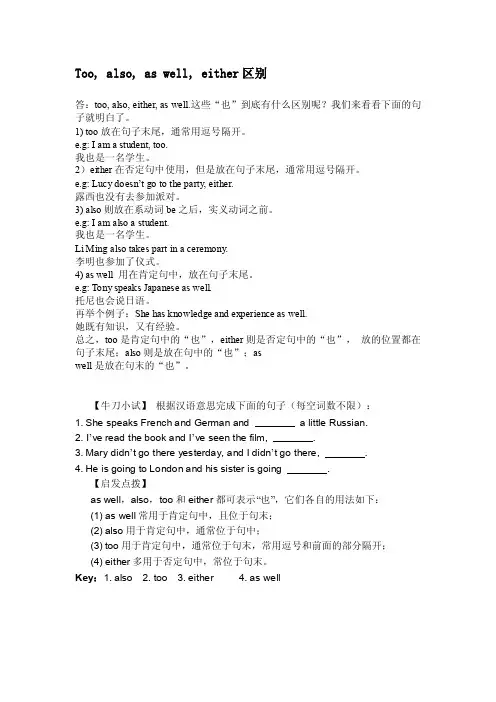
Too, also, as well, either区别答:too, also, either, as well.这些“也”到底有什么区别呢?我们来看看下面的句子就明白了。
1) too放在句子末尾,通常用逗号隔开。
e.g: I am a student, too.我也是一名学生。
2)either在否定句中使用,但是放在句子末尾,通常用逗号隔开。
e.g: Lucy doesn’t go to the party, either.露西也没有去参加派对。
3) also则放在系动词be之后,实义动词之前。
e.g: I am also a student.我也是一名学生。
Li Ming also takes part in a ceremony.李明也参加了仪式。
4) as well 用在肯定句中,放在句子末尾。
e.g: Tony speaks Japanese as well.托尼也会说日语。
再举个例子:She has knowledge and experience as well.她既有知识,又有经验。
总之,too是肯定句中的“也”,either则是否定句中的“也”,放的位置都在句子末尾;also则是放在句中的“也”;aswell是放在句末的“也”。
【牛刀小试】根据汉语意思完成下面的句子(每空词数不限):1. She speaks French and German and a little Russian.2. I’ve read the book and I’ve seen the film, .3. Mary didn’t go there yesterday, and I didn’t go there, .4. He is going to London and his sister is going .【启发点拨】as well,also,too和either都可表示“也”,它们各自的用法如下:(1) as well常用于肯定句中,且位于句末;(2) also用于肯定句中,通常位于句中;(3) too用于肯定句中,通常位于句末,常用逗号和前面的部分隔开;(4) either多用于否定句中,常位于句末。
中学英语中的几个“也”

中学英语中的几个“也”作者:林海东来源:《中学生英语·外语教学与研究》2016年第02期在现行中学英语教材中,我们遇到了几种表示“也”的方式,如too, also,either,as well,so+系动词/助动词/情态动词 +主语”等,它们既有联系,又有区别。
以下我将对它们的用法和区别做一归纳,以便参考。
1. 意义及区别too:中文释义:也;句中位置:句末,之前有逗号;句子类型:肯定句,疑问句。
also:中文释义:也;句中位置:通常位于谓语动词前面,助动词和情态动词后面;有时也可位于句首,其后用逗号隔开;句子类型:肯定句,疑问句。
either:中文释义:也(不);句中位置:句末,之前有逗号;句子类型:否定句。
as well:中文释义:也(不);句中位置:句末,前面一般无逗号;句子类型:肯定句,疑问句。
so+助动词/be动词/情态动词+主语:中文释义:也;句中位置:与上文并列,之前有逗号;句子类型:倒装句,肯定句。
2. 用法辨析◆too 意思是也,是最普通的用语,常与also通用,但不如also正式,在口语中它用得更多。
too通常放在肯定句句末。
例如:I went there, too.我也到那儿去的。
Are you in Grade 8, too?你也在八年级吗?◆either 意思也是也。
它用于否定句中,而且要放在句末。
例如:John is not an Englishman,I’m not, either. 约翰不是英国人,我也不是。
My brother doesn’t like this dish, either.我兄弟也不喜欢这道菜。
◆also意思是也,是比too较为正式的用语,通常用于肯定句或疑问句中,一般靠近动词。
例如:They are also students.他们也是学生。
Does she also want to read that book?她也想看那本书?◆ as well是副词短语,常用作状语,其义为“也”,相当于too,它一般放在句末,无须用逗号与句子分开。
also, too, either, as well的区别
also, too, either, as well的区别(最新版)编制人:__________________审核人:__________________审批人:__________________编制单位:__________________编制时间:____年____月____日序言下载提示:该文档是本店铺精心编制而成的,希望大家下载后,能够帮助大家解决实际问题。
文档下载后可定制修改,请根据实际需要进行调整和使用,谢谢!并且,本店铺为大家提供各种类型的经典范文,如词性大全、句法大全、句型大全、从句大全、时态大全、语态大全、语法大全、虚拟语气、用法辨析、其他资料等等,想了解不同范文格式和写法,敬请关注!Download tips: This document is carefully compiled by this editor.I hope that after you download it, it can help you solve practical problems. The document can be customized and modified after downloading, please adjust and use it according to actual needs, thank you!In addition, this shop provides you with various types of classic sample essays, such as part of speech, syntax, sentence pattern, clause, tense, voice, grammar, subjunctive, usage analysis, other materials, etc. If you want to know the different formats and writing methods of the model essay, please pay attention!also, too, either, as well的区别这四个副词均可表示“也”,区别如下:1. too 和 as well 多用于口语中,语气较轻,通常用于肯定句或疑问句,一般不用于否定句,且通常放在句末。
also too either as well的区别和用法(一)

also too either as well的区别和用法(一)Also, Too, Either, As well的区别和用法1. Also•用法一:位于句首的also–用于强调一个陈述句,并提供额外的信息,相当于汉语中的“还有”–例如:Also, I will need your help with this project. •用法二:位于句中的also–用于强调句中的某个词或短语,强调方式更为突出–例如:I love hiking, and also swimming.•用法三:位于句尾的also–用于加强某个陈述句,并给出相似的事实–例如:She loves reading, also.2. Too•用法一:位于句尾的too–用于表示与前面陈述相同的情况或意见,相当于汉语中“也是”–例如:I am tired, too.•用法二:位于句中的too–用于强调句中某人或某物和其他人或物一样–例如:He, too, has a dog.3. Either•用法一:位于句尾的either–用于在否定句中表示两种选择中的任何一种–例如:I don’t like tea, either.•用法二:either…or…–用于表示两种选择之间的关系,相当于汉语中的“要么…要么…”–例如:You can either study or play games.4. As well•用法一:位于句尾的as well–用于表示除了前面提到的情况之外,还有另外一项–例如:I like cooking and gardening as well.•用法二:as well as–用于列举一系列事物时,表示“还有…以及…”–例如:He is good at playing soccer as well asbasketball.以上是also, too, either, as well的常见用法及区别。
通过合理运用这些词语,可以使你的表达更加准确明确。
too also as well either的区别表格

用法示例
“I like apples, too.”(我也喜欢苹果。)
“I also like bananas.”(我也喜欢吃香蕉。)
“I like oranges as well.”(我也喜欢橙子。)
“I don't like pears, either.”(我也不喜欢吃梨。)
too also as well either的区别表格
以下是一个关于“too”、“also”、“as well”和“either”的区别的表格:
用法
“too”
“also”
“as well”
“either”
语法
只能放在句末
可以放在句中或句末
只能放在句末
可以放在句中或句末
语境
用于表示肯定或确认
用于强调或补充信息
用于表示附加信息或举例说明
用于表示否定或反驳
语气
语气比较强烈,常用于强调或反驳对方观点
语气比较中性,用于补充或强调信息
语气比较温和,常用于补充信息或举例说明
语气比较委婉,常用于否定或时放在句中
可以放在句中或句末,但通常不与“not”一起使用
常放在句末,但也可以放在句中,但通常不与“not”一起使用
简析also__too__as_well和either用法
2. I _________________ study English and
Russian.
A. too B. also C. either D. as well
3. Not only the children but
________________ their father is in town.
简析 also, too, as well 和 either 用法 also, too, as well, either,作“也”讲,为副词。 下面分别讲述: 一. too, also, as well:都用于肯定句,表示前 者怎样后者也怎样。 too:一般放在句尾,可用逗号和前面的句子 隔开,也可不用; also:其位置大多放在 be 动词、助动词、情 态动词之后,实义动词之前; as well:其位置一般放在句尾,三者可以作 同义句转换。例如: You need to go shopping and I need to go shopping, too. =You need to go shopping and I also need to go shopping. =You need to go shopping and I need to go shopping as well. 二. either:用于否定句中,表示前者不……, 后者也不……,其位置一般放在句尾。例如: He doesn”t want any coffee, and I don”t want any, either. You don”t know the way and I don”t know it,
5. The foreigner can speak English, he can
speak French __________________.
also,too,either,neither,so,as well的用法
also,too,either,neither,so,as well的用法1.also副词“也,而且,并且”用于肯定句或疑问句,但一般位于句中,通常位于be动词,助动词或情态动词之后,行为动词之前。
如:He has been to Beijing. I have also been there.他去过北京,我也去过。
He is good at English. He is also good at Japanese.他擅长英语,也擅长日语。
We are also students.我们也是学生。
He also went there on foot.他也是走着去的。
Did you also want to have a look? 你也想看看吗?I also want some tea.我也要点茶。
2.too副词表示“也”,常用于肯定句或疑问,常和also相互替换,一般放在句末。
如:He studies hard and I study hard, too.他学习用功,我(学习)也用功。
He likes China, too.他也喜欢中国。
Are you in Grade 3, too? 你也在三年级吗?3. either①副词,“也不”用于否定句,而且只能放在句末。
如:He didn’t know it.I didn’t know it either.他不知道那件事,我也不知道。
She is not a Japanese, I’m not, either.她不是日本人,我也不是。
My sister doesn’t like this song, either.我妹妹也不喜欢这首歌。
②代词,两个中任意一个,(两者之)每一个,故作主语时谓语动词用单数。
如:Either of the books is new.这两本书任何一本都是新的.She doesn’t like either of the films.这两部电影她都不喜欢.③形容词, 用来修饰单数名词,意思与作代词时相同.如:Either school is near my home. (这两所学校中的)任何一所学校都离我家很近.Either question is difficult.两个问题(中的任何一个)都难.There are many flowers on either side of the street.街道两旁有许多的花。
如何区别also, too, either与as well
如何区别also, too, either与as well(最新版)编制人:__________________审核人:__________________审批人:__________________编制单位:__________________编制时间:____年____月____日序言下载提示:该文档是本店铺精心编制而成的,希望大家下载后,能够帮助大家解决实际问题。
文档下载后可定制修改,请根据实际需要进行调整和使用,谢谢!并且,本店铺为大家提供各种类型的经典范文,如词性大全、句法大全、句型大全、从句大全、时态大全、语态大全、语法大全、虚拟语气、用法辨析、其他资料等等,想了解不同范文格式和写法,敬请关注!Download tips: This document is carefully compiled by this editor.I hope that after you download it, it can help you solve practical problems. The document can be customized and modified after downloading, please adjust and use it according to actual needs, thank you!In addition, this shop provides you with various types of classic sample essays, such as part of speech, syntax, sentence pattern, clause, tense, voice, grammar, subjunctive, usage analysis, other materials, etc. If you want to know the different formats and writing methods of the model essay, please pay attention!如何区别also, too, either与as wellalso, too, either与as well 均可表示“也”,用法及其区别分述如下:1. too 和 as well两者多用于口语中,语气较轻,通常用于肯定句或疑问句,一般不用于否定句,且通常放在句末。
as well,either,also,too的区别
as well, either, also, too的区别1.also用于肯定句,既可表示两人干了同样的事,也可表示一个人干了两件事,通常位于be动词,助动词或情态动词之后,行为动词之前。
如:He has been to Beijing. I have also been there.他去过北京,我也去过。
He is good at English. He is also good at Japanese.他擅长英语,也擅长日语。
I also wants some tea.我也要点茶。
注意:表示强调时,also也可放在助动词或情态动词等之前。
比较:I can also do it.我也能干。
I also can do it.(同上)2.too也用于肯定句,比also更通俗,和also, as well可以相互替换,可放在句中,也可放在句末。
如:Xiao Li went to Beijing and Xiao Zhao, too, went to Beijing.小李到北京去了,小赵也到北京去了。
He studies hard and I study hard, too.他学习用功,我(学习)也用功。
3.either用于否定句,而且只能放在句末。
如:He didn’t know it.I didn’t know it either.他不知道那件事,我也不知道。
I can’t speak French and can’t write it, either.我不会讲法语,也不会写法语。
4.as well在口语中用得很多,用法和too完全一样,可以互换,通常位于句末。
[见as well, as well as条]。
如:She not only sings,she plays the piano as well.她不但会唱歌,而且会弹钢琴。
I can do it as well.这事我也能做。
5.在含有责备、抱怨或规劝之类的句子中,若句子本身是以否定的形式表达肯定的意义时用“too”,而不用“either”。