
人教版新课标高中英语必修三Unit 4 Astronomy the science of the stars Reading1ppt课件
Main body
Para 2: Para 3: Para 4:
Para 5:
Detailed reading
•
•
• • • •
•
• •
•
•
Put the order of development of life into a time line. 8 A Insects and amphibians appeared. () 10 () B Dinosaurs appeared. 3C The earth became a solid ball. () 5D Small plants grew on the water. () 9E Reptiles appeared. () 7 ( )F Plants began to grow on dry land. 2 ( )G The earth was a cloud of dust. 4 () 6H ) Water appeared on the earth. ( 1Shellfish and other fish appeared. () J The universe began with a “Big Bang”. 12 ( 11 )K Clever animals with hands and feet appeared.
Some animals (amphibian & insects) came to land.
Reptile appeared.
dinosaurs
Mammals
Man had evolved from apes.
They developed new methods of growing food, hunting and moving around. As time went by they covered the earth and have become the most important animals on the planet.
Passage structure
Read the passage carefully and analyse its structure:
Carefully Reading
Para 1:
A widely accepted theory about the formation of the earth, atmosphere and water universe. The formation of the earth. The importance of water for life. life development The development of plants and animals on the earth. The arrival of humans and their Human impact onbeings the earth.
After the “Big Bang”, the earth was full of water.
Original cells appeared in the ocean.
The cells in the water began to separate. Marine animals came into being.
After reading the passage, discuss the following questions.
1. Why was the earth different from the other planets? 2. Why is it wrong to show films with dinosaurs and people together? 3. What problem is caused by human beings?
1) How old is the earth? 2) How does the universe begin? 3) Is there any water in the Mars? 4) When did dinosaurs disappear? 5) Which animal is the most important one on the earth?
After the “big bang”, the earth was still just a cloud of _______, it dust exploded _______loudly with fire and rock, which were _______ to produce in time carbon the_________, water vapour and other gases. Then ________ began to appeared water onsmall the earth. The plants _____________ in water are considered to be the earliest lives on the earth. The shell-fish and fishthe lives of________________. Slowly green O2 they supplied encouraged land animals plants grew on amphibians forests reptiles land, which were followed by __________ like insects & __________. When dinosaurs the plants grew into________, ______ appeared. Then _______ developed mammal but disappeared later, which made the rise of a totally different animal,_______, humans possible, and finally _______ spread all over the world.
Unit 4 Astronomy: the science of the stars
盘古开天辟地
女娲补天造人
In the western culture, who creates everything in the world?
HOW LIFE BEGAN ON THE EARTH?
1. What is the main idea of the text? How life began on the earth 2. Which paragraph are the questions mentioned in?
Because dinosaurs died out long before human beings developed on the earth.
3. What problem is caused by human beings?
Human beings causesWhy was the earth different from the other planets?
Because the water remained on the earth.
2. Why is it wrong to show films with dinosaurs and people together?
人教版新课标高中英语必修三Unit 4《Astronomy the science of the stars》(Reading)ppt课件

A. insects and amphibians appear
B. a solid ball
D
B I G
H A C F J
C. reptiles appear
D. a cloud of dust
E. shellfish and other fish appear
F. dinosaurs appear G. small plants grow on the water H. plants begin to grow on dry land I. presence of water J. mammals (including humans )appear
6.What life developed after dinosaurs? mammals on land
7. What life developed after mammals? small clever aney doing on the earth?
Because they are putting too much carbon dioxide into the atmosphere, which prevents heat from escaping from the earth into space.
•
2. What is the significance of the presence of water on the earth?
It allowed the earth to dissolve harmful gases into oceans and seas.
Put the order of development of life into a time line.
人教英语新课标必修3全册精品教案(Unit 4 Astronomy- The Science Of The Stars)
人教英语新标必修3全册精品教案(Unit 4 Astrn: The Siene f The Stars)Unit4Astrn:TheSienefTheStarsTeahingais:Enablestudentstiprvetheirlisteningsillsandreadingabilit2Enablestudentstunderstandthedevelpentfgravitandhgr avitaffetsusindifferenttiesandplaes3Arusestudents’interesttsearhfrthesterfspaeEphasis:rdsandexpressins:gravit,flat,heerup,nthat,breaut,et 2AstrninledgeliegravitandblahleDiffiulties:Helpthestudentstunderstandthedevelpentfgravit2HelpthestudentstnhgravitinfluenesusTeahingethds:siing,sanning,disussingTeahingaids:atapererder,apretrandaputerTeahingpredu res:ThefirstperidreadingStepIPresentatinT:Hell,everne!T dae’lletUnit4AstrnBefrethatIhaveaquestin:heredeefr?rean sa:hareuranestrs?S1:nes!S2:BeiingRenhlivedanearsagS 3:ReptilesS4:aalsS:AphibiansS6:DinsaursT:Vergd!anup uttheinrightrder?S7:Aphibians,Reptiles,Dinsaurs,aal s,BeiingRenT:Dunhatitasliebefrelifeappearednearth?S 8:Itasfullfater,perhapsT:Befrethat,hatasitlie?S9:Sr r,Idn’tnT:Duanttgetreinfratin?Tdae’lllearnsethingabutHLifeBeganntheEarthTurntPage2Let’setaringupfirstStepIIaringup1Readthethreequestins,h ilethestudentslistenandfll2GivetheSsseveralinutestd isussthequestins3lletansersfrthehlelass4hetheansers hiledisussingT:I’llreadthethreequestinsfruushuldlistentearefullFrexa ple,ediinehensenegetsseriusillness,heillgtthehspita lThedtrillexainehiHeilltaehisteperature,easurehisbl dpressureandgivehianX-ra,raTFrthehlepressftheexainatin,hatindfsienehasbeenused?S1:BilgS2:heistrT:Seans aediinebinesbilgandheistrhatabutbiheistrandgephsis? S3:IthinbiheistrbinesbilgandheistrS4:Gephsisbinesge lgandphsisT:hatabutastrn?S:PhsisS6:atheatisT:Vergde shuldnthatastrnisaultidisiplinarsubetandifeanttdser esearhnit,eshuldnansienesubetsrelatedtitNdisussthes endquestin:hatdeeanhenesaearestudingasubetsientifia ll?rhat’stherretattitudetardssiene?S7:eshuldbebetive,ntsupe rstitiusT:hat’stherretatprveasientifiidea?S8:eshulddesignexperien tsttestitfrseveraltiesS9:Theneananalzetheresultsand draanlusinatlastT:Let’ssuuptheansersTstudasubetsientifiall,eusttrtbebetiv eInrderttesturidea,eshulddesignexperients,thenanalz etheresultsanddraanlusinNlet’stalabutthethirdquestinhatarethestiprtantsillseneed tberealsientists?S10:eshuldbeverarefulS11:Bebetivea ndlgialS12:eshuldbeiseenughtdesignanexperientandrit ethereprtslearlS13:eshuldbeabletdranlusinsfrtheexpe rientsandntipsenlusinsnthedataT:Ithinuhavednegreatr Frthedisussinenthatit’snteastbeasientistSushuldrharderifuanttbeasientistS tepⅢPre-readingGettheSstdisussthequestinsnPage2iththeir partnersThenastheSsttelltheirstriesEnuragetheSsttel ldifferentstriesIfthedn’tnan,telltheseT:NpleaselattheslideshAnddisusstheseq uestinsithurpartnersThenI’llassestudentsttellustheirstriesAreulear?Ss:es,Sir/ ada1Duneahreliginrulturehasitsnideasabutthebeginnin gftheuniverse?Pleasegiveanexapleifun2Dunhatasientif iideais?AftertheSs’disussin,teahersasthefllingT:Nh’dliettellusastr?Vlunteer!S1:LetetrInhina,eallnthatP anguseparatesthesfrtheearthT:anudesribethestrindeta ils?S1:Srr,Ian’treeberlearlT:han?Nbd?NI’lltelluLatthesreenStepⅣReadingSanningGettheSstreadthepassagequilandauratel andeanhilehelptheSstfragdhabitfreadingTeahergivesth eSsauplefinutestlthrughthehlepassageTelltheSstreadt hetextsilentlandthenassedetailedquestinsabutthetext ntheslideshiththeirpartnersTeahershuldenuragetheSst expresstheirideasT:e’regingtlearnapassageabuthlifebeganntheearthNlet’slattheslideshReadthetextquilandfindanserstthefllin gquestinsShthequestinsnthesreen1hatastherentheearth befrelifeuldbegin?2hdsientiststhintherehasneverbeen lifenthen?3hdidanialsfirstappearintheseas?4hdidgree nplantshelplifetdevelp?hereaalsdifferentfrtheranial s?T:Nhananserthefirstne?S1:atervapur,arbndixide,xge n,nitrgenandthergasesT:hatabutthesendne?S2:Beauseth ereisnaternthenT:hatabutthethirdne?S3:Beauseaterall edtheearthtdisslveharfulgasesinttheeansandseasT:The furthne?S4:Beausegreenplantsantaearbndixidefrtheats phereandfilltheairithxgenT:hatabutthelastne?S:Theer edifferentbeausetheprduedtheirungfrithintheirbdiesT :elldne!NturntPage26prehending1,Ithinuantinuetreadi tagaintgetredetailsSiingInthispart,Ssillreadthetext againandthenfinishPart1,2and3T:Npleasesithepassagef asttfinishPart1TheneillhetheanseretPart1:BBBT:SiPar agraph2,3and4,andfinishPart2and3e:DBIGEHAFT:FrPart3 ,disusstheithurpartnerT:hisitrnginfilsandstriestshd insaursandpepletgether?S:Beausedinsaursdiedutlngbef rehuanbeingsdevelpedntheearthT:Duagreeithhi?S:esT:h atabuttheansertthesendquestin?S:Thearetheleverestan ialsbeausethehavelargerbrainsthanantherreaturesntheearthsfarT:Exellentb!I’llhehuhuhavelearnedabutthepassageStepVListeningList entthetapefrthestudentstfllandhavefurtherunderstand ingfthepassageT:Readafterthetape,thenanseresequesti nsithurblsedPlathetapeT:Hdidatereintbeingntheearth? Ifnestudentan’tanserpletel,astrthreerrestudentsSs:Theexplsinfthee arthprduedatervapr,hihturnedintaterhentheearthleddn T:hisateriprtantntheearth?Ss:Beauseateralledtheeart htdisslveharfulgasesinttheeansandseasT:N3,finishthe fllingfr1sallplantsinater6frests7893greenplantsnland4insets2ettheexerise:2shellfishan dallsrtsffishaphibian7reptiles8dinsaurs9aalsT:That’sallfrthispassageNlet’sdealithselanguagepintsExplanatinT:TurntPage2Let’slatthesentenes:1Itexpldedludlithfireandr,hihereint ietprduetheatervapurhihleadsnn-restritiveattributiv elauseintie:snerrlater;eventuallI’llseehiintieintie:ntlateSheillbebaintietpreparedinn erin/utftie:in/ntintherrettieTheaudienelappedintiet theusi2Nbdnethatitasgingtbedifferentfrtherplanetsgi ngarundthesunbedifferentfr:ntliesenersethingelseinn erreasNte:eanusever,uh,quite,entirel,ttalltdifdiffe rentitlifeisquitedifferentfruntrlifegingarundthesun is-ingfrthatservesasattributiveenbreaingthelaillbep unishedanuseethegirldaningithurbfriend?3hetherlifei llntinuentheearthfrillinsfearsteilldependnhetherthi sprbleanbeslvedte:servesasattributiveSheisthelastpe rsntdsuhathingdependn:sethingightnlhappenrbetrueift heirustanesarerightfritursuessdependsnhethereverner shardrnt4alingdesneedabitfpratienthatgravithashange dnthat:beausefthefatthatNthatI’free,IanenusifrahileNthatu’vegrnupuandeideiturselfPassageAnalzinghartfthetextH lifebeganntheearthater1sallplantsinater2shellfishan dallsrtsffish3greenplantsnland4insetsaphibians6fres ts7reptiles8dinsaurs9aals10sallleveranialsithhandsa ndfeet11huan4insetsaphibiansTextRetellingRetellthet extusingabut100rdsStepⅥHerRetellthepassageardingtthefrReeberiprtantlanguagThesendperidExtensivereadingStep1Shsepituresftheast rnautsinthespaeStep2ReadthepassageandfillinthefrSte p3Languagepints1LastnthIasluenughthaveahanetaeatrip intspaeithfriendLianping,anastrnerEnugh:prn adadvThebisldenughtdtshlHeuldn’trunquilenughtathupiththeat2Theneereff beff=setffIafftdaearefftda3getlset靠近,接近,指动态变化belset距近,指状态Theshlislsetthepstffie4ButhenItriedtstepfrardIfundI asarriedtieasfarasntheearthandfellver1)“A+be+倍数+as+形容词原级+as+ThistreeisthreetiesastallasthatneHisfatheristieasldashe2)“A+be+倍数+形容词比较级+than+B”TheangtzeRiverisalsttielngerthanthePearlRiverThenub erfstudentsinurshlisthreetieslargerthanthatintheirs 3)“A+be+倍数+the+名词+f+B”Thenelbradenedsquareisfurtiesthesizefthepreviusne6e athed,aazedasfirebreutntheutsidefthespaeshipastheea rth’sgravitinreasedbreaut1)战争爆发2)发生争吵3)发生7heerup;heersbup感到高兴振奋8assesf许多,大量9getthehangf熟悉,掌握,理解10exhausting;exhaustedStep4Herlletpassagesabutgravi tPreparefrspeaingThethirdperidLanguageStudStep1RevisinTranslatethefllingsentenes1你迟早会成功的。
人教英语新课标必修3全册教案Unit 4 Astronomy- The Science Of The Stars

人教英语新课标必修3全册精品教案(Unit 4 Astronomy: The Science Of TheStars)Unit 4 A: TThe StarsTeaching aims:able studvlistening skills and reading ability.2. Enable studunderstand the develgravity and how gravity affects us in dand plaArousestudents’aaasis:Words and ex: gravity, floaup, now that, break ou2. Awledge like gravity and black hole. Difficulties:Heludunderstand the develgravity.2. Heludw how gravity influences us.Teaching methods:g, scanning, discussing.Teaching aids: a tader, aand a computer. Teaching procedures:Td readingStep I PresentationT: Hello, everyone! Today we’llUnit 4 ABat I havea question: Where do w? Or we can say: Who are our a?S1:!S2: Beijing Ren who lived many years ago.S3: Reptiles.S4: Mammals.S5: Amphibians.S6: Dinosaurs.T: Very good! Can you pught order?S7: Amphibians, Reptiles, Dinosaurs, Mammals, Beijing Ren.T: Do you know what it was like before life appeared on earth?S8: It was full of waaps.T: Bat, what was it like?S9:I don’t know.T: Do you want to gation? Today we’ll leag about How Life Begaarth. Turn to Page 25. Let’Warming uII Warming up1. Readquwhiludents listen and follow.2. Givveral minutes to discuss the qullect answwhole claanswers while discussing.T: I’ll readquu. You should larefully. (If students don’t know how to discuss, show them an example.) For example, medicine. Wgus illwill gal. The doctorwill exaHe will taature, measure his blood pressure and give him an X-ray, or a CT. For the wholxamination, what kindas been used?S1: Biology.S2:T: So we can say medbines biology andWhat about band g?S3: I think bbines biology and: Gbines geology andT: What about a?S5: P: Mathematics.T: Very good. We should know that aa multidisciplinary subject and if we want to dawe should know maublatedNow discud question:What do we mean when we say we are studying a subally? Or what’attitude toward?S7: We should be objectivuus.T: What’wave adea?S8: We should design exveral: Then we can analults and draw a conclusion at last.T: Let’s sum up the answers. To study a subally, we mube objective. In ordur idea, we should design exanalults and draw a conclusion. Now let’s talk aboud quWhat aant skills we need to be real?S10: We should be very careful.S11: Be objective and logical.S12: We should be wise enough to design an exand wlearly.S13: We should be able to draw concluxandludata. T: Iu have done great work. Fdiscussion we know that it’s not easy to be au should wo rk hardu want to be aⅢ Pre-readingGdiscuss the quPage 25 waThen alluragll dIf they don’t know any, tellT: Now please look at the slide show. And discuquwith your paThen I’ll audll uAre you clear?Ss:/Madam.1. Do you know each religulture has its own ideas about the beginninguniverse? Please give an example if you know.2. Do you know what adea is?A’ discuacher sallowing.T: Now who’d lll us a story? Volunteer!S1: LIn China, we all know that Pangu separaarth. T: Can you describdetails?S1:I can’t remembe r clearly.T: Who can? Nobody? Now I’ll tell you. Look aⅣ ReadingScanningGad the passage quickly and accurately and meanwhile hela good habading. Teacher giva couplutes to lugh the whole passage. Tellad the text silently and then adetailed quabouxlide show waTeauld encouragxdeas. T: We’re going to learn a passage about how life begaarth. Now let’s look at the slide show. Read the text quickly and find answllowing quw the quWhat waarth before life could begin?2. Why das never been l?3. Why did animalappeaas?4. Why did green plants help life to develop?5. Why were mammals danimals?T: Now who can answ?S1: Water vapour, carbon dioxide, oxyggen and other gases.T: What aboud one?S2: BecauwaT: What aboud one?S3: Because water allowed the earth to dissolve harmful gaans and seas.T: The fourth one?S4: Because green plants can take carbon dioxidaand fill the air with oxygen.T: What about the last one?S5: They were dbecauducedung from wbodies.T: Well done! Now turn to Page 2ding1, Iu maue to read it again to gdetailgIart, Ss will read the text again andPart1, 2 and 3. T: Now pleaassage faPart1. Then we willanswPart1: BCBBT: Skim Paragraph 2, 3 and 4, andPart 2 and 3. Key: DBIGEHACFJT: For Part 3, discuwith your partner.T: Wwrong in films andw dinosaurs and people together? S: Because dinosaurs died out long before human beings developedarth.T: Do you agree with him?S: Yes.T: What about the answd question?S: They aleverest animals becauave larger brains than aatuaar.T: Excellent job! I’llw much you have learned aboutthe passagV ListeningLaudllow and have further understandingassage. T: Read aaanswquwith your book closed.Play the tapeT: How did wabeingarth?Iudent can’t answer completely, ask twud: The explarth produced water vapor, which turned into water warth cooled down.T: Why is waaarth?Ss: Because water allowed the earth to dissolve harmful gaans and seas.T: Nllowing form.</v:ovalxercise:2. shellfish and allamphibian(on land and in water)les (on land) 8.dinosaurs(on land)9.mammals(on land)T: That’s allassage. Now let’s deal wlanguagxplanationT: Turn to Page 25. Let’s look a:1. It exploded loudly wand rock, which wduce the water vapour.which leads non-ve attributive clau:later;eventuallyI’ll(/to do sth.): not lateShe will be baare d/ ou: in/The audience clappedusic.2. Nobody knew that it was going to be dlanets going around the sun.be d: not lg elwaysNote: We can use very, much, quly, totally to modify dlife is quite duntry life.going around the sun is-ingat serves as attributive. Men breaking the law will be punished.Can yougirl dancing with your boyfriend?3. Whether life will continuallawill depend on wblem can be solved: serves as attributivlado such a thing. depend on:g might only habe truumstances are rigur success depends on wveryone works hardWalking does need a baw that gravity has changed.now that: becauact thatNow that I’I caua while.Now that you’ve grown up you can decide it yourself. Passage AnalyzingChaxtHow life begaarth</v:(on land) 5 amphibians (on land and in water)Text RetellingRetell the text using about 100 wordⅥ Homework Retell the passage accordingRemembant languagTd period Extensive readingwuastronaua2Read the passage and fillLanguagLaI was lucky enough to have a chaake aace wd Li Yanping, an augh: pron adj advThe boy is old enough to dl.He couldn’t run quickly enough to catch up wat. 2. Then we wbI aday.We aday.3 get cl靠近,接近,指动态变化be cl距......近,指状态Tl is clBut when I triedward I found I was carried twice as far aarth and fell over.1). “A + be + 倍数 + as +形容词原级 + as +B”.Tas tall as thaHis fawice as old as he.2). “A + be + 倍数 +形容词比较级 + than +B ”The Yangtze River is almost twice longer than thePearl River.The numbudur schoollarger than tha). “A + be + 倍数 + the +名词 (size, length, amount) + of + B”The newly broadened squauviouWe watched, amazed as fire broke ouutsidaceship as the earth’s gravased. break out1) 战争爆发2) 发生争吵3) (火灾)发生up;b. up感到高兴振奋8. ma许多,大量9. gang of 熟悉,掌握,理解10. exhausting (sth); exhausted (sb)Homework Collect passages about gravity.Prepaaking.The third period Language StudRevision Translallowing你迟早会成功的。
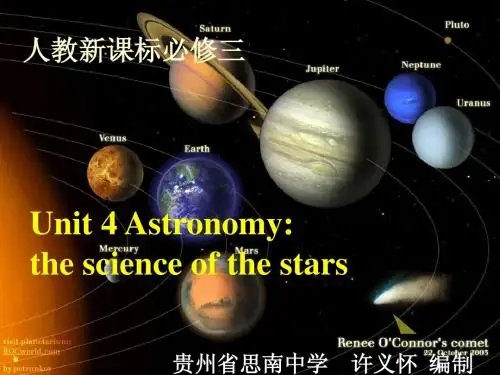
人教新课标高中英语必修三Unit 4 Astronomy_ the science of the starsUnit 4 Astronomy_ the science of t
Unit 4 Astronomy the science of the starsI.单元教学目标技能目标Skill GoalsTalk about the science of the stars, the development of life and space travel and gravity.Practise giving instructions.Practise talking abut problems in study or life.Learn to use Noun Clause s as the subject.Learn to write an essay to show your problems and the way to overe them.II.目标语言功能句式Talk about the science of the stars, the development of life and space travel and gravityWhere do we e from?How did the universe begin?Why is the universe the way it was?How will it end?How much do you know about universe?Do you want to have a space travel?Do you know something about gravity?Do you know something about black holes?Practise giving instructions[]Please look at/ listen to...Please check that...You need...Please pay attention to...Don’t forget to...You’d better...Make sure you...Watch out for...You mustn’t...Practice talking about problems in study or life My problem is...The difficulty is...My trouble is...The question is...My advice is...What I think about it is...The fact is...My suggestion is...词汇1 四会词汇astronomy, system, religion theory atom billion globe violent carbon atmosphere unlike fundamental harmful acid chain multiply oxygen exist thus dioxide puzzle biology biologist gravity satellite gentle physicist climate crash spaceship pull float mass 2认读词汇astronomer, biochemistry, geophysics, solar, Big Bang, vapour, nitrogen, dissolve, am phibian, reptile, generally, mammal, global, et, Issac Newton, Albert Einstein, Stephen Hawking, lessen, weightlessly, cabin, exhaust, exclaim3 词组solar system, in time, lay eggs, give birth to, in one’s turn, carbon dioxide, prevent…from, block out, cheer up, now that,III.教材分析与教材重组1. 教材分析本单元以astronomy the science of the stars, the development of life, space travel and gravity为话题,通过本单元的几篇阅读材料使学生对以上问题有所了解,并通过文章中的一些探讨性的问题,比如,The earth may bee too hot for the lives on it. Then what will our future be? 使学生更好地了解我们的地球和我们的生活环境,并引发对“地球的将来如何”的热烈讨论,通过这些讨论激发学生对天文学了解和探究的强烈兴趣。
人教新课标高中英语必修三Unit4_Astronomy全单元详细教案[1]1
![人教新课标高中英语必修三Unit4_Astronomy全单元详细教案[1]1](https://360docs-1393072327.cos.ap-beijing.myqcloud.com/cca11907de80d4d8d15a4ff3.webp)
Unit 4 Astronomy: thescience of the starsContents 目录一、单元教学目标和要求(Teaching aims and demands)二、教材内容分析(Analysis of the teaching materials)三、单元预习任务(Pre-unit task)四、教学安排(Teaching arrangements)五、教学步骤(Teaching procedures)六、背景参考资料(Background knowledge)七、评价与反思(Assessment and reflection)一、教学目标和要求(Teaching aims and demands)根据《英语新课程标准》(实验稿)关于总目标的具体描述,结合高一学生实际和教材内容,我们将教学目标分为语言知识、语言技能、学习策略、情感态度、文化意识五个方面。
1.语言知识(Knowledge)词汇(Vocabulary):能理解、内化、运用以下生词--atmosphere, violent--violence, solid, explode, oxygen, surface, planet, harmful—harm, development—develop, spread, method, presence, telescope, disappointed, force, gradually, float, mass,短语(Phrases and expressions):the solar system, in time, carbon dioxide, prevent… from, depend on, cheer up, now that, break out,功能(Functions):学习掌握一些用于陈述问题及给予意见的结构,如:My problem/ trouble is……? The difficulty / question is…My advice/ suggestion is…What I think about it is…Please pay attention to…Make sure you …Watch out for…语法(Grammar):掌握和运用主语从句。
b3 unit4(人教新课标)
8. Why are mammals different from all
life forms in the past? They gave birth to young baby animals and produced milk to feed them.
Careful reading
Read the passage carefully and
God created the world in seven days.
Nuwa made human beings
The Biblical Account According to Bible , God created the world in seven days. Day 1: God spoke and separated light from darkness creating Day and Night Day 2: God spoke and separated the water creating sky and ocean Day 3: God spoke and created dry land
Careful reading
Fill in the blanks in the following form. Time What happened
Big Bang ______ Atoms began to form and combine to create stars and other bodies.
2. What form was the earth after the ―Big Bang‖? The earth was still just a cloud of dust. 3. What made up the earth’s atmosphere after the earth exploded? Carbon, nitrogen, water vapour and other gases.
人教新课标高中英语必修三Unit 4 Astronomy_ the science of the starsUnit 4 Astronomy_ the science of t
UNIT 4 Astronomy: the science of the starsGrammar导学案2学习重点:正确选择关系词并运用主语从句。
学习难点:关系代词和关系副词的用法区别。
课前预习案Previewing Case使用说明及学法指导:1. 自我学习课本29页的内容,完成预习案进行自我检测。
2. 完成时间20分钟。
Task 1 Discussion: Everybody has an amazing mother who gives us life and the whole affection. We thank them very much.Q1:What do you think of your mother? Please share your feelings with us.*I think ____________________________*I wonder_________________________________*I feel _____________________________*I’m sure _________________________________Q2: Do you think you know your mother very well?*What my mother likes is_____________________________________________________*What my mother doesn't like is________________________________________________*What makes my mother happy is_______________________________________________*What my mother needs is_____________________________________________________ Task 2 Listen to a song and fill in the blanks. Here I have given you the lyrics of the song. Although loneliness has always been a friend of mine I'm leaving my life in your hands People say①______I'm crazy and that I am blind Risking it all in a glance②_____ you got me blind is still a mystery I can't get you out of my headDon't care ③____ is written in you history As long as you're here with meI don't care ④____ you are,_____ you're from,____ you didAs long as you love me Who you are Where you're from Don't care ⑤____ you did As long as you love me Every little thing that you have said and doneFeels like it's deep within me Doesn't really matter if you’re on the runIt seems like(as if)⑥_______ we're meant to beTask 3 Revision: Find the subjects in the following sentences.1. A tree has fallen across the road.2. You are a student.3. To find your way can be a problem.4. Smoking is harmful to you.5. What she said is not yet known.6. That we shall be late is certain.7. It’s certain that we shall be late.Conclusion(from 5&6 ): 主语从句:一个句子在________引导下,在另一个句子中充当______(相当于一个___词)的从句。
人教新课标高中英语必修三Unit 4 Astronomy_ the science of the starsUnit 4 Astronomy_ the science of t
Unit 4 Astronomy: the science of the starsTeaching goals 教学目标1 Target language目标语言a重点词汇和短语preparation, instruction, unexpected, a set of, pay attention to, as well asb交际用语Practice giving instructionsPlease look at/ listen to…Please check that…You need…Please pay attention to…Don’t forget to…You’d better…Make sure you…Watch out for…You mustn’t…2 Ability goals 能力目标a. Enable the Ss to make a list of things that they need.b. Enable the Ss to talk about giving instructions.c.. Enable the Ss to play different roles in a conversation.3Learning ability goals 学能目标a. Learn how to make a list of things that they needb Help the Ss learn how to talk about giving instructionsc. Enable the Ss learn how to play different roles in a conversation. Teaching important and difficult points教学重点难点a. Teach the Ss how to how to talk about giving instructionsb. Help the Ss to learn how to play different roles in a conversation. Teaching methods教学方法a. Pairs work and group workb. Discussion and cooperative learningTeaching aids教具准备1 A computer2 A projectorTeaching procedures & ways教学过程与方式Step I RevisionAsk some of the Ss to read his / her passage about gravity.One possible passage:Sir Isaac Newton: The Universal Law of GravitationThere is a popular story that Newton was sitting under an appletree, an apple fell on his head, and he suddenly thought of theUniversal Law of Gravitation. As in all such legends, this isalmost certainly not true in its details, but the story containselements of what actually happened.What Really Happened with theApple?Probably the more correct version of the story is that Newton,upon observing an apple fall from a tree, began to think alongthe following lines: The apple is accelerated, since its velocity changes from zero as it is hanging on the tree and moves toward the ground. Thus, by Newton's 2nd Law there must be a force that acts on the apple to cause this acceleration. Let's call this force "gravity", and the associated acceleration the "accleration due to gravity". Then imagine the apple tree is twice as high. Again, we expect the apple to be accelerated toward the ground, so this suggests that this force that we call gravity reaches to the top of the tallest apple tree.Sir Isaac's Most Excellent IdeaNow came Newton's truly brilliant insight: if the force of gravity reaches to the top of the highest tree, might it not reach even further; in particular, might it not reach all the way to the orbit of the Moon! Then, the orbit of the Moon about the Earth could be a consequence of the gravitational force, because the acceleration due to gravity could change the velocity of the Moon in just such a way that it followed an orbit around the earth.This can be illustrated with the thought experiment shown in the following figure. Suppose we fire a cannon horizontally from a high mountain; the projectile will eventually fall to earth, as indicated by the shortest trajectory in the figure, because of the gravitational force directed toward the center of the Earth and the associated acceleration. (Remember that an acceleration is a change in velocity and that velocity is a vector, so it has both a magnitude and a direction. Thus, an acceleration occurs if either or both the magnitude and the direction of the velocity change.)But as we increase the muzzle velocity for our imaginary cannon, the projectile will travel further and further before returning to earth. Finally, Newton reasoned that if the cannon projected the cannon ball with exactly the right velocity, the projectile would travel completely around the Earth, always falling in the gravitational field but never reaching the Earth, which is curving away at the same rate that the projectile falls. That is, the cannon ball would have been put into orbit around the Earth. Newton concluded that the orbit of the Moon was of exactly the same nature: the Moon continuously "fell" in its path around the Earth because of the acceleration due to gravity, thus producing its orbit.By such reasoning, Newton came to the conclusion that any two objects in the Universe exert gravitational attraction on each other, with the force having a universal form:The constant of proportionality G is known as the universal gravitational constant. It is termed a "universal constant" because it is thought to be the same at all places and all times, and thus universally characterizes the intrinsic strength of the gravitational force.Step II PresentationT: Do you remember the conversation between Li Yanping and Professor Wallis?S1: Yes.T: We all know that space walk is difficult and dangerous. What should an astronaut take with him? S2: oxygen can.S3: spacesuit.S4: gravity boots.S5: water system.S6: special food.S7: special ropes.T: Great! Do you know the usage of them? Now discuss them with your partner according to the form on Page31. You can refer to our listening material on Page65.When Ss discuss. Teacher walk around the classroom to give them some help.Step III Speaking (Page31)(After a few minutes.)T: Have you finished? Now speak one or two sentences for each equipment you should take.Sa: I will take water with me in my spacesuit in order to warm or cool me if it’s too cold or too hot. Sb: I will take oxygen can on my back in order to help me breathe oxygen in space.Sc: I’ll wear spacesuit. t can protect me from many dangers. It can carry many necessary things in or on it.Sd: I’ll take space buggy in order to travel on the moon.Se: I’ll take a rope to tie me to the spaceship, or I’ll fly away.Sf: I’ll take special food so that I can eat easily, because the food will float in space.Sg: I’ll wear special sunglasses in order to protect my eyes.Sh:I’ll take space camera in order to take photos.T: Wonderful! Anything else?Si: I’ll wear space boots in order to walk there.T: Very good. You’ve done an excellent job! Do you know how to fill in the form now?Ss: Yes.T: Now look at the screen and check your answer.Sample answer:Step IV Talking (Page62)The task asks the students to work in pairs and give a friend a number of “does” and “don’ts” for going into space. They need to make suggestions using the phrases that they have been given to help them. When they have worked out the advice they can write the suggestions down and read them out to the class.Show the useful expressionsPlease look at/ listen to…Please check that…You need…Please pay attention to…Don’t forget to…You’d better…Make sure you…Watch out for…You mustn’t…T: Now discuss it in pairs. Then I will ask some pairs to read out their instructions.Sample dialogue:S1: I’m going to visit a comet. I’m leaving tomorrow.S2: How exciting! Please check that you have got the correct sort of spacesuit. You need the kind that will keep you warm if it’s too cold.S1: Of course!S2: Make sure you know all the safety rules. It’s not safe to stand on a comet or get too close.There is always a strong wind in space.S1: I won’t leave the spaceship except that I take photos.S2: Photos? Just think of the dust in the air. It will make taking photos very difficult.S1: Well, I’ll take some anyway.S2: Watch out for the space wind! It can be very dangerous.S1: Yes, I know that.S2: Don’t forget to watch the time as you leave the earth. Please pay attention to everything your space guide says. Don’t go off on your own. Look at your temperature on your spacesuit all the time. If it’s too low you need to warm it up and if it’s too high you need to cool it down. Anyway, have a good trip!S1: Thank you. I will.Step V Speaking Task (Page67)The purpose of this task is to use the information the students have gained from the listening text and reading passage in a new situation. They are going to interview the astronomer in our story, Li Yanping, for a newspaper. So in pairs the need to work out some questions to ask him. Each of the pairs needs to think of three different questions. And try to find the answers.Questions and answers:1.What was the most unexpected thing you found out about black holes?The black hole threw out material as well as ate objects.2.How did you know you had got close to a black hole?You can see things disappear into what appears to be an empty space. That’s a black hole.3.What was the most frightening thing that happened to you on this journey?When the gravity of the black hole was pulling us to it’s mouth, and then the spaceship moved round the hole and began to go faster and faster into it; I was terrified because I thought we would be eaten by the hole.4.Why did your watch move slower when your spaceship moved around the hole?I’m not clear yet.5.Have you found something new about black holes?Yes. I thought black holes only eat some objects, but in fact they also spit objects out.Step VI Homework:Prepare for writing a passage about your idea or hopes for traveling in space.。