
现代大学英语精读Book 4-Unit 6课文
Book 4-Unit 5Text AThe TelephoneAnwar F. Accawi1.When I was growing up in Magdaluna, a small Lebanese village in the terraced,rocky mountains east of Sidon, time didn't mean much to anybody, except maybe to those who were dying. In those days, there was no real need for a calendar or a watch to keep track of the hours, days, months, and years. We knew what to do and when to do it, just as the Iraqi geese knew when to fly north, driven by the hot wind that blew in from the desert. The only timepiece we had need of then was the sun. It rose and set, and the seasons rolled by and we sowed seed and harvested and ate and played and married our cousins and had babies who got whooping cough and chickenpox—and those children who survived grew up and married their cousins and had babies who got whooping cough and chickenpox.We lived and loved and toiled and died without ever needing to know what year it was, or even the time of day.2.It wasn't that we had no system for keeping track of time and of the importantevents in our lives. But ours was a natural or, rather, a divine—calendar, because it was framed by acts of God: earthquakes and droughts and floods and locusts and pestilences. Simple as our calendar was, it worked just fine for us.3.Take, for example, the birth date of Teta Im Khalil, the oldest woman in Magdalunaand all the surrounding villages. When I asked Grandma, "How old is Teta Im Khalil?"4.Grandma had to think for a moment; then she said, "I've been told that Teta wasborn shortly after the big snow that caused the roof on the mayor's house to cave in."5."And when was that?" I asked.6."Oh, about the time we had the big earthquake that cracked the wall in the eastroom."7.Well, that was enough for me. You couldn't be more accurate than that, now, couldyou?8.And that's the way it was in our little village for as far back as anybody couldremember. One of the most unusual of the dates was when a whirlwind struck during which fish and oranges fell from the sky. Incredible as it may sound, the story of the fish and oranges was true, because men who would not lie even to save their own souls told and retold that story until it was incorporated into Magdaluna's calendar.9.The year of the fish-bearing whirlpool was not the last remarkable year. Manyothers followed in which strange and wonderful things happened. There was, for instance, the year of the drought, when the heavens were shut for months and the spring from which the entire village got its drinking water slowed to a trickle. The spring was about a mile from the village, in a ravine that openedat one end into a small, flat clearing covered with fine gray dust and hard, marble-sized goat droppings. In the year of the drought, that little clearing was always packed full of noisy kids with big brown eyes and sticky hands, and their mothers—sinewy, overworked young women with cracked, brown heels. The children ran around playing tag or hide-and-seek while the women talked, shooed flies, and awaited their turns to fill up their jars with drinking water to bring home to their napping men and wet babies. There were days when we had to wait from sunup until late afternoon just to fill a small clay jar with precious, cool water.10.Sometimes, amid the long wait and the heat and the flies and the smell of goatdung, tempers flared, and the younger women, anxious about their babies, argued over whose turn it was to fill up her jar. And sometimes the arguments escalated into full-blown, knockdown-dragout fights; the women would grab each other by the hair and curse and scream and spit and call each other names that made my ears tingle. We little brown boys who went with our mothers to fetch water loved these fights, because we got to see the women's legs and their colored panties as they grappled and rolled around in the dust. Once in a while, we got lucky and saw much more, because some of the women wore nothing at all under their long dresses. God, how I used to look forward to those fights. I remember the rush, the excitement, the sun dancing on the dust clouds as a dress ripped anda young white breast was revealed, then quickly hidden. In my calendar, thatyear of drought will always be one of the best years of my childhood.11.But, in another way, the year of the drought was also one of the worst of mylife, because that was the year that Abu Raja, the retired cook, decided it was time Magdaluna got its own telephone. Every civilized village needed a telephone, he said, and Magdaluna was not going to get anywhere until it had one. A telephone would link us with the outside world. A few men—like the retired Turkish-army drill sergeant, and the vineyard keeper—did all they could to talk Abu Raja out of having a telephone brought to the village. But they were outshouted and ignored and finally shunned by the other villagers for resisting progress and trying to keep a good thing from coming to Magdaluna.12.One warm day in early fall, many of the villagers were out in their fieldsrepairing walls or gathering wood for the winter when the shout went out that the telephone-company truck had arrived at Abu Raja's dikkan, or country store.When the truck came into view, everybody dropped what they were doing and ran to Abu Raja's house to see what was happening.13.It did not take long for the whole village to assemble at Abu Raja's dikkan.Some of the rich villagers walked right into the store and stood at the elbows of the two important-looking men from the telephone company, who proceeded with utmost gravity, like priests at Communion, to wire up the telephone. The poorer villagers stood outside and listened carefully to the details relayed to them by the not-so-poor people who stood in the doorway and could see inside.14."The bald man is cutting the blue wire," someone said.15."He is sticking the wire into the hole in the bottom of the black box," someoneelse added.16."The telephone man with the mustache is connecting two pieces of wire. Now heis twisting the ends together," a third voice chimed in.17.Because I was small, I wriggled my way through the dense forest of legs to geta firsthand look at the action. Breathless, I watched as the men in blue puttogether a black machine that supposedly would make it possible to talk with uncles, aunts, and cousins who lived more than two days' ride away.18.It was shortly after sunset when the man with the mustache announced that thetelephone was ready to use. He explained that all Abu Raja had to do was lift the receiver, turn the crank on the black box a few times, and wait for an operator to take his call. Abu Raja grabbed the receiver and turned the crank forcefully.Within moments, he was talking with his brother in Beirut. He didn't even have to raise his voice or shout to be heard.19.And the telephone, as it turned out, was bad news. With its coming, the faceof the village began to change. One of the fast effects was the shifting of the village's center. Before the telephone's arrival, the men of the village used to gather regularly at the house of Im Kaleem, a short, middle-aged widow with jet-black hair and a raspy voice that could be heard all over the village, even when she was only whispering. She was a devout Catholic and also the village whore. The men met at her house to argue about politics and drink coffee and play cards or backgammon. Im Kaleem was not a true prostitute, however, because she did not charge for her services—not even for the coffee and tea that she served the men. She did not need the money; her son, who was overseas in Africa, sent her money regularly. Im Kaleem loved all the men she entertained, and they loved her, every one of them. In a way, she was married to all the men in the village. Everybody knew it but nobody objected. Actually I suspect the women did not mind their husbands'visits to Im Kaleem. Oh, they wrung their hands and complained to one another about their men's unfaithfulness, but secretly they were relieved, because Im Kaleem took some of the pressure off them and kept the men out of their hair while they attended to their endless chores. Im Kaleem was also a kind of confessor and troubleshooter, talking sense to those men who were having family problems, especially the younger ones.20.Before the telephone came to Magdaluna, Im Kaleem's house was bustling at justabout any time of day, especially at night, when the loud voices of the men talking, laughing, and arguing could be heard in the street below—a reassuring, homey sound. Her house was an island of comfort, an oasis for the weary village men, exhausted from having so little to do.21.But it wasn't long before many of those men—the younger ones especially—startedspending more of their days and evenings at Abu Raja's dikkan. There, they would eat and drink and talk and play checkers and backgammon, and then lean their chairs back against the wall—the signal that they were ready to toss back and forth, like a ball, the latest rumors going around the village. And they were always looking up from their games and drinks and talk to glance at the phone in the corner, as if expecting it to ring any minute and bring news that wouldchange their lives and deliver them from their aimless existence. In the meantime, they smoked cheap, hand-rolled cigarettes, dug dirt out from under their fingernails with big pocketknives, and drank lukewarm sodas that they called Kacula, Seffen-Ub, and Bebsi.22.The telephone was also bad news for me personally. It took away my lucrativebusiness—a source of much-needed income. Before, I used to hang around Im Kaleem's courtyard and play marbles with the other kids, waiting for some man to call down from a window and ask me to run to the store for cigarettes or liquor, or to deliver a message to his wife, such as what he wanted for supper. There was always something in it for me: a ten or even a twenty-five-piaster piece.On a good day, I ran nine or ten of those errands, which assured a steady supply of marbles that I usually lost to other boys. But as the days went by fewer and fewer men came to Im Kaleem's, and more and more congregated at Abu Raja's to wait by the telephone. In the evenings, the laughter and noise of the men trailed off and finally stopped.23.At Abu Raja's dikkan, the calls did eventually come, as expected, and men andwomen started leaving the village the way a hailstorm begins: first one, then two, then bunches.24.The army took them. Jobs in the cities lured them. And ships and airplanes carriedthem to such faraway places as Australia and Brazil and New Zealand. My friend Kameel, his cousin Habeeb, and their cousins and my cousins all went away to become ditch diggers and mechanics and butcher-shop boys and deli owners who wore dirty aprons sixteen hours a day, all looking for a better life than the one they had left behind. Within a year, only the sick, the old, and the maimed were left in the village. Magdaluna became a skeleton of its former self, desolate and forsaken, like the tombs, a place to get away from.25.Finally, the telephone took my family away, too. My father got a call from anold army buddy who told him that an oil company in southern Lebanon was hiring interpreters and instructors. My father applied for a job and got it, and we moved to Sidon, where I went to a Presbyterian missionary school and graduated in 1962. Three years later, having won a scholarship, I left Lebanon for the United States. Like the others who left Magdaluna before me, I am still looking for that better life. (2121 words)。
现代大学英语精读4lesson6GroundlessBeliefs(可编辑)

现代大学英语精读4 lesson 6 Groundless Beliefs6But if the staunchest Roman Catholic and the staunchest Presbyterian hand been exchanged when infants doubt what the result would have been but if they were exchanged when they were infants and brought up in different homes and under different influences then the staunchest Roman Catholic would be the staunchest Presbyterian and vice versa This shows that our beliefs are largely influenced by our surroundings Presbyterian a member of the Presbyterian Church a Protestant denomination when infants elliptical when they were infants 9If we had grown up in a community where polygamy or head-hunting or infanticide or gladiatorial and perfectly moral and proper Polygamy headhunting infanticide gladiatorial fighting and dueling are practiced only in some communities or practiced in certain historical times They are considered immoral improper and abnormal elsewhere or in modern times For the meaning of polygamy headhunting etc see Notes to the Text Notice that the word community is often used where in the Chinese context it might be replaced by society Self –concern is the root of all evil Those who work with their brain rule We are now living on the eve of world revolution Once we have enough food we will have nothing to worry about Class struggle is the key link Once you grasp it everything else will fall into place Many hands make light work We must save every penny to support our national reconstruction 12Much of what passes as such is not Most people most of the time are mere parrots What passes as such what people take as thinkingAccording to the author most people most of the time are mere parrots They simply copy echo or repeat others ideas without question Notice that the author does not mean that we should not learn form others or benefit form the accumulated wisdom of the past The important thing is that all beliefs should be questioned reexamined and tested before we decide to accept or reject them The psychological reasons might be 1 new ideas require a great effort to discover and absorb and people have a natural tendency to be lazy the force of inertia 2 new ideas always threaten our sense of security and people usually prefer not to enter what they consider dangerous water the fear of the unknown 3 new ideas imply that our old ideas are wrong and people feel that they make them foolish They refuse to accept them in order to save their ego 4 new ideas always put some vested interests in danger and people often reject them to cling on to those interests 16But we should fully face the fact that beliefs which are merely inherited less than they know today So the fact that a belief is old is no argument in its favour One of our common mistakes is to accept beliefs simply on the merit of their long history But the author is right to say that the fact a belief is old is no argument in its favor There are many old prejudices which have been proved wrong However one might also add that the fact beliefs is new is no argument in its favor either because it has not stood the test of time and is likely to pass like many fashionable things So we might use the authors own approach to classify his proposition that the fact a belief is old is no argument in its favor according to its grounds and we might say it is well –grounded because it is true that many old ideas originated at a time whenwe knew much less than we do today But we can also say that it is not so well –grounded because the fact that a belief is old sometimes does mean that it has been proved correct again and again in history 18 We should remember that the whole history of the development knowledge and reason Examples of such cases We used to regard the following as obvious truth that the sun moves round the earth the earth is flat the moon is a huge lantern in the sky the stars we see are all twinkling at this particular moment the air is weightless there is always a king there are always slaves and slave-owners men are always stronger than women war is inevitable etc To break down to cease to be useful to fail to function to stop being acceptable In the light of in consideration of as a result of 27But we may extend the term to cover also his interest and goodwill be values To extend the term to extend the meaning of the word to understand the world in a broader sense The author does not use the word interest in the material sense only He include ones concern for position popularity fame respect love etc To be continued on the next page 29Putting it broadly we should always suspect any of our material or otherwise by changing our opinion If by changing our opinions we might lose something and therefore be unhappy we must be suspicious about these opinions and try to find out whether we are not being blinded by our self interest Notice that the author uses the word suspect It means that it is always wrong to link an opinion with interest To be continued on the next page 30Somewhat similar is the acceptance of an opinion through the desire –probably not recognized by the person concerned – to justify his own nature his own position or his won behaviour We often accept an opinionto justify or defend our weaknesses mistakes vulnerable positions or wrongdoings Here it is no longer the interest to gain but the interest to avoid losing certain things To be continued on the next page 31Many groundless opinions are held through sentimental associations The thought is associated with memories –pleasant or unpleasant as the case may be – of particular persons who held similar opinion Very often we like or dislike an opinion because it is held by somebody we like or dislike This is another common error The fact is that there is no correlation between the truthfulness of an opinion and the person who holds that opinion Nice and well –meaning people may have erroneous opinions whereas unpleasant people may hold correct opinions To be continued on the next page 32In adult life as we have often observed a bitter quarrel may change a mans opinion entirely Antagonism to a man usually produces some antagonism to his opinions Antagonism hostility dislike hatred There was a time when we believed that we should oppose whatever our enemies supported and support whatever our enemies opposed This often proved to be wrong The author has told us why here To be continued on the next page 36Once an opinion is accepted whatever be the cause of its acceptance it has a strong tendency to persist Whatever be the cause of its acceptance whatever the cause of its acceptance may be no matter what the cause of its acceptance may be To persist to continue to exist or happen Old ideas die hard Thats why it is not uncommon for a person to enter a new century while his brain remains in the old century Only a few great intellects can think ahead of their time Most people suffer from mental inertia or cultural lag To be continued on the next page 37The brain path becomes so well worn thepattern of bran –centres becomes so well connected up by continual use that the nerve current finds a route of practically no resistance and so it always takes almost exactly the same course We tend to hold old ideas Its easy to fall into a rut because they are familiar and make us feel secure and comfortable They are comfortable because we are following the same brain path which offers no resistance and our thinking The author calls it nerve current tends to follow the easy path the way water flows along a course which has the least resistance To be continued on the next page 39Put them on to the record about the good old days or and nothing on earth can stop him until the record has run out Put them on to the record and nothing can If you put them on to then nothing can Notice that the conjunction and here introduces a clause of consequence If you start them talking about these things they will repeat themselves just like the playing if an old gramophone Good old days happy days in the past One favorite subject for many people is how everything used to be better To be continued on the next page E L B T W Lesson 7 The Greatest Invention Lesson 6 Groundless Beliefs Part One ENTER One thing we all do every day is express our views state our beliefs or discuss our ideas we say to one another I think I believe Im convinced Im sure it goes without saying it s crystal clear it s as simple as ABC no doubt etc every day and often many times a day we may not be professional thinkers but we all do thinking as a habit we may not have reached the level of grade-one thinking but we cannot avoid thinking rightly or wrongly To be continued on the next page Introduction do we really know what we are doing though do we really know what it means when we say we are thinking do we reallythink for ourselves are our beliefs and ideas really well-grounded are we sure that all the beliefs we hold with intense conviction and accept without question are really true what constitutes adequate grounds for beliefs these are just some of the blunt embarrassing questions Mander an English psychologist asks in this passage taken from his book Logic for the Millions To be continued on the next page however this text is not chosen primarily for the purpose of shaking our beliefs Rather it is meant to serve as a suggestive example of a curious inquiring mind at work Mander does not say all beliefs are unreliable and silly He does not say that we should not have beliefs He simply wants us to find out how we came by our beliefs He wants us to know their bases or their grounds He wants us to see all sides of a question Above all he wants to test our beliefs To be continued on the next page Mander lists five sources for many of our groundless beliefs 1 result of early environment 2 parroting 3 self-interest4 sentimental associations5 fashion It might be a good idea for students to provide as many examples as they can of such beliefs as stem form these sources to show their understanding of the nature of these sources To be continued on the next page It is no disgrace to admit that we are all heavily influenced by prejudices And this is precisely the reason why we all need education Education according to one definition is just the progressive discovery of our ignorance and prejudices which are hidden in our mind like computer virus in a computer And unless we stay alert and check our computer constantly and wipe out all the virus we will be in serous trouble some day We will not know when and where they will hit us with serous consequences To be continued on the next page1In future we are going to follow the practice-until it becomes a habit-of classifying propositions according to their grounds to follow the practice to take this practice as a guide to copy this practice to develop the habit of doing things in this way to classify to arrange things systematically in classes or groups propositions views ideas assertions To be continued on the next page Detailed Study The author begins by emphasizing the importance of classifying our propositions according to their grounds This is important because people very often base their judgment of propositions according to their popularity usefulness source of authority as well as to their personal taste They do not always accept beliefs because they are true Often they accept them because these beliefs because they are true Often they accept them because these beliefs serve their immediate purpose or because they sound nice or because it is easier or safer to accept them To be continued on the next page 3Probably we shall be astonished at the number of propositions met with in everyday life which we shall find it necessary to class as groundless the number of propositions met with the number of propositions encountered or experienced to be astonished at Compare to be surprised at to be alarmed at to be disappointed at For more examples see Exercise 5 in Pre-class work to class as groundless to classify as groundless For more examples of verbs followed by as see Exercise 5 in Pre-class Work To be continued on the next page 5Many of our strongest convictions were established then They are strong because they have been in our mind for such a long time They are strong because they were imprinted on our mind when we were little children before wewere able to judge for ourselves They are strong because they were passed on to us during our most formative years and often by people we trusted and loved conviction firm belief or opinion Do not confuse this word with its other meaning as in "the conviction of a person for a crime" to be established to be formulated 7It is consistent with all our knowledge of psychology to conclude that each would have grown those he holds now We can conclude based on all our knowledge of psychology that each would have grown up having exactly the opposite beliefs to what they have now to be consistent with to be in agreement with More examples This practice is not consistent with government regulations What he is doing is consistent with his basic moral principles 8The same thing is true of course of many beliefs other than those of a religious nature Not only are religious beliefs like this Many other beliefs are too Other than This expression usually means except but here it means apart from This usage however is not considered standard by many Notice the pattern to be true of sth 10Many of our beliefs –many of our most deeply –rooted and fundamental convictions – are held simply as a result of the fact that we happen to have been brought up to them Many of our deep –rooted and basic beliefs are determined by our social or cultural traditions Ask students to give examples such as the following China is a large country with abundant natural resources Man will struggle to conquer nature Money is dirty To be continued on the next page 11Of course we do not cease to adopt new beliefs on mere suggestion to take only the most striking examples the enormous influence of newspapers and the effectiveness of skilful advertising Of course it does not mean that when we grow up weno longer have these mistaken beliefs we still do We are still easy and often willing of newspapers and advertising for example Newspapers in the West are supposed to bring the truth to the readers But actually they are often biased They often tell only half –truths sometimes they even tell bare- faced lies honest reporting is often censored or banned As for advertising political as well as commercial the purpose is to sell not to seek truth Therefore honest advertising is an oxymoron 13But as we leave childhood we tend to accept only such new ideas as fit in with the ideas we already hold To fit in with to say the same thing or follow the same principle to agree with If we tend to accept such new ideas as fit in with the ideas we already hold they are strictly speaking no longer new ideas Therefore it is often the case that when we say we are thinking we are really rearranging our deeply – rooted prejudices Experience has told us that it is not easy to develop and accept new ideas To be continued on the next page 14Propositons that are accepted simply because everybody says so must be classed under the same heading People often do this because group identity is a very strong psychological need People are afraid of being isolated They often have a tendency to follow the crowd to jump on the bandwagon It is because of this that tyrants often use group pressure to impose their views And it is because of this that we should learn to defy majoritarian tyranny if we want to stick to truth 15It may be part of the traditional belief of the people or the race A persons racial cultural national political class gender generation identity while enabling him her to see the world in a unique approach also tends to limit hisher vision Thats why we need to guard against our racial culturalnational political class gender generation prejudices and learn to be more open – minded To be continued on the next page 17when we find ourselves entertaining an opinion about which there is opinion is a non – rational one Another common mistake we make is to judge opinions according to our feelings An opinion is true because it is true not because we like it or find it desirable or useful In fact truth can often be unpleasant or painful whereas untruth can be soothing and attractive That is why opinions are often bitterly debated or enthusiastically cherished precisely because their truthfulness is not established Notice that to the author the right question to ask about any opinion is whether it is rational or whether it is true not whether it is good necessary desirable or important He obviously believes that in the final analysis an opinion that is rational and true cannot help being good necessary and desirable 22An assumed or dogmatic proposition which had been universally accepted seemed more beyond possibility or doubt This is a reference to the well – known story about Galileos experiment on the Leaning Tower of Pisa See Notes to the Text To demonstrate the contrary to prove that the contrary is a true by means of a demonstration Dogma a principle belief or a statement of an idea formerly and authoritatively considered to be absolute truth To be beyond possibility or doubt to be impossible or unquestionable 24Other beliefs are held through self –interest Modern psychology to do so This is obvious and has been proved by psychology Take for example our belief that human beings are superior to all other species We hold and cling to this belief because it is in our interest to believe that all other species are created by God only for those whobelieve in God to serve our needs a view no other animals in so far asthey can have a view will accept The author does not say whether it ispossible for us to transcend our interest in forming our beliefs The answeris yes but it is possible only when we can forgo selfish considerationsTo leave no room for doubt to make it impossible for people to doubt Topay sb to do sth to bring benefit or advantage to sb to do sth To becontinued on the next page 25But as a rule the person concerned is aboutthe last person in the world to be able to recognize this in himself Asa rule generally speaking usually To be the last person to do sth tobe the least possible person to do sth People who hold those beliefsthrough self –interest usually will not admit this They usually try tocloak themselves with beautiful altruistic words To be continued on thenext page 26It would be quite wrong to attribute all opinion – evenpolitical opinions – to self – interest But it would be equally wrongto deny that this is one potent factor Human motivations are complicatedThere are other –regarding motivations as well as self –regarding onesTherefore it is wrong to be cynical and think that all beliefs are basedon self – interest However we must admit that self interest is a verypowerful factor To attribute to to regard as resulting from To becontinued on the next page E L B T W Lesson 7 The Greatest Invention。
现代大学英语精读4第六单元课后习题答案
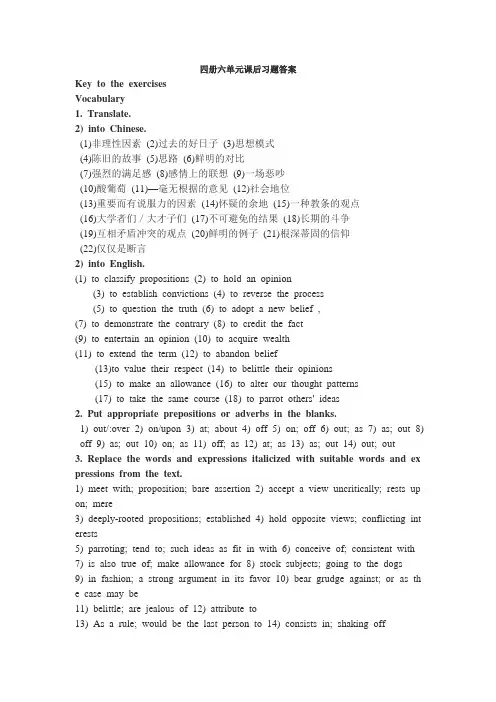
四册六单元课后习题答案Key to the exercisesVocabulary1. Translate.2) into Chinese.(1)非理性因素(2)过去的好日子(3)思想模式(4)陈旧的故事(5)思路(6)鲜明的对比(7)强烈的满足感(8)感情上的联想(9)一场恶吵(10)酸葡萄(11)—毫无根据的意见(12)社会地位(13)重要而有说服力的因素(14)怀疑的余地(15)一种教条的观点(16)大学者们/大才子们(17)不可避免的结果(18)长期的斗争(19)互相矛盾冲突的观点(20)鲜明的例子(21)根深蒂固的信仰(22)仅仅是断言2) into English.(1) to classify propositions (2) to hold an opinion(3) to establish convictions (4) to reverse the process(5) to question the truth (6) to adopt a new belief ,(7) to demonstrate the contrary (8) to credit the fact(9) to entertain an opinion (10) to acquire wealth(11) to extend the term (12) to abandon belief(13)to value their respect (14) to belittle their opinions(15) to make an allowance (16) to alter our thought patterns(17) to take the same course (18) to parrot others' ideas2. Put appropriate prepositions or adverbs in the blanks.1) out/:over 2) on/upon 3) at; about 4) off 5) on; off 6) out; as 7) as; out 8) off 9) as; out 10) on; as 11) off; as 12) at; as 13) as; out 14) out; out3. Replace the words and expressions italicized with suitable words and ex pressions from the text.1) meet with; proposition; bare assertion 2) accept a view uncritically; rests up on; mere3) deeply-rooted propositions; established 4) hold opposite views; conflicting int erests5) parroting; tend to; such ideas as fit in with 6) conceive of; consistent with 7) is also true of; make allowance for 8) stock subjects; going to the dogs9) in fashion; a strong argument in its favor 10) bear grudge against; or as the case may be11) belittle; are jealous of 12) attribute to13) As a rule; would be the last person to 14) consists in; shaking off15) In light of; on our guard 16) left us with no doubt4. Translate.1) We’ll achieve this result at any cost.2) Our economy began to grow by leaps and bounds as a result of the reformand opening- up policy.3) His repressive policies only resulted in his quick fall.4) Many of our present problems in a way result from our large population.5) The fact that you like somebody may dispose you to like his ideas also.6) So far we still have not found a safe way to dispose of nuclear waste.7) These shoes fit me perfectly. I'll take them.8) This set of furniture fits into our sitting room.9) The innkeeper found that the man fit the description of the wanted murder suspect.10) To keep fit, you should avoid eating too much salt, sugar and fat.11) The water was no longer even fit to swim in, let alone to drink.12) He was suddenly seized by a fit of laughter.13) She has had fits every now and then since she was a child.14) This subway will be extended to Cover the whole city.15) I would tike to take this opportunity to extend my heartfelt thanks to you.I6) The effect of the economic reform will naturally extend to other fields.17) Many people prefer government bonds to stocks.18) This kind of jacket is out of stock.19) This is one of his stock jokes. I have heard it many times.5. Complete the following sentences.1) were brought up in a different country; think and behave like a native of t hat country.2) will produce ten million kilowatts of power annually3) that she did not care for office work 4) the boy stabbing his own father 5) postpone my retirement for another year 6) pursue her studies overseas7) go to my brother 8) why we should accept it9) give us the excuse for doing wrong things10) he had been unusually lucky to have the best learning and working conditi ons11) she had very poor health 12) school education is useless13) as 14) as 15) share my basic value16) say no 17) take money18) the rewards hey cannot get 19) good food and drink(s), sex, etc.20) of which; in which/on which/under which21) she was very angry22) we must not allow others blindly 23) teachers are also inspired by good st udents6. Give brief comments on the following, using some of the expressions list ed below.1) Not always true. If fifty million people say a foolish thing, it will still bea foolish thing.Truth always has to be discovered by one individual first.2) Then why do we need to recruit workers? Why do we ask people to give us a hand?3) And how many is "too many"? Isn't this statement only one side of the sto ry?4) Are we sure it will not lead to poor efficiency?5) Time is money. What about many other things? There was a time when we believed that money was dirty and an evil monster, and now we hear that m oney is everything. Isn't it just like a fashion that comes and goes?6) To change things in what way? Can't they choose just to destroy? Isn't it p ossible that they will replace the old order with an order just as bad? Won't t hey upset social stability when stability is necessary for the whole nation?7) A popular saying during the "Cultural Revolution". But isn't it the other wa y around? Isn’t it true that the wat er of the mighty river comes from the smal l tributaries in the first place?8) But who are the people? Do the voters really have equal power and influen ce? In a country where wealth is concentrated, how can power avoid being co ncentrated too?9) This sounds pleasant in the ear, but it is not exactly true. Our arable land i s only 7% of the world’s total; pur per-capita water only one-third of the worl d’s average; timer, one-sixteenth; oil, 2% of the world's total; natural gas, 1. 2% of the world's total.10) This old saying is based on a false analogy. It is popular in a male-domin ant society.Men cling to this view not because it is true, but because it is useful to t hem.11) Not necessarily true. Good deeds should be their own reward. This old sa ying is meant to encourage people to do good, but because it is based on the concept of investment for future profits, many people refuse to make this un wise investment.7. Choose the best word or phrase for each blank from the four supplied in brackets.(1) awful (2) story (3) likely (4) fulfilling (5) supposed(6) from (7) gain (8) done (9) when (10) about(11) in particular (12) such as (13) interpreted (14) alone (15) context Grammar2. Grammar in context.1) Study the italicized abbreviated adverbial clauses, put in the omitted pa rts, and discuss the rules used in cutting short adverbial clauses.(1) when they (the staunchest Roman Catholic and the staunchest Presbyterian) were infants(2) when they (such "obvious truths") are examined(3) when it (the assumed or dogmatic proposition) was challenged(4) if he was/were told (5) while we are doing(6) while he (this young man) was attending(7) as if he (this beanpole with hair on top) wanted to say(8) as if he did all this to check (9) as if he was remembering(10) when it is measured against the lower crime rates(11) While you are in Rome (12) Though they are poor3. Shorten the following adverbial clauses where possible.1)If elected, he will turn out to be an excellent chairman.2) The adverbial clause cannot be cut short because its subject isn’t one and t he same with that of the main clause.3) If cooked too long, much of the vitamin C in vegetables will be destroyed.4) The conditional clause cannot be shortened for the same reason as stated in 2.5) The conditional cannot be shortened for the same reason as stated in 2.6) Though a foreigner, Dr. Bethune regarded the cause of the Chinese people as his own.7) If given every attention possible, the dying man still has a chance of recov ery,8) When questioned closely and severely by the teacher, the boy admitted chea ting in the exam.9) Even though still operating, the committee won’t play as an important a role as it used to.10) The teller turned to the next customer with a smile, as though deliberately snubbing the girl.11) Beijing looks more beautiful than ever (before).12) Unless invited, don't go to those meetings.13) Albert Einstein's hair looked wild as if electrified.14) When living in the Northeast, did you ever learn to ski?15) The conditional clause cannot be shortened for the same reason ass stated in 2.16) The conditional clause cannot be shortened for the same reason ass stated in 2.4. Complete the following sentences by translating the Chinese in brackets.1) When young 5) When urged2) unless it is forbidden 6) When ripe3) If cooked in tomato sauce 7) If not restricted4) Once out of trouble 8) Though well over seventy9) … as if turning over some important matter in his mind10) If detected sleeping on the job/at his post/on duty5. Translate these sentences that imply a condition.1) With better medical care my grandfather could have pulled through.2) They wouldn't have been able to do better under present conditions.Or: They couldn’t have been done better under present conditions.3)Even at gunpoint I would say, “He is guilty.”4) Further delay would cause us even greater losses.5) But for the seat belt, she would have been severely injured in the acciden t.6) A man without a strong sense of justice wouldn't have brought the matter up.7) With a smaller population there might be less unemployment in the country.8) Without an experienced guide like her, we might have been trapped in the jungle.9) She is not after name and money; otherwise she wouldn't have come back.10) But for the correct policy, many Chinese peasants wouldn't have become well-off so soon.11) I wonder how many of us would have done the same in his position.12) With a more sophisticated computer we would have completed the job mu ch sooner.13) This is something you should never do. It would mean the end of your jo urnalist career.14) Without a strong will even a healthy man wouldn't have reached the top of the mountainin two hours.15) A less resourceful person wouldn’t have been able to complete the project under such unfavorable conditions.6. Complete each of the following sentences with the most likely answer. 1-5 AACCB 6-10 DAADC 11-16 CDABDA。
现代大学英语精读6 paraphrase 原文+译文版
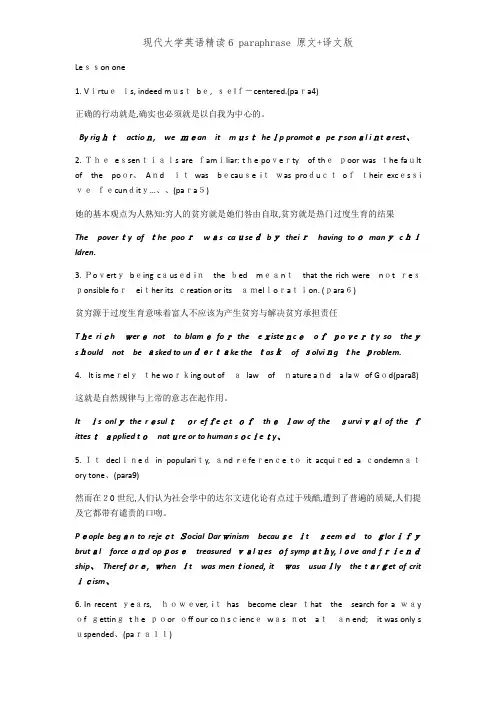
Lesson one1.Virtueis, indeed mustbe, self-centered.(para4)正确的行动就是,确实也必须就是以自我为中心的。
By rightaction,we mean it musthelp promotepersonal interest、2.Theessentials are familiar: the poverty of thepoor was the fault of the poor、Anditwas because itwas productoftheir excessi vefecundity…、、(para5)她的基本观点为人熟知:穷人的贫穷就是她们咎由自取,贫穷就是热门过度生育的结果The poverty of the poorwas causedbytheirhaving toomanychildren.3.Povertybeing caused inthe bed meantthat the rich were not responsible foreither its creation or itsamelioration. (para6)贫穷源于过度生育意味着富人不应该为产生贫穷与解决贫穷承担责任The richwerenot to blameforthe existenceofpoverty so theyshould not be asked to undertake the taskof solving the problem.4.It is merelythe working out ofalaw ofnature and a lawof God(para8) 这就是自然规律与上帝的意志在起作用。
Itis onlythe resultor effect ofthelaw of thesurvival of the fittestapplied tonature or to human society、5.Itdeclinedin popularity, and reference toit acquired a condemnatory tone、(para9)然而在20世纪,人们认为社会学中的达尔文进化论有点过于残酷,遭到了普遍的质疑,人们提及它都带有谴责的口吻。
现代大学英语精读4--unit6-groundless-beliefs--课件

a base for an argument
take this practice as a guide
Classifying propositions according to their grounds is important because people very often base their judgment of propositions according to their popularity, usefulness, source of authority as well as to their personal taste. They do not always accept beliefs because they are true. Often they accept them because their beliefs serve their immediate purpose, or because they sound nice, or because it is easier or safer to accept them.
• Other than: usually mean ‘except’, but here it means ‘apart from’. This usage is not considered standard by many people.
思路变得十分陈旧神经中枢的模式由于不断被使用而相互连接起来以至神经流找到了一条实际上没有阻力的路线因而总是走相同的路线
大家好
• Groundless Beliefs
• ground: (usu. pl.) the foundation / underlying condition for an argument, a belief, or an action; a cause or good reason for sth.
大学英语4精读Unit6课文HOWTOMARKABOOK

There are three kinds of book owners. The first has all the standard sets and best-sellers -unread, untouched. (This individual owns wood-pulp and ink, not books.) The second has a great many books -- a few of them read through, most of them dipped into, but all of them as clean and shiny as the day they were bought. (This person would probably like to make books his own, but is restrained by a false respect for their physical appearance.) The third has a few books or many -- every one of them dog-eared and dilapidated, shaken and loosened by con nual use, marked and scribbled in from front to back. (This man owns books.)
现代大学英语精读1unit6课文翻译
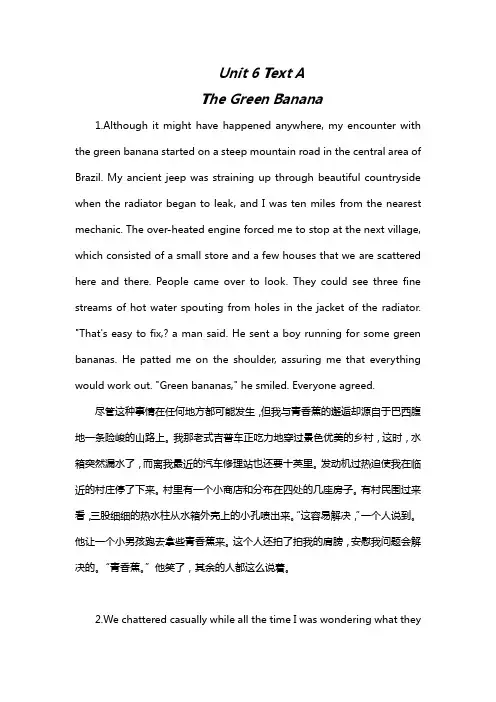
Unit 6 Text AThe Green Banana1.Although it might have happened anywhere, my encounter with the green banana started on a steep mountain road in the central area of Brazil. My ancient jeep was straining up through beautiful countryside when the radiator began to leak, and I was ten miles from the nearest mechanic. The over-heated engine forced me to stop at the next village, which consisted of a small store and a few houses that we are scattered here and there. People came over to look. They could see three fine streams of hot water spouting from holes in the jacket of the radiator. "That's easy to fix,? a man said. He sent a boy running for some green bananas. He patted me on the shoulder, assuring me that everything would work out. "Green bananas," he smiled. Everyone agreed.尽管这种事情在任何地方都可能发生,但我与青香蕉的邂逅却源自于巴西腹地一条险峻的山路上。
(完整版)现代大学英语精读Book4Unit6课文
Book 4-Unit 5Text AThe TelephoneAnwar F. Accawi1.When I was growing up in Magdaluna, a small Lebanese village in theterraced, rocky mountains east of Sidon, time didn't mean much toanybody, except maybe to those whowere dying. In those days, there was no real need for a calendar or awatch to keep track of the hours, days, months, and years. We knewwhat to do and when to do it, just as the Iraqi geese knew when to flynorth, driven by the hot wind that blew in from the desert. The onlytimepiece we had need of then was the sun. It rose and set, and theseasons rolled by and we sowed seed and harvested and ate and playedand married our cousins and had babies who got whooping cough andchickenpox—and those children who survived grew up and marriedtheir cousins and had babies who got whooping cough and chickenpox.We lived and loved and toiled and died without ever needing to knowwhat year it was, or even the timeof day.2.It wasn't that we had no system for keeping track of time and of the importantevents in ourlives. But ours was a natural or, rather, a divine — calendar, because itwas framed by acts of God: earthquakes and droughts and floods andlocusts and pestilences. Simple as our calendar was, it worked just finefor us.3.Take, for example, the birth date of Teta Im Khalil, the oldestwoman in Magdaluna and all the surrounding villages. When Iasked Grandma, "How old is Teta Im Khalil?"4.Grandma had to think for a moment; then she said, "I've been toldthat Teta was born shortly after the big snow that caused the roof onthe mayor's house to cave in."5."And when was that?" I asked.6."Oh, about the time we had the big earthquake that cracked the wall in the eastroom."7.Well, that was enough for me. You couldn't be more accurate than that, now,could you?8.And that's the way it was in our little village for as far back as anybodycould remember. One of the most unusual of the dates was when awhirlwind struck during which fish and oranges fell from the sky.Incredible as it may sound, the story of the fish and oranges was true,because men who would not lie even to save their own souls told andretold that story untilit was incorporated into Magdaluna's calendar.9.The year of the fish-bearing whirlpool was not the last remarkable year.Many others followed in which strange and wonderful things happened.There was, for instance, the yearof the drought, when the heavens were shut for months and the springfrom which the entire village got its drinking water slowed to a trickle.The spring was about a mile from the village, in a ravine that opened atone end into a small, flat clearing covered with fine gray dust and hard,marble-sized goat droppings. In the year of the drought, that littleclearingwas always packed full of noisy kids with big brown eyes and stickyhands, and their mothers —sinewy, overworked young women withcracked, brown heels. The children ran around playing tag or hide-and-seek while the women talked, shooed flies, and awaited their turns to fillup their jars with drinking water to bring home to their napping menand wet babies. There were days when we had to wait from sunup untillate afternoon just to fill a small clay jar with precious, cool water.10.S ometimes, amid the long wait and the heat and the flies and the smellof goat dung, tempers flared, and the younger women, anxious abouttheir babies, argued over whose turnit was to fill up her jar. And sometimes the arguments escalated intofull-blown, knockdown-dragout fights; the women would grab eachother by the hair and curse and scream and spit and call each othernames that made my ears tingle. We little brown boys who went withour mothers to fetch water loved these fights, because we got to see thewomen's legs and their colored panties as they grappled and rolledaround in the dust. Oncein a while, we got lucky and saw much more, because some of thewomen wore nothing at all under their long dresses. God, how I usedto look forward to those fights. I remember the rush, the excitement,the sun dancing on the dust clouds as a dress ripped and a youngwhite breast was revealed, then quickly hidden. In my calendar, thatyear of drought will always be one of the best years of my childhood.11.B ut, in another way, the year of the drought was also one of the worstof my life, because that was the year that Abu Raja, the retired cook,decided it was time Magdaluna got its own telephone. Every civilizedvillage needed a telephone, he said, and Magdaluna was not going toget anywhere until it had one. A telephone would link us with theoutside world. A fewmen—like the retired Turkish-army drill sergeant, and the vineyard keeper —did all they couldto talk Abu Raja out of having a telephone brought to the village. But they were outshoutedand ignored and finally shunned by the other villagers for resisting progress and trying tokeep a good thing from coming to Magdaluna.12. O ne warm day in early fall, many of the villagers were out in theirfields repairing walls or gathering wood for the winter when the shoutwent out that the telephone-company truckhad arrived at Abu Raja's dikkan, or country store. When the truckcame into view, everybody dropped what they were doing and ran toAbu Raja's house to see what was happening.13.I t did not take long for the whole village to assemble at Abu Raja'sdikkan. Some of the rich villagers walked right into the store andstood at the elbows of the two important-lookingmen from the telephone company, who proceeded with utmost gravity, like priests atCommunion, to wire up the telephone. The poorer villagers stoodoutside and listened carefully to the details relayed to them by the not-so-poor people who stood in the doorway and could see inside.14."The bald man is cutting the blue wire," someone said.15."He is sticking the wire into the hole in the bottom of the black box," someoneelse added.16."The telephone man with the mustache is connecting two pieces ofwire. Now he is twisting the ends together," a third voice chimed in.17.B ecause I was small, I wriggled my way through the dense forest oflegs to get a firsthand look at the action. Breathless, I watched asthe men in blue put together a black machinethat supposedly would make it possible to talk with uncles, aunts, andcousins who lived more than two days' ride away.18.I t was shortly after sunset when the man with the mustache announced thatthe telephonewas ready to use. He explained that all Abu Raja had to do was lift thereceiver, turn the crank on the black box a few times, and wait for anoperator to take his call. Abu Raja grabbed the receiver and turned thecrank forcefully. Within moments, he was talking withhis brother in Beirut. He didn't even have to raise his voice or shout to be heard.19.A nd the telephone, as it turned out, was bad news. With its coming, the face ofthe villagebegan to change. One of the fast effects was the shifting of the village'scenter. Before the telephone's arrival, the men of the village used togather regularly at the house of Im Kaleem, a short, middle-aged widowwith jet-black hair and a raspy voice that could be heard all over thevillage, even when she was only whispering. She was a devout Catholicand also the village whore. The men met at her house to argue aboutpolitics and drink coffee and play cards or backgammon. Im Kaleemwas not a true prostitute, however, because she did not charge for herservices —not even for the coffee and tea that she served the men. Shedid not need the money; her son, who was overseas in Africa, sent hermoney regularly. Im Kaleem loved all the men she entertained, and theyloved her, every one of them. In a way, she was married to all the menin the village. Everybody knew it but nobody objected. Actually I suspect the women did not mind their husbands'visits to Im Kaleem. Oh, theywrung their hands and complained to one another about their men'sunfaithfulness, but secretly they were relieved, because Im Kaleem tooksome of the pressure off them and kept the men outof their hair while they attended to their endless chores. Im Kaleem wasalso a kind of confessor and troubleshooter, talking sense to those menwho were having family problems, especially the younger ones.20.B efore the telephone came to Magdaluna, Im Kaleem's house was bustling atjust about anytime of day, especially at night, when the loud voices of the men talking, laughing, and arguing could be heard in the street below —a reassuring, homey sound. Her house was an island of comfort, an oasis for theweary village men, exhausted from having so little to do.21.B ut it wasn't long before many of those men —the younger onesespecially—started spending more of their days and evenings at AbuRaja's dikkan. There, they would eat and drink and talk and playcheckers and backgammon, and then lean their chairs back against thewall —the signal that they were ready to toss back and forth, like a ball,the latest rumors going around the village. And they were alwayslooking up from their games and drinks and talk to glance at the phonein the corner, as if expecting it to ring any minute and bring news thatwould change their lives and deliver them from their aimless existence.In the meantime,they smoked cheap, hand-rolled cigarettes, dug dirt out from undertheir fingernails with big pocketknives, and drank lukewarm sodasthat they called Kacula, Seffen-Ub, and Bebsi.22. T he telephone was also bad news for me personally. It took away mylucrative business —a source of much-needed income. Before, I used tohang around Im Kaleem's courtyard and play marbles with the otherkids, waiting for some man to call down from a window and askme to run to the store for cigarettes or liquor, or to deliver a message to his wife, such aswhat he wanted for supper. There was always something in it for me: aten or even a twenty-five-piaster piece. On a good day, I ran nine or tenof those errands, which assured a steady supply of marbles that Iusually lost to other boys. But as the days went by fewer and fewer mencame to Im Kaleem's, and more and more congregated at Abu Raja's towait bythe telephone. In the evenings, the laughter and noise of the mentrailed off and finally stopped.23.A t Abu Raja's dikkan, the calls did eventually come, as expected, andmen and women started leaving the village the way a hailstorm begins:first one, then two, then bunches.24.T he army took them. Jobs in the cities lured them. And ships andairplanes carried them to such faraway places as Australia and Braziland New Zealand. My friend Kameel, his cousin Habeeb, and theircousins and my cousins all went away to become ditch diggers andmechanics and butcher-shop boys and deli owners who wore dirtyaprons sixteen hours a day, all looking for a better life than the onethey had left behind. Within a year, only the sick, the old, and themaimed were left in the village. Magdaluna became a skeleton of itsformer self, desolate and forsaken, like the tombs, a place to get away from.25.F inally, the telephone took my family away, too. My father got a callfrom an old army buddy who told him that an oil company in southern Lebanon was hiring interpreters and instructors. My father applied for a job and got it, and we moved to Sidon, where I went to aPresbyterian missionary school and graduated in 1962. Three yearslater, having won a scholarship, I left Lebanon for the United States.Like the others who left Magdaluna before me, I am still looking for that better life. (2121 words)。
现代大学英语精读第四册课文原文
Lesson 1Thinking as a HobbyWilliam GoldingWhile I was still a boy, I came to the conclusion that there were three grades of thinking;and thatI myself could not think at all.It was the headmaster of my grammar school who first brought the subject of thinkingbefore me.He had somestatuettes in his study. They stood on a high cupboard behind his desk. One was a lady wearing nothing but a bath towel. She seemed frozen in an eternal panic lest the bath towelslip down any farther, and since she had no arms, she was in an unfortunate position to pull the towel up again. Next to her, crouched the statuette of a leopard, ready to spring down at the top drawer of a filing cabinet. Beyond the leopard was a naked, muscular gentleman, who sat, looking down, with his chin on his fist and his elbow on his knee. He seemed utterly miserable.Some time later, I learned about these statuettes. The headmaster had placed them where they would face delinquent children, because they symbolized to him to whole of life. The naked ladywas the Venus. She was Love. She was not worried about the towel. She was just busy being beautiful. The leopard was Nature, and he was being natural. The naked, muscular gentleman was not miserable. He was Rodin's Thinker, an image of pure thought.I had better explain that I was a frequent visitor to the headmaster's study, because of the latest thing I had done or left undone. As we now say, I was not integrated. I was, if anything, disintegrated. Whenever Ifound myself in a penal position before the headmaster's desk, I would sink my head, and writhe one shoe over the other.The headmaster would look at me and say,"What are wegoing to do with you?"Well, what were they going to do with me? I would writhe my shoe some more and staredown atthe worn rug."Look up, boy! Can't you look up?"Then I would look at the cupboard, where the naked lady was frozen in her panic and themuscular gentleman contemplated the hindquarters of the leopard in endless gloom. I had nothing to say to the headmaster. His spectacles caught the light so that you could see nothing human behind them. There was no possibility of communication."Don't you ever think at all?"No, I didn't think, wasn't thinking, couldn't think - I was simply waiting in anguish for theinterview to stop."Then you'd better learn - hadn't you?"On one occasion the headmaster leaped to his feet, reached up and put Rodin's masterpiece onthe desk before me."That's what a man looks like when he's really thinking."Clearly there was something missing in me. Nature had endowed the rest of the human race witha sixth sense and left me out. But like someone born deaf, but bitterly determined to find outabout sound, I watched my teachers to find outabout thought.There was Mr. Houghton. He was always telling me to think. With a modest satisfaction, he would tell that he had thought a bit himself. Then why did he spend so much time drinking? Or was there more sense in drinking than there appeared to be? But if not, and if drinking were in fact ruinous to health - and Mr. Houghton was ruined, there was no doubt about that - why was he always talking about the clean life and the virtues of fresh air?Sometimes, exalted by his own oratory, he would leap from his desk and hustle usoutside into a hideous wind."Now, boys! Deep breaths! Feel it right down inside you - huge draughts of God's good air!"He would stand before us, put his hands on his waist and take a tremendous breath. You couldhear the wind trapped in his chest and struggling with all the unnatural impediments. His bodywould reel with shock and his face go white at the unaccustomed visitation. He would staggerback to his desk and collapse there, useless for the rest of the morning.Mr. Houghton was given to high-minded monologues about the good life, sexless and full of duty. Yet in the middle of one of these monologues, if a girl passed the window, his neck would turn of itself and he would watch her out of sight. In this instance, he seemed to me ruled not by thoughtbut by an invisible and irresistible spring in his nack.His neck was an object of great interest to me. Normally it bulged a bit over his collar.But Mr. Houghton had fought in the First World War alongside both Americans and French, and had cometo a settled detestation of both countries. If either country happened to be prominent in current affairs, no argument could make Mr. Houghton think well of it. He would bang the desk, his neck would bulge still further and go red. "You can say what you like," he would cry, "but I've thought about this - and I know what I think!"Mr. Houghton thought with his neck.This was my introduction to the nature of what is commonly called thought. Through them Idiscovered that thought is often full of unconscious prejudice, ignorance, and hypocrisy. It will lecture on disinterested purity while its neck is being remorselessly twisted toward a skirt. Technically, it is about as proficient as most businessmen's golf, as honest as most politician's intentions, or as coherent as most books that get written. It is what I came to call grade-three thinking, though more properly, it is feeling, rather than thought.True, often there is a kind of innocence in prejudices, but in those days I viewed grade-three thinking with contempt and mockery. I delighted to confront a pious lady who hated the Germans with the proposition that we should love our enemies. She taught me a great truth in dealing with grade-three thinkers; because of her, I no longer dismiss lightly a mental process which fornine-tenths of the population is the nearest they will ever get to thought. They have immense solidarity. We had better respect them, for we are outnumbered and surrounded. A crowd of grade-three thinkers, all shouting the same thing, all warming their hands at the fire of their own prejudices, will not thank you for pointing out the contradictions in their beliefs. Man enjoys agreement as cows will graze all the same way on the side of a hill.Grade-two thinking is the detection of contradictions. Grade-two thinkers do not stampede easily, though often they fal linto the other fault and lag behind. Grade-two thinking is a withdrawal,with eyes and ears open. It destroys without having the power to create. It set me watching the crowds cheering His Majesty the King and asking myself what all the fuss was about, without giving me anything positive to put in the place of that heady patriotism. But there were compensations. To hear people justify their habit of hunting foxes by claiming that the foxes like it. To her our Prime Minister talk about the great benefit we conferred on India by jailing people like Nehru and Gandhi. To hear American politicians talk about peace and refuse to join the League of Nations. Yes, there were moments of delight.But I was growing toward adolescence and had to admit that Mr. Houghton was not the only one with an irresistible spring in his neck. I, too, felt the compulsive hand of nature and began to findthat pointing out contradiction could be costly as well as fun. There was Ruth, for example, a serious and attractive girl. I was an atheist at the time. And she was a Methodist. But, alas, instead of relying on the Holy Spirit to convert me, Ruth was foolish enough to open her pretty mouth in argument. She claimed that the Bible was literally inspired. I countered by saying thatthe Catholics believed in the literal inspiration of Saint Jerome's Vulgate, and the two books were different. Argument flagged.At last she remarked that there were an awful lot of Methodists and they couldn't bewrong, could they - not all those millions? That was too easy, said I restively (for the nearer you were to Ruth, the nicer she was to be near to) since there were more Roman Catholics than Methodists anyway; and they couldn't be wrong, could they - not all those hundreds of millions? An awfulflicker of doubt appeared in her eyes. I slid my arm round her waist and murmured that if wewere counting heads, the Buddhists were the boys for my money. She fled. The combination ofmy arm and those countless Buddhists was too much for her.That night her father visited my father and left, red-cheeked and indignant. I was given the thirddegree to find out what had happened. I lost Ruth and gained an undeserved reputation as a potential libertine.Grade-two thinking, though it filled life with fun and excitement, did not make for content. Tofind out the deficiencies of our elders satisfies the young ego but does not make for personal security. It took the swimmer some distance from the shore and left him there, out of his depth.A typical grade-two thinker will say, "What is truth?" There is still a higher grade of thought which says, "What is truth?" and sets out to find it.But these grade-one thinkers were few and far between. They did not visit my grammar school inthe flesh though they were there in books. I aspired to them, because I now saw my hobby as an unsatisfactory thing if it went no further. If you set out to climb a mountain, however high you climb, you have failed if you cannot reach the top.I therefore decided that I would be a grade-one thinker. I was irrelevant at the best of times. Political and religious systems, social customs, loyalties and traditions, they all came tumbling down like so many rotten apples off a tree. I came up in the end with what mustalways remainthe justification for grade-one thinking. I devised a coherent system for living. It was a moral system, which was wholly logical. Of course, as I readily admitted, conversion of the world to my way of thinking might be difficult, since my system did away with a number of trifles, such as big business, centralized government, armies, marriage...It was Ruth all over again. I had some very good friends who stood by me, and still do. But my acquaintances vanished, taking the girls with them. Young people seemed oddly contented withthe world as it was. A young navy officer got as red-necked as Mr. Houghton when I proposed a world without any battleships in it.Had the game gone too far? In those prewar days, I stood to lose a great deal, for the sake of a hobby.Now you are expecting me to describe how I saw the folly of my ways and came back to the warm nest, where prejudices are called loyalties, pointless actions are turned into customs by repetition, where we are content to say we think when all we do is feel.But you would be wrong. I dropped my hobby and turned professional.Lesson 2Waiting for the PoliceI wonder where Mr Wainwright's gone?' said Mrs Mayton.It didn't matter to her in the least where he had gone. All that mattered was that he paid his three guineas a week regularly for board and lodging. But life - and particularly evening life -wasnotoriously dull in her boarding-house, and every now and again one tried to whip up a little interest.`Did he go?' asked Monty Smith.It didn't matter to him, either, but he was as polite as he was pale, and he always did his best to keep any ball rolling.`I thought I heard the front door close,' answered Mrs Mayton. `Perhaps he went out to post a letter,' suggested Miss Wicks, without pausing in her knitting. She had knitted for seventy years,and looked good for another seventy.`Or perhaps it wasn't him at all,' added Bella Randall. Bella was the boarding-house lovely, but no one had taken advantage of the fact. `You mean, it might have been someone else?' inquired Mrs Mayton.`Yes,' agreed Bella.They all considered the alternative earnestly. Mr Calthrop, coming suddenly out of a middle-aged doze, joined in the thinking without any idea what he was thinking.`Perhaps it was Mr Penbury,' said Mrs Mayton, at last. `He's always popping in and out.'But it was not Mr Penbury, for that rather eccentric individual walked into the drawing-room a moment later.His arrival interrupted the conversation, and the company became silent. Penbury always had a chilling effect. He possessed a brain, and since no one understood it when he used it, it was resented. But Mrs Mayton never allowed more than three minutes to go by without a word; andso when the new silence had reached its allotted span, she turned to Penbury and asked:`Was that Mr Wainwnght who went out a little time ago?Penbury looked at her oddly.`What makes you ask that?' he said.`Well, I was just wondering.'`I see,' answered Penbury slowly. The atmosphere seemed to tighten, but Miss Wicks went on knitting. `And are you all wondering?'`We decided perhaps he'd gone out to post a letter,' murmured Bella.`No, Wainwright hasn't gone out to post a letter,' responded Penbury. `He's dead.'The effect was instantaneous. Bella gave a tiny shriek. Mrs Mayton's eyes became two startled glass marbles. Monty Smith opened his mouth and kept it open. Mr Calthrop, in a split second,lost all inclination to doze. Miss Wicks looked definitely interested, though she did not stop knitting. That meant nothing, however. She had promised to knit at her funeral.`Dead?' gasped Mr Calthrop.`Dead,' repeated Penbury. `He is lying on the floor of his room. He is rather a nasty mess.'Monty leapt up, and then sat down again. `You - don't mean . . . ?' he gulped.`That is exactly what I mean,' replied Penbury.There had been,countless silences in Mrs Mayton's drawing-room, but never a silence like this one. Miss Wicks broke it.`Shouldn't the police be sent for?' she suggested.`They already have,' said Penbury. `I phoned the station just before coming into the room.'`How long - that is - when do you expect . . . ?' stammered Monty.`The police? I should say in two or three minutes,' responded Penbury. His voice suddenly shed its cynicism and became practical. `Shall we try and make use of these two or three minutes? Weshall all be questioned, and perhaps we can clear up a little ground before they arrive.'Mr Calthrop looked angry.`But this is nothing to do with any of us, sir!' he exclaimed.`The police will not necessarily accept our word for it,' answered Penbury. `That is why I propose that we consider our alibis in advance. I am not a doctor, but I estimate from my brief examination of the body that it has not been dead more than an hour.Since it is now ten pastnine, and at twenty to eight we saw him leave the dining-room for his bedroom . . .'`How do you know he went to his bedroom?' interrupted Miss Wicks.`Because, having a headache, I followed him upstairs to go to mine for some aspirin, and my room is immediately opposite his,' Penbury explained. `Now, if my assumption is correct, he was killed between ten minutes past eight and ten minutes past nine, so anyone who can prove thathe or she has remained in this room during all that time should have no worry.'He looked around inquiringly.`We've all been out of the room,' Miss Wicks announced for the company.`That is unfortunate,' murmured Penbury.`But so have you!' exclaimed Monty, with nervous aggression.`Yes -so I have,' replied Penbury. `Then let me give my alibi first. At twenty minutes to eight I followed Wainwright up to the second floor. Before going into his room he made an odd remark which - in the circumstances -is worth repeating. "There's somebody in this house who doesn'tlike me very much," he said. "Only one?" I answered. "You're luckier than I am." Then he wentinto his room, and that was the last time I saw him alive. I went into my room. I took two aspirin tablets.Then as my head was still bad, I thought a stroll would be a good idea, and I went out. Ikept out till approximately - nine o'clock. Then I came back. The door you heard closing, Mrs Mayton, was not Wainwright going out. It was me coming in.'`Wait a moment!' ejaculated Bella.`Yes?'`How did you know Mrs Mayton heard the front door close? You weren't here!'Penbury regarded her with interest and respect.`Intelligent,' he murmured.`Now, then, don't take too long thinking of an answer!' glared Mr Calthrop.`I don't need any time at all to think of an answer,' retorted Penbury. `I know because I listened outside the door. But as I say, I came back. I went up to my room.' He paused. `On the floor Ifound a handkerchief. So I went into his room to ask if the handkerchief was his. I found him lyingon the ground near his bed. On his back. Head towards the window. Stabbed through the heart.But no sign of what he'd been stabbed with . . . It looks to me a small wound, but deep. It foundthe spot all right . . . The window was closed and fastened. Whoever did it entered through the door. I left the room and locked the door. I knew no one should go in again till the police andpolice doctor turned up.I came down. The telephone, as you know, is in the dining-room. Most inconvenient. It should be in the hall. Passing the door of this room,I listened, to hear what youall were talking about. Then I went into the dining-room and telephoned the police. And then Ijoined you.'Flushed and emotional, Mrs Mayton challenged him.`Why did you sit here for three minutes without telling us?' she demanded.`I was watching you,' answered Penbury, coolly.`Well, I call that a rotten alibi!' exclaimed Mr Calthrop. `Who's to prove you were out all that time?'`At half past eight I had a cup of coffee at the coffee-stall in Junkers Street,' replied Penbury. `That's over a mile away. It's not proof, I admit, but they know me there, you see, and it may help. Well, who's next?'`I am', said Bella. `I left the room to blow my nose. I went to my room for a handkerchief. Andhere it is!' she concluded, producing it triumphantly.`How long were you out of the room?' pressed Penbury.`Abour five minutes.'`A long time to get a handkerchief.'`Perhaps. But I not only blew my nose, I powdered it.'`That sounds good enough,' admitted Penbury. `Would you oblige next, Mr Calthrop? We all know you walk in your sleep. A week ago you walked into my room, didn't you. Have you lost a handkerchief?'Mr Calthrop glared.`What the devil are you implying?' he exclaimed.`Has Mr Calthrop dozed during the past hour?' pressed Penbury.`Suppose I have?' he cried. `What damned rubbish! Did I leave this room without knowing it, andkill Wainwright for -for no reason at all ?' He swallowed, and calmed down. `I left the room,sir,about twenty minutes ago to fetch the evening paper from the dining-room to do the crossword puzzle!' He tapped it viciously. `Here it is!'Penbury shrugged his shoulders.`I should be the last person to refute such an emphatic statement,' he said, `but let me suggestthat you give the statement to the police with slightly less emphasis, Mr Smith?'Monty Smith had followed the conversation anxiously, and he had his story ready.。
现代大学英语精读4lesson6-extension
Robert Frost - They Were Welcome To Their Belief
Grief may have thought it was grief. Care may have thought it was care. They were welcome to their belief,
The overimportant pair. No, it took all the snows that clung
To the low roof over his bed, Beginning when he was young, To induce the one snow on his head.
Grief may have thought it was grief. Care may have thought it was care.
But neither one was the thief Of his raven color of hair.
WB T L E
To be continued on the next page.
the following three quotations are from A. E. Mander's book, Logic for the Millions.
WB T L E
The End of group discussion.
2021/3/10
4
IV. Poem
Lesson 6-Groundless Beliefs
2. Differences between thinking with beliefs and thinking without beliefs
现代大学英语第二版精读4 Unit 6 The telephone Key to Exercises
◆Unit 6 The Telephone Key to Exercises◆Q Do the following exercises.◆1 Translate, paying attention to the use of the bold type.◆这辆二手车买得很便宜。
◆他的讲话被打断/缩短了。
◆在这里建造铁路之前,先要把这里的水抽千。
◆这花瓶擦干净以后看起来就会和新的一样。
◆这房子被刷成了淡绿色。
◆就在那时,门被突然賜开。
◆恐怖分子被枪杀,人质都被释放。
◆在日本,鱼往往是生吃的。
◆这可怜的孩子生下来就失聪,不久又失明了。
◆10.据说在皇陵完工的时候,那些建造皇陵的工人都被活埋在里面。
◆2 Give the corresponding adjectives of the following names of countries.◆1. Iraqi◆2. Pakistani◆3. Yemeni◆4. Lebanese◆5. Danish◆6. Hungarian◆7. Belgian◆8. Argentine◆9. Swedish◆10. Swiss◆11. Norwegian◆12. Polish◆3 Review how these words are formed.◆These are compound adjectives consisting of a noun plus an adjective with the noun serving as a modifier of the adjective. “Jet-black” for example means “as black as jet (a◆hard black material).”◆Vocabulary◆Q Translate the following expressions.◆Into English◆1. crack the walls◆2. save souls◆3. play hide-and-seek◆4. slow to a trickle◆5. grab sb by the hair◆6. call sb names◆7. rip her shirt◆8. reveal the secret◆9. resist progress◆10. c ome into view◆11. gather firewood◆12. talk sb out of doing sth◆13. wriggle one’s way out of the crowd ◆14. run errands◆15. deliver sb from suffering◆16. assure a steady supply◆17. take the pressure off sb◆18. keep him out of one’s hair◆Into Chinese◆梯田◆多岩石的群山◆百日咳◆周围的村庄◆林中的一块空地◆粉尘◆羊粪◆黏糊糊的双手◆精瘦强健的妇女◆旌旗如林◆第一手资料◆漆黑的头发◆一位虔诚的天主教徒◆家务事◆一种让人感到在家般自在的声音◆手卷香烟◆有利可图/十分挣钱的生意◆一家肉铺◆它原来模样的空架子◆一所教会学校◆Q Replace the parts in bold type with appropriate words and expressions from the text.◆1. caved in◆2. charged, lucrative◆3. talk him out of it, resist◆4. an argument, escalating◆5. relayed to/delivered to, assemble/congregate◆6. been reduced to mere skeletons, save/deliver◆7. began to/proceeded to, with utmost gravity◆8. cracked◆9. keep unwanted visitors off your hair◆10. packed with people, wriggle◆K1 Translate the following sentences into English.◆1. Incredible as it may sound, I hear that they charge 40 yuan for a bowl of simple noodles at the airport.◆2. Sun Quan finally talked everybody into agreeing to put Lu Xun, a young scholar, in charge of/commanding this decisive battle.◆3. He was arrested on the charge of smuggling, but in accordance with the law, no citizen can be arrested without evidence.◆4. She dropped the plate on the ground, but it miraculously did not break, without so much as a crack.◆5. I can assure you that if we dig a well deep enough here, we will strike water. So if you guys have no objection, let’s get started.◆6. She takes delight in shifting the tables and chairs in this room so as to give the room a new look.◆7. The focus of our economic development has shifted from the coastal areas in the east to the central and western areas.◆8. He shifted/changed to the highest gear, thus leaving all the other cars far behind.◆9. I maintained that smoking should be forbidden, but he disagreed because he said that the tobacco industry was an important source of government revenue.◆10. The local people raised a strong objection to installing the cable car over that beautiful mountain.◆Q Choose the right word(s) in their proper forms.◆1. assure◆2. assured◆3. reassuring◆4. insured, ensured◆5. ensure, reassured◆6. reassuringly◆2 1. twisted/turned◆3. wring◆4. distorted/twisted◆5. twisted◆6. twisted◆7. wringing◆3 1. gathered/assembled◆2. assembling◆3. gather/collect, gathered/collected◆4. gathering, assembled/gathered, collectors◆5. collect/gather◆6. collect,◆collecting,◆collection◆4 1. crack, break◆2. cracked, tear◆3. tore◆4. split, broke◆5. break, Split◆6. tore/ripped◆7. tom◆5 1. abandoned◆2. abandoned/deserted/forsaken, abandoned/deserted/forsaken◆3. abandon/desert/forsake◆4. desert◆5. forsaken, deserted◆6. abandoned◆1. ignore◆2. neglect◆3. overlook◆4. neglected◆5. ignore◆6. neglecting◆B Point out which of the following sentences contain paradox and which oxymoron.◆1 paradox◆2. paradox◆3. oxymoron◆4. oxymoron◆5. oxymoron◆7. paradox◆8. paradox◆9. oxymoron◆10. paradox◆11. paradox◆12. paradox◆13. paradox◆14. paradox◆15. oxymoron◆16. paradox◆Grammar◆D Learn to use as and though as concessive conjunctions.◆1 Group the patterns of concessive clauses in the following sentences into the categories listed below.◆Ol,2,3,6 ©4,9 ©5,8 ©7,10◆2 Complete the sentences by translating the Chinese in brackets using the patterns of concessive cl^uscs listed in the previous exercise.◆1 • Simple as it is◆2. Much as he loves his children◆3. Try as he might◆4. Trash as it is◆5. Happy and contented as they are in retirement◆6. Hard taskmaster though he appeared to be in the lab◆7. Tempting though it was◆8. Perfect talk show host though he is◆9. Much as I respect him◆10. Proud as they are of their father◆B Learn to use It is/was (high) time (that) sb did sth.◆1 Study the use of It is/was (high) time (that) sb did sth in the following sentences and put each into a category listed below.◆The structure “it is/was (high) time (that).",,is used to convey two meanings. One is “approximately the right time,” the other being “long past the right time.” For example, “It’s◆time you went to bed” can mean either that “You should have gone to bed much earlier” (often stated with emphasis on the word “time”),or that “Now is the appropriate time for you to go to bed.” The precise meaning of this term depends on the tone of voice and/or the◆context.◆O 1,3, 6, 7 ©2,4,5, 8◆2 Translate the sentences into English using it is/was (high) time (that) sb did sth.◆1. We've been training for the whole morning. It’s time we took a break and had lunch.◆2. The Johnsons decided that it was high time their 40-year-old son moved out of their house. ◆3. Twenty years have passed, and it’s time we buried the past misunderstandings of our two families.◆4. It’s time we protested publicly and said no to such gender discrimination in this department.◆5. It’s time unions and manage ment sat down and worked out a real solution to the problem.◆6 it h time national leaders took stock of their nation’s resources and worked out realistic plans.◆Q Study the grammatical structure of these involved sentences.◆1 • This is a complex sentence.◆Main clause: the story of the fish and oranges was true Subordinate clauses:◆Adverbial clauses of concession: Incredible as it may sound◆Adverbial clauses of reason: because men who would not lie even to save their own souls told and retold that story until it was incorporated into Magdalene’s calendar Both adverbial clauses modify the predicate verb of the main clause was true.◆In the second clause there are two subordinate clauses:◆1) who would not lie even to save their own souls (a relative clause modifying the subject of the reason clause “men”)◆2) until it was incorporated into Magdalene’s calendar (a time clause modifying its main ve rb “told and retold”)◆2. It is also a complex sentence.◆Main clause: I watched◆Subordinate clause: the rest of the sentence except for the opening word “breathless (This is a time clause)◆Within the subordinate clause:◆Two relative clauses:◆1) “That supposedly would make it possible to talk with uncles, aunts, and cousins,” modifies “a black machine.”◆2) “Who lived more than two days' ride away," modifies “uncles,aunts, and cousins.”◆Q Translate the selection into Chinese.◆然而这个问题仍然没有得到答复。