
2013新版外研版七年级英语下Module 7 Unit 1
be born —出生于 in, on 区别?
She was born in August,2000. She was born on August,18. She was born in a small village. 对划线部分提问 1. when was she born? ____
2. where was she born? _____
Tony:
Tony: Tony: Lingling:
What was the name of the village?
I was born in Cambridge. It‘s a small city in England. It was Darwin Primary School. Who was your first teacher?
4. Complete the table.
Born in First teacher Ms Yao First school First friend(s)
Lingling Tony
Xucun Cambridge
Mrs Lane
Darwin Primary School
Becky and Adam
1. √ Betty was born in the US. 2. √ Betty was born in a small town. × Betty’s first school was a big school. 3. × There were twenty-two students in Betty’s class. 4. √ Betty’s first teacher was strict. 5.
a) Who was your first teacher?
b) What was your first schபைடு நூலகம்ol like?
c) Where were you born? d) Was she strict?
3 2 1 4
Now answer the questions. Use the words and expressions from the box
Ask and answer
strict
— What was he like before? — He was strict.
friendly
— What was she like before? — She was friendly.
What is / … like?
1. Listen and number the questions as you hear them.
Tips (小提示)
am / is — was was not — wasn’t are — were were not — weren’t 动词过去式
Make conversations
— Where were you born ? — I was born in a village in Shandong Province. — When were you born? — I was born in 1993.
Words and expressions
/bɔ:n/ / strIkt/ /'frendli/ /'praIməri/ /taun/ /'vIlIdʒ/ /naIs/ /ɡud/ /'dIfIkəlt/
出生 adj.
严格的;严厉的 adj.
友好的 adj. 初等的;初级的 adj.
城镇;城市 v. 村庄 n.
1. Where was/were sb. born? 某人出生在哪儿? When was/were sb. born? 某人什么时候出生? e.g. Where were you born? —I was born in Haining, Zhejiang Province. When was she born? —She was born on September 8, 1993.
7
Unit 1 I was bore in a small village
Teaching aims
1. 本单元要求掌握的词汇: born, be born, were, strict, nice, good, friendly, primary, primary school, hey, difficult, US 2. 本单元要求掌握的句型: Where were you born? I was born in a small village. What was he like? He was naughty. What was the name of …? Were you born in Shanghai? Yes, I was. / No, I wasn’t.
Lingling: Ms Yao. She was very friendly. Who were your first
friends? What were they like? Tony: Their names were Becky and Adam. Becky was very good in class but Adam wasn’t. He was quite difficult. Lingling: And what were you like? Were you difficult Very in class too? Tony: No, I wasn’t. I was very good!
4. Was Mrs Smith Lingling’s teacher? No, she wasn’t.
5. Was Ms Yao very friendly? Yes, she was. 6. Were Becky and Adam Tony’s friends? Yes, they were. 7. Was Bccky good at school? Yes, she was. 8. Was Tony difficult at school? No, she wasn’t.
Jolin, singer, Taiwan, September15th, 1980
Jolin is a singer. Where was she born? She was born in Taiwan. When was she born? She was born on September15th, 1980.
My past life
I was born …. I was born …. My first school was…. My first teacher was…. He / She was…. My first friends were…. They were….
Language points:
Now choose the correct answer
1.Was Lingling bornNo,Xucun? Yes, she was. / in she wasn’t.
2. Was Tony’s firstNo, it wasn’t. Darwin Primary School? Yes, it was. / school called
be born friendly nice primary school strict town US
a)Who was your first teacher? Ms Smith. b) What was your first school like? It wasn’t a big school and it was very friendly. c) Where were you born?
3.Was his teacher’s name wasn’t. Yes, it was. / No,it Mrs Smith? 4. Was Mrs Smith Lingling’s teacher? Yes, she was. / No,she wasn’t.
5. Was Msshe was. / No, she wasn’t. Yes, Yao very friendly?
1.Was Lingling born in Xucun?
Yes, she was.
2. Was Tony’s first school called Darwin Primary School? Yes, it was. 3.Was his teacher’s name Mrs Smith? No it wasn’t.
Liu Xiang, runner, Shanghai, China, July 13th, 1983
Liu Xiang is a runner. Where was he born? He was born in Shanghai, China. When was he born? He was born on July 13th, 1983.
Can you make a summarize?
In 用在:
On 用在:
2.关于称呼: Mr. 先生 Mrs. 太太(已婚) Ms. 女士(不知婚否) Miss 小姐(未婚) e.g: We call Mr. Green’s wife Mrs. Green, and his daughter Miss Green.
6. Were Becky and Adam Tony’sweren’t. Yes, they were. / No,they friends? 7. Was Bccky good /at school? Yes, she was. No, she wasn’t. 8. Was Tony difficult athe wasn’t. Yes, he was. / No, school?
2013年新外研版七年级英语上册Module_7__Unit_1_How_do_I_write_my_homework_on_the_computer
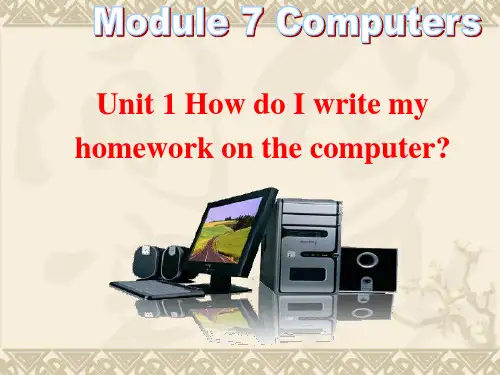
教学目标
1.掌握本单元的单词keyboard ,mouse, screen, ------paper 及短语:connect to, turn on等。 2.掌握四会句型: 1).How do I write my homework on my computer ? 2).What do I do next? 3).Where do I write the name? 4).How do I save the document? First ,open a new document .Then ,use the mouse and click “new document”. 3.掌握一般现在时的特殊疑问句的用法。
二、翻译下列短语。 1. 连接显示器 与主机 2. 打开电脑 3. 打开一个新 文件 4. 使用键盘 5. 给它命名 6. 再点击保存 connect the monitor to the computer turn on the computer open a new document use the keyboard write a name for it click “save” again
Listen again and answer:
What does Lingling want to do on the computer? She wants to write her homework . Who is good at using the computer?
Betty
7.Find the words from the box in the conversat Write the words they go with. Work in pairs.
(完整版)七下英语单词表(外研版)
*ball [bɔːl]
25
n. 球; 球类游戏
26
game [geɪm]
26
n. 运动项目
27
team [tiːm]
27
n。 队伍; 球队
28
best [best]
28
adj。 最好的
29
score [skɔː]
29
n. 得分; 成绩
30
tidy ['taɪdɪ]
30
adj. 整齐的; 整洁的;爱整洁的;爱整齐的
29
jam [dʒæm]
29
n. 堵塞; 拥挤
30
trafficjam
30
交通堵塞
31
wind [wɪnd]
31
n. 风
32
true [truː]
32
adj. 真的; 真实的
33
come true
33
(希望、梦想等)实现,成真
34
here is / are。。。
34
(用于介绍某人或某物)下面
35
*bike (= bicycle)[baɪk]
35
Australian [ɒ'streɪlɪən]
35
adj。 澳大利亚的
36
sightseeing ['saɪt,siːɪŋ]
36
n. 观光; 游览
37
go sightseeing
37
观光
38
beach [biːtʃ]
38
n. 海滨; 海滩
39
*early [’ɜːlɪ]
39
adv。 早; 提前
46
*hour ['aʊə]
外研版七年级英语下册Module7Unit1教学案例

外研版七年级英语下册Module7Unit1教学案例作者:刘珍来源:《新课程·中旬》2017年第09期我是一名扎根农村学校十几年的普普通通的英语老师,在这段美好而快乐的时光中,我感受着农村孩子们的淳朴向上,也感受到了孩子们对于英语的渴望与热情,由于各方面条件的限制与影响,孩子们的英语成绩总是普遍落后于城区学校的学生,尤其是在说英语方面,这让身为英语老师的我很是着急。
于是我不断实验、反思、总结,想尽一切办法,牢牢地抓住我们的课堂45分钟,帮助我们的孩子品尝英语学习中成功的滋味。
一、背景我是一名普通的农村英语教师,通过十几年的教学,我清楚地知道农村英语教学的现状,其中最典型的就是所谓的“哑巴英语”。
因此针对此特点,并经过精心的设计与安排,我在今年上半年上了一堂七年级Module7Unit1的实验课。
二、教材依据外研版七年级下册Module7 My past life Unit1 I was born in a small village.三、设计思想本课为七年级下册第七模块,以My past life为中心话题,展开各种学习活动。
其第一单元为听说课,谈论的是与学生密切相连的学习生活问题,这能够很好地激发学生的学习兴趣和参与意识,开展各类听、说、读、写活动,从而培养学生的语言技能和情感态度。
四、教学目标根据课标及第七模块内容,我将本节课教学目标细划为以下五个方面:语言目标、能力目标、情感和态度目标、策略目标、文化意识目标。
语言目标:(1)新词汇。
(2)初步了解一般现在过去时的用法。
能力目标:能读懂有关他人过去日常生活的文章,并能够流畅地谈论自己的过去生活。
情感和态度目标:了解他人过去生活的些许信息,拉近彼此之间的距离。
策略目标:学习与他人合作交流获取的相关信息。
文化意识目标:学习并了解西方文化。
五、教学重点与难点教学重点:学习本课的重点词汇与句型。
教学难点:初步了解一般现在过去时的用法。
六、教学准备多媒体辅助:用Powerpoint课件、教学光盘、电子白板等手段将本课所需要的动画、录音、图片、文字、图表和音乐展现出来,使抽象的语言变得直观,为学生运用英语进行交际创设情境,实现师生互动、生生互动和人机互动的多向交流。
外研版英语七年级上册Module 7 Unit 1(含音频)
Unit 1 How do I write my homework on the computer?
New words
keyboard mouse screen connect turn turn on learn
n. 键盘 n. 鼠标;老鼠 n. 屏幕 v. 连接 v. 转动 打开 v. 学;学习
Then, _s_a_v_e_ the document. Write the n__a_m_e_ in the _b_o_x__ and _c_li_c_k_ “save”.
Finally, _p_r_i_n_t_ your document.
4 Listen and read. Lingling: How do I write my homework on the
Learning to learn
Remember to use words like first, next and finally when you talk about a sequence of activities. Notice where the comma goes.
6 Complete the sentences with the correct form of the words from the box.
keyboard 2
mouse
3
screen
1
2 Label the parts of the computer.
1 screen 2 keyboard
3 mouse
3 Complete the sentences with the word and expression from the box.
7-7Module7单元知识小结七年级英语下册同步精品课堂(外研版)

外研版七年级下册Module 7单元知识小结◆◆知识点1 be born at / on /in 出生在什么时间?用哪个介词,取决于介词的用法Eg : I was born at 7 o’clock 1st July ,1990 .I was born on 1st ,1990 .I was born in 1990 .注意如果后面既有时间状语,又有地点状语,先时间状语,再地点状语。
I was born in 1st July 1990 in Wenzhou .2 what +be +sb +like? 某人性格怎么样3 it is /was +adj / n (for of sb )+to do sth (对某人来说)做某事是adj / nof for 取决于adj 是否是修饰人的形容词。
Eg : It is easy for me to learn English .It is friendly of you to help me .It is a good idea for my mother to go shopping .It is interesting to play computer games .4 hero(es)tomatoes potatoes 英雄爱吃土豆,西红柿。
初中阶段以o结尾的名词,除这三个,其它均加s eg: photos5 be strict with sb 对某人严格be strict in sth 对某事严格Eg :Our teachers are strict with us .Our teachers are strict in our schoolwork .6 there be +名词to do sth to do sth 作后置定语修饰名词Eg : There are a lot of places of famous to visit in Wenzhou .there be +n + doing sth 某某正在做某事Eg : There is a boy playing computer games .7 with 的用法既要做连词,又可做介词1 和某某一起eg : I go to school with my mother every day .2 表伴随,“有,带有”eg : There is a big school with a garden .。
(完整版)外研版七年级下册英语课文翻译

外研版精装修正版七年级下册全部课文翻译1初一下册Module 1 Lost and found2M1U1 Whose bag is this? 这是谁的书包?李老师:欢迎大家回到学校!首先,来看看失物招领箱!里面有好多东西。
这是谁的书包?玲玲:哦,对不起!是我的。
我的蜡笔也在里面吗?李老师:这些蜡笔是你的吗?玲玲:是的,是我的,还有这块橡皮也是。
谢谢你。
李老师:这些磁带是谁的?大明:是我的。
李老师:这里有一个紫色的钱包。
托尼:它是我的。
看!这里有我的名字“托尼”!谢谢。
李老师:不客气!看这块不错的表,也是你的吗,大明?大明:不,不是。
我想它是贝蒂的。
玲玲:是的,是她的。
李老师:同学们,从现在开始,请大家注意保管好自己的物品。
大明:这里有一些漂亮的手套。
他们是谁的?李老师:让我看看……哦,他们是我的!谢谢你!2 M1U2 他们是你的吗?纽约市失物招领处欢迎来到纽约市失物招领处。
人们在旅行时或者是匆忙之间经常会丢弃东西。
他们把东西落在飞机上、火车上、汽车上或出租车上。
那就是为什么机场和车站会设有失物招领处。
纽约市失物招领处非常大。
每天会有上百人来到这里。
他们来找他们的电话机、照相机、手表、计算机和许多其他东西。
我们通常大约有两千部手机和一千部照相机。
此时此刻,在纽约市失物招领处还有一些不同寻常的东西。
那里大约有一百辆自行车和一艘大船。
还有许多动物。
本周有三只狗,两只鸭子和一头猪!它们是谁的?它们是你的吗?我们不知道。
你正在寻找十五公斤重的香肠吗?它们也在这里!3 Module 2 What can you do? 你会做什么? M2U1 I can play the piano. 我会弹钢琴。
大明:看,本学期的新社团公布在布告栏里了。
我想参加音乐社团,因为我会弹钢琴。
你呢,贝蒂?贝蒂:我喜欢烹饪,所以我能参加吃喝社团。
你会做饭吗,大明?大明:不,我不太会。
嗯,我会做鸡蛋,不过仅此而已。
玲玲呢?她能参加哪个社团?贝蒂:我想她会参加舞蹈社团,因为她跳舞跳得很好。
外研版英语(新标准)七年级下册Module 1 Lost and found教学设计
Module1 Lost and found一、教学内容:Unit 1 Whose bag is this?二、课型:Listening and speaking三、教学目标:1、能够正确使用下列单词和词组:crayon, eraser, glove, wallet, watch, whose, firstof all, lose and found box, mine, yours tape, purple, hers, be careful with, from now on.2、能够听懂有关失物招领的简短对话;3、能用名词性物主代词来谈论、寻找失物主人。
4、学习英语文明礼貌的询问和回答方式,拾金不昧的做人原则和助人为乐的优良品质。
四、教学重难点:1、能够听懂有关失物招领的简短对话。
2、能够正确使用特殊疑问句“Whose…is this/that? 对物品的所属进行提问及其回答。
五、教学准备:本课指导学生通过听力获取信息,培养学生听力技能。
课堂上采用多媒体手段辅助教学,在轻松愉快的氛围中,在较真实的语境下,并联系学生生活实际,结合已有的知识和经验,运用所学的语言基础知识自我学习、互相学习,让学生在语言实践中相互启发、生成,体验成功。
培养学生的合作精神,发展其思维和想象等能力。
在教学过程中,采用多媒体手段辅助教学,利用各种图片和习题任务贯穿整个教学过程。
因此,本节课需准备:PPT课件、挂图、录音机、课堂练习表格、奖品。
六、预习要求:1、根据音标自学本课新单词;2、查找相关资料,找出你认为本课较重要的语言点和短语。
达标训练题一、选择填空。
1. — _______ bag is it? —I think it’s Aunt Li’s.A. WhoseB. WhoC. Who’sD. What2. Can I use your ________ eraser? _______ isn’t here.A. your; IB. you; MyC. yours; MineD. your; Mine3. Those crayons are _________.A. hisB. ourC. yourD. Tony4. Please be careful ______ your things.A. ofB. withC. fromD. at5. Welcome back ____ our hotel.A. toB. in C of D. for6. Here ________ some nice watches.A. beB. isC. amD. are7. It’s cold outside. Please wear your ________.A. bagB. watchC. glovesD. T-shirt二.根据中文提示补全句子。
外研版七年级英语下册Module 1知识点汇总
外研版七年级英语下册Module 1知识点汇总【重点短语】1. lost and found 失物招领2. welcome back to school 欢迎回校3. first of all 首先4. a lot of=lots of 许多5. look at 看6. from now on 从现在开始7. be careful with sth 小心对待某物8. talk to sb 与某人交谈9. look for 寻找10. get on the bus 上公交车11. in a hurry 匆忙地12. hundreds of 成百的13. leave sth + 地点把某物留在某地14. every day 每天15. at the moment 在此刻16. such as 例如17. help sb. to do sth 帮助某人做某事18. many other things 许多其他东西【重点句型】1. Welcome back to school, everyone.欢迎大家回到学校。
2. Please be careful with your things from now on.从现在开始请仔细看管你的东西。
3.Whose gloves are they?它们是谁的手套?4. People often lose things when they’re traveling or when they’re in a hurry. They leave things on planes, on trains, on buses and in taxis. 人们旅行或匆忙时经常丢东西。
他们把东西落在飞机上、火车上、公交车上或出租车里。
5. That’s why there are lost and found office at airports and stations. 那就是为何在飞机场和车站设有失物招领处的原因。
【随堂检测卷】外研版英语七年级下册 Module 7 Unit 1
Module 7 Unit 1 I was born in a small village 同步卷4一.填空题(共8小题)1.My home town is a small city in the(美国).2.My p school is very old now.3.Mr Zhao a bus driver in 2011.(用be动词的适当形式填空.)4.1.be born2.in class3.be strict4.小学5.…的名字..5.What the name the village?这个村庄的名字是什么?6.﹣﹣you?"你以前在课堂上也是难对付的吗?"﹣﹣No,I."不,我不是."7."你爷爷出生在哪里?""他出生在安徽省的一个小山村."﹣﹣Where your grandfather?﹣﹣He a small mountain village Anhui Province.8.﹣﹣they?"他们人怎么样?"﹣﹣Becky was very but Adam."贝姬在课堂上很守规矩,但亚当不."二.阅读理解(共1小题)9.In a village there lived a man named Henry.He had a wish to let poor people have meals at his home every day.But his wife didn't like this at all.She thought it a waste.One day,when he was on his way to another village,he met a poor boy.He asked the boy to have his meal with him.He said,"Please go to my place.I will be back home soon."The boy got to Henry's house.The wife naturally got angry when she saw the visitor at the door.But she thought,"My husband is not at home.I must make this unwanted visitor go! "So she welcomed him in and gave him a glass of water.Then she started to cry.When the boy asked her why,she said,"It is my husband's idea to let people have meals at home.Then he ties them and beats them with a stick(棍子).That is the reason why I am sad."Hearing this,the poor boy was afraid and asked her to save him.The wife then let him out of the house through the back door.When Henry returned home,his wife told him,"What a strange person the boy was!When he came in,he asked me for a stick and a piece of strong rope.I was afraid,and I said no.Then he left the house angrily."Henry said,"Maybe he wanted these for some use.Cive me the stick and the rope.I will go and find him." He started running after the boy.The boy walked slowly,thinking about the strange thing,so he did not go far.When he looked back,he saw Henry running after him with the stick and the rone in his hands.When Henry shouted,"Please wait! ".the poor boy ran away quickly.People always believe words from others easily.In fact,you should not just believe one side of the story.Always try to find out the fact with your own eyes.(1)Henry asked the poor boy to the house for a .A.talkB.mealC.wishD.party(2)When the boy arrived at the house,Henry's wife .A.started to cry at onceB.welcomed the boy happilyC.cooked a big meal for the boyD.had an idea to make the boy leave(3)How does the writer tell the story?A.By showing facts.B.By giving examples.C.By following the order of time.D.By following the change of people's words.(4)At last the boy ran away quickly because he .A.was afraid of HenryB.thought Henry's wife was strangeC.had something important to do himselfD.didn't like to have meals with Henry(5)What can we learn from the story?A.Seeing is believing.B.It 's never too old to learn.C.Doing is better than saying.D.Where there is a will,there is a way.三.词汇应用(共5小题)10.be,one,nice,town,difficult(1)﹣﹣﹣Was Diana your friend?﹣﹣﹣Yes.She sat next to me for three years.(2)Bob is good at school,but Jack is.(3)It's of you to help the old man cross the busy street.(4)﹣﹣﹣Where Tina and Nick yesterday afternoon?﹣﹣﹣In the museum.(5)The Whites are going to visit some beautiful in China.11.Mrs.Zhang is my Chinese teacher.She is(严格的).12.These students come from different(村庄).They study very hard.13.这是我们市里最好的小学.This is the best in our city.14.past,born,founder,scientist,professor,was,strict,nice,friendly,naughty,primary,well﹣behaved(1)Mr.Green is ,but we like him.(2)Betty is ,so everyone likes her.(3)We had a time at the party last week.(4)I often get up at half six in the morning.(5)My grandfather was in a small village.(6)Chinese people are to foreign friends.(7)Yuan Longping is a famous Chinese .(8)Could you tell me who the of Microsoft is?(9)My first teacher Miss Smith very nice to us.(10)There are twenty schools in my hometown.(11)Jack is very naughty and his brother is very ,too.(12)A from Beijing University will give us a talk next week.四.补全对话(共1小题)15.A:(1)?B:I'm going to my first school.A:Your first school?(2)?B:Guangming Primary School.I want to go there to say hello to my first teacher.A:(3)?B:My first teacher was Mr.Zhang.A:Mr.Zhang?(4).B:Really?Did you study in Guangming Primary School?A:Yes.When I was six years old,I went (动词go的过去式)to Guangming Primary School and Mr.Zhang was my first teacher.B:Let's go and say hello to Mr.Zhang together (一起).A:(5).Module 7 Unit 1 I was born in a small village 同步卷4参考答案与试题解析一.填空题(共8小题)1.My home town is a small city in the US(美国).【分析】我的家乡在美国一个小城市.【解答】答案.US 根据提示,推测意思是我的家乡在美国一个小城市.英语是US,专有名词大写.【点评】解答这类试题时,务必充分理解上下文的语境和前后文的逻辑关系,找到解题的依据,同时考虑单词的适当形式,准确作答.2.My p rimary school is very old now.【分析】我的小学现在很旧了.【解答】答案:primary.根据空格前面的词语是my,空格后面的词语是school,又根据"is very old now"很旧了.结合给出的首字母提示p,因此可知这句话的意思是"我的小学现在很旧了."综上所述,故填primary.【点评】首先要掌握这个句子的意思,然后结合具体的题目,就可以确定正确答案.3.Mr Zhao was a bus driver in 2011.(用be动词的适当形式填空.)【分析】赵先生在2011年当过公共汽车司机.【解答】答案:was.根据Mr Zhao﹣﹣a bus driver in 2011,可知赵先生在2011年当过公共汽车司机.这里in 2011是一个过去的时间,时态用一般过去时,主语是单数形式.故填was.【点评】本题考查用所给单词的适当形式填空,首先要根据语境明确句意,然后再根据相关语法对所给单词在形式上做出正确的变化.4.1.be born出生2.in class在课堂上3.be strict严格4.小学primary school5.…的名字.the name of….【分析】1.be born 出生2.in class 在课堂上3.be strict 严格4.小学primary school5.…的名字.the name of….【解答】1.be born 出生2.in class 在课堂上3.be strict 严格4.小学primary school5.…的名字.the name of….【点评】解答翻译这类试题时,翻译既要忠实于原文,又要符合汉语和英语的语法规则和表达习惯,准确翻译.5.What is the name of the village?这个村庄的名字是什么?【分析】What is the name of the village?【解答】分析句子,缺少是和"的"的表达,这里叙述一种客观事实,用一般现在时,主语是单数,故谓语动词用is,…的名字是固定短语the name of。
Module7Unit1教案外研版七年级英语下册
课题:Module7Unit1
Iwasborninasmallvillage.
教学对象:七年级下
课时:第1课时
一、文本分析
[What]主题意义和主要内容
本模块的话题是“过去的生活”。第一单元的语言输入材料是两段对话。第一段短对话是在Daming和Betty之间展开,Daming向Betty询问她的家乡,小学以及小学老师的情况。而在第二段长对话中,Tony和Lingling又通过互相询问,对自己的家乡,小学和小学老师及朋友作了介绍。两段对话虽然简单,却充满了对家乡,老师和朋友的怀念之情。这主要通过对各自首任学校,老师和朋友的评价体现出来的。
born?
*What was herfirstschoollike?
*Whatwasherteacherlike?
*Whatwasherfriendlike?
提供背景知识,并做语言上的铺垫。
教师回答学生的问题后,展示第一幅有关过去生活经历的思维导图。
学生阅读思维导图的信息后,回答问题。
本活动目的是培养学生通过使用思维导图来提高概括信息的能力。
[Why]写作意图
两段对话都是围绕小学的事情展开的,学生们可以通过对话了解不同国家同龄人的童年生活,从而帮助他们开阔视野,进一步探究不同国家的文化,教育以及生活等。同时唤醒学生对童年生活的美好回忆,培养他们对家乡和生活的热爱。[How]文体结构和语言修辞
两段对话内容都展开了中外学生对自己家乡,小学,老师和
的认知和理解,同时也提升了学生自主学习能力和思维能力。
五、教学重点及难点
本节课的重难点是学习含有动词“be”的一般过去式,能用它来询问对方过去的经历,并能表述自己过去的生活。所以我在设计听前活动时,有意识地让学生关注如何询问过去的经历。在听中环节,针对两段听力材料设计的活动,也都涵盖了“be”动词的陈述句及一般疑问句的肯定和否定回答形式,还有呈现了与主题意义相关的特殊疑问句。这些活动都能很好地帮助学生突破重难点。尤其是思维导图的加入,能帮助