
外研版七年级英语下册M6-U1
把(某人)带往;使(某人)到
看图猜单词或词组。
bank
museum
restaurant
station
bookshop = bookstore
flower store
an underground station
an underground = a subway
supermarket
market
5 Listen and repeat.
1 Can you tell me the way to Wangfujing Dajie? 2 Go across Dong Chang’an Jie, go along the street and turn left. 3 Is there a bookshop near here? 4 Could you tell me how to get to the National Stadium? 5 Go along the street and you’ll see an underground station.
3. Is there a bookshop near here?
这儿附近有一家书店吗?
Is there … near here? 在这儿附近有···吗? ··· 4. How can I get there? 我怎样能到那里? 5. Why not ask the policeman over there? (= Why don’t you ask the policeman over there?) 为什么不去问一下那边的那位警察呢?
Words and expressions
bank museum along across cross opposite tourist excuse excuse me street n. 银行 n. 博物馆
prep. 沿着
prep. 越过 v. 穿过 prep. 在……的对面 n. 游客
v. 原谅;谅解
Where is the bookshop? Just along Xi Chang’an Jie, on the right, opposite the bank. Who does the tourist ask for the way to the National Stadium? The policeman
at the third street 在第三大街 at the first crossing 在第一个十字路口 at the second turning 在第二个转弯处 例如: 1) Go down this street, turn right at the third crossing. 沿着这条街走在第三个十字路口右转。 2) Take the first turning on the left. 是在第一个转弯处左转
Quiz 一、用适当的介词填空。 1. The bookshop is near here, on the ___ corner of this road. 2. Who was sitting on your left at the ___ cinema? to 3. Can you tell me the way ___ the market? into 4. Please turn right ____ Heping Road, and you can see the hospital. of 5. Please look at the map ___ China.
二、根据句意及首字母提示完成下列单词。 1. The post office is b______ the big etween restaurant and the cinema. 2. Helen’s father didn’t have enough money ank to buy a car so he borrowed from a b___. 3. Can you see the theatre over there? The library is o______ it, on the other pposite side of the road. 4. Chinese people are proud of our c______. ountry hy 5. It’s very hot in the room. W____ not turn
2. Go across Dong Chang’an Jie, go along the street and turn left at the third street on the left.
穿过东长安街,沿着这条街走,在左边第三大街左转。
指引方向用语: 1) go across … 穿过······, go/ walk along … 沿着······走 go straight ahead… 径直向前走 指路时还有go down, go up,go past… (经过······) go down 指下坡或者往南走(上北下南) go up 指上坡或者北上; go along 沿着...走. 或返指沿着...走
Tips: 听的时候注意祈使句和疑问句的语调。
6. Read the conversation in Activity 3 again and complete the table.
Ask Answer
Can you tell me the way Go across … to …?
7. Work in pairs. Draw a map of where you live. Show places. Now ask for and give directions to places on the map. --- Where’s the market? --- It’s on … --- How do I get there? --- Go along …
Why not …? 为什么不···呢? ···
表示提建议. why not 后面要跟动词原型. 例如: Why not have a picnic this afternoon?
Pronunciation and speaking
分析: 英语有两种基本语调:升调和降调。说话 人可通过语调准确地表达各种信息。 升调多用来表示 “不肯定” 和 “未完结”,用 在 一般疑问句、委婉的祈使句和打招呼的用语中。 降调表示“肯定”和“完结”,一般出现在陈 述句、祈使句和特殊疑问句中。感叹句中多用 降调表示感叹。
2.
3.
4. Complete the questions with the correct
form of the words from the box.
could excuse policeman street tourist underground
1. Excuse me, is Wangfujing Dajie far from _________ Tian’anmen Square? 2. There’s a bookshop near here. What’s the name of the _______? street tourist 3. Can a ______ ask a _____________the way policeman to get to places in Beijing? Could 4. ______ you tell me how to get to the National stadium? underground 5. Where’s the _______________ station? Now work in pairs. Ask and answer the questions.
a
bcd3来自214
Now listen and number the places as you hear them.
2. Work in pairs. Say which places in Activity1 you can find in your hometown and where they are.
2) turn left / right 左转、右转 turn left / right into … 向左/ 右转到······ 例如:Turn left into Chang’an Jie and turn right into Chang Jie. left 左边,它的反义词是 right 右边 on the left / right 在左/右边 on my left / right 在我的左/ 右边 on the left / right of… 在……的左/右边
Language points
1. Excuse me, Can you tell me the way to Wangfujing Dajie? 劳驾,请问到王府井大街怎么走?
这是一句典型的问路用语。类似的表达: How can I get / go to…? Can you show me the way to…? Where is…? Is there … near here?等等。 上句可写为: How can I get to Wangfujing Dajie? Can you show me the way to Wangfujing Dajie?
Words: opposite, across, turn, tourist, underground Phrases: on the right, go across, take a taxi, at the third street, over there, near here Patterns: How can I get there? Can you tell me the way to …? Is there … near there? Go along…/Go across…
外研七下M6U1 Could you tell me how to教案

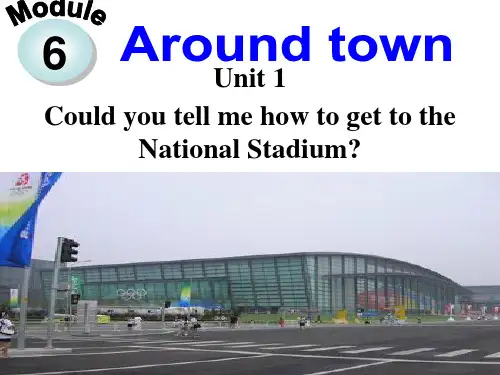
Module 6 Around town【教学内容分析】本模块以出行旅游为话题。
Unit 1 中的对话是通过读地图来呈现指路及说明具体位置的语言表达方式。
通过本单元的听说活动,给学生提供充足的体验和运用语言的时机。
【学情分析】学生具有一定的英语根底,学习热情高,表现欲强,能积极参与到课堂中。
而且相互之间能够很好地利用小组进行合作交流。
但是书上内容对大多数人来说较为简单,因此很有必要补充一些相关知识。
Unit 1 Could you tell me how to get to the National Stadium?【教学目标】Knowledge objectiveTo master some words and expressions about places, positions and giving directions.Ability objective1. To ask the way and give directions.2. To understand a conversation of giving directions.Moral objective1. To be polite to others.2. To be ready to help others.3. To know more about Beijing and love Beijing.【教学重点】1.To learn and review some words and expressions about places:Bank, museum, along, across, cross, opposite, tourist, excuse, excuse me, street ,turn, third, guidebook, bookshop, right, why not …?could, underground2. To learn and review some words about positions: near, opposite, along, on the left/right, across3. To learn some expressions about asking ways and giving directions:【教学难点】1. To get information from the conversation.2. To ask the way and give directions.【教学方法】PWP method, task-based method and interactive approach【教学手段】A tape recorder, multimedia and some pictures【教学过程】Teaching Procedures:Step 1 Leading inSs look the pictures and answer the questions, lead-in Unit 1.Step 2 Consolidate new words1. Look and say. The teachers shows the pictures of new words and let the students to say as quickly as possible.2. Find and say. The teacher shows pictures of direction prepositions, and the students find the right words. Step 3 Match the words from the box with the picturesLook at the pictures and match the words.Step 4 Work in pairs. Say which places in Activity 1 you can find in your hometown and where they are. Along across cross oppositeStep 5 Listen and read1. Listen and answer the question.Can the tourist go to the Wangfujing Dajie?2. Read the dialogue and answer the questions.(1) How will the tourist get to Wangfujing Dajie from Tian’anme n Square?(2) Where is the bookshop?(3) Who does the tourist ask for the way to the National Stadium?Answers:(1) Go across Dong Chang’an Jie, go along the street and turn left at the third street on the left.(2) The bookshop is just along Xi Chang’an Jie, on the right, opposite the bank.(3) A policeman.3. Point out the main points in the dialogue.Step 6 Complete the questions with the correct form of the words from the box. Then ask and answer the questions in pairs.1. ___________ me, is Wangfuji ng Dajie from Tian’anmen Square?2. There’re a bookshop near here.What’s the name of the ___________?3. Can a _________ ask a _________ the way to get to places in Beijing?4.____________ you tell me how to get to the National Stadium?5. Where’s the ___________ station?Answers:1. Excuse2. street3. tourist policeman4. Could5. undergroundStep 7 Listen and repeat1. Can you tell me the way to Wangfujing Dajie?2. Go across Dong Chang’an Jie, go along the street and turn left.3. Is there a bookshop near here?4. Could you tell me how to get to the National Museum?5. Go along the street and you’ll see an underground station.Make the conversation as much as possible in pairs.Step 9 Work in pairs. Draw a map of where you live. Show places.Now ask for and give directions to places on map.-Where’s the market?-It’s on …-How do I get there?-Go along …Step 10 Grammar问路的句型和指路的句型Step 11 Summary方位介词的用法。
外研版七年级下学期m6u1
running
sailing
A: Running is relaxing. Sailing (帆船) is more relaxing than running. B: I don’t think so. They are both tiring.
1 Listen and number.
1
2
3
4
Culture Corner
Match the year and the host city of the Summer Olympic Games. 2004
2000 1996
Seoul
Atlanta Los Angeles
1992
1988 1984
Athens
Barcelona Sydney mascots
II. 根据句意及所给中文提示写单词。 Skiing 1. ______ (滑雪) is my favourite sport. boring 2. This job is ______ (令人厌烦的). No one wants to do it. 3. The girl wants to have _____ (更多的) more friends. 4. Swimming in the pool can _____ (放松) relax you. 5. Betty loves __________ (体操) very much. gymnastics
(2) 动词不定式作主语,其形式是:
It is + adj. + for sb. + to do sth.
(it为形式主语)。例如: It’s very dangerous to ski here.
在这里滑雪很危险。
新外研版七下M6Unit1
turning
6. Turn left at the +序数词+street/ crossing
{into …street/ road
Bus stop
Park
Hospital
Zhongshan Road
School Bookstore Zoo
A
Supermarket
Changping Road
Toilet Museum
1.每人编写一个对话,组内交流; 2.背诵问路指路常用句型; 3.预习Unit2。
Thank you!
A:Excuse me ,could you tell me how to get to...? Could/Can you tell me the way to ...? B:Go along …then turn …at the ..
Listening
1
Now listen and number the places as you hear them.
There is a lot of money in it. People can save money(存钱) and get money from there. What is it ?
a bank
You can go there to eat your favourite food when you are hungry. What is it?
3.Sure! Go along the street and 3.Could you tell me how to you’ll see an underground station. Take the Underground get to the National Stadium? to the Olympic Sports Centre, or you can take a bus or a taxi.
外研社英语七年级下 m6u1
summary
ask Excuse me, how can I get to…..? can you tell me the way to…? could you tell me how to get to …? which is the way to…? Is there a … ? go across\cross… turn left… crossing 十字路口 turn right… turning 拐弯处 go along… street turn left at the third turn right into
I’d like to buy a guide book about Beijing. Is there a bookshop near here? Yes, there’s a big bookshop over there, just along Xi Chang’an Jie, on the right, opposite the bank.
Tips: 听的时候注意祈使句和疑问句的语调。
1. Can you tell me the way to Wangfujing Dajie? ◆我们问路时,可先说Excuse me, 然后使 用以下几种句型: ①Can you tell me the way to …? ②Can you tell me how to get to …? ③Can you tell me how I can get to…? ④Which is the right way to…? ⑤ Where’s ...? ⑥ How can I get to…? 上述句型在一定情况下可相互转换。
5 Listen and repeat.
1 Can you tell me the way to Wangfujing Dajie? 2 Go across Dong Chang’an Jie, go along the street and turn left. 3 Is there a bookshop near here? 4 Could you tell me how to get to the National Stadium? 5 Go along the street and you’ll see an underground station.
外研版英语七年级下Module6Unit1教学课件

1. E__x_c_u_s_e___ me, is Wangfujing Dajie far from Tian’anmen Square?
2. There’s a bookshop near here. What’s the name of
the _______?
street
3. Can a _t_o_u_ri_s_t ask a _p_o_l_ic_e_m__a_n____the way to get to places in Beijing?
The National Stadium (中国)国家体育场
the Olympic Sports Centre 奥林匹克体育中心
bookshop
an underground station
一个地铁车站
an underground = a subway
Listening and vocabulary
➢ It is on the right / left. left right
➢ Walk/Go across the road. ➢Cross the road.
go across the road cross the road
go along the street
Language points
along across cross opposite
There’s a station opposite our school gate.
3.Read the conversation again and complete the table
Ask
Answer
1.Can you tell me the
to the Olympic Sports Centre, or you can take a bus or a taxi.
外研版英语七年级下M6-U1

Bayi Road
At the first street 在第பைடு நூலகம்个路口
At the third street 在第三个路口
Longcheng Road
如何表达下列图示
bookshop
bank
4. The bookshop is opposite the bank.
书店在银行对面
如何表达下列图示
take a bus Wuxing Jie
看图猜单词
supermarket
超市
market 市场
bookshop 书店
bank 银行
Museum 博物馆
Restaurant
餐厅
Station
火车站
underground station
地铁站
National stadium
国家体育馆
1 将图片和单词配对 A restaurant bank museum restaurant
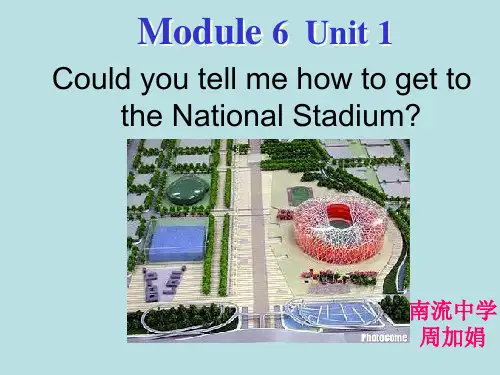
Module 6 Unit1 Could you tell me how to get to the National Stadium?
Words and expressions bank museum along acorss cross opposite tourist excuse excuse me n. 银行 n. 博物馆 prep.沿着 prep. 越过 v. 穿过 prep. 在……的对面 n. 游客 v. 劳驾;对不起 劳驾;对不起(用于礼貌 地引起某人的注意)
1
2
Longcheng Road
1. Take a bus to Longcheng Road. 2.Go across Longcheng Road 3.The Camera Shop is opposite Qingyun.
外研社七年级下册M6U1
Tian’anmen Square
天安门广场
the National Museum of China
国家博物馆
the Forbidden City
故宫
Wangfujing Dajie 王府井大街
the National Stadium [ˈsteidjəm] 国家体育馆
---prepositions of place (方位介词)
2.Can you tell me the way to the station?
Cross the street and turn left, it's quite near here.
Excuse me! Can you tell me the way to Wangfujing Dajie?
museum
station
Beihai Road
supermarket
bank
1. Can you tell me the way to Wangfujing
Dajie? ◆我们问路时,可先说Excuse me, 然后使
用以下几种句型: ①Can /Could you tell me the way
1.在……里面 1. in 2.在……上面 2. on 3.在……下面 3. under
※opposite 在……的对面
4.在……附近 4. near 5.紧挨着…… 5. next to
※ go across
6.在……后面 6. behind
=cross 穿过
7.在……左边 7. on the left (of)
15./raɪt/ right 好了(用于变换话题或活动);是的;好
16./kʊ d/ could可以;能 17./’ ʌ ndə ,graʊ underground地铁 n18d.//teɪk/ take 搭乘;乘坐;固定使用;把某人带往 19.为什么不....呢?Why not
外研版七年级下册Module6Unit1PPT课件
Discuss in groups: Match the opposite words.
• Dangerous • difficult • exciting • Expensive • popular • Relaxing
boring cheap easy safe tiring unpopular
5
6
running
skiing
1
table tennis
Discuss in groups: 1 Table tennis is popular.
a
2 Basketball is exciting. d
3 Gymnastics is difficult.
b
4 Cycling is tiring.
e
Eg: Football is more popular than cycling.
football cycling skiing running gymnastics
popular ***** *** ** *** ***
dangerous *** *
**** *
***
exciting ***** ***
2.What does Betty like? Betty loves gymnastics and cycling.
Compare sports.
Eg: 1.Swimming is tiring. Football is more tiring than swimming. 2.Gymnastics is popular. Running is more popular than gymnastics.
2.Gymnastics/exciting/table tennis.
七年级下册英语(外研)Module 6Unit 1
Exercise 3 :
1.Table tennis is unpopular. —— 乒乓球受欢迎。 乒乓球不受欢迎。 1.Table tennis is popular. 2.Basketball exciting. —— 篮球很枯燥。 2.Basketball is is boring. —— 篮球令人兴奋。 3.Gymnastics is difficult. —— 体操很难。 easy. —— 体操很容易。 4.Cycling is relaxing. —— 骑自行车很累人。 4.Cycling is tiring. —— 骑自行车令人放松。 5.Running is is cheap. —— 跑步很便宜。 5.Running expensive. —— 跑步很昂贵。 6.Skiing is safe. —— 滑雪很安全。 6.Skiing is dangerous. —— 滑雪很危险。
七年三班 齐海龙
1.Well 好地 3.Carelessly 粗心的;马虎的 5.Young 年轻的 7.Take around 领(某人)四处参观
1.Cassette 盒式磁带 3.Vocabulary 词汇 5.Quietly 安静的 7.Until 知道„„时;到„„为止
2. Badly 坏的;糟糕的 4.Better 更好 6.Hard 努力的
奥林匹克精神就是相互了解、友谊、团结和公平竞争的精神。 奥林匹克运动的宗旨是:“通过没有任何岐视、具有奥林匹克精 神——以友谊、团结和公平竞争的精神相互理解的体育活动来教育青年, 从而为建立1个和平的更美好的世界作出贡献。” 每年的6月23日定为奥林匹克日
Hale Waihona Puke 1.Olympic 奥林匹克的 3.More 更多的 5.Gymnastics 体操 7.Popular 流行的;受人欢迎的 1.Exciting 激动人心的 3.Unpopular不流行的;不受欢迎的 5.Relax(使)放松 7.Safe 安全的 1.Be good at 擅长 地区;邻里关系 mittee委员会 te 迟;晚于规定时刻 7.Back 后面;后部 1.However 可是;然而 3.Loudly 大声的;吵闹的 5.Visitor 游客;观光者 7.Quickly 快的
初中英语外研社初一下册M6-U1
could excuse policeman street tourist underground policeman the 3 Can a ________ tourist ask a ___________ way to get to places in Beijing? 4 _________ Could you tell me how to get to the National Stadium? underground 5 Where’s the _____________station?
Listen and answer these questions. 1) What does the tourist want to buy? A guidebook about Beijing. 2) Can you name the places he wants to visit? Wangfujing Dajie, a bookstore, the National Stadium. 3 Listen to the conversation again and answer another three questions.
4 Complete the questions with the correct form of the words from the box. could excuse policeman street tourist underground
Excuse 1 __________me, is Wangfujing Dajie far from Tian’anmen Square? 2 There’s a bookshop near here. What’s street the name of the ___________?