
Unit 2 Working the land教学反思
教学反思
本次大比武已落下帷幕,蓦然回首,发现有得亦有失,收获颇多。
我这学期担任高三3、4
班的英语老师,本次授课内容为复习课,现将授课过程中的不足总结如下:
1、开放型的、能激发学生想象力与创造力和发散学生思维的课堂提问比例还极小。
在英语课堂教学中,缺乏积极有效的互动,忽视对学生的基础能力、收获的关注。
这与新课程标准的“以学生为主体”,培养“学生主动思维”,发展“学生想象能力和创新精神” 以及“发展个性,发展心智”等教学目标还有很大的距离,与高考对高三英语课堂的要求也是不符合的。
2、课堂教学不能针对学生实际,缺乏“备学生”、“备学案”这一必要环节;课堂教学没有真正做到对学生进行基础知识点、高考热点和高考难点的“三点”渗透,学生原有的知识不能得到及时、适时地内化;课堂密度不足,学生参与机会少、参与面小;课堂节奏过慢,课堂气氛沉闷,课堂留给学生自疑、自悟、自学、自练、自得的时间十分有限。
3、课堂设计缺乏适当适时的教学评价,不能及时获悉学生在课堂上有没有收获,有多大收获等学情;课前设计“想教学生什么”,课堂反馈“学生学到什么”和课后反思“学生还想学什么”三个环节没有得到最大限度的统一。
今后努力方向:
一、做好对词汇量的扩充,利用好教材中的阅读材料。
教材中的阅读量是远远不够的,所以我们还要精选精泛读材料来弥补教材的不足。
在教学过程中遵循精泛结合,精少泛多,精泛有序的原则。
选择的精读材料要能够在教学中发挥最大效益,启发学生的思维,促进学生知识的掌握和能力的形成。
在教材的基础上,精选泛读材料,以巩固和拓宽语言知识,培养独立阅读能力。
我们以《英语周报》为基础,用好《英语周报》,因为报上的文章比较新,时代气息浓,篇幅多。
每期精选一两篇为精读材料,两三篇为泛读材料。
在平时教学新词汇的过程中,不失时机地由新翻旧,以旧带新,通过形近,义近,同义,反义,固定搭配等手段串联起大量有用的词汇,让学生从纵向,横向及各个方面将词汇的雪球滚大.学生们给我的这种复习方法起了一个时尚的名字“单词总动员”。
对于所有精泛读材料中碰到的生词,要求学生摘录下来,老师要采取必要的手段,如听写或再现认读的方式进行检查,以扩大学生的词汇量。
二、做好英语的层次教学。
临近高考,学生特别是文科学生,英语单科的差距逐渐扩大,因此在教学的实际中应把同学分为两类:英语科目强势的同学应往更高的目标努力,从作业的量和能力的要求上对他们要有更高的要求,力求突破高分;而英语弱势的同学则应加强对其双基的辅导,做好自信心的培养,力求稳拿基本分。
三、做好对复习材料的取舍工作。
这里的取舍指的是:教师教学的知识点要有重难点;学生复习的材料中有重难点;讲评课时要有重难点。
这样师生对于复习就能做到从容应对,做到有的放矢,从而从整体上提高复习效率。
四、做好对部分学生的英语复习方法的指导。
进入高三有些学生的英语复习方法效率低下,他们认为英语学习就是背单词和做练习。
缺乏宏观和系统的复习策略。
对此,应引导学生认识到外语的复习是个系统的过程,应“多条腿走路”,做到词汇、语法、阅读、写作并行,循序渐进,这样才能不断提高复习效率。
五、做好学生的自学能力的培养。
只有通过辅导学生掌握一套科学的学习方法,并培养学生的自学能力,才能使学生的学习积极性和主动性得以更好的发挥。
具体包括:培养学生的预习
能力,用各种方法掌握英语基本知识的能力,学生自己整理所学知识的能力。
另外,自学能力的提高还得益于大量的课外阅读,为此新学期开始就要要求学生人人必备一本英汉词典作为工具书,让学生勤查字典。
再者,在教学中培养学生的学习兴趣以增强教学效果,只有这样才能避免在以后的学习中产生两极分化。
具体做法是把语言教学与日常生活联系起来,上课可以结合时事、热点话题,给学生讲有关政治、历史、社会等各方面的新闻知识、幽默趣事等。
六、做好课堂教学的优化。
注意复习课的针对性。
我们把复习重点放在学生的难点、弱点上以及常易出错或失误的内容方面上,努力做到有的放矢。
课堂上坚持精讲多练,做到举一反三。
复习课上我们注意加强学生的操练活动,让学生多动脑筋思考问题,让他们尽可能多地举些例句,使他们能训练掌握语法的用法。
另外,在课堂上及时有效地获取学情反馈,有效地进行课前回顾,课堂小结等环节的落实。
坚持对学生的听课、作业、自习等方面进行跟踪,及时了解学生的学习、复习状态与状况,以便在课堂教学过程中做出针对性的调整。
高中英语_Unit 2 Working The Land教学设计学情分析教材分析课后反思

Unit 2 Working the landThe First Period ReadingTeaching goalsEnable Ss to learn more about agriculture, countryside and farming.Help Ss learn how to describe Dr Yuan Longping including his personality.Teaching important and difficult pointsa. Help to comprehend the text and grasp the main idea of the text.b. Grasp the usage of some words and expressions.c. How to help students learn more about agriculture.Teaching methodsTalking, questioning-and-answering activity and reading.Teaching aidsA tape recorder, a projector and a computer.Step Ⅰ. Greeting and leading in…Step Ⅱ. Warming up and Pre-readingT: Have you ever grown any plants? If so, what did you do to grow them? If not, what kind of plant would you like to grow? How will you grow it?S: I have ever grown corn and potatoes. In autumn, my father and I ploughed the soil deep for the first time, then in the next spring, we ploughed the soil for a second time, this time I put the corn seeds into the tunnel following my father. Finally my father covered the corn seeds by ploughing again……T: Very well. Have you ever been to the countryside? What did you do there?S: Yes, I went there to see my grandfather. In the village I played with other boys in the little stream and caught little fish. I even helped my grandfather get in the corn by cutting the corn stems, which made me tired…….T: Are you from a farmer’s family? What do you know about farming?S: Yes, my father is a farmer. In my view, farming is hard work. People have to plant crops, smooth away weeds and get in the crops at the right time. They have to get up early to work in the field so as to protect themselves from the sunshine…….T: That’s right. In the north, the biggest worry that farmers have is the drought. When it doesn’t rain, and they can’t irrigate the crops, the crops will die and they will have nothing after hard working.2. What can we do to solve world hunger?Control the populationOpen more areas for growingIncrease the output of cropsStep Ⅲ. Fast Reading1 What is the main idea of each para?Para1 His dreamsPara2 His personalityPara3 How he thinks of himself and his achievementpara4 His biography2 Read the text again and complete the following notes about Yuan Long ping.Name :______________________ Nationality: ____________________Age:_______________________ Occupation: ____________________Education: __________________________________________________Dream : ____________________________________________________Achievement : _______________________________________________Hobbies : ___________________________________________________Answers:Yuan Longping Chinese 77 scientist/farmer graduated from Southwest Agricultural College in 1953 to export his hybrid rice so that it can be grown around the globe in 1974,developed hybrid rice ,which produces1/3 more than normal rice listening to violin music,playing mah-jong ,swimming and readingStep Ⅳ. Please read the text again and answer these questions.1 What is special about his rice? (make it possible to do …)This special strain of rice makes it possible to produce one-third more of the crop in the same fields.2 What is his contribution to the world? (thanks to … / rid … of …)Thanks to his research, the UN has more tools in the battle to rid the world of hunger.3 What is his attitude to life? (be satisfied with … / care about …)Dr Yuan is satisfied with his life. However, he doesn’t care about being famous.Step V. HomeworkFinishing the exercises in Learning about Language. Exercise 1, 2 and 3 are about useful words and expressions. Finish them. Next time we’ll check the answers.学情分析学生经过初中阶段和高一上学期的学习,对英语阅读掌握了一定的阅读技巧,对细节的把握比较准确,但对于归纳概括题尚有欠缺,因此进一步提高学生的阅读技能是本节课的目标。
高中英语_人教版必修四 unit 2 Working the land 教学设计学情分析教材分析课后反思

Book4 unit 2 Working the landReading教学设计Teaching aims: 1.To get to know Dr. Yuan and his achievements,Dr.Yuan’s super hybrid rice and its influence on China and the world.2.To improve the reading abilities.3. DreamsImportant points: reading and summaryDifficult points: some different patterns about the words and phrases.Teaching process:Step1. Warming up:1. Show the students some pictures about planting something(设计目的和依据:本环节通过看图讨论来激发学生的学习兴趣,激活已有的背景知识,同时,接下来播放舌尖上的中国有关水稻的小视频,使学生能够运用已有的知识和经验思考本单元的中心话题。
)A short vedio about rice.(设计目的和依据:在读前先让学生讨论本节话题,预测文中要谈到的内容,能降低阅读难度,为后面的阅读环节和讨论环节做好铺垫。
)Step II Scanning readingFind out the main idea of each paragraph.(设计目的:通过寻找段落大意,让学生对文章结构有充分的认识,了解文章讲述的大致内容,同时培养学生快速阅读的能力,提高应试能力。
)Step III Careful readingTask I:complete the following notesName:Nationality:Date of birth:Occupation:Appearance:Education:Personality:Achievements:Dreams:Hobbies:(设计目的:逐一对每段内容进行阅读,并且分别完成此表格,能够更加细致的对文中内容进行把握。
高中英语_Working the Land教学设计学情分析教材分析课后反思
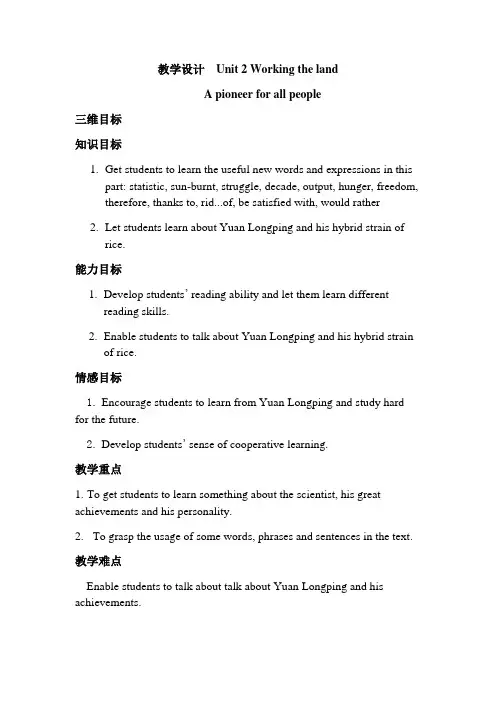
教学设计Unit 2 Working the landA pioneer for all people三维目标知识目标1.Get students to learn the useful new words and expressions in thispart: statistic, sun-burnt, struggle, decade, output, hunger, freedom, therefore, thanks to, rid...of, be satisfied with, would rather2.Let students learn about Yuan Longping and his hybrid strain ofrice.能力目标1.Develop students’ reading ability and let them learn differentreading skills.2.Enable students to talk about Yuan Longping and his hybrid strainof rice.情感目标1.Encourage students to learn from Yuan Longping and study hard for the future.2.Develop students’ sense of cooperative learning.教学重点1.To get students to learn something about the scientist, his great achievements and his personality.2.To grasp the usage of some words, phrases and sentences in the text.教学难点Enable students to talk about talk about Yuan Longping and his achievements.教学过程Step 1 Warming upPlay a guessing game and then watch a video about Yuan Longping.Step 2 PredictionLet students look at the title of the reading passage and the pictures and predict what the passage is about.Step3 SkimmingSkim the text quickly to get the main idea of the text.1.Which of the following statements tells the main idea of the text?A. how Yuan Long ping became rich and famous.B. an agricultural pioneer named Yuan Longping who worked hard to produce a new strain of rice.Step4 ScanningMatch the following headings with the right paragraphs.Para1 A. Dr Yuan’s dreams.Para2 B. Dr Yuan’s personality.Para3 C. Dr Yuan’s biography.Para4 D. Dr Yuan’s appearance and his achievement.Step5 Detailed ReadingTry your best to find out the answers to the following questions.Read Para. 1Dr Yuan’s appearance and achievementQ1. What does Dr Yuan look like?_________________________________________Q2. What is his achievement?__________________________________________________Q3. Is Dr Yuan more of a scientist or more of a farmer?__________________________________________________ Read Para. 2 His biographyRead Para.3 Yuan Long’s personalityTopic sentence:___________________________His hobbies:________________________________________________________Read para.4 Yuan Longping’s dreams1.The first dream:___________________________2.The second dream:_________________________Step6 SummaryCan you summarize the passage according to the following information?Born:_____________________________________Graduate:____________________________________ Appearance:__________________________________Achievements:________________________________Personality:___________________________________Hobbies:_____________________________________Step7 Post-readingWhat kind of person is Dr. Yuan?Step 8 Group workWhat is your dream? What will you do to realize your dream?Step 9 Homework1. Write a short essay about your dreams.2. Find out language points in the passage.学情分析本节课的授课对象是高一下学期的学生,他们已经熟悉了高中英语课程的结构和深度,并且已经具备了一定的英语知识储备。
高中英语_Unit2 Working the land教学设计学情分析教材分析课后反思
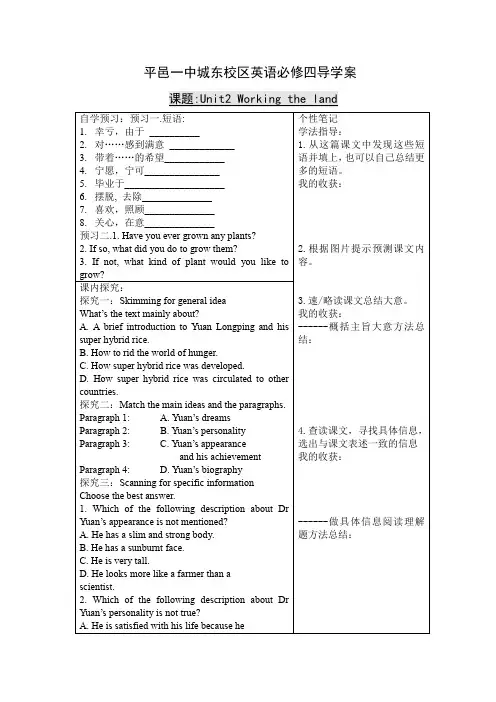
平邑一中城东校区英语必修四导学案学情分析1.高一(下)的学生,经过上一个学期的过渡衔接,语言基础知识、语言运用以及学习方法等方面有了很大提高,所以结合学生实际情况,分好学习小组,创设人文环境,发挥小组优势互补的作用,鼓励学生大胆参与讨论,通过体验、交流、合作和探究等学习方式,培养学生自主与合作的学习能力。
2.学生基本的阅读能力具备,对袁隆平话题比较熟悉。
通过设置问题指导学生正确阅读并掌握阅读技巧中的快速阅读和精读。
通过学生之间和师生之间的互动讨论让学生学会分析,归纳的方法,培养学生自主学习,有效交际的学习习惯。
3.在情感和认知方面:针对高中生思维活跃,自我意识强,求知欲旺盛等特点,引导学生通过资源媒体,对QQ农场的了解,动手操作农业种植的步骤,激发学生兴趣,获取更多的信息,形成知识技能。
效果分析通过这节课的学习,学生进一步加深了对农业词汇知识的理解,并能够在实际语言环境中进行交际和运用。
通过运用多媒体课件的形式为学生呈现了受学生喜爱的QQ农场的图片,围绕图片展开对农业种植步骤的交流及讨论,然后让学生表演动手操作,学生接受起来既有趣更轻松。
在8人一小组围坐在一起讨论的环节中,我把课堂交给了学生,大大提高了学生学习的自主性,充分体现了以学生为主体的教学思路。
本节课通过这种形式的学习,也进一步证明了发挥学生主动性,自主性的重要性。
同学们围绕解决饥饿话题展开热烈的讨论,既练习了句型又锻炼了英语口语交际能力,增强了学生学习英语的兴趣和信心。
在情感方面,学生在各种问答中,潜移默化,培养了爱惜粮食,勤俭节约,为将来而努力的意识。
教材分析本单元的中心话题是“农业”。
内容涉及我国著名的杂交水稻专家袁隆平的贡献。
本课阅读课“A Pioneer For All People”是核心部分,课文介绍中国著名的农业科学家袁隆平和他的巨大贡献。
全文分四段。
第一段讲袁隆平作为科学家,研制出了超级杂交水稻,但他却一致认为自己就是一个农民。
新课标必修四 Unit 2 Working the LandLearning about language 教学设计与教学反思

Step1 Self-introductionWatch the video about the teacher’s life story to recall the following words and p hrases.At the same time, the teacher provides students with examples of v-ing used as subject and object1. sunburnt2. hunger3. expand4.circulate5. struggle6. export7. rid…of 8. lead a …life 9. would rather 10. thanks toStep2 learn to understand Eglish explanations of the words and phrasesHelp students to fully understand the words and phrases mentioned in step one by giving the English explanations.Task1 Find words and phrases that can match the English explanation1. darkened skin from spending too much time in the sun2.need for food3.make something or somebody free of4.become larger in size, number or amount5. make information and ideas known to many people6. live a…life7. prefer to8. because of9. try extremely hard to achieve something10. send things to foreign countries for saleStep3 use the words and phrasesTask2 First, ask students to say something about Dr YuanSecond, complete the passageDr Yuan _______ a simple life. He _____ ______ work on the farm than have a rest. He has ________ for five decades to search for a way to increase rice harvest without _____________ the area of fields. _______ to the discovery of super hybrid rice, his dream of ______ China of _______ is realized . Now, he has another dream---to _______his rice so that it can be grown all over the world.Step4 V-ing used as subjectTask3 Ask students to make a self-introduction by using the following setence patterns.Doing…is/makes/gives/bring me…So…is my hobby/dream/what I like most.Step5 V-ing used as objectTask4 describe the following picturesPicture 11.It seems that the cat enjoys _____________ very much.2. The cat is fond of ________________3. The cat doesn’t care about_____________Picture 21.The dog dreams of_____________________2. The dog looks forward to ______________3. We can’t help _______ when we see the dog having such a dream.Step6 Consolidation of v-ing as subject and objectTask5 a guessing gameWork in groups of four,and use at least three sentences by using V-ing to describe one of your classmates. And The other students will guess who he/she is.Task6 complete the passageFirst, watch the video barnyardSecond, complete the following passageOddis spends a lot of time in _______with his friends.He is good at _________.He likes______________very much. ________the golf ball rolling into the hole brings him great fun. Although he and his friends are afraid of ________ discovered when they are playing in the town, they still risk(冒险)_________ a football match outside a doctor’s house, which brings them great excitement. His friends can’t help laughing after seeing Oddis ____ _______ behind the postman.Task7 Make an interview of Oddis. Try to make as many V-ing forms as you can during the interview.Step7 HomeworkWrite a passage about a great but simple person you admire.。
高中英语_必修4 Unit 2 Working the land教学设计学情分析教材分析课后反思
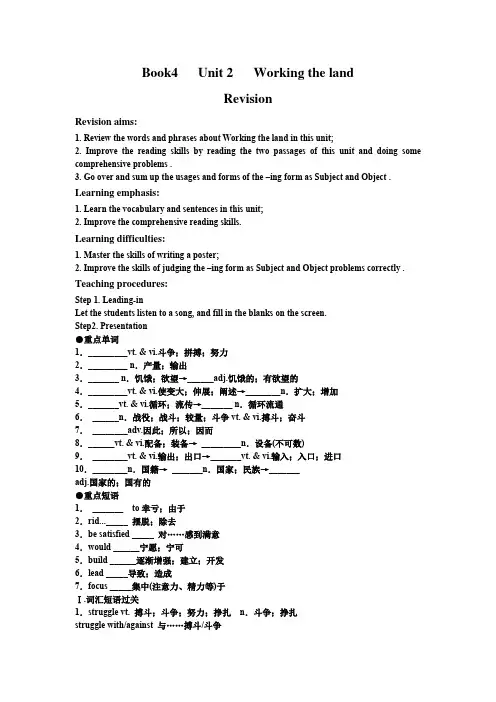
Book4 Unit 2 Working the landRevisionRevision aims:1. Review the words and phrases about Working the land in this unit;2. Improve the reading skills by reading the two passages of this unit and doing some comprehensive problems .3. Go over and sum up the usages and forms of the –ing form as Subject and Object . Learning emphasis:1. Learn the vocabulary and sentences in this unit;2. Improve the comprehensive reading skills.Learning difficulties:1. Master the skills of writing a poster;2. Improve the skills of judging the –ing form as Subject and Object problems correctly . Teaching procedures:Step 1. Leading-inLet the students listen to a song, and fill in the blanks on the screen.Step2. Presentation●重点单词1._________vt. & vi.斗争;拼搏;努力2._________ n.产量;输出3._______ n.饥饿;欲望→______adj.饥饿的;有欲望的4._________vt. & vi.使变大;伸展;阐述→________n.扩大;增加5._______vt. & vi.循环;流传→_______ n.循环流通6.______n.战役;战斗;较量;斗争vt. & vi.搏斗;奋斗7.________adv.因此;所以;因而8.______vt. & vi.配备;装备→_________n.设备(不可数)9.________vt. & vi.输出;出口→_______vt. & vi.输入;入口;进口10.________n.国籍→_______n.国家;民族→_______adj.国家的;国有的●重点短语1._______ to幸亏;由于2.rid..._____ 摆脱;除去3.be satisfied _____ 对……感到满意4.would ______宁愿;宁可5.build ______逐渐增强;建立;开发6.lead _____导致;造成7.focus _____集中(注意力、精力等)于Ⅰ.词汇短语过关1.struggle vt. 搏斗;斗争;努力;挣扎n.斗争;挣扎struggle with/against 与……搏斗/斗争struggle for sth./to do sth. 努力/争取……struggle through 奋力通过struggle to one‘s feet 挣扎着站起来struggle on/along (虽艰难仍)继续做某事with a struggle 费劲地[即学即练1](1)They had to _________ ______ their lives ______ weather and wild animals.为了生存他们必须与天气和野兽抗争。
高中英语_人教版必修四 unit 2 Working the land 教学设计学情分析教材分析课后反思
Book4 unit 2 Working the landReading教学设计Teaching aims: 1.To get to know Dr. Yuan and his achievements,Dr.Yuan’s super hybrid rice and its influence on China and the world.2.To improve the reading abilities.3. DreamsImportant points: reading and summaryDifficult points: some different patterns about the words and phrases.Teaching process:Step1. Warming up:1. Show the students some pictures about planting something(设计目的和依据:本环节通过看图讨论来激发学生的学习兴趣,激活已有的背景知识,同时,接下来播放舌尖上的中国有关水稻的小视频,使学生能够运用已有的知识和经验思考本单元的中心话题。
)A short vedio about rice.(设计目的和依据:在读前先让学生讨论本节话题,预测文中要谈到的内容,能降低阅读难度,为后面的阅读环节和讨论环节做好铺垫。
)Step II Scanning readingFind out the main idea of each paragraph.(设计目的:通过寻找段落大意,让学生对文章结构有充分的认识,了解文章讲述的大致内容,同时培养学生快速阅读的能力,提高应试能力。
)Step III Careful readingTask I:complete the following notesName:Nationality:Date of birth:Occupation:Appearance:Education:Personality:Achievements:Dreams:Hobbies:(设计目的:逐一对每段内容进行阅读,并且分别完成此表格,能够更加细致的对文中内容进行把握。
Unit 2 Working the landreading教学案例反思
Unit 2 Working the land---reading教学反思Unit 2 Working the land---reading教学反思1.初步学会明确任务目标,站在学生角度,精心设计活动。
精心设计可操作性强的任务化活动是成功组织任务型教学的首要条件。
这样学生可以通过完成具体的任务来学习和稳固言语,累积学习经验和享受成功的喜悦。
所以在设计活动时,教师应站在学生的立场上,充分考虑他们的兴趣及认知水平。
2.本堂课使用多媒体教学,旨在表达并调动学生英语学习的积极性,为学生创设了良好的英语交际环境。
学生显得乐学,善学,提高了他们自主探究的兴趣,在感想言语的根底上积极的开展英语思维活动。
学生参与方法较好,积极性高。
在这堂课中,注重“以人为本〞,发挥学生的主动性, 充分表达以学生为中心的教学理念。
3术,为学生创设各种言语学习环境,提供丰富的教学资源,拓宽了学生的学习渠道和学习方法。
4.整堂课师生,生生互动性强,在自主、互动、探究的方法中展开课堂教学,充分挖掘课文内容的内涵和外延,联系学生的生活,建构新知。
5.以任务型为教学原则,本节课的每一个任务都是围绕学习者“学〞的角度设计的。
通过小组活动,培养合作探究能力。
学生的每一个活动都具有明确的目的指向和具体的操作要求,完成了英语在真实情境中的应用。
五假设让我再上第二次下课之后我认真做了反思,如果让我重新上这节课,我会在以下方面做出改良: 1.打算工作在上课之前提前做好,由于自己的粗心大意导致u盘忘记等一系列失误耽误上课的珍贵时间。
2.在课堂导入环节让学生用历史和地理知识答复有关农业的问题时,学生没有完全用英语来说,这与一般班学生的英语根底有关,但更多的应是我对他们提供锻炼英语口语的时机不是太多,以后我会尽量给学生制造英语表达的时机,下次上课让学生答复下列问题尽量用英语。
3.在快速阅读和认真阅读局部,让学生自己举手抢答和自己阅读课文阶段,出现了学生答复下列问题积极性不高,读课文没有全心投入的情况,这是由于学生还没有完全适应我们刚刚开始进行的英语高效课堂改革,以后我会努力的探究,学习,让学生掌握并适应目前英语高效课堂的新模式。
working the land教学反思
working the land教学反思working the land教学反思1本次大比武已落下帷幕,蓦然回首,发现有得亦有失,收获颇多。
我这学期担任高三3、4班的英语老师,本次授课内容为复习课,现将授课过程中的不足总结如下:1、开放型的、能激发学生想象力与创造力和发散学生思维的课堂提问比例还极小。
在英语课堂教学中,缺乏积极有效的互动,忽视对学生的基础能力、收获的关注。
这与新课程标准的“以学生为主体”,培养“学生主动思维”,发展“学生想象能力和创新精神” 以及“发展个性,发展心智”等教学目标还有很大的距离,与高考对高三英语课堂的要求也是不符合的。
2、课堂教学不能针对学生实际,缺乏“备学生”、“备学案”这一必要环节;课堂教学没有真正做到对学生进行基础知识点、高考热点和高考难点的“三点”渗透,学生原有的知识不能得到及时、适时地内化;课堂密度不足,学生参与机会少、参与面小;课堂节奏过慢,课堂气氛沉闷,课堂留给学生自疑、自悟、自学、自练、自得的时间十分有限。
3、课堂设计缺乏适当适时的教学评价,不能及时获悉学生在课堂上有没有收获,有多大收获等学情;课前设计“想教学生什么”,课堂反馈“学生学到什么”和课后反思“学生还想学什么”三个环节没有得到最大限度的统一。
今后努力方向:一、做好对词汇量的扩充,利用好教材中的阅读材料。
教材中的阅读量是远远不够的,所以我们还要精选精泛读材料来弥补教材的不足。
在教学过程中遵循精泛结合,精少泛多,精泛有序的原则。
选择的精读材料要能够在教学中发挥最大效益,启发学生的思维,促进学生知识的掌握和能力的形成。
在教材的基础上,精选泛读材料,以巩固和拓宽语言知识,培养独立阅读能力。
我们以《英语周报》为基础,用好《英语周报》,因为报上的文章比较新,时代气息浓,篇幅多。
每期精选一两篇为精读材料,两三篇为泛读材料。
在平时教学新词汇的过程中,不失时机地由新翻旧,以旧带新,通过形近,义近,同义,反义,固定搭配等手段串联起大量有用的词汇,让学生从纵向,横向及各个方面将词汇的雪球滚大.学生们给我的这种复习方法起了一个时尚的名字“单词总动员”。
英语必修4-Unit 2 Working the land第一课时教学设计和教学反...
英语必修4-Unit 2 Working the land第一课时教学设计和教学反思(Ss: Really?Step ⅡWarming upT: Have you ever grown any plants? If so, what did you do to grow them? If not, what kind of plant would you like to grow? How will you grow it?S: I have ever grown corn and potatoes. In autumn, my father and I ploughed the soil deep for the first time, then in the next spring, we ploughed the soil for a second time, this time I put the corn seeds into the tunnel following my father. Finally my father covered the corn seeds by ploughing again.S: I never grow any plant. I’d like to plant sunflowers. They look beautiful. They always face the sun when they are young. I dig some holes in my garden, put some sunflower seeds in them, water them and finally cover them with some more soil.T: Very well. Have you ever been to the countryside? What did you do there?S5: Yes, I went there to see my grandfather. In the village I played with other boys in the little stream and caught little fish. I even helped my grandfather get in the corn by cutting the corn stems, which made me tired.T: Are you from a farmer’s family? What do you know about farming?S: Yes, my father is a farmer. In my view, farming is hard work. People have to plant crops, smooth away weeds and get in the crops at the right time. They have to get up early to work in the field so as to protect themselves from the sunshine.T: That’s right. In the north, the biggest worry that farmers have is the drought. When it doesn’t rain, and they can’t irrigate the crops, the crops will die and they will have nothing after hard working.Step ⅢPre-readingThe purpose of this step is to let students know the importance of rice. By answering the two questions, students can easily understand why we call Dr Yuan Longping a pioneer for all people, and why he devotes all his life to the rice research.T: Food is the basic need for man. Rice is a main food in all Eastern Asian and Southeastern Asian countries. It is said that there are 2.4 billion people to eat riceeveryday throughout the world. What do you think would happen if tomorrow there was suddenly no rice to eat?S: I think if that happened, people there would suffer from starvation. They would be panic and the whole country would get into trouble. Maybe the situation that human beings eat human beings will happen.T: That’s too terrible. But this kind of thing once happened in history. Well, if you had the chance to do one thing to help end famine in the world, what would you do?S: I would invent a new kind of plant to produce more food.S: I’ll make a kind of fertilizer to give rice enough nutrition and let them grow quickly and have high product. But first without pollution to our environment.T: A great idea! Your idea is just the same with Dr Yuan Longping. Do you know Yuan Longping?S: I heard that he is an expert on agriculture.T: Yeah, today we are going to read a passage about him. Let’s see how he helped the world to solve the problem- starvation. Please open your books to Page 9.Step ⅣFast ReadingThe reading material is about an agricultural pioneer named Yuan Longping who worked hard at a new strain of rice. It has proved so successful that his technology spread into other countries. The purpose of fast reading is to let students find some useful information, and get familiar with the text. So in this step, teacher can design some questions for students, so that they can easily find the answers and finish the reading task.T: Please scan the passage and find out the answers to the questions on the screen. Then I’d like to ask you to answer them.Show the questions on the screen and give students three minutes to read the text quickly.1. Why did Yuan Longping want to increase the rice output when he was young?2. Is Dr Yuan more of a scientist or more of a farmer? Do you think he is abusinessman?3. How would you describe Dr Yuan’s personality? Use three or four adjectives.4. What do you think is the main reason for his success?5. Dr Yuan thinks that a person with too much money has more rather than fewer troubles. Do you agree or disagree? Why?6. Dr Yuan developed super hybrid rice to help Chinese farmers and hungry people around the world. Can you think of any other major development that would make a great difference to world hunger?Step ⅤExplanationShow the following points on the screen.1. struggle v to make great effortse.g. They have struggled for years to free their country from the enemy.I’m struggling to finish the huge helping you gave me.2. sunburnt adj . sun-tannede.g. His sunburnt skin looks healthy.3. super adj (infml) excellent; splendide.g. You’ll like her, she’s super.You look super in your new clothes.It was super of you to help.4. expand v(cause sth to) become greater in size, number or importancee.g. Metals expand when they are heated.Why not try to expand your story into a novel?5. circulate v(cause sth to ) pass from one person, place, etc to anothere.g. People who circulate false news are to be blamed.Yet reports of this kind have been circulated by our newspapers.The news of the enemy’s defeat quickly circulated round the town.6. equip vsupply sb/sth (with what is needed, for a particular purpose)e.g. Now all fishing boats are radio-equipped.They can’t afford to equip their army properly.Please equip yourself with a sharp pencil and a rubber for the exam.7. export vsend (goods) to another country for salee.g. India exports tea and cotton to many different countries.This company has a large home market but doesn’t export.8. rid ... of make sb/ sth free from (sb/ sth unpleasant)e.g. We all wish that we would rid the world of famine.The farmer recently tried to rid the house of rats.9. be satisfied with, be content withe.g. The young lady isn’t satisfied with the peaceful life.Are you satisfied with his answers?10. would rather, prefer toe.g. I’d rather walk than take a bus.I’d rather you knew that now, than afterwards.Step ⅥListening and Post-readingAt first, let students listen to the tape, and then finish the exercise in Comprehending, we have involved some questions in Exercise 3, so teacher can choose some questions to do. For Ex 1 and 2, teacher can leave some time for students to finish and then check the answers with the whole class.Step ⅦSummary and Homework。