
中职英语 基础模块1 教学设1
中职英语基础模块1 教学设计(教案、学案)Unit 6 第二课时Unit 6 Would you like to order?(第二课时教学设计)一、教材分析1.教学内容本课时系教材《英语1》(基础模块高教版)第六单元的第二课时,即Dialogue B部分。
本部分内容是上一课时内容的深入,从去餐厅前的对餐厅的描述过渡到餐厅的点餐活动,带领学生一步步进入贴近其生活的场景,让学生在真实的情景中掌握餐厅点餐的习惯用语。
2.教学重点、难点(1)教学重点①通过有关餐厅点菜的听力活动,学生能听懂关于餐厅点餐的对话。
②通过与餐厅点餐对话的学习,学生能熟练运用点餐的习惯用语。
(2)教学难点①学生能听懂菜单并写下菜名②学生能在真实的情景中口头表达餐厅点餐的习惯用语。
二、教学目标1. 知识目标(1)学生掌握菜单上的食品词汇,如dish, burger, cheese, steak, chicken, coffee, salad等。
(2)学生能掌握餐厅点餐的习惯用语,如:①Would you like to order now ?②I’d like……③Well done or medium ?④Would you like something to drink ?2. 能力目标⑴学生能听懂关于餐厅点餐中菜名极其习惯用语。
⑵学生就餐厅点餐能进行熟练的对话活动。
3. 情感目标学生能够了解和掌握餐厅服务员及就餐者的基本礼仪。
三、教学步骤Step One Lead-in ( 4min)Teacher says: in the last lesson we have known that there are two restaurants. Now Sara want to go Meiwei Restaurant. Let’s step into Meiwei restaurants with her together to order something to eat or drink today. But do you knowHow should have behavior as a customer?How should a waiter/waitree should behavior?Students work in the groups to discuss to get the right answers to the above two questions.(设计意图: 教师从上一节课内容直接过渡到本节课,开门见山。
跟随课文的主人公想象与其一起到餐厅就餐,自然引入到本节课内容。
并通过讨论让学生了解和掌握餐厅服务员及就餐者的基本礼仪,实现情感目标。
)Step Two Vocabulary study (6min)Teacher asks students what they are favorite food when they eat out. Several of students are asked to compete with each other to list some favorite food when they eat out on the board. Then teacher shows some other words about food people usually order in restaurants. Teacher should give explanation by showing relative pictures to help them get the meaning of the words.(设计意图:让学生以比赛形式在黑板上写出自己在餐厅就餐时喜欢的食物,唤起旧词汇的学习。
教师通过图片补充相关词汇,扩充本单元的关于食物的词汇。
)Step Three Listening (15min)1. Pre-listening ( Activity 7 )(1) Read the menuteacher says we have our favorite foods when we eat out . Now let’s look at the menu of Meiwei Restaurant to find out if there are any foods you like. Students read the menu individually to get main idea of the menu.(2) Look and tickTeacher leads students to look at the two pictures and let them guess what the waiter might say, then tick the right answers.2. While-listening ( Activity 8, 9 )(1) Listen and checkStudents listen to the tape and check the answers to Activity 7.(2) Listen and completeStudents listen to the dialogue again and help the waiter finish the notes he makes about what Sara and Tang Hua order. If students can’t get the answers, teacher should play the tape for several times to help them to get the right answers.3. post-listeningTeacher divides the whole class into three groups to act as waiter, Sara and Tang Hua . The students acting as the waiter read the sentences of Activity 7. The students acting as Sara read the food she ordered. The students acting as Tang Hua read the food she ordered. Then all students take turns to act as different characters to.(设计意图: Pre-listening部分通过读菜单和猜测服务员所说的话,训练学生根据图片中提供的信息对听力内容进行预测。
While-listening让学生帮助服务员写出菜单,训练学生在听的过程中抓住细节信息的能力,并将听到并理解的内容以另一种直观的方式呈现出来。
post-listening部分通过学生扮演不同的角色朗读词汇和句子,巩固听力部分的重要内容,并为口语表达奠定基础。
)Step Four Speaking (18min)1. Read and underline (Activity 10)Students read the dialogue after the tape and underline the words and sentences used to order in a restaurant. Teacher asks several students to give the answers and write the words or sentences on the board. If necessary, teacher should explain the key words and sentences.(1) Would you like to order now?(2) Yes, I’d like ……(3) Well done or medium(4) Would you like something to drink?(5) What about you?(6) The same, please.(7) All right, wait a minute, please.(设计意图: 通过听材料,获取关键信息,掌握重要语句,为后面说的活动做好语言上的准备。
)2. Listen and repeat (Activity 11)Students read the dialogue after the tape again and learn to say the underlined words and sentences.(设计意图: 通过跟读对话,学说关于餐厅点餐时所用的语句,进一步为熟练进行对话操练做准备。
)3. Act and practice (Activity 12)Students make a dialogue with the partner about ordering food in a restaurant, using the sentences patterns and words of Activity 12. One student acts as a waiter, the other acts as a customer. Firstly, they work together in their groups. Secondly, teacher lets some of them to act out in the front of the class.(设计意图: 根据提供的句式和词汇与同伴练习在餐厅点餐,让学生进一步熟悉餐厅点餐的习惯用语。
把掌握的语句应用到实际的语境中,训练学生在相对真实的情景下用合适的方式和语句用英语点餐。
)Step Five HomeworkImagine you will open a restaurant. Now you make a menu for the restaurant. And you act as a waiter in your own restaurant make a dialogue with your partner who acts as a customer.(设计意图:让学生设想自己在将来成立一个餐厅并制定菜单,并扮演不同的角色进行餐厅点餐的对话,充分发挥学生的想象力,将课堂知识灵活运用于实际的情景中。
新高教版中职英语基础模块 第1册unit 1《nice to meet you!》教学设计(精品).doc

中职英语基础模块1 教学设计(教案、学案)Unit 1 第一课时Book1 Unit 1 Nice to meet you!一、学情分析本单元是新生入学的第一单元,教学重点是活用招呼用语、相互了解个人基本信息、制作个人名片、学习不同职业的表达与描述以及练习发音。
就学习英语而言,职业学校的许多学生是胆大心粗,能说不会写或写不到位。
因此,教师在教学过程中应充分利用学生的特点开展相应活动。
我们可以利用学生胆大、敢说的特点,充分利用头脑风暴法采集相关素材,开展如招呼用语集锦、刨根问底探隐私、名片栏目大荟萃等活动。
教学中名片栏目的设计、描述不同职业、圆润的发音是本单元难点。
圆润的发音要靠长期的示范与坚持来实现。
名片中各栏目的设计可以集体讨论商定,个人名片设计则可以体现个性化、专业化,并决出最佳名片设计奖,教师还可以请学生一起收集生活中的名片,探讨名片的基本要素和个性特色。
职业的描述教师可以借助体态语、道具、图片、视频等来推进,还可以设计相应的练习强化学生的认知。
本单元设计分为4个课时:第一课时lead-in + listening and speaking第二课时reading and writing第三课时language in use + vocabulary consolidation第四课时unit task + pronunciation practice第一课时Lead-in + Listening & Speaking二、教材分析1.教学内容本课时系教材《英语1》(基础模块高教版)第一单元的第一课时,包括Lead-in & Listening and speaking两部分,具体内容为:招呼用语,听懂并掌握询问和提供个人信息的词汇、句型。
2.教学重点、难点⑴教学重点:招呼用语,听懂并掌握询问和提供个人信息的词汇、句型⑵教学难点:个人信息的词汇、句型三、教学目标1.知识目标⑴掌握与个人信息相关的词汇,如name, first name; last name; name card; telephone number; age; address; e-mail address; job (engineer; manager; secretary; teacher; student; doctor; nurse; singer; fans); position(boss);⑵掌握提供或询问个人信息时所使用的句型,如:1) about greetingGood morning. Hi. Nice to meet you.2) about personal informationWhat’s you name?Where are you from? Which pany are you from?2.能力目标⑴学生能听懂关于询问和提供个人信息的对话。
中职英语基础模块教案
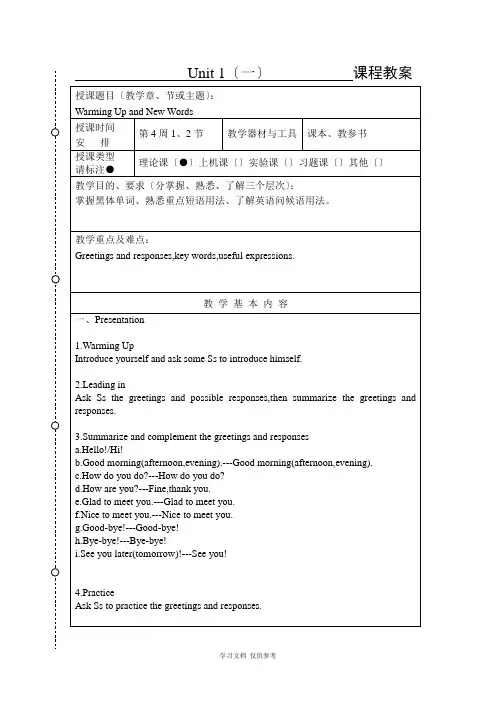
Welcome to... Look at... Be glad to do... A lot of... Thank...for...
Next to... There be... ...be glad to do... Do you see...?
句子:
1.Welcome to Xinhua Vocational School.
b.Good morning(afternoon,evening).---Good morning(afternoon,evening).
c.How do you do?---How do you do?
d.How are you?---Fine,thank you.
e.Glad to meet you.---Glad to meet you.
五、Summarize
总结Unit 1中重点单词、句子、语法。
六、Homework
Preview Unit 2.
教学过程设计:
一、Check (10mins)
Check the homework.
二、Review (10mins)
1. Reviewgrammar.
2. Reviewthe text and write the Reading Comprehensive Part.
从整体情况看,掌握程度一般。
授课类型
请标注●
理论课〔●〕上机课〔〕实验课〔〕习题课〔〕其他〔〕
教学目的、要求〔分掌握、熟悉、了解三个层次〕:
掌握短语和句型的用法、熟悉元音音标、了解国际音标。
教学重点及难点:
所学短语、句型的灵活运用。
教学基本内容
一、Check
Check the homework.
中职英语 基础模块 第一册 教学设计

中职英语基础模块第一册教学设计教学目标本教学设计旨在帮助学生掌握基础的中职英语知识和技能,包括基本的听、说、读、写能力,并培养学生的语言交际能力和学习策略。
教学内容1.单词学习–学习并掌握每单元的重点词汇–组织词汇记忆活动,提高学生的单词记忆和运用能力2.语法学习–学习基础的英语语法知识,如动词时态、主谓一致等–运用语法知识进行句子构造和语言表达练习3.听力训练–改进学生的听力技巧,提高听力理解能力–组织听力练习活动,培养学生听取信息和理解口语表达的能力4.口语表达–培养学生的口语表达能力,提高他们的口语交际能力–组织口语练习活动,让学生进行对话、演讲和角色扮演5.阅读理解–提高学生的阅读理解能力,培养他们的阅读习惯–组织阅读训练,让学生阅读和理解不同主题和体裁的文章6.写作训练–培养学生的写作能力,提高他们的写作表达能力–组织写作练习,让学生进行短文写作、信件写作等教学方法1.交互式教学法–鼓励学生积极参与课堂活动,提高学生的语言交际能力–组织学生进行问答、小组讨论、互动对话等活动2.合作学习法–创造合作学习环境,培养学生的团队合作意识和能力–组织小组合作活动,让学生共同完成任务3.情景教学法–创造真实的语言环境,让学生在情景中学习语言知识和技能–设计真实情景的活动,让学生进行情景模拟和角色扮演4.多媒体教学法–利用多媒体教具和资源,提高学生的学习兴趣和效果–使用演示文稿、视频、音频等多媒体材料进行教学教学评估1.课堂练习–在课堂上进行小测验、口头回答问题等形式的评估–评价学生对学习内容的掌握程度2.作业评估–对学生的书面作业进行评估,包括短文写作、阅读理解等–评价学生的写作表达和阅读理解能力3.表现评估–对学生的口语表达和听力理解进行评估–评价学生在真实情境中的语言交际能力教学资源1.教材:中职英语基础模块第一册–学生教材–教师用书2.多媒体教具和资源–电脑、投影仪等设备–演示文稿、视频、音频等3.计算机和互联网资源–提供相关的在线学习平台和网站链接教学进度安排本教学设计拟安排为每周3节英语课,共计40周。
中职英语基础模块1免费教案
中职英语基础模块1免费教案教案标题:中职英语基础模块1免费教案教学目标:1. 学习并掌握基本的英语语法知识和词汇。
2. 培养学生的听、说、读、写的基本技能。
3. 培养学生的团队合作和沟通能力。
教学重点:1. 英语基础语法知识的学习和运用。
2. 词汇的积累和运用。
教学难点:1. 如何帮助学生理解和运用英语语法。
2. 如何帮助学生扩大词汇量并灵活运用。
教学准备:1. 教学课件和教学素材。
2. 学生课本和学习资料。
3. 多媒体设备和投影仪。
教学过程:Step 1:导入(5分钟)通过引入一段简短的英语视频或图片,激发学生对英语学习的兴趣,并提出本节课的主题和目标。
Step 2:语法学习(15分钟)通过教师讲解和示范,学习本节课的重点语法知识。
例如,教授基本的句子结构、时态、冠词等。
教师可以使用多媒体设备展示相关例句和练习题,引导学生理解和运用。
Step 3:词汇积累(15分钟)通过教师讲解和示范,学习本节课的重点词汇。
教师可以使用图片、词汇表和例句等方式帮助学生记忆和理解词汇的意思和用法。
同时,鼓励学生积极参与词汇的运用练习,例如,进行单词拼写和造句。
Step 4:听力训练(15分钟)通过播放录音或视频,进行听力训练。
教师可以选择与本节课的语法和词汇相关的听力材料,让学生通过听力理解和回答问题,提高他们的听力技能。
Step 5:口语练习(15分钟)通过小组讨论或角色扮演等方式,进行口语练习。
教师可以给学生提供一些话题和问题,让他们进行交流和讨论,同时引导他们运用本节课学到的语法和词汇。
Step 6:写作训练(15分钟)通过给学生写作任务,进行写作训练。
教师可以给学生提供一些写作题目,引导他们运用本节课学到的语法和词汇进行写作。
同时,教师可以提供一些建议和指导,帮助学生提高写作能力。
Step 7:总结和反馈(5分钟)通过回顾本节课的重点内容,进行总结和反馈。
教师可以与学生一起复习本节课学到的语法和词汇,同时鼓励学生提出问题和反馈意见,以便进一步改进教学。
中职英语基础模块1Unit2教学设计 -完整获奖版
Book 2 Unit 2 I can do it!(第一课时教学设计)一、学情分析本单元是教材的第二单元,关于个人能力描述,要求能进行口头能力描述,向别人了解能力,能看懂求职表,根据求职表安排合适的工作岗位,填写求职表等,实用性强,内容贴近学生生活,新的词汇量不大,句型简单。
但是职业学校的学生通常会说却不能正确拼写单词,会七嘴八舌地说出许多词组,但是不能长段地独立表达个人观点,课堂热闹但是课后较少主动复习。
因此,教学中应重视基本词汇的四会,重视指导性作文的写作,重视指导学生养成课堂记笔记的能力。
职业学校的学生普遍发散性思维较强,教师可以充分利用集体的力量开展教学,集思广益。
二、教材分析1.教学内容本课时系教材《英语1》(基础模块高教版)第二单元的第一课时,包括Lead-in & Listening and speaking中的Dialogue A两部分,具体内容为:描述个人能力的词汇、询问和谈论能力的语句。
这些内容为整个单元的学习活动做语言和知识的准备,也为学生用英语流利表达个人能力提供了模版,还利于教师挖掘学生的多元智能,学生间进一步促进了解。
2.教学重点、难点⑴教学重点通过与个人能力描述相关的词汇和句型的学习,学生采访同学、老师,并拟写采访单。
⑵教学难点学生了解词汇记忆的策略之一——分类记忆;学生区分出不同购物场所的特点;三、教学目标1.知识目标⑴学生能掌握描述个人能力的词汇,如speak Chinese, drive cars, repair computers, teach English, read in Chinese, serve customers。
⑵学生能掌握询问和描述个人能力时所使用的句型,如:Can you say something about yourself?Can you sing English songs?Well, I can teach English and I can speak a little Chinese.2.能力目标⑴学生能听懂关于询问和描述个人能力的对话。
中职英语基础模块教案
中职英语基础模块教案第一章:英语字母表和基本发音规则1.1 教学目标让学生掌握英语字母表的26个字母。
学生能够正确拼读和书写字母。
学生了解并掌握基本发音规则。
1.2 教学内容英语字母表的顺序和书写规则。
26个字母的发音及其分类。
常见元音和辅音的发音规则。
1.3 教学方法采用直观演示法,通过字母卡片和动画展示字母表和发音。
采用游戏教学法,通过字母拼写游戏和发音练习,提高学生的学习兴趣和参与度。
1.4 教学步骤1.4.1 引入:通过播放英文歌曲,引导学生关注英语字母和发音。
1.4.2 讲解:展示字母表,讲解字母的书写规则和发音。
1.4.3 练习:学生分组进行字母拼写游戏和发音练习。
第二章:基本日常英语对话2.1 教学目标学生能够运用基本的日常用语进行自我介绍和日常交流。
学生能够理解和运用常用的疑问词和祈使句。
2.2 教学内容自我介绍的常用句型和表达方式。
日常交流中的常用疑问词和祈使句。
常见的日常用语和表达方式。
2.3 教学方法采用情景教学法,通过模拟真实场景,让学生在实际情境中学习和应用日常用语。
采用交互式教学法,通过学生之间的对话和互动,提高学生的口语表达能力。
2.4 教学步骤2.4.1 引入:通过播放日常英语对话视频,引起学生的兴趣。
2.4.2 讲解:教师展示常用疑问词和祈使句,讲解其用法和意义。
2.4.3 练习:学生分组进行角色扮演,模拟真实场景进行日常对话练习。
第三章:英语数词和基本句型3.1 教学目标学生能够理解和运用1-100的英文数词。
学生能够运用基本的英语句型进行表达。
3.2 教学内容1-100的英文数词的写法和读法。
基本的英语句型及其用法。
3.3 教学方法采用直观教学法,通过数字卡片和实物展示,帮助学生理解和记忆数词。
采用任务驱动法,通过小组合作完成句子构建任务,提高学生的句型运用能力。
3.4 教学步骤3.4.1 引入:通过展示数字卡片,引导学生关注英文数词。
3.4.2 讲解:讲解1-100的英文数词的写法和读法,展示基本句型的结构。
中职英语基础模块教案
中职英语基础模块教案【篇一:中职英语基础模块1 教学设计】中职英语基础模块1 教学设计(教案、学案)unit 6 第三课时unit 6 would you like to order?(第三课时教学设计)一、教材分析1.教学内容本课时系教材《英语1》(基础模块高教版)第六单元的第三课时,即reading and writing 部分。
本部分的主要活动是读懂菜单,在前两课时的基础上,学生已经了解了一些菜名,本部分内容要求学生通过就菜品的价格用英语进行比较,从而让学生学会在口头和书面表达中正确运用形容词比较级和最高级比较事物,进一步增加学生的学习词汇以及增强学生实际运用语言的能力。
2.教学重点、难点(1)教学重点①通过阅读菜单和表格,学生能总结并掌握形容词比较级和最高级的变化规律。
②学生能在口头及书面表达中正确运用形容词比较级和最高级比较不同餐厅③学生能根据阅读材料,纠正错误信息的表达。
(2)教学难点①学生通过文中给出的线索,猜出词义②学生能够运用阅读表格的策略对餐厅进行比较二、教学目标1. 知识目标(1)学生能理解并运用形容餐厅的词汇如,delicious, cheap, expensive等(2)学生能够正确运用形容词比较级和最高级比较各餐厅情况2. 能力目标 (1)学生能够读懂菜单,并通过文中给出的线索,猜出词义,归纳形容词比较级和最高级规律。
(2)学生能够运用形容词的比较级和最高级以书面形式简单介绍餐厅的基本情况,如路程远近,饭菜价格及质量。
3. 情感目标通过对餐厅的比较,学生外出就餐时能做出理智选择。
三、教学步骤step one lead-in (1min)teacher shows the situation: if you invite your friend to meiwei restaurant to eat out, what would youlike to order for your friend ?(设计意图:教师设定情境,让学生想象邀请朋友用餐。
中职英语基础模块1 enjoy the festival教学设计
中职英语基础模块1 enjoy the festival教学设计1. 学生能够听懂、理解并初步应用与本课相关的英语词汇和句型;2. 学生能够运用所学知识,描述和谈论关于节日的事情;3. 学生能够通过听、说、读、写的综合训练,提高自己的英语综合运用能力。
教学重点:学生在实际情景中学会使用与节日相关的英语词汇和句型。
教学难点:学生能够运用所学知识,描述和谈论关于节日的事情。
教学准备:课件、图片或实物资料、录音机。
教学过程:Step 1: Warm-up1. Greeting: Greet the students and ask about their favorite festival. For example, "Good morning, class! How are you today? What's your favorite festival? Why do you like it?"2. Show pictures: Show some pictures of different festivals and ask thestudents to guess the names of the festivals. For example, show a picture of Chinese New Year and ask "What festival is it?" The students can respond with "It's Chinese New Year."3. Discuss festivals: Divide the class into small groups and have them discuss the festivals they like and why they like them. After a few minutes, ask some groups to share their ideas with the whole class.Step 2: Presentation1. Introduce new vocabulary: Use the pictures or real objects to introduce new vocabulary related to festivals, such as "fireworks," "lanterns," "parade," etc. Write down the words on the board as you introduce them and have the students repeat the words after you.2. Listen and repeat: Play an audio recording of the new vocabulary and have the students listen and repeat after the recording. Repeat this process several times to help the students remember the words.3. Practice pronunciation: Choose a few words with similar sounds and have the students practice their pronunciation. For example, choose "fireworks," "lanterns," and "parade" and have the students say the words one by one. Correct any pronunciation errors and encourage thestudents to practice their pronunciation.Step 3: Reading and Listening Comprehension1. Show a short video or play audio recording about a festival: Show a short video or play an audio recording about a festival and have the students listen or watch and answer some comprehension questions. For example, "What festival is it? What can you see at the festival?"2. Reading comprehension: Provide the students with a short passage about a festival and have them read it silently. Then, ask some comprehension questions to check their understanding. For example, "What festival is mentioned in the passage? What activities can you do at the festival?"Step 4: Speaking Practice1. Role-play: Divide the class into pairs and have them role-play a conversation about their favorite festival. Provide a dialogue example and encourage the students to have a similar conversation. For example: A: What's your favorite festival?B: My favorite festival is Christmas. I like it because I can spend time with my family and receive presents. What about you?A: My favorite festival is Spring Festival. I like it because I can wear newclothes and eat delicious food with my family.2. Group discussion: Divide the class into small groups and have them discuss the following questions:- What festivals do you celebrate in your country?- How do you celebrate these festivals?- What is your favorite festival and why?Step 5: Writing Practice1. Writing a paragraph: Ask the students to write a paragraph about their favorite festival. Provide some guiding questions, such as:- What festival is your favorite?- Why do you like it?- How do you celebrate it?2. Peer review: Have the students exchange their paragraphs with a partner and ask them to review and provide feedback on each other's writing. Encourage constructive feedback and remind the students to focus on grammar, vocabulary, and organization.Step 6: Wrap-up1. Review: Review the new vocabulary and sentences learned in thislesson by asking some questions or playing a vocabulary game such as "What's missing?" where you show some flashcards or objects and remove one, and the students have to guess what's missing.2. Homework: Assign homework to the students, such as writing a short paragraph about a festival they want to celebrate in the future or preparing a presentation about a festival they have researched.3. Closing: Thank the students for their participation and summarize what they have learned in this lesson.。
中职英语基础模块1教案
中职英语基础模块1教案
教学目标:通过本节课的学习,学生将能够掌握基础模块1中的英语知识和技能,包括基本的词汇、语法和听力技能。
教学重点:基础模块1中的基本词汇和语法知识,以及听力技能的训练。
教学难点:学生对于英语基础知识的掌握和运用能力。
教学准备:
1. 教材:中职英语基础模块1教材
2. 多媒体设备:投影仪、音响等
3. 教学素材:与基础模块1相关的图片、录音等
教学过程:
1. 导入:通过播放一段相关的英语视频或音频,引导学生进入英语学习的氛围。
2. 学习基础词汇:教师通过多媒体展示基础模块1中的重点词汇,引导学生跟
读并掌握这些词汇的发音和意义。
3. 学习基础语法:教师通过示范和练习,讲解基础模块1中的重点语法知识,
例如简单句型、时态等。
4. 听力训练:教师播放相关的听力材料,让学生进行听力训练,并进行相关的
听力理解练习。
5. 练习与巩固:教师设计相关的练习题,让学生进行练习,并进行相关的巩固
训练。
6. 作业布置:布置相关的作业,巩固学生在本节课学习的内容。
教学反思:本节课主要围绕基础模块1中的英语知识和技能展开教学,通过多
种教学方法和手段,引导学生掌握这些知识和技能。
在教学过程中,要注重与
学生的互动和引导,激发学生学习英语的兴趣,提高学生的学习积极性。
同时,要根据学生的实际情况,灵活调整教学方法和手段,确保教学效果的达成。
中职英语基础模块Unit1教案设计教案资料
2.能用关键词描述简单节日的节日活动,介绍自己参加过的节日庆祝经历。
4、
5、
6、杨树高高的——高高的杨树走走之旁(赶超起)禾禾字旁(秋秒)教学方法
1.
2.竖心旁:快、忙、情、怕教学方法:图片引入法、任务教学法。
3.
4.
5.
6.远—近去—来黑—白高—低(矮)大—小小小的船儿长长的尾巴金色的阳光加两笔:口——(只)(古)(石)(右)(可)(加)(叶)学习方法:小组合作学习法
4、教材分析
本节教材为中等职业学校英语教材编写组编写的《英语基础模块3》Unit1 He decided have a big Christmas party,本模块一圣诞节为话题,介绍了一些西方传统节日的庆祝活动。这节课在学生初步掌握Unit1中所涉及的各种节日名称的基础上,进一步学习和认识各种节日的来历、庆祝方式等。根据对教材的理解,本节课的学习目标不仅要使学生能够结合音乐、图片、影视材料介绍西方的节日,还通过中国传统节日的介绍,让学生接受中西方文化的差异,具备对不同文化的包容意识。
25.Self-check:自我检测。
26.Words and Expressions:词汇表达练习。
27.Life and culture:讲解感恩节的由来和发展。
6、教学反思
这节课注重中西节日的讲述、理解,培养学生对中西文化差异的研究。
7、课后作业
让学生写一篇My favorite festival作文。
5、
6、
7、一(口)井一(辆)小车一(块)石碑一(口)水缸三点水:江、河、湖、海、沙、淡、没、洋、洗、活教学过程
1.
2.一条路一里路一只鹅一群鹅一根木
3.