
初中英语人教版八年级下册unit2教学设计
Unit 2 I’ll help to clean up the city park.Section A(3a-3c)一、教学目标:1. 语言知识目标:1) 能掌握以下单词:clean up, city, cheer, cheer up, give out, volunteer, notice, used to, lonely,能掌握以下句型:① You could help to clean up the city parks.② We should listen to them and care for them.2) 能了解以下语法:情态动词could, should的用法;用should或could提出建议并对别人的建议作出评价。
如何表达主动提供帮助。
2. 情感态度价值观目标:在授课过程中渗透助人就是助己,助人收获快乐的情感目标,使学生在谈论如何为别人提供帮助的对话中能意识到尽己所能,帮助他人,乐于奉献是一种良好的品德,培养学生为他人着想,热爱公益事业,乐于助人的优良品质。
二、教学重难点1. 教学重点:1) 掌握这些短语动词的构成和用法:clean up, city, cheer, cheer up, give out,volunteer, notice, used to, lonely2) 学会提供帮助的基本句型:I’d like to work outside.I’ll help clean the city park.You could give out food at a food bank.2. 教学难点:学会提供帮助的基本句型三、教学过程Step 1 Warming up1. 播放学生志愿者进行义务帮助别人的活动视频,通过询问他们以下问题来引导学生们了解社会上一些的志愿们进行的活动。
T: Who are they?S:They’re volunteers. They usually volunteer to help others.T: How could we help people?S1: We could clean up the parksS2: We could help sick people in the hospital.S3: We could help plant trees.…Step 2 New words1. city n.城市e.g. The library is in the north of the city. 图书馆在城市的北部。
2. notice n.公告牌;通告;布告e.g. Please read the list on the notice board. 请读公告板上的名单。
3. sign n.标志;信号e.g. Look around, we could see no sign of life.环顾四围,我们看不出一点生命的迹象。
4. lonely adj.孤独的;寂寞的e.g. I don’t feel lonely because I made new friends here.我不觉得孤独因为我交了新朋友。
5. used to 曾经,过去e.g. Jack used to be short, but now he’s tall. 杰克过去很矮,但现在高6.put off7. hand out8.care forStep 3 Listening . 2a:T: A group of students are planning a City Park Clean-up Day. Listen and check (√) the things they are going to do to tell people about it.1. Look at the pictures in 2a. Discuss the things they are going to do.2. Play the recording for the Ss to listen and check the pictures.3. Play the recording again to check the answers.Answers: b, c, e2. 2b:1. Let Ss read the sentences below. Explain some main sentences for the Ss. Make sure they know what to do.2. Play the recording for the Ss to write the correct words in the blanks.1. We need to _____ ___ ____ a plan to tell people about the city park clean- up.2. Clean-up Day is only two weeks from now. We can’t ___ ___ making aplan.3. We could ___ ___ signs.4. Let’s make some notices, too. Then I’ll ____ them ____ after school.5. We could each ____ ___ 10 students and ask them to come.3. Play the recording again to check the answers.Answers: 1. come up with 2. put off 3. put up 4. hand, out 5. call upStep 3. Pair work1. 2c. Tell Ss to make a conversation using the information in 2a and 2b.2. Let one pair to read out thei r conversation first.e.g.A: We need to come up with a plan for the City Park Clean-Up Day.B: Let’s have lunch first.A: No, we need to start now. Clean-Up Day is only two weeks from now.B: You’re right. We can’t put off making a plan. As we talk, I’ll write down all our ideas. Then we can decide which ideas are best.A: Let’s make some notices, too. Then I’ll hand them out after school.B: And we could each call up ten students and ask them to come.3. Ss act the conversation in pairs. Ask some pairs to act out their con versations. Step4. 2d .Reading and Role-play1. Read the conversations and answer the two questions:① Where’s Helen going to work this summer?__________________________________② What did Tom do to help the old people?____________________________________Answers:She’s going to work in an old people’s home.Reading the newspaper or just talking to the old people.2. Read the conversation after the teacher.3. Practice the conversation with their partner. Then let some pairs to act out theconversation.Step 5. Language points1. They told me stories about the past and how things used to be.used to do sth. 过去常常做某事;表示过去习惯性、经常性的动作或状态,暗指现在已经不存在。
used无人称和时态的变化。
e.g. I used to go to the Youth Center. But I have no time now.我过去经常去青少年中心,但现在我没有时间了。
Grandparents used to tell us stories when we were very young.在我们小时候祖父母常给我们讲故事听。
2. Yeah, a lot of old people are lonely.lonely adj. 孤独的;寂寞的指精神上感觉孤独、寂寞。
e.g. The old man feels lonely, so he raises a dog.那名老人觉得很孤独,因此他养了一只狗。
3. We need to come up with a plan for the City Park Clean-up Day.need 用作实义动词,有“必要”、“必需”之意,有人称、数和时态的变化,可以接名词、代词、动名词或带to 的动词不定式作宾语。
e.g. The man needs an English dictionary when he works.这个人在工作时需要一本英语词典。
Do you need to see him yourself?你必需亲自见他吗?4. clean up 意为“打扫;清理”。
但如果在clean 和up间加个连字符号, 它就是名词了, 意为“扫除”。
e.g. You must give your classroom a good clean-up.你必须对教室进行彻底地打扫。
come up with 提出(观点,看法)。
e.g. He’s come up with a great idea. 他想出了一个绝好的办法。
人教版八年级英语下册unit2教学设计

学法
Some pictures that the volunteers are working, or some signs of the volunteers’ clubs.
教学准备
PPT.
教学过程
设计意图
Step Ⅰ Revision
1.Check the homework by asking some children to read their conversation.
Read the article to the class and do some explanation on any new words.Tell the students to raise their hands when I come to any word or sentence they don’t understand.Pause and do some explanation.
Hui loves playing football.What could Hui do if he wants to join the school volunteer project?
Help the students answer.He could coach a fcf6tball team for little kids.
Train students’ writing skill with target language.
情感、态度与价值观:
If there is a student volunteer project in your school, try to join it; if not, try to set up one; being a volunteer is great!
人教版八年级英语下册Unit2SectionB2a2e教学设计
作业布置要求:
1.学生需认真完成作业,注意书写规范,保持作业整洁。
2.家长协助监督,确保学生按时完成作业,培养良好的学习习惯。
3.教师将认真批改作业,及时给予反馈,指导学生改进学习方法,提高学习效果。
-采用自评、互评和教师评价等多种评价方式,鼓励学生反思学习过程,提高自我认识。
5.拓展学习:
-利用网络资源、英语角等课外渠道,为学生提供更多语言实践的机会,提高他们的语言运用能力。
-鼓励学生参加英语竞赛、社团活动等,拓宽视野,培养跨文化交际能力。
四、教学内容与过程
(一)导入新课
为了激发学生对本节课的学习兴趣,教师将通过以下方式导入新课:
-口语表达的流利性和准确性:学生需要在口语交流中克服紧张情绪,提高语言的流畅性和表达的准确性。
(二)教学设想
1.创设情境:通过兴趣,使他们能够在真实的语境中运用所学知识。
2.分层次教学:
-对于基础薄弱的学生,设计基础性练习,如词汇填空、简单句型替换练习,巩固基础知识。
2.句型练习:运用本节课学到的句型,如“I think it's important to...”, “I had an opportunity to...”等,编写至少5个句子,描述自己的经历或计划。
3.口语作业:与同学合作,进行角色扮演,模拟实际情境,录制一段关于追求目标、努力和态度的对话,提高口语表达能力。
2.掌握语法:学生能够理解并运用一般现在时、一般过去时和一般将来时,描述个人经历、目标和计划。
3.句型运用:学生能够运用所学句型,如:“I think it's important to...”, “I had an opportunity to...”, “I will try my best to...”等,进行情景对话和写作。
人教版八年级英语下册Unit2教学设计
7.评价机制:采用多元化的评价方式,如自评、互评、教师评价等,关注学生的全面发展。
8.教学反思:在教学过程中,教师应不断反思和调整教学策略,以提高教学效果。
四、教学内容与过程
(一)导入新课
1.教学活动:教师展示一幅描绘成功人士的图片,引导学生观察并思考:“What does this picture remind you of? Can you guess who this person is?”
4.学生对于成功人士的故事有一定的兴趣,但可能对背后的努力和付出认识不足,需要教师引导他们正确看待成功,培养他们努力拼搏的精神。
5.学生在情感态度方面,部分学生对自己缺乏信心,容易受到挫折。教师在教学过程中应关注学生的情感需求,鼓励他们勇敢面对困难,树立自信心。
三、教学重难点和教学设想
(一)教学重难点
3.能够运用所学词汇和语法,进行简单的英文演讲和对话,提高英语口语表达能力。
4.能够阅读并理解关于成功人士的故事,提取关键信息,分析成功的原因。
5.掌握基本的写作技巧,如文章结构、过渡词的运用,能撰写一篇关于自己或他人成功经历的小短文。
(二)过程与方法
在本章节的教学过程中,学生将通过以下方法培养英语学习能力:
3.阅读作业:学生需阅读一篇关于成功人士的英文文章,并完成相关的阅读理解练习,如填空、选择、问答等。文章应选自可靠的英文资源,难度适中,以增加学生的阅读量,提高阅读理解能力。
目标:通过阅读拓展知识,增强学生对成功人士及其故事的理解,提高阅读分析能力。
4.小组作业:学生以小组为单位,共同探讨一个成功主题,如“努力与成功的关系”,“如何面对失败”等,并制作成PPT或海报,进行课堂展示。
人教版英语八年级下册Unit2SectionB(2a2e)教学设计
(2)注重个体差异,针对不同学生的需求,给予个性化的指导。
(3)运用多元化的评价方式,关注学生在学习过程中的表现,及时给予反馈。
3.教学步骤:
(1)导入:通过展示不同城市的交通图片,激发学生的兴趣,引出本节课的话题。
(二)过程与方法
在本章节的教学过程中,教师将采用以下方法:
1.采用任务型教学法,引导学生通过完成具体的任务,如小组讨论、调查、报告等,来学习和运用英语。
2.利用多媒体教学资源,如图片、视频等,激发学生的学习兴趣,帮助他们更直观地理解课文内容。
3.创设真实的语境,让学生在情境中学习和运用英语,提高他们的实际运用能力。
4.布置课后作业,要求学生结合本节课所学内容,写一篇关于自己城市交通状况的小短文,进一步巩固所学知识。
五、作业布置
为了巩固本节课所学知识,培养学生的实践能力和创新思维,特布置以下作业:
1.写作任务:结合本节课所学的词汇和语法,以“Transportation in My City”为主题,写一篇不少于80词的小短文。要求描述自己所在城市的交通状况,并提出改进建议。短文需注意以下几点:
3.讲解一般现在时态的用法,结合课文中的句子,让学生理解并掌握其用法。
4.分析课文中的语法结构,如原因和结果的连词"because", "so that",并举例说明。
(三)学生小组讨论(500字)
1.教师提出问题:“What are the advantages and disadvantages of different transportation in your city? How does it affect the environment?”
人教版八年级英语下册Unit2SectionB(第二课时)教学设计
(此作业旨在提高学生的口语表达能力,同时增进亲子或朋友间的互动交流。)
3.词汇作业:请学生用本节课学习的运动比赛类词汇和短语,编写5个句子,要求句子通顺、意义明确,体现一般过去时态的用法。
3.教师讲解一般过去时态的结构和特点,并让学生进行模仿和练习,巩固所学知识。
4.教师设计一些与运动比赛相关的句子,让学生用一般过去时态进行改写,如:They are playing basketball. → They played basketball yesterday.
(三)学生小组讨论
1.教师将学生分成小组,每组选择一个运动项目,用一般过去时态讨论以下问题:
1.教师呈现本节课的重点词汇和短语,如:baseball, tournament, team, victory, lose, score, encourage等,引导学生学习并理解这些词汇的含义。
2.教师通过示例句子和语境,引导学生学习一般过去时态的用法,如:We played baseball last week. Our team won the game.
2.教学难点突破设想:
(1)通过生动的语境和图片,引导学生感知和运用一般过去时态,降低学习难度。
(2)设计不同难度的听说读写活动,使学生在实践中逐步掌握一般过去时态的用法。
(3)针对学生的个体差异,提供个性化的辅导和反馈,帮助学生克服难点。
(二)教学设想
1.导入:以学生感兴趣的体育比赛为话题,通过图片和视频引入新课,激发学生的学习兴趣。
6.评价反馈:
人教版八年级下册英语Unit2SectionB(2a2e)教学设计
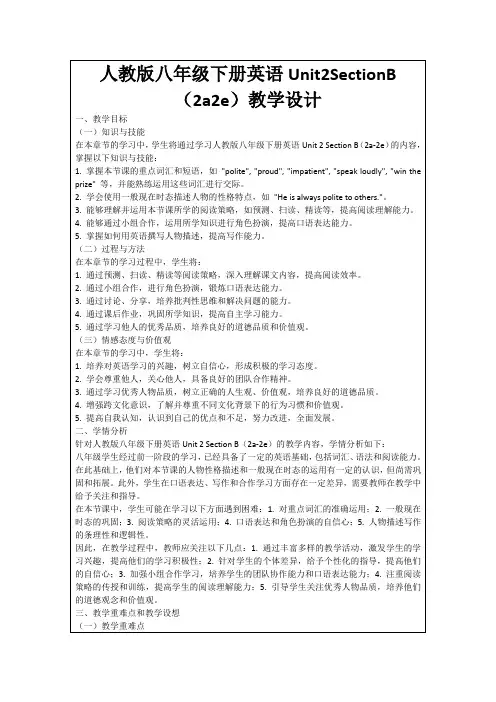
-针对学生的个体差异,给予个性化的指导,提高他们的自信心。
-对学习困难的学生,给予关注和鼓励,帮助他们克服困难,提高学习效果。
5.课后巩固,拓展提高:
-设计富有挑战性的课后作业,让学生在课后巩固所学知识。
-鼓励学生进行拓展阅读,了解更多优秀人物的品质,提高自身素养。
6.情感教育,培养价值观:
2.要求每组选择一个人物,用一般现在时态进行描述,并在组内分享。
3.鼓励学生互相提问、讨论,以提高口语表达能力和思维品质。
4.教师巡回指导,给予个性化的建议和指导,帮助学生提高讨论效果。
(四)课堂练习
课堂练习环节,教师将:
1.设计各种练习题,包括词汇填空、句型转换、阅读理解等,让学生巩固所学知识。
2.要求学生根据课文内容,用一般现在时态描述人物品质,提高写作能力。
2.学会使用一般现在时态描述人物的性格特点,如"He is always polite to others."。
3.能够理解并运用本节课所学的阅读策略,如预测、扫读、精读等,提高阅读理解能力。
4.能够通过小组合作,运用所学知识进行角色扮演,提高口语表达能力。
5.掌握如何用英语撰写人物描述,提高写作能力。
-在教学中融入情感教育,引导学生关注优秀人物品质,培养良好的道德观念。
-通过讨论、反思,帮助学生树立正确的人生观和价值观。
四、教学内容与过程
(一)导入新课
为了激发学生的学习兴趣,本节课将从以下方面导入新课:
1.利用多媒体展示不同国家和地区的人物图片,引导学生观察并讨论他们的性格特点。
2.邀请学生分享他们所了解的优秀人物及其品质,为新课的学习奠定基础。
二、学情分析
八年级英语下册(人教版)Unit2单元整体优秀教学案例
(一)导入新课
1.课堂起始,我将以一个有趣的问题引导学生思考:“同学们,你们有自己的爱好吗?能分享一下吗?”让学生自由发言,谈论自己的兴趣爱好。
2.紧接着,我会展示一段关于不同人爱好的视频片段,如收集邮票、打乒乓球、画画等,引导学生关注本节课的主题。
3.然后,我会向学生介绍本节课的学习目标,让他们明确本节课需要掌握的知识和技能。
二、教学目标
(一)知识与技能
1.学生能够掌握并熟练运用本单元核心词汇,如hobby, collect stamps, play table tennis, draw pictures, play the piano等。
2.学生能够理解并运用一般现在时描述个人的爱好,如I like playing football./ She doesn't like reading books.等。
2.合作完成任务:学生分组完成相关任务,如制作关于爱好的海报、编写对话等。
3.小组互评:学生相互评价,给出建议和意见,共同提高。
(四)反思与评价
1.学生自我反思:让学生回顾本节课的学习过程,总结自己的收获和不足。
2.同伴评价:学生相互评价,给出建议和意见,促进共同进步。
3.教师评价:教师对学生的学习过程和成果进行评价,给予鼓励和指导。
(二)讲授新知
1.通过PPT展示本节课的核心词汇,如hobby, collect stamps, play table tennis等,并引导学生跟读,确保他们正确掌握这些词汇。
2.接着,我会运用一般现在时引导学生描述个人爱好,如“I like playing football.”“She doesn't like reading books.”等,并让学生进行模仿练习。
人教版英语八年级下册Unit2SectionA1a2d教学设计
4.鼓励学生互相交流、讨论作业,共同提高。
2.邀请学生分享他们对这些图片的理解和感受,从而引出本节课的主题:“帮助他人,回馈社会”。
3.教师提出问题:“Can you tell me what you did to help others in the past?”,让学生运用一般过去时态分享自己的经历,为新课的学习做好铺垫。
(二)讲授新知
2.学习并运用一般过去时态描述过去发生的事情,巩固对一般过去时态的掌握。
3.能够理解并运用一般将来时态描述将来的计划或打算。
4.提高学生的听说能力,通过听力练习,提高学生对英语语音、语调的敏感度,培养良好的英语语感。
5.培养学生的阅读理解能力,通过阅读课文,理解文章的主旨大意,抓住关键信息。
(二)过程与方法
(三)情感态度与价值观
1.培养学生的社会责任感,使他们意识到帮助他人、回馈社会的重要性。
2.增强学生的团队合作意识,让他们明白团队协作的重要性。
3.培养学生的爱心和同情心,使他们关心他人,乐于助人。
4.引导学生树立正确的人生观和价值观,关注社会问题,积极参与社会公益活动。
5.培养学生的跨文化意识,让他们了解并尊重不同的文化背景,增强国际视野。
b. How did you feel about it?
c. What are you planning to do to help others in the future?
2.各小组进行讨论,并记录下讨论成果,准备进行课堂展示。
(四)课堂练习
1.教师设计以下练习题,帮助学生巩固所学知识:
a.填空题:根据句意,用适当的时态和词汇完成句子。
人教版八年级英语下Unit2SectionB(2a-3a)教案
人教版八年级英语下Unit2SectionB(2a-3a)教案人教版初中英语八年级下册第二单元Unit 2I’ll help to clean up the city parks.The Fourth period Section B (2a---3a)教学设计一、Teaching Goals:1.Read and understand the passage.2. Target language(五个句型,十二个单词或词组)(1) I’d like to thank you for giving money to Animal Helpline.(2) new words and phrases:1. set up 建立;设立2. thanks for doing sth 感谢做某事3.make it possible for someone to do something让某人做…成为可能4. help sb. out 帮助某人解决困难;帮助(某人)摆脱困境。
5. because of因为,由于。
二、Teaching key points:Read and understand the passage.三、Teaching difficult points:1. Read and understand the passage.2. According to the passage to answer the questions correctly.四、Teaching Aids:1. a tape recorder2. the blackboard3. a computer with Powerpoint五、Teaching procedures:Step1:Lead-inT:In last class we have known some important phrases. Doyou still remember them?S: Yes.T: Now we are going to do some exercises relating to the phrases.翻译下列词组。
【最新】人教版八年级英语下册Unit 2 教案
Unit 2 I’ll help clean up the city parks教案Part 1: Teaching design (第一部分:教学设计)SECTION AGoals●To learn to use p hrasal verbs●To read about being a volunteer●To listen and talk about clean up the city parksProceduresWarming up by learning about grammar focusHello, class. This week we shall go and help clean up the city parks. But first what is the meaning of “clean up”? What verb is it?Turn to page 61 and look at the chart to learn about “phrasal verb”What is a phrasal verb?▲It is an English verb followed by one or more particles where the combination behaves as a syntactic and semantic unit; “turn out” is a phrasal verb in the question “how many turned out to vote?”▲In the English language, a phrasal verb is a verb combined with a preposition, an adverb, or an adverbial particle, all three of which are uninflected.1a Looking and readingLook at the bulletin board on page 60 and read about ways by which you could help people. Then list other ways you could help people.1b Listening and completingYou are going to listen to several conversations.While listening, pay attention to information to complete the sentences on page 60 in the box.1c Doing pairworkIn pairs you are to practice the conversations in the picture on page 60. Then make similar conversations using the information in activity 1b.We could help stop hunger by giving out food2a Listening and checkingSome students talking about planning a City Parks Clean-up Day. Listen to their talk and check√the things they are going to do.2b Listening and filling in blanksI’ shall play t he tape again and you are to listen and fill in the blanks in the box on 61.2c Doing pairworkLet’s go on to role play the conversation in activity 2b.3a Reading, underlining and circlingOn page 62 is an article about volunteers. Read it and underline the kinds of work they do. YouRead the article again to darken the phrasal verbs found in it.3b Filling in the tableOn page 62 is a table showing the kinds of volunteer work the four students could do. Read thetable and fill in it.3c Doing pairNext take turns role playing being one of the people in 3b by asking and giving advice.4 Doing pairworkIn the table on bottom of page 62 write down three things you like to do and then ask your partner for advice about the kinds of volunteer work you could do.Closing down by reading an English poemFalling Asleep in ClassI fell asleep in class today,as I was awfully bored.I laid my head upon my deskand closed my eyes and snored.I woke to find a piece of papersticking to my face.I'd slobbered on my textbooksand my hair was a disgrace.My clothes were badly rumpledand my eyes were glazed and red.My binder left a three-ringindentation in my head.I slept through class, and probablyI would have slept some more,except my students woke meas they headed out the door.Kenn NesbittSECTION B●To Learn more phrasal verbs●To listen, speak and write using phrasal verbsProceduresWarming up by brainstorming phrasal verbsHello, everyone. To begin with, we shall brainstorm a list of phrasal verbs.On page 63 is a box with 4 sentences. Match them with their similar meanings on the right.1b Making sentencesOn page 63 you will find a box with some phrasal verbs. Make a sentence with each of the phrasalverbs.2a Listening and numberingListen to the recording that I am going to play and number the pictures on page 63. (Key:a4,b2,c1,d3 )2b Listening and circlingYou shall listen to the recording again to circle “T” or “F”.2c Doing pairworkIn pairs practice the conversations between Jmmy and the reporter. Use the information from the activities on page 63.3a Reading and underliningOn page 64 is an article about Jimmy the Bike Boy. Read to understand it and underline all the phrasal verbs.Copy all the phrasal verbs and useful expressions onto your notebook.3b Making a noteRead the article again to make a note of the things that Jimmy did in order to sole his problem.1.He did a radio interview.2.He also put up some signs asking for old bikes.3.He called up all his friends and told them about the problem.4.He even handed out advertisements at a local supermarket.5.He told the teachers at school about his problem and they set up a call-in center for parents.4 Doing groupworkBy brainstorming work out a plan for helping out in your community. Write down where and what you will volunteer and tell your classmates about your plan.Closing down by talking about volunteer workLook at the pictures below and talk about the volunteer work that the people in the pictures aredoing.SELF CHECK1.Filling and makingTurn to page 65 and fill in the blank with a correct word given in its correct form. Then make a sentence with each of the given words.2 Writing an article tell about SallyOn page 65 is a box with words and phrases. Write an article telling about what happens to Sally.Just for funLook at the pictures and make a storyout of them.Reading: I’ll send you a photo ofLucky.Before you read, listen to the recording without looking at the article.While you read,underline all the phrasal verbs, blacken all the expressions all the linking words.After you read, copy down all the phrasal verbs and useful expressions into your notebook.Part 2: Teaching Resources (第二部分:教学资源)I. What is a volunteer?A volunteer is someone who performs or offers to perform a service out of his own free will, oftenwithout payment. The year 2001 was the International Year of the Volunteer. 2005 is the UK Year of the Volunteer.People may volunteer to perform some work, e.g., of charitable character. Some volunteer for clinical trials or other medical research, and may even donate their bodies to science after their death.II. What is an online Volunteer?An online volunteer is a person who contributes time and effort with an organization through an online connection, rather than in person. A wide variety of people from around the world are online volunteers and most are not technology professionals.Online volunteers may provide advice, consultancy and perform remote administration tasks for the organisation, usually a charity or non-profit organisation. The practice of donating time online goes by other names, such as virtual volunteering, cyber service, telementoring, e-volunteering, and cyber volunteering.There are many opportunities for people to donate their services using the internet. Online volunteers do a variety of tasks, such as translating documents, editing or preparing proposals, designing logos, researching information, developing strategic plans, reviewing budgets, creating web pages, designing flash presentations, moderating online discussion groups and managing other online volunteers.III. What is an ICT Volunteer?An ICT volunteer is someone who is working to foster the implementation and use of Information and Communication Technologies. He or she can install hardware, software or carry on with ICT training programmes. There is no need to be an online volunteer to be an ICT volunteer: installing hardware is a good example. Likewise, there is no need to be an ICT volunteer to be an online volunteer: teaching a language through a virtual campus is not related with ICT fostering, at least in a direct way.....。