
湘少版三年级英语下册小学英语复习方法
1.根据儿童心理和生理特点,小学英语课程标准明确提出在小学阶段要为儿童打下较好的语音基础,把英语发音视为启蒙阶段的首要任务。
2.语音教学不以掌握语音知识为目的,而是让学生掌握英语字母和音位的基本发音,初步掌握句子的重音、节奏和语调,培养语音的交际意识,为以后的语言学习发展打下良好的语音基础。
3.语音复习内容:涉及音标、字母、单词、重读、语调、节奏等
音素(音标,把握按教材安排学,复习中条理化归纳,在情景中练习,发展语音意识) 音素组合(把握按教材安排学,复习中条理化归纳,在情景中练习,发展语音意识)
词与词发音的过渡(涉及连读,an apple, first of all, look at, Where is it? 等。
中国学生感到连读比较难,习惯于单个词孤立发音,真实生活中连读的使用在英语语言交际中是非常普遍的.如不掌握,交际就会受影响,因此有必要训练学生连读的技巧。
多音节词的重读模式(一般的了解,涉及音节)
单词的强读与弱读(一般的了解,涉及词性)
句子重音(一般的了解,涉及表达的意思,与句子中的词)
话语节奏(一般了解,体验)
语音语调与交际表达(掌握陈述句,一般疑问句,特殊疑问句,感叹句等)
复习注意事项:
1.学生没有口语会话词汇作为支撑,一开始要求他们掌握复杂的发音,是不能也是不合适的,死记硬背的效果很小,且容易挫伤学生的学习积极性。
所以语音训练要情景话。
2.虽然基本发音单位的训练有助于学生准确区分不同发音,但这种机械练习单调无意义。
语音教学不应只是为了发音而练习,它应该将语言与单词相结合,语言与上下文相结合,也就是与意义相结合,讲语音练习置于一定的情景中,帮助学生理解语音与意义的关系,这样可以增强学生的交际意识。
3.可以通过说句子,说歌谣,简笔画或游戏的方式进行。
如:语音归类——动物钓鱼,小朋友回家,比赛歌谣等。
年级不同所采用的方法也不相同,高年级可以有一些语音训练,充分利用汉语的正迁移,克服负迁移。
1.词汇、语音和语法是构成语言的三要素,其中词汇是最重要的因素。
没有一定的词汇量,就无法用所学的句法结构进行有效的交际。
研究证明,中国学生感到很困难的是记忆单词,因此,词汇是提高阅读,听力和写作水平的最大障碍。
词汇复习方法:
●语境复习:在一定语境中让学生再现、联想、记忆词汇;
●通过语境辨别理解、记忆、运用词汇;
●充分利用教具、实物、多媒体、肢体动作、游戏、唱歌、猜谜语等各种形式
表现词义。
学龄初期儿童还不能进行抽象思维活动,他们的思维需要具体事物的支持。
多媒体具有集成性、形象性、生动性等特点,既可以提供语言信息,也可以提供非语言信息,如图画、实物、音乐、声音、手势、表情等,在表现词义较具体的、形象的名词和形容词方面有很大的优势,而初学儿童学习的词汇多为实词,因此多媒体很适合儿童英语词汇的学习和复习。
●利用教学卡片;归类(词性,功能,性数,主代宾)认读,游戏,造句,复
习字母,找差异,反义词,搭配词组,表演猜词,抽词表演,仿写,比赛等。
三、语法的复习
●隐性的原则;
●情景原则;
●归纳总结条理化原则;
●操练运用原则
注意帮助学生了解、理解、记忆、运用形式、意义和功能。
●新课为展示、练习和测评
●复习课多为听、读、回忆、归类、运用(说明确含义,说问答句,造句、编
对话联系,看问选答,问答连线,选词填空,看图选句子等)
四、课文对话的复习
1.朗读、表演课文/ 对话(全班齐读、分角色朗读、分男女生、小组读)2.梳理、提取课文、对话中的主要功能句型,查漏、强化、练习和运用操练3.进行部分有针对性地练习、反馈、指导、再强化
4.对课文、对话中的关键词语、重点词语检测,了解学生掌握情况
5.引导学生联想与该课文、对话相同、类似或有关系的课文、对话,说出相同点及不同,做替换或改变练习
五、书写练习
1.抄写(抄写字母、单词、句子——英语课程标准的要求)
2.仿写(根据例句或某一话题的小语段仿写结构相同、替换个别词汇的语段,包括自我介绍、话题描述、书信、e-mail等)
3.书写(根据要求就某个题目写几句话的小短文,看图给图画加标题,写问候语、道谢语、祝语等,或根据试卷所提供的信息,完成书写任务)4.书写与听力结合、书写与阅读结合、写与说的结合
5.写的练习形式应考虑考核检测的形式
复习注意问题:
1.教师要吃透全册教材的内容,明确有哪些知识点,各单元各课学生必须掌握的和一般了解的,学生感到困难的和个别学生有困难的所有问题,在复习前教师必须做到心中有数(教材、学生、方法以及时间安排复习进度)2.作详细的复习计划安排,制定总体计划和各课时具体复习内容例如:语音复习什么内容,多长时间,与词汇的关联性,设计哪几项活动,用什么样的检测形式:听、说、读、写?与平时教学的联系,与检测题形的一致性相吻合。
一共有几次复习课,如何分配每一课时的几大块?如何处理教材,如何处理做练习篇子?如何提前对学生进行动员和布置复习预习,让学生在总复习开始之前就将全书过一遍,或者先找出自己存在的问题,做出记录,在复习课上有目的地提出疑问和向教师质疑,需要有详细的计划。
3.认真做好课前准备(板书,作业设计,各种复习练习篇子,教具卡片音标等)
4.做好复习课练习的批改,及时发现问题查漏补缺。
5.布置好家庭复习作业,有计划的抄写词汇、句子,或分层提出要求写、默、改编等形式的作业。
6.进行一、两次综合性的模拟测试练习,发现问题,提醒学生,熟悉题型,
树立信心。
7.带学生仔细看做过的练习,单元测试卷子,看看是否明白为什么错,是否会做了,错误改过没有,考前要做认真的梳理。
8.及时与家长沟通,互通情况,把好学生的脉,争取求的家长的支持。
9.积极配和班主任,主动向班主任通报学生情况,取得班主任的支持和帮助。
10.激励学生,在活动中让学生树立信心,增强兴趣,制定个人的奋斗目标(很具体,争取考到多少分,使学生自己有明确的方向和动机,利于考出好成绩。
)。
湘少版小学英语单词总复习.doc

三年级上册Unit1 HelloInicemeetyoutooUnit2whogood morning Miss Afternoon Unit3 Whatyour namemyUnit4bagthank welcome boygirldollman woman Unit5he brother fathershe mother sisterUnit6this family photo grandfather grandmotheruncleauntcousinUnit7soldierpostmannurseteacherdoctordriverUnit8firemanpolicemanpolicewomanpupilUnit9sorryknownosemouthheadhaireareyetoothUnit10touchraisehandtoelegbodyneckarmfootUnit11cowtakecardpigduckhenmouseUnit12schoolbaginrulererasergluepancil-boxapplebookpencil sharpenerUnit13lionbirdmonkeyall rightdogfrogcatUnit14computerfriendscreencanseethingonmeneedkeyboardtypewordshowmany三年级下册Unit1howfinewellkind about thanks Unit2 number caronetwothreefourfivesixseven eightninetenzeroUnit3oldsick please birthday Unit4thetimeOKatclock good-bye eleven twelveo’clock nightdayUnit5pen countthirteenfourteenfifteensixteenseventeeneighteennineteenwentyUnit6colourredredpinkblueyellowwhitegreencloudUnit7fooddrinkcupchopsticksbowlplateUnit8bananamangolemonmarketclassroomorangepineappleUnit9likesunnyrainice-creamrainywarmhotUnit10coldweatherwindysnowycloudyUnit11T-shirttheybeautifulbigtrousersshortscoatdressshirtUnit12come toschoolthemshipbyplanecarhimbusbicycletrainUnit13shapecircletrianglerobtUnit14jumpermummyfitput on四年级上册Unit1are thanks brother sisterUnit2flag sixteen eleven teapotUnit3 elephant big monkey naughty tiger strong beautiful smallUnit4 children outing these ladybird those seagull eggUnit5 hungry dumpling jambread biscuit noodle ricemilkUnit6 whose purse scarfhatUnit7guessleftrightturntraffic policepolicemencoinUnit8paintingexitphoto albumbeltUnit9flatnunbertheirin front ofdoorbedroombedbrowntablechairwardrobeUnit10whereunderinbathroomkitchenonliving roomUnit11homeworksumwrongforty-sixforty-fourtwentythirtyfortysixtyseventyeightyninetyone hundredUnit12swimfastjumphighrunthrowfarflyUnit13plateorangegreywarmUnit14lakeskyboatshipcity四年级下册Unit1a pair of shoe cupboard behindnew glassesUnit2in English busycanclimbwritelettercan’t=can not Unit3makepianobakepiemessboatUnit4sleepwork sweepcookpaintUnit5hopdance basketball skipUnit6walkemptygocome holiday post officeUnit7SundayMondayTuesdayWednesdayThursdayFridaySaturdaymusiclessonfootballUnit8coolspringsummerautumnwinterUnit9frominternationalcampChinaCanadaIndiaFranceAmericaAustraliaUnit10how muchdollarpoundyuanlollipopUnit11legfootfeetfingerkneepuppetholdUnit12tickethurryshirt pocketsockUnit13giveUnit14anymoney五年级上册Unit1cold drink market hungry bunfeelhaveUnit2 home please soup vegetable water breakfast lunch suppersaltUnit3me borrow English forget remember tomorrow blackboard brushUnit4 puppypetshop rabbit cage lovely holdUnit raincoat longshortthickthin thatcheapUnit6sweeta box ofhardsoftteethjellynutlollipopchocolateice-creamUnit7hobbycollectstickerroler-bladingsticker albumstoryUnit8get upgo to bedtimetableChinesemathmusichalf past oneclassUnit9make the bedironclotheshimmealplantUnit10signmeancinemaGuests do not go inNo mobile phoneNo talkingNo fishingNo picking of flowersNo spittingNo parkingturnUnit11teacherhappyangrysadshytiredsnap one’s fingersclapwinkfoldUnit12Spring Festivalrelativeeve of the Spring Fstivalreunionred packetburnfirecrackerlion dancedragon danceUnit13combkindsharpenUnit14Hunan Provincial MuseumYueyang TowerTaoyuadong National ForestParkWindow of the World五年级下册Unit1roofchimney aboveUnit2waitrubbish bin dirtybe carefulcaféspillsugarseata cup ofteaUnit3 anyoneroadcornerpost office outside shopping centre streetnearUnit4 yesterday todaysick weekday railway station hand inthenfinishUnit5metre=meter racesportsfirstsecondthird fourthfifthsixthseventheighthninthtenthlastUnit6helpringlook forbesidelampsofaon top ofUnit7yearChildren’s DaymonthJanuaryFebruaryMarchAprilMayJuneJulyAugustSeptemberOctoberNovemberDecemberUnit8mineoursyourshisherstheirsbothUnit9hitmatternaughtyeach othersorryUnit10enjoywhereoutingUnderwater WorldYuelu AcademyYuelu MountainzootopUnit11strangetelevisionaskstoreroomstealUnit12camptaxion footsubwayUnit13National DaysearchUnit14bamboopen knifescissorspastepullstringbroke六年级上册Unit1 swing bench stone angry bark chain slidebitecryUnit2 always family usually oftenlatenever wave them wake upUnit3 picnic library scienceUnit4 magic medicine miss lonely mooncake egg yolk grapeteaUnit5 room phone clearly noisily quietly Unit6weakworrieddoctorlittletallageheavylightUnit7bullfieldhornideauglyrubfoolishkillUnit8loudergardensmallerbiggerholepleasedUnit9monkeypick upshouttowardsput downscoldUnit10visitstairfilmexcitedhugeUnit11meetswimming suitdangeroussandUnit12ChristmasPresentOpenSanta ClausstockingcardbikecomputerrobotUnit13carrydifficultunderstandcleverUnit14fairy talepickwolfhidearrivereplyhunter六年级下册Unit1kidgood atgood idea picturewtch a film Unit2learnskating rink keepstraightfall overUnit3cover enoughsell bookstore dictionary dirty mark usefulof courseUnit4earthlightSpace Museum landtalk interested Unit5similarsamehawkermorefewer differentlessUnit6across near interesting butchera piece of bridgeanotherbetterotherdropUnit7mostleastboringlibrarianspaceUnit8Dragon Boat Race rice dumpling famouspoetlunar monthUnit9noticebus farenever mind catchUnit10willwon’tweather forecast stayhate。
小学三年级下册英语复习提纲
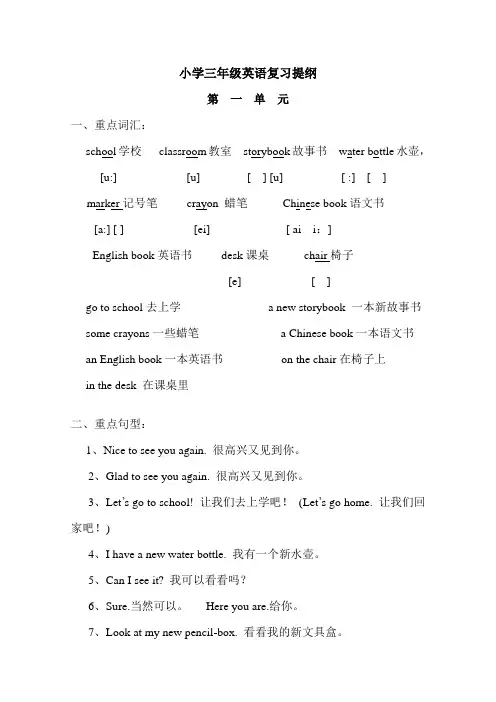
小学三年级英语复习提纲第一单元一、重点词汇:school学校classroom教室storybook故事书water bottle水壶,[u:] [u] [ ] [u] [ :] [ ] marker记号笔crayon 蜡笔Chinese book语文书[a:] [ ] [ei] [ ai i:]English book英语书desk课桌chair椅子[e] [ ]go to school去上学 a new storybook 一本新故事书some crayons一些蜡笔 a Chinese book一本语文书an English book一本英语书on the chair在椅子上in the desk 在课桌里二、重点句型:1、Nice to see you again. 很高兴又见到你。
2、Glad to see you again. 很高兴又见到你。
3、Let’s go to school! 让我们去上学吧!(Let’s go home. 让我们回家吧!)4、I have a new water bottle. 我有一个新水壶。
5、Can I see it? 我可以看看吗?6、Sure.当然可以。
Here you are.给你。
7、Look at my new pencil-box. 看看我的新文具盒。
8、How nice! 真好看!9、What’s in it? 里面有什么?10、What’s in my bag? 我的书包里面有什么?11、What’s on the desk? 课桌上面有什么?12、Show me your marker. 给我看看你的记号笔。
13、Touch your chair. 摸摸你的椅子。
三、对句1、Nice to see you again. Glad to see you again.2、Let’s go to school! OK. Let’ go!3、Can I see it? Sure. Here you are.4、What’s on the desk? A Chinese book.5、Thank you. That’s OK.(You’re welcome.)不必客气,不用谢注意冠词的使用:an English book第二单元一、重点词汇:one 一two 二three 三four 四five 五six 六[ ] [ ] [ ] [ ] [ ] [ ]seven七eight八nine 九ten 十eleven十一[ ] [ ] [ ] [ ] [ ]twelve 十二zero零[ ] [ ]二、重点句型:1、I’m in Class 1,Grade 3. 我在三年一班。
2024年湘少版小学英语复习第一讲三年级上、下册课件
2.Good morning!/Good afternoon!/Good evening!早上好!/下午好! /晚上好!(三上P6)
“Good morning!/ Good afternoon!/Good evening!”是上午、下午或晚上 任何时间跟别人打招呼时的问候用语,分别意为“早上好!”“下午好!” “晚上好!”回答时也用同样的问候语或简短答语“Morning./ Afternoon./ Evening.”
第一讲 三年级上、下册
三年级上、下册常考词汇见《速记手册》P1。
1.Hi/Hello, I'm Mingming.你好,我是明明。(三上P1)
“Hi/Hello, I'm…”意为“你好,我是……(姓名)”。这是向别人作自我介绍时 的常用句型。回答也用此句型向别人介绍自己的姓名。如: Hello, I'm Lingling.你好,我是玲玲。
3.What's your name?你叫什么名字?(三上P9)
这是询问对方姓名时的一种日常用语,其答语为“My name is…或I'm…”。 如: —What's your name? 你叫什么名字? —My name is Anne.我叫安妮。
4.This is my father.这是我的爸爸。(三上P21)
6.Are you Lingling?你是玲玲吗?(三下P5)
这是一个询问对方“你是……吗?”的一般疑问句。肯定回答:Yes, I am. 是的。否定回答:No, I'm not.不,我不是。注意:am不能与not缩略。
7.What colour is this balloon?这个气球是什么颜色的?(三下P9)
“This is…”是用来介绍单个人或物品的句型,既可以用来介绍人,也可以 用来介绍物体。但注意一次只能介绍一个人或物。如: This is my mother.这是我的妈妈。 This is my book.这是我的书。
卓顶精文最新湘少版小学三年级下册英语复习资料.doc
湘少版小学三年级下册英语复习资料1HowaYeYou?词汇:how怎样fine好的well很好kind友善的about关于句型:1、HowaYeYou?你好吗?-----I’mfine.我很好.I’mnotveYYwell.我不好.2、HowaYeYou?/HowaboutYou?/AndYou?你呢?-----I’mfine.too.我也很好.I’mnotveYYwell.我不好.2AYeYouLinglig?词汇:boY男孩giYl女该babY婴儿man男人woman女人句型:1、AYeYouLingling?你是玲玲吗?-----Yes,Iam是的,我是。
No,I’mnot.不,我不是。
2、HeYeYouaYe.给你。
-----ThankYou.谢谢。
小总结:AYeYou+人名.你是某人吗?肯定回答,Yes,Iam否定回答No,I’mnotIshe/she+人名他/她是某人吗?肯定回答,Yes,he/sheis.否定回答No,he/sheisn’t(isn’t=isnot)3WhatcolouYisthisballoon?词汇:colouY颜色Yed红色blue蓝色Yellow黄色white白色gYeen绿色句型:WhatcolouYisthis?这个是什么颜色?或:WhatcolouYisthisballoon?这个气球是什么颜色?ItisYed/pink/blue…是/红色/粉红色/蓝色小总结:WhatcolouYisthis+东西?这个东西是什么颜色?-----It’s+颜色.这个是某种颜色。
4LookattheT-shiYts.词汇:T-shiYtT恤theY他们(主格)beautiful漂亮的big大的tYouseYs裤子shoYts短裤coat外套dYess套裙shiYt衬衫句型:lookatthe…看这…LookattheT-shiYts.看这些T恤ThebluetYouseYsaYenice.这条蓝色的裤子很好看.TheYaYeveYYnice.它们很漂亮.IliketheYedone.我喜欢这个红色的。
三年级下册英语湘少版
三年级下册英语湘少版
湘少版三年级下册英语教材的内容涵盖了多个方面,旨在帮助学生巩固英语基础,并培养他们的语言运用能力。
以下是该教材的一些主要内容和特点:
1.词汇和短语:教材通过各个单元的学习,教授学生新的词汇和短语,
这些词汇和短语与学生的日常生活和学习紧密相关,如颜色、数字、家庭成员、水果、位置等。
2.对话和短文:每个单元都包含对话和短文,通过这些对话和短文,学
生可以学习到如何在实际情境中运用所学的词汇和语法。
对话和短文的内容也贴近学生的生活实际,有助于提高他们的阅读理解和口语表达能力。
3.语法和句型:教材逐步引入新的语法点和句型,通过练习和实际应用,
帮助学生掌握和巩固所学知识。
例如,学生将学习到如何描述事物的颜色、数量、位置等。
4.歌曲和韵律诗:教材中还包含一些歌曲和韵律诗,通过这些有趣的形
式,学生可以更加愉快地学习英语,同时也能提高他们的语感和发音。
5.文化知识和跨学科内容:除了语言本身的学习,教材还注重培养学生
的跨文化意识,介绍一些英语国家的文化和习俗。
同时,教材还包含一些跨学科的内容,如科学、社会等,以拓宽学生的知识面。
总之,湘少版三年级下册英语教材注重学生的全面发展,通过多样化的内容和形式,激发学生的学习兴趣和积极性,提高他们的英语综合运用能力。
小学英语三年级下册英语期末复习资料(单词,句型,语法)

小学英语三年级第二学期单词默写表Unit One树谁谁是她她是祖母;外婆;奶奶祖父;外公;爷爷对的女儿父亲;爸爸母亲;妈妈兄弟姐;妹叔叔;舅舅;大伯;姨;姑姑儿子他他是那么;如此他的表、堂兄弟、姐妹Unit Two老的;旧的有;和……在一起关于……呢?美丽的妇女漂亮的;美丽的高的男人矮的;短的那些男孩看……逗人喜欢的婴儿她的强壮的长的Unit Four有农场助动词,没有特别意思一些;某些;任何有猪一些;某些大的牛;母牛;奶牛在这儿。
鸭子鹅鹅(复数)鸡山羊不;不对;没有绵羊马喜欢狗猫Unit Five宠物小的尾巴鱼家兔Unit Seven美国;美利坚合众国邮票美国的;美国人;美国人的中国的;中国人;中国人的;汉语火车仅仅;唯一的大不列颠的;英国人加拿大的;加拿大人;加拿大人的Unit Eight中国我们我们是(两者)都不列颠;英国中华人民共和国玩具Unit Ten画(画)卧室门窗当然地板;地下;层墙凳子Unit Eleven放哪一个;哪些在……旁边他(它)们(宾格)在……下面地图灯;台灯电视;电视机在……前面在……旁边在……后面Unit Thirteen来进来。
看厅;起居室坐厨房玻璃;玻璃杯Unit Fourteen英格兰;英国可爱的浴室看一看计算机书房;学习电冰箱Unit Sixteen清洁;清洁的课室练习练习本在……(两者)中间老鼠老鼠(复数)在……附近黑板小的Unit Seventeen我们的学校大楼;建筑物办公室教师办公室厕所;洗手间大门游泳池单词归类1、家庭成员: grandfather grandmother fathermotheruncleauntsisterbrothercousinhusbandwifesondaughter2、动物:chickengoose(复数geese) froggoatrabbitgoldfishcatsheeppighorsecowbulldogchickduckmouse(复数mice) fishbirdturtleguinea pigspider3、国家名:PRC/ChinaUSA/AmericaUK/England/Britain GermanyFranceCanadaAustraliaJapan4、国籍:ChineseAmericanBritish/English GermanFrenchCanadian Australian Japanese5、家具:bedwardrobesofachairdeskstooltablecupboardshelf6、有关房屋:floordoorwindowwallceilingbedroom bathroomstudykitchenliving room gardengarageupstairs downstairs7、学校场所: buildinglibraryteachers’ roomswimming pool headmaster’s office playgroundclinicclassroomtoiletgatecanteenschoolofficeflowerbedstatue8、方位介词:onunderinbesidebyagainstin front ofbehindnearbetweenopposite8、电器及摆设: paintingpicturemapclocklampfridgeTVcomputer9、人的类别:manwomanladyboygirlbaby10、形容词:beautifulprettyslimcutestronglongtallshortoldbigsmalllittlelovely11、动词:cleansitdrawlikelooklook athave a lookput12、疑问词:whichwhowherewhathow many三年级下学期常见句子配对Module 1 & Module 2:Who are the children?——They are my cousins.Who’s the sho rt girl with black hair? ——She’s my sister.Who’s David Webb?——He’s my brother.What’s that?——It’s my family tree. / It’s a pig.Do you have any cows?——Yes, I do. / No, I don’t.Do they have a sister?——Of course, they do. / No, they don’t. Is Susan your sister?——Yes, she is. / No, she isn’t.Is Jim your uncle?——Yes, he is. / No, he isn’t.Is her hair long? ——Yes, it is. / No, it isn’t.Is that a bull?——Yes, it is. / No, it isn’t.Module 3 & Module 4:Where are you from?——I am from Australia / America / England …Where is Janet from?——She’s from Canada / Japan / Germany …Where is he from?——He’s from China / France …Are you Australian?——Yes, I am. / No, I am not.Are you from China?——Yes, I am. / No, I’m not.What’s this? ——It’s a bedroom.Where is the chair?——It’s under the desk .Where is the lamp? ——It’s on the desk. Where is the desk? ——It’s beside the shelf. Is the lamp on the wall?—— Y es, it is. / No, it isn’t.Is it a stamp?——Yes, it is. / No, it isn’t.Are those French stamps?——Yes, they are. / No, they aren’t. How many beds are there in it? ——There is one.Do you have a Japanese bike?——Yes, I do. / No, I don’t.What are these?——They are Canadian stamps.Put the books on the desk. ——OK. Why do you like this toy car? ——Because the toy car is green.Which cars do you like?——I like the red cars.Module 5 & Module 6Is that a building?——Yes, it is. / No, it’s a house.Are there any trees near the house?——Yes, there are. / No, there aren’t.Are there any dogs under the chair?——Yes, there are. / No, but there is a cat under it.Is there a TV in the living room?—— Yes, there is one on the shelf. / No, there isn’t.Is the swimming pool opposite the clinic? ——Yes, it is. / No, it isn’t.Where is the kitchen?——It’s downstairs.Where is the lamp? ——It’s on the shelf.重要句子1.Is this/that/it ….?Yes, it is. / No, it isn’t.2.Is he/she ….?Yes, he/she is.No, he/she isn’t.3.Is there …..?Yes, there is.No, there isn’t.4.Are these/those/they?Yes, they are.No they aren’t.5.Are there …..?Yes, there are.No, there aren’t.6.Are you …?Yes, I am. / No, I’m not.7.Do you …..?Yes, I do. / No, I don’t.8.Who is he/she ?He /She is ….9.Who are they?They’re….10.What are these/those/they?They’re…..11.What’s your name ?I’m…..12.What is this/that/it ?It’s ……13.What colour is ….?It’s….14.What colour are ---?They’r ---15.Where are you from?I’m from …..16.Where is he/she from?He/She is from…..17.Where are they from?They’re from ….18.Where is ….?It’s in/on/under….. 19.Where are …..?They’re in/on/under…..20.How many …are there?单数:There is one.复数:There are….日常生活用语:1.A: Thank you .B: You’re welcome.2.A: Here’s your juice.B: Thank you.3.A: Come and sit with me on the sofa .B: Thank you.4.A: Put the tape recorder on the shelf.B: OK. / All right.5.Put….on /in…..OK./ All right.按实际情况回答问题:1.Is your mother from Canada?2.Is your father strong?3.Is your school big?4.Is there a TV in your living room?5.Are there any books in your bag?6.Are your bedrooms messy?7.Are you a girl?8.Do you have any pet?9.Who is your English teacher?10.Where is your lamp?11.Where are your exercise books?12.Where are you from?13.Where is your teacher from?14.What’s your name?15.What is this/that?(冰箱)16.What are these/those?(鹅)17.How many rooms are there in your ho 18.How many buildings are there in your school?19.What colour is your bag?______________________________20.What colour is your pencil-case?______________________________21.Do you have a sister?______________________________22.Do you have a dog?______________________________23.Do you like China?______________________________24.Is your father tall?______________________________25.Is your mother beautiful?______________________________26.Where is your bag now?______________________________27.Where are your exercise books?______________________________28.Is there a TV in your living room?______________________________29.Is there a computer in your classroom? ______________________________30.Are there any desks in your classroom? ______________________________31.Are there any books in your bag?______________________________32.Is your bedroom upstairs?______________________________33.Is your classroom downstairs?______________________________34.Let’s clean the blackboard.______________________________35.Wash your hands.______________________________36.Brush your hair,please.______________________________37.Give the stamp to me, please______________________________38.Please lend me your ruler.______________________________39.Here’s my ruler.______________________________40.Here’s the tissue.______________________________41.Thank you.______________________________42.How are you?______________________________43. How many books are there in your bag?44.What is in your bag?语法知识一.可数名词变复数的规则1.一般情况,直接在名词后面加“s”. 如: bed – beds cat—cats2.以“ s, x, sh, ch”结尾,在后面加“ es ”. 如: bus—buses box—boxes glass—glasses3.以辅音字母+y 结尾的名词, 改y变i再加es. 如: baby—babies study—studies lady—ladies4.特殊情况,不规则:①复数不变:sheep—sheep fish—fish goldfish—goldfish②不规则:goose—geese mouse—mice child—children shelf—shelves tooth—teeth man—men woman—women◆不可数名词(不加s)hair---头发 juice---果汁 tissue---纸巾 chalk---粉笔 water---水二.“是”动词有三个:am are is第一人称单数:I — am 第二人称单数:you — are第三人称单数:he,she,it — is 全部复数都用:are注意不可数名词:Is there any tissue on the table ?Is there any orange juice in the glass?三.some 和anysome 和any 的主要区别为:some和any都表示“一些”,但是“some”用于肯定句,any用于否定句(not;n’t)和疑问句(?)。
三年级下册英语期末复习计划(合集3篇)
三年级下册英语期末复习计划(合集3篇)1.三年级下册英语期末复习计划第1篇一、学情分析经过一学期的学习,大部分的学生对英语已经有了比较浓厚的兴趣,学习态度比较端正,逐步养成了较好的学习习惯。
但是学生在英语学习中还是存在着一些差距,班级中大部分的学生英语水平不错,好的同学学习习惯较好,上课爱开口,动脑筋,作业完成较及时,课堂听讲认真。
有小部分学生作业经常漏做或是少做,学习上有教大的困难,针对学生不同的情况,我将采取相应措施进行复习,为今后的学习打下扎实的基础。
二、关于复习为了使学生学习的内容得到巩固、强化和发展,老师需要带领学生对所学的知识进行系统的归纳、梳理,加深理解及掌握,从而使学生的语言运用能力得到进一步的发展。
(一)复习内容与目标:1.字母:能熟练掌握 26个字母的听(听辨出字母读音)、读(字母准确读音)、写(字母大、小写);字母排列顺序以及能记住一些常见的字母缩写词等。
2.词汇:能准确记住本学期课本要求的四会词及词组;对课本中的三会词汇能听、说、读理解,鼓励有能力的学生记住尽量多的词汇。
3.对话:能流利朗读、鼓励背诵课文里的dialogues,并能准确理解对话的情景和主题功能。
4.句型结构:熟练理解每个单元的主要句型结构,并能在情境中准确运用。
(二)复习要点:1、突破重点和难点。
(1)学生明确各单元学习要求,教师引导学生课后多读、多记、多写(四会要求的单词和句子)。
(2)单词记忆是小学生英语学习的难点,教师要帮助学生养成记忆单词的良好习惯,如根据发音规则记忆、根据词义记忆、联想记忆等等,并帮助学生由单独记一个词转为记几个、一串词。
(3)对于重点和难点内容,教师要通过多检查、多反馈的方式促进学生对语言知识的掌握。
2、回归课文、联系实际。
语言知识转化为语言技能,须经过意义性的训练。
教材内容有情景、有意义、有完整的情节,所以引导学生把语言知识放入语篇中记忆,复习阶段回归教材,对教材内容要求学生读得滚瓜烂熟。
湘少版小学英语三年级下册教案(全册)
湘少版三年级英语下册教学计划计划人:一、教学目标:1、能听、说、读、写英语字母并能按字母顺序背诵、默写二十六个字母.2、根据实物、图片说出所学单词要求读音正确。
3、能比较熟练地运用所学的日常交际用语。
4、能在非语言提示的帮助下,听懂清晰的话语和录音。
5、能演唱已学过的英语歌曲,诵读已学过的歌谣.二、学情分析:学生接触英语只有一个学期,大部分学生对英语有比较浓厚的学习兴趣,但也有少数学生由于遇到困难,学习习惯也不太好,有待于端正学习态度,掌握良好的学习方法。
所以,在教学中,教师应该以学生的发展为宗旨,以培养学生的创新精神和实践能力为重点,面向全体学生,始终把激发学生的学习兴趣放在首位。
三、教材分析:三年级教材的特点:内容比较多,情景性强,语言知识点多,但是,它们都是在学生原有知识上的扩展。
所经我们在教学时要注意联系学生已有的知识,由旧知识切入新知识的学习,由旧引新,温故而知新,这样才有利于学生的理解、记忆。
四、教学措施:1、课堂教学要以学生为主体,充分发挥学生的积极性、主动性。
2、以课标理念指导教学,突出英语学科的人文性、工具性特点。
3、力求质量为先,面向全体学生,以训练促思维,促英语水平的提高,充分保证学生的自主、自学时间。
4、强化口语、听力训练,尽心辅导。
5、形成性评价列入学业学习评价,按照20% 的学习行为和口语学习评价,80%的双基评价。
以促进学生的学习为主要目的。
6、单元卷练习:任务,可以提前完成,或者同伴合作。
目的在于考核语言的掌握和兴趣的维持,不给学生太大的压力。
7、期末评价原则是:重兴趣,重双基,促能力。
五、教学进度安排:Unit 1 How are you?Period 1一、教学目标:1、能听懂、会说本课会话;2、能运用“How are you?”进行问候,并对此做出回应;力求在第一课堂就激发学生学习英语的兴趣。
二、教学重点及难点:重点:自我介绍,运用“How are you?”向他人询问情况。
湘少版小学英语3-6年级复习要点
湘少版小学英语3-6年级要点三年级上册U nit 1 Hello!〔你好!〕Unit 2 Good morning〔上午好!〕Unit 3 问:What’s your name?〔你的名字是什么?〕答:My name is Peter/Anne.<我的名字是Peter/Anne.> Unit 4 问:How old are you?〔你几岁了?〕答:I’m nine.<我九岁.>Unit 5 This is my family.〔这是我的家〕Unit 6 问:What’s he?〔他是谁?〕答:He is my grandfather.〔他是我爷爷.〕Unit 7 It’s a dog.〔它是一只狗.〕Unit 8 问:What’s this?〔这是什么?〕答:It’s a pencil-box.<它是一个文具盒.>问:What’s that?〔那是什么?〕答:It’s a pen.〔它是一支钢笔.〕Unit 9 It’s a mouth.〔它是一X嘴.〕Unit 10 Touch your head.〔摸你的头〕Unit 11 I like the bird.〔我喜欢那只鸟.〕Unit 12 Happy birthday!〔生日快乐!〕三年级下册Unit 1 问:How are you?〔你好吗?〕答:I’m fine ,thank you.〔我好,谢谢你.〕Unit 2 问:Are you Lingling?〔你是玲玲吗?〕答:Yes,I am./No, I’m not.<是的,我是/不是的,我不是.>Unit 3 问:What color is this balloon?〔这个气球是什么颜色?〕答:It’s blue/pink.<它是蓝色/粉色.>Unit 4 Look at the T-shirts.〔看这件T恤衫.〕Unit 5 问:What time is it?〔几点钟了?〕答:It’s seven o’clock. /Sorry, I don’t know.<7点/对不起,我不知道.> Unit 6 问:How many pens are there?〔有几只钢笔?〕答:Four pens.<四只钢笔.>Unit 7 问:Is this an orange?.〔这是一个橘子吗?〕答:Yes,it is./No,it isn’t.<是的,它是./不是的,它不是.>Unit 8 I like a sunny day.〔我喜欢晴天〕Unit 9 问:What’s the weather like?〔天气怎样?〕答:It’s raining.<在下雨.>Unit 10 问:Is he a farmer?〔他是一个农民吗?〕答:Yes, h e is /No, he isn’t.<是的,他是./不是的,他不是.>Unit 11 问:What’s he?〔他是干什么的?〕答:He is a postman/teacher/policeman/farmer/pupil/fireman.〔他是邮递员/教师/警察/农民/小学生/消防员〕Unit 12 问:How do you go to school? 你怎样来学校?答: I e to school by bus.〔我坐公交车来学校.〕四年级上册Unit 1 Nice to meet you.〔见到你很高兴!〕Unit 2 It’s a circle.〔它是一个圆.〕Unit 3 Look at this elephant.〔看这只象.〕Unit 4 These are flowers.〔这些是花.〕Unit 5 I like noodles.〔我喜欢面条.〕Unit 6 Turn right.〔向右转.〕Unit 7 问:Whose is this?〔这是谁的?〕答:It’s my wallet.〔它是我的钱包.〕Unit 8 She wears a white and black sweater.〔她穿白黑相间的毛衣.〕Unit 9 It’s one hundred.〔它是一百〕Unit 10 Wele to our home.〔欢迎来我们的家〕Unit 11 问:Where’s the cat?〔猫在哪里?〕答:She’s in the kitchen.〔她在厨房.〕Unit 12 Peter can jump high.〔Peter 能跳高.〕四年级下册Unit 1 问:Where is my cap? 我的帽子在哪里?答:It’s on your head!〔它在你的头上.〕Unit 2 Spring is warm.〔春天暖和.〕Unit 3 问:What can you see?〔你能看见什么?〕答:I can see a river/a lake/a boat/the blue sky/white clouds/.〔我能看见一条小河/一个湖/蓝色天空/白云.〕Unit 4 问:Can you write in English?〔你能用英语写吗?〕答:Yes, I can./ No, I can’t.〔是的,我能./ 不是的,我不能.〕Unit 5 Peter is writing.〔Peter 在写字.〕Unit 6 问:What’s Anne doing?〔Anne 在做什么?〕答:She is skipping.〔她在跳绳.〕Unit 7 问:What day is today? 今天星期几?答:Today is Saturday.〔今天是星期六.〕Unit 8 问:Where are you from?〔你从哪里来?你是哪里人?〕答:I e from China.〔我来自中国. 我是中国人.〕Unit 9 问:How much is it?〔它多少钱?〕答:It’s fifty-six yuan.〔它是56元.〕Unit 10 He has two feet.〔他有两只脚.〕Unit 11 问:Do you have a ticket?〔你有票吗?〕答:Yes,I do./No, I don’t.〔是的,我有./不,我没有.〕Unit 12 问:Do you have any money?〔你有钱吗?〕答:Yes, I have two yuan.〔是的,我有两元.〕五年级上册Unit 1 问:What does she look like?〔她看起来怎样?〕答:She has short hair and small eyes. She is beautiful.〔她有短发和小眼睛,她很漂亮.〕Unit 2 问:What would you like ?〔你想要什么?〕答:I’d like a hamburger.〔我想要汉堡包.〕Unit 3 问:Do you want some rice?〔你想要吃米饭吗?〕答:Yes, please./No,thank you.〔是的,请来一些.〕〔不,谢谢你.〕Unit 4 问:Can I use your pencil, please?〔请问我能用你的铅笔吗?〕答:Yes, here you are.〔可以,给你.〕Unit 5 问:Can I have a pet?〔我可以养宠物吗?〕答:Yes, you can./No, you can’t.〔是的,你可以.〕〔不,你不能.〕Unit 6 问:Which one do you want?〔你想要哪一个?〕答:I want the thick one.〔我想要厚的这一件.〕Unit 7 问:What time do you get up?〔你几点起床?〕答:I get up at 6:50.〔我六点五十起床.〕Unit 8 Lingling helps her parents.〔玲玲帮助她的父母.〕Unit 9 问:What’s your hobby?〔你的业余爱好是什么?〕答:My hobby is reading.〔我的爱好是读书.〕Unit 10 问:What does that sign mean?〔这个标志是什么意思?〕答:It means "You can go out from there .〞〔它的意思是"你可以从那儿出去.〞〕Unit 11 I’m sorry./I feel sorry. 〔对不起/我觉得不好意思.〕Unit 12 The Spring Festival.〔春节〕Children wear new clothes.〔孩子们穿新衣服.〕五年级下册Unit 1 We are going to read stories.〔我将要读故事.〕Unit 2 We are going to do some research.〔我们将要做一些调查.〕Unit 3 Let’s make a kite.〔让我们做风筝吧.〕Unit 4 Don’t talk here.〔不要在这里讲话.〕Unit 5 问:W hen’s your birthday?〔你的生日是什么时候?〕答:My birthday is in March./It’s on the fifth of March.〔我的生日在三月.〕〔我的生日在3月5日.〕Unit 6 I’ll make a beautiful card.〔我将要做一X漂亮的卡片.〕Unit 7 问:Is there a post office near my school?〔我的学校附近有一个邮局吗?〕答:Yes ,there is./No,there isn’t.〔是的,有./不,没有.〕Unit 8 问:Can you show me the way to the Xinhua hotel?〔你能告诉我到新华旅社的路吗?〕答:Y ou can go straight along this road.〔你可以沿着这条路直走.〕Unit 9 He’s kind to children.〔他对孩子们好.〕Unit 10 问:Where were you yesterday?〔昨天你在哪里?〕答:I was at work.〔我在工作.〕Unit 11 问:Who was first?〔谁第一?〕答:Amy was first.〔艾米第一.〕Unit 12 问:Where did you go?〔你们去过哪里?〕答:We went to the park.〔我们去过公园.〕六年级上册Unit 1 问:What did you do during the holidays?〔假日你做了什么?〕答:I read many books/We watched TV.〔我读了书/我们了看电视.〕Unit 2 Katie always gets up early.〔Katie总是起床早.〕Unit 3 问:What do you like ? 你喜欢什么?答:I like my puter.〔我喜欢电脑.〕Unit 4 The Mid-Autumn Festivals is ing.〔中秋节要来了.〕Unit 5 It will be sunny and cool tomorrow.〔明天天气将晴朗又凉爽.〕Unit 6 问:What will you bring for the piic?野炊你将带什么?答:I will bring a big bottle of orange juice.〔我将带一大瓶橘子汁.〕Unit 7 问:What can you do?〔你能做什么?〕答:I can ask Mun to make cakes for them. 我可以要妈妈给他们做蛋糕. Unit 8 We shouldn’t waste water.〔我们不应该浪费水.〕Unit 9 This bird is bigger than the first one.〔这只鸟比第一只鸟大些.〕Unit 10 问:What’s wrong with you? 你怎么啦?答:I have a fever. 我发烧问:What’s wrong with you today? 你今天怎么啦?答:I don’t feel well today.〔今天我觉得不舒服.〕Unit 11 问:Shall we go to the theatre?〔我们将去剧院吗?〕答:Well,it’s a good idea.〔好,这是一个好主意.〕Unit 12 It’s Christmas again!〔圣诞节又到了!〕六年级下册Unit 1 A family outing.〔家庭旅游.〕Unit 2 Some stories are more interesting.〔有些故事更有趣.〕Unit 3 We should learn to take care of ourselves.〔我们应该学会照顾好自己.〕Unit 4 Planting trees is good for us.〔植树对我们有好处.〕Unit 5 Our Earth looks like this in space.〔我们的地球在太空中象这个样子.〕Unit 6 Anne wanted to dance.〔Anne想要跳舞.〕Unit 7 I’m not afraid.〔我不害怕.〕Unit 8 International Children’s Day.〔国际六一儿童节.〕Unit 9 Look at these beautiful places in the world.〔看世界上这些漂亮的地方.〕。
期中复习(课件)湘少版英语三年级下册
小试牛刀
A. Yes, I am. C. Thank you.
B. It’s red. D. Good morning!
( C )1. Here you are.
( A )2. Are you Miss Yang? ( B )3. What colour is this apple? ( D )4. Good morning!
-What colour is this? -It’s blue.
-What colour is this? -It’s black.
小试牛刀
1.-Are you Lingling? -___B____.
A. Yes, I am not. B. Yes, I am. C. No, I am.
2.This __A__ is my father. A.man B.woman C. girl
2.当别人递给你东西时,你说:___A___ A. Thank you! B. I’m glad to see you!
3.当你想询问别人是否是汤姆时,你可以这样问:__A___ A. Are you Tom? B. You are Tom.
Unit 3 What colour is this balloon?
当想询问物品的颜色时,可以使用句型 What colour is this? 回答: It's + 颜色. 这是……颜色的。
Let’s Practise 仿照例子编对话。
-What colour is this? -It’s red.
-What colour is this? -It’s green.
3. __A___ colour is this? A. What B. What’s C. How