
译林英语八年级上册unit2详解
1.vacation (名词)假期。
泛指一般的假期,多用于美式英语holiday 一般用于英式英语,常用短语:on vacation 在休假go on/take a vacation 度假2. Wh don't/doesn't sb do sth.?=Why not do sth.? 表示提出建议,意思是“为什么不做某事”通常肯定回答用“OK,/All right/Good idea. "其形式为:Why don't/doesn't/didn't+主语+谓语动词原形+其他=Why not you+谓语动词原形+其他....为什么不...呢?例“Why don't you have a good sleep?=Why not you have a good sleep?"为什么不睡个好觉呢3.What's...like? 常用来询问对事物的看法,或者要求对方描述有关人,物的外貌或品德。
例What's your brother like? He is tall and handsome. 你哥哥长什么样?他高大英俊What's...like?常与How is...?互换例:What's the weather like in summer?=How is the weather in summer?夏天的天气怎么样?4.few,a few,little,a littlefew 很少,几乎没有,表否定,修饰可数名词的复数a few 有些,有几个,表肯定,修饰可数名词复数(quite a few,a good few,not a few都表示相当多,不少之意)little 几乎没有,表否定,修饰不可数名词a little 一点,少量,表肯定,修饰不可数名词记住:few,little 有异同,few可数,little不可数,其前有a表肯定,其前无a表否定。
5.I'd like to buy some biscuits. 我想买一些饼干(p19)would like 意思为“想要”,would是情态动词,没有人称和数的变化。
1)would like sth 想要某物回答肯定用Yes,please 否定用No,thank you例:I would like some apple.我想要一些苹果2)would like to do sth. 想要做某事例:He would like to eat some bananas.他想吃一些香蕉3)would like sb to do sth想要某人做某事。
肯定回答Yes,I'd love/like to. 否定I'd love to,but... 例:What would you like me to do? 你想要我去做什么?Reading 语法6.Among all my subjects,I like French best. 在所有学科中,我最喜欢法语。
(p20)like....best among. 意思是“在....中最喜欢”其中,best为well的最高形式,among为介词拓展;当我们想要表达最喜欢什么时,用like best后加表示范围的介词短语,比如in... among..... of.....等,like...best的同义词为favourite,意为最喜欢among,用于三个或者三个以上,或笼统的一群人或一些物之中between 一般指两者之间,也可以用来指三个或三个以上的人或物中的每两个之间。
7.During the week,we can borrow more books from the school library.during,介词,意为“在....期间”不要误用做连词。
borrow,借入,lend和keep区别1)borrow 对主语而言为“借入”,指从别人或别处借东西,为非延续性动词。
borrow sth. from sb.意思为“从某人/某处借某物”例He borrowed a dictionary from the library. 他从图书馆借了一本词典。
2)lend 对主语而言为“借出”。
把自己的东西借给别人。
lend sb sth.=lend sth. to sb.将某物借给某人。
例I lend my bike to him yeserday=I lend him my bike yesterday3)keep意为“持有”指借用某物一段时间,为延续性动词。
keep sth. for some time“借用某物一段时间You can keep the book for a week.这本书你可以借一周。
8.We can aslo bring in books and magazines from home. 我们也可以从,家里带来书和杂志。
bring动词,意为"带来“相当于bring sth to sb=bring sb sth.意为“把某物带给某人”,bring in意为“带入,带进,引入,提出。
bring 指“从别处把东西或人带来例He brings a new book with him. 他带来一本新书take 把东西带走或拿走”例Please take the letter to the post office. 请把这封信送到邮局9.the end of ....的末尾例Near the end of the week,we discuss the books with our classmates in the class.在这一周快要结束时,我们在课堂上和同学们一起讨论这些书at the end of 在...的末尾/尽头后例There is a museum at the of the street.在街道尽头有一个博物馆in the end 最,终于例He work out the problem in the end. 最后他解出了这道题discuss 动词,意为“讨论,议论”可直接加宾语,无须加out。
discussion名词,意为讨论discuss sth=talk about sth. 讨论某事例They ar scussing/talk aboutthe news. 他们正在讨论那则新闻discuss sth with sb=have a discussi n with sb. about/on sth 与某人讨论某事例I want to discuss the exam with you=I want to have a discussion with you about the exam我想要和你讨论一下这次考试10.He often listens carefully to my problem and offers me help. 他经常认真的倾听我的问题并提供我帮助problem 名词,问题,难题out the math problem1)have problem with sth ...有问题例He said he had some problem with the pronunciation. 他说他发音有些问题2)have problems (in) doing sth. 做某事有困难例They have some problems (in)working out the math problem. 他们解出那道数学题有困难、offer 动词,主动提出,自愿给与,有(主动)拿给,给予的含义,相当于give,后可接名词或代词作宾语,也可接双宾语,即offer sb sth(相当于give sb sth)=offer sth. to sb(相当于give sthto sb)T例he young man offered the old man an umbrella=The young man offered an umbrella to the old man这个年轻人将伞让给了那个老人11.onfriday afternoon,our school ends earlier than usual.在周五下午,我们放学比平时玩更早on friday afternoon 意为在星期五的下午,吃出on作介词,意思为在.....之时。
表示时间,用来表示具体的某一天或某一天的上午,下午晚上或星期,节日等名词前。
也可用在某中天气的一天或某季节的一天及其上午,下午晚上。
end动词,结束,固定短语:end the meeting 结束会议end with..以...结in the end 最后at the end of 在...末尾near the end of 在快要结束时by the end of 到..为止12.Time seems to go faster when we are reading interesting books. 当我们读有趣的书时,时间似乎过得更快weem to do sth 意思是“看起来..../似乎....。
此时seem与不定式构成复合谓语1)主语+seem+(to be)+表语,表语多为名词或形容词,说明主语的特征,状态例Daniel seems (to be)a very clever boy. 丹尼看上去是一个非常聪明的男孩2)It seems +that从句,其中It是形式主语,that引导主语从句I例t seems to me that he will not come again. 在我看来他不会来了3)There+seem to be+名词,其中tobe可省略。
seem的单复数主要看后面作主语的名词的单复数例There seems no need to wait longer. 看来没有再等的必要了appear 强调外表给人的印象,有时含有实质上并非如此的意思seem暗示有一定根据的判断,这种判断往往接近事实look着重由视觉得出印象grammar 语法13比较事物的重量more...than 比...多few....than,less...than(比...少)more是many及much的比较级形式,后面接可数名词复数形式或不可数名词fewer是few的比较级,后面接可数名词复数;less是little的比较级,后面接不可数名词我们用the most(最多的)来表示最多的数量,用the fewest/the least(最少的)来表示最少的数量。
牛津译林版英语八年级上册Unit 2 同步语法讲解和练习
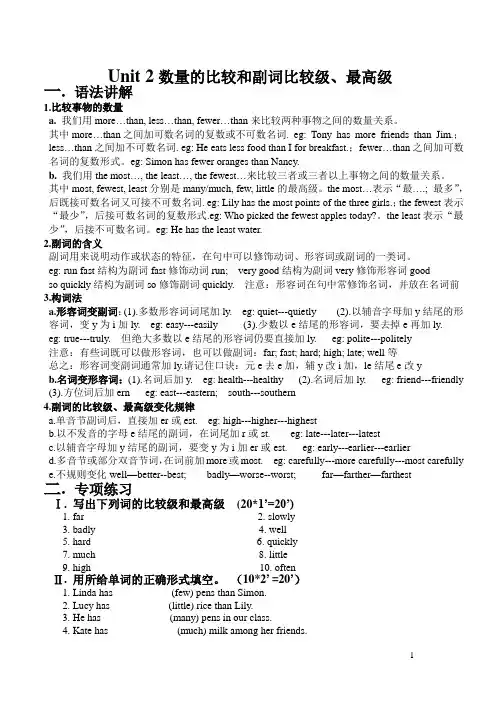
Unit 2数量的比较和副词比较级、最高级一. 语法讲解1.比较事物的数量a.我们用more…than, less…than, fewer…than来比较两种事物之间的数量关系。
其中more…than之间加可数名词的复数或不可数名词. eg: Tony has more friends than Jim.;less…than之间加不可数名词. eg: He eats less food than I for breakfast.;fewer…than之间加可数名词的复数形式。
eg: Simon has fewer oranges than Nancy.b.我们用the most…, the least…, the fewest…来比较三者或三者以上事物之间的数量关系。
其中most, fewest, least分别是many/much, few, little的最高级。
the most…表示“最….; 最多”,后既接可数名词又可接不可数名词. eg: Lily has the most points of the three girls.;the fewest表示“最少”,后接可数名词的复数形式.eg: Who picked the fewest apples today?。
the least表示“最少”,后接不可数名词。
eg: He has the least water.2.副词的含义副词用来说明动作或状态的特征,在句中可以修饰动词、形容词或副词的一类词。
eg: run fast结构为副词fast修饰动词run; very good结构为副词very修饰形容词goodso quickly结构为副词so修饰副词quickly. 注意:形容词在句中常修饰名词,并放在名词前3.构词法a.形容词变副词:(1).多数形容词词尾加ly. eg: quiet---quietly (2).以辅音字母加y结尾的形容词,变y为i加ly. eg: easy---easily (3).少数以e结尾的形容词,要去掉e再加ly. eg: true---truly. 但绝大多数以e结尾的形容词仍要直接加ly. eg: polite---politely注意:有些词既可以做形容词,也可以做副词:far; fast; hard; high; late; well等总之:形容词变副词通常加ly.请记住口诀:元e去e加,辅y改i加,le结尾e改yb.名词变形容词:(1).名词后加y. eg: health---healthy (2).名词后加ly. eg: friend---friendly(3).方位词后加ern eg: east---eastern; south---southern4.副词的比较级、最高级变化规律a.单音节副词后,直接加er或est. eg: high---higher---highestb.以不发音的字母e结尾的副词,在词尾加r或st. eg: late---later---latestc.以辅音字母加y结尾的副词,要变y为i加er或est. eg: early---earlier---earlierd.多音节或部分双音节词,在词前加more或most. eg: carefully---more carefully---most carefullye.不规则变化well—better--best; badly—worse--worst; far—farther—farthest二. 专项练习Ⅰ. 写出下列词的比较级和最高级(20*1’=20’)1. far_____________ _____________2. slowly____________ ____________3. badly___________ ______________4. well____________ _____________5. hard ___________ ______________6. quickly __________ ___________7. much___________ ______________ 8. little ____________ ____________9. high____________ ____________ 10. often __________ _____________Ⅱ. 用所给单词的正确形式填空。
2021-2022学年牛津译林版英语八年级上册unit2 end词汇讲义

Unit2词汇讲义拓展end英 [end]美 [ɛnd]第三人称单数:ends第三人称复数:ends现在分词:ending过去分词:ended过去式:ended end 基本解释名词端; <正>结果; 终止; 最后部分及物/不及物动词结束,终止end 相关词组1. keep one's end up : 精神饱满地对付;2. on end : 连续地;3. at a loose end : 闲着;4. in the end : 最后, 终于;5. no end : 非常;6. win one's end : 达到目的; ;7. from end to end : 从头到尾地;8. end to end : 首尾相连;9. achieve one's end : 达到目的; ;10. bring to an end : 使结束;11. at one's wit's end : 不知所措;12. meet one's end : 死;13. end on : 端头直对(某物体)地;14. at an end : 结束;end 相关例句及物动词1. I hoped that this might end my suffering.我希望这会结束我的苦痛。
不及物动词1. The book ends in tragedy.这本书以悲剧结尾。
名词Unit2词汇讲义拓展1. I used the scientific method to attain this end.我用科学的方法来达到这一目的。
2. There is no end to his grumbles.他的抱怨没完没了。
3. I'll look after the advertising end.我来负责广告方面的工作。
end 情景对话搬家A:I can (live with it/ stand it/ bear it/ endure it.)我可以(应付/忍受/忍受/吃得消)。
Unit2知识点讲解牛津译林版英语八年级上册

牛津译林版8AU2知识点讲解1.知识目标:学生能够掌握U2的短语和词汇。
2.技能目标:学生能够掌握U2单词的用法。
3.情感目标:学生能够学会自己学会安排学校的活动。
Comic&Welcome to the unit知识点01.why don’t...?用法【用法详解】含义:为什么不.......?,通常表示建议和责备,相当于why not+动词原形例:1.why don’t dogs go to school?为什么狗不用上学?2.Why don’t you play basketball with me?=why not play basketball with me?为什么不和我一起打篮球呢?【典例讲解】1.翻译:为什么不在你生日开个派对呢?(两种译法)__________________________________________________________________________________________________________________________2.-------Are you going to try out for the host of the English party?-------______?It is such a good chance to improve my spoken English.A.what’s upB.What’s wrongC.Why meD.Why not知识点02.have to用法【用法详解】1.have to do sth,意思为不得不做某事,含有因为外界原因而造成的结果的色彩。
2.must do sth,意思为必须,表示人主观上的看法,是主观上的必须。
例:1.Because we are cleverer than people,they have to work harder.因为我们比人聪明,他们不得不工作更努力。
Unit2知识点梳理牛津译林版八年级英语上册
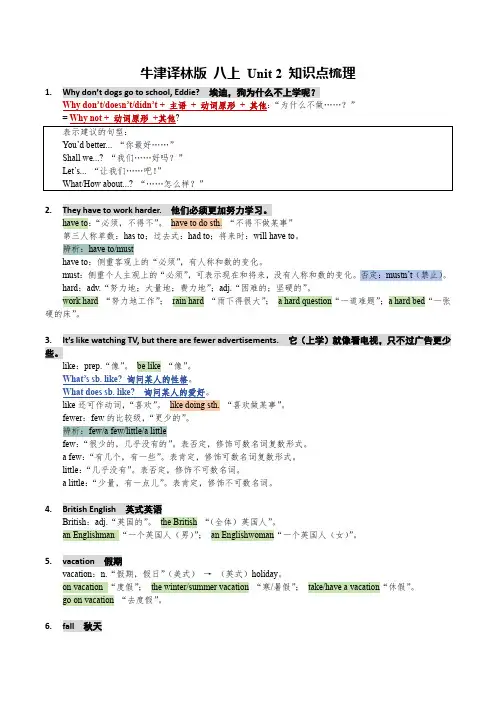
牛津译林版八上Unit 2 知识点梳理1.Why don’t dogs go to school, Eddie? 埃迪,狗为什么不上学呢?Why don’t/doesn’t/didn’t + 主语+ 动词原形+ 其他:“为什么不做……?”2.They have to work harder. 他们必须更加努力学习。
have to:“必须,不得不”。
have to do sth. “不得不做某事”第三人称单数:has to;过去式:had to;将来时:will have to。
辨析:have to/musthave to:侧重客观上的“必须”,有人称和数的变化。
must:侧重个人主观上的“必须”,可表示现在和将来,没有人称和数的变化。
否定:mustn’t(禁止)。
hard:adv.“努力地;大量地;费力地”;adj.“困难的;坚硬的”。
work hard “努力地工作”;rain hard “雨下得很大”;a hard question“一道难题”;a hard bed“一张硬的床”。
3.It’s like watching TV, but there are fewer advertisements. 它(上学)就像看电视,只不过广告更少些。
like:prep.“像”。
be like “像”。
What’s sb. like? 询问某人的性格。
“喜欢做某事”。
fewer:few的比较级,“更少的”。
辨析:few/a few/little/a littlefew:“很少的,几乎没有的”。
表否定,修饰可数名词复数形式。
a few:“有几个,有一些”。
表肯定,修饰可数名词复数形式。
little:“几乎没有”。
表否定,修饰不可数名词。
a little:“少量,有一点儿”。
表肯定,修饰不可数名词。
4.British English 英式英语British:adj.“英国的”。
the British “(全体)英国人”。
Unit2知识点讲义牛津译林版八年级英语上册

8AU2 School life 教师版【词汇过关测】【知识梳理】ic strip & Wele to the unit1)★ What’s school like?like prep.询问某人外貌:2)3)买东西给某人巩固练习●—What is your English teacher like? (立达)—.•She likes fruit and vegetables B. She is very kindC. She is fineD. She is 35●—What does he look like?—He’s. (星湾)•tall and humorous B. kind and goodlookingC. clever and helpfulD. big and strong拔高练习●Not all the (advertise) tell the truth. (译林)advertisementsReading● a mixed school一所混合学校●Learning foreign languages is fun.学习外语很有趣。
●bring in some books 带一些书来●★borrow sth. from sb. 从某人那借某物把某物借给某人借一段时间eg借) the book? Keep●be under discussion 在讨论中●★seemseem +adj. / to doIt seems that +句子●offer v.◆主动提出做某事★提供某物给某人●●1)v. 结束2)n. 末尾;结束★最后★在…结束的时候在…快结束的时候near the end of…反义词组:首先在…开始的时候在…快开始的时候near the beginning of●还有什么someone else 其他人●了解更多关于…●帮助某人某事帮助某人做某事巩固练习1)His new business 1,000 dollars.A.gets inB. brings inC. takes inD. lets in2)John is kind and helpful. He often his seat the old on the bus.A. offers; toB. offers; /C. offers; withD. gives; /3)this year, I will go to Suzhou for a job.A.In the end ofB. At the end ofC. In the endD. At the end4)Boys and girls, listen carefully. I have to tell you. This term, we willhave new students. We will have more fun studying together.A.else something; another twoB. else something; two moreC. something else; two anotherD. something else; two more5)together.6)It’s important to learn a f language well.(译林)foreign7)自愿给予) me 500 yuan to do the difficult job and I agreed.8)happy.9)他经常认真听我的问题并且给予我帮助。
Unit2知识点牛津译林版英语八年级上册
ic strip& Wele to the unit1.why don’t you do sth.? = why not do sth.?2.what’s school like?It’s like watching TV. (like 介词, +doing)3.an advertisement 一则广告4.British English / American English 英式英语/ 美式英语5.plans for the weekend 周末计划Reading1.in Year 8 = in Grade Eight = in the eighth grade名词+基数词(首字母都大写)= the +序数词+名词(首字母小写)2. a mixed school 一所男女生混合的学校3.discuss the books with our classmates 和我们同学讨论书4.have lessons 上课5.in class 在课堂上in the class 在班级6.Learning foreign languages is fun. 学习外语是趣事。
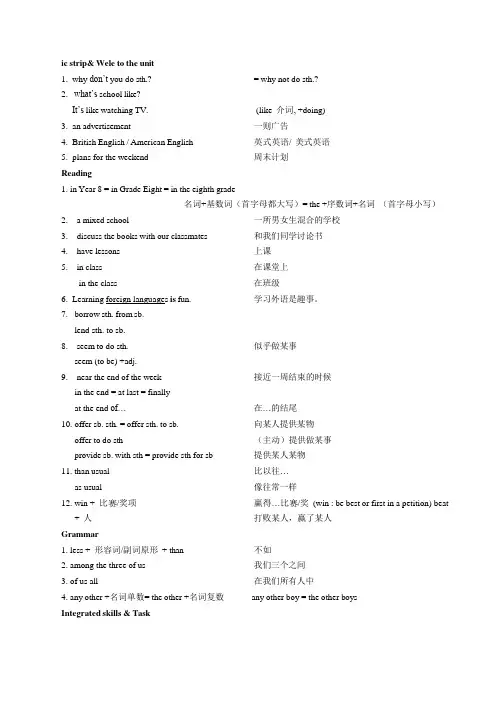
7.borrow sth. from sb.lend sth. to sb.8.seem to do sth. 似乎做某事seem (to be) +adj.9.near the end of the week 接近一周结束的时候in the end = at last = finallyat the end of…在…的结尾10.offer sb. sth. = offer sth. to sb. 向某人提供某物offer to do sth (主动)提供做某事provide sb. with sth = provide sth for sb 提供某人某物11.than usual 比以往…as usual 像往常一样12.win + 比/奖项赢得…比/奖(win : be best or first in a petition) beat+ 人打败某人,赢了某人Grammar1.less + 形容词/副词原形+ than 不如2.among the three of us 我们三个之间3.of us all 在我们所有人中4.any other +名词单数= the other +名词复数any other boy = the other boysIntegrated skills & Task1.wear uniforms / ties 穿着校服/ 打领带2.do morning exercises 做操exercise “锻炼”不可数,其余都可数3.have (some time )off 休息(一段时间),有…假期4.have time for sth / to do sth “有时间做某事”5.at most / at least 至多/ 至少6.look through 浏览,快速查看7.keep (on) doing sth 继续,重复做…8.go on a school trip 进行一次学校旅行9.one hour and a half= one and a half hours 一个半小时10.have an English test 进行一次英语测试11.at/on weekends= at/on the weekend 在周末12.at lunchtime 在午餐时间语法:比较级,最高级(2)构词:ly 后缀1. adj. + ly adv.2. n. + ly----- adj.real really day ----- d ailyusual usually week ----- w eeklyeasy easily month ----- monthlycareful carefully year ----- y early英式英语和美式英语对应表。
八年级上册英语译林版unit2知识点
八年级上册英语译林版unit2知识点本篇文章将介绍八年级上册英语译林版unit2知识点。
unit2主要围绕着“what’s the matter?”这一话题展开,讲述了在日常生活中,我们可能会遇到一些问题,需要询问对方“怎么回事”。
同时,还包括了一些询问病情和提供帮助的表达方式。
下面,我们将一一讲述。
Section A1. What’s the matter?“What’s the matter?”是句常用的问候语,意思是“怎么了?”在日常生活中,我们可能会询问朋友、同学和家人的状况。
例如:A: Hi, what’s the matter?B: I have a headache.A: Do you want to go to the hospital?2. I don’t feel well.“I don’t feel well.”意思是“我感觉不好。
”在询问对方是否需要帮助时,能够使用这个表达方式。
例如:A: Are you okay?B: I don’t feel well.A: Do you need to see a doctor?3. I have a sore throat.“I have a sore throat.”意思是“我喉咙疼。
”在病情询问时,这个表达方式非常常见。
4. I have a fever.“I have a fever.”意思是“我发烧了。
”同样也是在病情询问时经常出现的表达方式。
Section B1. Can I help you?“Can I help you?”意思是“我可以帮助你吗?”在看到别人遇到困难时,我们可以主动表示帮助。
例如:A: Can I help you?B: Yes, please. I’m lost.2. What can I do for you?“What can I do for you?”意思是“有什么我能为你做的吗?”同样也是在别人遇到问题的时候,我们可以主动询问并表示帮助的一种方式。
译林英语八年级上册unit2详解
1.vacation (名词)假期。
泛指一般的假期,多用于美式英语holiday 一般用于英式英语,常用短语:on vacation 在休假 go on/take a vacation 度假2. Wh don't/doesn't sb do sth.?=Why not do sth.? 表示提出建议,意思是“为什么不做某事”通常肯定回答用“OK,/All right/Good idea. "其形式为:Why don't/doesn't/didn't+主语+谓语动词原形+其他=Why not you+谓语动词原形+其他....为什么不...呢?¥例“Why don't you have a good sleep?=Why not you have a good sleep?"为什么不睡个好觉呢3.What's...like? 常用来询问对事物的看法,或者要求对方描述有关人,物的外貌或品德。
例What's your brother like? He is tall and handsome. 你哥哥长什么样?他高大英俊What's...like?常与How is...?互换例:What's the weather like in summer?=How is the weather in summer?夏天的天气怎么样?4.few,a few,little,a little|few 很少,几乎没有,表否定,修饰可数名词的复数a few 有些,有几个,表肯定,修饰可数名词复数(quite a few,a good few,not a few都表示相当多,不少之意)little 几乎没有,表否定,修饰不可数名词a little 一点,少量,表肯定,修饰不可数名词记住:few,little 有异同,few可数,little不可数,其前有a表肯定,其前无a表否定。
译林版八年级上册英语Unit2SchoollifeIntegratedskillsandTask讲解
Unit 2 School life Integrated skills1. Chinese students have fewer weeks off for the summer holiday than British students. (1) ___________________________________ 休息,休假星期一不上班__________________________解析:(1)have…off=take…c休息,休假;如:have Mo nday off星期一不上班2. How much time do you spend on your hobbies every day, Daniel? Half an hour for playing computer games and another half an hour for playing chess. I have only half an hour for my hobbies at most. I often do some reading.(1) spend的用法:花时间/钱在某事上____________________________________花时间/钱做某事____________________________________注意区分spend,cost,pay和take的用法及区别(2) 介词for 的用法:表示目的或用途,是“给,供,用于”的意思(3) 有(很多/没有)时间做某事 ___________________________________某人是时候做某事了。
_______________________________(4) 至多________________ 至少_________________(5) 做一些阅读工作__________________________________类似的词组还有:购物________________________________打扫,做清洁 _________________________________洗衣服__________________________________做饭__________________________________解析:(1)①spend+时间/金钱+ on sth在某事物上花时间金钱spend+时间/金钱+(in) doing sth花时间金钱做某事。
牛津译林版八年级英语上册Unit2 school life单元知识点汇总
牛津译林版八年级英语上册Unit2 school life单元知识点汇总Comic strip and welcome to the unit知识详析.积累拓展➊[辨异] clever, smart,bright的区别clever表示“聪明;灵巧”时,指人或动物的脑子灵活;指做成的事物时,常含有巧妙的意思。
如:People love to see the clever monkey.人们爱看这只聪明的猴子。
smart与clever 同义,但更强调顽皮的一面。
如:You can not cheat him because he is a smart boy.你骗不了他,因为他是个聪明的男孩。
bright意为“聪明;思路敏捷”,它多用来指年轻人或小孩,常用于口语中。
如:She is rally a bright little girl.她真是一个聪明的小姑娘。
❷[辨异]must和have to(1)must没有时态和人称的变化,后面跟不带to;而have to有时态和人称的变化。
②must not 的意思是“不许,不可以” ; don't have to的意思是“不必”③must带有主观因素,意思是“一定、必须”;have to带有客观因素,意思是“不得不”。
[中考典例)----- How do you usually go to school?----My school is far away.I______take the bus to school.A. mustB. mightC. have to答案:C 解析本题考查情态动词的用法。
因为前句说的是“我的学校很远。
”所以下句是“我得乘公交车上学。
”这里是客观因素导致了我乘公交车上学,因此此处用have to来表示。
❸few用作形容词时,意思是“少数的,不多的",修饰可数名词,作定语。
其比较级和最高级是fewer和fewest. few用作不定代词时,表示否定,意思是“少数几个、几乎没有”。