
豫园英文PPT简介
The night scenery of the zigzag bridge
The Dragon Wall
YU Yuan Old Street
Let's take a look at some famous scenic spots
Great Rockery (大假山)
Great Rockery(大假山)- it is the first scene visitors can see when entering the garden. It is the oldest and largest rockery in the area of south Yangtze River with a height of 14 meters. The top of the rockery is the best site for a bird’s view of the garden. At the foot of the rockery, there are surrounded old trees and beautiful flowers
Zigzag Bridge & Mid-lake Pavilion(九 曲桥&湖心亭)
they are the marks of the garden. Zigzag Bridge is 18 meters long and 2 meters wide, totally composed of granites and jade stones. It is a perfect leisure site with a pond and fish, pavilions on both two sides, stone tables and benches in pavilions. Mid-lake Pavilion is a primitive but elegant tea house with great traditional features
Yangshan Hall
Yangshan Hall(仰山堂)- it has a roundabout corridors(迂回走廊) in the face of the pond. It is a superior place to admire the Great Rockery and to appreciate the cultural inscribed stones of Orchid Pavilion Series by the famous Calligrapher Wang Xizhi
Yu Yuan Garden
Location
Yu Yuan Garden located in the center of the Old City next to the Chenghuangmiao area in shanghai , is considered one of the most lavish(奢华) and finest Chinese gardens in the region. The garden is accessible from the nearby Yuyuan garden Station on the Shanghai line 10.
History
The garden was first established in 1559 as a private garden created by Pan yunduan, who spent almost 20 years building a garden to please his father Pan En, a senior official in the Ming Dynasty, during his father‘s old age. Over the years, the gardens fell into disrepair(失修) until about 1760 when bought by merchants, before suffering extensive damage in the 19th century.
英语导游词豫园
Yuyuan GardenYuyuan Garden is northeast of the Old Town. A high official had it designed in the Suzhou style as a private garden and built from 1559-- 1577. Later, it was restored several times. In spite of its relatively small area of two hectares it seems considerably larger due to the skillful arrangement of 30 different landscape scenes.The garden consists of an inner and an outer section. The inner garden, neiyuan, is in the southern part and substantially smaller than the outer one, but then, it is more impressive and romantic, if it is possible to visit it in the early moring hours in order to enjoy it alone. An excellent calligrapher displays his work in one of the halls.the outer part is in the north and contains numberous halls, pavilions and lakes. In1853, the Pavilion of Spring in the northeast was the seat of the Xiaodao Hui, the Society of Little Swords, tho led an uprishing against Qing rule and occupied Shanghai for 17 months. Today, weapons and coins made by the Xiaodao Hui society, among other objects, are exhibited in this hall.A man-made, 11-m-high hill bounds the garden in the northwest. Huxin Ting teahouse is a favorite with the citizens of Shanghai. It is in the southwest, outside of the garden grounds, a two-story building resting on posts in the middle of a pond and connected to the shore by a 'Zigzag Bridge'.。
豫园 (yù yuán)Yuyuan Garden—中国古建筑及其故事英文版介绍
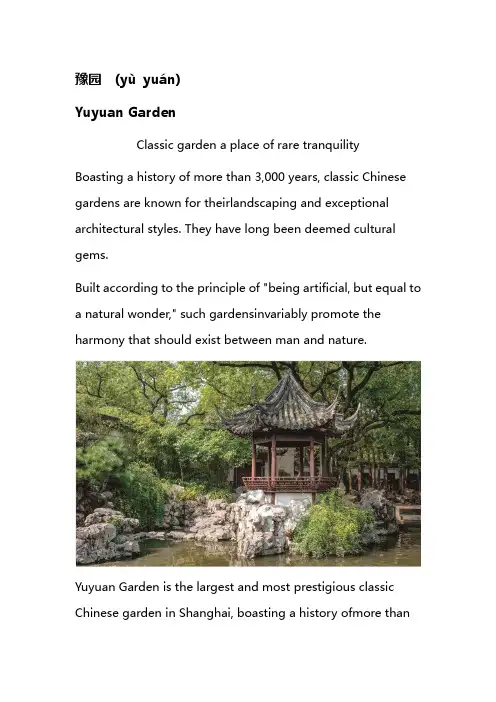
豫园(yùyuán)Yuyuan GardenClassic garden a place of rare tranquility Boasting a history of more than 3,000 years, classic Chinese gardens are known for theirlandscaping and exceptional architectural styles. They have long been deemed cultural gems.Built according to the principle of "being artificial, but equal to a natural wonder," such gardensinvariably promote the harmony that should exist between man and nature.Yuyuan Garden is the largest and most prestigious classic Chinese garden in Shanghai, boasting a history ofmore than450 years.Among them, Yuyuan Garden is the largest and most prestigious one in Shanghai, boasting ahistory of more than 450 years.The idea of building the garden was first conceived by Pan Yunduan in 1559. Pan was the son ofPan En, a minister of justice during the Ming Dynasty (1368–1644). The son decided to create agarden shortly after he failed the imperial examination.Pan picked the family's vegetable garden in the northeast of the Old City of Shanghai as the sitefor the project. But soon after construction began, Pan was appointed chief secretary of remoteSichuan in southwest China. The garden was not completed until Pan returned to Shanghainearly 20 years later. But before Pan died he had squandered most of his wealth and had to sell his lands andproperties to make ends meet. His granddaughter's husband inherited Yuyuan Garden. Through the years it changed hands several times and was used as the British army'sheadquarters during the First Opium War (1840–1842) and the Small Swords Society during theTaiping Rebellion (1851–1864).It also suffered severe damage during these occupations and later was further ruined byJapanese invaders in 1942.It was not until the late 1950s that the garden was fully repaired by the Shanghai government.Like other classic Chinese gardens, Yuyuan Garden —listed as a key historical site under stateprotection in 1982 —is known for its miniature landscapes comprising ponds, rocks, trees andflowers.It also houses a variety of halls, pavilions, towers and bridges. The garden is enclosed by a long white wall with five dragons made of black tiles crawling alongits top.In the center of the garden stands a very precious rock from nearby Taihu Lake. Known asYulinglong, or Exquisite Jade, the rock weighs about three tons and is reputed to be one of thetop three ancient "Taihu Rocks" in the Yangtze River Delta.Another attraction in Yuyuan is the zigzag bridge spanning a large lotus pond. Called Jiuqu Qiao,or Nine-Bend Bridge, it leads to the garden's entrance. In the middle of the pond and next to thebridge is a teahouse popular with visitors.Among the buildings in the garden, Dianchun Hall, or the Spring Heralding Hall, was once usedby the leader of the Small Swords Society as its headquarters.The hall was first built in 1820 by a merchant from Fujian Province.In addition to richly painted beams and doors and windows decorated with vivid woodsculptures, the hall faces a small stage, which stands partly in the surrounding water.Jiuqu Qiao, or Nine-Bend Bridge, leads to the garden's entrance. In the middle of the pond and next to thebridge is a teahouse popular with visitors.On the walls that divide the gardens into different scenic areas, there are a number of latticewindows. Such ornamental windows are frequently employed in Chinese gardens to create theeffect of "each window having its own view" and "one scenic view in another."In the garden, there are also a few waterside pavilions which provide visitors a place to rest andtake in the sights.Partly built on stilts above the water, such waterside pavilions are also an ideal location to look atlotus flowers when inseason or watch the fish leisurely swimming in the pond.The garden is enclosed by a long white wall with five dragons made of black tiles crawling along its top.Pictorial dictionary·水榭(shuǐxiè) waterside pavilionWaterside pavilions are common in classic Chinese gardens.Built partly on stilts above the water, a waterside pavilion is designed to provide travelers orvisitors a place to rest and take in the surrounding sights.On the water side, there is usually a long bench with a low railing, where people can sit and gazeat the water plants such as lotus flowers or watch fish swimming in the pond.Such pavilions usually feature gable and hip roofs with flying eaves and richly decorated windowsextending all the way to the floor.They are also designed with salient horizontal lines in order to create harmony with the surfaceof the water.。
豫园介绍ppt课件

会景楼、九狮轩
九狮轩
会景楼位于豫园 中央,登楼可观全 园景物,故名“会 景楼”。 九狮轩在会景楼 西北,1959年重 修豫园时,拆去民 宅,凿池垒石,池 北筑轩,名“九狮 轩”。
17
中部景区
中部景区有得月楼、绮藻堂 得月楼建于清乾隆二十五年(1760年)后,光绪十八年(1890 年)重建,取“近水楼台先得月”之义而名。四面环水。 皓月当空时,俯视湖心亭、九曲桥上月光,别有情趣。清代 上海人王萃龠禾一副描写得月楼的联语“本地风光,旧时月 色”,耐人寻味。 绮藻堂位于得月楼下,以“水波如绮,藻彩纷披”而名。堂 内装潢美观,别具一格。堂檐下有100个不同字体的木雕 “寿”字,称为“百寿图”,富有民族特色。
34
谢
谢
完
观 赏
35
27
绿化种植
该园的绿化的特点是古树名木多、大盆景多、摆花多。全园共有乔 灌木670余株,常绿和落叶树约各占一半。古树名木有27株,其中百 年以上20株,200年以上5株,300年以上2株。在万花楼前的一株古 银杏已有430余年树龄,在静观大厅前的一株白皮松,树龄已有200 余年,每年花开繁盛,为上海所罕见。鱼乐榭南侧的一株老紫藤,树 高4.2米,有300余年树龄。在亭、台、楼、阁、厅、堂、廊榭的周 围栽植银杏、女贞、广玉兰、白玉兰、紫薇、瓜子黄杨、白皮松、 罗汉松、桂花、茶花、茶梅、香樟、紫藤。有的地方摆设了铁树、 五针松、罗汉松等大盆景。在群置、散置的湖石间与桥旁栽植青枫、 五针松、茶花、桂花、杜鹃、瓜子黄杨、黄馨等,在墙脚下植常绿 的箬叶、天竹、麦冬、竹、盆花等。整个园内树木苍翠,层次分明, 体现了明清两代古典园林的艺术风格。
28
豫园活动
豫园成为城隍庙西园以后,一直免费开放,东园于每 月朔望之日也对外开放。豫园是城内游览和举办各种 活动的主要场所。豫园举办各类花展历史悠久,还有 重阳节登高望远活动、元宵节灯会等游艺活动,平时 常举办奇石、书画展和茶道活动等。这些传统民间活 动在日军占领上海后基本上停办。1979年以后,花展、 灯会、书画展等活动相继恢复。
上海豫园英语介绍
Location
• Yuyuan Garden, located in the southern part of Shanghai, is a famous classic garden. It is characteristic of the architectural style of the Ming dynasty.
• Opened up to the public in 1961, the attraction was included in the important heritage sites under state protection in 1982. During the celebration for 440 years anniversary in 1999, the former general secretary Jiang Zemin inscribed a title for the garden as Famed Garden by the Sea, which now standing in the garden for admiring. The British Queen Elizabeth Ⅱ, the US President Clinton, the German President Herzog, the Japanese Prime Minister Murayama, and other chiefs and honorable guests from other countries also had visits in Yuyuan garden during their stay in Shanghai.
• Covering an area of 20 000 square meters, the attraction can be divided into four parts, the Eastern Area, the Western Area, The Central Area and Internal Garden. Each part owns distinguish features within several characteristics scenic spots. There are totally 48 masterly partitioned scenic spots in the garden, providing visitors a different scene at every step. Chambers, pavilions, halls, rockeries, terraces and waters all reflects the style and features of Ming and Qing dynasties' gardening art of the south of the Yangtze.
上海豫园英文讲解词

上海豫园英文讲解词Yuyuan Garden, located in the southern part of Shanghai, is a famous classic gard en. The owner of the garden, Pan Yunduan, once a treasurer of Sichuan Province, had the garden built to please his parents in their old age. Hence the name of the garden “Yu”, which means “pleasing one’s parents”.The construction started in 1559 but went on and off for lack of money and di d not come to completion till 28 years later. Unfortunately, Pan’s father did not live to see the garden completed. What’s more, the Pans went down the drain and his descendents were eager to sell the garden. Some businessmen soon bought it at a low price and incorporated it into the City God Temple to become its “West Garde n”, and later turned it into many trade guild offic es. During the Opium War and the Taiping Revolution, foreign aggressors stationed their troops in the garden for mor e than once. So, the garden experienced repeated calamities in its history and lost much of its former grandeur. With the care of the people’s government since 1949, Yuyuan Garden has gone through many renovations with the recent one carried ou t in 1987 to restore its eastern part. And since 1982, it has been under the special protection of the State Council.Yuyuan Garden is a residence garden and one of the best in southern China. Al though a small one, with an area of only 2 hectares, it strikes visitors as quite larg e because of its zigzag layout. With pavilions, halls, chambers, towers, ponds and r ockeries, it presents more than 40 vista points. At least 10,000 people visit the gar den every day. No wonder people say “Those who have come to Shanghai but miss ed Yuyuan Garden and the City God Temple Bazaar cannot claim that they have be en to the city.”Before entering the garden, you will see a beautiful lotus pond. Across the pond is a bridge with a pavilion in the middle. The Mid-lake Pavilion was rebuilt in 1784 and converted into a teahouse 80 years ago. One of the best in Shanghai, the tea-house is a popular place for senior citizens, who enjoy chatting with each other ov er a cup of tea.By the tea-house is a nine-zigzag bridge. The bridge is an indispensable part of a Chinese garden. It divides up the water space. A zigzag bridge slows down visit ors’ pace so that they may enjoy the scenery more leisurely and it also enables the m to have a different view whenever they make a turn. But why nine zigzags? It is because “nine” is the biggest digit before ten and is, therefore, a lucky number.This is the Three Corn-ear Hall, the largest and tallest in the garden. Called the “Hall of Happiness and Longevity” at fir5st, it was a place where the host entertai ned his guests and held banquets. There are three plaques in the hall. The top pla que is “Mountains and Forests in the City”. It expresses Pan Yunduan’s love for lan dscape. As Shanghai lies in a flat country with no mountains or forests around, he had the garden built with plenty of trees and plants and rockeries, hoping to bring natural beauty into it. The middle plaque is “Lin Tai Jin Shi”. “Lin Tai” refers to the high terrace where the King of Zhou Dynasty offered sacrifices to his ancestors. Th e hall used to be a place for the gentry to explain and study the imperial edicts, s o this plaque is used to suggest this function. The third plaque is “Three Corn-ear Hall”. After the hall was turned into an office for the rice and bean businessmen, t he name was changed into “Three Corn-ear Hall”, reflecting the wishes of business men for a rich harvest. For the same reason, there are crops and fruits carved on the doors of the hall.Yuyuan Garden boasts many lattice windows, which are found in the corridors a nd on the walls. They were covered by papers or foils of shells 400 years ago befo re glass was introduced as construction material. Built with a mixture of clay, lime and alum, each of them presents a different design. On the windows near the Thre e Corn-ear Hall are designs of pine, crane, and linzhi herb, which symbolize fortune, wealth, longevity and happiness.Behind the Three Corn-ear Hall stand the Yanshan Hall (Hall for Viewing the Mo untain) built in 1866. Opposite the hall is a beautiful rockery. Designed by Zhang Nanyang, a famous landscape architect, it is a rarity in southern China. While sipping tea with your friends in the hall, as the owner did, you can enjoy the rockery in f ront. As is described by the words on the plaque in the hall “High Mountain Ridge s”, the 12-merter-high rockery hill, dumped with 2,000 tons of rocks, is noted for it s steep cliffs and hidden, winding paths. It is no exaggeration to say that the rocke ry is the crystallization of the wisdom and creativeness of the working people as to move the rocks from 200-kilometer-away Wukang in Zhejiang Province alone was n o easy job at all. What is more amazing is that the rocks were stuck together by c ooked glutinous rice mixed with alum and lime, for at that time cement was not av ailable. Visitors feel as if they were on real mountain ridges once they ascend the r ockery covered with trees and flowers and with streams flowing down the slopes int o the pond below. The pavilion on the hilltop, the highest point in Shanghai 400 ye ars ago, commanded an excellent view of the Huangpu River by sails and masts, h ence the name “Pavilion for Viewing the River”.Above the Yangshan Hall is the “Rain Rolling Tower” with its named derived fro m the Tang Dynasty poet Wang Bo’s poem. A verse of it reads “Dusk finds the pea rl curtain rolling up the rain drifting from Western Hill.” It is true that on the four sides of the hall there used to be pearl curtains, which gave off a kind of rain-like sound against the wind. While enjoying in the hall the excellent views of the rocker y and pond full of lotus blossoms and goldfish, visitors seem to hear the sound of rain, thus feeling carried away by the poetic surrounding with mountains in the rai n.Behind the rockery is a wall topped with a dragon, called the reclining dragon. There are five dragon walls in the garden, dividing the garden into different scenic sections.In Yuyuan Garden there are many brick carvings and clay sculptures, dating bac k to the Qing Dynasty, 300 years ago. Here is a clay sculpture called “Plum Wives and Crane Sons”. The legend connected with the carving describes Lin Heqing who loved plum and crane as if they were his wife and son. Hence the title. Though a great poet, Lin fell out of favor. Disappointed, he lived in seclusion in a country co 9ttage on the Gushan Hill in Hangzhou. During the twenty years of his stay there,he did nothing but plant plum trees and raise a crane. Every year, when the plum bloomed, he simply stayed at home and enjoyed the plum blossoms. That was why he was able to write a number of beautiful poems in praise of plum trees, which have ever since been greatly admired and recited by people. His crane Wuno was a lso a great help to him. When, occasionally, his friends called on him and found hi m out, his crane would fly around. Seeing the crane, he got the message that woul d return home immediately to receive his guests. The death of its master mad the crane so sad that it stood in front of his tomb day after day, crying till it died. The crane was buried not far from Lin’s tomb. By the side of Wono’s tomb, a pavilion, the Crane Pavilion, was built in memory of this faithful and loyal wading bird. Perh aps, Mr. Pan Yunduan used this clay sculpture to express his idea that he and Mr. Lin Heqing had the same fate.The brick carving on the right describes a warrior who came out first in the mili tary examinations at three levels.At the entrance to the corridor are two iron lions. Cast in the Yuan Dynasty, th ey are nearly 700 years old. Iron lions are very rare in China as most of them are made of wood or stone. Regarded as the king of animals, lion signified “dignity” an d “majesty”. Such lions, usually put in front of palaces or courts, were meant to sh ow the owner’s prowess. It is very easy to tell the sex of the two lions. The rule is that the female one is always put to the left while the male one stands on the rig ht. What is more, the female lion fondles a baby, while the male plays with a ball. There is an old saying in China, “The lion’s cub has to learn how to rough it.” Th e mother lion makes it a point to give the baby a hard time so that it will be train ed into a brave animal. From the way the lion keeps it under her paws, we know t hat it is the female.These two lions were originally found in Anyang County, Henan Province. They were shipped to Tokyo and did not return to China until the victory of the Anti-Jap anese War in 1945. However, they were put among scraps under the KMT’s regime, which did not care about the historical relics. They were recovered after 1949 and moved to this garden.We are now walking through the corridor. A corridor provides the link between buildings in ancient gardens. Appearing in different forms---straight or zigzag, high o r low, hill-climbing or water-hugging, a corridor is a visitor’s guideline. It divides up the space and combines the views. With every step the visitor takes following a co rridor, the view changes. A technique in building court gardens is to create parallele d views. That is to say the pavilions, halls, chambers, and towers should match eac h other. Here is a case in point. Standing on the Rain Rolling Tower and looking o n the right, visitors seems to see a landscape painting dominated by the rockery re sembling a real mountain. When visitors on top of the rockery cast their eyes to th eir left, they will be struck by a genre painting centered on towers and chambers with pavilions, bridges, and ponds tucked away as the background.The rock in the middle of the corridor looks like a young lady. It serves to bloc k the scenery behind. It is another technique in Chinese garden building.The plaque abo ve says “Gradually Entering the Wonderland”. It means that you should slowly follow the winding corridor in order to really appreciate the beautiful views ahead.You can now see another brick carving on your left. The old man holding a wal king stick is the God of Longevity. He is distinguished by an abnormally large, protr uding forehead, which is deeply lined and crowned with snow-white hair. He is a le gendary figure said to be in charge of the life span of mankind. Above the God of Longevity is the Goddess of Mercy.This is Happy Fish Waterside Pavilion. Surrounded by water on three sides, it is a good place for enjoying goldfish swimming happily in the pond. The pavilion ofte n reminds visitors of the dialogue between two ancient philosophers, Zhuang Zi and Hui Zi. Once they came to a pond like this, Zhuang Zi said, “The fish must be ver y happy.” Hui Zi asked him, “How do you know they they are happy since you are not fish?” The former answered, “How do you know that I do not know they are happy si nce you are not me?” Visitors do find themselves in a happy frame of mind when they hear the sound of flowing water and see the goldfish swimming freely i n the limpid water of the pond.This small area itself is a garden as it is completely with the basic elements call ed for by a Chinese garden: plant, water, building, and rock. The pond, partitioned in the middle by a crenellated wall with the water flowing through an arched openi ng at the foot of the wall, looking deeper and longer than itself. This is what we c all creating the maximum space out of a small area. If your eyes follow the stream beyond the arch, you will see in the water the reflection of people and scenery on the other side of the wall. This is the technique of “scenery borrowing”. It means using the scenery “borrowed” from outside the wall as the setoff to enrich the view s inside and make the two become one.There is a 300-year old wisteria at the corner. It is said the tree once withered but came into bloom again. Some people regard wisteria as a symbol of welcomin g guests. When summer sets in, the tree is laden with white, butterfly-like flowers, which give off refreshing fragrance.This is the Double Corridor partitioned by a wall with open windows. When you look through the windows, you will see different views like traditional Chinese paint ings in frames. This is another technique in Chinese garden building called “scenery framing”. One side of the corridor presents you with chambers, towers and a hous eboat, which are all static. The other side provides you with the views of water, tre es and flowers, which are all in motion. As you walk along, the pictures are changi ng like pictures.At the end of the corridor is the Chamber of Ten Thousand Flowers. It is so ca lled because there used to be fresh flowers here all the year round. Designs of pla nts and flowers are carved on the doors and windows. Particularly eye-catching are the designs on clay sculptures of the orchid, the bamboo, the chrysanthemum, and the plum at the four corners of the chamber, representing spring, summer, autumn and winter respectively. The furniture with carved flowers in the chamber are over 200 years old. In front of the chamber are many rocks brought here from Taihu L ake. Eroded by water, they are in different shapes, many, interestingly, resembling animals.Here are two ancient trees: one gingko and the other, magnolia. It is said that Mr. Pan Yunduan’s father planted here 400 years ago two gingko trees, one male a nd the other female. Later the female gingko died and a magnolia was planted in it s place. Known as “living fossil”, gingko trees used to grow profusely about 146 mil lion years ago, but are now on the brink of extinction. It is also called “gongsun” t ree because it grows so slowly that the grandfather plants the tree and the grands on picks the fruit. The tree looks like a large parachute because its dark green leav es resemble small fans. Its seeds and leaves can be used for medical purposes.If you look up, you will see the second dragon on top of the wall. The dragon sprawls on the wall, with its head raised high, ready to mount the cloud. Hence th e name “Dragon Mounting to the Clouds”. Dragon is a mythical animal. It is said dr agon could call up wind and waves. Fairies rode on them or used them as messen gers. Dragon is said to have horns like a deer’s antlers, the head of an ox, eyes of a shrimp, the body of a snake, scales of a fish, and talons of an eagle. Regarded as something sacred and the symbol of the emperor, dragons were used to consoli date the rule of the feudal rulers in ancient China.The dragon has, in its mouth, a pearl which is its life-line. There is also a toad under its mouth. It is said that these two animals depend on each other for surviv al. The toad lives on the saliva of the dragon. The dragons in the garden all have three talons instead of five. It is said that the owner did this on purpose because t he dragons in the imperial palace had five talons and he did not want to offend th e emperor by having the same kind of dragons.This is the Spring Hall (Dian Cun Tang). Being one of the three treasures in Yu yuan Garden, it was built around 1820. the name of the hall was derived from one of the poems by Su Dongpo, a great poet in the Song Dynasty. The name Dian C un also means ordering one’s favorite theatrical work. In Chinese, Dian means order ing or choosing, while Cun means theatrical work. The Pans used to sit in this hall and appreciate the performances given on the stage just in front of it.In 1853, people in Shanghai organized a secret society---the Small Sword Society---i n response to the Taiping Heavenly Revolution, a peasant uprising against the corru pt Qing government. It was an uprising on the largest scale, with the longest durati on and greatest number of participants in the contemporary history of Shanghai. Th e uprising army once headquartered its northern city command post in this hall. Th e army took the city and held out for one and half years before it was defeated by the reactionary Qing government in collusion with the foreign powers. However, th e uprising dealt a heavy blow at the ruling class. It had remained desolated since t he defeat of the uprising. However, after the founding of New China, this hall was restored by the Shanghai local government in 1956 and has been serving as a base for the patriotic education. There is, on the wall, a traditional Chinese painting na med “Appreciating the Sword”. It was made by a famous Qing Dynasty painter Ren Bonian, who once took part in the uprising. The Spring Hall is now an exhibition h all, displaying some pictures, weapons, and coins used by the Small Sword Society.The stage in front of the hall was built partly on water and partly on land. On the roof of the pavilion stage are some clay figures from the Chinese classic novel “The Romance of the Three Kingdoms”. The building on the left, when viewed from the front, is a stage but looks like a pavilion on the water when viewed from the back.The two-storied structure over there is the “Tower of Happiness” built with Taih u rocks in the shape of clouds. The tower, like a “castle in the air”, seems floating amidst clouds. This scenic section, centered on the “Tower of Happiness” with othe r buildings around and dotted by rockery, wat er and “clouds”, presents a mythical t ouch. Arriving here, visitors feel like entering a fairyland.This is the Hall of Mildness, located between a pond and a huge rock. The hall, bright and spacious, with windows on four sides, is cool in summer and warm in winter. Please have a look at the furniture on display in the hall. The furniture is m ade of banian tree roots with a history of over 200 years. The decorations in the h all are also made of banian tree roots---the phoenix on the right, a “Ru Yi” or say “As you wish”, an ornamental object in the middle, and a unicorn on the left.On top of the wall here are the third and fourth dragons with a pearl between them. They are called “Twin dragons playing with a pearl”. On festive occasions str eets packed with people present a bustling scene, whereby twin dragons manipulate d by players dance and fiddle with a pearl.Here is another famous piece of brick carving, “Eight Immortals Crossing the Se a”. Each of the immortals had some magic power and wor king together they manag ed to cross the rough sea. It implies the meaning that when people working togeth er with concerted efforts, they will finally succeed.This is the eastern part of Yuyuan Garden. It was leveled to the ground after the Opium War but has recently been restored. Following the Mind Dynasty-styled “Sprin g Corridor” flanked by green bamboo, visitors will see Huijing (Scenery Gathering) T ower, the center of one of the three scenic sections in the eastern part. The tower, built in 1870, commands an excellent view of the whole garden. Not far from it is the Nine-Lion Study erected in 1959. visitors may stop in front of the tower and e njoy the elegance of the pavilion in the distance. Or they may cross the stone brid ge and following the stone path leading to it. Ascending the pavilion, they may enj oy the sight of the lotus blossoms in the pond or appreciate the tranquility of the p avilion tucked away amidst ancient trees.Besides a rockery stands another pavilion called Liushang (Toasting). Its shadow s are thrown onto the pond. It is recorded that on March 3rd of the lunar calendar every year, men of letters in Shanghai would gather here and compose poems ove r a glass of wine like Wang Xizhi (a famous calligrapher 1,700 years ago) and his f riends did in Lanting Pavilion.Next to the Liushagn Pavilion is a three-zigzag stone bridge spanning the water. Walking on the bridge, one feels like tiptoeing on water.On the far end of the bridge is a wall with a moon-shaped door. The words “Yi ngyu” or leading to the jade” are above the door. The grotesquely-shaped huge rock behind the door will arouse visitors’ curiosity. You will hastily enter the next sceni c section---the Exquisite Jade Stone.Once entering this section, you will fin d yourself in a world of “jade”. The huge rock, the Jade Magnificence Hall, the beautiful rockery peak and the wonderful corr idor all contain in their names the Chinese character “yu” or jade. Even the Yulan (magnolia), Shanghai’s city tree newly planted in front of the hall means “white jad e orchid” in Chinese.The 3.3-meter-high Exquisite Jade Stone is a rare treasure and, actually, one of the three best in China. The other two, one in Beijing and one in Suzhou. It was one of the many valuable rocks which should have been sent to the Northern Song Dynasty Emperor, Huizhong, a rock collector. But it got lost while being transporte d from the south to the northern capital Kaifeng. It finally ended up in a private ga rden in Shanghai’s Sanlingtang, east o f the Huangpu River. The owner, a local offici al, when marrying his daughter to the younger brother of Pan Yunduan, presented the rock to his son-in-law as a dowry.The rock is noted for its slender shape, permeable nature, wrinkled surface and numerous holes, 72 in all. Water poured on the top drips down through the holes, while smoke from incense sticks burned below coils up through them.The Jade Magnificence Hall was used as the study by Pan Yunduan. It is said t hat Pan would come to the hall every day and look for a long time at to Exquisite Jade Stone. He thus felt delighted and was inspired to write. The hall has been res tored with ancient books, writing brushes and an ink stone on display.Jiyu Peak used to be in the eastern part of the garden. After the damage done to this part, some remains of Jiyu Peak lay for a long time by the roadside. In 19 56, Chen Congzhou, an eminent architect and professor at Tongji University in Shanghai, discovered them. They were moved to the present site during the recent reno vation. “Jiyu” means piling up of numerous pieces of beautiful jade.The Jiyu Corridor, which is over 100 meters long, was built in the style of the Mind Dynasty. It is the longest water-side corridor in China. It is so called because Jiyu Peak stands on it. Added to it are some stone tablets, bearing important dates about the garden. This is considered by Chen a valuable piece of “jade” in the gar den.To the west of the Jade magnificence Hall is the Moon Tower. The name aptly implies that the jade is as bright as the moon. Ascending the tower on the 15th ni ght of August of the Chinese lunar calendar, people will enjoy two bright moons: o ne in the sky and the other reflected on the pond below. The Moon Tower is, actu ally, the upper part of a two-storied structure built by a pond in 1883. below the “Moon Tower” is Qizhao Hall, an ideal place for enjoying the beautiful lotus in the pond. There are sixteen screen doors in the winding corridor in front of Qizhao Hall. On each of them there is a carved picture of ploughing and weaving. On the eave s of the hall, there are many Chinese characters of “longevity” carved out of wood. They are called “hundred-longevity map” with distinct national feature.On the eastern wall is a nother brick carving “Guang Han Palace”. It is a palace in the moon according to a legend. The lady in the middle of the brick carving is C hang E, known as the Moon Goddess. She flew to the moon after swallowing an eli xir of immortality stolen from her husband, Hou Yi, who got it from Xi Wangmu (H eavenly Empress) of the Kunlun Mountains as a reward for shooting down nine sun s in the sky. Wu Gang is another legendary figure on the moon. As he had made s ome serious mistakes while studying under a deity, he was ordered to fell a cassia tree growing on the moon. Every time Wu Gang raises his axe, the cut he has just made grows over, so he must go on chopping for eternity.To the south of the Exquisite Jade Stone are the screen wall and the Coiling Dr agon Bridge. Both are new additions built in the Ming style. Carved on the wall are the four Chinese characters “Huan Zhong Da Kuai”, meaning “happiness under heaven”. What is now one of the exits of the garden used to be the entrance. Once M r. Pan entered the ga rden, he would enjoy the “worldly happiness first and then ap preciate the rest of the beauty in the garden.The eastern part of the Yuyuan Garden, only 0.5 hectare in size, has ponds taki ng up 60 percent of the total area. The halls, pavilions, chambers and bridges and their reflections on the water contrast wonderfully with each other, making the area loo much larger in size.Here we are in the Inner Garden, formerly the back garden of the City God Te mple. It was reconstructed in 1709. this typical Qing Dynasty-styled garden only cov ers 0.14 hectare but is exquisitely and tastefully laid out. How apt it is to call this a garden with a garden!Here is the Hall of Serenity, the main building in the Inner Garden. If you stan d in front of the hall and quietly look at the rocks opposite, you will, again, find th at many of them are in the shape of animals.Two stone lions squat on both sides of the hall. Each of the lions has a small ball in its mouth. The stone ball is carved inside the lion’s mouth.There are some sculptures on the roof of the hall. The one on the left is Yue F ei, a famous general of the Song Dynasty. To this day, people still speak highly of him for his meritorious deeds of resisting the Jin invaders.This is the Nine-Dragon Pond built with Taihu rocks. There are actually only fou r dragons carved on the rocks, but with their reflections on the water and the pool itself in the shape of a dragon, they make up nine dragons altogether.This brick carving “Guo Ziyi Being Congratulated on His Birthday” is a pice of ar t work of the Qing Dynasty going back 300 years. Guo Ziyi, a general of the TangDyansty, suppressed the rebellious minister An Lushan and later drove away the inv ading enemy. He was once looked up as a symbol of happiness, fortune, and longe vity.This is the Sleeping Dragon, the last of the five dragons in the garden. Its scal es are carved out of clay while those of the others are made of tiles.On top of the rockery stands a two-storied pavilion. Stopping here for a brief re st, you may enjoy the beautiful views around the feel delighted.This is a stage built in the Qing Dynasty-style with exquisite carvings and elabor ate decorations. It is the oldest and largest stage preserved in perfect conditions in Shanghai. On the sides of the stage are two-storied buildings for audience to watc h performances from both floors.。
英语导游词之豫园 原创
The Yuyuan GardenWell my friends, welcome to shanghai. My name is **. I’m going to be your tour guide. As an old saying in China goes: fate will bring you together if you are meant to be. It sure is fate that we are sitting side by side in the same bus to spend holiday together. Today, i will bring you to appreciate the charm of the Yuyuan Garden.Before we arrive at our first destination—Yuyuan Garden and environs, please let me introduce the it briefly to you.Yuyuan Garden and environs is located a few blocks south of the Bund. The locals call it the Old Town or the Old City Temple as the temple used to be the center of the public life. Before the concessions were established in Shanghai in the mid-19th century, this area had been the downtown of Shanghai for several hundred years.Yuyuan Garden was built by Pan Yunduan, who was the administrative commissioner of Sichuan in Ming Dynasty and its designer was Zhang Nanyang, who was famous at that time.In 1760, the garden was offered for sale by Pan family heir, who had apparently fallen on hard times. Money for it was raised by the transport merchants of Shanghai, who donated the garden to the City Temple. The former Yuyuan Garden was no longer private but rather open and accessible to the public.During the Opium War the garden was ransacked by British officers who were barracked here and again bu the French during the Taiping Revolution.People always call Yuyuan Garden the "shopping paradise" because there are more than 10,000 different kinds. And it’s also known as the “Commodity kingdom", many century-old shop and famous brand stores have settled there.In addition, Yuyuan Garden and environs are also known as the "snacks Kingdom”, the food from all parts of the country and world gathered here.As the old towns in most cities, Yuyuan Garden and environs seem to naturally invoke nostalgia(乡愁) and memory in the visitors. When the locals feel like enjoying some leisure, they would habitually come to the Old Town. Among the visitors, this area tops the list of traditional attractions in Shanghai.A trip to Shanghai, they say, is never complete without a visit to the Yuyuan Garden and environs.Perhaps you want to know more about these. Don’t worry, I will do specific explanations to the various attractions later.Now, we will soon arrive at the first scenic spot--Jin Mao Tower,. I hope all of you will enjoy this trip.That’s all of my brief introduction to the Yuyuan Garden, thx.这个就是我当时抽到的景区,我讲的就是以上的导游词,因为我觉得这个景区比较难背,所以我准备的导游词并不长,你如果要背这段的话语速不能过快啊!我建议是你把5个景区的导游词自己写一遍啊!这样的话印象会很深。
东方明珠和豫园的英文简介
The Oriental Pearl TV TowerWalking along the beach, we can see the Shanghai Oriental Pearl TV Tow er standing like a giant on the other side of the Huangpu River. It's visited by thousands of people from different parts of the country and the world every day.The Shanghai Oriental Pearl TV Tower, which can be seen from far away, is 468: meters tall, It's the tallest TV tower: in Asia and the third tallest in t he world.From the TV tower, we can get a clear view of the whole city. Its c onstruction was started in 1991 and completed in 1994. Soon after that, it was opened to the public.Now it has become the centre of the culture, entertainme nt and tourism in the city of Shanghai.The Shanghai Oriental Pearl TV Tower is the symbol of the rapid develop ment of Pudong in recent years. We're all proud of it.( 146 words)东方明珠电视塔漫步江滩,远远可见上海东方明珠电视塔像一个巨人屹立于黄浦江畔。
豫园英语介绍七年级
篇一:豫园位于上海南部,是一座古典园林。
豫园的建设保持着明代的风格。
Location:Yuyuan Garden,located in the southern part of Shanghai,is a famous classic garden.It is characte ristic of the architectural style of the Ming dynasty.History:1.Pan Yunduan,once an official of Sichuan Province,there is another saying that he was a treasur er,had the garden built to please his parents.The garden’s name“Yu”means“Pleasing one’s pare nts”.2.The construction started in1559but went on and off for lack of money and did not plete until t wenty-eight years later.3.Some businessmen bought it at a low price and later make it the City God Temple’s West Garde n.During the Opium War and the Taiping Revolution,it was occupied and experienced a lot of dis asters,so it lost much of its former grandeur.After the liberation of Shanghai,the people’s govern ment makes many renovations to Yuyuan Garden and it opened to public at last in1987with a tota lly new look.篇二:Yuyuan Garden is northeast of the Old Town.A high official had it designed in the Suzhou style as a private garden and built from1559-ter,it was restored several times.In spite of its relatively small area of two hectares it se ems considerably larger due to the skillful arrangement of30different landscape scenes.The garden consists of an inner and an outer section.The inner garden,neiyuan,is in the southernpart and substantially smaller than the outer one,but then,it is more impressive and romantic,if it is possible to visit it in the early moring hours in order to enjoy it alone.An excellent calligrapher displays his work in one of the halls.The outer part is in the north and contains numberous halls,pavilions and lakes.In1853,the Pavil ion of Spring in the northeast was the seat of the Xiaodao Hui,the Society of Little Swords,tho le d an uprishing against Qing rule and occupied Shanghai for17months.Today,weapons and coins made by the Xiaodao Hui society,among other objects,are exhibited in this hall.A man-made,11-m-high hill bounds the garden in the northwest.Huxin Ting teahouse is a favorite with the citizens of Shanghai.It is in the southwest,outside of the garden grounds,a two-story building resting on posts in the middle of a pond and connected to the shore by a‘zigzag bridge’.。
英语版上海豫园导游词
The Yuyuan Garden Area 豫园景区(景点概述)Ladies and gentlemen, we are now at Yuyuan Garden AreaThe Yuyuan Garden area is located a few blocks south of the Bund. The locals call it the Old Town or Old city Temple as the temple used to be the center of the public life.It is the origin of the city of Shanghai in 1292. The city of Shanghai was born on the west bank of the Huangpu River In the next hundreds of years it developed into an influential urban center in this region.In the 1990s, a part of this former urban center was restored. The restored area contains some popular attractions, including the City God Temple, The Yuyuan Garden, the Huxingting Teahouse and the Bridge of Nine Turnings, and a big number of traditional shops and restaurants.The major portion of this area is taken up by more than 100 specially shops and restaurants. It is a place you are likely to chance upon those odds and ends(小玩意) and native products which are not available in shops on the main streets.The Shanghai Old Street is a great stop for souvenir shopping. Here you could find a series of quaint crafts shops and some century-old stores and teahouses.Standing on the Shanghai Old Street is the City God Temple, a Taoist house of worship of several hundred years. The temple was dedicated to two gods, Huo Guang, a widely acclaimed ancient general In the Ming period, Qin Yubo, a respected local scholar, was made the new city god. Two gods are housed in the temple.At the north of the temple lies the Yuyuan Garden, a classical garden of more than 400 years. It was originally a private garden built between 1559 and 1587. The owner named Pan Yunduan, planned it as a retreat for his father, a former cabinet minister. The completed garden was rated one of the best gardens south of the Yangtze River. In 1760, some merchants bought the garden and donated it to the City Temple. The former private garden was open to the public and a few common-trade guilds were set up in it. In that period, the garden was massively renovated with new pavilions and halls added.Since the 1950s, the garden has been renovated a couple of times, and it is listed as a National Heritage. Occupying an area of just 2 hectares, the restored garden is a pastoral world within the modern and hectic Shanghai. It is a remarkable maze of rockeries, ponds, plants, pavilions, bridges, etc. The traditional layout of the estate has produced over a dozen gardens within gardens.At the South of the entrance to the Yuyuan Garden is lotus pond spanned by a zigzag bridge. The building in the middle of the bridge is one of the most famous teahouses in China called Huxing ting.A trip to Shanghai, they say is never complete without a visit to the Yuyuan Gardern area.The Grand Rockery Section (大假山景区)—小景点The Hall of Three Corn-ears(三穗堂)--1760Ladies and Gentlemen, when you enter the Yuyuan Garden, the first hall you will see is the Hall of Three Corn-ears. It is built in 1760. It used to serve as an office for merchants dealing in agricultural produce. A single stalk with three ears is a symbol of bumper harvest. The hall is decorated with carving of crops and fruits which all suggest the agriculture theme. Beside business meetings, the hall had also served meetings place for officials to study imperial edicts.The original building on the site constructed 400 years ago was Hall of Happiness and Longevity, overlooking a scenic lake. It was the place for the owner to entertain his guests as well as his family.Now when you enter the hall, you will find it is a typical meeting room with a complete set of furniture. In the middle of the hall stands a screen which carries an essay on the birth of the garden by its founder Pan yunduan.There are three plaques hung on the ceiling, the Plaque at the bottom carries the name of this hall. The middle one reads Ling Tai Jing Shi, which refers to the first legendary garden in China. The plaque at the top reads Cheng Shi Shan Lin, meaning mountains and forests in the city. It is a popular expression used by visitors for this garden, which is noted for its awesome rockeries and a growth of lush trees and plants.The Grand Rockery is standing across a pond. It is the cream of the Yuyuan Garden, a legacy of Ming Dynasty. Designed by Zhang Nanyang, a famous garden artist in the Ming Dynasty, the rockery was created with 2000 tons of yellow stones fused together with a mixture of alum, lime and rice. Measuring 60 meters in width and 14 meters in height, the rockery seems quite small in your eyes. However a close observation would reveal many of the features of High Mountains, such as peaks, cliffs, ravines(深谷), caves, rocks. The water at the foot of the fill provides a pleasant home for some colorful fish. On a rainy day, waterfalls could be seen.On the side of the rockery is a small pavilion for a rest stop. The pavilion on the hilltop is called Pavilion for Viewing the River, 望江亭in Chinese. Four hundred years ago, it was the highest point in Shanghai, when standing at the pavilion at that time, the Huangpu River, the mother river of the city could be seen very clearly.At the back of the Grand rockery is a wall topped with a huge dragon. The dragon hides itself behind the hill, so it is called the reclining dragon.The Sculpture of Plum wives and Crane sons.Here is a sculpture in the window frame. You could see a plum tree and a crane in the sculpture. It is called Plum Wives and Crane Sons.The sculpture is associated with a poet of the Song Dynasty by the name of LinBu Lin was a talent poet and nature lover. He chose to live as a hermit in the hills of Hangzhou. He built himself a hut and planted trees and flowers all around. Among all the plants he loved plums best. It is said that he cared for them as a man would dohis wife. Lin also raised a crane as his companion, and he treated it as his son.The story about Lin loving the plum trees and his crane spreads very quickly, that people said about him as ‘the poet who loves plums as wives and cranes as sons.’A man is often judged by what he likes. As plums and cranes are symbols of great virtues in Chinese culture, Lin’s love for these things suggests his virtuous character. When he died, the emperor conferred on him an honorary title: Mr. HejingLin was buried in the Hangzhou. After his death, his crane did not eat and drink and companied Lin’s tomb. As last, the crane was believed to die of the sadness of his master’s death. In memory of the loyal bird, a pavilion was erected nearby.The Sculptures of Iron Lions(铁狮)At the entrance to the corridor are two iron lions cast in 1292. They are over 700 years old.These two lions were originally found in front of the government building of Anyang County. Henan Province, During the war of fighting against Japanese’s aggressions. They were shipped to Japan as loot and did not return to China until the end of the war in 1945. When Yuyuan was renovated in 1950s, they were planted here, guarding the corridor.Regarded as the king of animals, lions signify ‘majesty’ and ‘dignity’. Lion sculptures are often found in front of palaces, banks, courts to show the owner’s power and statue.Such sculptures are usually in pairs. The female one is always put to the right while the male one stands on the left. The female lion is often pictured with a baby lion under its paw and the male with a ball.The Happy Fish Pavilion(鱼乐谢)The garden is less than 100 square meters in size but serves as a sample of typical Chinese gardens. In the middle of the garden is a green pond, deep and wild with rocky banks. On the side of the pond are growing some plants with broad green leaves and on the other are vines hanging down into the water. In the corner, you will find a about 300-year-old wisteria. The pavilion crossed over the pond is called Happy Fish Pavilion.At the far end, you will see a white wall has an opening, allowing the pond to spill into yard outside and the reflections of the scenery on the other side of the wall is borrowed into this garden. Creating a larger space than it really has.The name of the pavilion is related to one of the founders of Daoism, Zhuangzi. The story goes like this. Once upon a time, Zhuang Zi and his friend Hui Zi, came upon a pond in which some fish were swimming. Zhuang zi said, ‘Look, the fish are so happy’. Huizi asked ‘How do you know they are happy since you are not fish?’Zhuangzi answered, ‘How do you know that I do not know they are happy since you are not me’? Then Huizi said ‘if I cannot know what you know that you cannot know the happiness of fish either.’To that Zhuang zi answered ‘When you asked me how Iknew the happiness of the fish, you knew that I knew, you just ask me How? and I knew it from my own feelings’ This story tells us to find the true meaning of a thing through your senses rather than reasoning.The Double corridor (复廊)This is the Double Corridor. It is a zigzag structure with two parallel corridors partitioned by a wall with open windows in it.Along the corridors the scenery on the side is different from that on the other. On the side of the Happy Fish Pavilion, the scenery features trees and flowers which are dynamic in a breeze. The other side provides the views of chambers, towers and a houseboat, which are all static buildings standing in a small yard.When you are walking on one side, through the open windows in the partition allow you to have a glimpse of the other side in a framed form, just like a beautiful Chinese painting hung on the wall. Creating views with frames is a technique widely used in Chinese gardens. The open windows which take various shapes create a variety of forms of views. If you walk fast the frames views are changing like motion picture. The Tower of Ten Thousand Flower(万花楼)At the end of the corridor is a separate courtyard dominated by a two-storied building called Tower of Then Thousand Flowers.It is so called because there used to be fresh flowers all the year round. The original building was the shrine for Goddess of Flowers. Since 1950s, it has been called Tower of Ten Thousand Flowers.At the four corners of the ground floor are the designs of some special plants in the window frames. They are the orchid, the bamboo, the chrysanthemum and the plum. The four plants represent spring, summer, autumn and winter respectively. In Confucian ideology, each also symbolized a particular aspect of the Junzi (noble person)Now in the tower are on display a set of ancient furniture with delicate carved flowers. The furniture is over 200 years oldIn the yard grow two giant trees, one gingko and other, magnolia. It is said that the founder of the garden planted two gingko trees 400 years ago, one male and the other female. Later the female gingko died, and a magnolia was planted in the place. The gingko tree is 400 years old, and the magnolia tree is over 100 years old.In the front of the tower is a narrow pond which is the extension of the pond found in the Happy Fish Pavilion section. On the far side against the white-washed wall are set some rocks, bushes and flowers.Dragon Walls 龙墙In the Yuyuan Garden there are five walls topped with the images of dragon, which are in different posture. The one behind the Grand Rockery is reclining and the one in the inner Garden is sleeping. In this section, you could find three dragons, two playing with a ball and one ready to fly up into the sky. The most beautiful might be the dragon mounting the clouds. The dragon sprawls on the wall raising its head high,ready to mount the clouds.Dragons are mythical animals, and their images are very peculiar. They are said to have horns like a deer, the head of an ox, eyes of a shrimp, the body of a snake, scales of a fish, and talons of an eagle. As they possess the best of many animals, they are believed to be the most powerful of sacred beyond all creatures. Regarded as something sacred, dragons were used as the symbol of the emperor in ancient China.The Spring Hall Section(点春堂)This is the Spring Hall. The name of the hall was derived from one of the poems by Su Dong Po, a great poet in the Song Dynasty.The Spring Hall was built around 1820 and was used as a guild office for Fujian merchants dealing in candy and sweets.In 1853, people in Shanghai organized an uprising against the Qing government. The uprising was led by a secret society-the small sword society. One of whose leaders made the Spring Hall his commanding office. The small sword society suffered defeat in the end and the Spring Hall was turned into barracks for the foreign army.Now the hall is mainly for exhibition, displaying the weapons and coins once used by the Small Sword Society. The painting on the wall is named ’Appreciating the sword’ it is a work of Ren Bo Nian, a celebrated painter.Tower of Joy 快楼To the east of the Spring Hall is a rockery on which stands a two-storied building called the Tower of Joy. The rocks are piled up in such a way that they suggest some clouds and the Tower on them looks like a castle in the air. Being the tallest building in this section, the Tower of Joy commands a broad view of the garden.Hall of Mildness 和煦堂To the south of the stage stands the hall of mildness. The name of the hall suggests the mildness people enjoy on a spring day.It is flanked by a strip of rocks and a stream on one side and a 150-year-old camellia on the other and fronted by a whitewashed wall topped with a dragon body.The hall is quiet and spacious. The windows on the four sides keep the hall cool in summer and mild in winter. The furniture in this hall is made of the roots of banyan tree it is over 200 years old. Two decorative articles are also on display, the phoenix and the Qilin. They are also made of the roots of banyan trees. The phoenix is an auspicious bird in Chinese culture and the symbol of queen-ship, the Qilin on the right, which looks like a lion, is another auspicious animal. The Qilin is always believed as a mystery animal to delivers babies.The Tower of Gathering Scenery Section(会景楼景区)Unlike other parts which are crowed with buildings, this central section is a broad open space dominated by stretches of water and trees and bushes.Tower of Gathering Scenery 会景楼The central building is the two-storied Tower of Gathering Scenery, Hui Jing Lou in Chinese, whose second floor offers a fantastic view of the whole garden. It was built in 1870. The building is the center of the whole garden, and the starting point of a 100-meter-long corridor bridge named Jiyu corridor in Chinese.The building in red color is clustered around by green plants and surrounded on three sides by water space.九狮轩Nine-lion StudyNorthwest of the Tower of Gathering Scenery is a quiet place with a single-stored chamber at the side of a bamboo grove and overlooking a large pond.The chamber is called the Nine-lion Study. Nine Lion is pronounced Jiu Shi in Chinese which sounds like a phrase meaning saving the world.The platform in front of the chamber is a nice place for enjoying fish play and lotuses in summer. The banks of the pond are built with yellow stones, different from the ponds with rocks from Taihu Lake.The Toasting Pavilion 流觞亭South to the Nine-lion Study, a piece of land juts out into the pond, on which stands a graceful pavilion, called Toasting Pavilion. It is in honor to memorize a great event in literary Chinese history. About 1700 years ago, some talented scholars of the time gathered in the Orchid Pavilion, named Lan Ting in Chinese, in Shaoxing Zhejiang province to celebrate the water festival. After the festival, they settled themselves at a beautiful stream for a literary party. They exchanged ideas of life and composed poems. Meanwhile they drank wine from the cups carried by the stream, which called Liushang in Chinese.Among the scholars was the greatest calligrapher, Wang xizhi, on the event he wrote a beautiful article in his hand, which was greatly admired by all the calligraphers. This event has been copied throughout history. And in Shanghai, this kind of parties has often been held in this garden.The exquisite stone section 玉玲珑景区This section is referring to be the previous section in the garden. It is dominated by a large patch of water. But the cream of this section is the stone that stands against a whitewashed wall.In Chinese gardens you would find a lot of bizarre rocks. They are adored for their beauty that nature molded in their forms, which can be associated with the virtuous character in Confucianism.Most of them used for garden decoration are produced in Taihu Lake. The exquisite stone is no exception. In Chinese we called YuLingLong.The rock is 3.3 meters high and weight 500 kilograms. It features holes and being wrinkled, thin and hollow. It is said that water poured on the top, it will run out through each hole, and when you burn an incense stick below the stone, the smoke will float out from each hole.It was said that the exquisite stone has been planned to send to the Emperor Huizong of Northern Song Dynasty, a keen rock lover. On the way the very stone got lost and finally ended up in a private garden east of the Huangpu River. The owner of the stone married his daughter to the younger brother of Pan Yunduan and presented the rock as part of the dowry. Since then, it was settled here.Jade Magnificence Hall 玉华堂The Jade magnificence hall used to be the study of Pan Yunduan, the founder of the garden.It is said that Pan came to this place every day and would study the exquisite stone for a while before he sat down to work.Pan had a hobby of writing diary. For fourteen years, he kept writing diary in this study. His diary recorded much of the life of his time and is of great historical value. And now his diary is kept in Shanghai Museum. His writing tools are displayed in the hall. The furniture is made of rare rosewood pieces dating to Ming Dynasty.积玉水廊Jiyu CorridorAt the east of the Jade magnificence hall, a covered bridge stretches over the water to a magnificent wooden structure in the south. It is part of the 100-meter-long corridor bridge named Jiyu corridor. Partly on land and partly over water, this bridge is the longest of its kind south of Yangtze River. The long bridge serves as a passage, in the middle of the bridge stands a rockery, offering a mountain scenery.内园景区The Inner GardenThe Inner Garden is south of the Yuyuan Garden. It is a separate garden with a separate gate. The garden was first constructed in 1709 as an attachment to the temple on the west. In 1776 it was rebuilt by the local Finance Association who set up their offices in it. For more than a century, the garden had been one of the most important financial venues in Shanghai. Surviving from repeated damages, the garden was restored and joined the Yuyuan Garden as its southern section in 1956. In the present day, Inner Garden consists of a garden area and the theater.The Garden AreaThe center of the garden is hillock made of Taihu rocks on which trees and bushes are growing. Less grand than the Big Rockery, it has interesting connecting caves and a graceful pavilion crowns the hill.To the north of hillock across a yard stands a palace-like building with a pair of stone lion sculptures in front. The hall is called Jingguan Hall, the main building in Inner Garden. In the old days, it was another popular shrine of city god. Now the hall exhibits traditional Chinese paintings and other craftsThe name of the hall is subject to dual interpretation. In Taoism, Jingguan refers to a seclude dwelling of Taoists. In the garden, Jingguan means to enjoy the hill view in a peaceful mind.The pond is called Nine Dragon Pond but only four dragon heads can be found carved in its rocky banks. The other five dragons are the reflections of the stone carving in the water and pond itself whose shape zigzags like the body of a dragon. Other attractions include a dragon topping the wall, the fifth in Yuyuan Garden and a beautiful brick carving.The theater is at the end of the garden. The stage was built in 1888 and moved here in 1974 from a branch of finance association in northern Shanghai. It is a traditional stage, measuring 15 meters in height and 7 square meters in size. It is decorated with wood carvings featuring lions and phoenixes. The stage is known for its grand ceiling which is delicately done with 22 rings joined by 20 curving lines. The stage is flanked on both side by two-storied structures with tables and chairs ready for audience. That’s all for …。
上海2011导游员考试 英语 豫园课件
城隍庙 二城隍 布局 历史
The City God Temple in the southeast of this complex had been the center of the town’s public life…. The earliest shrine … was outside the city. It was by the Ming period that the preferred location for city temples was in the center of the city, near the government offices. The temple had originally been dedicated to the popular deity Huoguang, an ancient general. In the Ming period a new city god was selected as the guardian of Shanghai, whose name was Qin Yubo. Since the image of Huoguang could not be removed, a new hall was constructed behind the original building, so that the new ―back hall‖ became the temple of the new city god and the old ―front hall‖ containing the statue of Huoguang became its forecourt. The temple was rebuilt once more and rededicated in 1602…. In later years, the temple was repaired and added to several times….. The present temple keeps its original layout with two courts which are flanked by minor shrines on both sides for other deities in Taoism. It has some fine carvings on the roof and such peculiar articles as a big abacus at the entrance. The temple was restored to its religious service in 1994.