
人教版必修三Unit 1语法专题练习 情态动词
Ⅰ.用适当的情态动词填空
1.When you cross the street, you must be careful with the passing cars.
2.It can’t be his mother, for she has been ill at home for a long time.
3.We enjoy good weather in January, but sometimes it can be terribly cold.
4.I may come to the party with you, but I am not sure.
5.When he was young, he would climb the small hill every morning.
6.—May I take this seat?
—Yes, you may/can.
7.Tom comes from Australia, so he can speak English very well.
8.If you can pass the driving test, you shall get a new car.
Ⅱ.单项填空
1.—I heard they went skating in the mountains last winter.
—It ________ be true because there was little snow there.
A.may not B.won’t
C.couldn’t D.mustn’t
解析:选C。
句意:“我听说他们去年冬天去山区滑雪了。
”“那不可能是真的,因为那里几乎没有雪。
”couldn’t“不可能”,表示有把握的否定推测。
may not“可能不”,与语境不符;won’t“不会”;mustn’t“禁止”。
2.—I haven’t got the reference book yet, but I’ll have a test on the subject next month.
—Don’t worry. You ________ have it by Friday.
A.shall B.could
C.must D.may
解析:选A。
句意:“我还没拿到参考书,下个月我要参加这门科目的考试。
”“别担心。
周五之前你会拿到。
”shall用于第二、三人称,表示允诺、威胁、警告等。
3.—Could I use your computer while you are out?
—Of course you ________.
A.could B.should
解析:选D。
句意:“你不在时我能用一下你的电脑吗?”“当然可以。
”以could开头的问句征求对方意见时,回答用can表示许可。
4.A computer ________ think for itself, it must be told what to do.
A.can’t B.couldn’t
C.may not D.might not
解析:选A。
句意:电脑不会自己思考,必须指挥它怎么做。
can’t“不能”,表示能力。
5.—Is John coming by bus?
—He should, but he ________ not. He likes riding his bike.
A.must B.can
C.need D.may
解析:选D。
句意:“约翰要坐车来吗?”“应该是,但也可能不。
他喜欢骑自行车。
”表示较小的可能性用may。
must not“禁止;不准”;can not“不可能”;need not“不需要”。
6.Her brother ________ be at home now, because he was seen playing basketball in the stadium just now.
A.mustn’t B.needn’t
C.can’t D.shouldn’t
解析:选C。
句意:她哥哥现在不可能在家,因为刚才有人看见他正在体育场里打篮球。
can’t“不可能”。
7.I often see lights in that empty house. Do you think I ________ report it to the police?
A.should B.may
C.will D.can
解析:选A。
句意:我时常看见那座空房子里有灯光。
你觉得我应该向警察举报吗?should“应该”,表示职责或义务,符合题意。
may“可以”;will“将要;愿意”;can“可以;能够”。
8.When we were young,every evening my brother and I________ stay at home waiting for our mother to come back from work.
A.would B.might
解析:选A。
句意:小时候,我和我哥哥每天晚上都会在家等妈妈下班回家。
would 和表动作的动词连用,表示过去的一种习惯。
9.You________learn Chinese if you want to work in our company; it’s a must here.
A.should B.can
C.would D.may
解析:选A。
考查情态动词。
should在此意为“应该”,表示建议或劝告。
句意:如果你想在我们公司工作,你得学习汉语,因为这是必须的。
10.The fire spread through the net bar very quickly but everyone ________ get out.
A.had to B.would
C.could D.was able to
解析:选D。
考查could与was able to的区别。
was able to可以表示在困难的情况下,经过一番周折而“能……”,并且成功地做了。
could则无此种含义。
11.— The room is so dirty.________ we clean it?
—OK.
A.Will B.Shall
C.Would D.Can
解析:选B。
句意:“这个房间这么脏。
我们要不要打扫一下?”“好的。
”shall用于第一人称为主语的问句中表示征求对方意见。
12.—________I use the dictionary to look up new words in the exam?
—I’m afraid not.
A.Would B.Should
C.May D.Will
解析:选C。
考查情态动词。
根据句意可知说话人在征求对方的许可,因此选择C项。
句意:“我能在考试中用词典查生词吗?”“恐怕不行。
”
13.—Must he come to sign this paper himself?
—Yes, he ________.
A.need B.must
C.may D.will
解析:选B。
句意:“他必须过来亲自签署这份文件吗?”“是的,必须。
”must可
以表“推测”或“必须”,当表示“必须”时,简单答语也必须用must。
14.—Are you coming to Jeffy’s party?
—I’m not sure. I ________ go to the concert instead.
A.must B.would
C.should D.might
解析:选D。
句意:“你要去参加杰弗里的宴会吗?”“不一定。
我可能会去听音乐会。
”由“I’m not sure.”判断,此处表示一种较小的可能性,应用might。
15.—Is Jack on duty today?
—It ________ be him, it’s his turn tomorrow.
A.mustn’t B.won’t
C.can’t D.needn’t
解析:选C。
句意:“今天杰克值日吗?”“不可能是他,明天才轮到他呢。
”can’t“不可能”。
人教版高一英语必修三 unit1 grammar --情态动词
4. 情态动词表推测时应注意的几个问题:
1) 完全否定推测用can’t be(“不可能”): 肯定 推测用must be(“肯定,一定”)
He can’t be Peter. Peter has gone abroad. 2) 疑问句中的推测用can…be:
3. He is black and blue all over. His father _m__u_st__h_a_v_e_b_e_a_t_e_n__ (beat) him.
4. The train started an hour ago. Now it _m__u_s_t_b_e_t_r_a_v_e_ll_in__g_ (travel) on the great plain.
16
7.Lily came to school last Sunday. She __n_e_e_d_n’_t_h_a_v_e _g_o_n_e___ to school. (本来没必要上学) 8. You __c_o_u_l_d h_a_v_e__do_n_e____ your homework better last time. (本来可以做得更好) 9. _M__a_y__ I open the window, Mr Wang? (可以) 10. I __s_h_a_ll beat you if you tell me a lie. (我会打你的)
18
16. You n__ee_d_n__’t _ come to school this afternoon.(不必)
1t7h.Yisoauft_e_rn_o_doonn_.’_(t_n_不e_e必d__t)o___ come to school
人教版必修三unit1情态动词训练题及答案
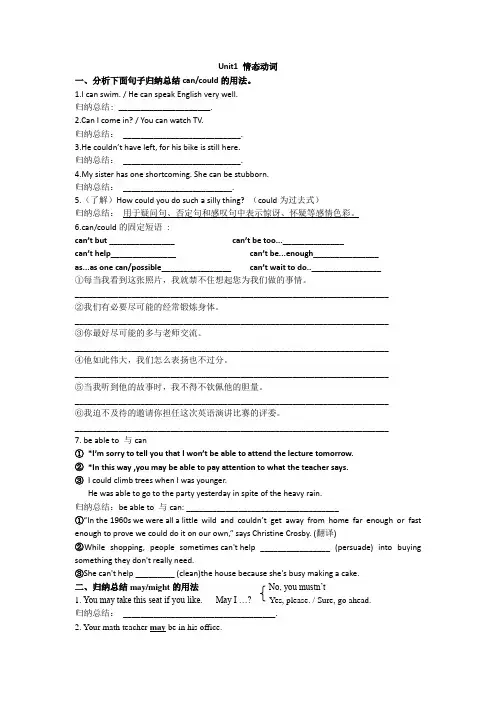
Unit1 情态动词一、分析下面句子归纳总结can/could的用法。
1.I can swim. / He can speak English very well.归纳总结: _____________________.2.Can I come in? / You can watch TV.归纳总结:___________________________.3.He couldn’t have left, for his bike is still here.归纳总结:___________________________.4.My sister has one shortcoming. She can be stubborn.归纳总结:_________________________.5.(了解)How could you do such a silly thing? (could为过去式)归纳总结:用于疑问句、否定句和感叹句中表示惊讶、怀疑等感情色彩。
6.can/could的固定短语:can’t but _______________ can’t be too...______________can’t help_______________ can’t be...enough_______________as...as one can/possible________________ can’t wait to do..________________①每当我看到这张照片,我就禁不住想起您为我们做的事情。
________________________________________________________________________②我们有必要尽可能的经常锻炼身体。
________________________________________________________________________③你最好尽可能的多与老师交流。
人教版必修三Unit 1语法专题练习 情态动词

人教版必修三Unit 1语法专题练习情态动词人教版必修三unit1语法专题练习情态动词ⅰ. 用适当的情态动词填空1.―iheardtheywentskatinginthemountainslastwinter.―it________betruebecauseth erewaslittlesnowthere.a.maynotb、不会的,千万不要c.couldn’t解决方案:选择C。
我听说他们去年冬天去山上滑雪,“那不可能是真的,因为那里几乎没有雪。
”“不可能”是指某种消极的猜测。
可能不“可能不”,这与上下文不一致;“不会”;千万不要“禁止”。
2.―ihaven’tgotthereferencebookyet,buti’llhaveatestonthesubjectnextmonth.―不要结婚。
周五之前你就有了。
a、应该b.couldd.mayc、必须解析:选a。
句意:“我还没拿到参考书,下个月我要参加这门科目的考试。
”“别担心。
周五之前你会拿到。
”shall用于第二、三人称,表示允诺、威胁、警告等。
b、应该c.mustd.can解决方案:选择D。
你不在的时候我可以用你的电脑吗当询问对方的意见时,答案以“可以”开头。
b.couldn’td.mightnot分析:选择a。
计算机无法独立思考。
它必须命令它怎么做。
“不能”表示能力。
―heshould,buthe________not.helikesridinghisbike.a.mustc.needb、坎德梅解析:选d。
句意:“约翰要坐车来吗?”“应该是,但也可能不。
他喜欢骑自行车。
”表示较小的可能性用may。
mustnot“禁止;不准”;cannot“不可能”;neednot“不需要”。
6.herbrother_______________________。
a.mustn’tc.can’tb、不需要,不应该解析:选c。
句意:她哥哥现在不可能在家,因为刚才有人看见他正在体育场里打篮球。
新人教必修3_Unit1_Grammar情态动词]
![新人教必修3_Unit1_Grammar情态动词]](https://360docs-1393072327.cos.ap-beijing.myqcloud.com/35b7c822453610661ed9f4a7.webp)
3. may 与might
1). 表示“许可”或“请求”,在这样的句中,might比m 语气更委婉,客气。 肯定回答用may或can,否定 回答时用mustn't或can't,表示“不可以”或“禁止”。 Eg: --- May I come in ? 我可以进来吗? --- Yes, you may/can. 可以,请进来。 --- No, you mustn’t/can't. 不,你不能。
4. 用于祈使句表祝愿。
Eg: May you succeed! May God bless you!
5. may have done 和might have done 表示 对过去的推测。
1. Sorry I'm late. I _____ A have turned off the alarm clock and gone back to sleep again. A. might C. can B. should D. will
二、表示对过去所发生事情的遗憾或责备
1. should/ought to have done “过去本该做而没做” eg: I really regretted wasting the hours when I should have studied hard, but it was too late. 2. shouldn’t/oughtn’t to have done “过去不该做的事却做了” eg: I’m very sorry for the words I shouldn’t have said to you at that moment. 3. could/might have done “本来能够做的事却没做” eg: He could have worked out the problem.
人教版高一英语必修三 unit1 grammar 情态动词 练习试题

情态动词练习1.------"May I go now?"-------"No, you ________. "A. mustn'tB. needn'tC. mightn'tD. won't2. You _________ do the exercise if you don't want to.A. may notB. can'tC. mustn'tD. needn't3. You _________ pay more attention to your spelling next time.A. wouldB. shouldC. willD. shall4. The girl _________ out alone at night.A. dare not goB. dare not to goC. dares not goD. does not dare go5.Bruce must have been in China for a long time,_____?A.hasn’t heB.mustn’t heC.Isn’t heD.wasn’t he6. There ________ be a lot of small houses on both sides of the street.A. used toB. get used toC. wouldD. did use to7.It must have snowed last night,____?A.isn’t itB.haven’t heC.mustn’t itD.didn’t it8.If they _________ to do this work, he might do it some other way.A. wereB. shouldC. willD. can9. I was told yesterday that the company _________ me to Rome next week for a business conference.A. should have sentB. were going to sendC. should be sendingD. should send10.Let's take a walk, ________?A. will weB. don't weC. do weD. shall we11. You must have seen him off yesterday, _________?A. haven't youB. didn't youC. mustn't youD. needn't you12.---- That must be a mistake.---- No .it _________ be.A. can'tB. isn't able toC. canD. was able to13. He had known the matter before you told him, so you _________ have told it to him.A. mustn'tB. can'tC. needn'tD. shouldn't14. How ________ so?A. dare you to sayB. dare you sayC. do you dare sayD. dare to say15. You are their teacher. You _________ care of them.A. should to takeB. might to takeC. ought to takeD. need to take16. She is studying medical science now but she _________ a lawyer.A. used to beB. would beC. wereD. had been17. If you were in an English-speaking country, you, too, _________ English every day.A. will be used to speakB. will be used to speakingC. must be used to speakD. would be used to speaking18. I did not call to make my airline reservation (预订) but I _________.A. should have B, may have C. must have D. shall have19. As a girl, she _________ get up at six every day.A. wouldB. willC. mightD. should20. Don't you remember that we _________ to the cinema tonight?A. would goB. goC. are goingD. will be gone21.---- Shall I tell John about it?---- No, you _________. I've told him already.A. needn'tB. wouldn'tC. mustn'tD. shouldn't22.------"Would you mind if I open the window?"-------“__________”.A. I don't like itB. Yes .pleaseC. No, pleaseD. No. I'm sorry23.-----"Would you tell me something about the affair?"------“__________”.A. Yes .pleaseB. All rightC. Not at allD. I do24. M:________?T:I'd love to, but I'm afraid I have no time."M:0h, no. You'll surely come over.T: It's very nice of you. But I'm sorry I have to go to a meeting.A. Do you have lunch out in a restaurantB. Shall I have you with me at my birthdayC. Did you go to see the filmD. Have you enjoyed yourself at the party25.------"You ought to have come here ten minutes ago?"--------"Yes, I _________. "A. ought toB. ought to haveC. oughtD. have ought to26.------"Would you like to go out for a walk?"------"Yes, ___________. "A. I'd like toB. I'd likeC. I'll like toD. I would27. ________ you succeed !A. CanB. MayC. MustD. Will28. Did he need ________ then?A. leaveB. to leaveC. leavingD. left29. Do you think if he dares _________ in public.A. speakB. speakingC. to speakD. spoken30. He ________ eating American food since he came here.A. used toB. has been usedC. has been used toD. was used to31. A computer ________ think for itself; it ________ be told what to do.A. may not, mustB. mustn't, mightC. shouldn't, couldD. can't, must32.-------"________ you mind my opening the window?"--------"Not at all. "A. ShallB. ShouldC. WillD. Would33.1 didn't hear the phone. I _________ asleep.A. must beB. must have beenC. should have beenD. could have been34. You _________ me about it earlier, but you didn't.A. should have toldB. would have toldC. must have toldD. should tell35. The teacher told the students that they ________ keep silent in class all the time.A. ought to notB. ought not toC. ought not to haveD. can't36.-------Do you speak Japanese?-------No,I don’t , but I_____speak Chinese.A.oughtB.have toC.doD.must37.If you_____quiet ,I’ll tell you what happnedA.beB.will beC.areD.are to be38.-------Look ,it_____be Li Ping.------No,it____be him.He’s gone abroad.A.may;mustn’tB.must;mayC.must;can’tD.can;may not39.Professor Wang,many students want to see you. _____they wait here or outside?A.DoB.AreC.WillD.Shall40.I can’t find Mr Wang anywhere in the office building.Where____he have gone?A.mayB.canC.mustD.Should41.Wherever you____,there’s no place like home.A.can goB.must goC.might goD.may go42.------Don’t forget to post the letter for me.------I _____.A.won’tB.willC.don’tD.can’t43.--------Must I take a taxi?-------No,you_____.You can walk from here.A.don’tB.must notC.don’t have toD.had better not to44.The bus _____start;I don’t know what to do with it.A.can’tB.won’tC.shan’tD.may not45.He was a good swimmer so he _________ swim to the river bank when the boat sank.A. couldB. mightC. shouldD. was able to46. I went to the doctor's yesterday, I had to wait for half an hour before he ________ see me.A. canB. mayC. mightD. could47.---- _________ this book be yours?---- No, it ________ not be mine. It ________ be his.A. Can, must, mayB. May, might, mustC. Can, may, mustD. Must, can, may48.------"We didn't see him at the lecture yesterday. "------"He _________ it. "A. mustn't attendB. can't have attendedC. would have not attendedD. needed have attended49. They _________ the plane, or perhaps they have been prevented from coming for some reason.A. can have missedB. may have missedC. can have lostD. may have lost50. Since the ground is white, it _________ last night.A. had snowedB. must have snowedC. must be snowingD. must have been snowing51. You must be fifty, ________?A. mustn't youB. needn't youC. aren't youD. mnyn't you52.Your coat is dirty,_____it for you?A.Am I washingB.Will I washC.Am I going to washD.Shall I wash53.No one _____that to his face.A.dare sayB.dare to sayC.dares sayingD.dares said54.There used to be a church in the east of the town,_____?A.didn’t thereen’t to thereed thereedn’t to there55._____you be happy!A.CanB.MayC.MustD.Would56.Where is my pen?I_____it.A.should have lostB.must have lostC.would have lostD.might lose57..A computer____think for itself ; it must be told what to do.A.can’tB.couldn’tC.may notD.might not58.We_____last night ,but we went to the concert instead.A.must have studiedB.might studyC.should have studiedD.would study59.I didn’t hear the phone ,I_____asleep.A.must beB.must have beenC.should beD.should have been60.Be sure to write to us,_____?A.will youB.aren’t youC.can youD.mustn’t you61.I didn’t see her in the meeting-room this morning.She____at the meeting.A.mustn’t have spokenB.shoudn’t have spokenC.needn’t have spokenD.couldn’t have spoken62.There is plenty of time.She____.A.must have hurriedB.needn’t have hurriedC.must not hurryD.couldn’t have hurried63.You don’t______to go there if you have no time.A.needB.wantC.mustD.ought64.Sir,you_____be sitting in this waiting-room.It is for women and children only.A.oughtn’t toB.can’tC.won’tD.don’t65.Tom ought not to_____me your secret ,but he meant no harm.A.have toldB.tellC.be tellingD.having told66.Put on more clothes . You_____be feeling cold with only a shirt on.A.wouldB.canC.couldD.must67.------Why didn’t y ou answer when I called you?------I_____but you didn’t hear me.A.had toB.couldn’tC.didn’t answerD.did68.I_____that time is more valuable than money.A.hardly need sayB.need hardly sayC.need hardly to sayD.hardly need to say69.I____like to become a pianist some day.A.willB.mayC.wouldD.shall70 He_____there now,but I am not sure.A.maybeB.may beC.may have beenD.might have been71.------I didn’t see him yesterday.------Oh,but you______.A.ought toB.should haveC.can’t haveD.may have72.------Where were you this morning?I tried to call you.------I _____ to the library for a while.A.tried to goB.should goC.must goD.had to go73.The flower is dead.I_____it more water.A.will giveB.must giveC.should have givenD.would have given74.------Does Tom want to go to the film?------Yes,but he says_____tonight.A.he’d not rather goB.he’ll rather not goC.he won’t rather goD.he’d rather not go75.------Did you walk home by yourself last night?------Yes ,I did. But I guess I_____.A.shouldn’tB.needn’tC.may not haveD.needn’t have76.It’s nearly seven o’clock.Jack_____be here at any moment.A.mustB.needC.shouldD.can77.You ____ fail to pass the entrance examination if you don't study harder.A. shallB. couldC. willD. should78. I ____ think it would be better to try it again.A. shallB. shouldC. ought toD. can79. If you ____ change your mind, please let me know.A. willB. needC. shouldD. ought to80. I can't understand why you all ____ think that I did it.A. shallB. willC. canD. should81. When I was studying at Beijing University, I ____ take a walk along the lake every evening.A. willB. wouldC. couldD. shall82. ---Mr. John didn't come to the party last night, did he?---No, In fact, we ____ for him. A whole evening was wasted.A. needn't waitB. needn't be waitingC. needn't have wattedD. needn't to wait for.83. He was really very lucky or he ____ his leg.A. would hurtB. might hurtC. would have hurtD. could hurt84. You ____ here two hours ago, and the party will be finished soon.A. should beB. need to beC. should have beenD. mustbe85. I saw Mr. Smith just now. He ____ to Paris for a conference.A. couldn't goB. mustn't goC. couldn't have goneD. might not86. You ____him a hand, though you were very busy, after all, you are close friends.A. might giveB. might have givenC. could giveD. should give87. The party ended up with a failure. I would rather____the party.A. not have attendedB. not attendC. not to attendD. not to have attended88.The little girl ____ go out for a walk after dark, ____ she?A. doesn't dare to; dareB. daren't to; doesC. dares not; dareD. daren't ;dare89.------___ I finish all the work before the noon?------No, you ____ , you ____ finish it by tomorrow.A. Must;needn't; mustB. Must;needn't;mayC. May;needn't;willD. Need;needn't;may90. You ought ____ for what you have done.A. not to be punishedB. to not be punishedC. to not punishedD. not be punished91.------___ I tell John about it?------No, you ____. I have told him yesterday.A. Shall;shan'tB. Must;mustn'tC. Shall;needn'tD.Can;can't92. Sir, you ____ be sitting in this seat. It is for women or childen only.A. can'tB. oughtn't toC. won'tD. needn't93. ---I hear you've got a set of valuable Australian coins. ____ I have a look? ---Yes, certainly.A. DoB. MayC. ShallD. Should94. ---Shall I tell Li Ming about it? ---No, you _____, he has known-about it already.A. oughtn't toB. needn'tC. shouldn'tD. mustn't95. Sorry, I am late again. I ____ have taken a taxi to come here.A. needB. shouldC. willD.must96.I didn't hear the phone.I ____ asleep.A.must be B.should be C.must have been D.should have been 97.Li Ming ____ to visit his maths teacher last night.(but I am not sure)A.must have gone B.might have gone C.might go D.may go98.I can't find my umbrella.I ____it at the office.A.could have left B.can leave C.should have left D.shall have 99.I don't know what's the m atter.The train____here an hour ago.A.shall arrive B.should arrive C.should have arrived D.ought have arrived 100.You ____ the book to me.You can keep it if you like.A.can't return B.needn't have returned C.may not return D.can't have returned 巩固练习答案:1-5ADBAA 6-10 A DABD 11~15 BACBC 16~20 ADAAC 21~25 ACBBB26~30 ABBCC 31~35 DDBAB 36-40 CBCDB 41-45 DACBD 46--50 DCBBB51-- 55 CDAAB 56--60 BBCBA 61--65 DCAAA 66--70 DDDCB 71--75 BDCDD76--80 CABCD 81--85BCCCC 86--90BADBA 91--95 CBBBB 96--100 CBACB。
人教版必修三Unit-1语法专题讲解与练习-情态动词

Book 3 unit1 情态动词(练习与讲解)情态动词总结most will cherish this learning of free-style.一些学生很可能在这段困难时期忽略他们的家庭作业,然而大部分学生都会珍惜这种自由的学习风格。
4.may/might as well do sth 最好做...;不妨做...We may as well drown ourselves in study to kill time. 我们不妨专注学习来消磨时间。
Ⅰ.用适当的情态动词填空1.When you cross the street, you must be careful with the passing cars.2.It can’t be his mother, for she has been ill at home for a long time.3.We enjoy good weather in January, but sometimes it can be terribly cold.4.I may come to the party with you, but I am not sure.5.When he was young, he would climb the small hill every morning.6.—May I take this seat?—Yes, you may/can.7.Tom comes from Australia, so he can speak English very well.8.If you can pass the driving test, you shall get a new car.9. —Must he come to sign this contract himself?—Yes, he must. /No, he needn’t.10.It is surprising that that mean man should give away his money to the poor.11.—To stop the oil from flowing into the gulf is difficult. What should we do?—Shall the robots have a try?12.They were determined to carry out the plan at first, but then we were able to persuade them to change their minds.13.You mustn’t/ can’t park your car in front of the teaching building, for the students are coming out soon.14.I have told you the truth already. Must I keep repeating it?15.I cannot but admire her courage. 我不得不佩服她的勇气Ⅱ.单项填空1.—I heard they went skating in the mountains last winter.—It ________ be true because there was little snow there.A.may not B.won’tC.couldn’t D.mustn’t解析:选C。
新人教版必修三 Unit 1 Festival around the world语法情态动词练习含答案
Grammar Structures for Unit 1 Book IIIModal verbs(情态动词)跟踪练习I. 单项填空:1.Write in simple English in order that everybody ______ understand you.A. mayB. mustC. shouldD. will2.You _______ miss the lecture, though you ______ have it.A. mustn’t; needn’tB. needn’t; mustn’tC. mustn’t; mustn’tD. can’t; needn’t3.--- Better not have the operation right now. --- ________.A. I mustn’tB. I shouldn’tC. I won’tD. I can’t4.The train was ten minutes late, so I ______ have run all the way from my house to the station.A. couldn’tB. shouldn’tC. needn’tD. mustn’t5.I’m not going simply because I don’t see why I _______.A. willB. wouldC. shouldD. shall6.--- It must be Mr. Li who did it.--- No, it _____ be Mr. Li.A. mustn’tB. can’tC. wouldn’tD. may7.--- It’s getting cloudier and cloudier.--- Yes, I’m afraid it ______ be raining soon.A. mustB. shouldC. mightD. can8.I promised to get there before 5 o’clock, but now the rain is pouring down. They _____ for meimpatiently.A. mat waitB. ought to waitC. could waitD. must be waiting9.--- ______ you make so much noise?--- Sorry, I’ll take care not to.A. Must;B. CanC. MayD. Would10.On Sundays when I was a child, Father and I _____ get up early and go fishing.A. couldB. wouldC. mightD. should11.I ______ have written to him because he phoned me shortly afterwards.A.ought toB. mustC. couldn’tD. needn’t12.--- _____ the plane have taken off on time?--- I’m afraid not. The fog was too thick then.A. NeedB. ShouldC. CanD. Must13.This looks like a different kind of stone. What _____ we do with it?A. willB. shallC. wouldD. do14.He has much money at the beginning of every month, but by the end of it he _____ little left.A. can haveB. will haveC. should haveD. need have15.How _______ you say that you really understand the whole story if you have finished onlypart of the article?A. mustB. needC. mayD. can(Keys: 1. A 2. A 3. C 4. C 5. C 6. B 7. A 8. D 9. A 10. B 11. D 12. C 13. B 14. B 15. D )第 1 页共1 页。
人教版高一英语英语必修3Unit1语法情态动词 (共35张)
1 Children under 12 years of age in that
country ____ be under adult
supervision when in a public library.
(2004 上海)
A. must
B. may
C. can
D. need
2 — What’s the name? — Khulaifi. _____ I spell that for you?(2006 北京) A. Might B. Would C. Can D. Shall
Modal Verb I
may/might can/could will/would shall/should must/can’t
7/30/2021
6
can和could
can的主要用法是:
1. 表示能力: eg. The girl can dance very well.
2. 表示说话者的推测﹑事物的可能性: eg. Can the news be true?
should 用法
1. 应该=ought to (劝告、建议) You should study hard. You should read his new book.
2. 表估计,可译为“按理应当”、“估计”。 Try phoning Robert, he should be home
now.
should 用法 3. 用于第一人称,询问意愿,语气温和委婉
can(could)和be able to都可以表示能力,意思 上没有区别。但can只有现在式和过去式, 而be able to则有更多的形式。如:
Those bags look really heavy, are you sure you’ll be able to carry them on your own?
人教版高中英语必修3 Unit1 高考真题汇编-情态动词
Unit1高考真题汇编-情态动词单元语法:情态动词(1)can和could ,may和might,must,shall,should,will, would真题1:(2015•北京)-29.—Can’t you stay a little longer?—It’s getting late. I really _____go now. My daughter is home alone.A .mayB .can C. must D .dare【解析】C试题分析:句意:——你不能再多待会儿吗?——很晚了,我必须得走了。
我女儿一个人在家。
A. may可能,可以,也许;B. can能,会;C. must必须,必然要,必定会;D. dare敢,胆敢。
结合句意,故选C。
【考点定位】考查情态动词辨析【名师点睛】本题是考查情态动词,这里考查的是语气的强度,在这里结合语境是“一定”的意思,所以要做好此类辨析题需掌握情态动词选项的语气并结合语境。
真题2:【2015·重庆】-12.You ____ be Carol. You haven’t changed a b it after all these years.A. mustB. canC. willD. shall【答案】A【解析】句意:你肯定是卡罗,这些年你一点也没有变化。
must表示对现在的肯定推测。
故选A。
【考点定位】考查情态动词。
【名师点睛】must 表推测的用法must 表示很有把握的推测,其意为“一定会”“肯定会”,只用于肯定句,一般不用于否定句或疑问句。
表示对现在或未来的情况作推测,后接动词原形。
You have worked hard all day. You must be tired 你辛苦一整天,一定累了(对现在情况的推测判断)I didn’t hear the phone. I must have be asleep. 我刚才没有听到电话,我想必是睡着了。
(完整版)人教版必修三Unit1语法专题练习情态动词
Ⅰ .用适合的神态动词填空1. When you cross the street, you must be careful with the passing cars.2. It can ’ t be his mother, for she has been ill at home for a long time.3. We enjoy good weather in January, but sometimes it can be terribly cold.4. I may come to the party with you, but I am not sure.5. When he was young, he would climb the small hill every morning.6.— May I take this seat?— Yes, you may/can .7. Tom comes from Australia, so he can speak English very well.8. If you can pass the driving test, you shall get a new car.Ⅱ .单项填空1.— I heard they went skating in the mountains last winter.— It ________ be true because there was little snow there.A . may not B. won ’ tC. couldn ’ t D. mustn ’ t分析:选C。
句意:“我听闻他们昨年冬季去山区滑雪了。
”“ 那不可以能是真的,由于那边几乎没有雪。
” couldn ’ t“不可以能”,表示有掌握的否认推断。
may not “可能不”,与语境不符; won ’ t “不会”; mustn ’ t“严禁” 。