
最新人教版新目标初中英语八年级下册 下Unit 1 What's the matter 全单元教案
Unit 1 What’s the matter?Period 1 Section A (1a-2c)Before class: Listen to an English song.Step 1 Warming-up and check what students have learned before class.1. Greet.T: This song is about our bodies. This class , we’ll talk about something about our bodies—unit 1 together, go. Unit 1 What’s the matter?2. We have learned the words before class.Present a picture of a girl . Look at the girl. How many...Now, all the No. 3 and No. 4 stand up ,say the words one by one .You can get two marks for each word.4. Work on Section A 1a students say one by one.Look at 1a. Before class, have you finished1a? Let’s say the answers like this.T:Good job. You are very careful.Step 2 Presentation .1. Just now , we know the words about our bodies . But sometimes our body may get ill. Howdo we ask and answer about illness?Let’s watch a video. Follow it and do some actions.From the video. We know we can ask “what’s the matter with you?”and you can answer “I have a ...”.2.T: We also know some illnesses. Here are the new words about the illnesses. Let’s learn ingroup.A.Demonstrate :No 1 read the sentences one by one. The others follow him/ her. When you read ,please do some actions like me.Let me see which group read best and act best.B. Study in groups.C. Find the rules.D. Group report. Stop studying, look at these words , what can you find?You are good at thinking.Step 3 Guessing game:Have you remember the words? Let’s play a guessing game. No 6 come here.quickly. You each act an action. (边说边发纸条)Each group have chances toguess the illness. The others answer like this: “He /She has a...”Step 4 Work on 1b.1. T: Now, you know some illnesses . Look at the picture .These students ger ill. Show thepictures one by one and ask.What are their names? Let’s do 1b.How do we do it? For example, we’ll hear Sarah has a cold, and No 1 has a cold , so write 1 behind Sarah. What about 2, 3, 4 and 5? When you hear the illnesses , write their numbers behind the names.2. Listen.3. Check the answers.Step 5 Group work.1. T: Why do they get ill? Look at the chart, match the reasons with the illnesses.2. Check the answers.3. Demonstrate .Look at the chart. Let’s talk about their illnesses in pairs. Here is the example.Boys ask , girls answer.4. Look at the chart and make more similar conversations.When you talk , please talk loudly, correctly and politely, please do some actions and use the nice intonations.5. Let students show their conversations.Step 6 Work on 2a and 2b.1. T: David has a stomachache, what should he do?Show the pictures ,ask and answer. 板书What should …do? …should….T: Your advice is very useful. Let’s learn more advice from 2a and 2b.2. Listen, finish 2a. What’s the matter with the people? What advice do they get?3. First , guess the answers to 2b. Then listen and check the answers.OK, you have good listening skills.Step 7 Group work.The advice for illness is very useful . It can help us take good care of ourselves and others.T: If some students are ill, will you give some advice and help them? let’s act andmake conversations. Let me see who is the kind person? How do we talk?Look at the example.2. Show the example.When you talk , please talk loudly, correctly and politely, please do some actions and use the nice intonations.3. Students work.4. Let students show their conversations.Step 8 Summarize and homework:1. Summarize.Period 2 Section A 2d,GrammarKnowledge aims:1. The students will be able to learn the words and phrases: take breaks, hurt,2.Summarize the grammar and practice them.3. Target Language:①What’s the matter with Ben? –He hurt himself./ He has a sore back.②-Do you have a fever? -Yes, I do./ No, I don’t.③-Does he have a toothache? -Yes, he does.④You shouldn’t eat so much next time.⑤What should she do?⑥She should take her temperature.⑦-Should I put some medicine on it? -Yes, you should. / No, you shouldn’t.Structure: ①“should/ shouldn’t + verb” for suggestion ②Reflexive pronouns. Ability Object:1.Enable students to talk more about health.2.Learn to give others some advice according to their matters.3.Enable the students to do things using the target language and the grammar. Emotion Object:1.Learn to live in a healthy way.2. Learn to take care of others and themselves.Teaching Key Points:1. How to teach the Ss to learn the names of the illness: toothache, fever andheadache.2. How to give others some advice according to their matters.3. The grammar.Teaching Difficult Points:1.How to give advice using should.2. Use the grammar to do things.Teaching Procedures:Step 1 Review.1. Free-talk. What ‘s the weather like today? If you don’t wear warm clothes,what will happen?2.Show the pictures and say.He / She has_______________. He /She should___________.Step 2 Work on 2d.1. Game.Do in the same way2. Listen to the conversation and answer my questions .1). What's the matter with Lisa?2). What did Lisa do on the weekend?3). What should Lisa do ?3. Role-play the conversation.First, have students to role-play the conversation in 2d in groups and choose the best.Step 3 Group work.1. Give more examples. Have students read the conversation in 4c.2. and then ask them to work in groups. One student mimes a problem. The otherstudents in his/ her group guess the problem and give their advice.Step 4 Grammar Focus .Have students to read and remember the sentences of Grammar Focus by themselves, and then have them work in groups to sum up how to talk about health problems and give right advice.Step5 Work on 4a.Ask students to go through each conversation in 4a quickly, and then complete the conversations individually. Move around the classroom and help them ifnecessary.Check the answers.Ask some students to practice every conversation in pairs.Step 6 Work on 4b.Have students choose and circle best advice for the health problems in 4b. Then ask students add their own advice about these health problems.Have some students to report their own advice in class.Step 7 Summary.Health problems and give right advice.Ask one or two students to sum up the key phrases in the passage, and help them to make up more sentences with them.Step 8 Homework .Have students make up conversations to talk about sb.’s health problems and give them some advice.Period 3 Section A 3aKnowledge aims:The students will be able to learn the words and phrases: passenger, get off, to one’s surprise, onto, trouble, hit, right away, get into.2.The students will be able to use the expressions:The driver didn’t think about thinking about himself. He only thought about saving a life. Ability aims:The students can understand the passage.2.To train the students’ cooperation with their partners.Emotional aims:To train the students to care about others and help others who are on trouble..Teaching important points:The students can understand the passage and use the useful expressions freely.Teaching difficult points:The students can learn from the drivers and do as the driver does if possible.Teaching procedures:Step 1 Warming-up and lead-in.1. Watch a video.2. What is the short sketch about?3.Look at the picture. What can you see? Can you guess what is happening?Step 2 Preparing reading.1. Guess the main idea.What is this passage mainly about?Strategy : The title and pictures can be helpful to understand the text.Title may be the main meaning of the article.2. Read the passage. Do you think it comes from a newspaper or a book?Step 3 While-reading.1.Find the topic sentence(中心句)of each paragraph.1). At 9:00 a.m. yesterday, bus No. 26 was going along Zhanghua Road when the driver sawan old man lying on the side of the road.2). Some passengers helped Mr. Wang to move the man onto the bus.3). Thanks to Mr. Wang and the passengers, the doctors saved the man in time.2. Which sentences touched you? Read them in the way that you like.Step 4 Post-reading.1. Praise the persons.What a great person the driver was!He stopped the bus without thinking twice, when he saw an old man lying on the side of the road.What _______ the _____ was/were!2. Work on 3bAfter checking the answers, have Ss scan the passage and check (√) the things that happened in the story.3. Work on 3c.T: Ask the students to discuss the questions in pairs.Step5 Homework.1. If you are the driver, write a diary about what happened yesterday.2. If you are the passenger, write a diary about what happened yesterday.3. Act the story out in your group.4. Read some messages about good men.Period 4 Section B 1a-1dStep 1 Lead –in and learn the new words.It’s a beautiful song, I like it very much. Let’s learn the new words.1. Who can be the teacher? One student teach one word.2. Let’s sing and remember the new words.The teacher teaches to sing, ask some group to sing. Finally sing together.(可以课前教唱,。
初中英语人教新目标八年级下册全册单元话题作文必背范文(共10篇)
八年级英语下册单元话题作文必背范文Unit 1 What’s the matter?★假如你是Ann,你的朋友Mary得了重感冒,请你写一封信,告诉她如何保持身体健康。
Dear Mary,How are you? I'm sorry to hear that you had a bad cold.I think you should look after your health more carefully than before. First, you should have some healthy eating habits. You should eat more vegetables and fruit. And you should also drink more water. Second, it's important for you to take more exercise, like playing football and swimming. For me, I play football once a week and go swimming monthly. Doing sports can make your body strong. Third, you should make yourself happy every day. This is also very important for your health. Last,I think you should get enough sleep, if you don't, you may feel tired. Make sure to go to bed early and don't stay up late. If you have a healthy life, you will be in good health.I hope you will fell better soon.Your friend,AnnUnit 2 I'll help to clean up the city parks.★假设你是李明,你们学校的“English Garden”正在举办主题为“付出即收获”的征文活动, 请你联系自己平时的爱心行为和感受写一篇文章投稿。
人教新目标八年级英语下册教案Unit1Whatsthemat教案
Unit1 What’s the matter?复习课教学设计一、设计背景初中英语升学考试所涉及的知识面广,因而复习时需要扎扎实实打好基础,对课本的复习可以说是以“地毯式”搜捕的方式进行的。
教师要在有限的时间内完成如此大容量的复习任务,就必须要想方设法提高复习效率,让学生的复习取得事半功倍的效果。
我在复习中采用“知识递进式”复习法,用话题带动词句的使用,注重知识的综合运用。
二、设计理念本课是以“problems and advice”为话题的复习课,课堂上把主动权交给学生,以听说训练为主线,通过看、听、说、写等一系列教学活动,让学生运用所学知识来完成单词拼写、即时翻译短语、小组合作翻译句子,定时背诵语篇。
使学生获得最基本的英语听、说、读、写能力,并在教学中充分激发学生强烈的学习愿望。
在注重学生知识能力发展的同时,注重提高学生的人格修养,学会关心别人,帮助别人,达到培养学生互助的德育教育的目的。
三、教学目标设计用具体、明确、可操作的行为语言,描述本课的知识、技能、能力、方法、情感、态度、价值观等方面的教学目标。
Objectives: By the end of the session, most students will be better able to acquire the required information. This will be achieved by: 1.Knowledge Objectives:1)Be able to master the pronunciation, meaning and spellingof the names of diseases: fever, sore throat, sore back; stomachache, headache, toothache, cold, cough; 2) Be able tolearn the e某pressions of giving advice: lie down and rest, drink hot tea with honey, see a dentist, take this medicine;3) Be able to talk about health problems by using “What’s the matter? I have a?” and give advice by using “Youshould?You shouldn’t?” 2. Ability Objectives:1) Be able to talk about one’s health problems and give advice fluently; 2) Be able to role play doctor and patient; 3. Moral Objectives:1) Improve the cooperative spirit through pair work and role playing 2) Care more about yourself and your family members’ health. 四、教学重点难点设计由于本节课的话题是谈论健康,根据教学大纲的要求,学生需掌握有关疾病的单词,并能针对疾病提出合理的建议。
人教新目标八年级英语下册Unit 1 What's the matter单词速记
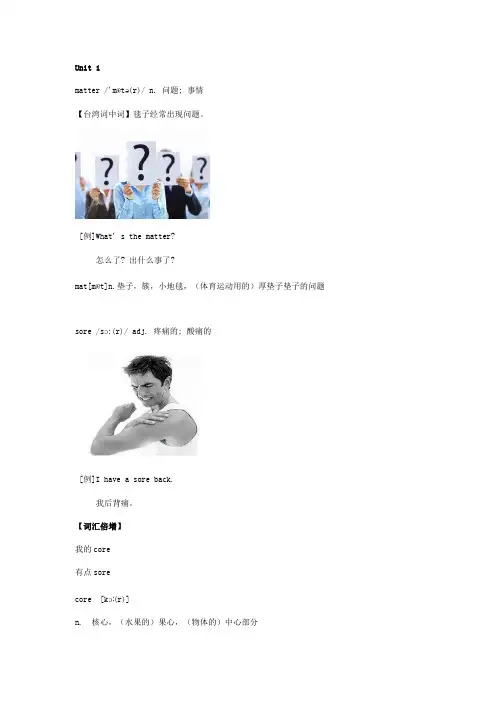
Unit 1matter /'mætə(r)/ n. 问题; 事情【台湾词中词】毯子经常出现问题。
[例]What' s the matter?怎么了? 出什么事了?mat[mæt]n.垫子,簇,小地毯,(体育运动用的)厚垫子垫子的问题sore /sɔ:(r)/ adj. 疼痛的; 酸痛的[例]I have a sore back.我后背痛。
【词汇倍增】我的core有点sorecore [kɔː(r)]n. 核心,(水果的)果心,(物体的)中心部分have a cold 感冒[例]I have a cold.我感冒了。
stomachache /'stʌməkeɪk/ n. 胃痛; 腹痛have a stomachache 胃痛[例]I have a stomachache.我胃痛。
【英国字母索源法】stomach(胃)+ache(痛)foot /fʊt/ n. 脚; 足【英国字母索源法】f代表“五官”[例]One of my feet is dirty.我的一只脚脏了。
neck /nek/ n. 颈; 脖子【英国字母索源法】n代表“细长”[例]The neck of the glass is dirty.杯颈脏了。
stomach /'stʌmək/ n. 胃; 腹部[例]what a stomach he has got !他可真是个大腹便便的人!【脑图单词速记】蛇s吐to马ma吃chthroat /θrəʊt/ n. 咽喉; 喉咙 p.1【英国字母索源法】thr代表“三”throat喉咙--通向三处,Third第三 thirteen十三 thirty三十。
[例]She has a very sore throat now.她现在嗓子疼的很厉害。
【词汇倍增】一只goat(山羊)穿件coat(衣服)上了boat(船)掉进moat(城壕)摔断throat (喉咙)fever /'fi:və/ n. 发烧[例] She has a fever.她发烧了。
人教版英语人教新目标八年级下册(新)unit1what'sthematter
某人某部位不舒服/出了毛病。
常用sore 修饰的词: throat leg foot eye 常加后缀-ache构成的词: head tooth stomach
两者都可用的词:back
a.喉咙痛 b.背痛 c.牙痛 d.头痛 e.胃痛 f.感冒 g.发烧
B:Thatsoundslikeagoodidea.
Conversation3
A:Youlookterrible!What’sthematter? B:IthinkIatetoomuchatdinnerlastnight.It wasanall-you-caneatmealattherestaurant.ButnowIhaveast omachache. A:That'stoobad.Youshouldn'teatso muchnexttime.Rightnow,youshouldl iedownandrest.
你怎么啦?
Ihavea(bad)cold.
=Ihavegota(bad)cold. 我患感冒了。
What’sthematterwithhim? Hehas/hasgotastomachache.
他胃痛。
What’sthematterwithhim? Hehas/hasgotasoreback/backache.
Conversation2
Nurse:What’sthematter,David? AreyouOK? David:Iatetoomuchjunkfoodatmyfriend' sbirthdayparty. Solastnight,Igotastomachache.Ialmost couldn'tgetmyselfoutofbedthismorning.
八级英语下册UnitWhat'sthematter全单元教案新版人教新目标版
Unit 1 What's the matter年级八学科英语课型新授课时间主备人八年级英语组教学课题Unit 1 What’s the matter?Section A (1a~2d)课时 1教学目标1. 学习用英语表达身体各部位的名称及如何谈论身体健康状况。
2. 培养学生能运用所学语言简单地描述自己的健康状况及如何询问对方的身体健康状况。
3. 通过学习课文内容,养成健康的生活方式。
4. 教育学生学会关心他人,通过询问他人的健康情况并能给予帮助,增进人与人之间的感情。
重点难点教学重点:1.掌握情态动词should / shouldn’t.的用法.2.学习have的用法.教学难点:学会提供帮助的基本句型教学准备PPT教学过程1、新课导入:Step1: Can you name the parts of the body?让学生用英语所处器官名称。
Step2:Follow me:(让学生站起来完成韵律操)Everybody moves your bodyNod your head and touch your faceTouch your nose and close your eyesTouch your ears and clap your handsRaise your arms and look at your backTouch your stomach and tap your footSit down and move your legs2、设问导读:二次备课4. 如果你的头和脖子明天仍然疼的话,请去看医生。
五.拓展探究Homework: Make up a conversation between a doctor and a patient.课堂小结本课通过身体器官韵律操导入课时内容,激发学生的学习兴趣,提高课堂教学的效率,同时针对学生日常生活中的常见症状,让学生在列举过程中掌握患病方式的三种表达方式。
人教版(新目标)初中英语八年级下册Unit 1
人教版(新目标)初中英语八年级下册Unit1Unit1 Whats the matter?Unit1 知识梳理【重点单词】matter [?m?t?] v. 重要,要紧,有关系Whats the matter? 怎么了?出什么事了?sore [s?:(r)] adj. 疼痛的,酸痛的have a cold 感冒stomach [st?m?k] n. 胃,腹部stomachache [st?m?ke?k] n. 胃痛,腹痛have a stomachache 胃痛foot(复数feet) [fu:t] n. 脚neck [nek] n. 颈,脖子throat [rt] n. 喉咙fever [fi:v?] n. 发烧,发热lie [la?] v. 躺,平躺lie down 躺下rest [rest] n. 剩余部分,其余;放松,休息cough [k?f] n. v. 咳嗽X-ray [eksre?] n. X光,X射线toothache [?tu:e?k] n. 牙痛take ones temperature 量体温headache [?hede?k] n. 头痛have a fever 发烧break [bre?k] n. v. 休息,暂停;打破take breaks (take a break)休息hurt [h?:t] v. 伤害,损害,使受伤passenger [p?s?nd] n. 乘客,旅客off [?f] adv. prep. 离开(某处);从去掉get off 下车to ones surprise 使惊讶,出乎意料onto [nt?] prep. 向,朝trouble [?tr?bl] n. 麻烦,烦扰,问题hit [hit] n. v. 碰撞,打,打击right away 立即,马上get into 陷入,参与herself [h?:?self] pron. 她自己,她本身(she的反身代词)bandage [b?nd?d?] n. v. 绷带;用绷带包扎sick [s?k] adj. 患病的,不适的knee [ni:] n. 膝盖nosebleed [?nzbli:d] n. 鼻出血breathe [bri:e] v. 呼吸sunburned [?s?nb?:nd] adj. 晒伤的ourselves [ɑ:?selvz] pron. 我们自己(we的反身代词)climber [?kla?m?(r)] n. 登山者be used to 习惯于适应于risk [r?sk] n. v. 风险,危险;冒险take risks (take a risk) 冒险accident [ksid?nt] n. 意外事件;事故situation [?sitju?ein] n. 状况,形式,情况kg=kilogram [?k?l?gr?m] n. 公斤,千克rock [r?k] n. 岩石run out (of) 用尽,耗尽knife [naif] n. 刀,餐刀cut off 切除blood [bl?d] n. 血mean [mi:n] v. 意味着,意思是,意欲get out of 离开,从出来importance [?m?p?:tns] n. 重要性decision [d?sn] n. 决心,决定,抉择control [k?ntrl] v. 控制,支配,操纵be in control of 掌管,管理spirit [sp?r?t] n. 勇气,意志death [de] n. 死亡give up 放弃nurse [n?:s] n. 护士【重点短语】1.have a fever 发烧2.have a cough 咳嗽3.have a toothache 牙疼4.talk too much 说得太多5.drink enough water 喝足够的水6.have a cold 受凉;感冒7.have a stomachache 胃疼8.have a sore back 背疼9.have a sore throat 喉咙痛10. take risks 冒险11.hot tea with honey 加蜂蜜的热茶12.see a dentist 看牙医13.get an X-ray 拍X 光片14.take one s temperature 量体温15.put some medicine on sth. 在上面敷药16. give up 放弃17. sound like 听起来像18. all weekend 整个周末19. in the same way 以同样的方式20. go to a doctor 看医生21. go along 沿着走22. on the side of the road 在马路边23. shout for help 大声呼救24. without thinking twice 没有多想25. get off 下车26. have a heart problem 有心脏病27. to one s surprise 另某人惊讶的是28. thanks to 多亏了;由于29. in time 及时30. make a decision 做出决定31. get into trouble 造成麻烦32. right away 立刻;马上33. because of 由于34. get out of 离开;从出来35. keep on doing sth. 继续或坚持做某事36. put a bandage on sth. 用绷带包扎37. fall down 摔倒38. feel sick 感到恶心39. have a nosebleed 流鼻血40. cut his knee 割伤他的膝盖41. put her head back 把她的头向后仰42. have problems breathing 呼吸困难43. mountain climbing 登山运动44. be used to doing sth. 习惯做某事45. run out (of) 用完;用尽46. so that 以便47. so...that... 如此以至于...48. be in control of 掌管;管理49. in a difficult situation 在闲境中【重点句型】1. Whats the matter with you?= Whatthe trouble with you?= Whats wrong with you? 你怎么了?2. What should she do? 她该怎么办呢?3.Should I take my temperature? 我应该量一下体温吗?4.You should lie down and rest. 你应该躺下休息一会儿。
人教新目标八年级英语下册语法讲义:Unit1What'sthematter?
Unit 1What's the matter?1.I have a stomachache.我胃痛。
(1)stomachache为可数名词,意为“胃痛;腹痛”。
在英语中,一部分表示身体部位的名词加上名词ache(疼痛),可以构成合成名词。
如:headache头疼;toothache牙痛;backache背痛。
(2)have a+以上合成名词,表示“……痛”。
如:Mary didn't come to school yesterday because she had a stomachache.昨天玛丽因为胃痛没来上学。
2.drink some hot tea with honey喝一些加蜂蜜的热茶(1)with作介词,意为“具有;带有”,表示某物带有或具有某种特征。
如:She is a girl with big eyes.她是一个大眼睛女孩。
(2)反义词为without,意为“没有”。
如:I think I sat in the same way for too long without moving.我想我保持同一个姿势一动不动地坐太久了。
3.see sb. do sth.和see sb. doing sth.的区别(1)see sb. do sth. 意为“看见某人做某事”(看到动作发生的全过程或经常看到动作发生)。
如:I often see him play basketball on the playground.我经常看见他在操场上打篮球。
(2)see sb. doing sth. 意为“看见某人正在做某事”(强调动作正在发生)。
如:I saw him playing basketball on the playground just now.刚才我看见他正在操场上打篮球。
八年级英语下册 Unit 1 What’s the matter知识点总结、作文 (新版)人教新目标
What’s the matter1.What’s the matter?= What’s the trouble?=What’s wrong? 怎么了?(wrong 错误的,有毛病的)2.What’s the matter with you? 你怎么了?What’s the trouble with her? 她怎么了?What’s wrong with the computer? 电脑怎么了?感冒发烧咳嗽头疼胃疼,肚子疼牙疼背疼,腰疼背疼,腰疼喉咙痛脖子疼腿疼疼; 使……受伤My head hurts. = I have a headache. 我头疼。
I hurt my leg. 我伤到了腿。
You hurt my heart/feelings. 你伤了我的心/感情。
5.He has a bad/terrible cold. 他得了重感冒。
He has a high fever. 他发高烧。
6.with prep. 用We look with our eyes. 我们用眼睛看。
Don't write with a pencil. 别用铅笔。
7.lie v. 躺;撒谎;位于n. 谎言 tell lies 撒谎A boy is lying on the grass. (lie - lying)Don't lie. = Don’t tell lies. 别撒谎。
Shandong lies in the east of China.山东位于中国东部。
8.休息一下 have a rest = have a break=take a rest =take a break9.carry 运,搬,提,背He is carrying a big bag his back.他背着一个大包。
10.There is something wrong with………有毛病。
11.There is nothing wrong with………没毛病。
(完整版)人教新目标英语八年级下册unit1what‘s+the+matter_短语与固定搭配
Unit 1 What’s the matter?Section A1. have a fever 发烧2. have a cough 咳嗽3. have a toothache 牙疼4. talk too much 说得太多5. drink enough water 喝足够的水6. catch/have a cold 受凉;感冒7. have a stomachache 胃疼8. have a sore back 背疼9. have a sore throat 喉咙痛10. lie down and rest 躺下来休息11. hot tea w ith honey 加蜂蜜的热茶12. see a dentist 看牙医13. get an X-ray 拍X 光片14. take one’ s temperature 量体温15. put some medicine on sth. 在…上面敷药16. feel very hot 感到很热17. sound like 听起来像18. all weekend 整个周末19. in the same way 以同样的方式20. go to a doctor 看医生21. go along 沿着……走22. on the side of the road 在马路边23. shout for help 大声呼救24. without thinking twice 没有多想25. get off 下车26. have a heart problem 有心脏病27. to one’ s surprise 使....... 惊讶的28. thanks to 多亏了;由于29. in time 及时30. save a life 挽救生命.save one’s life 挽救某人的生命save one’s own life 挽救某人自己的生命31. get into trouble 造成麻烦32. right away 立刻;马上33. because of 由于34. get out of 离开;从……出萍35. hurt oneself 受伤36. put a bandage on sth. 用绷带包扎37. fa ll down 摔倒38.away from 远离39. enough 的用法adj/adv做够(的),充分(的)1.)have enough+n.+to do sth 有足够的...去做...2.) adj./adv.enough to do sth= so + adj./adv.+ that从句. 足够..去做某事如此...以至于...He is old enough to join the army.=He is so old thathe can join the army.3.)not adj./adv.enough to do sth=too adj./adv.to dosth不够...去做某事太...而不能...He isn’t old enough to carry the big stone.=He istoo young to carry the big stone.40. see a dentist = go to a dentist看牙医see a doctor = go to a doctor 看医生42. need v 需要◆用于肯定句是实义动词(1) need sth 需要某物(2) 人做主语,sb need to do sth 某人需要做某事◆一般情况用于否定句是情态动词needn’t = don’t have to 没有必要must ,need 引导的疑问句肯定回答用4343. because/because of【记】:跟句子时用because ,加名词短语时用because of【注】:(1) because of +n/ving /代词宾格(用于句中)She’s worried because of her son.(2) because conj +从句(引导原因状语从句)He didn’t go to school yesterday because he was ill. (3) because 还可以回答why 引导的句子— Why do you like pandas?— Because they are cute.(4) because 和so 不能一起连用,二者只能用其一。
人教新目标(Go for it)版八年级下Unit 1 What's the matter_单元单词
人教版新目标八年级英语下册,第1单元单词英汉汉英专项训练(前面是题,后面紧接是答案;分为填空题和选择题两种。
)(1)press______________________(2)risk______________________(3)onto______________________(4)spirit______________________(5)have a cold______________________(6)have a stomachache______________________(7)be used to______________________(8)lie down______________________(9)death______________________(10)run out______________________(11)nosebleed______________________(12)bandage______________________(13)get out of______________________(14)herself______________________(15)take risks______________________(16)foot______________________(17)headache______________________(18)breathe______________________(19)climber______________________(20)break______________________(21)rest______________________(22)rock______________________(23)cut off______________________(24)neck______________________(25)fever______________________(26)get into______________________(27)trouble______________________(28)lie______________________(29)knee______________________(30)passenger______________________(31)sunburned______________________(32)give up______________________(33)to one's surprise______________________(34)control______________________(35)matter______________________(36)knife______________________(37)take one's temperature______________________(38)cough______________________(39)hit______________________(40)be in control of______________________(41)toothache______________________(42)right away______________________(43)sore______________________(44)off______________________(45)ourselves______________________(46)hurt______________________(47)decision______________________(48)take breaks______________________(49)importance______________________(50)What's the matter______________________(51)nurse______________________(52)kilo______________________(53)mean______________________(54)stomachache______________________(55)X-ray______________________(56)accident______________________(57)throat______________________(58)stomach______________________(59)situation______________________(60)have a fever______________________(61)blood______________________(62)get off______________________(63)sick______________________(1)n. 压,挤,按(2)n.&v.危险;风险;冒险(3)prep.向;朝(4)n.勇气;意志(5)感冒(6)胃痛(7)习惯于;适应于(8)躺下(9)n.死;死亡(10)用光;耗尽(run out of)(11)n.鼻出血(12)n.綳带v.用绷带包扎(13)离开;从...出来(14)pron.(she 的反身代词)她自己(15)冒险(take a rish)(16)n.脚;足(17)n.头痛(18)v.呼吸(19)n.登山者;攀登者(20)n.间歇;休息(21)v.&n.放松;休息(22)n.岩石(23)切除(24)n.颈;脖子(25)n.发烧(26)陷入;参与(27)n.问题;苦恼(28)v.躺;平躺(29)n.膝;膝盖(30)n.乘客;旅客(31)adj.晒伤的(32)放弃(33)使...惊讶的;出乎...意料(34)n.&v.限制;约束;管理(35)n.问题;事情(36)n.刀(37)量体温(38)n.v.咳嗽;(39)(用手或器具)击;打(40)掌管;管理(41)n..牙痛(42)立即;马上(43)adj.疼痛的;酸痛的(44)adv.prep 离开(某处);不工作;从...去掉(45)pron.我们自己(we的反身代词)(46)v.(使)疼痛;受伤(47)n.决定;抉择(48)休息(49)n.重要性;重要(50)怎么了?出什么事了?(51)n.护士(52)n.千克;公斤(53)v.意思是;打算;意欲(54)n.胃痛;腹痛(55)n.X 射线;X光(56)n.(交通)事故;意外遇险(57)n.咽喉;喉咙(58)n.胃;腹部(59)n.情况;状况(60)发烧(61)n.血(62)下车(63)adj.生病的;有病的( )1.pressA. adj.生病的;有病的B. n. 压,挤,按C. v.(使)疼痛;受伤D. pron.我们自己(we的反身代词)( )2.riskA. n.&v.危险;风险;冒险B. n.鼻出血C. n.登山者;攀登者D. n.岩石( )3.ontoA. n.v.咳嗽;B. n.问题;事情C. prep.向;朝D. n.血( )4.spiritA. n.勇气;意志B. n..牙痛C. 放弃D. n.发烧( )5.have a coldA. n.问题;事情B. n.乘客;旅客C. 感冒D. n.间歇;休息( )6.have a stomachacheA. 立即;马上B. v.呼吸D. 怎么了?出什么事了?( )7.be used toA. 习惯于;适应于B. n.颈;脖子C. n.勇气;意志D. v.意思是;打算;意欲( )8.lie downA. n.间歇;休息B. 躺下C. n.綳带v.用绷带包扎D. 掌管;管理( )9.deathA. n.岩石B. n.乘客;旅客C. n.死;死亡D. 冒险(take a rish)( )10.run outA. 胃痛B. n..牙痛C. 用光;耗尽(run out of)D. n.脚;足( )11.nosebleedA. n.死;死亡B. n.问题;苦恼C. n.咽喉;喉咙D. n.鼻出血( )12.bandageA. n.綳带v.用绷带包扎B. v.呼吸C. 切除D. 躺下( )13.get out ofA. n..牙痛B. n.头痛C. 离开;从...出来D. n.(交通)事故;意外遇险( )14.herselfA. n.登山者;攀登者B. pron.(she 的反身代词)她自己C. n.綳带v.用绷带包扎D. n.重要性;重要( )15.take risksA. 怎么了?出什么事了?B. n.刀C. 量体温D. 冒险(take a rish)( )16.footA. n.脚;足B. n. 压,挤,按C. adv.prep 离开(某处);不工作;从...去掉( )17.headacheA. n.头痛B. 感冒C. prep.向;朝D. 陷入;参与( )18.breatheA. v.呼吸B. n.胃痛;腹痛C. 掌管;管理D. 胃痛( )19.climberA. 放弃B. n.脚;足C. n..牙痛D. n.登山者;攀登者( )20.breakA. 离开;从...出来B. n.勇气;意志C. n.间歇;休息D. 习惯于;适应于( )21.restA. v.&n.放松;休息B. 立即;马上C. n.情况;状况D. adj.疼痛的;酸痛的( )22.rockA. n.岩石B. n.登山者;攀登者C. 躺下D. 切除( )23.cut offA. n..牙痛B. v.躺;平躺C. 切除D. 使...惊讶的;出乎...意料( )24.neckA. n.&v.危险;风险;冒险B. n..牙痛C. n.颈;脖子D. n.勇气;意志( )25.feverA. 切除B. n.乘客;旅客C. 感冒D. n.发烧( )26.get intoA. n.千克;公斤B. 下车C. v.&n.放松;休息D. 陷入;参与( )27.troubleA. (用手或器具)击;打B. 冒险(take a rish)C. 量体温D. n.问题;苦恼( )28.lieA. v.躺;平躺B. pron.(she 的反身代词)她自己C. n.(交通)事故;意外遇险D. n.发烧( )29.kneeA. n.膝;膝盖B. n.问题;事情C. n.岩石D. n.咽喉;喉咙( )30.passengerA. 习惯于;适应于B. n.间歇;休息C. 量体温D. n.乘客;旅客( )31.sunburnedA. n.綳带v.用绷带包扎B. adj.晒伤的C. n.发烧D. 掌管;管理( )32.give upA. n.发烧B. 放弃C. (用手或器具)击;打D. v.(使)疼痛;受伤( )33.to one's surpriseA. n.发烧B. n.鼻出血C. n.膝;膝盖D. 使...惊讶的;出乎...意料( )34.controlA. 发烧B. 怎么了?出什么事了?C. n.&v.限制;约束;管理D. n.胃;腹部( )35.matterA. n.问题;事情B. v.呼吸C. v.&n.放松;休息D. 量体温( )36.knifeA. n.刀B. n.情况;状况C. 陷入;参与D. pron.(she 的反身代词)她自己( )37.take one's temperatureA. pron.我们自己(we的反身代词)B. 量体温C. n.登山者;攀登者D. n.千克;公斤( )38.coughA. 切除B. n.v.咳嗽;C. n.颈;脖子D. v.(使)疼痛;受伤( )39.hitA. (用手或器具)击;打B. adj.疼痛的;酸痛的C. pron.(she 的反身代词)她自己D. v.呼吸( )40.be in control ofA. n.问题;事情B. n.(交通)事故;意外遇险C. 掌管;管理D. n.&v.危险;风险;冒险( )41.toothacheA. n..牙痛B. n.勇气;意志C. 放弃D. v.&n.放松;休息( )42.right awayA. n.綳带v.用绷带包扎B. n.乘客;旅客C. 立即;马上D. n.X 射线;X光( )43.soreA. v.意思是;打算;意欲B. n.膝;膝盖C. n.情况;状况D. adj.疼痛的;酸痛的( )44.offA. n.头痛B. 躺下C. n.刀D. adv.prep 离开(某处);不工作;从...去掉( )45.ourselvesA. 用光;耗尽(run out of)B. n.决定;抉择C. v.躺;平躺D. pron.我们自己(we的反身代词)( )46.hurtA. 感冒B. n. 压,挤,按C. v.(使)疼痛;受伤D. adj.疼痛的;酸痛的( )47.decisionA. n.刀B. 切除C. n.&v.危险;风险;冒险D. n.决定;抉择( )48.take breaksA. n.问题;事情B. 用光;耗尽(run out of)C. n.胃痛;腹痛D. 休息( )49.importanceA. n.重要性;重要B. v.(使)疼痛;受伤C. 离开;从...出来D. n.胃痛;腹痛( )50.What's the matterA. 立即;马上B. 怎么了?出什么事了?C. n.头痛D. 掌管;管理( )51.nurseA. n.头痛B. 感冒C. 下车D. n.护士( )52.kiloA. n.胃;腹部B. n.咽喉;喉咙C. prep.向;朝D. n.千克;公斤( )53.meanA. 切除B. v.意思是;打算;意欲C. 量体温D. n.情况;状况( )54.stomachacheA. 用光;耗尽(run out of)B. pron.我们自己(we的反身代词)C. n.乘客;旅客D. n.胃痛;腹痛( )55.X-rayA. n.决定;抉择B. n.问题;事情C. n.岩石D. n.X 射线;X光( )56.accidentA. n.登山者;攀登者B. n. 压,挤,按C. n.(交通)事故;意外遇险D. 冒险(take a rish)( )57.throatA. n.咽喉;喉咙B. n.决定;抉择C. n.胃痛;腹痛D. (用手或器具)击;打( )58.stomachA. n.膝;膝盖B. 休息C. n.鼻出血D. n.胃;腹部( )59.situationA. n.情况;状况B. 放弃C. n. 压,挤,按D. 躺下( )60.have a feverA. pron.我们自己(we的反身代词)B. n.v.咳嗽;C. 用光;耗尽(run out of)D. 发烧( )61.bloodA. n. 压,挤,按B. n.血C. n.岩石D. 下车( )62.get offA. 放弃B. n.胃;腹部C. 下车D. n. 压,挤,按( )63.sickA. 怎么了?出什么事了?B. 使...惊讶的;出乎...意料C. adj.生病的;有病的D. 用光;耗尽(run out of)1.B2.A3.C4.A5.C6.C7.A8.B9.C10.C11.D12.A13.C14.B15.D16.A17.A18.A19.D20.C21.A22.A23.C24.C25.D26.D27.D28.A29.A30.D31.B32.B33.D34.C35.A36.A37.B38.B39.A40.C41.A42.C43.D44.D45.D46.C47.D48.D49.A50.B51.D52.D53.B54.D55.D56.C57.A58.D59.A60.D61.B62.C63.C(1)n.膝;膝盖______________________(2)n.胃痛;腹痛______________________(3)发烧______________________(4)使...惊讶的;出乎...意料______________________(5)n.勇气;意志______________________(6)n.鼻出血______________________(7)n. 压,挤,按______________________(8)n.咽喉;喉咙______________________(9)n.死;死亡______________________(10)adj.疼痛的;酸痛的______________________(11)pron.(she 的反身代词)她自己______________________(12)掌管;管理______________________(13)怎么了?出什么事了?______________________(14)立即;马上______________________(15)切除______________________(16)n.头痛______________________(17)放弃______________________(18)v.躺;平躺______________________(19)n.问题;苦恼______________________(20)prep.向;朝______________________(21)n.X 射线;X光______________________(22)n.颈;脖子______________________(23)n.v.咳嗽;______________________(24)n.脚;足______________________(25)n.綳带v.用绷带包扎______________________(26)n..牙痛______________________(27)v.意思是;打算;意欲______________________(28)离开;从...出来______________________(29)用光;耗尽(run out of)______________________(30)v.&n.放松;休息______________________(31)n.决定;抉择______________________(32)下车______________________(33)感冒______________________(34)休息______________________(35)冒险(take a rish)______________________(36)陷入;参与______________________(37)n.(交通)事故;意外遇险______________________(38)量体温______________________(39)n.发烧______________________(40)躺下______________________(41)n.刀______________________(42)n.岩石______________________(43)胃痛______________________(44)n.千克;公斤______________________(45)adv.prep 离开(某处);不工作;从...去掉______________________(46)n.间歇;休息______________________(47)v.(使)疼痛;受伤______________________(48)adj.生病的;有病的______________________(49)n.胃;腹部______________________(50)adj.晒伤的______________________(51)n.&v.危险;风险;冒险______________________(52)n.血______________________(53)v.呼吸______________________(54)n.护士______________________(55)n.问题;事情______________________(56)n.&v.限制;约束;管理______________________(57)n.乘客;旅客______________________(58)(用手或器具)击;打______________________(59)n.情况;状况______________________(60)习惯于;适应于______________________(61)n.重要性;重要______________________(62)n.登山者;攀登者______________________(63)pron.我们自己(we的反身代词)______________________(1)knee(2)stomachache(3)have a fever(4)to one's surprise(5)spirit(6)nosebleed(7)press(8)throat(9)death(10)sore(11)herself(12)be in control of(13)What's the matter(14)right away(15)cut off(16)headache(17)give up(18)lie(19)trouble(20)onto(21)X-ray(22)neck(23)cough(24)foot(25)bandage(26)toothache(27)mean(28)get out of(29)run out(30)rest(31)decision(32)get off(33)have a cold(34)take breaks(35)take risks(36)get into(37)accident(38)take one's temperature(39)fever(40)lie down(41)knife(42)rock(43)have a stomachache(44)kilo(45)off(46)break(47)hurt(48)sick(49)stomach(50)sunburned(51)risk(52)blood(53)breathe(54)nurse(55)matter(56)control(57)passenger(58)hit(59)situation(60)be used to(61)importance(62)climber(63)ourselves( )1.n.膝;膝盖A. passengerB. kneeC. bloodD. break( )2.n.胃痛;腹痛A. pressB. stomachacheC. be in control ofD. toothache( )3.发烧A. take one's temperatureB. lieC. have a feverD. foot( )4.使...惊讶的;出乎...意料A. give upB. take breaksC. knifeD. to one's surprise ( )5.n.勇气;意志A. breatheB. take risksC. spiritD. stomach( )6.n.鼻出血A. restB. stomachacheC. be used toD. nosebleed( )7.n. 压,挤,按A. pressB. have a coldC. kneeD. take risks( )8.n.咽喉;喉咙A. right awayB. throatC. kneeD. stomach( )9.n.死;死亡A. deathB. controlC. riskD. sunburned( )10.adj.疼痛的;酸痛的A. bandageB. soreC. accidentD. cut off( )11.pron.(she 的反身代词)她自己A. decisionB. pressC. matterD. herself( )12.掌管;管理A. be in control ofB. be used toC. lie downD. sick( )13.怎么了?出什么事了?A. rockB. ontoC. troubleD. What's the matter( )14.立即;马上A. right awayB. footC. herselfD. break( )15.切除A. nurseB. soreC. deathD. cut off( )16.n.头痛A. troubleB. stomachacheC. headacheD. to one's surprise( )17.放弃A. What's the matterB. neckC. nosebleedD. give up( )18.v.躺;平躺A. nosebleedB. knifeC. cut offD. lie( )19.n.问题;苦恼A. to one's surpriseB. troubleC. footD. hit( )20.prep.向;朝A. ourselvesB. have a feverC. throatD. onto( )21.n.X 射线;X光A. offB. controlC. accidentD. X-ray( )22.n.颈;脖子A. climberB. kiloC. hitD. neck( )23.n.v.咳嗽;A. coughB. to one's surpriseC. climberD. risk( )24.n.脚;足A. footB. take risksC. get offD. get out of( )25.n.綳带v.用绷带包扎A. throatB. bandageC. ontoD. headache( )26.n..牙痛A. be in control ofB. toothacheC. nosebleedD. sunburned( )27.v.意思是;打算;意欲A. meanB. pressC. neckD. accident( )28.离开;从...出来A. get out ofB. rockC. have a feverD. foot( )29.用光;耗尽(run out of)A. get offB. bloodC. run outD. get into( )30.v.&n.放松;休息A. deathB. controlD. rest( )31.n.决定;抉择A. climberB. decisionC. riskD. get into( )32.下车A. troubleB. bloodC. get offD. lie( )33.感冒A. offB. have a coldC. herselfD. break( )34.休息A. headacheB. have a coldC. footD. take breaks( )35.冒险(take a rish)A. stomachB. restC. take risksD. sore( )36.陷入;参与A. get offB. lie downC. soreD. get into( )37.n.(交通)事故;意外遇险A. kiloB. footC. accidentD. be used to( )38.量体温A. take one's temperatureB. cut offC. sunburnedD. breathe( )39.n.发烧A. accidentB. give upC. feverD. hit( )40.躺下A. soreB. lie downC. rockD. take risks( )41.n.刀B. get intoC. headacheD. sunburned( )42.n.岩石A. rockB. throatC. cut offD. run out( )43.胃痛A. sickB. kneeC. have a feverD. have a stomachache( )44.n.千克;公斤A. kiloB. take breaksC. importanceD. sunburned( )45.adv.prep 离开(某处);不工作;从...去掉A. offB. spiritC. accidentD. neck( )46.n.间歇;休息A. spiritB. breakC. throatD. rock( )47.v.(使)疼痛;受伤A. hurtB. take risksC. feverD. toothache( )48.adj.生病的;有病的A. sickB. matterC. have a coldD. death( )49.n.胃;腹部A. sunburnedB. toothacheC. stomachD. get out of( )50.adj.晒伤的A. bandageB. meanC. sunburnedD. be in control of( )51.n.&v.危险;风险;冒险A. herselfB. riskC. breathe( )52.n.血A. get intoB. bloodC. feverD. toothache( )53.v.呼吸A. breatheB. sickC. be in control ofD. passenger( )54.n.护士A. nurseB. importanceC. controlD. kilo( )55.n.问题;事情A. climberB. matterC. take one's temperatureD. passenger( )56.n.&v.限制;约束;管理A. hitB. riskC. controlD. mean( )57.n.乘客;旅客A. spiritB. bloodC. passengerD. death( )58.(用手或器具)击;打A. passengerB. lie downC. breakD. hit( )59.n.情况;状况A. pressB. toothacheC. situationD. sunburned( )60.习惯于;适应于A. hitB. What's the matterC. to one's surpriseD. be used to( )61.n.重要性;重要A. neckB. get out ofC. have a coldD. importance( )62.n.登山者;攀登者A. toothacheC. climberD. control( )63.pron.我们自己(we的反身代词)A. headacheB. climberC. ourselvesD. right away1.B2.B3.C4.D5.C6.D7.A8.B9.A10.B11.D12.A13.D14.A15.D16.C17.D18.D19.B20.D21.D22.D23.A24.A25.B26.B27.A28.A29.C30.D31.B32.C33.B34.D35.C36.D37.C38.A39.C40.B41.A42.A43.D44.A45.A46.B47.A48.A49.C50.C51.B52.B53.A54.A55.B56.C57.C58.D59.C60.D61.D62.C63.C。