
牛津译林版英语7B Unit2 Grammar课件(共42张PPT)
are Amy: What _________ your parents _______________ (do) ? going to do are going to bring Simon: They ___________________ (bring) some water.
Amy: How
我们除了用“will/shall+ 动词原形”可以表示一般将 来时外,我们还可以用“be going to+动词原形”来表 示一般将来时.
一般将来时用法(二) be going to+动词原形
We use be going to when we talk about: 1. 决定、打算将来要做的事 2. 根据某种迹象推断很可能要发生的事
Unit 2
Grammar
( Simple future tense)
翻译句子
一般现在时 1. Tom 每天6点起床 Tom gets up at 6 o'clock everyday.
2. Tom 正在操场上踢足球 现在进行时 Tom is playing football in the playground. 3. Tom 明天拜访他的祖父母 一般将来时 Tom will visit his grandparents tomorrow. Tom is going to visit his grandparents tomorrow.
Daniel isn’t going to study computer this afternoon. Is Daniel going to study computer this afternoon? What is Daniel going to do this afternoon? 3.They are going to see the film this evening. They aren’t going to see the film this evening. Are they going to see the film this evening?
about your uncle? is going to make Simon: He ________________ (make) a fire.
is she your aunt? What ____ going to do (do)? _____________ is going to cook Simon: She _______________ (cook) some food.
一、一般将来时的意义:
用来描述一个即将要发生的动作;谈 论未来的计划和打算。
• 二、一般将来时的基本结构:
will/shall+动词原形 be going to+动词原形
一般将来时用法(一) will /shall+ 动词原形
用法 We use will or shall when we talk about: 将来肯定会发生的事 It will rain this afternoon. There will be a train at 2 this afternoon. 现在为将来做计划 I will/shall take an umbrella with me. He will ask an engineer to check it.
阅读六个句子,讨论并完成问题2-7
1. She will help the children with their lessons. 2. They will help the old make dumplings. 3. I /we will not tell it to him. 4. Jim won’t go to see a film this afternoon 5.Will he help you? Yes, he will./No, he will not /won’t. 6.Will there be heavy rain tomorrow?
1.我打算去拜访我的新邻居。 I’m going to visit our new neighbours.(计划) It’s so cloudy. I think it’s going to rain. (根据事实推断极有可能发生) 基本结构:主语+ be(is are) going to +动原
否定句和疑问句.
be going to各种句式:
肯定句: be going to+V.原形 否定句:be+not+going to +V.原形
一般疑问句: 将be置于句首
Simon: Hi, Amy.My parents and I are planning a day out with my uncle’s family the day after tomorrow going to do (do) Amy: What ______ are you ____________ the day after tomorrow ? am going to buy Simon: I _________________ (buy) some food. And my cousin Annie _________________ is going to buy (buy) some plates and forks.
练习
• He will go to Paris next month. • 否: He will not go to Paris next month.
won’t • 一般: Will he go to Paris next month.
Where will he go next month? • 特殊:
Shall we _____(go) go 1. ______ to the Great Wall next Sunday? 2. Mike’s fatherwill __________ arrive (arrive) in Nanjing in two weeks. change 3. He doesn’t like his job. He will ____________ (change) his job. will go 4. We ______(go) to the Summer Palace soon. 5. Most of us think No. 2 Middle School football team ________ will win (win) in this match. 6. Mary’s birthday is next Monday , her mother __________ will give (give) her a present.
Look at the following sentences.
1. Shall we go walking in the hills? (七年级上册 U4) 2. Today we are going to show you different styles of clothes. (七年级上册 U8)
否定句:shall not +动词原形
一般疑问句:shall 提前
浏览书上的表格,观察will和shall
will和shall的区别
will用于一切人称,shall只用于第一人称(I/we)。
但现代英语倾向于所有人称都使用will而不用 shall,shall主要出现在非常正式的英语场合中, 或用于口语提出请求或征求对方意见。如: • Shall I go home now? (请求) • Shall we see a film? (建议)
1.We are going to have a sports meeting next month. We aren’t going to have a sports meeting next month. Are you going to have a sports meeting next month? What are you going to do next month? 2.Daniel is going to study computer th+动词原形do
小试牛刀: 我们将明天见面(肯定句,否定句,一般疑问句)
We shall meet tomorrow. We shall not meet tomorrow. shan’t Shall we meet tomorrow?
肯定句:shall +动词原形
Sentences from this unit: 1. I’m going to visit our new neighbours. (P18) 2. I’m afraid they won’t welcome visitors like you. (P18) 3. Are they going to have a meeting this weekend? (P20) 4. I’m going to ask a computer engineer to check it. (P20) 5. … she’s going to ask someone to fix it. (P20) 6. This weekend, they’ll help the old people clean their flats. (P20)
will 引导的一般将来时:表示将来发生的动作或现在制定的计划,最基本的结构: 主语+will+动词原形+… do(动词原形) 1.肯定:______+_______ will 2.否定:____________+______ will not/won’t do will 3.一般疑问句:把________ 提前 will 否定回答用will won’t not/won’t .will not 可缩写成____ 肯定回答用______/ _______ 思考?will是否随着人称的变化而变化?主语是单数呢?
牛津译林版英语7BUnit2Grammar学习教案
牛津译林版英语7BUnit2Grammar学习教案一、教学内容本节课我们将学习牛津译林版英语7B Unit2的Grammar部分。
具体内容包括:一般过去时的用法,动词过去式的变化规则,以及一些常用动词的过去式形式。
教学内容涉及教材第26页至第28页。
二、教学目标1. 掌握一般过去时的用法,能够正确运用动词过去式描述过去发生的事情。
2. 了解动词过去式的变化规则,能够准确变换常用动词的过去式形式。
3. 能够在实际语境中运用所学知识进行交流,提高英语实际运用能力。
三、教学难点与重点1. 教学难点:动词过去式的变化规则,尤其是不规则动词的过去式形式。
2. 教学重点:一般过去时的用法,以及常用动词过去式的正确运用。
四、教具与学具准备1. 教具:多媒体设备,PPT,黑板,粉笔。
2. 学具:学生用书,练习本,彩色笔。
五、教学过程1. 导入:通过展示一组图片,引导学生用一般过去时描述图片中的场景,激发学生对本节课的兴趣。
2. 讲解:详细讲解一般过去时的用法,以及动词过去式的变化规则。
结合实例进行说明,让学生更好地理解。
3. 例题讲解:分析教材第26页至第28页的例题,引导学生正确运用一般过去时和动词过去式。
4. 随堂练习:让学生完成教材第28页的练习题,及时巩固所学知识。
5. 小组活动:组织学生进行小组讨论,共同完成PPT上展示的练习题,培养学生的合作意识。
六、板书设计1. 一般过去时的用法2. 动词过去式的变化规则3. 常用动词过去式形式七、作业设计1. 作业题目:(1)根据所给情景,用一般过去时完成句子。
(2)将下列动词变为过去式。
答案:(1)I visited my grandparents last weekend.(我上周末拜访了我的祖父母。
)(2)play played, go went, eat ate, read read, write wrote八、课后反思及拓展延伸1. 反思:本节课的教学效果,关注学生在课堂上的参与度,以及他们对一般过去时和动词过去式的掌握程度。
牛津译林版七年级英语下册Unit2复习课件
4.I think it is true that Jill ___D____to work today because she is on a trip.
A.has come
B. didn 't come C. is coming D. will not come
Grammar:
(2).含有 be going to的一般将来时 构成:主语+ be going to+动词原形+其他 具体句型结构为: 肯定句: 主语+ be going to+动词原形+其他 否定句: 主语十 be not going to+动词原形+其他 一般疑间句: Be+主语+ going to+动词原形+其他? 特殊疑问句: 特殊疑问词+一般疑问句? 用法:①表示打算或准备做的事。 如:We are going to put up a building here.我们打算在这里盖一栋楼。 ②表示很有可能要发生的事。 如:I think it is going to snow.我觉得要下雪了。
7B Unit2 Revision
导学稿:
单词拼写: 1. What's your ____n_e_ig_h_b_o_u_r____(邻居)like? 2. The man is _____f_ix_in_g_______(修理)my bike. 3. How many __v_is_i_to_r_s________(游客)are there in the team? 4. I have some ____p_r_o_b_le_m__s____(问题)now. 5.Can you _____ch_e_c_k_______(检查)my washing machine?
Unit 2 Grammar课件初中英语七年级下册(牛津译林版)
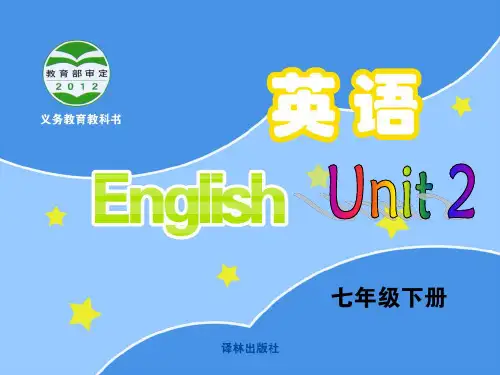
help mother do some housework cook dinner for buy her a present/ flower... write a letter/ postcard to her study hard ...
Post-task
一、用正确的时态填空
will
1. Women’ Day is coming.aIm__g_o_i_n_g__t_o_g_i_v_e___ (give) my mother a present.
2. -- What _a_r_e_ you ___g_o_i_n_g__t_o_b__e_ (be) when you
We shall/ will have classes tomorrow.
Will you have classes tomorrow?
Yes, I(we) will / shall.
后天
Will you have classes the day after tomorrow?
No, I (we) wiwllonno’t / shashllanno’t. t t
3W.We e aren’t gnooitndgotooudro outrohnoigmhte=wthoirsk
tonight/this evheonminegw. ork evening
4T.hTehtwe itnwin brontohteprlsayaren’tngeoxitnTguetosdpalyay
Sum up(总结) the time expressions in the simple future tense.
将来时的典型标志:
7B Unit2 Grammar 课件(共29张PPT)

一般将来时
be going to do sth谈论即将发生的事情。
表示主观上计划、打算在将来某个时间要做的事情
或表示说话人根据已有的迹象,估计将要发生的事。
Unit2 Neighbours Grammar
一般将来时:
will/ shall+do表示说话人知道或认为将会 发生的事情;
或表示说话人说话时所做的决定
(1) _s_h_a__l_l__用于第一人称___I__/ _w_e___;
will适用于__任___何__人__称____。 I will/I shall 缩写____I_’l_l______
这里明天将进行一场比赛。
(2)There is/are going to be …
T_h_e_r_e_is_ _g_o_in_g_ _t_o_ _b_e_ a party at the _y_o_u_t_h_ c_e_n_t_r_e tomorrow
afternoon.
明天下午计划在青少年活动中心进行一个聚会。
他们会和我一起去那里吗?愿意。
——_W___il_l they __g_o_ there with me ? ——Yes, _t_h_e_y_ w__i_ll__
当主语是第一人称(I/we)的时候,
通常用shall来提问,多用于征求意见或建议。
如: 我能和你一起去购物吗?
_S_h_a_ll__ __I___ ___g_o___s_h_o_p_p_i_n_g_ with you? 我们一起去购物好吗?好主意。
2.否定句: will/shall +not+v.原形 won’t/shan’t+v.原形
牛津译林版7BUnit2 Reading(1)课件 (共15张PPT)

Write about Simon’s neighbours
My neighbours are kind and helpful. Some of them are different skills volunteers.They have _____________and often help us all kinds of problems. with____________ at the weekend Usually there is a “helping hands” meeting__________. People go there when they need help with problems their____________. Computer engineers are popular. check They help people ___________ their computers. You can fix broken also find someone to ___________ things like _______ bicycles.
2. There is a meeting called “helping the old” at the weekend.
3. Simon wants to ask someone to fix his bicycle. 4. Annie’s computer is broken. 5. Parents help their children with their homework. 6. Volunteers also help the old people.
help at the community
helpful
牛津译林版7A Unit2 Grammar (共28张PPT)
I don’t live in a small house.
Complete the sentences. Use the proper verb forms in brackets
1. Jordan _p_l_a_y_s__(play) basketball. He _d__o_es_n_’_t_p_l_a_y(not play) football.
Unit 2 Let’s play sports
Grammar
Simple present tense
Simple present tense of the verb “to be”
am (主语为I) be is (主语为第三人称单数)
are (主语为第二人称you或所有复数)
Daniel is helpful. 否定句: Daniel isn’t helpful. 一般疑问句: Is Daniel helpful? 肯定&否定回答: Yes, he is. No, he isn’t.
实义动词的一般现在时
一、什么叫实义动词? 实义动词指某种动作行为,有具体意
思的动词,也叫行为动词。 如: like, eat, live, have, run 等等,
实义动词占英语中动词的绝大多数。
我们已学过的be 动词可译成 “是”,有时译成“成为”,有时 则没有具体意思。如: “She is tall.”这句译成: “她很高”。故 be 动词不属于实义动词。
你能再举出一些第三人称单数 的例子吗?
三、 一般现在时实义动词作谓语时 的动词形式:
一,动词原形 二,第三人称单数动词形式 (如: enjoy叫原形, enjoys叫第三人称单 数形式)。
牛津译林版7B英语unit2 Reading2课件
Neighbours
Neighbours’ Day
Simon
Simon’s neighbours
1. Simon’s neighbours are kind and helpful. 2. Some of them are volunteers . 3. They often meet at community centreand
For the old, we can… For the young, we can… If I am a …, I can…
Try to be kind and helpful to the people around !
When you are good to others, you are best to yourself !
ask sb to do sth 要求某人做某事
ask sb not to do sth 要求某人不要做某事
1.Our teachers ask us to listen (listen) carefully in class. 2.The parents ask their children not to play ( not play)
computer games too much.
Teacher Sissi’s neighbour
He is a computer engineer.
If there’s something wrong with computers , …
Language points:
3.There’s something wrong with your computer.
1.Today: Try to do a good deed for the people around you.
牛津译林版七下英语7bunit2grammar课件
4.Myfather__w_i_ll_c_o_m_e_(come)backfromHongk ongsoon.
Shewillhelpthechildrenwiththeirlessons.
1.一般将来时结构 主语+Will+v.原形 (肯定句结构):
Will是否随人称的变化而变化? No.
1.TomorrowisSunday.We__w_i_ll_h_a_v_e______(h ave)apicnicinthepark.
2.Theskyissodark.Ithinkit____w__il_lr(arainin).
Amy:What(4)______yourparents_________(do)? Simon:They(5)a_re_________(bring)sgooimngetowdoater. Amy:Howaboutyoaruegruoinncgtloeb?ring
Simon:He(6)____________(make)afire. Amy:Andyouraiusgnoti?nWgtohmaatk(e7)______she________(do)? Simon:She(8)__________(cook)issomefood.
活动
Whatisshe/hegoingtodo?She/heisgoingto… Whataretheygoingtodo?Theyaregoingto…
Thecatisgoingtodrinkwater . Sothecatisn’tgoingtocatchmice.
牛津译林版七年级英语上册Unit 2 Grammar课件
You + like sports.
They
当主语是第一人称、第二人称、第三人称复数时,
谓语动词以_动__词__原__形____构成。
How to change into negative sentences
Activity 1: Look and say.
1. I talk to my parents at lunchtime. →I don’t talk to my parents at lunchtime.
4. 他们每天带小狗出去散步。 _T_h_e_y__ta_k_e__th_e__d_o_g_f_o_r_a__w_a_lk__e_v_e_ry__d_a_y_. _________
How to use the simple present tense of the verb to do
Activity 2: Work out the rule.
3. We often go shopping at weekends. _W__e_d_o_n_’_t _o_ft_e_n__go__s_h_o_p_p_in__g_a_t_w_e_e_k_e_n_d_s_._______ _D_o__y_o_u_o_f_t_e_n_g_o__sh__o_p_p_in_g__a_t _w_e_e_k_e_n_d_s_?________ _Y_e_s_, _w_e_d_o_._/_N__o_,_w_e__d_o_n_’t_.___________________
4. 米莉在晚上写作业。 _M__i_ll_ie__d_o_es__h_e_r_h_o_m__e_w_o_r_k_i_n_t_h_e_e_v_e_n_i_n_g_. _______
How to use the simple present tense of the verb to do
牛津译林版英语7BUnit2Grammar学习教案
牛津译林版英语7BUnit2Grammar学习教案一、教学内容本节课我们将学习牛津译林版英语7B的Unit2 Grammar部分。
具体内容包括:现在进行时的用法,常见现在进行时态的动词词组,以及现在进行时在句子中的应用。
涉及的章节为Unit2的Grammar Focus 和Task部分。
二、教学目标1. 掌握现在进行时的基本结构,并能正确运用到句子中。
2. 学会使用现在进行时描述正在进行的动作或状态。
3. 能够运用现在进行时进行日常交流,提高口语表达能力。
三、教学难点与重点1. 教学难点:现在进行时的结构以及不同动词的现在分词形式。
2. 教学重点:现在进行时的用法以及在句子中的应用。
四、教具与学具准备1. 教具:PPT,黑板,录音机,磁带。
2. 学具:英语课本,练习本,词典。
五、教学过程1. 导入:通过展示一幅描绘正在进行活动的图片,引导学生用现在进行时描述图片中的活动,激发学生兴趣。
2. 讲解:详细讲解现在进行时的结构,并结合例句展示其用法。
3. 实践:让学生两人一组,运用现在进行时进行对话练习。
4. 例题讲解:分析并讲解Grammar Focus中的例题,引导学生正确运用现在进行时。
5. 随堂练习:让学生完成Task部分的练习,巩固所学知识。
六、板书设计1. Unit2 Grammar Focus2. 内容:现在进行时的结构:主语 + be动词(am/is/are) + 现在分词常见现在进行时的动词词组例句展示七、作业设计1. 作业题目:根据所给词组,用现在进行时造句。
完成课后练习册中的相关习题。
答案:1. 根据所给词组,用现在进行时造句。
She is reading a book.He is playing football.They are watching TV.八、课后反思及拓展延伸1. 反思:关注学生在课堂上的表现,及时发现问题并进行针对性指导。
2. 拓展延伸:鼓励学生在课后观察周围正在进行的动作或状态,用现在进行时进行描述,提高英语实际运用能力。