
食品专业英语Lesson2 Carbohydrate汇编
食品专业英语
Micro-前缀,意为极微小的 microwave微波炉,microorganism微生物 microbiology 微生物学, microbiological微生物学 的, microbiologist 微生物学家 Macro-表示“大的,长的”之义
grade等级;upgrade升级;gradation,渐变,等级; degradation降级;retrogradation老化; undergraduate大学生;graduate大学毕业生; postgraduate 研究生
食品专业英语
While some molecular aspects are in common to both groups, the sugars and polysaccharides have vastly different functional properties.
尽管这两类物质在分子层面上有某些相似之处,但糖 译文 和多糖的功能性质差异却很大。
这种葡萄糖单元之间具有特殊链接的多聚物,不受加热、 译文 中强度酸、碱影响,也不受食品加工和人类消化道常用 酶的作用。
食品专业英语
β-D-glucopyranose
CelluloseFra bibliotek 食品专业英语
amylose支链淀粉
α-D-glucopyranose
amylopectin 直链淀粉
食品专业英语
食品专业英语
Lesson 2 Carbohydrates
一.词汇讲解 二.课文阅读 三.课后作业
食品专业英语
carbo-碳:,carbochain碳链 Carbon碳;Carbonyl 羰基 Hydrogen氢 ;Hydro-水、氢的;hydrate水合物; hydrogenation氢化,hydrocarbon碳氢化合物; carbohydrate碳水化合物 Hydrolyze/hydrolyse水解 Aldehyde醛,乙醛 Starch淀粉 Mailard browning美拉德褐变
食品专业英语
Concentrated sugar solutions are viscous and provide some body to sweetened soft drinks compared to water or soft drinks sweetened with high intensity sweeteners.
食品专业英语
Another class of carbohydrates are the polymers made up of various monosaccharide subunits linked in various ways that are not degraded by the human digestive process.
食品专业英语
Sugar alcohols are sugar derivatives that are found naturally but are more commonly manufactured from sugars and added as pure ingredients.
麦芽糖由两个葡萄糖单位构成,存在于发生过淀粉降解 译文 的产品中。
食品专业英语
Saccharide 糖类; monosaccharide 单糖; disaccharide二糖;polysaccharide多糖; Reducing sugar还原糖;nonreducing sugar非还原糖 Covalent(ly)共价的(地);co-,co-worker; ooperation
-ose糖的后缀 单糖有:glucose 葡萄糖 ;dextrose 葡萄糖; fructose 果糖;galactose半乳糖 双糖有:lactose 乳糖,;maltose 麦芽糖;sucrose 蔗糖
-ol后缀,意为该物质为醇或酚 sorbitol 山梨醇;xylitol木糖醇;mannitol甘露醇
食品专业英语
The specific linkage between glucose units creates a polymer that is not affected by heat, moderate acid, alkali, or enzymes normally used in food processing and the human digestive tract.
另一类碳水化合物由各种单糖元以各种方式联接而成的 译文 聚合物,它们不能被人类消化降解。
食品专业英语
These carbohydrates are relatively inert chmeically although they bind water and develop significant viscosity and/or form gels.
Gelatinization is temperature dependent starting as low as 50℃ and not being totally completed until temperatures reach 120℃。
译文 糊化作用与温度有关,始于50℃,直到120℃才完全结束。
浓缩糖液具有黏性,为甜味软饮料提供有别于水或高强度 译文 甜味剂软饮料的质感。
食品专业英语
Maltose, composed of two glucose units, is found in products where there has been starch degradation.
麦芽糖由两个葡萄糖单位构成,存在于发生过淀粉降解 译文 的产品中。
食品专业英语
Sugar alcohols are sugar derivatives that are found naturally but are more commonly manufactured from sugars and added as pure ingredients.
糖醇是天然存在的,但通常由糖类制造而形成 并以纯配料 译文 形式添加使用糖的衍生物。 糖醇是天然存在的糖的衍生物,但通常由糖类制造而形成 并以纯配料 形式添加使用。
食品专业英语课件

译文
重组DNA技术在食品和食品配料的生产应用的20年的时间 里,已经从基础研究的水平发展成商业化的地步。
Part 2 食品科技英语的阅读
Lesson 1 WHO Strategy on Food Safety
From the very beginning, development and use of genetic engineering have been accompanied by strict regulations. These regulatory requirements cover the contained use of genetically modified organisms (GMO), their deliberate release into the environment as well as the placing on the market of products containing or consisting of GMO.
B. Most developing countries are willing to be responsible for the consequence of using the new technology.
C. Most developed countries are not willing to be responsible for the consequence of using the new technology.
到目前为止,还没有关于由人们消费转基因食品所产生的 译文 负面影响的报道。然而,转基因食品的本质(伦理问题)
和发展速度引起了消费者的恐慌。
Par Strategy on Food Safety
食品专业英语Lesson2 Carbohydrate
译文
食品专业英语
These carbohydrates are relatively inert chmeically although they bind water and develop significant viscosity and/or form gels.
食品专业英语
While some molecular aspects are in common to both groups, the sugars and polysaccharides have vastly different functional properties.
译文
尽管这两类物质在分子层面上有某些相似之处,但糖 和多糖的功能性质差异却很大。
食品专业英语
The hydrolysis of disaccharides to monosaccharides occurs with heat and acid and enzyme . Why do a reducing sugar have reactivity?
hint:ketone or aldehyde group
Gelatinization is temperature dependent starting as low as 50℃ and not being totally completed until temperatures reach 120℃。
译文 糊化作用与温度有关,始于50℃,直到120℃才完全结束。
食品专业英语
Saccharide 糖类; monosaccharide 单糖; disaccharide二糖;polysaccharide多糖; Reducing sugar还原糖;nonreducing sugar非还原糖 Covalent(ly)共价的(地);co-,co-worker; ooperation
第3章第2节 碳水化合物 (carbohydrate)
1.2 双糖(disaccharide):
由两分子单糖缩合而成。常见以下几种。
①蔗糖(sucrose) ,由一分子葡萄糖和一分子果糖以α糖苷 键连接而成。存在于甘蔗、甜菜及有甜味的果实之中, 在许多水果和蔬菜中含有。 ②麦芽糖(maltose) ,由两分子葡萄糖以α糖苷键连接而成。 是淀粉的分解产物,大量存在于发芽的谷粒,特别是麦 芽中。 ③乳糖(1actose) ,有一分子葡萄糖与一分子半乳糖以β糖 苷键连接而成。是唯一没有在植物中发现过的糖,存在 于乳中。
• ①.提供热能 • 碳水化物是机体主要的能量营养素,是 人类从膳食中取得热能的最经济最主要的来 源。 • 当碳水化物提供能量充足时,可发挥对蛋 白质的节约作用和对脂肪的抗生酮作用。
•
中枢神经、红细胞只能靠葡萄糖提供能 量,故碳水化物对维持神经组织和红细胞功 能有重要意义。 • 糖原是肌肉和肝脏中碳水化物的贮存形 式,其中肝脏中糖原在机体需要时,分解为 葡萄糖进入血循环,提供机体对能量的需要; 肌肉中的糖原只供自身的能量需要。
第1节 碳水化合物的分类
• 1. FAO/WH0 1998按照碳水化合物 的聚合度 (DP)将其分为3类: (1)糖类:单糖(monosaccharide)
双糖(disaccharide) 糖醇(sugar alcohol) (2)寡糖(oligosaccharide):异麦芽低聚寡糖、其 他异麦芽低聚寡糖 (3)多糖(polysaccharide):淀粉、非淀粉多糖
• ③.半乳糖(galactose) ,是乳糖的组成成分,半乳 糖在人体中先转变成葡萄糖后被利用,母乳中的半 乳糖是在体内重新合成的,而不是食物中直接获得 的。 • ④.其它单糖: • 戊糖类,如核糖(ribose) 、脱氧核糖(deoxyribose) 、阿拉伯糖(arabinose)、木糖(xylose)等; • 甘露糖,主存在于水果和根、茎 类蔬菜中; • 糖醇类,如山梨醇(sorbitol) 、甘露醇(mannitol) 、 木糖醇(xylitol)、麦芽糖醇(maltitol)、肌醇 (inositol) 等。
食品专业英语目录
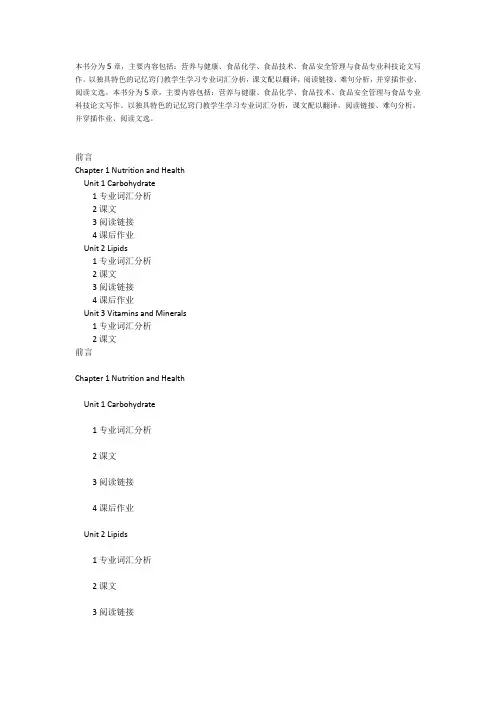
本书分为5章,主要内容包括:营养与健康、食品化学、食品技术、食品安全管理与食品专业科技论文写作。
以独具特色的记忆窍门教学生学习专业词汇分析,课文配以翻译,阅读链接、难句分析,并穿插作业、阅读文选。
本书分为5章,主要内容包括:营养与健康、食品化学、食品技术、食品安全管理与食品专业科技论文写作。
以独具特色的记忆窍门教学生学习专业词汇分析,课文配以翻译,阅读链接、难句分析,并穿插作业、阅读文选。
前言Chapter 1 Nutrition and HealthUnit 1 Carbohydrate1专业词汇分析2课文3阅读链接4课后作业Unit 2 Lipids1专业词汇分析2课文3阅读链接4课后作业Unit 3 Vitamins and Minerals1专业词汇分析2课文前言Chapter 1 Nutrition and HealthUnit 1 Carbohydrate1专业词汇分析2课文3阅读链接4课后作业Unit 2 Lipids1专业词汇分析2课文3阅读链接4课后作业Unit 3 Vitamins and Minerals1专业词汇分析2课文3阅读链接4课后作业Chapter 2 Food ChemistryUnit 1 Fhod Additives1专业词汇分析2课文3阅读链接4课后作业Unit 2 Enzymes in food1专业词汇分析2课文3阅读链接4课后作业Unit 3 Food Fermentation1专业词汇分析2课文3阅读链接4课后作业Chapter 3 Food‘technologyUnit 1 Food Processing1专业词汇分析2课文3阅读链接4课后作业Unit 2 Food Preservation1专业词汇分析2课文3阅读链接4课后作业Unit 3 Food Products Making1专业词汇分析2课文3 阅读链接4课后作业Chaptee 4 Food Safety and Management Unit 1 Transgenic Food1专业词汇分析2课文3阅读链接4课后作业Unit 2 GMP and SSOP1专业词汇分析2课文3阅读链接4课后作业Unit 3 HACCP1专业词汇分析2课文3阅读链接4课后作业Claapter 5 WritingUnit 1 Food Science and Technology English Papers Translation Methods and Techniques 1专业词汇分析2课文3课后作业Unit 2 Introduction to Research Paper Writing in Food science and technology1课文2The PaperUnit 3 The Writhing of Title.Abstract and Chart Title in Food Science and Techwology English Papers1英文标题的写作2英文摘要的写作3英文图表标题的写作主要参考文献。
教学大纲-食品专业英语
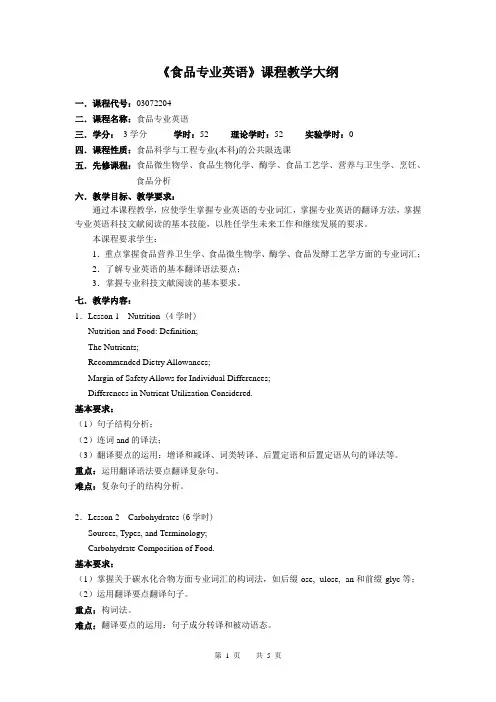
《食品专业英语》课程教学大纲一.课程代号:03072204二.课程名称:食品专业英语三.学分:3学分学时:52 理论学时:52 实验学时:0四.课程性质:食品科学与工程专业(本科)的公共限选课五.先修课程:食品微生物学、食品生物化学、酶学、食品工艺学、营养与卫生学、烹饪、食品分析六.教学目标、教学要求:通过本课程教学,应使学生掌握专业英语的专业词汇,掌握专业英语的翻译方法,掌握专业英语科技文献阅读的基本技能,以胜任学生未来工作和继续发展的要求。
本课程要求学生:1.重点掌握食品营养卫生学、食品微生物学、酶学、食品发酵工艺学方面的专业词汇;2.了解专业英语的基本翻译语法要点;3.掌握专业科技文献阅读的基本要求。
七.教学内容:1.Lesson 1 Nutrition (4学时)Nutrition and Food: Definition;The Nutrients;Recommended Dietry Allowances;Margin of Safety Allows for Individual Differences;Differences in Nutrient Utilization Considered.基本要求:(1)句子结构分析;(2)连词and的译法;(3)翻译要点的运用:增译和减译、词类转译、后置定语和后置定语从句的译法等。
重点:运用翻译语法要点翻译复杂句。
难点:复杂句子的结构分析。
2.Lesson 2 Carbohydrates (6学时)Sources, Types, and Terminology;Carbohydrate Composition of Food.基本要求:(1)掌握关于碳水化合物方面专业词汇的构词法,如后缀-ose, -ulose, -an和前缀-glyc等;(2)运用翻译要点翻译句子。
重点:构词法。
难点:翻译要点的运用:句子成分转译和被动语态。
3.翻译方法(8学时)(1)构词法(2)单词(3)词类转换的译法(4)句子成分转换的译法(5)被动语态的译法(6)后置定语从句的译法(7)专业英语的主要特点和翻译标准基本要求:熟悉各种翻译要点。
(大学专业英语2)Lesson2 Nutrition
Unit2 NutritionWhat we eat as well as how much we eat determine our nutrition status to an important extent,and influenced by a diversity of external and internal factors.The person who wants to find the answer to the question" what should I eat for good nutrition?“,might easily become lost in the maze of informational corridors,confused by the wealth of technical information provided by scientists or mislead by simplistic answers provided by those with products to sell.Somewhere in between is some reasonable,commonsense information that we can use to guide us our quest for sound nutrition knowledge.To begin,we need to learn some definitions of commonly used nutrition terms and find out what sorts of guidelines are available to help us measure the quality of our diets and to develop healthful eating patterns.NUTRITION AND FOOD:DEFINITIONSThe word nutrition is often paired with the word food because the two go together. They are interdependent,but not interchangeable.Food might be defined as any edible substance that provides nourishment when consumed. It is made up of many natural ingredients all chemicals that have different functions such as providing odor,flavor,color,and nourishment. The ingredients that give us nourishment are called nutrients.These nutrients are categorized as fats,proteins carbohydrates (sugars and starches),minerals,vitamins,and water. They are called essential nutrients because we cannot get along without them. We need them for energy,for building and maintaining body tissue;and for regulating body processes ,these are the three essential functions of foods in the body.Nutrition might be defined as the process whereby we obtain the essential nutrients and use them to make many other substances our bodies need,this process would include eating and digesting food and absorbing and using,or metabolizing,the nutrients it contains.We can obtain all of the essential nutrients from food. However,it is possible to obtain nourishment without eating and digesting food-if,for example,the nutrients are injected directly to our veins as in intravenous feeding.Thus,it is the nutrients that are essential and the food that normally provides them. Since food is vital,we need to know the nutritive content of foods,whichones are the best sources of the various nutrients and how to combine them into a healthful diet.The term good nutrition implies that we are obtaining from our food all of the essential nutrients in the amounts needed to keep our bodies functioning and to maintain optimum health. A very simplified definition of good nutrition might be" eating the right foods in the right amounts.“The work of nutrition scientists involves finding the answer to questions about nutrients-their function in the body,the amount of each that we need,what happenings when we receive too much or too little and about food and diet-what foods we should eat and in what amount.Yet nutrition science in its broadest sense has many more facets:the influence of sensory factors of flavor,color,and texture of food on eating behavior;the psychological,cultural,emotional,and social aspects of food intake;and even the economics of food availability and consumer behavior in the purchase of food.THE NUTRIENTSTo date,nutrition scientists have identified some 40 to 45 substances as essential nutrients. But the list is growing as new nutrients continue to be identified;the history of nutrition science contains fascinating stories about the ways food substances have been identified as essential nutrients. In some instances,medical researchers seeking the cause of a particular disease found that problem was due to a single substance,and that when this substance was added to the diet,the symptoms of the disease disappeared. A number of vitamins were discovered in this way.Nutrients might be divided into two general categories based on the amount that we need. These are the macronutrients (carbohydrates,fats,proteins,and water),which we need in relatively large amounts and the micronutrients (mineral elements and vitamins),which we need in relatively small amounts. All of the nutrients except for mineral elements and water are classified as organic chemicals because they contain the element carbon. Mineral elements and water are inorganic chemicals because they do not contain carbon.The vitamins are divided into two general categorizes based on their solubility in either water or fat .the fat-soluble vitamins are vitamins A,D,E,and K;the water-soluble vitamins include vitamins C (ascorbic acid),niacin,thiamin,riboflavin,flacon (also called folic acid)antithetic acid,pyridoxine,vitamin B12 and biotin.The mineral elements are divided into two categories based on the quantity of them that we need. Macroelements are those needed in relatively large amounts,while microelements are those needed in very small amounts,some example ofmacroelements are sodium,calcium,and phosphorus. Some example of microelements is iron,iodine,manganese,zinc,and fluorine.RECOMMENDED DIETARY ALLOWANCESOnce a nutrient is identified,one of the principal research efforts of nutrition scientist is to determine how much of it is needed by people at various ages and stages of life. Initial studies usually are conducted with laboratory animals,but the information developed in these studies cannot be applied directly to humans since people's needs often are quite different from animals' needs. Human nutrition studies on the other hand,are time-consuming,costly,and difficult to conduct,especially because of the problems of controlling variables and possibly causing harm to the individuals involved. Because of the obstacles to collecting accurate data,our present knowledge of nutrient needs is incomplete,and the requirements of humans for many nutrients have not been established.However,the data on human and animal needs currently available are used by nutrition scientists to establish estimates of the amounts of essential nutrients per day that will meet the needs of most health persons. In the United States,the most widely used nutrient guidelines are the recommended dietary allowance (RDA),which are issued by the national academy of sciences,national research council,and food and nutrition board.The RDA serves as dietary of nutritional standards for a wide range ofage-weight-sex groups such as infants,children,adolescents,pregnant and lactating women,and younger and older adults. They are recommendations,not average requirements,for satisfactory levels of intake of essential nutrients of population groups of average,healthy people. They do not take account of special needs certain individuals may have due to genetic make up,metabolic disorders,chronic infections,and other abnormalities,which may result in their needing different levels of nutrients.MARGIN of SAFETY ALLOWS for INDIVIDUAL DIFFERENCESTo allow for individual difference,the usually are set with a generous margin of safety. Thus,they are thought to meet the needs of 95 to 97 percent of the people within each age-sex group. In other words,the RDA exceed the requirements of most individuals to ensure that the needs of nearly all are meet. For this reason,a person who consumes a diet that provides less than the RDA for one or more essential nutrients is not necessarily getting a diet that is nutritionally inadequate. What can be concluded,however,is that the farther the intake of an essential nutrient falls below the RDA,the greater the probability of nutritional inadequacy,on the other hand,if an individual is getting all the essential nutrients at or above the RDA level of his or her age,chances are good that diet is nationally adequate.An exception is the RDA for energy or calories,which are not designed,as guides for individual caloric needs. Other variables not included in the RDA,such as body size and physical activity,are involved in an individual's caloric requirements.DIFFERENCES IN NUTRIENT UTILIZATION CONSIDEREDAnother factor considered when the RDA are established is the availability of the nutrient and factors that affect how efficiently it is used in the body. For some nutrients,such as iron,absorption or use in the body may be incomplete;so the RDA needs to be set high enough to allow for this. And because in the case of certain other nutrients,substance in food ,called precursors,may be converted into the nutrient in the body ,the RDA needs to allow for this .An example is carotene, the orange-colored substance found in carrots and other vegetables and fruits,which our bodies convert to vitamin A.On the other side of the coin,receiving too much of certain nutrients,amounts significantly above the RDA,can be just harmful as not obtaining enough. Certain vitamins (such as A and D)and minerals can be highly toxic if high doses are used over a period of time.Thus,the RDA can serve as guidelines for optimal nutrient intake from the standpoint of both maximum and minimum levels.Vocabulary:maze n. ①迷宫,迷津,曲径;②混乱,迷惑vt.①使如入迷津②使困惑,使为难‖~d a.迷惘的,困惑的corridor n. ①走廊,回廊,通路②走廊地带③空中走廊diversity n.①差异,不同②多样性,变化in between 在中间,每间隔,在…期间commonsense 有常识的,明明白白的,一望而知的commonsensible (符合)常识的guideline n.①指导路线,方针,准则,指标②指路绳;样张,样行,标线interchangeable ①可交换的,可交替的②可互换的interdependent 互相依赖的,互相依存nourishment ①食物,滋养品②营养情况nutrient ①营养的,滋养的②营养素,营养物consume vt.①消费,消耗,浪费,吃光,喝光②消灭,毁灭vi.消灭,毁灭,消磨,(花,叶等)枯萎(away)be ~d with 被…所吞噬;因(忧愁,妒嫉)而变的憔悴nutrition 营养nutritional 营养的nutritive 营养的,滋养的,食品的,食物的odor气味odorant ①有香气的,有气味的②任何有气味的物体flavor ①味,香味,风味,滋味②食用香料③食用香精④调料category n.①种类,部属,类目②范畴,类型③范畴carbohydrate 碳水化合物,糖类mineral 矿物质,食品中的痕量物质vitamin 维生素,维他命get along 过活,生存essential a.①本质的,实质的,基本的②必需的,必不可少的③提炼的,精华的n.①本质,实质②要素,要点,必需品whereby ad.①(疑问副词)靠什么②(关系副词)靠那个A device ~to get warmth取暖的设备metabolism 新陈代谢,代谢(作用)intravenous feeding 静脉进食vein n.①静脉,血管②性情,气质,才干,语调,风格,意向③纹理,木纹vital 生命的;生机的;维持生命所必需的optimum n.(生长繁殖的)最适条件;最适度 a.最适的facet n. ①(多面体的)面,(宝石等的)刻面,小(平)面②(题目,性格,思想等的)某一方面vt. 在…上刻面intake n. ①吸入,纳入,收纳②纳入(数)量③(水、气体流入沟、管的)入口④被收纳的东西⑤摄取~of food食物摄取availability n.①可用性,有效性,效力②可得性,可得到的东西(或人员)identify vt.①使等同于,认为…一致(with)②认出;识别,鉴定,验明③确定…在分类学上的位置vi.一致,成为一致fascinate vt.①迷住,使神魂颠倒,强烈地吸引住②使呆住,蛊惑vi.迷人,极度吸引人fascinator n.①迷人者②网眼毛披巾macronutrient 主要营养micronutrient 微量营养micro- ①小,微,微量,百万分之一②放大,扩大microphone,microscopeascorbic acid 抗坏血酸niacin 烟酸,尼克酸thiamine 硫胺素riboflavim 核黄素VB2folacin 叶酸(=folic acid)pantothenic acid 泛酸pyridoxine 吡哆醇,吡哆素,维生素B6 biotin 生物素macroelement 主要成分microelement 微量成分sodium 钠potassium 钾phosphorus 磷phosphorous 磷的,亚磷的,含磷的costly a.①昂贵的,代价高的②价值高的,豪华的obstacle n.障碍(物),妨碍pregnant a.①怀孕的,怀胎的,孕育着的,充满的,富有的②意义深长的,含蓄的③富于想象力的,有创造力的④富于成果的,多产的lactate vi.①分泌乳汁②喂奶,授乳n.乳酸盐(或酯)calcium ~乳酸钙lactation n.genetic a. ①创始的,发生的②遗传学的gene n. 基因chronic infection n.①传染,侵染②传染病③影响,感染chronic a.①长期的,慢性的②惯常的,经常的③剧烈的,顽固的n.患慢性病的人abnomality n.①反常,变态,不规则②反常的事物,畸形council n.①政务会,理事会,委员会②商讨会,讨论会议chance n.①机会②可能性,或然性③偶然性,运气a.偶然的vi.碰巧;偶然发生vt.冒…险precursor n.①先驱者,先锋②前辈,前任③预兆,先兆carotene n.胡萝卜素;叶红素carrot n.①胡萝卜②红头发(的人)③政治诱骗,不能兑现的允诺carroty a.①胡萝卜色的②红发的standpoint n.主场,观点。
食品专业英语文选(第二版)
电子出版物数据中心中国轻工业出版社出品京新出音[2010]419号ISBN 978-7-89991-109-9高等学校专业教材食品专业英语文选(第二版)许学勤主编目录•Lesson 1 Food Industry •Lesson 2 Water•Lesson 3 Carbohydrates •Lesson 4 Proteins•Lesson 5 Lipids•Lesson 6 Vitamins and Minerals •Lesson 7 Food Additive •Lesson 8 Food Microbiology •Lesson 9 Fermentation Glossary Glossary Glossary Glossary Glossary Glossary Glossary Glossary Glossary•Lesson 10 Physical Properties of Foods•Lesson 11 Food Dispersions•Lesson 12 Food Preservation•Lesson 13 Food Processing•Lesson 14 Unit Operations in Food Processing •Lesson 15 Food Packaging•Lesson 16 Thermal Treatment and Thermal Processing •Lesson 17 Food Concentration•Lesson 18 Food Dehydration and Drying Glossary Glossary Glossary Glossary Glossary Glossary Glossary Glossary Glossary•Lesson 19 Food Freezing•Lesson 20 Extrusion Cooking•Lesson 21 Membrane Separation•Lesson 22 Meat and Meat Products•Lesson 23 Milk and Milk Products•Lesson 24 Poultry and Eggs•Lesson 25 Principles of Baking•Lesson 26 Confectionery and Chocolate Products •Lesson 27 Fruit Juices Glossary Glossary Glossary Glossary Glossary Glossary Glossary Glossary Glossary•Lesson 28 Beverages•Lesson 29 Food Safety•Lesson 30 Hazard Analysis and Critical Control Points •Lesson 31 Good Manufacturing Practice (GMP)•Lesson 32 Sanitation in Food Plant•Lesson 33 Food Quality•Lesson 34 Shelf-life of Food Products Glossary Glossary Glossary Glossary Glossary Glossary Glossary。
食品专业英语参考资料
旗开得胜1nutrition 营养nourishment 食物,滋养品,营养情况 nutrient 营养素,营养物 odor 气味flavor 味,香味,风味,滋味;食用香料;食用香精;调料carbohydrate 碳水化合物,糖类 metabolism 新陈代谢,代谢(作用) intravenous feeding 静脉进食 vein 静脉,血管vital 生命的;生机的;维持生命所必需的 optimum .最适的macronutrient 主要营养素,常量营养素 micronutrient 微量营养ascorbic acid 抗坏血酸thiamine 硫胺素folacin 叶酸pyridoxine 吡哆醇,吡哆素,维生素B6 niacin 烟酸,尼克酸riboflavin 维生素B2,核黄素 pantothenic acid 泛酸 biotin 生物素维生素Hsodium 钠potassium 钾 phosphorus 磷lactate 分泌乳汁,喂奶,授乳.乳酸 ,乳酸盐[酯, 根]genetic 遗传学的,遗传上的,遗传基因的 infection.传染,侵染 ;传染病 ;影响,感染 chronic 长期的,慢性的 biotin.维生素H, 生物素 oxidation.氧化氧化[作用]conalbumin 伴清蛋白, 伴白蛋白 avidin 抗生物素蛋白 thiaminase. 硫胺酶 blanch 漂白, 使变白sterilization 灭菌, 消毒; 绝育消毒 asparagus 芦笋 retention 保持力 dehydrated 脱水的 snap bean 四季豆; 豆荚thaw.解冻fluorescent.荧光的 sulfur dioxide 二氧化硫amylase 淀粉酶; 液化酶; 淀粉糖化酶 carbohydrate 碳水化合物,糖类 cellulose 纤维素 fructose 果糖,左旋糖 galactose 半乳糖 glucose 葡萄糖, 右旋糖 hydrolysis 水解(作用) hemiacetal半缩醛isomers 同分异构体 lactose 乳糖 maltose 麦芽糖polymers 聚合物,多聚物 starch 淀粉 stereochemistry 立体化学 sucrose 蔗糖emulsion .乳浊液,乳胶,乳剂 fatty acid 脂肪酸triacylglycerol 甘油三酸酯三酰〔基〕甘油triglyceride 即甘油三酯 glycerol 甘油,丙三醇 phospholipid 磷脂 glyceride 甘油酯 tallow (炼制牛,羊)油脂linoleic acid 亚油酸,十八(碳)二烯-9,12-酸linolenic acid 亚麻酸,十八(碳)三烯-9.12.15-酸stearic acid 硬脂酸,十八(碳)(烷)酸 safflower 红花cholesterol 胆甾醇,胆固醇 diglyceride 甘油二酸酯 hydrogenate 氢化 pepper 胡椒; 辣椒; 花椒tactile 触觉的, 有触觉的, 能触知的 olfactory 嗅觉的neuron 神经细胞, 神经元 aldehyde 醛, 乙醛 ketone 酮 amine 胺heterocyclic 杂环的, 不同环式的 aromatic 芬芳的,芳香的 pyrazine 吡嗪, 对二氮杂苯, 胡椒嗪 threshold 阈; 阈值 chromatograph 色谱仪 isomerization 异构化(作用) lipolysis 脂解(作用)doughnut 油炸圈饼,.圆环图 hydroperoxide 氢过氧化物,过氧化氢物pentylfuran 戊基呋喃cottage scale bakery 作坊式规模的面包房plain flour 普通面粉 prove 使(面团)发起来cookery 烹任方法;烹调技术;烹调场所 bicarbonate of soda 碳酸氢钠 cream of tartar 酒石酸氢钾 baking powder 焙烤粉;发粉 feed on 以……为食;取……为养料 city water 城市给水;自来水air sifter with pneumatic conveyor 带气力输送系统的风筛机 jot 添加剂rounder 面团揉圆机;面团成圆机 the straight dough system 直接发酵面团制面包法bread improver 面包改良剂ferment in bulk 整块发酵;大容量发酵 knocked —back (发面过头后)揉紧回缩。
食品专业英语之工业基本术语
动物性食品 food of animal origin (animal food)植物性食品 vegetable food (plant food)传统食品 traditional food干制食品 dehydrated food糖制食品 confectionery腌制品 curing food烘焙食品 bakery熏制食品 smoking food膨化食品 puffed food (extruded food)速冻食品 quick-frozen food罐藏食品 canned food方便食品 convenient food(fast food, prepared food, instant food) 特殊营养食品 food of special nutrients婴幼儿食品 infant or baby food强化食品 nutrient fortified food天然食品 natural food摸拟食品 imitation food预包装食品 prepackaged food食品制造 food manufacturing食品加工 food processing食品工业 food industry食品资源 food resource食品新资源 new resource for food原料 raw material配料 ingredient主料 major ingredient (major material)辅料 minor ingredient食品添加剂 food additive食品营养强化剂 food enrichment加工助剂 processing aid配料表 list of ingredients配方 formula食品包装材料 packaging material for food食品包装容器 food container软包装 flexible package硬包装 rigid package食品标签 food labelling保质期 date of minimum durability食品质量管理 food quality control食品质量监督 food quality supervision食品质量检验 food quality inspection食品卫生 food hygiene (food safety)食品营养 food nutrition食品成分 food composition食品分析 food analysis食品工业标准化 food industry standardization食品标准 food standard食品产品标准 food product standard食品卫生标准 food hygienic standard食品厂卫生规范 hygienic code of food factory食品分析方法标准 food analysing standard methed良好加工规范 good manufacturing practice (GMP)危害分析关键控制点 hazard analysis and critical control point (HACCP) 食品生产许可证 food production licence食品产品合格证 food product qualification食品卫生许可证 food hygiene licence食品卫生合格证 food hygiene qualification食品工业副产品 by-product of food industry粮食 grain粮食制品 cereal product肉制品 meat product食用油脂 edible oil and fat乳制品 dairy product水产品 sea food水果制品 fruit product蔬菜制品 vegetable product植物蛋白食品 vegetable protein food淀粉制品 starch-based product蛋制品 egg product糕点 pastry糖果 candy调味品 condiment (seasoning)食用盐 edible salt (food grade salt)饮料酒 alcoholic drink无酒精饮料 non-alcoholic drink ( soft drink )2.食品工艺原料清理 raw material handling (raw material cleaning) 原料预处理 pretreatment of raw material酸处理 acid treatment硫处理 sulphuring treatment碱处理 alkali treatment粉碎 grinding破碎 cracking (crushing)打浆 mashing搅拌 mixing分离 separation离心分离 centrifugal separation过滤 filtration膜分离 membrane separation筛分 screening (sifting)沉降 precipitation浓缩 concentration蒸馏 distillation精馏 rectification (distilling)蒸发 evaporation闪蒸 flash evaporation离子交换 ion exchange吸附 adsorption吸收 absorption解吸 deabsorption干燥 drying脱水 dehydration复水 rehydration浸取 extraction压榨 pressing乳化 emusifying均质 homogenizing发酵 fermentation酿造 brewing糊化 gelatinization凝沉 retrogradation液化 liquifying (liquefaction)糖化 saccharification (conversion) 氢化 hydrogenation嫩化 tenderization软化 softening营养强化 fortification (enrichment) 膨化 extrusion (puffing)精制 refining烘焙 baking熏制 smoking保鲜 refreshment (refreshing)冷藏 cold storage , frozen storage速冻 quick-freezing气调贮藏 storage in controlled atmosphere干制保藏 drying preservation (preserved by dehydration ; drying process) 腌制保藏 curing preservation (preserved by curing process)盐渍 salting酱渍 saucing糖渍 sugaring酸渍 pickling糟渍 cured or pickled with germented grains辐照保藏 irradiation preservation化学保藏 chemical preservation成熟 ripening后熟 maturation灭菌 sterilization超高温瞬时灭菌 ultra high temperature short time sterilization商业无菌 commercial sterilization消毒 disinfection巴氏消毒 pasteurization接种 inoculation培菌 cultivation染菌 microbiological contamination ( contamination )3.食品指标营养素 nutrient蛋白质 protein粗蛋白质 crude protein植物蛋白 vegetable protein动物蛋白 animal protein蛋白质营养学评价 nutritional evaluation蛋白质变性 protein denaturation蛋白质互补 complementary action of protein氨基酸 amino acid必需氨基酸 essential amino acid脂肪 fat (oil and fat)粗脂肪 crude fat脂肪酸 fatty acid饱和脂肪酸 saturated fatty acid不饱和脂肪酸 unsaturated fatty acid碳水化合物 carbohydrate有效碳水化合物 effective carbohydrate粗纤维 crude fiber膳食纤维 dietary fiber矿物质 mineral matter微量元素 trace element维生素 vitamin脂溶性维生素 liposoluble vitamin (fat soluble vitamin)水溶性维生素 water soluble vitamin每日推荐的营养素供给量 (RDA) recommended daily nutrient allowance 水分 moisture content水分活度 water activity热量 calorie固形物 solid content可溶性固形物 soluble solid不溶性固形物 insoluble solid食品污染 food contamination生物性污染 biologic contamination化学性污染 chemical contamination放射性污染 radioactive contamination重金属 heavy metal微生物毒素 microbial toxin农药残留 residue of pesticide兽药残留 residue of veterinary drug食物中毒 food poisoning酸败 rancidity腐败 spoilage霉变 mould褐变 browning食物安全毒理学评价 toxicological evaluation for food safety 人体每日允许摄入量 (ADI) acceptable daily intake (ADI)食品感官检验 sensory analysis ( sensory evaluation)感官特性 organoleptic attribute食品理化检验 food physical and chemical analysis总糖 total reducing sugar还原糖 reducing sugar酸度 acidity总酸 total acid碘价 iodine value酸价 acid value过氧化值 peroxide value食品微生物学检验 food microbiological analysis菌落总数 total plate count大肠菌群 coliform致病菌 pathogenic bacterium抗生素 antibiotic4.粮食、油料及其加工产品的名词术语粮食 grain原粮 raw grain稻谷 "paddy,rough rice " "籼稻谷 long-grain nonglutinous rice早籼稻谷 early long-grain nonglutinous rice晚籼稻谷 late long-grain nonglutinous rice粳稻谷 medium to short-grain nonglutinous rice早粳稻谷 early round-grain nonglutinous rice晚粳稻谷 late medium to short-grain nonglutinous rice糯稻谷 glutinous rice "籼糯稻谷 long-grain glutinous rice粳糯稻谷 round-grain glutinous rice中熟稻谷 middle-season rice陆稻谷(旱稻谷) upland rice小麦 wheat "冬小麦 winter wheat春小麦 spring wheat "白色硬质小麦 hard white wheat白色软质小麦 soft white wheat红色硬质小麦 hard red wheat红色软质小麦 soft red wheat混合硬质小麦 hard mixed wheat混合软质小麦 soft mixed wheat黑麦 rye黑小麦 triticale高梁 "sorghum,kaoliang,milo " "玉米 "maize,corn(美) ""黄玉米 yellow corn白玉米 white corn糯玉米 glutinous corn杂玉米 mixed corn燕麦 common oats "莜麦 "hulless oats,naked oats "大麦 barley。
营养与食品卫生专业词汇 2
营养与食品卫生专业词汇2 Ccachexia 恶病质cadaverine 尸胺cadmium 镉cadmium carbonate 碳酸镉cadmium chlorate 氯酸镉cadmium hydroxide 氢氧化镉cadmium nitrate 硝酸镉cadmium sulfide 硫化镉caffeine 咖啡碱calciferol 钙化醇calcitonin,CT 降钙素calcium 钙caloric quotient 热能系数calorie 卡(路里)calorifacient 生热的,产热的calorimeter 测热计,热量计calorimetry 测热法Camplobacter fetus subsp.jejuni 胎儿弯曲菌空肠亚种Camplobacterjejuni 空肠弯曲菌Candida 假丝酵母,念珠菌属cannabidiol 大麻二酚cannabinol 大麻酚cannabis seed oil poisining 大麻子油中毒canned food 罐头食品capsanthin 辣椒红caramel 酱色,焦糖carbamate 氨基甲酸酯carbohydrate 碳水化物carbonic anhydrase 碳酸酐酶carcinogen 致癌物carcinogenicity test 致癌试验carithamine 红花黄色素carnitine 肉毒碱casein 酪蛋白cassava 木薯catabolism 分解代谢cation exchange resins 阳离子交换树脂cell transformation test 细胞转化试验cellulose 纤维素ceramics 陶瓷ceruloplasmin 血浆铜蓝蛋白cesium 铯chemical expansion 化学性膨胀(罐头) chemical engineering ,chemical industry,chemical technolog 化工chemical pollution 化学污染chemical prevention 化学防治Chlorella 小球藻属chlorinated hydrocarbon,organochlorine 氯化烃,有机氯chlorogenic acid 绿原酸cholesterol 胆固醇cholecal ciferol 维生素D3,胆钙化醇choline esterase 胆碱酯酶chromium 铬chromosome 染色体chromosome abberation 染色体畸变chromosome aberration assay test 染色体畸变分析试齄chronic mercury poisoning 慢性汞中毒chronic toxicity test 慢性毒性试验chylomicron 乳糜微粒cigarette 香烟Citreoviridin 黄绿青霉素citrinin 桔青霉素Cladosporium 枝孢属clam 蛤Clavus secalinus 麦角Claviceps purpurea Tulasne 麦角菌cleaner 洗涤剂cleaning 净化cleavage of phosphide ester linkage 磷酯键裂解cleft palate 腭裂Clitocybe 杯伞属Clostridium 芽胞杆菌属Clostridium botulinum 内毒杆菌Clostridium butylicum 丁酸杆菌Clostridium perfringens 产气荚膜杆菌coagulant 凝固剂coagulase 凝固酶cobalt 钴cobalt chloride 氯化钻coffee 咖啡colchicine 秋水仙碱cold frozen 冷冻cold press 冷榨cold sterilization 冷灭菌cold storage 冷藏coliform group 大肠菌群colitap 大肠菌快速检验纸片coli test 大肠杆菌试验colliod 胶体colloid system 胶体系统colonization factor antigen,CFA 定居因子抗原complementary action 互补作用concentrated milk 浓缩奶concentration factor 浓集系数condensed milk 炼乳congenital mercury poisoning 先天性汞中毒conglycinin 伴大豆球蛋白conjunctival dryness 结膜干燥contaminants in food 食品污染物contaminants of biological origin 生物性污染物contaminants of chemical origin 化学性污染物contaminants of radioactive origin 放射性污染物contamination 污染control organ of food hygiene 食品卫生监督机构control system of food hygiene 食品卫生监督制copper 铜corn cockle seed 麦仙翁籽corn soybean milk (CSM) 玉米大豆乳coronary heart disease 冠心病cowmilk 牛乳Coxsackie virus 柯沙奇病毒crayfish 蝲蛄critical porion 敏感期cumulative coefficient 蓄积系数cumulative toxicity index 蓄积毒性系数cumulative toxicity test 蓄积毒性试验Curcuma longa 姜黄curcumin 姜黄素β-cyanoalanine β-氰丙氨酸cyanogenetic glycoside plant poisoning 含氰甙植物中毒cyanogenetic glycoside 含氰甙cyanomethemoglobin 氰化正铁血红蛋白cycasin 苏铁素cyclamate 环己氨基磺酸盐cyclic N-nitroso compound 环状N-亚硝基化台钧cyclochlorotine 环氯素cysteine 半胱氨酸cystine 胱氨酸cytochrome 细胞色素cytochrome oxidase 细胞色素氧化酶Ddaily dietary allowance 每日膳食供给量Datura stramonium L. 蔓陀萝day blindness 昼盲(症)daylily 黄花莱,金针莱21-day survival index 21天哺育成活率2,4-D;2,4-dichlorophenoxyacetic acid 2,4-D; 2,4-二氯苯氧醋酸DDVP;dichlorvos;dichlorphos 敌敌畏dealkylation 脱烷基化作用deamination 脱氨基作用Debaryomyces 德巴利氏酵母属decimal reduction time (DRT) 90%递减时间diarrhea 腹泻difference between individuals 个体差异delayed neurotoxicity 迟发性神经毒作用delayed neurotoxicity test 迟发神经毒性试验delta-BHC δ-六六六Demeton,systox 内吸磷Density of energy 热能密度Density of nutrient 营养素密度dental plaque 斑牙deoxyadenosylcobalamin 腺苷钴胺酸Deoxynivalenol (DON) 脱氧雪腐镰刀菌醇descendant 子系体,后代Deuteromycetes (Imperfect fungi) 半知茵纲(不完全菌纲) dhurrin 蜀黍氰甙diabetes mellitus,DM 糖尿病diabetic ketoacidosis 糖尿病酮症酸中毒diacetoxyscirpenol 二醋酸熏草镰刀菌烯醇dialycerides 甘油二脂Diazinon 二嗪农dibenz(a,h)anthracene,DBA 二苯并(a,h)蒽dichloro-diphenyltrichloroethane;1,1,1-trichloro-2, 2-bis(P-chlorophenyl)ethan 滴滴涕(DDT) dientamoeba fragilis 脆双核阿米巴diet 膳食,饮食dietary 食谱,饮食的dietary history 饮食习惯dietary fiber 膳食纤维dietary guidelines 膳食指南dietary recall 膳食回顾dietary reference values,DRVs 膳食参考量difference between species 种间差异digestibility 消化率digestion 消化dihydrochalcone 二氢查耳酮dihydronivalenone 二氢雪腐烯酮dihydrosafrole 二氢黄樟素1,25-dihydroxycholecalciferol 1,25-二羟维生素D37,12-dimethylbenz(a)anthracene;7,12-DMBA 7,12-二甲基苯并(a)蒽dioxin 二噁英direct calorimetry 直接测热法discrimination factor 差异系数diterpene 双萜dithion 畜虫磷diverticulosis 憩室病DNA repair synthesis test DNA修复合成试验domestic animal 家畜dominant lethal test 显性致死试验dopamine-β-hydroxylase 多巴胺-β-羟化酶dose-effect(dose-response) relationship 剂量效应(反应)关系drogs 废渣dried bean curd 豆腐干Drosophila melanogaster recessive lethal test 果蝇隐性致死试验Drosophila recessive lethal assay 果蝇隐性致死试验duodenum 十二指肠dwarfism 矮小,侏儒症dystrophic hyperkeratosis 营养不良性角化过度。