
苏州科技城外国语学校2018-2019学年第二学期行事历-SSFLS
18th, Feb. Opening Ceremony
19th,Feb. Lantern Festival celebration activites
Feb.
Kindergarten: PTO meeting, one on one
parents' meeting
Feb.
Primary School: Start students' clubs
21 22 23 24 25 26 27
10
十七 十八 十九 廿 廿一 廿二 廿三
28 29 30
11
廿四 廿五 廿六
April
April. Kindergarten: Social practice activities for kids
• 4月,幼儿园:幼儿社会实践活动 • 4月,小学部:第二届赴英修学,六 年级毕业典礼 • 4月,IB PYP:家长会,单元展示
March
• 3月, 乐活创智节 • 3月,歌德学院来访 • 3月,幼升小、小升初调研 • 3月,大型招聘活动 • 3月,余映潮工作室活动 • 3月,幼儿园:洪院长来园督导,家 长沙龙活动 • 3月,博慧杯青课赛 • 3月,小学教导处:萤火虫俱乐部活 动 • 3月,初中部:市教科室全面听课调 研 • 3月,春游暨社会实践活动 • 3月末,西班牙代表团来校访问
苏州科技城外国语学校2018-2019学年第二学期行事历
The Schedule for the 2nd Semester 2018-2019 of Suzhou Science & Technology Town Foreign Language School
2019年2月
Wk 日 一 二 三 四 五 六 No. Sun. Mon Tue. Wed Thu. Fri. Sat.
Feb.
Junior middle school: studentearch between teachers and students
Feb.
Start Bohui Reading Club
March. Lohas Konwledge & Innovation Festival March. Visit by Goethe-Institut March. A survey to kindergerten&primary school graduates March. Recruitment for new staff March. Actvities of Yuyingchao Studio March. Kindergarten: Supervision&guidance from principal Hong, Parents salon activities March. Bohui Teaching Competition for young teachers March. Primary school guidance office: Firefly Club activities March. Junior middle school: Supervision of classes from City Teaching Department March. Spring outing & social practice activities March. Visit from Spanish delegation
18 19 20 21 22 23
1 十四 元宵 十六 十七 十八 十九
24 25 26 27 28 2
廿 廿一 廿二 廿三 廿四
2019年3月
Wk 日 一 二 三 四 五 六
No. Sun Mo Tue. Wed Thu Fri. Sat.
2
12
廿五 廿六
3 34 5 6 78 9
廿七 廿八 廿九 惊蛰 初一 妇女节 初三
2019年4月
Wk 日 一 二 三 四 五 六 No. Sun Mo Tue. Wed Thu Fri. Sat.
1 2 345 6
7
廿六 廿七 廿八 廿九 清明 初二
7 8 9 10 11 12 13
8
初三 初四 初五 初六 初七 初八 初九
14 15 16 17 16 19 20
9
初十 十一 十二 十三 十四 十五 谷雨
April. Primary school: 2nd oversea study trip to England, Graduation ceremony for 6th grade students April. IB PYP: Parents' meeting & Demonstration activites
• 4月,初中教导处:中考人机对话, April. Junior middle school guidance office: Man-
第二届高能少年PK
machine Dialogue of SHSEE & 2nd PK of Talented
• 4月,多语种组美食嘉年华活动
Teenagers
• 4月,初中国际部:IG官考,Science April. Food Carnival activites
4 10 11 12 13 14 15 16
初四 初五 植树节 初七 初八 初九 初十
5 17 18 19 20 21 22 23
十一 十二 十三 十四 春分 十六 十七
6 24 25 26 27 28 29 30
十八 十九 廿 廿一 廿二 廿三 廿四
7 31
廿五
February
• 2月18日,开学典礼 • 2月19日,各学部庆元宵活动 • 2月,幼儿园:PTO会议,一对一家 长会 · 2月,小学部:社团启动 • 2月,初中部:社团,师生共研启动 • 2月,博慧书苑启动
Fair • 4月,高中国际部:印尼峰会 • 4月末,小学国际部:家长开放日活 动
April. IG: Cambriage IGCSE Exams, Science Fair April. Senior high school international department: Indonesia's Summit April. International department of primary school: School Open Day for parents
江苏省苏州市2018-2019学年七年级英语下学期期末模拟测试卷(2)_牛津版
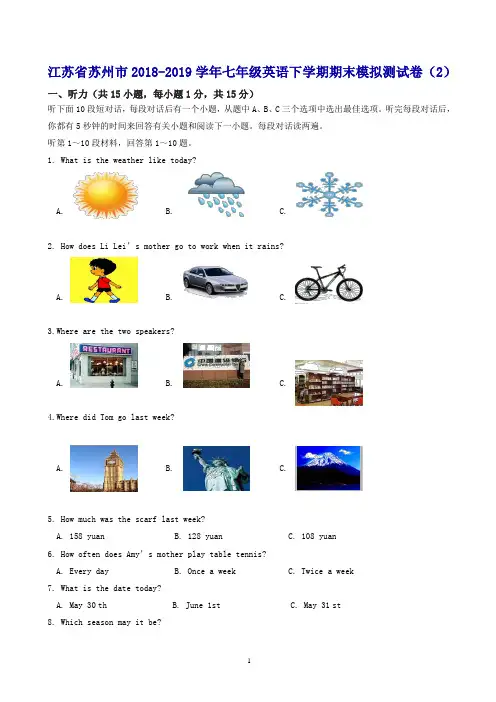
江苏省苏州市2018-2019学年七年级英语下学期期末模拟测试卷(2)一、听力(共15小题,每小题1分,共15分)听下面10段短对话,每段对话后有一个小题,从题中A、B、C三个选项中选出最佳选项。
听完每段对话后,你都有5秒钟的时间来回答有关小题和阅读下一小题。
每段对话读两遍。
听第1~10段材料,回答第1~10题。
1. What is the weather like today?A. B. C.2. How does Li Lei’s mother go to work when it rains?A. B. C.3.Where are the two speakers?A. B. C.4.Where did Tom go last week?A. B. C.5. How much was the scarf last week?A. 158 yuanB. 128 yuanC. 108 yuan6. How often does Amy’s mother play table tennis?A. Every dayB. Once a weekC. Twice a week7. What is the date today?A. May 30thB. June 1stC. May 31st8. Which season may it be?A. AutumnB. SpringC. Winter9. What’s in the tree?A. A big birdB. A kiteC. A model plane10. What would the man like to drink?A. A glass of milkB. A cup of coffeeC. A cup of apple juiceII听对话和短文回答问题(10分)听下面一篇短文,从题中A、B、C三个选项中选出最佳选项。
短文读两遍,回答第11~15题。
20182019学年第二学期期末、暑假放假和新学年开学安排 .doc

2018-2019学年第二学期期末、暑假放假和新学年开学安排2018-2019学年第二学期期末、暑假放假和新学年开学安排时间:6月--8月地点:/内容:2017级康复治疗学中美班学生赴威斯康星协和大学留学启程(6月21日、7月15日、8月20日共三批)学生暑期海外交流项目(6月中-8月31日)澳大利亚墨尔本21天雅思强化培训项目(8月5日--8月25日)赴英国跨文化与创新管理项目(8月5日--8月24日)时间:6月13日(周四)地点:图书馆4楼内容:上海市幼儿园园长培训第一期开班、上课时间:6月13日--7月17日(周四--周三)地点:图书馆4楼内容:上海市幼儿园园长培训第一阶段集中授课时间:6月14日(周五)之前地点:/内容:各部门完成学期工作总结,上报校办时间:6月14日(周五)地点:/内容:第九次网上质量测评综合评分会时间:6月15日(周六)全天地点:/内容:大学英语四、六级考试时间:6月16日(周日)上午地点:/内容:日语专八考试时间:6月中下旬地点:/内容:辅导员学期述职答辩、合同期满辅导员考核时间:6月中下旬地点:/内容:外省市招生咨询时间:6月20日(周四)地点:图书馆4楼内容:新闻发布会上海市幼儿园园长培训第二期开班时间:6月20日(周四)地点:/内容:第二批三双教师培训时间:6月21日(周五)地点:/内容:2019届毕业生办理第二阶段离校手续,离校完毕2019届毕业生感恩母校“八个一”系列活动2019届学生毕业典礼暨学位授予仪式时间:6月底地点:/内容:毕业生档案转递辅导员学年工作述职答辩会2019届毕业班宿舍移交工作学生宿舍安全大检查时间:6月22日--7月1日(周六--周一)地点:/内容:学生期末考试时间:6月28日--7月5日(周五--周五)地点:/内容:2019级学生集中军训时间:6月中下旬地点:/内容:资产采购委员会招投标会时间:6月底地点:/内容:各二级学院、各部门总结会时间:7月2日(周二)地点:/内容:暑假项目工作布置推进会时间:7月2日--7月4日(周二--周四)地点:/内容:试卷批改、登分和成绩统计工作;其他部门做好总结、档案等学期结束各项工作时间:7月5日(周五)地点:晖华楼报告厅内容:上午9:00 全校教职工大会下午校园安全大检查时间:7月6日(周六)起地点:/内容:校园转入假期运行保卫干事校园值班各部门根据工作需要安排职工来校上班时间:7月6日--8月底地点:/内容:校园修缮时间:7月--8月地点:/内容:招生录取工作时间:7月初地点:/内容:辅导员学期工作总结大会时间:7月初地点:/内容:教职工疗休养时间:7月初地点:/内容:学位委员会第二次会议时间:7月底之前地点:/内容:新专业申报材料上报时间:7月22日--8月23日(周一--周五)地点:/内容:上海市幼儿园园长培训第二阶段线上学习时间:8月初地点:/内容:2016级小学教育中美班学生赴阿拉巴马大学留学启程时间:8月地点:/内容:2017级财务管理(CFA)学生赴西弗吉尼亚大学留学启程时间:8月10日(周六)之前地点:/内容:党政监领导向董事会递交新学期工作计划时间:8月下旬地点:/内容:新老学生缴费工作统计时间:9月2日(周一)地点:/内容:校务委员会全体成员来校研究新学年工作时间:9月3日(周二)地点:/内容:全体中层干部、行政部门工作人员来校正式上班各条线、部门领导研讨布置开学工作新入职教师培训时间:9月初地点:/内容:2017级学前教育中美班学生赴西俄勒冈大学留学启程时间:9月初地点:/内容:新学期辅导员工作大会时间:9月6日(周五)地点:/内容:全体教职工上班上午9:00 全校教职工大会(晖华楼报告厅)各二级学院、部门检查开学准备工作庆祝教师节大会全体教职工聚餐时间:9月6日(周五)地点:/内容:第九次质量测评总结交流会时间:9月7日--8日(周六--周日)地点:/内容:7日大二、专升本及三校生学生报到8日大三、大四学生报到时间:9月9日(周一)地点:/内容:大二、大三、大四学生上课时间:9月中旬地点:/内容:新生入学报到协调会时间:9月13日--15日(周五--周日)地点:/内容:中秋节假期时间:9月14日--15日(周六--周日)地点:/内容:14日9:00~12:00,商学院、健康学院新生报到14日13:00~16:00,学前教育学院、初等教育学院新生报到15日9:00~12:00,工学院、语言文化学院新生报到15日13:00~16:00,艺术设计学院新生报到时间:9月15日下午--18日(周日--周三)地点:/内容:入学教育、领教材(含英语分级测试)时间:9月18日(周三)地点:/内容:上午9:00 新生开学典礼时间:9月19日(周四)地点:/内容:大一新生开始上课时间:9月20日(周五)地点:/内容:第十次网上质量测评启动会时间:9月23日起(暂定)地点:/内容:开学补考时间:9月地点:/内容:第三次学位评定委员会会议时间:10月1日--10月7日(周二--周一)地点:/内容:国庆节假期。
苏州市中小学2019—2020学年度第二学期校历及放假安排

廿九
二月
24 25 26 27 28 29
1
第3周
龙抬头 初三
初四
初五
初六
初七
初八
2
3
4
5
6
7
8
第4周
初九
初十
十一
惊蛰
十三
十四 妇女节
9
10 11 12 13 14 15
第5周
十六
十七
十八 植树节 二十
廿一
廿二
16 17 18 19 20 21 22
3月 第6周
廿三
廿四
廿五
廿六
春分
廿八
廿九
23 24 25 26 27 28 29
廿八
廿九
三十
四月
初二
初三
初四
27 28 29 30
1
2
3
劳动
第12周
初五
初六
初七
初八 劳动节 初十
十一
五天
4
5
6
7
8
9
10
第13周
青年节 立夏
十四
十五
十六
十七 母亲节
第14周 11
12
13
14
15
16
17
十九
二十
廿一
廿二
廿三
廿四
廿五
5月
18 19 20 21 22 23 24
第15周
廿六
廿七
小满
廿九
三十 闰四月 初二
25 26 27 28 29 30 31
第16周
初三
初四
初五
初六
初七
初八
苏州市中小学2018-2019学年度第二学期校历精编版

三 20 十六 27 廿三 6 惊蛰 13 初七 20 十四 27 廿一 3 廿八 10 初六 17 十三 24 二十 1 劳动节 8 初四 15 十一 22 十八 29 廿五 5 初三 12 初十 19 十七 26 廿四
四 21 十七 28 廿四 7 二月小 14 初八 21 春分 28 廿二 4 廿九 11 初七 18 十四 25 廿一 2 廿八 9 初五 16 十二 23 十九 30 廿六 6 芒种 13 十一 20 十八 27 廿五
五 22 十八 1 廿五 8 初二 15 初九 22 十六 29 廿三 5 清明节 12 初八 19 十五 26 廿二 3 廿九 10 初六 17 十三 24 二十 31 廿七 7 端午 14 十二 21 夏至 28 廿六
六 23 十九 2 廿六 9 妇女节 16 初十 23 十七 30 廿四 6 初二 13 初九 20 谷雨 27 廿三 4 青年节 11 初七 18 十四 25 廿一 1 儿童节 8 初六 15 十三 22 二十 29 廿七
日 备注 24 二十 3 廿七 10 妇女节 初四 17 植树节 十一 24 十八 31 廿五 7 清明节 初三 14 初十 21 期中考试 十七 28 廿四 5 劳动节 四月初一 12 母亲节 19 十五 26 廿二 2 廿九 9 端午节 初七 16 父亲节 23 廿一 30 期末考试 廿八
Tips:本学期 19 周,假日、周末休 41 天,上班 92 天。1.17 报道,1.18 日开学,6.30 学期 结束,7.1 放暑假。
苏州市中小学 2018-2019 学年度第二学期(春夏)校历 By Liner
月份 2月
10 天
周次 第1周 第2周 第3周 第4周
3月 第5周 第6周 第7周 第8周 4月 第9周 第 10 周 第 11 周 第 12 周 第 13 周 5月 第 14 周 第 15 周 第 16 周 第 17 周 6月 第 18 周 第 19 周
2019-2020学年苏州外国语学校高三英语下学期期末考试试卷及答案
2019-2020学年苏州外国语学校高三英语下学期期末考试试卷及答案第一部分阅读(共两节,满分40分)第一节(共15小题;每小题2分,满分30分)阅读下列短文,从每题所给的A、B、C、D四个选项中选出最佳选项APersonal Time Off(PTO)is something my wife and I created after having kids. We learned that,over time,a full life can leave little time for personal rest and for reflection,hanging out with friends,or just being“off. ”So,after a number of years,we make a change. If I can persuade you to take your own PTO,then these might help.■Schedule itFirst of all,one of our favorite family sayings is“schedule it. ”Sounds easy enough,but life gets complicated managing full-time work and full-time family. Put yourPTO time on the calendar and you make it a real thing.■Be flexible and strictIf you can schedule PTO at the same time each week,then all the better. Because our calendar can get rather full,flexibility in scheduling becomes a necessity. But being strict in actually taking the time each week is more important. Skipping it once makes it easier to skip again.■Take enough timeMy typical PTO lasts a couple of hours or longer. Sometimes it might be half the day depending on what I’m doing. The goal is to spend enough time away to1et your shoulders drop.■Do what you want to doRemember,PTO time is about personal time to do what you want to do,not what you have to do. PTO time is about relaxation. Grab a friend and get a beer. Work can wait until tomorrow.1.What can be the first step to take the PTO?A.Persuade the family.B.Have a personal rest.C.Ask friends for advice.D.Make a time plan.2.What does the underlined part“let your shoulders drop”probably mean?A.Get you more focused.B.Have you feel relaxed.C.Shake your shoulders often.D.Make you feel more stressed.3.What does the text mainly talk about?A.Tips on how to take your time offB.Skills to manage work and familyC.Advice on how to free yourselfD.Ways of scheduling your workBScientists often compare coral reefs(珊瑚礁) to underwater rainforests, yet unlike the leafy plant base of a forest, corals are animals. The soft creatures are naturally half-transparent and get their brilliant color1 from algae(藻类) living inside them. When corals experience stress from hot temperatures or pollution, theyhaltthe interdependent relationship with algae, typically pushing them out and turning white. Corals are still alive when they are white, but they're at risk and many eventually die, turning dark brown.Scientists around the world are looking for means to protect and maybe increase corals. One common option is to create more protected areas — essentially national parks in the ocean. Beyond nature preserves, some conservationists are looking to more hands-on methods. One research center in the Florida Keys is exploring a form of natural selection to keep corals remaining. The reef system in the Keys has been hit hard by climate change and pollution, which is especially tough, because corals there help support fisheries worth $ 100 million every year.To keep the wild ecosystem alive, Erinn Muller, the center's director, and her team are harvesting samples of the corals that survived the environmental stress naturally, keeping them to make them reproduce, and then reattaching them to the reef. They have 46,000 corals on plastic frames under the sea. So far, the center has regrown over 70,000 corals from five different species on damaged reefs.In The Bahamas, Ross Cunning, a research biologist at Chicago's Shedd Aquarium, focuses on corals with genes that could make them natural candidates for restoration projects. He published a study of two Bahamian reefs, one that survived an extreme 2015 heat wave, and one that didn't. "We think their ability to deal with these higher temperatures is built into their genes," says Cunning. There's evidence of corals evolving more quickly to resist rapidly warming climate. The big question scientists need investigate, adds Gunning, is how much more heat corals can adapt to.4. What does the underlined word "halt" in the first paragraph mean?A. End.B. Develop.C. Strengthen.D. Weaken.5. What do Muller and her team do to save corals?A. Restore the damaged reefs.B. Grow corals by hand underwater.C. Create more protected areas.D. Move corals to unpolluted areas.6. What do Gunning's words suggest?A. Many corals have been genetically improved.B. Cooling down the waters is key to rescuing corals.C. Reasons for corals surviving heat waves are shocking.D. The highest temperature corals can survive is unclear.7. Which can be a suitable title for the text?A. Relationship between corals and algaeB. Efforts made to save coralsC. Impact of climate warming on coralsD. Survival crisis faced by coral reefsCIn recent years, with the development of technology, it is common to see robots into our homes in the form of toys and vacuums (吸尘器) without question. Children’s toys that rely on robotics for both entertainment and education are becoming more popular and more easily accessible. Robot vacuums, too, are so popular that the Roomba has even earned itself a name in popular television.A selection of other household wares can be purchased and owned for a reasonable cost, but they all look and perform like vacuums. Our domestic helpers are currently designed to vacuuming, mopping, sweeping and mowing.Of course the best known of these is the Roomba, but there is actually some competition amongst the autonomous vacuum manufacturers. Roomba, made by iRobot, now comes in several designs and has been through many versions of improvements. The basic model is just about $400, but there’s a more attractive version, complete with a wireless command center to control the robot from anywhere in the home. Samsung also has a vacuum, called the Smart Tango, which makes increased improvements on the Roomba by including brushes for cleaning corners. It’s possible that some of the less well-known vacuums might be even more exciting, like the Neato Robotics XV that takes on a square shape to better clean corners. Incremental (增值的) improvements are what drive the home robot industry.Now that domestic robots are becoming more popular, the near future should be exciting. If we are going to welcome robots into our lives and our homes, we should expect them to work for it, and work hard. It’s the dawn of the robot revolution, whether we like it or not, and it would be great to see that technology put to use in moreinnovative(创新的) ways.8. What does Roomba in the passage mean?A. A man’s name who has bought a domestic robot.B. A name of a big company who makes robots.C. A type of vacuum whose name is Roomba.D. A place where people can buy proper robots.9. The Smart Tango is different from other types in that ________.A. it has a wireless command centerB. it has brushes for cleaning cornersC. it is more famous and excitingD. it is driven without electricity10. What can we infer according to the last paragraph?A. Domestic robots will free us from housework.B. Domestic robots will become cheaper and cheaper.C. Domestic robots have brought environmental revolution.D. Domestic robots takes the lead in science and technology.11. What does the author intend to tell in the passage?A. Domestic robots are closely related to our daily life.B. It is interesting to see domestic robots at home.C. Domestic robots are too expensive for most people.D. It is convenient to buy a domestic robot.DAs COVID-19 spread through Japan last spring, a doctor despaired. What shocked him was not the pace of infection, or a lack of protective equipment, but the old systems used to record test results and so track the course of the epidemic. “Even with coronavirus, we're handwriting and faxing,” he complained on Twitter.Japan has excellent health care. Life expectancy at birth is 85 years, the highest in the world. But doctors have been slow to embrace(欣然接受) the efficiencies of information technology, despite Japan's reputation for medical technology. The OECD ranks it last among its members for its management and use of data in health care.A commission of experts convened(召集) by the Asia-Pacific Initiative, a think-tank in Tokyo, declared Japan's response to COVID-19 a “digital defeat”。
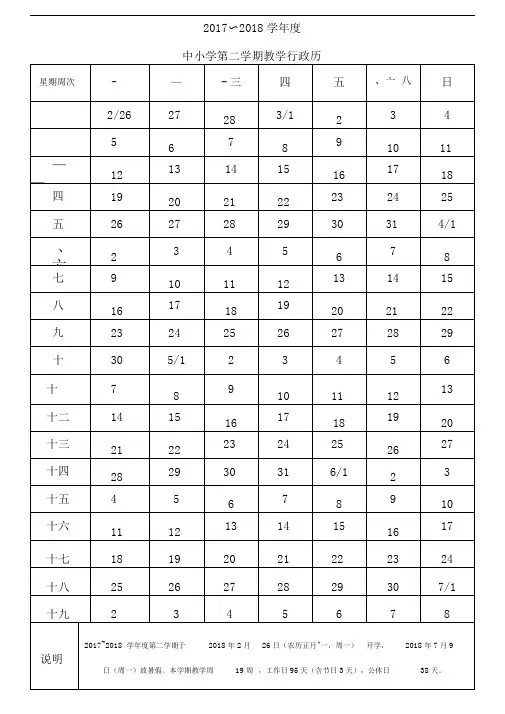
2018~2019学年度教学行政历
26
27
28
29
十
30
5/1
2
3
4
5
6
十
7
8
9
10
11
12
13
十二
14
15
16
17
18
19
20
十三
21
22
23
24
25
26
27
十四
28
29
30
31
6/1
2
3
十五
4
5
6
7
8
9
10
十六
11
12
13
14
15
16
17
十七
18
19
20
21
22
23
24
十八
25
26
27
28
29
30
7/1
十九
2
3
4
5
6
7
8
2017~2018学年度第二学期于
四
17
18
19
20
21
22
23
五
24
25
26
27
28
29
30
、
六
10/1
2
3
4
5
6
7
七
8
9
10
11
12
13
14
八
15
16
17
18
19
20
21
九
22
23
24
25
26
27
江苏2018-2019校历
二十 23 24 25 26 27 28 29 分钟,课间操活动时间不少于 20
分钟。
二十一 30 1/7 2 3 4 5 6
三 24 25 26 27 28 1/3 2
2019 年 2 月 11 日(农历正月
初七):教师到校。
四
3456789
2019 年 2 月 12 日(农历正月
五
10 11 12 13 14 15 16 初八):学生正式上课。
六 七 八 九 十 十一 十二 十三
17 18 19 20 21 24 25 26 27 28 31 1/4 2 3 4 7 8 9 10 11 14 15 16 17 18 21 22 23 24 25 28 29 30 1/5 2 56789
30 31 1/9
678
13 14 15
20 21 22
27 28 29
456
2018 年秋季校历安排:
11 12 13 (教学时间共 20 周)
18 19 20
2018 年 8 月 27 日:教师
25 26 27 到校。
1/11 2 89 15 16 22 23
3
2018 年 8 月 27 日—8 月
22 23
2019 年 7 月 1 日初中暑假开
始;2019 年 7 月 6 日高中暑假开始。
29 30
清明节放假 1 天,“五一”国
5
6 际劳动节放假 1 天,端午节放假 1
天。
12 13
普通高中每学年教学时间 40
19 20 周,社会实践 1 周,假期(包括寒
暑假、国家法定节假日和农忙假)
26 27 11 周。高中学生在校学习时间每周
关于2018~2019学年第二学期教务校历
正常上课作息表 第一节 第二节 第三节 第四节 8:00 ~ 8:45 8:55 ~ 9:40 10:00 ~ 10:45 10:55 ~ 11:40
第七节 第八节 第九节 第十节 第十一节 第十二节
13:30 ~ 14:15 14:25 ~ 15:10 15:30 ~ 16:15 16:25 ~ 17:10 18:00 ~ 18:45 18:55 ~ 19:40
教务处 2019 年 2 月 19 日
暑 假 ( 含 短 学 期 ) 补考、学籍处理
备注
1. 学生于2月24日领取教材及办理注册,2月25日上课。 2. 2017、2018级学生的实习和暑假时间为7月1日至9月1日(具体安排由各系、 部与各专业根据具体情况而定)。 3. 2019~2020学年第一学期开学时间为9月2日。 4. 4月5日清明节、5月1日劳动节、6月7日端午节为国定假日。
2016级
年级 2017级 教学内容
2018级
说明 补考
Hale Waihona Puke 1 2 3 4 5 6 7 8 9 10 11 12 13 14 15 16 17 18 19 20 21 22 23 24 25 26 27
毕 业 综 合 实 践 二
理 论 教 学
理 论 教 学
毕业离校周 考试 考试 考试 考试
暑 假 ( 含 短 学 期 )
关于 2018~2019 学年第二学期教务校历 和上课作息时间安排的通知
全体教职工、学生: 现将 2018-2019-2 学期教务校历和上课作息时间安排发布如下, 请仔细阅读。
2018 ~ 2019学年第二学期教务校历
年级 教学 周次
日期 2.25~3.3 3.4~3.10 3.11~3.17 3.18~3.24 3.25~3.31 4.1~4.7 4.8~4.14 4.15~4.21 4.22~4.28 4.29~5.5 5.6~5.12 5.13~5.19 5.20~5.26 5.27~6.2 6.3~6.9 6.10~6.16 6.17~6.23 6.24~6.30 7.1~7.7 7.8~7.14 7.15~7.21 7.22~7.28 7.29~8.4 8.5~8.11 8.12~8.18 8.19~8.25 8.26~9.1
2018―2019学年第二学期期末2019-2020第一学期期初安排
关于2018-2019学年第二学期末、暑期暨2019-2020学年第一学期初学校工作安排的通知一、期末授课、考试、离校日程安排1、体、音、美、心健、初一、二年信息等科目于6月14日前考试结束,成绩于6月21日前送到学籍室。
以上各科结束后,科任教师应根据年段安排按原课程下班督修。
2、初一、初二年期末复习6月17日开始,考试时间为6月26—28日;高一、高二年期末复习7月1日开始,考试时间为7月8日—7月10日。
每科考试结束,各备课组及时开展阅卷。
教务处于6月30日、7月11日内分别向初一、二年、高一、二年段反馈成绩。
本学期授课、考试及评卷等工作的其他具体要求根据教务处有关会议精神落实。
3、学生离校时间:初一6月29日;高一年段7月11日。
4、初二年段、高二年段7月12日至7月25日上课,7月26日离校。
5、本学期最后一次教工大会时间为:7月12日(周五)下午3:00(因梯层大教室改造,以年段为单位举行)。
教师离校时间:7月13日。
二、离校前完成各项工作1、6月30日前,各处室主任把本处室应存档案材料送交办公室杨丽老师处;7月12日前,各处室本学期工作总结及下学期计划交办公室高斌副主任处;“党员目标管理”考评表,民主评议测评表,民主评议登记表(2份)学习笔记簿等交到融侨楼二层党务干事陈祥松办公室处。
2、7月11日前向教务处缴交:(1)教研组长工作总结及工作手册;(2)集备工作手册;(3)兴趣小组记载簿;(4)校本选修课材料;(5)培优辅差手册、研究性学习材料、课题阶段小结等;(6)寓德于教的教案或教学设计一篇;(7)质量分析相关材料。
3、各科任教师必须在6月30日前向实验室交还借出的教学仪器;理、化、生老师应缴交实验报告及实验通知单,要求装订成册,注明学年、学期;凡向图书馆借出书刊的教职工请于期末总复习前将书刊归还图书馆。
4、离校前,班主任向政教处德育档案室缴交《班主任工作手册》、《班会课教案》,学生操行评定等级,学生常规量化考评表,班级手机。
昆山、太仓市2018—2019学年第二学期初二英语期末测试题
2018~2019学年第二学期期末教学质量调研测试初二英语2019.06 一、听力测试。
(共20小题,每小题1分,计20分)本部分共有10小题,每小题你将听到一段对话,每段对话听两遍。
1.What does Jack wear?2. Which place has Sam visited these days?3. What sign will they see?4. What does John think people in poor countries need most?5. How many people with blindness has the hospital cured?A. More than 130,000B. Over 13,000.C. Less than 130,000.6. What did the woman think of the people in London?A. They have good manners.B. They are rude.C. They are impolite.7. How old was Tom last year?A. 11 years old.B. 10 years old.C. 9 years old.8. How did Mr. Chen like the journey?A. Interesting.B. Exciting.C. Bad.9. Where are they probably talking?A. In the office.B. At home.C. At a restaurant.10. What can we know about the woman?A. She likes cooking.B. She likes reading sports news.C. She doesn't like cleaning the windows.听对话和短文回答问题。