
最新牛津译林初中八年级英语上册 Unit 8 Natural disasters Reading I教案
Unit 8 Natural disastersComic strip and welcome to the unitTeaching Aims:1. To learn the new words and phrases2. To meet the past continuous tense3. Talk about s ome natural disaster.Step 1 Presentation1. Show some pictures to learn some words.2. Then read aloud the new words.disaster mop up earthquake thousands of accident coach crash flood wash away village lightning storm thunder catch fire Step 2 Do some exercises.Do Part A on page 93.Check the answers.Step 3 PresentationShow some pictures to present comic strip.Step 4 Listen and answer1. Listen to the tape and answer the follow questions.1) What’s the weather like?2) What happened to Hobo?3) What was Hobo doing when it started to rain?4) Did Hobo hear the rain?5) Why doesn’t he want to go home alone?6) What do you think of Hobo?2. Read the d ialogue in pairs.3. Act it out.Step 6 Listening1. Listen to part B and answer the following question.1) What happened to Vivien’s school?2) When did it happen?2. Read after the recorder.3. Pratice in pairs.4. Act it out.5. Make their own dialogue.Step 7 Explanation1. wake up 醒过wake sb. up 叫醒某人e.g. I wake up at six every morning!我每天早上六点钟醒来。
She wakes me up at six every morning.她每天早上六点钟叫醒我。
2. mop up 拖干净,把......拖干净e.g. Hobo wants Eddie to mop up the water.Hobo想要Eddie把水拖干净。
3. thousands of 成千上万的e.g. There are thousands of people on the road.路上有成千上万的人。
4. a car accident 一场车祸e.g. There was a car accident yesterday.昨天有一场车祸。
5. crash into 猛撞,碰撞e.g. A car crashed into a tree last night.昨天晚上一辆车猛撞到一棵树上。
6. wash away 冲走e.g. A terrible flood washed away his house.一场可怕的洪水冲走了他的房子。
7. fall from 从……掉下,落下e.g. The boy fell from a tree and hurt his legs.那个男孩从树上掉下来伤到了他的腿。
8. catch fire 着火e.g. The house caught fire because of the lightening.因为闪电那个房子着火了。
Step 8 Exercises根据汉语提示或所给词的正确形式填空:1. There are many _________ (灾害) in the world every day.2. I heard of a car _________ (事故) here.3. --- What was the weather like yesterday?--- It was_________ (sun) but ________ (wind).4. Our school football tea m _______ (lose) the game last Friday.5. My brother __________ (fall) off his bike just now.6. I __________ (do) my homework when my mother came back.翻译下列句子:1. 下周天气将会变得更糟。
The weather _________________ next week.2. 数千人在一次地震中丧生了。
____________ people _____________ in the earthquake.3.一场洪水冲走了他们的房子。
A flood ________________________.Step 9 Homework1. Read the text book and learn the new words and phrases by heart.2. Do the exercises in the workbook.Reading ITeaching Aims:1. Learn some new words.2. According to t he pictures, keywords and context speculate the main ideas.3. Practise reading skills by learning “An earthquake”.Step 1 PresentationPresent the new words with pictures and read them aloud.slight shake loud fear bomb shake direction in all directionsbrick come down silent not at all nervous heart beat trappedmind calm calm down since still alive dark shout at lastdaylight safe asleep after find one’s way outStep 2 Match the words on the left with the meanings on the right.1. Do part B1 on page 95.2. Check the answer.Step 3 Presentation1. Enjoy some pictures and present ‘What is earthquake?’St ep 4 Listening1. Listen to text and do part B3.2. Check the answers.Step 5 Read ing1. Read pa ragraph1 and finish the table.At firstWhen it wasWhat he didWhat he heardHow he felt2. Read paragraph 2 and complete the passage.The real noise was like ______ under the ground. People ran _________. Timmy tried his best to _____ to the street. Pieces of glass and bricks _____________, and then the walls began to _________, too.Read paragraph 3 and do the following exercises.1) Timmy _____ after the noise and shaking ended?A. screamedB. calmed downC. ran wildlyD. cried2) He could see __________.A. AnythingB. someone around himC. nothingD. the bright daylight3) He could hear _________.A. some people screamingB. shouts from peopleC. a loud noise like bombsD. It is not mentioned(涉及)4. Read paragraph 4 and answer the following questions.1) What did Timmy feel when he was trapped?2) Did he shout for help?5. Read paragraph 5 and match the sentences.1) I was trying to find my way out ____2) I screamed _____3) Then I heard shouts from _____4) They quick ______5) At last, I saw _____a. Help! Please help! I’m here!b. move away the bricks.c. the bright daylight.d. when I suddenly heard some noise above me.e. excited people.Step 6 Exercises1. Complete part B 2 on page 95.2. Check the answers.Step 7 Discuss ionAfter the earthquake, Timmy has some useful ways of protecting himself in the earthquake. If you are Timmy, what good ways of protecting yourself do you know?Step 8 Homework1. Read aloud the article and underline the difficult parts.2. Remember the new words in this lesson.。
牛津译林版八年级英语上册《nit 8 Natural disasters Reading 1: An earthquake》赛课导学案_8
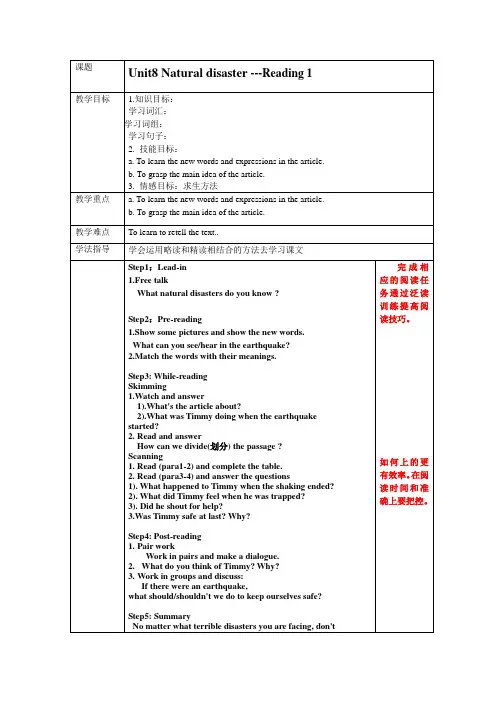
How can we divide(划分) the passage ?
Scanning
1. Read (para1-2) and complete the table.
2. Read (para3-4) and answer the questions
1). What happened to Timmy when the shaking ended?
2). What did Timmy feel when he was trapped?
3). Did he shout for help?
3.Was Timmy safe at last? Why?
Step4: Post-reading
1.Pair work
Work in pairs and make a dialogue.
2.What do you think of Timmy? Why?
3.Work in groups and discuss:
If there were an earthquake,
what should/shouldn't we do to keep ourselves safe?
Step5: Summary
完成相应的阅读任务通过泛读训练提高阅读技巧。
如何上的更有效率。在阅读时间和准确上要把控。
学会运用略读和精读相结合的方法去学习课文
Step1:Lead-in
1.Free talk
What natural disasters do you know ?
Step2:Pre-reading
1.Show some pictures and show the new words.
最新译林牛津版初中英语八年级上册Unit 8 Natural disasters Study skills公开课教学设计(1)
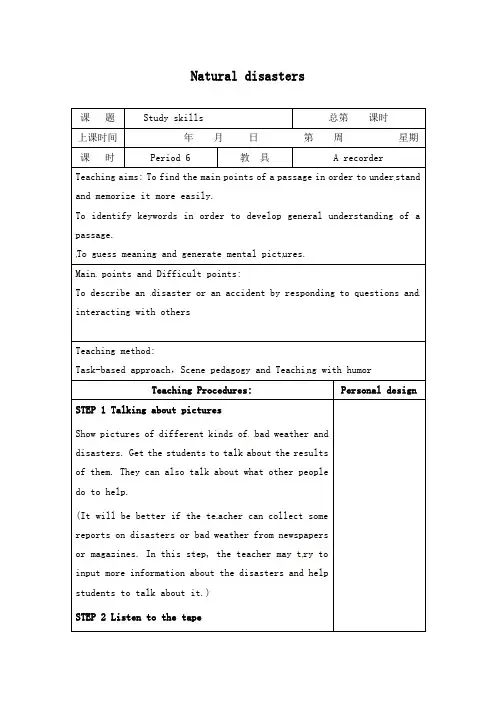
Get them to talk about a disaster. They can choose what the would like and try to make a new dialogue .
Offer them enough time to practice and then get them to act their own dialogue out in front of the
Teaching Procedures:
Personal design
STEP 1 Talking about s
Show pictures of different kinds of bad weather and disasters. Get the students to talk about the results of them. They can also talk about what other people do to help.
With the help of these questions, it will be easier for students to focus on the key information e.g. in Britain, last week, heavy storm, thunder and lightening, ter rible, school caught fire, no one was hurt, students on holiday. They will also help them to organize their own dialogue.
To describe an disaster or an accident by responding to questions and interacting with others
牛津译林版八年级英语上册Unit 8 Natural disasters Task示范公开课教学课件

Suddenly, a strong wind came from behind. I lost my (6) ________ in the wind and I nearly (7) ___ over. We had to walk slowly in the deep snow. When we arrived at the bus stop, we saw many people (8) ________ there. At last, we got on a bus to Millie's home. I stayed at Millie's home that night. I heard the noise of (9) ________ the next morning. People were trying to (10) _______ the snow from the streets.
Para. 3
How did Sandy feel about the wind from behind?What happened to them?What were many people doing?
Revision
Suddenly, a strong wind came from behind. I lost my umbrella in the wind and I nearly fell over. We had to walk slowly in the deep snow. When we arrived at the bus stop, we saw many people waiting there. At last, we got on a bus to Millie's home.
最新译林牛津版初中英语八年级上册Unit 8 Natural disasters Task公开课教学设计(1)

Teaching procedures
The second preparing lessons
STEP 1 Talking about pictures
Show a picture of a Nhomakorabeasnowstorm and get the students to talk about it.
STEP 3 Making a flow chart
Tell the students thatSandy also makes a flow chart to organize her ideas. Divide the students into groups of 4. Invite the students to helpSandycomplete the flow chart. Then ask them to discuss the answers in groups of 4. Check the answers.
STEP 5Homework
a.Read the sample article once again and try to understand its structure.
b.Write about a disaster
Teaching notes
STEP 5 Locating some important sentence patterns
Go through the article and help the students to locate some important sentence patterns.
牛津译林版英语八年级上册:Unit 8 Natural disasters. 教案1
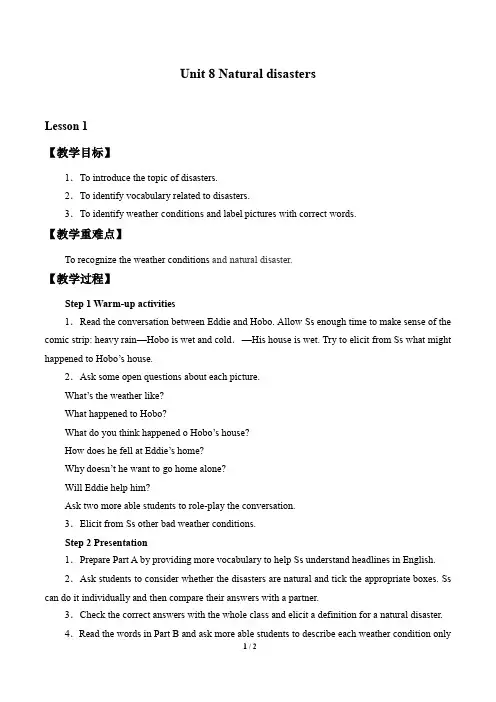
Unit 8 Natural disastersLesson 1【教学目标】1.To introduce the topic of disasters.2.To identify vocabulary related to disasters.3.To identify weather conditions and label pictures with correct words.【教学重难点】To recognize the weather conditions and natural disaster.【教学过程】Step 1 Warm-up activities1.Read the conversation between Eddie and Hobo. Allow Ss enough time to make sense of the comic strip: heavy rain—Hobo is wet and cold.—His house is wet. Try to elicit from Ss what might happened to Hobo’s house.2.Ask some open questions about each picture.What’s the weather like?What happened to Hobo?What do you think happened o Hobo’s house?How does he fell at Eddie’s home?Why doesn’t he want to go home alone?Will Eddie help him?Ask two more able students to role-play the conversation.3.Elicit from Ss other bad weather conditions.Step 2 Presentation1.Prepare Part A by providing more vocabulary to help Ss understand headlines in English.2.Ask students to consider whether the disasters are natural and tick the appropriate boxes. Ss can do it individually and then compare their answers with a partner.3.Check the correct answers with the whole class and elicit a definition for a natural disaster.4.Read the words in Part B and ask more able students to describe each weather condition only1 / 2with simple phrases and words.5.Ask Ss to complete the task on their own and check the correct answers with the class as a whole.Step 3 Language pointsNatural disasters, really warm, for too long, mop it up, lose the game, kill thousands of people, a car accident, crash into a tree, wash the village away, start a big fireStep 4 Homework:1.Learn the language points by heart.2.Preview the Reading Part.2 / 2。
最新牛津译林初中八年级英语上册 Unit 8 Natural disasters Study skills教案(1)
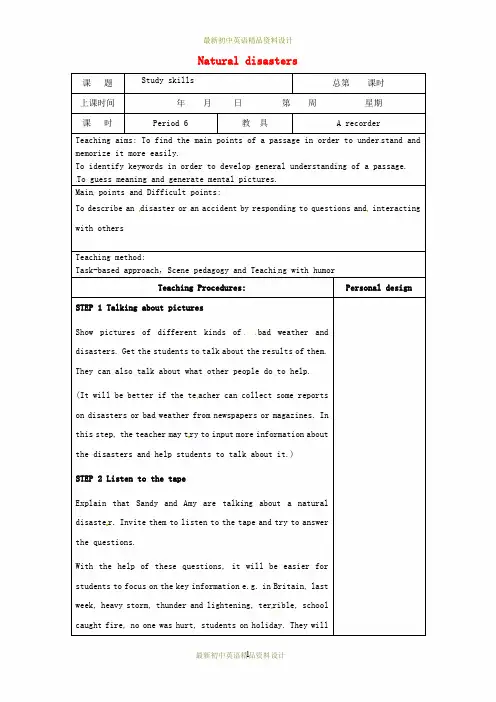
Natural disasters课题Study skills总第课时上课时间年月日第周星期课时Period 6 教具 A recorder Teaching aims: To find the main points of a passage in order to under stand and memorize it more easily.To identify keywords in order to develop general understanding of a passage. To guess meaning and generate mental pictures.Main points and Difficult points:To describe an disaster or an accident by responding to questions and interacting with othersTeaching method:Task-based approach,Scene pedagogy and Teachi ng with humorTeaching Procedures:Personal design STEP 1 Talking about picturesShow pictures of different kinds of bad weather anddisasters. Get the students to talk about the results of them.They can also talk about what other people do to help.(It will be better if the te acher can collect some reportson disasters or bad weather from newspapers or magazines. Inthis step, the teacher may t ry to input more information aboutthe disasters and help students to talk about it.)STEP 2 Listen to the tapeExplain that Sandy and Amy are talking about a naturaldisaste r. Invite them to listen to the tape and try to answerthe questions.With the help of these questions, it will be easier forstudents to focus on the key information e.g. in Britain, lastweek, heavy storm, thunder and lightening, ter rible, schoolcaught fire, no one was hurt, students on holiday. They willalso help them to organize their own dialogue.STEP 3 Reading the dialogue againGet the stude nts to read the dialogue aloud. Direct the students attention to the intonation of different sentences. We use a rising tone for general questions. We use falling tones for ‘wh-’ questions or statements. Get the students to read the dialogue again. Pay special attention to the intonation patterns used here. Then give the students several minutes for the students to practice and act.STEP 4 Talking about a disasterGet them to talk about a disaster. They can choose what the would like and try to make a new dialogue.Offer them enough time to practice and then get them to act their own dialogue out in front of theclass.STEP 5Homeworka.Write down the dialogue you made up in class in yourexercise books.b.Finish off the exercises in the Evaluation Handbookand Learning English.。
牛津英语译林版八年级英语上册Unit8 Natural disasters Reading1公开课课件精美PPT
A powerful 8.0-magnitude earthquake(8.0 级强震) struck Wenchuan on 12, May, 2008. Nearly 70,000 people died.
a bomb
炸弹
in all directions
4 silent
e move quickly from
5 at last 6 safe
side to side, up and down, etc. f quiet
While-reading: Skimming
1.When did the earthquake start? At about two o’clock in the early morning.
Read Paragraph 3 and choose the best answer.
1. Timmy __B___ after the noise and
shaking ended.
A.screamed
B. calmed down
C. ran wildly
D. cried
2. He could see ___C___.
the desk. 4. Don’t use the lift. 5. Save energy to survive.
…
1. Read aloud the article and try to retell the story.
2. Remember the new words in this lesson.
Timmy is a teenager. He lives in Taiwan. He survived the (1) _e_a_r_th_q_u__a_k_e in 1999. He was sleeping when he heard a loud noise. It was like the noise of (2) _th_u__n_d_e_r. Then the noise became really loud. It sounded like (3) _b_o_m_b__s under the ground.
译林版英语八年级上册 Unit8 教案
1.自然灾害2.把它拖洗干净3.一起车祸4.引起一场大火5.从树上摔下来6.成千上万人7.输了比赛8.把村庄冲走9.撞在一棵树上10.开始下雨
Teaching notes
课题
Reading 1
总第课时
备课时间
上课时间
at first=at the beginning在开始
a loud noise like thunder像雷声一样的声音
in fear恐惧be frightened害怕
in all directions四面八方run wildly拼命地跑
try one’s best to do sth=do one’s best to do sth尽力做某事
Heavy rainandrainstorm----------flood
Thunder and lightning---------fire
Step4.Finish the exercises in Part A.
Do and check the answers
Step5.Discussing about the bad weather and disaster.
Did the writer survive?
Stpe4.Presentation.
1)Read the passage themselves.
2)Repeat after the tape.
3)Have difficulties to explain.
be trapped=be in trouble陷入困
1.Introduction:Rainy days and fine days are very commom,(ask students:What other kind of weather do they know?
牛津译林版-英语-八上-8单元 Natural disasters reading I
初中英语牛津译林版八年级上册Unit 8 Natural disasters reading IContent:Reading IPeriod:10-2Teaching aims and demands:1. To develop students’ reading skills (skimming and scanning).2. To get the useful information of the text.3. To guess the meaning of words and expressions in the text.4. To gain better understanding through the framework of the material.5. To guide the students to experience the pleasure of reading and how to protect themselves when are in danger..Key points:1. To develop students’ reading skills (skimming and scanning).2. To gain better understanding through the framework of the material.Difficult points:To get the useful information of the textTeaching aids:A tape recorder and some picturesTeaching methods:Reading and tasked-based methods.Teaching procedures:复备栏目Step 1 PreviewTranslate some phrases to check the content students have previewed.Step 2 Presentation1. Show some pictures of natural disasters to present the topic of this unit– natural disasters2 Present the topic of reading – earthquakeGet the students to discuss:In your opinion, what is the most dangerous kind of natural disaster?Show some pictures of earthquakes3 Teach some new words:The teacher ask the students: What happened during the earthquake?Shake, bomb, fear, scream, direction, wildlyStep 3 Reading1. Get the students to skim the article and find the answer to the question:Did Timmy give up or try his best to survive when he was indanger during the earthquake?2 .Read the article for detailed information1) When the earthquake came, what did Timmy feel/ hear/see/do?2) How did Timmy save himself after he was trapped?3) How did other people save Timmy?3.Read the article for further understanding1) Listen to the tape and finish Exercises C, textbook Page 972) Read with feelings and finish Exercises D, textbook Page 97Step 4 PracticePlay the tape for the students to listen and repeat. Then get the students to read the article loudly.Ask the stud ents to discuss : How to save yourselves when you are in danger?Step 5 HomeworkThink of ways of saving yourself during other natural disasters, write them down .Do the exercises in Part B, Page 96.Try to say something about the main idea of the article.教学反思:达标检测Unit 6 Reading I (40’)一、词组翻译(10’)1.在一个购物中心_____________________________2.恐惧地互相看着______________________________3.破碎玻璃片_________________________________4.一阵恐惧___________________________________5.吃一包巧克力_______________________________6.a sligh t shaking _______________________________7.run in all directing ____________________________8.clam down __________________________________9.shout for help ________________________________10. stay here for a long time _________________________二、根据中文完成句子(15’)1.他们告诉自己镇静下来。
初中英语牛津译林版八年级上册Unit8TaskAnaturaldisaster教学设计
初中英语牛津译林版八年级上册Unit8TaskAnaturaldisaster教学设计【名师授课教案】1教学目标1.give facts for writing;anize ideas by making notes;3.write an article about a natural disaster.2学情分析在这节课之前,学生已经在本单元前几课时学了天气和自然灾害的相关内容,这说明学生头脑里已经构建了有关灾害的词汇。
并通过Reading部分巩固了所学的语言知识, 充分的说和读进一步发展了语言运用能力,为本课时Task写的任务打下伏笔。
3重点难点anize ideas by drawing up an outline.2.Write an article about a natural disaster in easy and clear English.4教学过程4.1第一学时教学活动1【导入】Step 1 Lead-in1. Compare two articlesT: Today I am going to tell you a story about how Timmy survived the 1999 Taiwan earthq uake.Listen to this, pleaseIn 1999, a terrible earthquake happened in Taiwan.At first Timmy was sleeping. When he felt the shaking, he wanted to run out of the buil ding, but he failed. And unluckily he was trapped in the dark. After that, he calmed do wn and tried to find his way out.At last, some people heard him and saved him.T: What do you think of the story? Do you think I’m good at telling stories? Why or wh y not?Is there anything good in my story?T: Here are some good points and bad points of my version. So you all think Timmy’s ve rsion isbetter than mine. And I agree with you. Now let’s go over the structure of Timmy’s ve rsion.。