
北师大unit3Lesson 1grammar
16
Thanksgiving was first celebrated in 1621. The Pilgrims(早期移民) invited Native Americans(印第安人) for a three-day festival in gratitude for (庆祝) the successful harvest that followed a hard winter. Thanksgiving was proclaimed(宣布) a national holiday by President Abraham Lincoln in 1863. Today’s traditional dinner contains turkey, mashed potatoes(土豆泥) and pumpkin Pie(南瓜派).
Point out the verb, the subject and the object in the following sentences:
16
• Easter is originally the day to commemorate the Resurrection of Jesus Christ.(复活节原是纪念耶酥复活的日 子) For children, Easter eggs or chocolate eggs means more than anything else in Easter.
carnation
1. sb/sth is said to do = It is said that sb/sth 据说某人/某事物… The moon is said to be its biggest and
brightest. = It is said that the moon is
its biggest and brightest. It is said that he is from France. = He is said to be from France 据说他是法国人.
中。E.g. Linda takes an active part in the school activities.
attend 指出席或参加会议、聚会、讲
座等。E.g. We have to attend a meeting
this afternoon.
join 指加入某个组织或团体,成为其中 一员。E.g. We joined the English Club. join in 多指参加正在进行的活动,如游 戏,谈话或比赛等。E.g. We are playing football. Do you want to join in?
Women’s Day
the Qingming Festival
summer
The Dragon Boat Festival
Children’s Day the birthday of the Party the birthday of the army
autumn
Teacher’s Day
National Day
Typical Festivals Season& activity date/ month or food Moon cakes The Septembr Meet in Midor the Autumn October evening and Festival watch the moon
Special meaning A special occasion for family reunion
4. fall = happen 发生, 适逢 今年的圣诞节是星期一。 Christmas Day falls on a Monday this year.
5. take part in
参加
attend join join in 参加
take part in 参加活动或比赛等,强调
在其中积极作用,不强调活动正在进行
Western Festivals: Christmas the New Year Halloween(万圣节前夕) Thanksgiving(感恩节) April Fool’s Day Easter(复活节) Mother’s Day Father’s Day Valentine’s Day
16
(一般放在它所说明的词语前) included adj. 包括在内的 (只能放在它所说明的词语后)
Five students failed in the exam, including Li Ping. Five students failed in the exam, Li Ping included.
the Mid-Autumn Festival
the Lantern Festival
Festival :一般指中国的传统农历 计算的节日, 如:the Lantern Festival 元宵节.
Day: 一般指国际上通行的按公历
计算的节日, 如:Children’s Day.
Are you interested in these festivals? Read the text quickly and the following sentences, tell me which festival it belongs to?
Mid-Autumn Day
winter
New Year’s Day The Lantern Festival
The Spring Festival
Look at the following pictures and guess what festivals they are?
the Dragon Boat Festival
Jan.1st Feb.14th Western festivals of Solar Calendar The Friday before Easter Mar.12th The next Monday after Easter Apr.1st New Year’s Day Valentine’s Day (情 人节) Good Friday (耶酥受 难日) Easter (复活节) Easter Monday (复活 节星期一)
Voice your opinion
1. Do you think too much money is spent at festival times? Why or why not? 2. Which festival in China is most important for children? Young people? Old people? Women and men?
Halloween : 31st October, the night before All Saints’ Day(万圣节) , was originally New Year’s Eve celebrated by the Celts(克尔特人).
All Saints’ Day, which falls on 1st November is regarded in the West as a festival.
4. The special food for this festival is sweet dumplings. the Lantern Festival 5. The festival falls on fifth day of the fifth month of the lunar calendar. the Dragon Boat Festival
Lesson 1 Chinese Seasonal Festivals
What’s your favorite season?
Spring
Summer
Autumn
Winter
What festivals happen during your favorite season?
spring
May Day
6. On that day, the moon is said to be biggest and brightest.
the Mid-Autumn Festival
Read the texts again and fill in the table with the information you read from the texts. Add another typical festival that you know well. Then work in pairs and tell each other about the different festivals.
16
April Fool’s Day In Great Britain, tradition only allows April Fool’s stricks from midnight to noon on April 1st . Those who try to play tricks in the afternoon become the fools themselves.
16
People in the United States honor their parents with two special days: Mother’s Day, on the second Sunday in May, Father’s Day, on the third Sunday In June.
The Mark the The fifteenth Sweet end of the Lantern of the dumplings Chinese Festival first New Year month of celebration the lunar calendar
北师大版高中英语必修第1册 Unit 3 Lesson1 Festivals
Lead-in:
1 What is your favourite season?
2 What festivals happen during your favourite season?
3) Can you say something about the lanterns in the past and that nowadays? (Paragraph 3)
The Dragon Boat Festival 4)How long is the history of the Dragon Boat Festival?
Unit 3 Celebration
Lesson 1 Festivals
Unit 3 Lesson 1
Festivals
Objectives:
1 To learn about festivals.
2 To read a text quickly to find specific information.
Dragon Dance
sweet dumplings
Marks the end of Chinese New Year celebrations
Now read the texts aloud and then answer the following questions.
The Mid-Autumn Festival 1)What is the moon said to be on the Mid-Autumn
2)The activities and the food
高中英语 Unit 1 Period 3 Grammar课件 北师大版必修1

A.are dropped
B.drop
C.are being dropped
D.have dropped
第十五页,共26页。
13 . Nowadays , a large number of children , especially
middle school boys,________ playing computer games.
我正要离开,这时电话铃响了。
第六页,共26页。
3.“am(is,are)to+动词原形”表示必须(bìxū)、必然、注 定或计划将要做的事。
The president is to give a talk on TV. 总统要做电视讲话。 He was to have the accident. 他注定会有那次车祸。
11.C [固定句型“It will not be+一段时间+before从句” 意为“用不了多久就会……”,主句使用一般将来时,before从 句通常用一般现在时。]
month.
A.will leave
B.am to leave
C.will be leaving
D.am going off
4.—What are you going to do this afternoon?
—I'm going to the cinema with some friends.The film ______
experiห้องสมุดไป่ตู้ent.
A.will not be;will know B.is;will know
C.will not be;know
D.is;know
12.In the spoken English of some areas in the US,the
高一英语北师大版必修1 Unit 3 Lesson 1 Grammar 学案
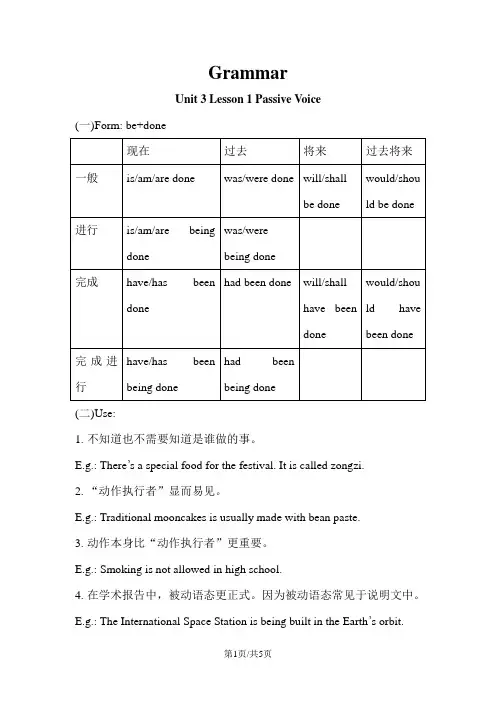
GrammarU nit 3 Lesson 1 Passive Voice(一)Form: be+done(二)Use:1.不知道也不需要知道是谁做的事。
E.g.: There’s a special food for the festival. It is called zongzi.2.“动作执行者”显而易见。
E.g.: Traditional mooncakes is usually made with bean paste.3.动作本身比“动作执行者”更重要。
E.g.: Smoking is not allowed in high school.4.在学术报告中,被动语态更正式。
因为被动语态常见于说明文中。
E.g.: The International Space Station is being built in the Earth’s orbit.(三)使用动词的被动语态应注意以下几点:1.不及物动词易被误用在被动语态中(只有及物动词有被动语态,因为只有及物动词有动作的承受者),如happen, take place, break out, break down, etc.E.g.: An accident happened on the highway yesterday.2. 并非所有及物动词都可以用于被动语态:表归属的词没有被动语态,如:have, lack, etc.3. 有些动词既可以作及物动词,也可作不及物动词,如:sell, wear, wash, weigh, measure, etc4.“get+done”可以表示被动,意为处于/达到...状态=to reach a particular state/conditionE.g.: The patient got treated once a week.5. ※※※主动形式表被动意义的情况:(1)不及物动词或短语动词一般不用于被动语态,因此,有些不及物动词的主动形式可以表达被动的意义,如:happen, cost, last, stay, belong to, take placeE.g: An accident happened on the highway yesterday.(2)系动词构成系表结构,如:look, sound, feel, smell, taste, appear, seem, go, prove, turn, stay, become, get, grow, keep等+adj./n.E.g.: The steel feels cold.His plan proved (to be) practical.It has gone bad.(3)表示主语的某种属性特征的动词,如read, write, act, iron, cut, draw, drive, sell, wash, clean, wear, open, cook, lock, shut, dry, eat, drink。
最新北师大版高中英语必修一unit3 lesson1 Festivals
北师大版高中英语必修一u n i t3l e s s o n1F e s t i v a l sCelebrationFestivalsPart A Warm-up:1. Look at the photos. What are the people celebrating?Key Words:graduation, a birthday, Christmas, passing an exam, winning a scholarship, a sporting victory, the Mid Autumn Festival, the New Year, a wedding, Halloween, the Dragon Boat Festival2. What have you celebrated recently?Part B Reading: FestivalsBefore you start1. What’s your favourite season? What festivals happen during your favourite season?FestivalsA: AutumnEvery year in September or October, the Mid-Autumn Festival is celebrated by the Chinese people all over the world. On this day, the moon is said to be its biggest and brightest. People like to meet in the evening and watch the moon.The Mid-Autumn Festival is important because it is a special occasion for family. It is also a day for special foods like moon cakes. There are all kinds of moon cakes. Traditional moon cakes are usually made with bean paste, but nowadays, there are many different kinds of moon cakes including fruit, coffee, chocolate and even ice-cream moon cakes.B: WinterThe Lantern Festival falls on the fifteenth day of the first lunar month. It marks the end of the Chinese New Year celebration s.There are many stories about how the Lantern Festival started. In one story, lanterns were lit to celebrate the power of light over darkness. In another story, a town was almost destroy ed but the light from many lanterns saved it. The story was about a god who wanted to burn down the town. He was fooled when he saw thousands of lanterns. He thought the town was already burning.In the past, lanterns were usually lit by candles and decorate d with pictures of birds, animals and flowers, etc. Nowadays, most lanterns are made with light bulbs and batteries, and they come in many shapes and sizes. In the north-eastern part of China, there are even ice-lanterns.The special food for the Lantern Festival is the sweet dumpling. Sweet dumplings are boil ed and serve d in hot water.C: SummerThe Dragon Boat Festival falls on the fifth day of the fifth month of the lunar year, As it is in early summer, it marks the beginning of the hottest season of the year.The tradition of the Dragon Boat Festival started more than 2,000 years ago. In the old days, dragon boat races were organized only by Chinese people. However, in recent years, people from other cultures have also taken part in races and enjoyed the fun.There is a special food for the festival. It is called zongzi, which is sticky rice in fresh bamboo leavesRead to learn2. Read the texts again and fill in the table with the information you read from the texts. Add another typical festival that you know well.voice your opinion3. Do you think too much money is spent at festival times? Why or why not?4. Which festival in China is most important for children? Young people? Old people? Women and men?Part C Grammar: The Passive5. Look at the first sentence in each group and complete the second sentence with the correct verb forms.(1) …the Mid-Autumn Festival is celebrated by Chinese people all over the world.Traditional moon cakes (make) with beam paste.(2) In one story, lanterns were lit to celebrate the power of light over darkness.In the old days, dragon boat races only (organise) by the Chinese people.6. Look at the given sentences and work out the correct verb forms of the other sentences.(1) A school fot the blind has been opened in the area.The wedding celebration (arrange).(2) The theatre is being built in the centre of the city.The money (collect) for the disabled.(3) The girl was being operated on in the hospital.The house (paint) white when I was there.★ We use the Passive in the following cases:(1) 不知道也不需要知道谁做的这件事时:The streets were decorated with flowers.(2) “动作执行者”显而易见时:Rice is grown in the south of China.(3) 动作本身比“动作执行者”更重要,或不想指出谁做的这件事时:These beliefs were not encouraged by the church.(4) 在书面语,特别是在科技报告、报刊文章中,被动语态比主动语态更正式。
(完整word版)北师大版高中英语教材(必修一至五)目录(20200805075319)

5
Lesson 1
Hale Waihona Puke Permissio nwill ” for decisions
Dance
Performa nee
--i nformal
Music
Rhythm
Lesson 2
Is it OK if I go…?
Adverbialclauses
Con cert
Beijing Opera
Let'Dance
--formal
⑵
Pronun ciati on
Would it be all right if
--cause, result and
Un stressed
Communi cati on Workshop
I…?
Could I…?
No, Imafraid you can't.
purpose
Units
Lessons
Fun cti on
Grammar
Vocabulary
1
Lifestyles
Lesson 1
A Perfect Day
Lesson 2
Relaxi ng
Lesson 3
A Volun teer Teacher
Lesson 4
City and Country
Communi cati on
words
6
Lesson 1
Describ ing places
Prepositi ons
Art and painting
A matter of Taste
It'ona…
--time
words
北师大(2019)高中英语目录+语法总结
北师大(2019)高中英语目录+语法总结Grammar Summary语法总结(北师大新版)必修一(第一册)必修/单元Unit 1 Life ChoicesUnit 2 Sports and Fitness语法1.Infinitives不定式2.-ed/-ing Adjectives-ed/-ing形容词1.Relative Clauses(1)定语从句(1)--Relative Pronouns关系代词2.Indefinite Pronoun不定代词1.The Passive被动语态2.Emphatic Sentence强调句1.Pat Future过去将来时1.Relative Clauses(2)定语从句(2)--Relative adverbs关系副词2.Suffix后缀1.Relative Clauses(3)定语从句(3)--prepositions+which/whom介词+which/whom2.Synonyms and Antonyms同义词和反义词1.Noun Clauses名词从句1.Verb-ing and-ed Forms动词-ing和-ed形式1.Verbs Followed by Verb Form or Infinitive接动词-ing形式或不定式的动词2.Subject-Verb Agreement主谓一致Unit 3 Celebrations 必修二(第二册)Unit 4 Information TechnologyUnit 5 Humans and NatureUnit 6 The Admirable必修三(第三册)Unit 7 ArtUnit 8 Green LivingUnit 9 LearningGrammar Summary语法总结(北师大新版)选修一(第一册)选择性必修/单元Unit 1 RelationshipsUnit 2 SuccessUnit 3 Conservation语法1.Past Perfect过去完成时1.Verb-ing Form动词-ing方式2.Articles冠词1.Relative Clauses(4)定语从句(4)--Defining and Non-defining Relative Clauses限定性和非限定性定语从句1.Continuous tenses: present perfect continuous, past perfect continuous, future continuous举行时态:目前完成进行时、过去完成进行时、将来进行时something done have/get something done结构1.It人称代词ited to and would used to和would1.Verb-ed Form动词-ed形式2.Negative Expressions表达否定意义的词或词组1.State Verbs and Activity Verbs状况动词和举措动词1.The Perfect完成时2.Phrasal Verbs(2)短语动词(2)1.Passive Forms in the Past曩昔时中的被动语态1.Modal Verbs情态动词1.Adjectives形容词选修二(第二册)Unit 4 HumourUnit 5 EducationUnit 6 The Media选修三(第三册)Unit 7 CareersUnit 8 LiteratureUnit 9 Human Biology选修四(第四册)Unit 10 Connections。
北师大版模块1 Unit 3 Grammar课件(语法部分讲解)
1. Present simple
2. Present continuous 3. Past simple 4. Past continuous
Be动词
P.P. 过去分词
am/is/are am/is/are being was/were was/were being have/has been done
It is being used. to you now. __________________
repair
I have to go to work by taxi because my car is being repaired ________________________.
Oh, my God!
The room has already been decorated with flowers.
the keys, lose Joan can’t get into the house, because the keys have been lost. _____________________
Harry Portter, translate, more than 60 languages
Harry Portter has been translated into more than 60 languages.
the present perfect passive voice 现在完成时的被动语态
The room has already been decorated with flowers. The keys have been lost. Harry Portter has been translated into more than 60 languages.
北师大八年级上学期课本教材单词汇总全
北师大八年级上学期课本教材单词汇总全八年级上册Unit 1 lesson 1province ::n.省hobby ::n. 业余爱好married ::a. 已婚的single ::a. 单一的,单身的 strict ::a. 严格的,严厉的 violin ::n. 小提琴piano ::n. 钢琴model ::n. 模型collect ::vt. 收集coin ::n. 硬币stamp ::n. 邮票chat ::vi. 聊天download ::vt. 下载 poster ::n. 海报form ::vt. 形成,(使)组成Lesson 2vacation ::n. 假期farm ::n. 农场milk ::vt. 挤奶cow ::n. 母牛country ::n. 国家;乡村 deliver ::vt. 递送newspaper ::n. 报纸 away ::ad. 在远处,到远处 go away 走开,离去course ::n. 课程extra ::a. 额外的fix up 修理,修补unfortunately ::ad. 不幸地 accident ::n. 意外事件,事故 earn ::vt. 赚,挣得camp ::n. 露营地tent ::n. 帐篷later ::a. 更迟的,更后的1afraid ::a. 害怕的,担心的Lesson 3win ::vt. (获)胜,取得胜利 work out 做大运动量的锻炼 invite ::vt. 邀请score ::n. 得分vt. 记分 goal ::n. (球赛)得分;目标 ant ::n. 蚂蚁except ::prep. 除了……之外 enormous ::a.巨大的,庞大的Lesson 4nothing ::neg pron. 无get together 聚会,联欢lunchtime ::n. 午餐时间 appointment ::n. 约会,约定Expansion 1horseback ::n. 马背rock ::n. 岩石rock climbing 攀岩scary ::a. 引起惊慌的;害怕的 program ::n. 节日,节目 till ::prep. 直到conj. 在……以前,直到……为止midnight ::n. 午夜probably ::ad. 大概,或许Unit 2 lesson5article ::n. 文章project ::n. 工程;方案 totally ::ad. 完全地,整体地 accept ::vt. 接受refuse ::vt. 拒绝reason ::n. 理由,原因 tonight ::ad. 今晚,今夜 tomorrow ::n. 明天2guest ::n. 客人,来宾 stay up 不睡觉;熬夜fishing ::n. 钓鱼Lesson 6future ::n. 未来,将来 grow ::vi. 生长,成长 grow up 长大成人,成长sports car 跑车poor ::a. 贫穷的,可怜的 cure ::n. 药物,治疗方法 aids ::n. 艾滋病college ::n. 学院,大学 general ::adj. 普遍的,总体的 in general 通常,大体上 dumb ::a. 哑的,无说话能力的 part-time 兼职的less ::a. 较少的though ::ad.&conj. 虽然,尽管 first of all 首先find ::vt. 发现,找到find out 发现,查明why ::ad. 为什么checkup 核对,检验energy ::n. 精力,活力 appetite ::n. 食欲,胃口 discover ::vt. 发现Lesson 7teenage ::a. 十几岁的 percent ::n. 百分比,百分数 ticket ::n. 票,入场券 overweight ::a. 超重mexican ::a. 墨西哥的 n. 墨西哥人iced ::a. 冰冷的,冰冻的 pocket ::n. 衣袋,口袋 pocket money 零用钱3babysitting ::n. 临时保姆,照顾婴儿boat ::n. 小船key ::n. 钥匙ring ::n. 环状物luck ::n. 运气Lesson 8term ::n. 学期progress ::n. 进步make progress 取得进步little by little 渐渐地vocabulary ::n. 词汇in front of 在……前面at least 至少confident ::a. 自信的 grammar ::n. 语法rule ::n. 规则improve ::vt. 改进,提高 skill ::n. 技能,技巧habit ::n. 习惯advantage ::n. 优势,有利条件 take advantage of 利用offer ::n.&vt. 提议,提供 worry about 担心take part in 参加mistake ::n. 错误responsible ::a. 有责任的 be responsible for 对……负责Expansion 2concentrate ::vi. 全神贯注于 graduate ::n. (大学)毕业生vi. 毕业language ::n. 语言keep fit 保持健康the great sphinx (古埃及)狮身人面像 egypt ::n. 埃及pyramid ::n. 金字塔4camel ::n. 骆驼law ::n. 法律,法规Unit 3 lesson9india ::n. 印度western ::a.西方的mountion ::n. 山,山脉 ancient ::a. 远古的be famous for 因……著名Lesson 10the amazon river 亚马孙河 the nile river 尼罗河the sahara desert 撒哈拉沙漠 the gobi desert 戈壁滩 mount qomolangma 珠穆朗玛峰 lake baikal 贝加尔湖the caspian sea 里海foot ::n. 英尺(pl.feet) eastern ::a. 东方的;东部的 pacific ::adj. 和平的,太平的 the pacific ocean 太平洋 atlantic ::adj. 大西洋的n. 大西洋the atlantic ocean the indian ocean 印度洋in terms of 根据,按照bit ::n. 少量a bit 一点儿compare ::vt. 比较compare…with与……相比 hometown ::n. 故乡 certainly ::ad. 的确,当然Lesson 11attraction ::n. 吸引,吸引力 traditional ::a. 传统的historically ::ad. 历史地5used ::adj. 已使用过的,已习惯的 used to 过去常常clean ::a. 清洁的,干净的vt.打扫 than ::conj. 比thousand ::num. 一千 basic ::a. 基本的peaceful ::a. 和平的,平静的 prohibit ::vt. 禁止,阻止 toy ::n. 玩具Lesson 12dust ::n. 尘土,灰尘storm ::n. 风暴,暴风雨 dust storm 沙尘暴danger ::n. 危险during ::prep. 在……期间 reach ::vt. 到达separate ::vt. 分开;隔离 government ::n. 政府become ::vi. 变成,成为 salty ::a. 有盐分的,咸的 plant ::n. 植物,工厂no longer 不再clear ::a. 清楚的,清晰的 fisherman ::n. 渔夫sand ::n. 沙子wasteland ::n. 荒地lift up 提起来everybody ::pron. 每个人,人人 complain ::vi. 抱怨condition ::n. 条件;情形 soon ::ad. 立刻,不久promise ::vt.&n. 许诺,允诺,保证village ::n. 乡村affect ::vt. 影响,感动Expansion 36volcano ::n. 火山crater ::n. 火山口bring ::vt. 拿来,带来 another ::a. 另一个breeze ::n. 微风 vi. 吹微风 itself ::pron. 它自己convenient ::a. 便利的,方便的service ::n. 服务on the other hand 另一方面 conference ::n. 会议 business ::n. 交易,生意;事情 personally ::ad. 亲自 worth ::a. 值钱的;值得的Unit 4 lesson13story ::n. 故事,小说 talent ::n. 天才,才能 could ::v. can的过去式already ::ad. 已经keyboard ::n.(钢琴的)键盘 invent ::vt. 发明comic ::a. 喜剧的performance ::n. 表演 night ::n. 夜晚count ::vt. 数copy ::vt. 模仿beat ::vt. 打;打败act ::vi. 扮演Lesson 14card ::n. 卡片suspect ::n. 嫌疑犯 lord ::n. 封建领主,统治者 tower ::n. 塔,城堡shine ::vi. 照耀n. 光亮 servant ::n. 仆人front ::n. 前面7wait ::vi. (~for)等待, steal ::vt. 偷,偷窃gold ::n. 黄金;金色 evidence ::n. 证据return ::vi. 返回reply ::n.&vi. 答复,回答 myself ::pron. 我自己 lady ::n. 女士,夫人,小姐 gardener ::n. 园丁just now 刚刚trust ::vt. 信任,信赖 garden ::n. 花园Lesson 15customer ::n. 顾客 suddenly ::ad. 突然地 appear ::vi. 出现streetlight ::n. 街灯 suitcase ::n. 手提箱wave ::vi. (挥手)示意;致意 paper ::n. 纸silence ::n. 沉默stoplight ::n. 停止行进标志 mirror ::n. 镜子look at 看cry ::vi. 哭,叫,喊inside ::prep. 在……之内 knock ::(~on)vi. 敲,敲打 waste ::vt. 浪费empty ::a. 空的die ::vi. 死亡light ::n. 光;灯Lesson 16save ::v. 解救;保存;储蓄 burn ::v. 烧,烧焦flame ::n. 火焰8ladder ::n. 梯子emergency ::n. 紧急事件(情况)place ::v. 放置truck ::n. 卡车ambulance ::n. 救护车 firefighter ::n. 救火队员 put out 扑灭,熄灭take care of 照顾bravely ::ad. 勇敢地sadly ::ad. 悲痛地,悲哀地 scene ::n. 现场,场面,情景 knife ::n. 刀fork ::n. 叉casually ::ad.偶然地;随便地 formally ::ad.正式地Expansion 4assistant ::n.助手,助理 investigate ::vt.调查,研究 kill ::vt.杀死hero ::n.英雄;男主角 crime ::n.犯罪officer ::n.政府官员,军官 in the end 最后,终于murder ::n.谋杀death ::n.死亡sign ::n.征兆,迹象perhaps ::ad.或许birthplace ::n.诞生地well-know ::a.众所周知的Unit 5 Lesson 17fair ::a.公平的stubborn ::a.顽固的,固执的 motorcycle ::n.摩托车 seem ::vi.好像,似乎 stupid ::a.愚笨的9trusting ::a.表示信任的 look after 照顾complaint ::n.诉苦,抱怨 surfboard ::n.冲浪板point ::n.点;尖端have a point 有道理Lesson 18mood ::n.心情,情绪deal with 安排,处理annoyed ::a.烦恼的yourself ::pron.你自己put off 推迟,拖延until ::prep.到……为止conj.直到……才lie ::n.说谎tell lies 说谎absent-minded ::a.心不在焉的 hardworking ::a.苦干的,不辞辛劳的impatient ::a.不耐烦的,急躁的 moody ::a.喜怒无常的self-centered ::a.自我中心的 humorous ::adj.幽默的,诙谐的helpful ::a.有帮助的,有用的 lonely ::a.孤独的,寂寞的 laugh ::n. &vi.笑sporty ::a.擅长运动的loud ::a. & ad.高声,大声 shout ::n. &vi.呼喊,呼叫Lesson 19goldfish ::n.金鱼mouse ::n.老鼠(pl.mice) turtle ::n.海龟experiment ::n.实验take place 发生horse ::n.马a number of 许多的10treatment ::n.对待,治疗 calm ::a.平静的,镇静的 criticize ::vt.批评,责备 secret ::n.秘密keep a secret 保守秘密feed ::vt.喂养,饲养goat ::n.山羊note ::n.笔记,记录take notes 做笔记wonder ::vi.,vt.对……感到惊讶;想知道power ::n.能力,力量 guard ::vt.保卫,警卫Lesson 20careless ::a.粗心的complete ::a.完全的;完成的 patient ::a.有耐心的tidy ::a.整齐的,整洁的 careful ::a.小心的,仔细的 be careful with 小心electricity ::n.电save electricity 节电rubbish ::n.垃圾,废物 metal ::n.金属plastic ::n.塑料trashcan ::n.垃圾桶right ::a.合适的,恰当的 make sure 确定drip ::vi.滴下,滴水Expansion 5have problem with 在……(方面)有问题pick up 捡起shout at sb.(向某人)大声喊叫 heavy metal music 重金属音乐 ugly ::a.丑陋的,难看的 operation ::n.手术11Unit 6Lesson 21gift ::n.赠品,礼物 decoration ::n.装饰,装饰品 last ::vi.持续;维持celebrate ::vt.庆祝decorate ::vt.装饰silver ::n.银,银色common ::a.共同的;普通的 colored ::a.有颜色的 angel ::n.天使at the top of 在……顶端 send ::vt.送,寄,发送 message ::n.消息;讯息 greeting ::n.祝贺,问候 christmas eve 圣诞节前夕 include ::vt.包括,包含 wise ::a.英明的,明智的Lesson 22from top of bottom 从头至尾 window frame 窗框suppose ::vt.推想;假设 be supposed to 应该poem ::n.诗,韵文dumpling ::n.饺子meatball ::n.肉丸子 spare ::a.多余的,剩下的 certain ::a.某一个,某些 packet ::n.小包裹Lesson 23clap ::vi.鼓掌,轻拍 cheer ::vi.欢呼arrive ::vi.到达,抵达 nearby ::a.附近的,邻近的12countdown ::n.倒数计秒 pole ::n.棒,杆look up at 向上看shoulder ::n.肩,肩部culture ::n.文化jewish ::a.犹太人somewhere ::ad.某处,在某处Lesson 24surprise ::n.惊讶,惊喜 fortieth ::num.第四十notice ::n.通知,布告vt.注意到 candle ::n.蜡烛breath ::n.呼吸,气息,短暂的休息 out of breath 上气不接下气direction ::n.方向celebration ::n.庆祝,庆典 epiphany ::n.主显节doll ::n.洋娃娃,玩偶figure ::n.(人或动物的)像Expansion 6candy ::n.糖果trick ::n.诡计,恶作剧 treat ::v.对待;治疗jack-o’ lantern 杰克灯,空心南瓜灯 scare ::vt.惊吓public ::a.公众的,公共的 roast turkey 烤火鸡envelope ::n.信封set off 燃放(焰火,爆竹) firework ::n.焰火13。
高中英语Unit3celebrationLesson1Grammar教案北师大版必修1
Step 4 Let the Ss do some exercises on the Ss’ book on P 37 5, 6, 7 and check the answers.
Do the exercises. Check whether the Ss grasp or not.
Step 5
Ask the Ss to try to finish “sentence-making” exercises on Grammar Book On P 43
Ss will try to finish the exercises.
Unit3 celebration Lesson1 Grammar
教学步骤 程序 课堂安排 教师活动 学生活动 目的
Step 1
教
Let the Ss pick up the Sentences used the passive Voice in the text. Then choose the three Sentences with different tense.
Make Ss have different abilities.
Step 3: Lead the Ss summarize the structures of Passive with five different tenses.
Follow the teacher Ability of summary
Read the text and pick up the Sentences.
Identify and recall the passive.
Hale Waihona Puke Step 2Think and summarize or Ss can look at the 1. Look at the grammar’s grammar book P44 book and pick up another two Or Ss’ book on P98 sentences with different tense. 2. Ask Ss to think when the Passive is properly used. 3. Summary: When we don’t know or there is no need to say who the “doer” of an action is.
北师大英语必修第三册第一单元作文仿写
北师大英语必修第三册第一单元作文仿写全文共3篇示例,供读者参考篇1Unit 1: New HorizonsAs an old Chinese saying goes, "No matter how tall the mountain is, there is always a level road over it." This proverb has motivated me throughout my journey of learning English and pursuing my academic dreams. Looking back on the winding path that has led me here, I can clearly see how determination, perseverance, and an open mindset have empowered me to scale daunting heights and unlock new horizons.My English learning adventure began like any other –stumbling through ABCs and stuttering simple greetings. However, even from those humble beginnings, I was captivated by the beauty of this global language and its power to connect people across cultures. With each lesson, new realms of knowledge unfolded before me, igniting an insatiable curiosity to explore beyond my immediate surroundings.The first summit I encountered was undoubtedly the college entrance examination, looming like an unconquerable mountain.Countless nights were spent poring over vocabulary lists and grammar rules, my pen scratching feverishly as I fought to etch the intricacies of English into my very being. The road was arduous, lined with self-doubt and frustration, but I refused to surrender. Each mock test, each practice essay, etched away at the mountain until finally, I glimpsed the warmth of success peeking over the horizon.Yet, as I stood at the gates of Beijing Normal University, I quickly realized that this was merely the start of a new and loftier journey. The university's reputation as a prestigious institute for language studies only fanned the flames of my ambition. I immersed myself in the rich tapestry of English literature, letting the cadence of Shakespeare's verse and the poignancy of Austen's narratives wash over me like rejuvenating raindrops.With each class, I found myself traversing uncharted intellectual territories, grappling with complex theories and ideologies. The road grew steeper, the air thinner, but my determination only solidified. I sought guidance from professors who became my sherpas, generously sharing their wisdom and experiences, showing me shortcuts to circumvent treacherous crevasses of misunderstanding.Beyond the classroom, I embraced every opportunity to engage with the language in its living form. I joined the English drama club, stepping into the shoes of characters from distant lands and eras. The stage became my training ground, where I honed my linguistic prowess and learned to inhabit the nuances of English expression. The roar of applause after each performance was the sweetest affirmation that I was heading in the right direction.As my horizons broadened, so did my perspective. I began to appreciate English not just as a tool for communication, but as a gateway to understanding the rich diversity of human experiences. Through the works of authors like Chinua Achebe and Toni Morrison, I encountered narratives that challenged my worldview, forcing me to confront harsh realities and embrace empathy as a compass for personal growth.Inevitably, there were moments when the summit seemed impossibly distant, when the weight of expectations threatened to crush my resolve. Yet, it was during those darkest hours that the true value of perseverance revealed itself. Each setback became a stepping stone, every failure a chance to re-strategize and emerge stronger, more resilient.Now, as I approach the culmination of my undergraduate studies, I can proudly gaze upon the incredible vistas that have unfolded before me. The once-distant horizon of fluency is now a familiar landscape, and I find myself poised to embark on new adventures, armed with the linguistic prowess to navigate any terrain.Yet, even as I savor the hard-earned triumphs, I am acutely aware that this journey is far from over. The pursuit of mastery is an endless ascent, with new peaks and valleys forever beckoning. Perhaps my path will lead me to become a teacher, igniting the same passion for language in young minds. Or maybe I will venture into the realm of translation, serving as a bridge between cultures and facilitating the cross-pollination of ideas.Regardless of the route I ultimately choose, one thing is certain – the lessons I have learned in scaling the heights of English proficiency will forever guide my steps. The tenacity and open-mindedness that propelled me this far will continue to be my loyal companions, ensuring that no matter how daunting the challenge, I will always find that level road over the mountain.For now, I stand at the threshold of a new horizon, the boundless possibilities of the future stretching out before me like an endless expanse of undiscovered terrain. And though thepath ahead may twist and turn, I know that with the linguistic prowess I have cultivated and the resilience I have forged, I possess the essential tools to navigate any obstacle and emerge triumphant on the other side.The Chinese proverb that once inspired me has become my personal mantra, a rallying cry that reminds me that no summit is too lofty, no journey too arduous, for those who wield the power of determination and an open mind. As I stand at this new precipice, I feel a profound sense of gratitude for the winding road that has led me here, and an unshakable resolve to continue scaling ever higher, unlocking new horizons with every step.篇2Unit 1: Globalization and Cultural DiversityIn this era of unprecedented globalization, the world has become an intricate tapestry woven from countless cultural threads. As borders blur and nations intermingle, the interplay between global forces and local identities has sparked a fascinating discourse. On one hand, the homogenizing influence of globalization threatens to erode the vibrant mosaic of cultural diversity. On the other, the resilience of deeply-rooted traditionsand the emergence of new hybrid forms of expression paint a more nuanced picture. This intricate dialectic begs the question: How can we strike a harmonious balance between the global and the local, preserving the richness of our cultural heritage while embracing the dynamism of an interconnected world?The inexorable march of globalization has undeniably brought about a certain degree of cultural homogenization. The ubiquity of multinational corporations, the dominance of Western media, and the prevalence of English as a global lingua franca have all contributed to the dissemination of a homogenous, consumer-driven culture. From the bustling streets of Tokyo to the remote villages of the Amazon, the familiar golden arches of McDonald's and the alluring glow of Hollywood blockbusters have become universal symbols of this phenomenon. Critics argue that this onslaught of global forces has eroded the unique identities of local communities, leading to a loss of cultural diversity and a sense of existential rootlessness.However, to paint globalization as an unmitigated force of cultural imperialism would be an oversimplification. While global influences have undoubtedly permeated every corner of the world, they have also catalyzed a resurgence of local pride and a reassertion of cultural identities. In response to the perceivedthreat of homogenization, many communities have fiercely defended their traditions, reviving ancient rituals, preserving indigenous languages, and celebrating their distinct art forms. This resilience has given birth to vibrant cultural revivals, from the resurgence of traditional music in the Andes to the renaissance of Aboriginal art in Australia.Moreover, the dynamic interplay between global and local forces has birthed entirely new hybrid cultural forms. The fusion of diverse musical genres, the amalgamation of architectural styles, and the blending of culinary traditions have all resulted in novel and captivating expressions of human creativity. The infectious rhythms of reggaeton, the bold lines ofNeo-Vernacular architecture, and the tantalizing flavors of fusion cuisine are but a few examples of this syncretic process. Far from being a one-way street, globalization has enabled across-pollination of ideas, a fertile exchange that has enriched and diversified our collective cultural landscape.Yet, as we navigate this intricate terrain, we must remain vigilant to the potential pitfalls of unrestrained globalization. The relentless pursuit of economic growth and the insatiable appetite for natural resources have led to the displacement of indigenous communities and the desecration of sacred lands.The homogenizing forces of mass media and consumerism have eroded traditional value systems and threatened the very fabric of cultural identity. It is imperative that we strike a delicate balance, harnessing the potential of globalization while safeguarding the invaluable heritage of our diverse cultures.One possible solution lies in the concept of "glocalization," which advocates for the adaptation of global forces to local contexts. By embracing a spirit of cultural sensitivity and respect, multinational corporations can tailor their products and services to resonate with local sensibilities. Educational institutions can incorporate elements of global perspectives while preserving the richness of local histories and traditions. Governments can enact policies that protect cultural heritage sites and promote the revitalization of endangered languages and art forms.Ultimately, the preservation of cultural diversity in an era of globalization requires a collective effort, a shared commitment to celebrating our differences while recognizing our common humanity. It is a delicate dance, a constant negotiation between the forces of homogenization and the vibrant tapestry of local identities. By embracing this complexity, by respecting the unique narratives of every culture, and by fostering an ethos of mutual understanding, we can forge a path towards a trulyglobalized world, one that embraces the kaleidoscope of human experiences while cherishing the common threads that bind us together.篇3A Journey of Self-Discovery: Embracing My Passion for Language and CultureAs I embarked on my third year of studying English at the esteemed Beijing Normal University, I found myself at a pivotal juncture, where the paths of academic pursuit and personal growth intertwined. The first unit of our compulsory textbook, "Exploring Linguistic Landscapes," opened my eyes to the intricate tapestry of language and culture, igniting within me a newfound appreciation for the multifaceted nature of human communication.The unit's introductory chapter delved into the concept of linguistic landscapes, a term that initially seemed abstract and unfamiliar. However, as I delved deeper into the readings and engaged in thought-provoking discussions, I realized that linguistic landscapes encompassed far more than mere words on signs or billboards. They represented the intricate interplay between language, culture, and the environments we inhabit,shaping our perceptions and influencing our interactions with the world around us.One particular case study that captivated my attention was the exploration of linguistic landscapes in multilingual cities. The authors painted a vivid picture of bustling metropolitan areas where diverse languages coexisted, each one contributing to the rich tapestry of cultural identities. I found myself drawn to the notion of linguistic diversity, marveling at how different communities could seamlessly navigate and embrace multiple tongues, each one a testament to the resilience and adaptability of human communication.As I immersed myself in these discussions, I couldn't help but reflect on my own linguistic journey. Growing up in a monolingual household, I had always viewed language as a mere tool for communication, a means to an end. However, through the lens of linguistic landscapes, I began to appreciate the profound connection between language and cultural identity. Each word, phrase, and expression carried within it a wealth of history, traditions, and lived experiences, serving as a bridge between generations and fostering a sense of belonging.The unit's exploration of semiotics, the study of signs and symbols, further deepened my understanding of how languageshapes our perception of the world. I learned that even the most mundane signage or advertisement could convey complex cultural narratives, influencing our subconscious biases and shaping our worldviews. This realization prompted me to embark on a personal journey, actively observing and analyzing the linguistic landscapes that surrounded me, seeking to unravel the hidden meanings and stories woven into the fabric of my daily life.As the weeks progressed, our class delved into the intricate relationship between language and power dynamics. We examined how linguistic choices could reinforce or challenge existing power structures, shaping societal perceptions and perpetuating inequalities. This critical analysis of language as a tool for both empowerment and oppression resonated deeply with me, igniting a newfound sense of responsibility as a student of linguistics.I began to understand that language was not merely a means of communication but a powerful force capable of shaping narratives, challenging paradigms, and fostering social change. With this realization came a renewed commitment to utilizing my linguistic skills in a manner that promoted inclusivity, challenged stereotypes, and amplified marginalized voices.Beyond the academic realm, the unit's exploration of linguistic landscapes also sparked a personal journey ofself-discovery. As I engaged with diverse perspectives and narratives, I found myself questioning my own cultural biases and preconceptions. I realized that my understanding of the world had been shaped by the linguistic landscapes I had been exposed to, and that embracing new linguistic landscapes could broaden my horizons and foster a deeper appreciation for the rich tapestry of human experiences.This realization prompted me to seek out opportunities to immerse myself in diverse linguistic environments, whether through participating in cultural exchange programs, attending language workshops, or simply engaging in conversations with individuals from different linguistic backgrounds. Each encounter became a tapestry of stories, traditions, and perspectives, weaving together a vibrant narrative that challenged my assumptions and expanded my understanding of the world.As I reflect on my journey through this unit, I am filled with a profound sense of gratitude for the opportunity to explore the depths of linguistic landscapes. What began as a mere academic pursuit has blossomed into a lifelong passion, a commitment toembracing the richness of language and culture, and a desire to be an agent of positive change through the power of communication.Looking ahead, I am eager to continue this journey ofself-discovery, to delve deeper into the intricacies of linguistic landscapes, and to use my knowledge and skills to bridge divides, foster understanding, and celebrate the diversity that makes our world so vibrant and beautiful. For it is through the exploration of linguistic landscapes that we not only unravel the complexities of human communication but also discover the true essence of our shared humanity.。