
九年级上册英语Unit4 Problems and advice第七课时课件、
Self-assessment
Homework
1. 根据课堂上所列的问题,通过各种途径获
得解决问题的方法,并作适当记录。然后, 小组合作设计编写答读者问专栏。 2. 选择性完成《综合练习册》第61至64页 Integration的练习。
Read Aunt Linda’s replies to the Internet posts on page 51. Then complete the table below.
Linda’s suggestions:
• You should try • You should • You should to get Jolin to make up your stop paying see a doctor. own mind in attention to • You should the same your friends. also tell her situation next • You should that she’s not time. think of the alone—we all •You shouldn’t beautiful, worry about listen to your straight teeth our looks friends. you’ll have in sometimes. a few months’ time.
B Each group should choose a kind of problem and discuss what difficulties students might have. Use the example below to help you.
C Think of ways to solve these problems. You can do research in the following ways.
• You should talk to your sister more. • You should try spending some time with her every day.
Discuss what the four students will say to Aunt Linda after they have received her advice. Anna: Thank you, Aunt Linda. I’ve talked with Jolin and she agreed to see a doctor and eat more sensibly. Peter: Yes. I’ve learnt an important lesson now. It was cruel of my friends to laugh at that woman. I’ve told them not to do that again and they accepted my advice. Simon: I agree with you. There are so many people wearing braces. I’ve talked to my friends and they apologized to me. I feel much better now. Thank you very much. Julie: Yes, you’re right. I’ve talked with my younger sister. She just wants more attention from me. We’re now living happily with each other. You’re so helpful.
Project
An advice page for the school newspaper
A What kinds of problems do teenagers usually have? In groups, discuss this and make a list. Follow the example.
Oxford English
Unit Module 2 Ideas and viewpoints
4
Problems and advice
Period 6 More practice Project
ห้องสมุดไป่ตู้ More practice
Think about the possible advice for the problems from the Internet posts on page 51.
英语九年级上册《Unit 4 Problems and advice Reading: Aunt Linda‘s advice page》_17
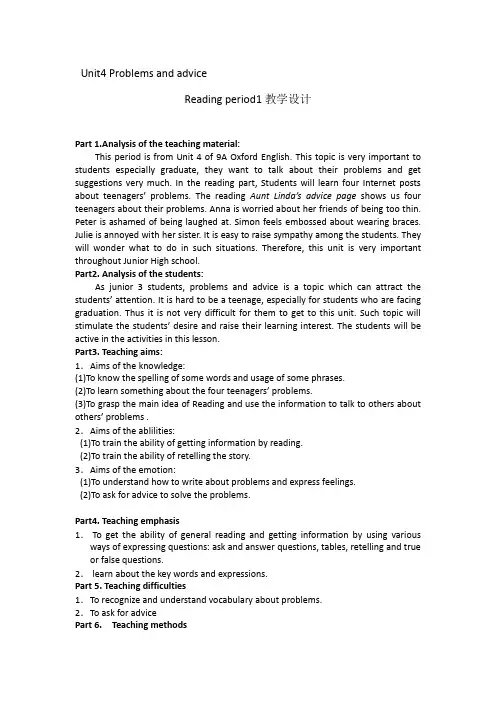
Unit4 Problems and adviceReading period1教学设计Part 1.Analysis of the teaching material:This period is from Unit 4 of 9A Oxford English. This topic is very important to students especially graduate, they want to talk about their problems and get suggestions very much. In the reading part, Students will learn four Internet posts about teenagers’problems. The reading Aunt Linda’s advice page shows us four teenagers about their problems. Anna is worried about her friends of being too thin. Peter is ashamed of being laughed at. Simon feels embossed about wearing braces. Julie is annoyed with her sister. It is easy to raise sympathy among the students. They will wonder what to do in such situations. Therefore, this unit is very important throughout Junior High school.Part2. Analysis of the students:As junior 3 students, problems and advice is a topic which can attract the students’ attention. It is hard to be a teenage, especially for students who are facing graduation. Thus it is not very difficult for them to get to this unit. Such topic will stimulate the students’ desire and raise their learning interest. The students will be active in the activities in this lesson.Part3. Teaching aims:1.Aims of the knowledge:(1)To know the spelling of some words and usage of some phrases.(2)To learn something about the four teenagers’ problems.(3)To grasp the main idea of Reading and use the information to talk to others about others’ problems .2.Aims of the ablilities:(1)To train the ability of getting information by reading.(2)To train the ability of retelling the story.3.Aims of the emotion:(1)To understand how to write about problems and express feelings.(2)To ask for advice to solve the problems.Part4. Teaching emphasis1.To get the ability of general reading and getting information by using various ways of expressing questions: ask and answer questions, tables, retelling and true or false questions.2.learn about the key words and expressions.Part 5. Teaching difficulties1.To recognize and understand vocabulary about problems.2.To ask for advicePart 6. Teaching methodsIn this topic, I will use five-step Teaching Method and Task-based language Teaching. I design some tasks to help the students learn. I think if I want to improve the students’ oral English, I should give them enough chances to practice and I will use pair work, group work to let the students take an active part in all kinds of activities. That is “Learning by doing,learning by using”.Let the students be the masters of the class teaching. Thus, student-centered teaching method is well shown. Part 6. Teaching aidsProjector, computer and blackboardPart 7 Teaching procedurestep1. lead-inThe purpose is to arouse the students’ interest of study.Let’s have a free talk.T: Good morning, boys and girls. It has been almost two month since you became a Grade 9. Have you got used to the life as a graduate? Let’s have a test to see if you are doing well. Here is a picture and you can see many white and black dots in it. Are the black dots moving or not? If your answer is yes, put up your hands! Actually, the faster the black dots move, the greater pressure you have.Pressure comes from problems. Have you got problems? You look unhappy. What happened?S1:I didn’t go to bed until 12 o’clock. I am sleepy now.T:What have you done to solve this problem?S1: I don’t know.T:Do you have the same problem? Do you have any advice for him?S2: He should …T: Great! I think you all have great ideas. Here is my advice. First, plan your day carefully, so you can make full use of your time. Next, You should also manage to find time to rest. Because “all work and no play makes Jack a dull boy.”See? When we have problems, we should never keep them to ourselves. We can ask for advice. This is also what we are going to learn today “Problems and advice” Turn to page 50.Step2. Before readingThe purpose is to develop the skills of guessing and getting information from the introduction, the title and other obvious materials.T: Look at the introduction, the title and the names of the four teenagers on page 51. Then answer the questions.1)Where can you find the passage? ( On the Internet)2)What does Aunt Linda do?( She gives advice on an online newspaper.)3)What are the names of the four teenagers?(Anna, Peter, Simon and Julie)T: Skimming: Read the four posts and match the sentences with the four students.Step2. While reading1. Ask students to read the first post and answer the questions:The purpose is to develop the skills of skimming and how to gain the main ideaof the articles. It will help the students to grasp the main idea of this paragraph. Inthis way, the reading will be more effective. When the students answer the questions, it is also a progress of outputting the language based on the understanding of the text.1)Who is Anna worried about?She is worried about_____________________.2)Why is Anna worried about Jolin?Because she is _________________________.3)Why is she always dieting?Because she_______________________.4)What does Anna think of her friend?She thinks__________________________.2. Read the second post and fill the table.The purpose is to develop the skills of scanning and how to gain the details from the articles.3. Read the third post. Then decide whether the following statements are T (True) orF (False). Find the sentences in the post to support your answers.The purpose is to develop the skills of scanning and how to gain the details from the articles.( )My friends all laugh at me and say bad things about me.”( )I feel embarrassed when I smile or open my mouth.”( )I feel it was a mistake for my mother to make me wear these ugly braces4. Read the fourth post and answer the question below.The purpose is to develop the skills of retelling.1. What does Julie’s sister do to make Julie annoyed?( play the piano, take her things, make a mess)2.Read the fourth post carefully and finish the mind map.Step 4. Post-reading.Design idea: It is pretty necessary to make a conclusion of the whole passage. On one hand, it will help the students to get a better understanding of the passage about it’s purpose, main idea….On the other hand, it is a good chance for the students to review and realize all the reading strategies.Read the Internet posts again and complete the table on Page 53.Step5. GroupworkThe purpose is to train the ability of the students’ Oral English.Divide the students into group of 5. Make one of them to be the reporter. The reporter is going to interview the other four students(Anna, Peter, Simon, Jolin). Make a conversation.Reporter: Can I ask some question?Student1: Sure. Go head.Reporter : What’s your problem, Anna?Student 1: I am…Repo rter: why are you…?Student1: Because…Step 5. Homework1.Listen to the recording and correct the pronunciation.2.Write down the interview you make in class.3.Finish the corresponding exercises on your exercise book.教学反思本堂课教学思路清晰,教学过程流畅,学生兴趣浓厚,积极性高,课堂气氛好,较好地完成了预期目标,达到了《义务教育英语课程标准》的要求,基本体现了《义务教育英语课程标准》的理念。
英语九上《Unit 4 Problems and advice Reading: Aunt Linda‘s advice page》_20

9A Unit 4 Reading B How can we deal with bullying?教学设计课题:九年级上册Unit 4 How can we deal with bullying?教学内容: Reading B How can we deal with bullying?课型:阅读课教学时间:40分钟教材分析:本单元的主题是谈论“我应该怎么做”,是关于学生责任意识的培养和正确处理问题方式的引导。
本课是本单元的第二课时,阅读材料讲述一位优秀学生受到欺负后,学校辅导员给他关于处理方式的一些建议。
此类事件也会发生在学生实际生活中,他们有必要学会一些应急的措施和正确的处理方式。
教材主题贴近学生生活,是比较感兴趣的话题。
但是语篇比较长,生词比较多,对普通班的学生来说,单词朗读和段落理解以及英语语言的运用都是挑战。
学情分析:1.三(2)班的学生都比较内向,不太说话,英语学习热情一般,课堂不太活跃,学生不太乐于表现自己,能运用一定的英语进行对话。
但学生对英语的记忆和灵活运用能力需要进一步的提高,部分内容需要用中文辅助解释。
课文中出现的除必学以外还有许多生僻的词汇需要反复学习,较长的句子需要进一步的理解。
2.通过初中两年的学习,学生已具备一定的阅读理解能力,掌握了一些阅读理解的策略与技巧。
将借助本课的阅读理解活动进一步巩固、运用已学的策略与技巧,以提高学生的阅读理解能力和英语语言的运用能力。
教学目标:1.认知目标:1) 学生能够掌握教多的新词汇如gifted, upset, ashamed, lonely, alone, nervous, adult, trust, evidence, ignore ;2) 学生能够掌握课文词组:get\ be bullied, keep a diary, It’s not your fault. 3)能理解课文中的英文指导提示。
2. 能力发展目标:1)阅读能力:通过多种形式的阅读活动与任务,指导学生进一步巩固、运用已学的阅读理解策略与技巧,培养一些阅读微技能,如:猜测生词大意、搜寻细节信息等,从而提高学生的阅读理解能力;2)语言能力:学生能运用自己的语言表达建议。
沪教牛津版-英语-九年级上册4单元 Problem and advice P4 课件
Why don’t you tell her how you feel?
L1ine.tRg’rosoleusppeslea; ywthhe iccohnvegrrsoatuiopn 2. Rodleopelsaytthhee cboensvetr.sation
1.S1 failed his/her Maths test because of some careless mistakes. He/She is afraid to tell his/her parents.
2.S2 is taller than all his/her classmates. He/She feels so out of place!
Let’s have a race!
Ready? Make up your own conversations.
Use the conversation A as a model. Which group is the best?
B Speak up
In pairs, make conversations according to the situations below. You may use your own situations. (P 58)
I think you should + V. … Maybe you should + V. … You could + V. … Why don’t you +V. …? Why not + V. …?
点击此处
Objectives
英语九年级上册《Unit 4 Problems and advice Reading: Aunt Linda‘s advice page》_8

Unit 4 Problems and advice一、教材分析本单元围绕着“问题和建议”的话题来展开听、说、读、写的训练。
教材以四个不同青少年具有不同的困惑以及需要建议的网贴为载体,帮助学生如何就生活中存在的问题寻求相关的解决途径。
作为初三年级的学生,就如何解决存在的问题寻求正确的解决途径尤其重要。
语法方面是认识和正确运用句子成分,并培养学生完成一篇关文章寻求正确的解决途径或建议并尝试正确使用句子成分。
二、教学对象分析1.学生通过初一、初二的学习,对工具书和蛛网图的使用有一定的了解,通过对蛛网的介绍和用法,提高学习的自学能力和概括归纳能力,有利于开展本单元的听、说、读、写任务。
2.学生在初一、初二平时学习过程中就已经接触过了有关句子的成分以及本单元再通过系统地复习,在学习方式上引导学生学习归纳总结。
三、单元教学目标1.认知目标:2. 思想情感目标:通过谈论“问题与建议”的相关话题,帮助学生如何就自己存在的各种问题寻求正确的解决方法。
3. 能力发展目标:1)能够在听、说、读、写等语言综合实践活动中运用本单元的重点词汇、句型与语法。
2)在学习中提高交流和传递信息的能力,在写作中正确运用连词使文章更连贯和流畅。
3)通过指导学生在模拟交际中运用所学的知识,培养学生探究学习、合作学习、自主学习的能力。
四、单元教学重点1. 学生熟练掌握重点词语,词组及句型。
2.指导学生利用所学句型正确表达思想、进行交际活动。
3.指导学生归纳、总结动词不定式的用法,并在实践运用中熟练运用。
五、单元教学难点1.句子成分的归纳整理及运用。
六、教学策略1. 引导学生积极主动的通过预习完成可以自己学会的部分,课堂学习完成学习的重难点,通过复习及归纳总结完善单元的学习。
2. 在教学中以旧带新,引导学生用正确的句子表达思想。
3. 适当补充与课文话题相关的内容,拓展学生的阅读视野。
七、学习策略1.初步接触略读(skimming)和找读(scanning)这两种阅读策略。
九上Unit4-Problems-and-Advice-
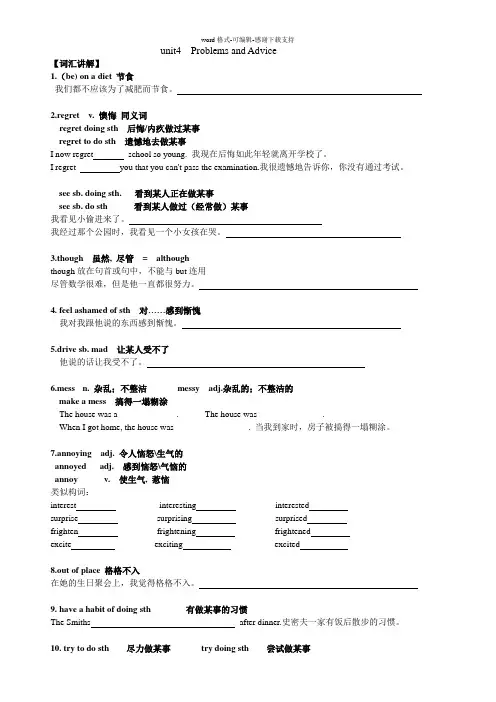
unit4 Problems and Advice【词汇讲解】1.(be) on a diet 节食我们都不应该为了减肥而节食。
2.regret v. 懊悔同义词regret doing sth 后悔/内疚做过某事regret to do sth 遗憾地去做某事I now regret school so young. 我现在后悔如此年轻就离开学校了。
I regret you that you can't pass the examination.我很遗憾地告诉你,你没有通过考试。
see sb. doing sth. 看到某人正在做某事see sb. do sth 看到某人做过(经常做)某事我看见小偷进来了。
我经过那个公园时,我看见一个小女孩在哭。
3.though 虽然, 尽管= althoughthough放在句首或句中,不能与but连用尽管数学很难,但是他一直都很努力。
4.feel ashamed of sth 对……感到惭愧我对我跟他说的东西感到惭愧。
5.drive sb. mad 让某人受不了他说的话让我受不了。
6.mess n. 杂乱;不整洁messy adj.杂乱的;不整洁的make a mess 搞得一塌糊涂The house was a _____________. The house was _____________.When I got home, the house was _______________. 当我到家时,房子被搞得一塌糊涂。
7.annoying adj. 令人恼怒\生气的annoyed adj. 感到恼怒\气恼的annoy v. 使生气, 惹恼类似构词:interest interesting interestedsurprise surprising surprisedfrighten frightening frightenedexcite exciting excited8.out of place 格格不入在她的生日聚会上,我觉得格格不入。
初三英语作文专题problems and advice市公开课一等奖全国优质课特等奖PPT课件
过
渡 Here I’ll share with you my suggestions.
句 I’ll try to make some constructive
suggestions.
第13页
善
First… Second…Third Firstly…secondly…Finally
用 Firstly…Besides…Moreover/what’s more
第3页
Unit 4 Problems and
advice
第4页
Pre-reading
What problems have you got? How do you feel?
第5页
While-reading: Get the problems on the sheet.
• What problems have other students got?
第7页
Pre-writing: Understand the task
In order to make a poster for Problem Solvers of The 21st Century, You need to write replies on common problems from teenagers and give them advice.
• Do you have a problem?
• stressed /anxious • drive sb mad • nervous/confused • Upset/feel sorry about
doing sth
第12页
妙 Here are my suggestions.
用
Unit4Writing(problemsandadvice)问题与建议写作课件牛津深圳版英语九年级
___B___With a little hard work, I believe you will deal with the homework problem
and feel relaxed in your study. Yours, A. In this way, you can improve your learning efficiency(学习效率). Linda B. To sum up, you should stay positive and try different ways to solve the problems.
The sentence patterns to give suggestions: had better (not) do.../ I advise to... Doing...is( a good choice)./ If you..., you will... It’s a good way to... You’re supposed/expected to... I suggest that you (should)...
Act. 3- Read the email again and find out some sentence patterns to give suggestions.
Dear Eric, I learn that you have trouble finishing your homework everyday and you suffer from a
牛津深圳版英语九年级上册:Unit 4 《Problems and advice》 教学设计7
牛津深圳版英语九年级上册:Unit 4 《Problems and advice》教学设计7一. 教材分析《牛津深圳版英语九年级上册》Unit 4《Problems and advice》主要围绕问题和建议展开,让学生学会描述常见的问题以及给出相应的建议。
本节课主要介绍了一些日常生活中的问题,如健康、学习、环境等,并通过对话和阅读材料,让学生学会如何表达这些问题,以及如何给出合理的建议。
教材内容丰富,贴近学生生活,有利于激发学生的学习兴趣和参与度。
二. 学情分析九年级的学生已经具备了一定的英语基础,能够进行简单的日常交流。
但部分学生在表达问题时,可能会受到中文思维的影响,不知道如何用英语准确表达。
此外,学生在给出建议时,可能会出现词汇量不足、句子结构混乱等问题。
因此,在教学过程中,需要关注学生的个体差异,有针对性地进行指导。
三. 教学目标1.知识目标:学生能够掌握描述问题的相关词汇和表达方式,如“haveproblems with”,“give advice”等;2.能力目标:学生能够用英语准确地描述生活中遇到的问题,并给出合理的建议;3.情感目标:培养学生关心他人,乐于助人的品质。
四. 教学重难点1.重点:学生能够用英语描述生活中遇到的问题,并给出合理的建议;2.难点:如何引导学生运用所学知识,准确、流畅地表达问题和建议。
五. 教学方法1.任务型教学法:通过设定各种现实生活中的情境,让学生在完成任务的过程中,学会描述问题和给出建议;2.交际型教学法:鼓励学生积极参与课堂对话,提高他们的口头表达能力;3.情境教学法:通过设定情境,让学生在实际语境中学会运用所学知识。
六. 教学准备1.教材:《牛津深圳版英语九年级上册》Unit 4《Problems andadvice》;2.课件:相关图片、视频、音频等教学资源;3.练习题:针对本节课内容的练习题;4.小组活动准备:分组名单、任务分配等。
七. 教学过程1.导入(5分钟)利用图片或视频展示一些日常生活中的问题,如健康、学习、环境等,引导学生思考并讨论这些问题。
Unit 4 Problems and advice 课件-优质公开课-上教9上精品
It’s an interesting story. 那是 一个有趣的故事。 Do you have time to help us? 你有时间帮助我们吗? Who is the woman being operated on? 正在动手术的 女人是谁?
状语:
用于修饰动词、形容词、副词、 短语或整个句子等的成分是状 语,修饰形容词的状语通常放 在它所修饰的词之前,修饰的 状语通常放在动词之后。但有 些副词(如:always,often等) 作状语时,则放在行为动词之 前。一般由副词、介词短语、 非谓语动词短语、名词词组、 动词不定式短语、分词短语或 状语从句充当。如
We like English very much. 我 们非常喜欢英语。 Her uncle lives in Canada. 她叔 叔住在加拿大。 She was lying in bed reading. 她躺在床上看书。
United we stand, divided we fall. 团结则存,分裂则亡
Module 2
Unit 4 Problems and advice
句子成分
主语 谓语 宾语 宾语补足语 表语 定语 状语
主语:
是说明人或物,是句子的主体,一般放在句 首。名词、代词、数词常在句中作主语。此 外,动名词,动词不定式也可以作主语。
例子: 1)Comrade Chen is a well-known scientist. (名词) 2)He reads newspapers every day.(代词) 3)Two and six is eight.(数词) 4)Smoking is harmful to the health.(动名词) 5)To swim in Kunming Lake is a great pleasure.(不定式) 6)What we shall do next is noe ye decided.(主语从句)
牛津深圳版英语九上Unit 4《Problems and advice》教学设计3
牛津深圳版英语九上Unit 4《Problems and advice》教学设计3一. 教材分析牛津深圳版英语九上Unit 4《Problems and advice》主要讨论了日常生活中可能遇到的问题以及相应的解决方法。
本节课的教学内容主要包括如何描述问题,如何给出建议,以及如何表达自己的观点。
教材通过丰富的语境和真实的例子,帮助学生掌握相关词汇和句型,提高他们的语言运用能力。
二. 学情分析九年级的学生已经具备了一定的英语基础,能够理解和运用一些基本的词汇和句型。
然而,在描述复杂问题和给出具体建议方面,他们可能还存在一定的困难。
因此,在教学过程中,需要关注学生的个体差异,充分调动他们的积极性,引导他们主动参与课堂活动。
三. 教学目标1.知识目标:学生能够掌握描述问题的词汇和句型,如have problemswith, give advice, suggest doing等;2.能力目标:学生能够在日常生活中运用所学词汇和句型,描述问题并给出建议;3.情感目标:学生能够学会倾听他人的意见,尊重他人的观点,形成良好的沟通习惯。
四. 教学重难点1.重点:描述问题的词汇和句型,如have problems with, give advice,suggest doing等;2.难点:如何运用所学词汇和句型,在实际情境中进行有效的沟通和表达。
五. 教学方法1.情境教学法:通过设定真实的生活情境,让学生在实践中学习和运用词汇和句型;2.交际法:鼓励学生积极参与课堂活动,进行真实的交流和互动;3.任务型教学法:通过完成具体任务,培养学生解决问题的能力和合作精神。
六. 教学准备1.教材:牛津深圳版英语九上Unit 4《Problems and advice》;2.多媒体设备:电脑、投影仪等;3.教学课件:根据教学内容设计的课件;4.练习题:针对本节课内容的练习题。
七. 教学过程1.导入(5分钟)利用图片或实物,引导学生谈论日常生活中遇到的问题,激发学生的学习兴趣。