
一般过去时、过去进行时、过去完成时
are
begin break bring build buy can
were
begun broke brought built bought could
come
do draw drink drive eat fall
came
did drew drank drove ate fell
用
法
1、表示过去某个时间发生的动作或存在的状态。
4.I don’t think Jim saw me; he ___ into space. A. just stared B. was just staring C. has just stared D. had just stared
5.I first met Lisa three years ago. She ___ at a radio shop at the time. A. has worked B. was working C. had been working D. had worked 6.---Hey, look where you are going! ---Oh, I’m terribly sorry.________. A. I’m not noticing B. I wasn’t noticing C. I haven’t noticed D. I didn’t
2、结尾是 e 的动词加 -- d
3、末尾只有一个辅音字母的 重读闭音节词,先双写这 个辅音字母,再加—ed
4、结尾是“辅音字母+y”的动词, study carry 先变“y”为“i”再加—ed
规则动词词-ed的读音
清念 /t/ ,元浊/d/ ;
/t/ /d/ 之后念/id/
说明:
1、清念 /t/ ,即 ed 在清辅音后面念 /t/ ,例:finished helped passed cooked
4、There was some orange in the cup.(变一般疑问句) Was any _____ there _____ orange in the cup?
That’s great√
基本概念:过去进行时表示在过去某一时 刻或某一段时间内进行或发生的动作。 基本结构 主语+was/were + doing +其他内容 注:doing 就是现在分词,词形变化与现在 进行时相同
用法
1. 过去进行时的基本用法主要表示过去某一 时间正在进行的动作。 如: He fell asleep when he was reading. 他看书时睡着了。
2. 过去进行时表示现在主要是为了使语气委 婉、客气。 如: I was wondering if you could give me a lift. 我不知你能否让我搭一下车 【注】一般过去时也有类似用法,但比较 而言,用过去进行时显得更客气,更不肯 定。能否让我搭一下车。
返 第三人称
疑问句式
PRACTISE
改写句子: 1、Lucy did her homework at home.(改否定句) didn’t do Lucy _______ _______ her homework at home. 2、He found some meat in the fridge.(变一般疑问句) Did find any ______ he _____ ______ meat in the fridge? 3、She stayed there for a week.(对划线部分提问) How long did stay ______ ______ _____ she _____ there?
3. 过去进行时表示感情色彩与现在进行时 相似,过去进行时也可表示满意、称赞、 惊讶、厌恶等感情色彩,也通常与 always, forever, continually等副词连用。 如: They were always quarrelling. 他们老是吵架。
4. 动词be的过去进行时也可表示过去一时的 表现或暂时的状态。 比较: He was friendly. 他很友好。 (指过去长期如此) He was being friendly. 他当时显得很友好。(指当时一时的表现)
常用的时间状语
this morning, the whole morning, all day yesterday, from nine to ten last evening, when, while , at that time, just now
不同的句式
肯定句: 主语+was/were +doing +其它 否定句: 主语+was/were +not +doing +其它 一般疑问句: Was/Were+主语+doing+其它 特殊疑问句: 特殊疑问词+was/were+主语+doing+其它
一般过去时
知识结构
动词的过去式
构成
一般过去时
用法
1、表示过去某个时 间发生的动作或 存在的状态。 2、表示过去经常或 反复发生的动作。 yesterday last night in 1990 two days ago
常用时间
构成 规则动词 动词过去式 的构成 不规则动词 读音
规则动词过去式的构成 构成规则 1、一般在动词原形末尾加– ed look play start live hope use stop plan trip 例词 looked played started lived hoped used stopped planned tripped studied carried
一般过去时与过去进行时的区别
1、一般过时往往表示某一动作已经完成, 而过去进行时却表示动作在持续或未完成。 比较: She wrote a letter to her friend last night. 她昨晚给朋友写了封信。 (信写完了) She was writing a letter to her friend last night. 她昨晚一直在给朋友写信。 (信不一 定写完)
单项选择题
1. My brother ___ while he ___ his bicycle and hurt himself. A. fell, was riding B. fell, were riding C. had fallen, rode D. had fallen, was riding
2. Tom ___ into the house when no one ___. A. slipped, was looking B. had slipped, looked C. slipped, had looked D. was slipping,
3.The last time I __ Jane she ___ cotton in the fields. A. had seen, was picking B. saw, picked C. had seen, picked D. saw, was picking
I/You/He/She/It/We/You/They did not(didn’t) work.
I/You/He/She/It/We/ work You/They worked.
进入下页
返回首页
一般过去时态句式的构成
动词
Was I …? Were you…? Was he/she/it…? Yes, you were. Yes,I was. Yes,he/she/it was. No, you were not. No,I was not. No,he/she/it was not. Were you…? Were they…? be Were we…? Yes,we/you were. Yes,we were. Yes,they were. No,we/you were No,we were No,they were not. not. not. Did I work? Did you work? Did he/she/it work? Yes,you did. Yes,I did. Yes,he/she/it did. No,you did not. No, I did not. No,he/she/it did not. work Did we work? Did you work? Did they work? Yes,we/you did. Yes,we did. Yes,they did. No,we/you did not. No,we did not. No,they did not. 特殊疑 特殊疑问词+一般疑问句? what did you/ she/ they do yesterday? 问句 I / she/ they worked.
He was here yesterday. I got up at six thirty yesterday morning.
My father was at work yesterday afternoon.
Did you have a good time last summer? 2、表示过去经常或反复发生的动作。 My father often went to work by bus last year.
一般过去时态句式的构成
陈述句式
动词 肯定式 否 定 式 I was …. I was not(wasn’t)…. He /She/it was…. He/She/It was not(wasn’t)…. be We/You/They were …. We/You/They were not (weren’t)…
2) As she ___ the newspaper, Granny ___ asleep. read; was falling B. was reading; fell C. was reading; was falling D. read;fell
一般过去时、过去进行时、过去完成时(课堂PPT)

3
常用时间 常与一般过去时态连用的时间有:
yesterday yesterday morning (afternoon, evening…) last night (week, month, year…) two days ago, a week ago, three years ago… in 1990, (in 1998…)
C. has just stared D. had just stared 18
5.I first met Lisa three years ago. She ___ at a radio shop at the time.
A. has worked
B. was working
C. had been working D. had worked
指当时一时的表现12一般过去时与过去进行时的区别1一般过时往往表示某一动作已经完成而过去进行时却表示动作在持续或未完成
一般过去时
1
一般过去时
知识结构
构成 用法 常用时间
动词的过去式
1、表示过去某个时 间发生的动作或 存在的状态。
2、表示过去经常或 反复发生的动作。
yesterday
last night
in 1990
two days ago
2
用法 1、表示过去某个时间发生的动作或存在的状态。
He was here yesterday. I got up at six thirty yesterday morning. My father was at work yesterday afternoon. Did you have a good time last summer?
一般过去时,过去进行时和过去完成时
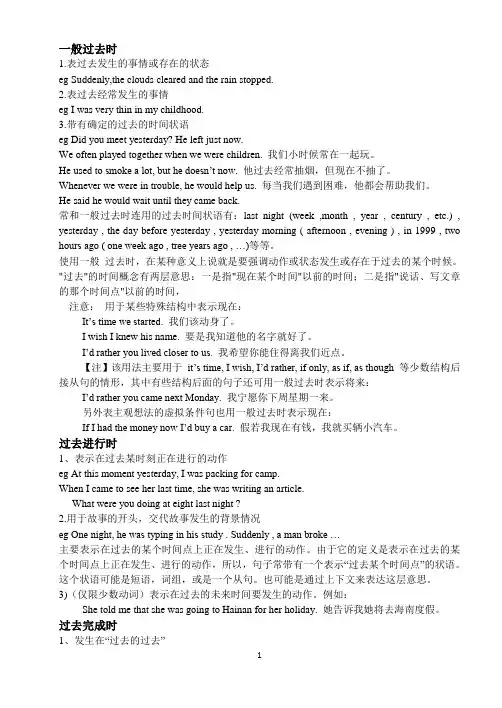
一般过去时1.表过去发生的事情或存在的状态eg Suddenly,the clouds cleared and the rain stopped.2.表过去经常发生的事情eg I was very thin in my childhood.3.带有确定的过去的时间状语eg Did you meet yesterday? He left just now.We often played together when we were children. 我们小时候常在一起玩。
He used to smoke a lot, but he doesn’t now. 他过去经常抽烟,但现在不抽了。
Whenever we were in trouble, he would help us. 每当我们遇到困难,他都会帮助我们。
He said he would wait until they came back.常和一般过去时连用的过去时间状语有:last night (week ,month , year , century , etc.) , yesterday , the day before yesterday , yesterday morning ( afternoon , evening ) , in 1999 , two hours ago ( one week ago , tree years ago , …)等等。
使用一般过去时,在某种意义上说就是要强调动作或状态发生或存在于过去的某个时候。
"过去"的时间概念有两层意思:一是指"现在某个时间"以前的时间;二是指"说话、写文章的那个时间点"以前的时间,注意:用于某些特殊结构中表示现在:It’s time we star ted. 我们该动身了。
I wish I knew his name. 要是我知道他的名字就好了。
初中英语八大时态知识点详解 4
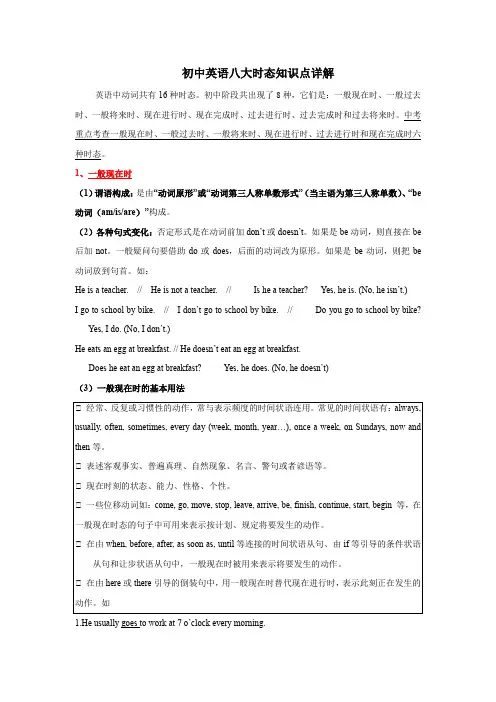
初中英语八大时态知识点详解英语中动词共有16种时态。
初中阶段共出现了8种,它们是:一般现在时、一般过去时、一般将来时、现在进行时、现在完成时、过去进行时、过去完成时和过去将来时。
中考重点考查一般现在时、一般过去时、一般将来时、现在进行时、过去进行时和现在完成时六种时态。
1、一般现在时(1)谓语构成:是由“动词原形”或“动词第三人称单数形式”(当主语为第三人称单数)、“be 动词(am/is/are)”构成。
(2)各种句式变化:否定形式是在动词前加don’t或doesn’t。
如果是be动词,则直接在be 后加not。
一般疑问句要借助do或does,后面的动词改为原形。
如果是be动词,则把be 动词放到句首。
如:He is a teacher. // He is not a teacher. // ---- Is he a teacher? --- Yes, he is. (No, he isn’t.)I go to school by bike. // I don’t go to school by bike. // ---- Do you go to school by bike? ---- Yes, I do. (No, I don’t.)He eats an egg at breakfast. // He doesn’t eat an egg at breakfast.---- Does he eat an egg at breakfast? ---- Yes, he does. (No, he doesn’t)(3)一般现在时的基本用法1.He usually goes to work at 7 o’clock every morning.2.Every dog has its day. 凡人皆有得意日。
3.Pride goes before a fall. 骄者必败。
4.The earth goes around the sun. 地球绕着太阳转。
(完整版)英语常用的八种时态
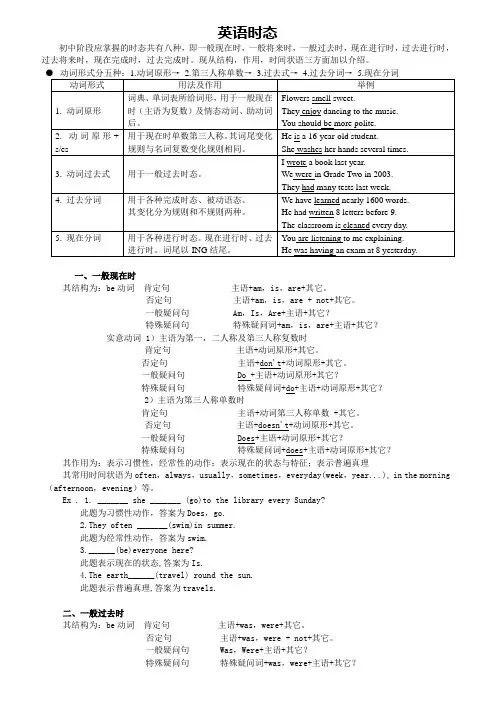
英语时态初中阶段应掌握的时态共有八种,即一般现在时,一般将来时,一般过去时,现在进行时,过去进行时,过去将来时,现在完成时,过去完成时。
现从结构,作用,时间状语三方面加以介绍。
一、一般现在时其结构为:be动词肯定句主语+am,is,are+其它。
否定句主语+am,is,are + not+其它。
一般疑问句 Am,Is,Are+主语+其它?特殊疑问句特殊疑问词+am,is,are+主语+其它?实意动词1)主语为第一,二人称及第三人称复数时肯定句主语+动词原形+其它。
否定句主语+don't+动词原形+其它。
一般疑问句 Do +主语+动词原形+其它?特殊疑问句特殊疑问词+do+主语+动词原形+其它?2)主语为第三人称单数时肯定句主语+动词第三人称单数 +其它。
否定句主语+doesn't+动词原形+其它。
一般疑问句 Does+主语+动词原形+其它?特殊疑问句特殊疑问词+does+主语+动词原形+其它?其作用为:表示习惯性,经常性的动作;表示现在的状态与特征;表示普遍真理其常用时间状语为often,always,usually,sometimes,everyday(week,year...), in the morning (afternoon,evening)等。
Ex . 1. _______ she _______ (go)to the library every Sunday?此题为习惯性动作,答案为Does,go.2.They often _______(swim)in summer.此题为经常性动作,答案为swim.3.______(be)everyone here?此题表示现在的状态,答案为Is.4.The earth______(travel) round the sun.此题表示普遍真理,答案为travels.二、一般过去时其结构为:be动词肯定句主语+was,were+其它。
一般过去时过去完成时和过去进行时的区别
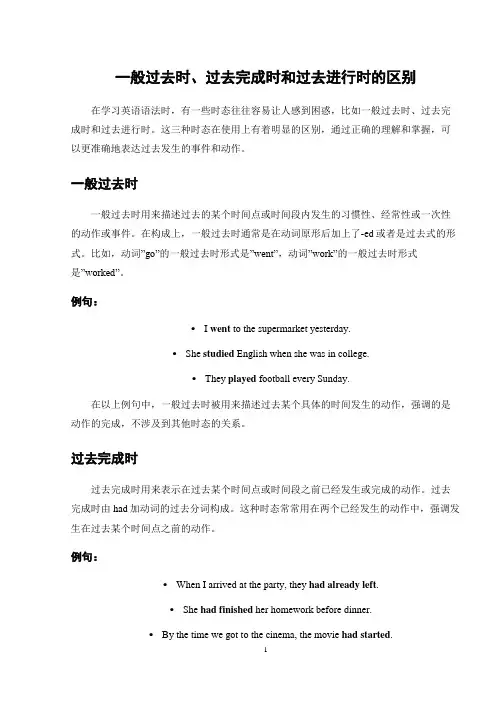
一般过去时、过去完成时和过去进行时的区别在学习英语语法时,有一些时态往往容易让人感到困惑,比如一般过去时、过去完成时和过去进行时。
这三种时态在使用上有着明显的区别,通过正确的理解和掌握,可以更准确地表达过去发生的事件和动作。
一般过去时一般过去时用来描述过去的某个时间点或时间段内发生的习惯性、经常性或一次性的动作或事件。
在构成上,一般过去时通常是在动词原形后加上了-ed或者是过去式的形式。
比如,动词”go”的一般过去时形式是”went”,动词”work”的一般过去时形式是”worked”。
例句:•I went to the supermarket yesterday.•She studied English when she was in college.•They played football every Sunday.在以上例句中,一般过去时被用来描述过去某个具体的时间发生的动作,强调的是动作的完成,不涉及到其他时态的关系。
过去完成时过去完成时用来表示在过去某个时间点或时间段之前已经发生或完成的动作。
过去完成时由had加动词的过去分词构成。
这种时态常常用在两个已经发生的动作中,强调发生在过去某个时间点之前的动作。
例句:•When I arrived at the party, they had already left.•She had finished her homework before dinner.•By the time we got to the cinema, the movie had started.在以上例句中,过去完成时指明了在过去某个时间点之前已经完成的动作,通过这种时态可以清晰地表达出事件之间的先后顺序。
过去进行时过去进行时用来描述在过去某个具体时间或时间段内正在进行的动作。
过去进行时由was/were加动词的ing形式构成。
这种时态强调了动作或事件发生时正在进行的状态。
一般过去时、过去进行时及过去完成时重难点

一般过去时、过去进行时及过去完成时重难点一、一般过去时一般过去时主要表示在过去某一时刻发生的动作或存在的状态。
在条件、时间、让步等状语从句中,常用一般过去时表示过去进行的动作。
一般过去时由动词的过去式构成。
如:She told me she wouldn?蒺t leave until you came back.重点提示:要注意一般过去时和现在完成时的区别。
现在完成时表示某一动作对现在造成的影响或结果,强调的是现在的情况,因此不能与表示过去的时间状语连用。
一般过去时只表示过去发生过某事,常与表示过去的时间状语连用。
试比较:He has lost the key. (现在没有了)He lost the key. (现在可能找到了,也可能没找到)二、过去进行时过去进行时的构成是“was / were + V-ing形式”。
过去进行时主要用于:1. 表示过去某个时刻正在进行的动作。
2. 表示过去某个阶段正在进行的动作。
3. 一些表示位置移动的动词,如come, go, leave, stay, start, take, arrive, move, close等也可以用过去进行时表示过去将来的动作。
如:The naughty boy was making trouble all the time.三、过去完成时过去完成时是一种相对概念,是相对于过去某一时间或动作而言的。
因此一定要在形式或意义上有明显的过去时间或动作作为参照标志。
主要表示在过去某一时间或动作之前已经完成的动作或存在的状态,即动作或状态发生在“过去的过去”。
常用于下列情形:⑴主语+ 过去完成时+ before 从句(从句用一般过去时)⑵主语+ 过去完成时+ by 从句(从句用一般过去时)⑶主语+ 过去完成时+ when 从句(从句用一般过去时)⑷主语+ told (said, knew, heard, thought...) + 宾语从句(从句用过去完成时)。
七个时态:一般现在时、现在进行时、将来时:begoingto(=will)、一般过去时、过去进行时、过去完成时、现在
主要要一下七个时态:一般现在时、现在进行时、将来时:be goingto(= will )、一般过去时、过去进行时、过去完成时、现在完成进行时。
(1)一般现在时1.一般现在时表示经常或习惯性的动作,也可表示现在的状态或主语具备的性格和能力。
2.一般现在时中,没有be动词和情态动词,主语为第三人称单数的肯定句,动词要按规则加上s,主语是非第三人称单数的肯定句,动词用原形。
3.在一般现在时中,句中有be动词或情态动词时,否定句在be 动词和情态动词后加not,一般疑问句将be动词或情态动词放在句4.在一般现在时中,句中没有be动词或情态动词时,主语为第三人称单数的否定句在动词前加does+not (doesn’t),一般疑问句在句首加does,句子中原有动词用原形;主语为非第三人称单数,否定句用do+not (don’t),一般疑问句在句首加do,句子中动词用原形。
5.动词+s的变化规则1)一般情况下,直接加-s,如:cook-cooks, milk-milks2)以s. x. sh. ch. o结尾,加-es,如:guess-guesses,wash-washes,watch-watches, go-goes3)以“辅音字母+y”结尾,变y为i, 再加-es,如:study-studies6. 句中be动词和动词一般情况下只能有一种而且也必须有一种。
如:The childrenare very happy on Christmas Day .7.一般现在时中的be动词:一般用原形:am is aream用于第一人称单数(I);is用于第三人称单数(he she it和其他人名或称谓,如:Ben his sister等);are用于第二人称单数(you)和所有复数(包括第一人称复数we、第二人称复数you;第三人称复数they和其他复数,如his parents等)。
8.一般过去时中的动词:有两种情况:第一种情况:主语是第三人称单数(he she it 和其他,如Helen 、her cousin 等),动词后一般加s或es。
英语八大时态总结表时态结构与用法
英语八大时态总结表时态结构与用法八大时态是指一般现在时、一般过去时、一般将来时、现在进行时、过去进行时、过去完成时、现在完成时和过去将来时。
英语时态分为16种:一般现在、一般过去、一般将来、过去将来时,以及这四者的进行时、完成时和完成进行时下面就英语中常见的八种基本时态进行阐述,其它的时态都是在这八种时态的基础上结合而成的。
一、一般现在时:1.概念:经常、反复发生的动作或行为及现在的某种状况。
2.时间状语: always, usually, often, sometimes, every week day, year, month…, once a week, on Sundays,3.基本结构:动词原形(如主语为第三人称单数,动词上要改为第三人称单数形式)4.否定形式:am/is/are+not;此时态的谓语动词若为行为动词,则在其前加don't,如主语为第三人称单数,则用doesn't,同时还原行为动词。
5.一般疑问句:把be动词放于句首;用助动词do提问,如主语为第三人称单数,则用does,同时,还原行为动词。
6.例句:. It seldom snows here.He is always ready to help others.Action speaks louder than words.二、一般过去时:1.概念:过去某个时间里发生的动作或状态;过去习惯性、经常性的动作、行为。
2.时间状语:ago, yesterday, the day before yesterday, last week,lastyear, night, month…, in 1989, just now, at the age of 5, one day, long long ago, once upon a time, etc.3.基本结构:be动词;行为动词的过去式4.否定形式:was/were+not;在行为动词前加didn't,同时还原行为动词。
八种英语时态基本句型
八种英语时态基本句型英语时态是指表示动作或状态所发生的时间的一种语法形式。
正确使用英语时态可以让我们表达清晰、准确地传达信息。
常见的英语时态包括:一般现在时、一般过去时、一般将来时、现在进行时、过去进行时、过去将来时、现在完成时和过去完成时。
下面我们将详细介绍这八种英语时态的基本句型。
一、一般现在时:1. 肯定句:主语 + 动词原形 + 其他。
例句:I eat breakfast every morning.They play soccer on weekends.2. 否定句:主语 + do/does + not + 动词原形 + 其他。
例句:She does not watch TV in the evening.We do not like spicy food.3. 疑问句:Do/Does + 主语 + 动词原形 + 其他?例句:Do you drink coffee?Does he play basketball?二、一般过去时:1. 肯定句:主语 + 动词过去式 + 其他。
例句:She visited her grandparents last weekend.They watched a movie yesterday.2. 否定句:主语 + did not + 动词原形 + 其他。
例句:He did not go to the party.We did not see him at the park.3. 疑问句:Did + 主语 + 动词原形 + 其他?例句:Did you finish your homework?Did they play tennis this morning?三、一般将来时:1. 肯定句:主语 + will + 动词原形 + 其他。
例句:I will visit my friend tomorrow.They will have a party next month.2. 否定句:主语 + will not + 动词原形 + 其他。
初中动词的时态与语态
初中动词的时态与语态动词是语言中最基本的词类之一,它用来表达动作、状态和行为。
在英语中,动词的时态和语态是非常重要的语法概念。
掌握动词的时态和语态对于我们正确使用动词、准确表达意思至关重要。
本文将对初中动词的时态和语态进行详细介绍。
一、动词的时态时态是指动词所表示动作、状态或者事实发生的时间。
英语中常见的时态有一般现在时、一般过去时、一般将来时、现在进行时、过去进行时、将来进行时、现在完成时、过去完成时、将来完成时等多种时态。
1. 一般现在时(Simple Present Tense)一般现在时表示经常性或者客观事实,常用来表达日常的习惯、科学事实、真理等等。
它的基本构成为主语 + 动词原形。
例如:- They play basketball every Sunday.(他们每周日打篮球。
)- Water boils at 100 degrees Celsius.(水在100摄氏度沸腾。
)2. 一般过去时(Simple Past Tense)一般过去时表示过去发生的动作或者状态,常用于叙述过去的经历或者事件。
它的基本构成为主语 + 动词过去式。
例如:- I visited my grandparents last weekend.(我上个周末去看望了我的祖父母。
)- She didn't go to school yesterday.(她昨天没有去上学。
)3. 一般将来时(Simple Future Tense)一般将来时表示将来要发生的动作或者状态,常用于表达计划、打算、预测等等。
它的基本构成为主语 + will + 动词原形。
例如:- We will have a party next Friday.(我们下周五要举办一个聚会。
)- She won't come to the meeting tomorrow.(她明天不会来参加会议。
)4. 现在进行时(Present Continuous Tense)现在进行时表示正在进行的动作,通常用于描述当前正在发生的事情。