
一年级英语上册unit 8 Apples, please. Period 2 牛津上海版
一年级上册英语素材 Unit1-Unit6 单元重点词汇与句型归纳总结 人教新起点版
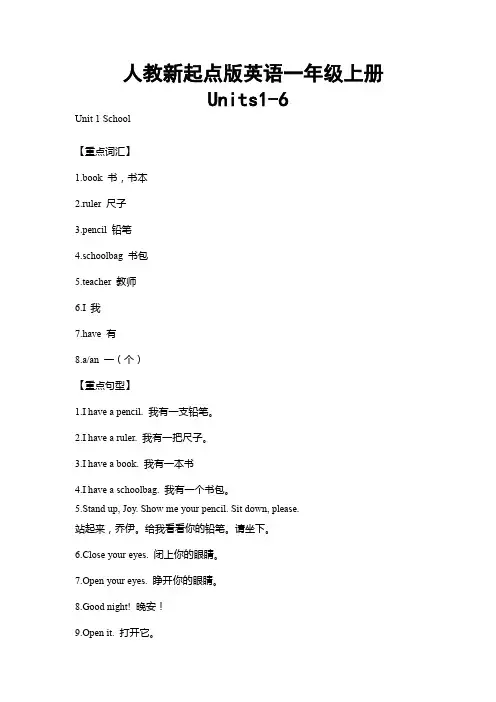
人教新起点版英语一年级上册Units1-6Unit 1 School【重点词汇】1.book 书,书本2.ruler 尺子3.pencil 铅笔4.schoolbag 书包5.teacher 教师6.I 我7.have 有8.a/an 一(个)【重点句型】1.I have a pencil. 我有一支铅笔。
2.I have a ruler. 我有一把尺子。
3.I have a book. 我有一本书4.I have a schoolbag. 我有一个书包。
5.Stand up, Joy. Show me your pencil. Sit down, please.站起来,乔伊。
给我看看你的铅笔。
请坐下。
6.Close your eyes. 闭上你的眼睛。
7.Open your eyes. 睁开你的眼睛。
8.Good night! 晚安!9.Open it. 打开它。
10.Show me your schoolbag. 给我看看你的书包。
11.Show me your ruler. 给我看看你的尺子。
Unit 2 Face【重点词汇】1.face 脸2.ear 耳朵3.eye 眼睛4.nose 鼻子5.mouth 嘴巴6.this 这(个)7.is 是8.my 我的【重点句型】1.Touch your mouth. 摸你的嘴巴。
2.This is my mouth. 这是我的嘴巴。
3.Touch your nose. 摸你的鼻子。
4.This is my nose. 这是我的鼻子。
5.Look at my eye. 看我的眼睛。
6.Look at my ear. 看我的耳朵。
7.Look at my nose. 看我的鼻子。
8.Look at my mouth. 看我的嘴巴。
9.I have two ears. 我有两只耳朵。
10.I have two eyes. 我有两只眼睛。
11.I have no tail. 我没有尾巴。
一年级上Unit 8 For apples, please

一年级上册Module3 Unit8 Four apples, please 第一课时教学设计李玥瑶一、教学目标1.在语境中理解核心词汇的意思,如:apple, pear, peach, orange 及其复数形式。
2.用简单的句子提出请求购买水果,如:Four apples, please.二、教学重点1.能听出语句中的中心词汇,如:apple, pear, peach, orange。
2.能听懂别人提出的请求,如:Four apples, please.3.能说出每个单词的复数形式。
三、教学难点1.能简单提出购买水果的请求,如:Four apples, please2.能说出每个单词的复数形式。
四、教学准备多媒体设备,课件,单词卡片,图片,水果,围裙七、教学过程Step 1 Greeting & Sing a songTen little paper rabbitsStep 2 Revision & Lead in1、复习上一单元的数字和名词复数。
T: Look! This is a bag. What’s in the bag?2. 引出本单元第一个新单词:apple。
导入新课Spet3 Presentation1. 通过PPT呈现apple领读之后学习复数apples。
之后通过歌谣Apples, apples, I like apples. Apples, apples, yummy, yummy.操练apples。
出示本课对话flash,引入本课对话。
2. 复习chant A for ant, b for bear. Ant, ant, ant. Bear,bear,bear. 引出bear,后引出pear。
之后通过歌谣Pears, pears, I like pears. Pears, pears, yummy, yummy.操练pears。
通过PPT呈现买梨场景,让学生试着仿照书中对话编新对话。
外研版一起点一年级上册英语 Module 8 Unit 1课件
单元新词
seven
(数词)七
短语 at sixes and sevens 乱七八糟 例句 There are seven apples on the tree.
这棵树上有七个苹果。
第十一页,共二十七页。
单元新词
eight
(数词)八
形近 light(名词)光 night(名词)夜晚
随堂练习 将下列图片与单词连线。
1.
2.
3.
4.
five
four
two
six
第二十四页,共二十七页。
随堂练习
看图,圈出正确的答语。
( )1. —How many? —______
A A. Four.
B. Two.
第二十五页,共二十七页。
随堂练习
看图,圈出正确的答语。
( )2. —How many?
one
(数词)一
联想 first(数词)第一 短语 one day 一天 例句 I have one pen.我有一支钢wo
(数词)二
同音 too(副词)也
to(介词)向…… 例句 There are two cats. 有两只猫。
第四页,共二十七页。
单元新词
three
单元新词
five
(数词)五
形近 live(动词)居住
短语 five erasers 五块橡皮 例句 I have five pencils. 我有五支铅笔。
第九页,共二十七页。
单元新词
six
(数词)六
形近 sit (动词)坐 fix(动词)修理
例句 Five and one is six. 五加一等于六。
一年级上册英语试题-Unit 8 Apples, please 同步练习(含答案)沪教牛津版

Unit 8 Apples, please知识梳理一、单词1.apple苹果 2.pear梨 3.peach桃子4.orange桔子 5.at在(地点) 6.the(表示特指)7.supermarket超市二、句型1.Apples,please.请给我一些苹果。
2.How many apples? 多少个苹果?3.Four apples,please.请给我四个苹果。
4.Here you are.给你。
5.Thank you.谢谢。
重点点拨1.Apples,please.请给我一些苹果。
这个句型用在买东西的时候,比较直接地表达出自己的需求。
我们也可以说Give me some apples,please.如果你想买尺子,可以说:Rulers,please.2.Here you are.给你。
这个句子是卖家把东西给买家的时候说的话。
我们还可以说:Here's.../Here are...。
但是Here's后面接可数名词单数形式或不可数名词。
而Here are...后面接可数名词复数形式。
如:Here's a pear.给你一个梨。
Here's the money.给你钱。
Here are three oranges.给你三个桔子。
3.orange在本课是“桔子”的意思,它还有个意思是“橙色的”,表示颜色。
训练大本营Ⅰ.看图读一读,单词与图片相符的打“√”,不相符的打“×”。
apple ( ) pear ( ) orange ( ) peach ( )Ⅱ.情景会话。
( )1.一个桔子,可以说:A. an orangeB. two oranges( )2.你想买三把尺子,可以说:A. six rulersB. Three rulers, please.( )3.你想买苹果时,可以说:A. Apples, please.B. Books, please.( )4.几个梨?可以说:A. How many pears?B. How many bananas?( )5.给你。
Module5 Unit2 Period2 (教案及素材)-外研社(三起)-四年级英语上册
Module5 Unit2 Period2 (教案及素材)-外研社(三起)-四年级英语上册教学目标1.学会使用描述水果的单词和句子2.学会使用正确的数量词来表达数量3.能够听懂和使用描述水果的常用短语和句子4.提高学生的口语表达和听力能力教学准备1.我的口袋里有一个水果篮子2.一些水果图片3.学生英语课本教学步骤步骤一:引入教师拿出一个水果篮子和几个水果图片,让学生猜猜篮子里有哪些水果,引导学生使用已学单词和短语进行描述。
步骤二:学习新单词通过观看幻灯片或板书,介绍新的单词:apple, banana, orange, pear。
让学生跟随老师读单词,再重复跟读。
可采用图片+单词、拼写单词等形式进行教学。
步骤三:学习新短语通过幻灯片或板书,介绍新的短语:How manyapples/bananas/oranges/pears do you have? 和 I have __apples/bananas/oranges/pears.。
让学生重复跟读,巩固短语的发音及表达方式。
步骤四:独立练习老师拿出几个水果图片,让学生自己使用已学短语描述自己手中的水果,例如:“I have three apples.”和“How many bananas do you have? I have five bananas.”等。
步骤五:合作练习让学生分成小组,相互进行提问和回答,巩固短语和单词的使用。
步骤六:总结老师带领学生总结本节课所学的内容,复习已掌握的水果单词和短语,并与学生们一起回顾提高口语表达和听力能力的方法。
教学素材1. 单词图片•apple•banana•orange•pear2. 短语图片•How many apples/bananas/oranges/pears do you have?•I have __ apples/bananas/oranges/pears.3. 句子练习•How many __ do you have? I have __.•I like ___. How about you?•Could you give me a/an ___?•How much is/are they?总结本节课是四年级英语上册的第五模块第二单元第二课时,主要是学习水果单词和数量词的使用方法,并通过交流、练习等方式提高学生的口语表达和听力能力,通过本课的学习,学生们能够更加准确地描述水果,并且使用正确的英语短语表达数目,同时也为后续学习打下基础。
(沪教牛津版)一年级英语上册教案Unit8Period3
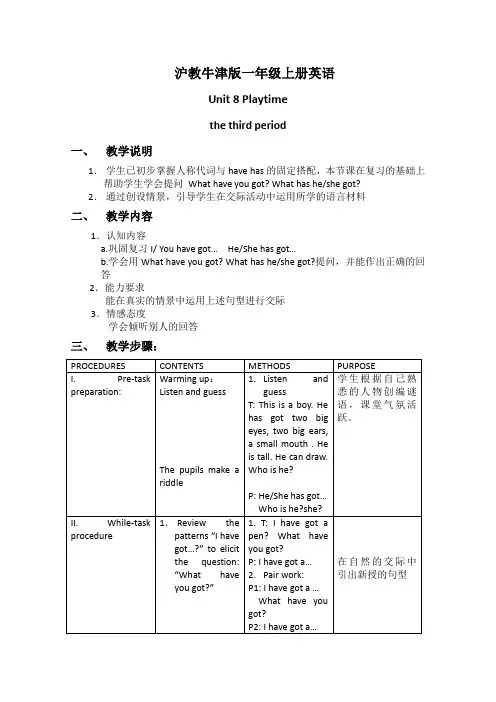
沪教牛津版一年级上册英语Unit 8 Playtimethe third period一、教学说明1.学生已初步掌握人称代词与have has的固定搭配,本节课在复习的基础上帮助学生学会提问What have you got? What has he/she got?2.通过创设情景,引导学生在交际活动中运用所学的语言材料二、教学内容1.认知内容a.巩固复习I/ You have got… He/She has got…b.学会用What have you got? What has he/she got?提问,并能作出正确的回答2.能力要求能在真实的情景中运用上述句型进行交际3.情感态度学会倾听别人的回答三、教学步骤:四、教学提示1.媒体准备:实物:一盒玩具内有toy dog toy car doll…录音机,调查表2. 教学关注点:1)关注特殊疑问句朗读时的语调2)关注绕口令的朗读,注意吐字清楚,发音正确3. 资料分享:《剑桥少儿英语》第一级上P34,将这首Chant,做些改变You’ve got we’ve got they’ve got booksWhat have you got?I’ve got books pens pencils and rulers.He’s got It’s got Bill’s got applesWhat has she got?She’s got apples. Lemons, mangoes and oranges.4. 设计思路:通过猜一猜自己身边的同学来复习上节课学过的句型:He/ She has got…,在自然真实的情景中通过问答引出新授内容What have you got? What hashe/ she got? 并在调查活动中帮助学生积累语言材料,掌握所学知识。
5.教学反思:要使英语课堂交际化必须从组织活动入手,不要让学生死记硬背例句,而应该让学生创造性地运用语言进行交际。
一年级上册英语Unit 6 Fruit Lesson 1教案-人教新起点版
一年级上册英语Unit 6 Fruit Lesson 1教案-人教新起点版教学目标1.能够听、说并认读单词:apple, banana, orange, watermelon。
2.能够运用所学单词进行简单对话。
3.能够理解并用简单的英语表述有关水果的信息。
教学重点1.单词的听、说、认读。
2.对话的练习。
3.通过课文理解有关水果的基本信息。
教学难点1.英语单词的听、说、认读。
2.多样化的对话练习。
教学准备1.大型水果图片或水果模型。
2.PPT课件,包括单词图片、对话练习等内容。
3.练习册、笔和纸。
教学过程Step 1 启发学生思维,引出课题(5分钟)老师可以在课堂上出示大型水果图片或水果模型,让学生看图说话,启发学生对水果的兴趣。
Step 2 教授单词(10分钟)老师可以通过PPT展示英文单词和图片,让学生听、说、看、认读四种方式掌握单词的含义,每个单词的教学可以按照以下步骤进行:1.出示单词图片2.教授单词的发音和基本含义3.让学生模仿读单词并复述意思4.跟读单词几次,在练习中理解单词的发音和音标Step 3 对话练习(20分钟)老师可以通过两人或组间对话练习,让学生在实际场景中运用所学单词,加深对话的理解和记忆力。
对话练习1:A: What fruit do you like? B: I like apple. A: What fruit do you not like? B: I don’t like watermelon.对话练习2:A: May I have a banana, please? B: Sure, here you are. A: Thank you.Step 4 课文阅读(10分钟)老师可以让学生跟读课文,让学生理解课文所提到的水果,并提醒学生注意语音语调,增强听力能力。
Step 5 写作练习(15分钟)老师可以把带有水果单词图示的练习册发给学生,引导学生根据图片写出相应的单词或句子,加强写作训练,也通过测验检查学生的掌握情况。
一年级上册英语知识点总结「完整版」
一年级上册英语知识点总结「完整版」一年级上册英语知识点总结「完整版」Unit 1 School (Lesson 1~Lesson 6)重点单词(学习用具):book, ruler, pencil, pencil case , eraser, backpack,问候语:-Hello/Hi! -Hello/Hi!-Good morning! -Good morning!早上好!-Good afternoon! -Good afternoon! 下午好!- Good evening! -Good evening! 晚上好!-Good night! -Good night! 晚安!重点句型:1 -Stand up,please! (请)起立!-Sit down,please! (请)坐下!2 Show me your ……3 -Hi, I’m……-Hi, I’m…… 你好。
我是……4 - Your book/……-Thanks!Unit 2 Body (Lesson 7~Lesson12)重点单词(身体部位、数词、感官动词):eye, ear, mouth, nose, face, hand, arm, leg, foot; one, two;see, hear,smell重点句型:1 This is the way I wash my face. 这是我……的`方式2 I have one nose/mouth/face 我有……3 I have two eyes/ears/arms/feet/hands/legs4 My eyes can see/My mouth can talk/My ears can hear/My nose can smell 我的……能……5 -What’s this?-It’s the head. 这是什么? 它是头6 Touch your eyes/ mouth/ ears/ arm…… 摸你的……Unit 3 Animals (Lesson13~Lesson18)重点单词:动物:cat, bird, rabbit, dog, duck, monkey, chicken, tiger, panada, elephant, fish,butterfly重点句型:1 -Are you Joy?-No, I’m Lily. I’m a cat. 你是……吗?不,我是……2 -What do you see?-I see a panada/a bird/a monkey……. 你看见了什么?我看见了……3 Look at me! 看着我4 -What’s this?-It’s a cat/a tiger/a bird 这是(叫)什么? 它是……5 It has long e ars/short legs/big eyes…… 它有……6 I like my …… 我喜欢我的……Unit 4 Revision (Lesson19~Lesson24)重点单词:here, there, call, give, sorry, big, small重点句型:1 Here is my hair/pencil/book/eraser/ruler/…… 这是我的……2 Look at my big eyes/small face 看我的……3 I see a rabbit/ bird……. Me too. 我看见……,我也是。
七年级上册英语u8单词
七年级上册英语u8单词1. apple (苹果) -一种水果,通常为圆形或略带椭圆形,常被用作食物。
2. banana (香蕉) -长条形水果,呈弯曲的管状,常被用作食物。
3. cat (猫) -一种常见的家养动物,有四条腿和锋利的爪子和牙齿。
4. dog (狗) -一种常见的家养动物,是人类的好朋友,常常被驯化用于看家护院。
5. fish (鱼) -生活在水中,有鳞和鳍的动物。
6. bird (鸟) -有羽毛、翅膀和喙的动物,通常能够飞翔。
7. deer (鹿) -一种有角的哺乳动物,生活在森林中。
8. elephant (大象) -一种大型陆生哺乳动物,有长鼻子和大耳朵。
9. fox (狐狸) -一种小型至中型的肉食性哺乳动物,有狡猾和机智的声誉。
10. giraffe (长颈鹿) -一种有着非常长的脖子的哺乳动物,生活在非洲的草原上。
11. zebra (斑马) -一种有着独特黑白条纹的哺乳动物,生活在非洲的草原上。
12. tiger (老虎) -一种大型猫科动物,有着橙色或棕色条纹。
13. lion (狮子) -猫科动物中的一种,是“丛林之王”。
14. monkey (猴子) -一种灵长类动物,有手和脚,能够攀爬树木。
15. panda (熊猫) -一种有着黑白皮毛的大型哺乳动物,以竹子为主食。
16. rabbit (兔子) -小型哺乳动物,有长耳朵和后腿。
17. wolf (狼) -一种犬科动物,与狗有近亲关系,但通常更大、更凶猛。
18. snake (蛇) -没有四肢的爬行动物,通常通过扭动身体来移动。
19. turtle (乌龟) -有硬壳的爬行动物,通常缓慢移动。
20. spider (蜘蛛) -有八条腿的无脊椎动物,能够织网捕食昆虫。
这些单词涵盖了常见的动植物、动物和昆虫等词汇,对于初一学生来说是重要的基础词汇。
苏教牛津版英语一年级上册《Fruit》教案_一年级英语教案上册
苏教牛津版英语一年级上册《Fruit》教案_一年级英语教案上册教材:苏教牛津版英语一年级上册 Unit 2 Fruit教学目标:1. 能听、说、认读并正确书写单词 apple, banana, pear。
2. 能理解、说出并正确运用句型 What’s this? It’s an apple/banana/pear。
能掌握对事物名称的提问方式What’s this? 的语音语调。
3. 能积极参与课堂活动,提高学生的语言表达和合作能力。
教学重点:1. 能听、说、认读并正确书写单词 apple, banana, pear。
2. 能理解、说出并正确运用句型 What’s this? It’s an apple/banana/pear。
教学难点:1. 能够用正确的形式来表达和回答课文中的问题。
2. 能够准确、流利地朗读教材中出现的单词。
教学过程:Step 1 Warm-up1. 打招呼:Good morning, boys and girls! (作出相应的回答)2. Play a game “What’s missing”T: Let’s play a game “What’s missing”. Look, there are some fruits on the table. I will take away one fruit. Can you guess what’s missing?(The teacher displays some fruits on the table such as apple, banana, pear and asks students to look at them carefully. Then the teacher takes away one of the fruits and asks students what’s missing. Students take turns to guess and the teacher says yes or no until the correct answer is given.)3. Review the names of the fruits4. Say “What’s this?”(After reviewing the names of the fruits, the teacher introduces the target sentence “What’s this?” to everyone. Teacher points to the fruits on the table and asks “What’s this?” and students answer “It’s an …..”)Step 2 Presentation1. Introduce and learn new wordsT: Look, what’s this? (pointing to an apple)St: It’s an apple.T: How do we spell ‘apple’?Ss: A-p-p-l-e.Repeat the process for ‘banana’ and ‘pear’.2. Action game1) T: Let’s play an action game.(Teacher demonstrates how to act out each fruit such as for apple, the teacher picks up an imaginary apple and take a bite from it, for banana, the teacher pretends to peel a banana by rubbing hands together, for pear, the teacher makes a pear shape with two hands)2) T: Now it’s your turn to act out. Let’s do it together.(the teacher acts out one of the fruits and the students do the same action)3. Reading the names of the fruits1) T: Let’s look at the picture on the screen. Can you read the names of the fruits?2) Students read out the names of the fruits on the screen.Step 3 Practice1. It’s your turn to askT: Good job. Now boys and girls, can you ask me “What’s this?”.(The teacher points to a fruit)Ss: What’s this?T: It’s an apple.Then students take turns to ask the teacher “What’s this?”. The teacher answers and the student repeats the answer.2. Group work1) Divide the class into four groups.2) Each group gets a set of cards with pictures of the different fruits on them.3) One student picks up a card and asks his/her group members “What’s this?”.4) The group answers “It’s an …..”5) The student who asked the question puts the card in the middle of the group.6) The group repeats the process until all the cards are used up.Step 4. Conclusion1. T: Today we learned the names of the fruits and how to use the sentence “What’s this?”. Great job, everyone!2. T: Can you tell me the names of the fruits?Ss: Apple, banana, pear.T: Well done!3. T: Who can tell me how to use “What’s this?”?Ss: We use it to ask about the name of something.T: Excellent!Step 5. Homework1. Ask family members or classmates about the names of different fruits.2. Draw pictures of the fruits we learned today.3. Write the names of the fruits we learned today in your notebook.Blackboard design:Fruitapple banana pearWhat’s this? It’s an apple/banana/pear.。