
2014年人教新目标九年级英语Unit10 You're supposed to shake hands.(全单元)课件
1.( B.)In America, the people are supposed to_____ when they meet for the first time. A. bow B. shake hands C. hug D.kiss 2. Korea, are, expected, you, to, bow, in, (.) You are excepted to bow in Korea. ____________________________________________ 3. 当你遇到某人的时候应该怎么做? are supposed ____to do What ______ you _________ ____ ________ when you meet someone? 4. 下次你该问你应穿什么? should ask what you _______ You ______ ______ ______ are supposed to wear next time?
shake hands
bow v. & n. 鞠躬
kiss v. & n.
亲吻,接吻
Different countries have different customs 习惯, 风俗.
what are people in the United States supposed to do when they meet for the first time?
• 快速阅读3a, 回答下面问题: /kə'lʌ mbɪə/ • 1) Are they relaxed about time in Colombia?
哥伦比亚
Yes, they are.
态度 对于
• 2) What‘s the attitude towards time in Switzerland? /‘swɪtsələnd/ 瑞典 In Switzerland, it‘s very important to be on time.
be supposed to do sth. =be expected to do sth. =should do sth. 应该
1) What are people supposed to do when they meet someone for the first time? 应当,被期望,理应做某事 此句中的be supposed to do 的意思为________________ 。其 be expected to do should 同义词为___________, 同义短语为 _______________ 练习:根据汉语完成句子 (1) 你应该独立完成那项工作。 are supposed to do the work alone. You ______ _______ _______ (2) 你不应该在公交车上抽烟。 You _____ ________ are ______ not supposed ___ to smoke on the bus. 握手 2) shake hands 是_______ 的意思。shake 常用作及物动词,意 shaken 。 shook ,过去分词为________ 摇动;晃动 其过去式为________ 为__________,
find out 找出、查明(事实、真相)+(that)从句
1.custom 风俗;习俗 - customer顾客 2. 第一次 3.应该 be supposed to do sth. =be expected to do sth. =should do sth. 4.foreign 外国的 -foreigner外国人 5.一个名叫佐藤的男孩 a Japanese boy called Sato 6.一...就...(引导时间状语从句) as soon as 7.伸出某人的手 hold out one‘s hand 8.相互问候 greet each other 9.伸出我的手 (伴随状语) with my hand out 10.令某人吃惊的是 to one‘s surprise 11.找出、查明(事实、真相) find out +(that)从句
2d
Role-play the conversation.
1. How was the welcome party for foreign students? Great. 2. Who did John meet? A Iapanese boy called Sato. 3. Is it polite to know nothing about other countries’ customs? No, it isn‘t. 4.What are French people supposed to do when they meet each other? They are supposed to kiss each other.
Maria was supposed to …
arrive at 7:00 (a little earlier) shake hands with Paul’s mother
wear a T-shirt and jeans
Role-play a conversation between Maria and Dan.
河北省沧州市青县 大杜庄中学 何忠辉
-What are the people doing in the picture? -They are shaking hands.
should
What are people in China supposed to do when they meet for the first time? bow
They are supposed to
shake hands
kiss
Doபைடு நூலகம்you know where … is?
Brazil
the United States
Japan
Mexico
Korea
What are people supposed to do when they meet for the first time?
√
√ √
arrived at 8:00 to come later shake hands wear
Fill in the chart according to 2a & 2b:
Maria’s mistakes
arrived late greeted others the wrong way wore the wrong clothes
1.( B.)In America, the people are supposed to_____ when they meet for the first time. A. bow B. shake hands C. hug D.kiss 2. Korea, are, expected, you, to, bow, in, (.) You are excepted to bow in Korea. ____________________________________________ 3. 当你遇到某人的时候应该怎么做? are supposed ____to do What ______ you _________ ____ ________ when you meet someone? 4. 下次你该问你应穿什么? should ask what you _______ You ______ ______ ______ are supposed to wear next time?
• 1) 仔细阅读3a, 判断正(T)误(F)。 • T ( ) 1. In Colombia, it’s OK if you arrive a bit late for a dinner. • (F) 2. People in Colombia usually make plans to meet their friends. • (F) 3. In Switzerland, people are pretty relaxed about time. • (T) 4. In Switzerland, people never visit a friend’s house without calling first.
欢迎晚会
外语foreign language foreign 外国的-foreigner外国人 外国学生
交一些新朋友 一个叫佐藤的男孩
hold out one‘s hand 伸出某人的手
一...就...(引导时间状语从句) 相互问候 伸出我的手(伴随状语)
在大街的两侧 I often sleep with the light on. on both sides of the street on either side of the street on each side of the street to one‘s surprise令某人吃惊的是 例:There‘re many trees on both sides of the street.
c a b a
1b. Listen and check your answers in 1a.
c a b a
custom 风俗;习俗- customer顾客
In …, people are supposed to are expected to should….
Listen again and fill in the blanks.
supposed to do when they meet in Yoshi: What are people _________ your country, Rodrigo? Rodrigo: Do you mean when friends meet for the first time? Yoshi: Yeah. shake hands Rodrigo: In Mexico, we __________. Yoshi: What about in Brazil, Celia? kiss How about in Celia: Well, in Brazil, people sometimes ____. Japan, Yoshi? What are people expected to do when they meet for the first time? bow Yoshi: We _______. Kim: And in Korea we also bow. Mike: Well, I guess in most Western countries we shake hands __________.
人教新目标 九年级全册英语unit10 You're supposed to shake hands
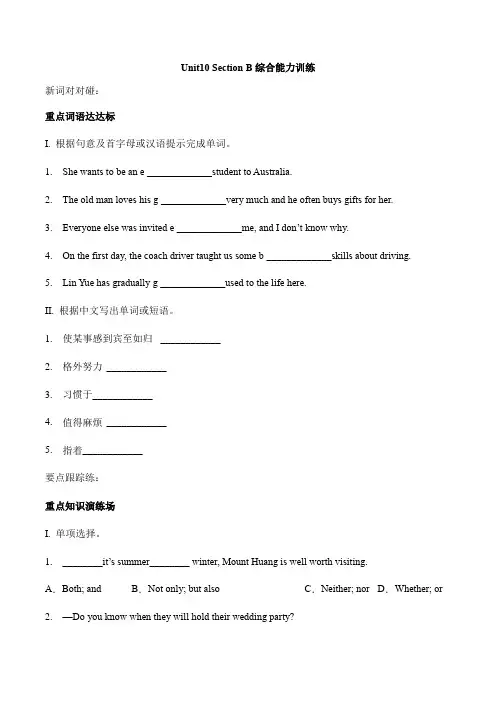
Unit10 Section B综合能力训练新词对对碰:重点词语达达标I. 根据句意及首字母或汉语提示完成单词。
1.She wants to be an e _____________student to Australia.2.The old man loves his g _____________very much and he often buys gifts for her.3.Everyone else was invited e _____________me, and I don’t know why.4.On the first day, the coach driver taught us some b _____________skills about driving.5.Lin Yue has gradually g _____________used to the life here.II. 根据中文写出单词或短语。
1.使某事感到宾至如归____________2.格外努力____________3.习惯于____________4.值得麻烦____________5.指着____________要点跟踪练:重点知识演练场I. 单项选择。
1.________it’s summer________ winter, Mount Huang is well worth visiting.A.Both; and B.Not only; but also C.Neither; nor D.Whether; or 2.—Do you know when they will hold their wedding party?—No, I don’t. Their wedding date is a ________ and nobody knows it.A.message B.secret C.suggestion D.request3.The teacher's words were encouraging and ________ me, so I decided to plan my life carefullyand have a new start.A.get on well with B.had an influence onC.took pride in D.got used to4.Today many people give out and receive ____________ red envelopes (红包)on mobile phones. A.natural B.electronic C.national D.basic5.—I don’t know what to do. I need some ___________.—No problem.A.information B.advices C.news D.suggestionsII. 从(II)中选择合适的句子补全(I)对话,有两个选项多余。
人教新目标九年级英语-Unit10单元知识点总结
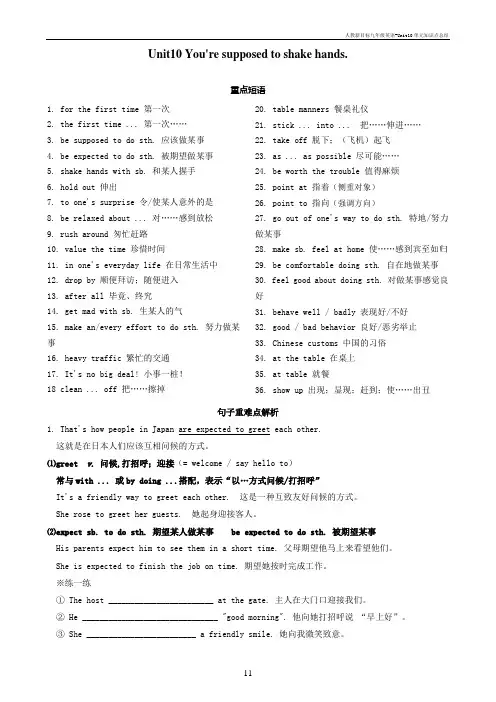
Unit10 You're supposed to shake hands.重点短语句子重难点解析1. That's how people in Japan are expected to greet each other.这就是在日本人们应该互相问候的方式。
⑴greet v. 问候,打招呼;迎接(= welcome / say hello to )常与with ... 或by doing ...搭配,表示“以…方式问候/打招呼”It's a friendly way to greet each other. 这是一种互致友好问候的方式。
She rose to greet her guests. 她起身迎接客人。
⑵expect sb. to do sth. 期望某人做某事 be expected to do sth. 被期望某事His parents expect him to see them in a short time. 父母期望他马上来看望他们。
She is expected to finish the job on time. 期望她按时完成工作。
※练一练① The host ________________________ at the gate. 主人在大门口迎接我们。
② He _______________________________ "good morning". 他向她打招呼说 “早上好”。
③ She _________________________ a friendly smile. 她向我微笑致意。
1. for the first time 第一次2. the first time ... 第一次……3. be supposed to do sth. 应该做某事4. be expected to do sth. 被期望做某事5. shake hands with sb. 和某人握手6. hold out 伸出7. to one's surprise 令/使某人意外的是8. be relaxed about ... 对……感到放松9. rush around 匆忙赶路10. value the time 珍惜时间11. in one's everyday life 在日常生活中12. drop by 顺便拜访;随便进入13. after all 毕竟、终究14. get mad with sb. 生某人的气15. make an/every effort to do sth. 努力做某事 16. heavy traffic 繁忙的交通 17. It's no big deal! 小事一桩! 18 clean ... off 把……擦掉 20. table manners 餐桌礼仪 21. stick ... into ... 把……伸进…… 22. take off 脱下;(飞机)起飞 23. as ... as possible 尽可能…… 24. be worth the trouble 值得麻烦 25. point at 指着(侧重对象) 26. point to 指向(强调方向) 27. go out of one's way to do sth. 特地/努力做某事 28. make sb. feel at home 使……感到宾至如归 29. be comfortable doing sth. 自在地做某事 30. feel good about doing sth. 对做某事感觉良好 31. behave well / badly 表现好/不好 32. good / bad behavior 良好/恶劣举止 33. Chinese customs 中国的习俗 34. at the table 在桌上 35. at table 就餐 36. show up 出现;显现;赶到;使……出丑2. Where I'm from, we are pretty relaxed about time. 我来的那个地方对时间非常放松。
2014年人教版新目标九年级英语Unit10(第5课时)ppt精华课件

You’re expected to put your bread on the table. You have to cut anything up and eat it with a fork You’re expected to say , “ That was delicious.” if you don’t want any more food.
hands. 2.In China, you’re ____ to stick your chopsticks into the food. 3.In Korea, the youngest person
____ start eating first.
4. In France, you’re _____ put your bread on the table. 5. In China, you’re____ use your chopsticks to hit an empty bowl.
2b
Read the letter and answer the questions.
1. Why is Lin Yue in France?
She is there as an exchange student. 2. Does she enjoy staying with her host family? How do you know? Yes , she does.Because she said that they went out of their way to make her feel at home.
2e
Compare the table manners in France and China in your group. How are they the same or different? Make a list.
人教新目标九年级全册 Unit 10 You,re supposed to shake hands
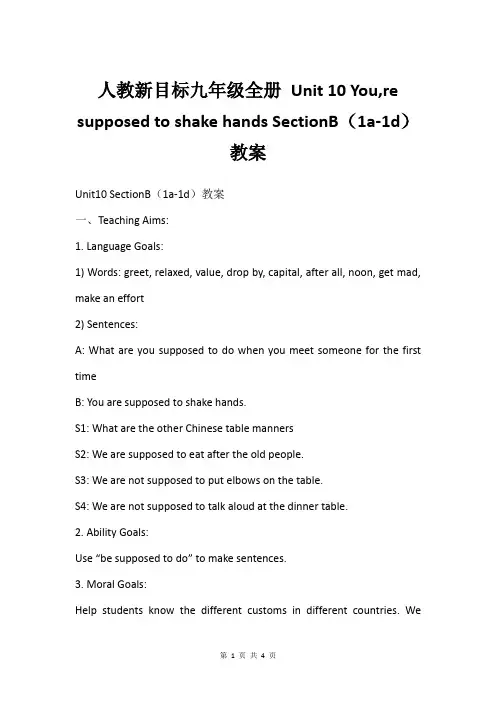
人教新目标九年级全册Unit 10 You,re supposed to shake hands SectionB(1a-1d)教案Unit10 SectionB(1a-1d)教案一、Teaching Aims:1. Language Goals:1) Words: greet, relaxed, value, drop by, capital, after all, noon, get mad, make an effort2) Sentences:A: What are you supposed to do when you meet someone for the first timeB: You are supposed to shake hands.S1: What are the other Chinese table mannersS2: We are supposed to eat after the old people.S3: We are not supposed to put elbows on the table.S4: We are not supposed to talk aloud at the dinner table.2. Ability Goals:Use “be supposed to do” to make sentences.3. Moral Goals:Help students know the different customs in different countries. Weshould know when in Rome, do as the Romans do.二、Teaching important Listening, speaking, reading, writing methods.五、Teaching ProceduresⅠ. Lead-in1. Watch a short movieT: Hello, everyone! We know different countries have different customs. But how do we display impeccable manners Let’s see a movie about how to behave good manners. How do you feel after watching the movie 2. After watching movie, Ss try to answer the questions.Ⅰ. Presentation1. See teaching objectsTo learn the table manners around the world.To read, listen and speak how you are supposed to behave at dinner tables in China.2. Students look at pictures and say different customs in different countries by using “be supposed to do” to make sentences.3. Ask students to turn to P77 to finish 1a and check the answers.4. Ask students about Chinese table manners:After seeing the pictures and say Chinese table manners.Summarize Chinese table manners.Ⅰ. Listening1. T: Steve is going to China to study. His friend Yang Ming is telling himabout table manners in China. Now listen and number the pictures in the order you hear them.2. Play the recording twice. Students number the pictures and match sentences parts.3. Play the recording again. Check the answers with the Ss.Ⅰ. Group workAsk student to make conversations.E.g.S1: What are the other Chinese table mannersS2: We are supposed to eat after the old people.S3: We are not supposed to put elbows on the table.S4: We are not supposed to talk aloud at the dinner table.Give students two minutes to make their conversations and perform their conversations.Ⅰ. Writing1. Ask students to summarize the phrases about Chinese table manners.2. Let some Ss read the information about writing and ask them to use sentence.3. Ss try to write a composition about Chinese table manners by using information in the chart. (Give students five minutes to write their compositions)4. Invite some students to read their compositions and check if there aremistakes.Ⅰ. SummaryAsk students to summarize the key phrases.Ⅰ. Homework:1. Find the differences about the table manners between France and China.2. Write a composition about Chinese table manners.。
人教版新目标英语九年级Unit10You’resupposedtoshakehands教案.doc
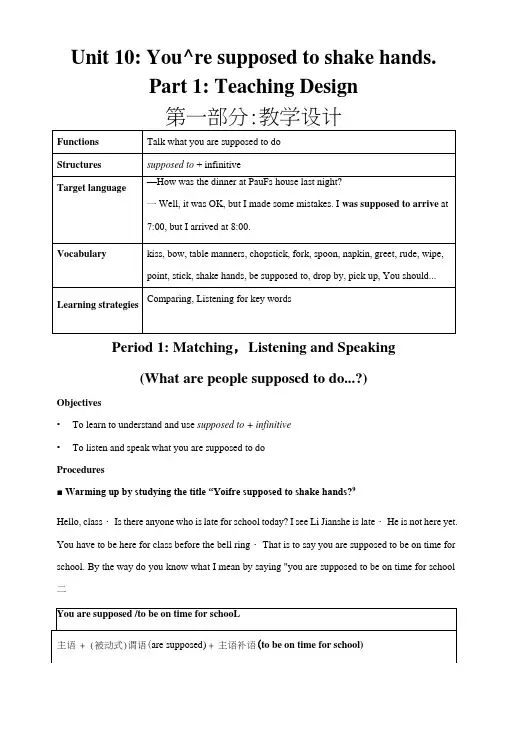
Unit 10: You^re supposed to shake hands.Part 1: Teaching Design第一部分:教学设计Period 1: Matching,Listening and Speaking(What are people supposed to do...?)Objectives•To learn to understand and use supposed to + infinitive•To listen and speak what you are supposed to doProcedures■ Warming up by studying the title “Yoifre supposed to shake hands?9Hello, class・ Is there anyone who is late for school today? I see Li Jianshe is late・ He is not here yet. You have to be here for class before the bell ring・ That is to say you are supposed to be on time for school. By the way do you know what I mean by saying "you are supposed to be on time for school 二be supposed to...其中to是动词不定式符号,不是介词,其后要跟动词原形。
当be supposed to...的主语是“人”时,意为“应该……”;“被期望……”,它可以用來表示劝告、建议、义务、责任等,相当于情态动词should。
如:Everyone is supposed to wear a seat-belt in the car.每个人在汽车里都应该系安全带。
2014年秋新目标英语九年级Unit10《You're supposed to shake hands》全单元课件
Customs a. bow b. shake hands c. kiss
2.____the United b States 3.____Japan a
4.____Mexico b
5.____Korea a
Listen again and fill in the blanks.
Role-play the conversation between Maria and Dan. Use the information from 2a and 2b.
A: How was the dinner at Paul’s house last night? B: Well, it was OK, but I made some mistakes. I was supposed to arrive at 7:00, but I arrived at 8:00.
Mexico—Mexican (s) shake hands They are supposed to …
In Korea what do people do when they meet for the first time?
bow
Korea --- Korean (s)
They are supposed to ...
supposed to do when they meet ___ A1: What are people________ for the first time? B1: Well, do you mean when friends meet for the first time? A1: Yeah. B1: Well, in___________, friends___________. Brazil kiss Mexico A1: What about in_____ห้องสมุดไป่ตู้_____, Rodrigo? A2: In Mexico we __________________. shake hands Japan A1: How about in _________, Yoshi? A3: We __________. bow bow B2: And in __________we also ____________. Korea countries A1: Well, I guess in most Western _____________we shake hands.
2014人教版新目标九年级英语Unit_10_You're_supposed_to_shake_hands_SectonA_2d-3c
7. expect;v.“期待”“期望”,它有以下常见用法: ①. expect + n. / pron. 期待某人或某物 I expect your letter. ②. expect + to do sth. 料想做某事 I expect to get a birthday present from my dad. ③. expect sb. to do sth. 期望某人做某事 Do you expect him to teach you English? ④. expect + 从句 预计/ 料想 I didn’t expect that you would get there so soon. ⑤.用于“It+be+过去分词+从句”结构,表示“预 计……”。 【例句】:It’s expected that the war would end soon.
“should + have+过去分词” 肯定句表示 “过去本应该已经做…… 却没有做”, “要是已经……就好了”。表示过去该做 某事,而没做的责备或后悔的语气。否定 句表示:本不应该做却做了…
You should have done your homework. You should have handed in your homework. You shouldn’t have invited him to the party. You shouldn’t have made so many mistakes if had been more careful.
John: I wouldn’t mind that!
Katie: Very funny. Later I found out French
2014人教版新目标九年级英语Unit_10_you're_supposed_to_shake_hands_period_1_1a-2d
What are people in ________ India supposed to do when they meet for the first time ?
They are supposed to
put hands together and nod heads.
They are supposed to touch noses.
Unit 10 You’re supposed to shake hands.
Section A 1a-2c
be supposed to 表示 “被期望(做)或要求应该”, 后须接动词原形. be supposed + to do
= should do
eg. You are supposed to arrive on time. be not supposed + to do eg. You are not supposed to arrive late.
In New Zealand Maori people
shake hands:You should shake hands with others with a smile. At the same time you shouldn’t wear hats or gloves when you do this. Usually, the time of shaking hands shouldn’t last no more than 3 seconds. It is polite to wait for the ladies, the leaders or the old to show their hands first, then you can shake with them.
人教版英语九年级全册 Unit10 You’re suppose
Unit10 You’re supposed to shank hands。
1.custom(n)风俗customer(n)顾客2.greet sb问候某人greet each other向彼此打招呼greet gusts 迎接客人3.relaxed(adj)放松的(修饰人) relaxing(adj)令人放松的(修饰物)(注意区别)4.value(v)重视(过去式:valued 过去分词:valued -ing:valuing)value sth重视某物value the time珍惜时间(n)价值the value of ...的价值5.drop by顺便拜访drop by+某人/某地拜访某人/某物drop in on sb顺便拜访某人drop in at+地点顺便拜访某地6.capital(n)首都the capital of ...的首都7.after all毕竟(注意:可放句首、句中、句末)8.get mad生气be/get mad at /with sb生某人的气be/get mad about sth因某事生气(注意:等同于angry)9.make an effort to do sth =try to do sth 尽力做某事10.clean...off...把...擦掉clean sth off擦掉某物clean it off擦掉它(注意:代词放中间,名词放中间或后面)clean up打扫干净do some cleaning打算工作11.east(n)东方west(n)西方south(n)南方north(n)北方eastern(adj)东方的western(adj)西方的southern(adj)南方的northern(adj)北方的(注意区别东西南北)12.knock on/at the door敲门knock into与...相撞knock down 撞倒13.take off起飞、脱下反义:land 着陆put on穿上14.worth(adj)有价值的be well worth doing sth值得做某事be worth+钱值钱be worth+名词值得15.manners礼貌table manners餐桌礼仪manner方式in a friendly manner以友好的方式(注意:礼仪用matters,方式用matter)16.exchange(n/v)交换an exchange student一名交换生in exchange for交换exchange A for B用A交换B17.go out of one’s way格外努力go out of one’s way to do sth竭力做某事18.make sb feel at home使某人感到宾至如归make sb do sth让某人做某事19.behave well/badly 表现得好/坏(v)behavior(n)表现20.except除...之外(后面的成分不包括在内)besides除...之外(后面的成分包括在内)but除了(句中有no one、nobody、nothing、all、everyone、everything)except for除...之外(说明情况后加以改正)(注意区别)21.be/get used to doing sth习惯做某事used to do sth过去经常做某事be used to do sth/be used for doing sth被用来做某事22.be supposed top do sth=be expected to do sth=should do sth 应该做某事23.for the first time第一次24.shake hands握手(过去式:shook 过去分词:shaken)25.foreign(adj)外国的foreigner(外国人)26.make friend with sb与某人交朋友make mistakes in在...犯错误27.as soon as一...就(注意:主句用将来时,从句用现在时;主句用过去时,从句用过去时)28.hold out one’s hand伸出某人的手29.it is+adj+to do sth做某事是什么样的30.return sth to sb=give sth back to sb把某物还给某人31.on both sides of the street=on either side of the street=on each side of the street在街的两边32.expect sth期待某事except to do sth期待去做某事expect sb to do sth期待去做某事expect sb to do sth期待某人去做某事expect+that从句be expected to do sth被期待去做某事33.to one’s surprise使某人惊讶的是in surprise惊讶地be surprised at对...感到惊讶be surprised to do sth做某事感到惊讶34.walk around散步35.avoid sth避免某事avoid doing sth避免做某事36.keep others waiting让某人等keep sb doing sth让某人一直做某事37.plan to do sth=make a plan to do sth计划做某事38.arrive in+大地点=arrive at+小地点=reach=get to到达39.point out指出point at近指point to远指40.thanks for doing sth=thank sb to do sth谢谢某人做某事41.mind小心(注意:后加名词、代词、动词ing)42.sb have/has(no)reason to do sth 某人(没)有理由做某事=there is(no)reason for sb to do sth43.about one’s age同某人的年龄差不多by one’s age在某人这个年龄find it+adj+to do sth发现做某事是怎样的(注意:think、believe、know、feel也用此用法)。
2014年新目标九年级英语Unit10(第一课时)实用课件
Customs
a. bow b. shake hands c. kiss
1b
Listen and check your answers in 1a.
Countries c 1. _________ Brazil b 2. _________ the United States a 3. _________ Japan c 4. _________ Mexico a 5. _________ Korea
bow. How about in the United States?
In the States, What are United people in Korea they’re to supposed toexpected do when they meet for the first time? shake hands.
Customs
a. bow b. shake hands c. kiss
1c
Make conversations about what people in differentcountries dot time.
They’re supposed to
Language points
You’re supposed to shake hands.
(1) be supposed to do sth. 这一结构常用来表示主语被要求 或劝告做某事,含有必须、应该或理应做某事之意。常 意为“理应;应该做某事”。否定形式在be动词后加not, 表示禁止做某事。 如:We are supposed to be here at six. You aren’t supposed to take the books out of the reading room.