
四年级英语上module3unit1what are they doing
还记得我们吗?
People_i_n__ the park
公园里的人们
people o__n__ the lake
湖上的人们
Men_u_n__d_e_r_ the tree
树下的(男)人
Group work 小组活动
No 1: doing Taijiquan No 2: rowing a dragon boat No 3: playing chess No 4: drinking soya milk 各小组长抽取序号,对抽到的相应序号做 表演,其他组同学和老师配合完成对话表 演,根据各组表现进行打分。
What is he/she doing?
他/ 她正在做什么?
He _is__p_la_y__in_g_ football.
He i_s_w_a_t_c_h_ing TV.
She _i_s_t_a_l_k_in_g_ to her friend.
What are they?
They’re animals .
They are_d_o_i_n_g__ta_i_ji_q_u_a_n__. 打太极拳
What are they doing?
They are__r_o_w_in_g__a__d_r_a_g_o_n_b_o_a_t_____. 划龙舟
What are they doing?
They are_p_l_a_y_in_g__c_h_e_s_s. 下象棋
Module 3 In the park Unit 1
What are they doing ?
他Hale Waihona Puke 正在干什么呢?Miss Liang
Look and say 看看说说
I’m listening to music.
I’m reading a book.
I’m watching TV.
What are you doing ?
课堂练习
一、汉译英 1、do Taijiquan _打_太__极_ 2、play chess_下__象__棋 3、row a dragon boat_划__龙__舟 4、drink soya milk_喝__豆__浆 二、选词填空。
are is
1、What _a_r_e__you doing ? 2、What _i_s__ Tom doing ?
3、What _i_s_she doing ? 4、What _a_r_e__they doing ? 三、 连词成句 1、 doing, they, what, are (?) What___a_r_e__t_h_e__y_d__o_i_n_g____________? 2、 rowing,dragon boat , a , are, they (.) They __a_r_e__r_o_w__i_n_g__a__d_r_a__g_o_n__b__o_a_t______. 3、 are , drinking, soya milk, they (.) They__a_r_e__d_r_i_n_k__in__g__s_o_y_a__m__i_l_k_________.
What are they doing?
What are they doing?
soya milk
豆浆
They are drinking soya milk .
Let’s = let us 让我们一起
get on the bus 上公交车
迪斯尼乐园
lots of interesting things 许多 有趣的事情
What are they doing ?
They’re listening to music.
What are they doing?
They are__p_la_y_in_g__b_a_s_k_e_tb_a_l_l.
What are they doing?
They are__s_w_i_m_m__i_n_g__.
外研版-英语-四年级上册-外研版四年级 Module 3 Unit 1 教材全解
Unit 1 What are they doing?他们正在做什么?教学目标:情感目标:培养学生学习英语的兴趣。
知识目标:掌握句型What are you doing?能力目标:能询问别人正在做什么,描述自己在做什么。
知识详解重难点1.询问“他们正在做什么?”的句型及其答语——What are they doing? They're...课文应用:What are they doing? 他们正在做什么?They're doing taijiquan.他们正在打太极拳。
句型结构问句:What are they doing?答语:They are+动词-ing形式十其他.重点解析这个句子是一个现在进行时的特殊疑问句。
what意为“什么”,位于句首,引导特殊疑问句。
they是人称代词,意为“他们”。
are不翻译成“是”,它只是与doing 一起构成现在进行时,表达“正在……”。
要点提示当人称代词是第三人称单数she,he,it时,be动词要用is。
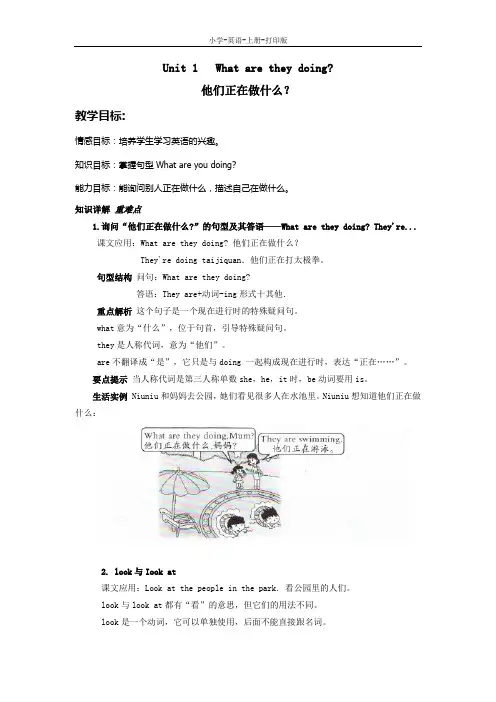
生活实例Niuniu和妈妈去公园,她们看见很多人在水池里。
Niuniu想知道他们正在做什么:2. look与Iook at课文应用:Look at the people in the park. 看公园里的人们。
look与look at都有“看”的意思,但它们的用法不同。
look是一个动词,它可以单独使用,后面不能直接跟名词。
例如:Look,that is my father. 看,那是我父亲。
Look,I have a new book. 看,我有一本新书。
look at是一个短语,后面可以接名词或代词,意思是看某人或某物。
例如:Look at this bird.看这只鸟。
Look at me.看我。
知识详解拓展点1.let's的自述课文应用:Let's get on the bus.让我们上公共汽车吧。
大家好!我是let's,我很热情,我总是建议或邀请别人和我一起做一些事情。
四年级上册英语说课稿 Module 3 Unit 1 What are they doing 外研版
四年级上册英语说课稿 Module 3 Unit 1 What are they doing外研版(三起)一、背景和目的本篇文档是一份根据外研版三起英语四年级上册 Module 3 Unit 1 设计的英语说课稿。
本单元主要介绍现在进行时态,并围绕“what are they doing”这一问题展开。
本文旨在通过课堂实践的经验和整合外部资源,为英语教师提供一些教学思路和实践经验。
二、教学内容本节课的主要内容是现在进行时的用法,以及问答句“What are they doing?”及其答复。
本节课也介绍了动词-ing形式的构成方法,并鼓励学生使用现在进行时来描述周围的环境和正在进行的活动。
本节课还通过游戏、歌曲和视频等多种形式来激发学生的兴趣,并促进学生的语言输出。
三、教学过程1. 导入环节•外教展示视频,让学生看到场景,提问“What are they doing?”,引起学生的兴趣。
•展示几个图片,让学生说出图片中人物正在做的事情,奖励出色的回答。
•师生互动问答,让学生复述前面学过的动词,引导学生想到现在进行时的用法。
2. 语言输入•展示正在进行的活动的图片,让学生模仿老师说“What’s he/she/they doing?”,寻找正在进行的动作。
通过游戏来帮助学生巩固新的单词。
•介绍动词-ing形式,让学生可以正确地使用现在进行时描述活动。
例如,“I am reading a book”,“He is dancing”等。
•给学生留足时间练习拼读和正确发音,以及应用新的语法知识。
3. 语言输出•外教给学生展示一个视频,让学生跟随视频练习描述正在进行的活动,例如,游泳、绘画或者跑步等。
•学生分组,展示自己正在进行的活动。
鼓励学生使用完整句子进行描述,并互相校对发音。
•教师提供一些参考问题,例如“What are you doing?”,“What ishe/she doing?”等。
让学生练习回答与之相对应的问题。
四年级上册Module 3Unit 1 What are they doing
《英语》(新标准)(三年级起点)四年级上册Module 3 Unit 1 What are you doing?教学设计一、教材分析(Analysis of teaching material)本课题为《英语》(新标准)(三年级起点)四年级上册Module 3 Unit 1 What are you doing?二、学情分析(Analysis of the students):小学四年级学生初步具备了一定的听说读写能力,形成了较好的英语学习习惯。
教学中积极创设符合学生实际的语言教学情境,通过听、读、演等设计活动,使学生边学边练并获得一定的成就感,激发英语学习兴趣。
三、教学目标(Teaching aims):1. 知识目标(Knowledge objects)(1)能够正确听、说、认读本课相关词汇:kid, can, see, interesting, people, boat, men,between,drink,clock, hungry;do taijiquan, row a dragon boat, play chess, drink soya milk(2)能理解词汇:get on, lots of,thing, row,Me too.文中意思。
(3)能够用所学语言询问以及描述他人正在发生的动作:What are they doing? They are doing…2. 能力目标(Ability objects)能够通过语言学习以及形式多样的课堂活动,掌握本单元词汇和主要句型,将其运用到实际情景中,询问和描述他人正在进行的动作。
3. 情感目标 (Emotion objects)培养学生培养学生多留心观察生活,体验小组合作的喜悦和收获知识的幸福感。
四、教学重点和难点(Teaching important and difficult points):1. 教学重点(Teaching important points)(1)能够进一步理解现在进行时,正确听说、认读词汇:doing taijiquan rowing a dragon boat playing chess drinking soya milk 2. 教学难点(Teaching difficult points)在情境中使用What are they/the kids doing? They’re doing …来提问生活他人正在进行的动作,并能够回答他人对于动作的问答。
四年级上册英语教案-Module 3 Unit 1 What are they doing (2)

四年级上册英语教案-Module 3 Unit 1 What are they doing (2)外研社(三起)一、教学目标1.知识目标:能够掌握单词fishing, sunbathing, cycling并能正确使用句型“What are they doing?”和“I’m/We’re/They’re…”进行交际表达。
2.能力目标:培养学生观察、分析、表达和交流的能力。
3.情感目标:激发学生对英语学习的兴趣,积极参与课堂活动。
二、教学重难点1.教学重点:掌握单词fishing, sunbathing, cycling。
能正确使用句型“What are they doing?”和“I’m/We’re/They’re…”进行交际表达。
2.教学难点:让学生能在未有老师提示下,根据图画与句子的判断进行正确的对话。
三、教学准备1.课件、图片等多媒体教具。
2.单词卡片、板书工具等教具。
四、教学过程1. Warm-up让学生用I am, We are, They are或者Im, Were, Theyre 将以下句子补充完整。
1._____ reading.2._____ dancing.3._____ drawing.4._____ playing football.2. Presentation1.让学生看图片,按照老师的指示一起说出图片中人物正在干什么,老师可以给予一些提示,如“用竿子”,“在浴盆里”,“坐在车子上”等等。
2.让学生学习新单词fishing, sunbathing, cycling。
老师可以使用图片、单词卡片或者真实场景帮助学生获得新单词。
3.教师让学生观察图片,问他们正在干什么?给他们一个你自己造句,“What are they doing?”来回答老师的问题。
然后教师给学生演示如何说句型。
外研版四年级英语上册Module3Unit1Whataretheydoing(第2课时)教案
Unit 1 What are they doing?
What are they doing? They’re + doing…
学 生 活 动
效果反思
导
入
新
课
1、教师出示卡片,学生说出动词的ing形式。
2、齐读卡片上的单词ing形式。
1、请学生挑选卡片上所提供的任一动词,做出相应的动作 。
2、边做动作,边说。
动词+ing.
自
主
学
习
1、教师提问:What is he\she doing?复习He̓s\she̓s 动词+ing.
释
难
解
疑
They 为人称代词主格形式,为第三人称复数。故be动词要用“are”.
They are listening to music.
拓
展
训
练
1、We can see _______ interesting things.
A、 many B、 lots of C 、lot of
作业设计
抄写单词,对课文进行英汉互译。
2、板书What are they
doing ?并作出相应回答。
1、听录音,读课文。2、运用句型进行ຫໍສະໝຸດ 话。小组合
作
学生两人一组进行对话练习。
描述在某个地方的人:Look at the people in the park.
展
示
反
馈
What are they doing?
They̓re playing football.
Module 3 Unit 1 What are they doing
主备教师
审核教师
四上Module 3 Unit 1 What are they doing说课稿
Module 3 Unit 1 What are they doing ?说课稿尊敬的各位领导、老师大家好!我是来自哈尔脑乡中心小学的教师邹源,今天我说课的题目是外研版三年级起点四年级上册Module 3 Unit 1 《What are they doing ?》。
我从教材分析、学情分析、教学目标、教学重难点、教法和学法、教学过程、板书设计七个方面进行本次说课。
一、教材分析本课主要是延续上一个模块继续学习现在进行时态。
本课讲到Amy 和Daming 去逛公园,Amy不知道公园里的人们在做些什么,于是就用句型What are they doing ?与Daming进行问答。
二、学情分析本课的教学对象是学过一年英语的四年级学生,此阶段学生天真活泼,好奇心强,有较强的模仿能力和求知欲望,而且富有一定的逻辑思维能力,对英语的喜欢已初步体现出个性。
但在单词的学习过程中,还是较容易出现发音不到位或发音不准确的语音错误。
三、教学目标1、知识目标语句:What are they doing ?They are ….单词:can、see、interesting、thing、people、 row 、boat、men、between、chess、drink、clock、hungry 短语:get on 、lots of 、play chess、dragon boat2、能力目标能够运用所学句型和短语描述人们正在进行的动作。
3、情感目标学会细心观察,与他人合作和关心他人。
四、教学重难点1、重点:学习问句What are they doing ?及答语They aredoing sth..2、难点:能清晰准确地发出本课所学单词的音。
五、教法和学法:为了完成以上教学目标,更好的突出重,难点。
按照学生的认知规律和本课教材特点,我设计了:情境教学法、视听法、问答法、小组合作学习法。
六、教学过程Step 1 热身1、Greetings2、Sing a song “I am listening to music.”鼓励学生根据歌词内容做出相应的动作。
四年级上册英语教案-Module 3 Unit 1 What are they doing (4)
四年级上册英语教案-Module 3 Unit 1 What are they doing (4)外研社(三起)教材简介《外研社(三起)英语》是由外研社出版的面向小学生的英语教材。
本教材充分融入了课程的多元化、问题的引导和思维的培养等教育教学理念,注重培养学生的语言能力和语言应用能力。
模块介绍Module 3是《外研社(三起)英语》四年级上册的教学模块之一,包含了5个单元。
Unit 1是该模块的第一个单元,名为“What are they doing”。
教学目标1.理解和运用动词短语What are they doing?进行聆听、口语、阅读和写作活动。
2.集成语言技能,培养学生的听说读写能力。
3.发掘学生的多元智能,开拓思维,促进学生全面发展。
教学重点1.动词短语What are they doing?2.手势动作的学习和理解。
3.动词短语的扩展和运用。
教学难点学生掌握动词短语What are they doing?的使用和运用。
教学准备教师:图片、PPT、音频设备、录音设备等。
学生:学生活动手册、笔、本、彩色笔等。
教学过程Step 1 Revision1.T: Class, do you remember the actions in the last lesson? Let’s say it together.Ss: Sure. Playing football, running, swimming, dancing, singing and jumping.2.T: Great, I am happy to see you remember it.Step 2 Presentation1.T: What are they doing now? (Show a picture of people doing different actions) Can you guess?Ss: …2.T: Let’s chant. (Teach the chant)What are they doing? (Pointing to each picture)What are they doing?Let’s find out. (Point to our ears and mouth)3.Play the audio to help the students understand and chant.Step 3 Practice1.T: Can you do it with me? (Gesture to each picture and the students will say What are they doing?).2.Students practice with their partners.3.T: Ok, now let’s change. You do the gesture and let your partner guess.4.Students practice with their partners.Step 4 Consolidation1.T: Let’s write one sentence for each picture.2.Ss: (Write the sentence)3.T: Let’s check the answers.Step 5 Extension1.T: Can you add more actions to the chant? Think about it.Ss: (Think about it)2.T: Show me your answers.Ss: (Raise their hands and share their answers)T: Excellent.Step 6 Assessment1.T: Let’s make a dialogue. (Show a picture of two people doing the actions.)2.T: Who can be the person A and who can be the person B?3.Ss: (Volunteer to play the roles)4.T: Ok, let’s start.Step 7 Homework1.T: Please write a short paragraph about what you like to do at home.Step 8 Summary1.T: In this class, we learned。
Module3Unit1Whataretheydoing(教学设计)英语四年级上册
《英语》(新标准)(小学三起)四年级上册M3U1What are they doing? 教学设计教学目标一、知识目标(1)学生能够听、说、认读单词:let’s, get on, lots of, interesting, thing, look at, people, park, lake, row, boat, men, chess, drink, hungry(2)学会用句型Look at... 引起他人观察的注意,用What are they doing? 描述多人正在进行的活动,以及会用They are doing... 进行回答。
(3)学生能够了解语篇内容并流利地朗读对话,语音、语调准确优美。
二、能力目标(1)学生能在实际的生活场景中听懂单词、句型并能进行恰当的口语交际。
(2)能运用所学句型描述正在发生的行为或动作。
(3)掌握并灵活运用现在进行时。
三、情感态度目标(1)各学习环节采用形式多样的练习开发学生的发散思维,提高学生的自我展示能力和小组协作能力,增强学生学习英语的兴趣,同时进行情感教育,升华课堂内容。
(2)培养学生认真观察思考、学会沟通及合作交流的能力。
四、文化意识目标了解端午节的传统习俗赛龙舟,以及中国传统健身活动太极拳、中国象棋,培养团队合作精神。
加深学生对中国传统文化的理解,增强学生的民族自豪感。
教学重点及难点1.教学重点(Teaching important points)(1)能够进一步理解现在进行时,正确听说、认读词汇:doing taijiquan rowing a dragon boatplaying chess drinking soya milk2. 教学难点(Teaching difficult points)在情境中使用What are they/the kids doing? They’re doing ...来提问生活他人正在进行的动作,并能够回答他人对于动作的问答。
四年级上册英语教案Module3Unit1Whataretheydoing∣外研版(三起)
《What are they doing?》教学设计教材版本:外研版(三年级起点)四年级上册授课内容:Module 3 Unit 1 What are they doing? 第一课时课型:对话课执教:教学目标(一)语言知识目标1、在感知文本,回答问题的过程中,通过出示单词卡以旧引新的方式,98%的学生能认读单词kid people man-men between drink interesting boat2、通过情境图的提示和帮助、师生交流,95%的学生能够听懂以下单词:can see clock hungry3、通过课文学习,95%的学生能听懂What are they doing/drinking? They are ….这类语句;通过替换练习,巩固操练,90%的学生能口头运用这类语句进行询问和回答;90%的学生能用Look at the people in the park. 这类语句描述看到的是什么人,以及他们所处的位置。
4、通过感知文本、回答问题、朗读课文的方式,98%的学生能理解课文含义。
(二)语言技能目标1、通过观察动词的变化以及Chant等方式,98%的学生能总结出doing, rowing, playing, drinking这类单词的拼读规律。
2、通过师生问答、生生问答、句型操练等方式,95%的学生知道怎样询问和描述所看到的正在发生的事情。
3、通过跟读、自读、分角色读的方式,85%的学生能正确、流利地朗读课文。
(三)学习策略及情感态度目标学生在回答问题、感知文本、解决问题、游戏活动的过程中积极思考,乐于参与,主动运用所学英语进行表达和交流。
在课堂活动中喜欢与其他同学配合和合作,在学习过程中养成良好的学习习惯。
(四)文化意识目标学生通过对课文的理解和教师的引导,关注中外文化异同,加深对中国文化的理解。
五、教学重点难点重点:What are they doing/drinking? They’re …难点:理解现在进行时的含义,能在具体的语境中正确、恰当地运用所学知识与他人进行交际。
四年级上册英语教学设计-Module 3 Unit 1 What are they doing (4
四年级上册英语教学设计-Module 3 Unit 1 What are theydoing (4)一、教学目标1. 知识目标1.学习使用现在进行时描述正在进行的动作。
2.学习使用一些常用的动作动词,并掌握它们的现在进行时。
3.学习使用一些词汇:jumprope, hopscotch, draw, read, eat和drink。
2. 能力目标1.通过观察图片和听录音,能够较好地理解并模仿现在进行时的句型。
2.能够用英语表述自己正在进行的动作。
3.能够接受他人的询问并作出相应回答。
3. 情感目标1.学生了解到英语是一门语言,能够在生活中运用英语进行简单交流。
2.学生培养积极向上的学习态度,培养自信心和英语学习兴趣。
二、教学重难点1. 教学重点1.现在进行时的句型。
2.常用的动作动词的现在进行时。
2. 教学难点1.英语背景不好的学生可能对现在进行时的概念理解不到位。
2.学生在表述自己正在进行的动作时可能会遇到一些难点。
三、教学过程1. Warm-up1.教师和学生相互打招呼:Hello, how are you? I’m fine, thank you. And you?2.教师与学生一起完成跳绳、跳跃、画画、阅读、吃东西、喝水等动作,借此调动学生的积极性。
2. Presentation1.教师播放录音,让学生跟读并观察幻灯片上显示的正在进行的动作。
2.教师通过指向ppt图片,让学生说出句子:What is he/she doing? He/She is …ing (现在进行时)3.教师将四五组学生分别安排成两人一组,要求他们在课堂上互相询问并回答正在进行的动作。
3. Practice1.教师在黑板上画出两个时间点(now和a minute ago)。
让学生用现在进行时说出每个人现在在做什么事情。
2.教师让学生模仿课本中的图片,用现在进行时描述出正在进行的活动,例如:I am jumping. She is running. He is drawing. We are reading. They are eating. She is drinking.3.教师将学生分成小组,让他们一起说出他们正在做的事情。