
人教PEP版三年级英语上册《Unit4_B_Let’s_learn名师教案》
教材版本:PEP小学英语三年级上册第四单元
课题Unit 4 We love animals 备课时间
主备人复备教师内容Part B Let’s learn Let’s do
一、课程标准
1. 能根据听到的词语识别或指认图片或实物。
2. 能根据指令做事情,如做动作。
3. 能根据图﹑文说出单词或短语。
二、教材解析
: 本部分通过动物园的场景,呈现要学习的5个动物单词:bird, panda, Let’s learn
…进行巩固练习。
tiger, elephant, monkey. 并运用句型What’s that? It’s a
Let’s do:本部分是通过Act like an elephant. Act like a bird/tiger/monkey/panda. 五个指令短语,练习动物单词,并按照指令做出相应的动作。
三、目标预设
1. 能听说、认读、辨认5个动物类单词bird, panda, tiger, elephant, monkey。
询问动物信息。
2. 能用What’s that? It’s a …
四、重难点预设
1. 进一步学习动物单词:bird, panda, tiger, elephant, monkey。
2. bird中ir的发音不易到位,教师要注意纠正。
3. Let’s do部分是关于动物模仿的多个指令,学生能根据指令正确理解并做出
快速的反应。
五、评价设计
1. 通过小组开火车、千里传音的游戏来检测目标一的达成情况。
2. 通过教师说学生做动作、一学生说动作一学生做的活动来检测目标二的达成
情况。
六、教学设计
第5 课时
教学环节教学预设。
小学人教PEP版英语三年级上册Unit4 B Let’s learn名师教案
3.Let’s do部分是关于动物模仿的多个指令,学生能根据指令正确理解并做出
快速的反应。
五、评价设计
1.通过小组开火车、千里传音的游戏来检测目标一的达成情况。
2.通过教师说学生做动作、一学生说动作一学生做的活动来检测目标二的达成情况。
六、教学设计
Zoom: OK. What’s that? It’s black and white.
Zip: It’s a panda. Oh, I see an elephant.
Zoom: Me too. What’s that? Zip: Oh, it’s a bird.
Zoom: (老虎叫声)Ah, it’s a tiger.
2.“我说你做”“你说我做”
教师说指令,学生来做动作,或者教师做动作,学生说指令的形式,操练Let’s do的短语。可由慢到快,加强练习。
3.语篇听力训练
根据课本动物园游行的情景,改编一个完整的听力语篇,让学生边听边在P42上标出动物出现的顺序。
Zoom: Hey Zip! What’s that? Zip: It’s a monkey.
个指令短语,练习动物单词,并按照指令做出相应的动作。
三、目标预设
1.能听说、认读、辨认5个动物类单词bird, panda, tiger, elephant, monkey。
2.能用What’s that? It’s a …询问动物信息。
四、重难点预设
1.进一步学习动物单词:bird, panda, tiger, elephant, monkey。第5时教学环节教学预设
一、热身/复习(Warm-up/Revision)
Unit 4 Part B Let's learn (教案)人教PEP版英语三年级上册

PEP English Grade 3Teaching DesignUnit 4 We love animalsB. Let’s learn &Let’s doⅠ. Teaching aims①Knowledge aimsa. Students can master the new words: tiger, bird, elephant, monkey, panda, zoob. Students can use new words in sentences.c. Students can master the key sentence pattern and use it to ask or answer questions.②Ability aimsa. Students can develop their listening and speaking skills through a series of activities and group discussion.b. Students are able to talk about the topic in their daily life.③Emotional aimsa. Students know We should love animals and protect them. Because we are friends!b. Students will learn to cooperate by group work.c. Students will increase their interest in English.d. Students will set up self-confidence in English class.Ⅰ. Teaching key points①To learn the new words and sentences.②Help the students to master the structures of sentences.③To arouse the students' interest of listening and speaking.Ⅰ. Teaching difficult points①To master the structures of new words and sentences.②To improve the students' listening and speaking ability.③Use the words and the target language learned in this class to describe situations in the life.Ⅰ. Teaching procedures●step 1: Warming upSing a song: Everyday I go to school, I meet my friends, and we all say, Hello Hello, How are you?●step 2: Lead in①Listen to some voices and guess where this is?②Watch the video and discuss the animals in the zoo.●step 3: Presentation①Introduce a new friend, her name is Dora.②Create a scene of going to the zoo with Dora.③Learn the new word “zoo” according to the picture. The students read aloud with the teacher.④The teacher shows the map of the zoo and led the students to the zoo with Dora.⑤Watch the video to elicit new words, Guide students to pay attention to word pronunciation. Read new words in different ways and spell the new words. Show the pictures and guide the students to practice the new words in the sentences.⑥Do connecting exercises to check students' mastery of new words.●step 4: Practice①Create a situation to lead students to go to children's paradise with Dora.②Practice words in the game.●step 5: Production①Create a situation to lead students to the circus.②Practice the sentence patterns "What's this?" and "act like a/an…" in the game of guessing animals.③Read the sentence and act like it.④Use group competition to practice sentence patterns in the game. Divide the class into boys' team and girls' team, and let the two teams compete.⑤Use the practice of translating sentences to test students' mastery of sentence patterns.⑥Watch the video about protecting wild animals and guide students to take care of the animals around them in their daily life.●step 6: Summary①We learned six new words: bird, tiger, panda, elephant and monkey, zoo.②We learned two new sentences:a.What’s that? It’s a /an...b.Act like a/an...③We know, We should love animals and protect them. Because we are friends!●step 7: Homework①Write the new words.②Write the let's do.③Can read let's do and act like animals.。
PEP三上英语Unit 4 Part B Let's learn优质课教学设计
4.能够小组合作设计植物保护宣传海报,介绍植物生长需要的条件、人类如何帮助植物,以及植物能为人类提供什么,理解人类和植物互利共生的关系。
教学内容
教学重难点
能够听、说、认读sun、water、air、tree、flower、grass等单词,能够运用句型“Plants need ...”介绍植物生长所需要的基本条件。
1.听录音,指读Let’s learn的单词和句子。
2.跟录音学唱Listen and chant的歌谣。
3.完成活动手册中该板块的活动2。
选做:
查询资料了解更多有关植物生长所需条件的单词。
巩固与拓展
1.完成Listen and chant活动
教师播放Listen and chant的动画,请学生跟读歌谣。教师可准备水壶、花盆等道具以及单词卡片,请学生借助道具和单词卡片,尝试表演歌谣内容。
2.设计植物保护宣传海报(Think and choose;Design your poster)
教师请学生小组合作,设计植物保护宣传海报,介绍植物生长需要的条件、人类如何帮助植物,以及植物能为人类提供什么。教师可以呈现C部分Project的步骤2,请学生以此为范例,将单词和词组归类。教师引导学生在设计植物保护宣传海报的过程中理解人类和植物的共生互利关系。教师呈现并解释评价标准,学生小组评价。
课后作业
教学过程
教学环节
主要师生活动
导入
歌谣导入,激活已学知识
Listen and chant
教师请学生跟随动画吟唱开篇页歌谣,根据动画回答“What do plants give us?”,并在歌谣中画出对应的单词,如apple、grapes。教师提问“What helpsthese trees grow?”,引导学生结合实际生活思考,可以适当使用中文表达。教师总结学生发言内容,引出将要学习的内容。
人教PEP 三年级英语上册 Unit 4 B Let's Learn教案
(5)同桌之间合作,根据课本上的图片运用句型“What's that?It's a/an...”进行对话练习。
2.Let's do
(1)教师一边说Let's do部分的句子,一边示范相应的动作。
(2)播放两遍录音,学生跟读句子并做动作。
(3)做游戏。如:选一名学生到讲台上闭上眼睛,教师将大象的动物头饰给他带上,然后让他睁开眼,再选另外一名学生模仿大象做动作,戴头饰的学生猜。依次利用不同的动物头饰进行游戏。
Unit4 B Let’s learn
教学过程
一、Warm-up& Revision
1.检查作业。学生表演B Let's talk的对话。
2.复习五个动让学生看图说单词。
二、Presentation & Practice
1.Let's learn
作业
设计
完成课本第43页的Read and count.部分的题目。
板书
设计
Unit 4 We love animals
zoobirdpandatiger
monkeyelephant
(1)通过课件呈现动物园的图片,教授单词zoo,书写在黑板上并带领学生读五遍。
(2)教师让学生想一想动物园里有哪些动物,并用英语说一说,看看学生会说哪些动物词汇,有些学生可能知道一些没学的动物词汇。
(3)通过动物图片,依次引出单词bird、panda、tiger、monkey、elephant,写在黑板上并带领学生读五遍。读的时候注意elephant的发音。
Unit4 Part B Let’s learn(教学设计)三年级英语上册(人教PEP版2024秋)
Unit 4 Plants around us单元:Unit4 课时:第5课时教学内容分析:本课时以Chen Jie介绍植物的生长条件展开,让我们一起跟随Chen Jie的脚步一起去了解植物生长需要哪些条件吧。
本课主要单词有:sun,water, trees, flowers, grass,air。
本课时的主要句型有:Plants need…本课时结合前几课时的内容,运用重点句型进行巩固和突破。
B部分以绿色校园建设为情景,需要通过图片,词卡,运用主要句型表达自己如何能够帮助植物生长/保护环境。
教学目标:1.语言能力:学生能够听、说、读、写词汇sun,water, trees, flowers, grass,air 等。
学习核心句型:How can we help...? We can...讨论植物的种植条件。
2.学习能力:学生能够运用所学单词和句型讨论植物的种植条件,并且学习有关植物的各种语言表达。
3.思维能力:培养学生运用英语的表达能力,认识和学习植物及其种植条件。
4.文化意识:学生能够通过了解植物的生存条件,从而更好的帮助植物生长。
教学重点:学生能够听、说、读、写词汇sun,water, trees, flowers, grass,air等。
学习核心句型:Plants need...讨论植物的种植条件。
教学难点:学生能够通过了解植物的生存条件,从而更好的帮助植物生长。
教学方法:情境教学法,任务型教学法,归纳总结法,口语训练法,游戏教学法教学过程:Step I: Warm up1.Watch a video2.ReviewT:Look at the pictures and write the words.S:apples/pears/grapes/oranges设计意图:本环节欣赏与植物生长必要条件的科普视频。
既能够激发课堂氛围,又引导学生进入本节课主题。
然后通过一问一答的方式进入本节课的主题。
人教版小学三年级英语上册 Unit 4 PB Let's learn 教案
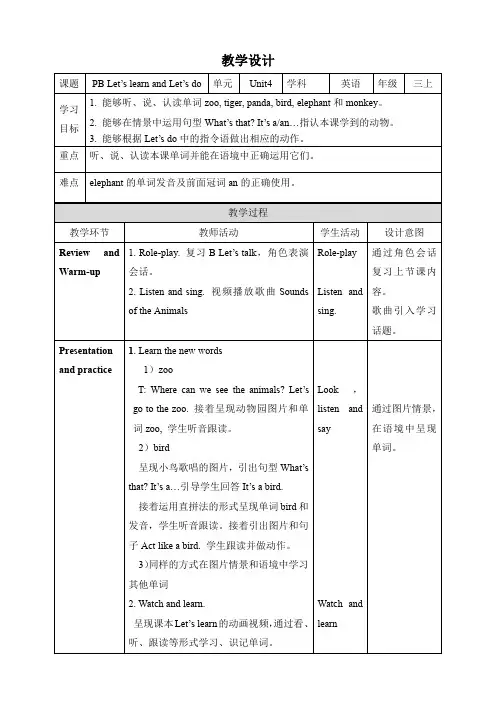
Listen and 通过 任 务 的 形
chant
式,采用多种趣
味活动和练习
巩固所学词汇。
课堂小结
4)Let’s do. 播放 let’s 视频,边说边做。 然后教师说指令,学生做动作。 5)Describe the picture
2.课堂小结。
Homework
1.听音跟读并练习朗读 P42 中的单词。 2.设计、制作本课的单词记忆卡片。比一 比,看谁做的漂亮。 3.完成同步练习。
词 zoo, 学生听音跟读。
say
在语境中呈现
2)bird
单词。
呈现小鸟歌唱的图片,引出句型 What’s
that? It’s a…引导学生回答 It’s a bird.
接着运用直拼法的形式呈现单词 bird 和
发音,学生听音跟读。接着引出图片和句
子 Act like a bird. 学生跟读并做动作。
3)同样的方式在图片情景和语境中学习
其他单词
2. Watch and learn.
Watch and
呈现课本 Let’s learn 的动画视频,通过看、 learn
听、跟读等形式学习、识记单词。
Consolidation 1.Practice 创设情景完成五个练习任务
1) Listen and translate 2) Sharp eyes. 闪现单词并快速读出来。 3)Guessing game.
of the பைடு நூலகம்nimals
sing.
歌曲引入学习
话题。
Presentation 1. Learn the new words
and practice
1)zoo
T: Where can we see the animals? Let’s Look ,
人教PEP(2024)三年级英语上册Unit 4 B Let’s learn核心素养教学设计
学会tree flower gras sun air water单词。演唱歌谣,抓住韵律和节奏。
教学难点
背会Listen and chant中的内容。演唱歌谣,抓住韵律和节奏。
教学方法
情景教学法、口语练习法、情景交际法、归纳总结法
教学准备
教师准备:PPT
学生准备:课本、笔
教学过程
教学环节
教师活动
2.能够在情景中运用句型:Plants need…help…do
3. chant,能熟练唱出来.
板书设计
Unit 4 Plants around us
tree flower gras sun air water
Plants need…help…do
课后作业
1 听、说、认读本节课的重要词汇,理解植物生长要素。
学生活动
设计意图
导入新课
1.Let’s review
How can they help plants?
plant new trees
water the flower
2.Look and say
看图片想一想。
了解英语的单词是构成句子的基础。
通过图片的内容,引出本节课所学主要内容。
讲授新课
1.Let’s talk
学情分析
本课是学生第一次接触这套教材,在开始进行教材重点句式和词汇的学习之前,应该先让学生熟悉了解英语中可数名词指能够数得清数量的名词,明确可数名词变复数的规律及英语单词的发音规律,对于他们之后长期的英语学习都会有帮助。在此基础上,再带学生进行学习活动,才能起到操练、巩固重点句式的作用。由于英语字母的发音有很多的不同,在学习中还要关注学生的发音,帮助他们克服模仿的困难,大胆地开口,大方地交流。
人教PEP三年级上册Unit4 We love animals B let's learn教案
Ss:(Dotheaction.)Act1ikeabird.
Chant
表演
1etstudentspracticeitrowbyrow.
2.依次显示单词panda,tiger,e1ephant,tiger的相关内容,教学步骤基本同上,略有变化)
学习词汇
3.a∕an的用法
4.Summary
44Whafsthat?”意为“那是什么?”,
总结
用来询问距离说话人较远的事物,
用“It'sa∕an+物体来回答。
5.1et,swatch.
看视频
1.1istenandrepeat.
读一读
训练学生的听,
播音频动画并跟读
让学生去听地
2.Sharpeyes.说一说ຫໍສະໝຸດ 道的英语发音。游戏
在听与模仿这
3.1ookandsay“Great!”Or"Uh-oh!”
我说你指
个输入过程后,
4.1pointyousay.
猜一猜
让学生去自己
5.1ookandguess根据身体部位猜动物
6.Turntab1egame
操练
读,查漏补缺,正确输出。
What,sthat7It,s...
单词纠音和操练。ASkstudentstopayattentiontothepronunciationofthe1ettercombination"ir''
操练
whichpronounces*73:Γ∖1etstudentspracticethewordrowbyrow.
人教PEP版英语三年级上册Unit4 B.Let's learn教学设计
教学思路(B.Let’s learn)Let’s learn一、复习1.通过chant “What’s this?”来复习学过的4种动物。
二、学习新知并操练1.通过动物园zoo的动物来导入今天要学习的几种动物,看图用What’s that?来提问,引导学生用It’s a /an...来回答。
学生可能会用中文说动物名,老师讲授单词发音方法并操练。
并且做该动物的标志性动作边说Act like a /an...2.学生分组操练后,呈现结果。
3.用类似方法讲授其他4个动物单词,讲单词过程中要穿插操练单词的游戏环节。
4.翻开书P42边听边跟读边指认单词和句子。
5.看图片请学生用What’s that?It’s a /an...进行问答,表演。
6.老师说指令语Act like a /an ...学生做相应的动物的标志性动作,分组加分比赛。
三、Homework课外作业的布置。
让学生回归课本,通过作业的形式,巩固本次课所学内容,并为下次课的学习做准备。
人教PEP英语三年级上册知识点归纳一.单词Unit 1学习文具:pen (钢笔) pencil(铅笔) pencil-box ( 铅笔盒) ruler(子) eraser(皮) crayon (蜡笔) book (书) bag (书包) school (学校)Unit 2身体部位:head (头) face( 脸) nose (鼻子) mouth (嘴) eye (眼睛)leg (腿) ear (耳朵) arm (胳膊)leg (腿) foot (脚)body (身体)Unit 3颜色:red (红色的) yellow (黄色的)green (绿色的)blue (蓝色的) white (白色的) black (黑色的) orange (橙色的)brown(棕色)Unit 4动物:cat (猫)dog (狗)monkey (猴子)panda (熊猫)rabbit( 兔子) duck (鸭子)pig (猪)bird (鸟) bear (熊)elephant (大象)tiger(老虎)Unit 5食物:cake (蛋糕)bread (面包) juice (果汁)milk (牛奶)water (水) fish(鱼)Unit 6数字:one (一) two (二) three (三)four (四) five (五)six( 六)seven (七) eight (八) nine( 九) ten( 十)二.对话1、向别人问好应该说――A: Hello! (你好!) B: Hi! (你好!)2、问别人的名字应该说-――A:What’s your name?你的名字是什么?B:My name’s Chen Jie.我的名字是陈洁。
英语人教版三年级上册Unit4 B Let`s learn 教案
Unit4 B Let`s learn 教案教学内容:PEP三上Unit4 B Let`s learn教学目标1)能听、说、认读单词:elephant, monkey, bird, tiger, panda. (2)能听懂、会说句型“What’s that? It’s a/an…”。
(3)能在图片、实物或情景的帮助下运用句型“What’s that? –It’s a/an …”询问远处看到的动物并回答动物的名称。
重点难点评论教学重点:能在图片、实物或情景的帮助下运用句型“What’s that? –It’s a/an …”询问远处看到的动物并回答动物的名称。
教学难点:单词elephant的发音及表示“一头大象”前边要用an,即an elephant教学过程StepⅠ热身与复习1. Greetings.2. T: What animals can you see in the zoo? Have you ever been to the zoo? Ⅱ呈现与操练创设情境,教授新知,手势表达1.Lead-inT: Today animals have a concert.Do you want to visit the zoo? OK! Today let’s go and have a look. (课件出示动物园场景)。
2.Teach the new words (1)教学bird T: Listen! Who is singing?(呈现小鸟唱歌声音) T:What’s this?(离屏幕近) Ss: It’s a bird(引导学生使用已学句型It’s a…回答,然后播放视频读音,纠正学生读音) T: What’s that?(离屏幕远) Ss: It’s a bird. T: The bird is singing. T: I can act likea bird. Who can act like a bird?(师利用小鸟头饰做动作模仿小鸟) (2)简笔画引出panda与 tiger教学。