
初一七年级英语下册人教版Unit 3 How do you get to school? 单元教案、教学设计
Unit 3 How do you get to school?Learning Objectives一、Topics(话题):Transportation二、Functions (功能)Talk about how to get to places三、Structures (结构)1. How questions2. How long questions3. How far questions四、Target Language (目标语言)How do you get to school?I ride my bike.How long does it take to get to school?It takes about 20 minutes.How far is it from your home to school?It’s about two kilometers.五、V ocabulary (词汇)train, bus, subway, bike, car, boat, river, year, minute, kilometer, sixty, seventy, eighty, ninety, hundred, ride, drive, live, leave, cross take the train/bus, go by bike/subway, ride a bike, drive a car, think of, between … and …, leave home/school, come true六、Skills (技能)Listening for key informationScanning in reading七、Recycling (复习巩固)Numbers 1–30I usually …It is easy to …Thanks for …八、教材分析本单元以How do you get to school?为中心话题,主要运用How long/How far 询问“去某地的交通方式、时间、距离”,简单描述路线。
本课时为本单元的第二课时,是一节听说练习与写作相结合的课型,我将采用大量操练使学生掌握How far 和how long 的句型以及学会运用简单的语言对自己上学的路线、方式进行描述。
根据《英语课程标准》关于总目标的具体描述及《新目标英语》教材的语言教育理念,我将教材内容进行整合,如为了让学生更好的理解3a课文我将书上的三个预设问题分解为听文章回答简单问题,理解问题,以及细节问题三个层次,层层递进。
九、教学目标(一)知识技能1)能够掌握how,how far, how long 句型,并用其询问他人上学方式及时间、路程。
2)能运用简单的语言对自己上学的路线、方式进行描述;3)阅读3a上的文章,能理解大意,回答相应问题,并复述大意。
能运用语言简单描述他人出行的路线。
(二)过程与方法运用功能交际法,游戏法,利用多媒体创设情境情,等多种教学方法。
同时通过在英语朗读,完成任务的过程中让学生进行有效的自我调控,提升语言交际能力。
(三)情感态度对比班级学生上学方式与山村孩子的艰辛上学路,让学生珍惜现在,努力学习。
十、教学重难点:how,how far,how long 句型的综合运用以及单三的使用。
解决措施: 运用功能交际法,情境教学法,以及对比提问法进行大量操练。
十一、课时安排第一课时:完成Section A 1a–2d第二课时:完成Section A 2e–3c第三课时:完成Section B 1a–1e第四课时:完成Section B 2a–Self CheckThe First Period (Section A, 1a–2c)Teaching aims (教学目标)1. 学习表示交通工具的单词。
2. 学会使用动词短语表示交通方式。
3. 能够熟练掌握How do you get to school?的句型。
4. 学习使用how far询问距离,how long 询问时间。
Language points (语言点)1. 词汇:1)名词n. train, bus, subway, ride, minute, kilometer2) 动词v. ride3) 数词num. sixty, seventy, eighty, ninety, hundred4) 形容词和副词adj. & adv. far5) 词组take the subway, ride a bike2. 句型:How do you get to school? I …How long does it take …? It takes …How far is it from … to …? It’s about …Difficulties (教学难点)1. 交通工具的表达法。
2. How,how far,how long 句型的使用及区别。
Teaching steps (教学步骤)1. Warm-up and revision(课堂热身和复习)(1)Greet the class. (Talk about the weather. Use the present and past tense. )T: How’s the weather today?S: It is …T:How was the weather yesterday?S: It was …(2) Play a guessing game.T: Look at the sentences and pictures and guess the kinds of transportation.【教学设计说明】通过多媒体屏幕向学生展示所学单词,图文并茂,非常直观地向学生展示了新单词.简单的单词游戏既调动了学生的学习积极性又强化了单词记忆。
2. Presentation (呈现新知识)(1) Present the new words: take a train, take the bus, take the subway, ridea bike, walkShow some pictures of the new words on the screen. Ask Ss to try to read these words.T: Let’s play a word game. (Ask Ss to look through the new words quickly, and check how many they can reme mber. Give Ss some pictures of the new words and some word cards. Then show the new words or the pictures of the new words on the screen. For example, when you show the word “train” on the screen, the student who has the picture of a train should stand up quickly and say “I’m here!”)【教学设计说明】图片教学法是呈现新知识最简单有效的方法之一,学生通过图片,能更价值观的理解新单词的含义。
此环节重点在新单词及词组的意思和发音上,所以要尽量让更多的学生张口说,必要的机械操练是必不可少的。
3. Drill (练习)Show the pictures as quickly as possible. Let Ss say the new words. Then use the new words to make conversations.T: Let’s play a game. Please say the new words as quickly as you can. Then make a conversation like this:A: How do you get to school?B: I take a bus to school.【教学设计说明】此环节为机械操练,使不同层次学生初步掌握目标语言。
机械操练是英语初始阶段教学必不可缺的部分,学生要先从模仿到初步掌握,最后才能熟练应用。
机械操练时应注意着重提问成绩较差的学生,由于机械操练比较简单,因此是激发后进生兴趣,培养后进生自信的一个很好的途径。
4. Work on 1a (完成1a)(1) Match the words with the pictures.(2) Talk about the picture with Ss using the target language.T: How does “a” get to school?【教学设计说明】通过1a的练习,使学生进一步学会运用新单词。
和学生一起谈论图片,目的在于引导学生学会使用交通工具的表达法。
5. Work on 1b (完成1b)(1)Listen and write the numbers next to the correct Ss in the picture.(2) Look at the picture in 1a. How do the Ss g et to school?Make conversations with your partner.A: How does Mary get to school?B: She takes the subway.【教学设计说明】此环节着重是听力训练。
让学生在听对话的过程中抓住关键词汇,由于前面已做了一些训练,因此学生听起来比较容易,让他们都有一次成功的喜悦和感受,这样可以增强他们的学习自信心。
6. Work on 2a–2c (完成2a, 2b和2c)(1)T: Please turn to page 14. Look at the numbers in 2a. Read them aloud.(2)T: Now let’s listen carefully and complete the chart.(3)T: Can you get the answers? Listen again and check your answers.(4)T: How does Tom get to school?How long?How far?【教学设计说明】此环节进一步巩固了本堂课所学的词汇和句型。
通过反复听读,可以让学生尽快熟悉生词。
人教版七年级下册英语Unit3 How do you get to school教材听力原文及译文
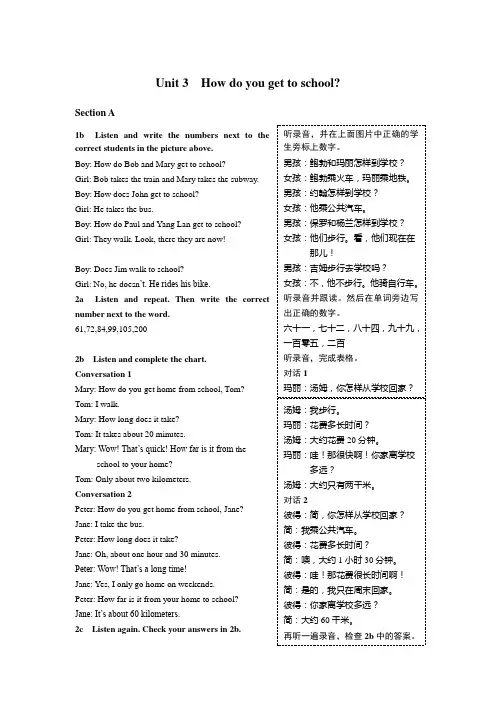
Unit 3 How do you get to school? Section A1b Listen and write the numbers next to the correct students in the picture above.Boy: How do Bob and Mary get to school?Girl: Bob takes the train and Mary takes the subway. Boy: How does John get to school?Girl: He takes the bus.Boy: How do Paul and Yang Lan get to school?Girl: They walk. Look, there they are now!Boy: Does Jim walk to school?Girl: No, he doesn’t. He rides his bike.2a Listen and repeat. Then write the correct number next to the word.61,72,84,99,105,2002b Listen and complete the chart.Conversation 1Mary: How do you get home from school, Tom? Tom: I walk.Mary: How long does it take?Tom: It takes about 20 minutes.Mary: Wow! That’s quick! How far is it from the school to your home?Tom: Only about two kilometers.Conversation 2Peter: How do you get home from school, Jane? Jane: I take the bus.Peter: How long does it take?Jane: Oh, about one hour and 30 minutes.Peter: Wow! That’s a long time!Jane: Yes, I only go home on weekends.Peter: How far is it from your home to school? Jane: It’s about 60 kilometers.2c Listen again. Check your answers in 2b. 听录音,并在上面图片中正确的学生旁标上数字。
【人教版七年级英语下】Unit How do you get to school 知识点归纳
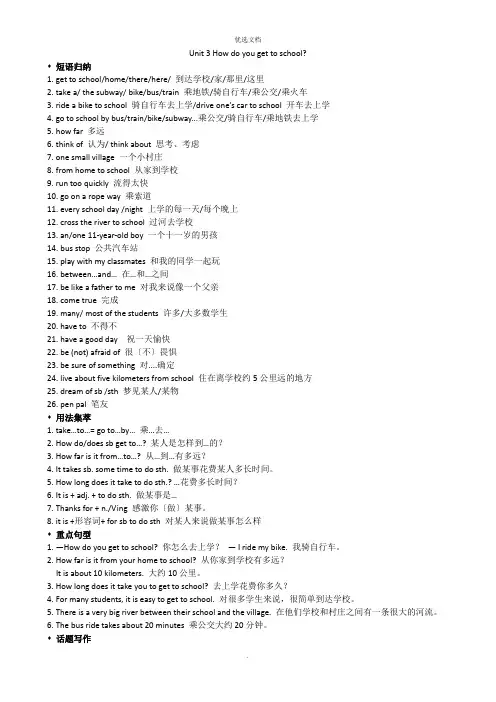
Unit 3 How do you get to school?◆短语归纳1. get to school/home/there/here/ 到达学校/家/那里/这里2. take a/ the subway/ bike/bus/train 乘地铁/骑自行车/乘公交/乘火车3. ride a bike to school 骑自行车去上学/drive one’s car to school 开车去上学4. go to school by bus/train/bike/subway...乘公交/骑自行车/乘地铁去上学5. how far 多远6. think of 认为/ think about 思考、考虑7. one small village 一个小村庄8. from home to school 从家到学校9. run too quickly 流得太快10. go on a rope way 乘索道11. every school day /night 上学的每一天/每个晚上12. cross the river to school 过河去学校13. an/one 11-year-old boy 一个十一岁的男孩14. bus stop 公共汽车站15. play with my classmates 和我的同学一起玩16. between…and… 在…和…之间17. be like a father to me 对我来说像一个父亲18. come true 完成19. many/ most of the students 许多/大多数学生20. have to 不得不21. have a good day 祝一天愉快22. be (not) afraid of 很〔不〕畏惧23. be sure of something 对....确定24. live about five kilometers from school 住在离学校约5公里远的地方25. dream of sb /sth 梦见某人/某物26. pen pal 笔友◆用法集萃1. take…to…= go to…by… 乘…去…2. How do/does sb get to…? 某人是怎样到…的?3. How far is it from…to…? 从…到…有多远?4. It takes sb. some time to do sth. 做某事花费某人多长时间。
人教版七年级英语下册Unit3Howdoyougettoschool单元整体教学设计

4.通过课堂提问、课后作业等方式,及时了解学生的学习进度,调整教学策略,提高教学效果。
5.注重学生个体差异,针对不同学生的需求,给予个性化的指导,提高学生的学习兴趣和自信心。
(三)情感态度与价值观
在本单元的教学中,教师将关注以下情感态度与价值观的培养:
-实施个性化教学,关注每个学生的学习差异,提供个性化的辅导和支持,帮助每个学生达到最佳学习效果。
3.教学评估:
-结合形成性评估和终结性评估,通过课堂观察、作业反馈、小组讨论评价等方式,全面了解学生的学习进展。
-鼓励学生自我评估和同伴评估,培养他们的自主学习能力和批判性思维能力。
4.教学支持:
-提供丰富的教学资源,如词汇卡片、句型海报、在线互动平台等,辅助学生学习和复习。
3.教学方法:采用小组合作学习、讨论交流等方式,培养学生的合作能力和口语表达能力。
4.教学目标:使学生能够运用所学词汇和句型,进行小组讨论和交流。
(四)课堂练习
1.教学内容:设计各种练习题,巩固本节课所学知识。
2.教学活动设计:教师设计以下练习题:
a.选择题:让学生选择正确的交通工具和频度副词。
b.填空题:让学生运用所学词汇和句型,完成句子或对话。
-设计丰富的听说活动,如角色扮演、小组讨论、问题解决等,让学生在互动中自然习得语言,提高口语表达能力。
-通过听力练习和口语练习,逐步增加难度,帮助学生逐步克服听力理解的困难和口语表达的障碍。
2.教学方法设计:
-采用情境教学法,创建与学生日常生活密切相关的场景,使学生在情境中感知、体验和运用语言。
-引入任务型教学法,设计有意义的任务,如调查问卷、地图导航等,让学生在完成任务的过程中,练习和巩固所学知识。
初中英语人教版七年级下册Unit 3 How do you get to scho
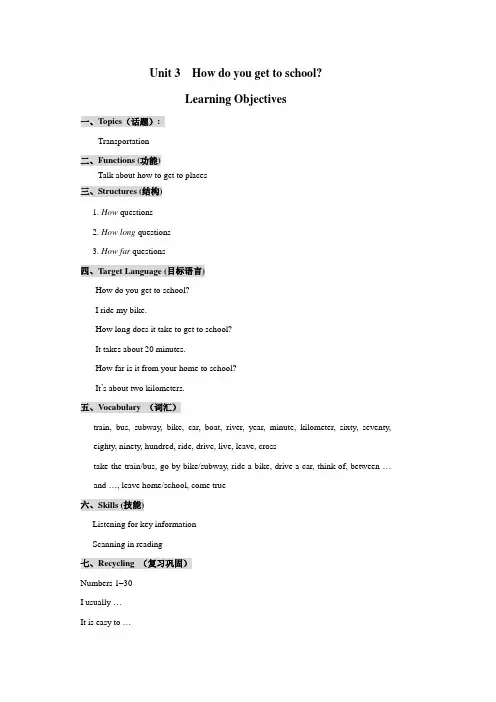
Unit 3 How do you get to school?Learning Objectives一、Topics(话题):Transportation二、Functions (功能)Talk about how to get to places三、Structures (结构)1. How questions2. How long questions3. How far questions四、Target Language (目标语言)How do you get to school?I ride my bike.How long does it take to get to school?It takes about 20 minutes.How far is it from your home to school?It’s about two kilometers.五、Vocabulary (词汇)train, bus, subway, bike, car, boat, river, year, minute, kilometer, sixty, seventy, eighty, ninety, hundred, ride, drive, live, leave, crosstake the train/bus, go by bike/subway, ride a bike, drive a car, think of, between …and …, leave home/school, come true六、Skills (技能)Listening for key informationScanning in reading七、Recycling (复习巩固)Numbers 1–30I usually …It is easy to …Thanks for …八、教材分析本单元以How do you get to school?为中心话题,主要运用How long/How far 询问“去某地的交通方式、时间、距离”,简单描述路线。
七年级英语下册 Unit 3 How do you get to school交通方式的表达和提问以
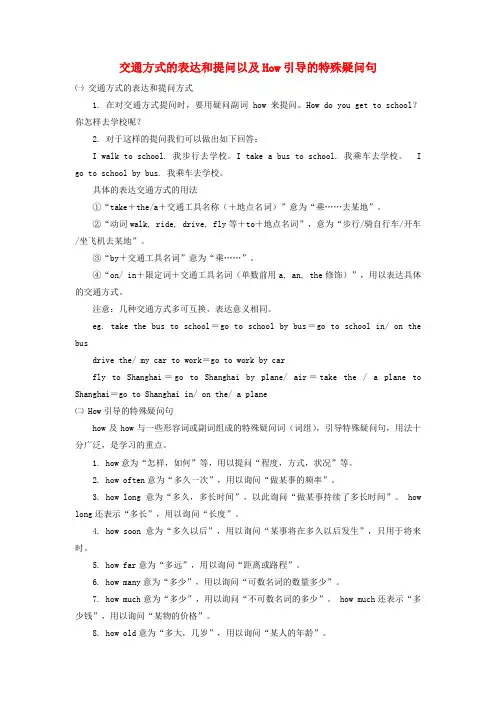
交通方式的表达和提问以及How引导的特殊疑问句㈠交通方式的表达和提问方式1. 在对交通方式提问时,要用疑问副词how来提问。
How do you get to school?你怎样去学校呢?2. 对于这样的提问我们可以做出如下回答:I walk to school. 我步行去学校。
I take a bus to school. 我乘车去学校。
I go to school by bus. 我乘车去学校。
具体的表达交通方式的用法①“take+the/a+交通工具名称(+地点名词)”意为“乘……去某地”。
②“动词walk, ride, drive, fly等+to+地点名词”,意为“步行/骑自行车/开车/坐飞机去某地”。
③“by+交通工具名词”意为“乘……”。
④“on/ in+限定词+交通工具名词(单数前用a, an, the修饰)”,用以表达具体的交通方式。
注意:几种交通方式多可互换,表达意义相同。
eg. take the bus to school=go to school by bus=go to school in/ on the busdrive the/ my car to work=go to work by carfly to Shanghai=go to Shanghai by plane/ air=take the / a plane to Shanghai=go to Shanghai in/ on the/ a plane㈡ How引导的特殊疑问句how及how与一些形容词或副词组成的特殊疑问词(词组),引导特殊疑问句,用法十分广泛,是学习的重点。
1. how意为“怎样,如何”等,用以提问“程度,方式,状况”等。
2. how often意为“多久一次”,用以询问“做某事的频率”。
3. how long意为“多久,多长时间”,以此询问“做某事持续了多长时间”。
how long还表示“多长”,用以询问“长度”。
Unit 3 How do you get to school-初中英语人教版七年级下册单元书面表达

Presentation
审题格式
①时态: 主要使用一般现在时 ②人称: 第一人称 ③框架结构: 书信格式 Dear Tom,
Thank you for your letter. Now I am writing to tell you about how I go to school…… …… Yours, friend
句型
1. Sb. go(es) to school by... 某人乘 …… 去上学。 2. It takes sb. some time to do sth. 某人花费多少时 间做某事。
3. It’s about ... kilometers from my home to school. 从我家到学校大约 …… 千米。
Unit3 How do you get to school? 单元话题写作
话题Pres分ent析ation
本单元以“谈论如何到达某地”为话题,要求同学们能描 述人们去上班或学生去上学所用的交通方式、路程、所花费 的时间、感受及对未来出行方式的憧憬。 写作要求:
1.能用“take the train/walk/ride a bike/drive a car/by subway/on foot…”描述使用的交通工具;
Dear Tom, How are you? Thank you for your last e-mail. I know how you
get to school. Now let me tell you how I get to school. I usually leave home at half past seven. First, I walk to the
2019-2020年人教版英语七年级下册Unit 3 How do you get to schoo
2019-2020学年人教版英语七年级下册单元知识点Unit3 How do you get to school? Section A 基础部分Part1词汇:●get to, how far. bicycle, subway, car, train. early● bus stop, train station, bus station, subway station●minute, kilometer, mile, transportation , calendar句型:●How do you get to school? I take the bus.●How long does it take? It takes 20 minutes.●How far is it? It’s 10 miles.Part2.巩固练习1..搭乘(某种交通工具) v2..地铁。
地下火车n3.走。
步行。
散步v.4..(用以促使注意,表示惊异或询问)嘿。
喂int5..火车n6.四十num.7.五十num.8..六十num9..七十num10.八十num.11.九十num.12..一百num13..分钟n14.花费(时间) v.15.经、由(表示交通、传递等的方式)prep16.乘坐公共汽车17.远的。
遥远的adj.18. 多远19.公里。
千Mn. 20. &n.淋浴v.21.快的。
迅速的adj.22..自行车。
两轮脚踏车n23..车站n24..早的。
提早的adj25..英里n26..车站n27.运送。
运输28..北部的。
北方的29.北美洲30.地区。
区域n.31.事物。
事情n.32.另外的。
其他的adj.33..依赖。
依靠v34. 视……而定。
决定于35.河。
江n36.船n37.乘坐小船38. (表示推测)一定v.39..(用于形容词、副词的比较级之后)比conj40. (用于构成部分形容词及副词的比较级)(比……)更。
期末复习人教版七年级英语下册unit3解析词汇、句型解析及练习(有参考解析)
期末复习人教版七年级英语下册unit3解析词汇、句型解析及练习Unit3 How do you get to school?01词汇讲解1. subway1)subway 在美式英语中意为“地铁”。
更常用“take the subway”或者“go by subway”表示“乘坐地铁”,而一般不用“take a subway”或者“go by a/the subway”。
例如:Let’s go by subway. 让我们乘地铁去吧。
You can take the subway to come to my house.你可以坐地铁来我家。
2)subway在英式英语中意为“地下通道”。
英式英语的“地铁”是“the underground”。
例如:We travelled across London on the underground.我们乘地铁穿过伦敦。
3)subway train 指“地铁列车”; subway station指“地铁站”。
例如:I’m on a subway train. I can’t hear you clearly.我在地铁上呢,听不清楚你说话。
It takes me 15munites to walk to the nearest subway station from my home.从我家步行到最近的地铁站需要15分钟。
2. ride1)ride 做名词时,意为“(乘坐汽车等的)旅行;乘骑;(乘车或骑车的)短途旅程”等。
常用于词组:go for a ride (去兜风) give sb. a ride (让……搭车)。
例如:Can you give me a ride to the market?你能让我搭车去市场吗?I’d like to go for a ride.我想出去兜兜风。
How much is a ride? 乘一次多少钱?2)ride做动词,意为“乘车,乘坐,搭乘”。
人教版七年级英语下册unit3(详细内容)
人教版七年级英语下册Unit 3 How do you get to school一、单词回顾1、train[treɪn]火车2. bus 公交车3、subway['sʌbweɪ]地铁4、ride[raɪd]v.骑n.旅rode. [rəʊd]ridden.['rɪdn.]5、bike[baɪk]自行车6、sixty['sɪkstɪ]六十7、seventy['sev (ə)ntɪ]七十8、eighty['eɪtɪ]八十9、ninety['naɪntɪ]九十10、hundred['hʌndrəd]一百11、far[fɑː]很12、minute['mɪnɪt]分钟13、kilometer['kɪlə,mitɚ]公里14、new[n juː]新的15、every ['evrɪ]每一个16、by[baɪ]通过,被17、drive[draɪv]开车18、live [lɪv]活的,生动的19、stop[stɒp]停止20、cross[krɔs]交叉21、river ['rɪvə]河,江22、many ['menɪ]许多23、village[' vɪlɪdʒ]村庄,村民24、between[bɪ'twiːn]介于…之间25、bridge[brɪdʒ]桥26、boat [bəʊt]小船27、ropeway['rop,we]n. 索道空中缆索28、year[jɪə]n. 年;年度;岁29、afraid[ə'freɪd]害怕;惧怕30、like [laɪk]像;怎么样(介词)31、leave [liː v]离开;left (lea ve的过去式)32、dream[driːm]梦想;睡梦33、true[truː]真的;符合实际的二. 词汇辨析:1. take/spend/pay/costspend,cost,take和pay都可以表示“花费”,但用法却不尽相同。
Unit3Howdoyougettoschool?单元背诵人教版七年级英语下册
Unit 3 How do you get to school?姓名:签名:①How +do/does+人称+get to…? 某人如何去某地,当get后面为home、here、there时,则需要省去toEg:How does she get to school?她如何去学校?How do you get home?你如何回家?①其回答为:①人称代词+交通工具+to…Eg: She takes the bus to school. 她乘公共汽车去学校(没有get!)①人称代词+get to…+by 交通工具(by放句尾)Eg:She gets to school by bus.(有get!)①take the bus=by bus take the subway=by subwaytake the train= by tarin ride a bike=by bike walk=on footdrive a car = by car①It takes sb.+时间+to do sth. 做某事花费某人多长时间It takes me 10 minutes to play games 玩游戏花费了我十分钟。
①How long does it take to get to school 需要花费多长时间去学校其回答为:It takes+时间①How far is it from A to B?A离B 有多远?其回答:It is +距离①100900:(基数)+hundred(不可数)101999:(基数)+hundred and (基数)如:500 five hundred 567:five hundred and sixtyseven①hundreds of… 数百(+s)①It is good exercise. 它是一个不错的运动。
①Think of 认为;What do you think of+doing?你认为…怎么样?①For many students 对于很多学生来说①In one small village in China. 在中国的一个小村庄①The river runs too quickly 水流太快了①11yearold =11 years old(an eleven)①Between A and B 在A与B之间between you and me 在你和我之间①Be like =look like 看起来像①Dream e ture 梦想实现①be afraid of doing sth. =be afraid to do sth. 害怕做某事①too+adj. 太… too fun 太有趣了!so+adj. 如此…. So fun 如此有趣②①go on ropeway 坐索道②②leave the village 离开村庄②③at the bus stop在公共汽车站。