
牛津译林版英语七年级下册期末知识点复习(无答案)-word文档资料
7B 期末复习地球同一的;相同的低语4 答复;回答5 离开6 吃惊的;惊讶的7 独自8 世纪;百年9 伸手够到10 出生;诞生11 足够地;充分地12 虚弱的13 失败14 通过15 她自己16 后部;背部17 脂肪18 发生19 奇怪20 木头21 向,朝22干燥的23 通常的;平常的24 激动的25 琢磨26 到达;击中27 拾起28能力29 座位30甚至31 付费32 募集33 救助34 独自35 相信36 发送37 能够,能38 笔记本39 勇敢的40 火柴41 学期42 小提琴43 女士44 推荐45 老鼠,耗子46 喂养47 充分地48 湿的49麻烦50 文章51 握住一、重点语法1用括号内所给动词的正确形式补全对话。
A: Last summer, I (1) (visit) my aunt in Singapore with my family. We (2) (live) in her house for some days.B: Did you have fun there?A: Yes. We (3) (have) a great time!B: What (4) (do) you do there?A:Well, we (5) (see) many interesting things. We (6) (go) to the bird park one day. There (7)(be) lots of birds there. We also (8) (go) to some shopping centres. We (9) (buy) some new clothes. In the evening, I often (10) (read) books with my aunt.答案:1. visited 2. lived 3. had 4. did 5. saw 6. went 7. were 8. went 9. bought 10. read2、写出下列动词的过去式sit________ reply_________ say_________ hear_________ see___________ ride_____________stand________ fall__________ hit____________ get___________ go_________ put____________become__________ forget___________ send___________ pay__________ cost____________ spend__________take__________ burn___________ nod_________ lose___________ hold_________ fed________ teach_________hide_______ build___________ fight________ keep________ grow________ bring_________ buy________2、我们学过哪些情态动词?还记得他们的意思和用法吗?完成下面的练习一. 用can, could, can’t和couldn’t填空。
1. Camels live without water for a long time.2. You pass the test if you don’t work hard.3. —you speak French?— Yes, I , but I speak it well.4. —she drive before?— No, she drive before. But now, she .5. —they use computers last month?— No, they use computers last month. But this month, they .答案:1. can 2. can’t 3. Can; can; can’t 4. Could; couldn’t; can 5. Could; couldn’t; can二. 根据情景及所给提示,写出相应的疑问句,完成对话或句子。
1. The air conditioner (空调) is on in summer. (could)A:?B:No, you can’t. It is too hot.2. You want to order food in a restaurant. (may)A: ?B: Yes, of course you can have the menu.3. You and your friend see some lost travellers. (may)A: ?B: Oh yes, please help us!4. Your pen is broken, but you have to use a pen. (can)A: ?B: Yes. Here you are.5. You’re trying to do your homework, but your sister is making a lot of noise. (can)quiet? I will have a test tomorrow.答案:1. Could I turn the air conditioner off 2. May I have the menu 3. May we help you 4. Can I use your pen5. Can you be / keep3、还记得感叹句是什么吗?在写感叹句的题目时有什么步骤?完成下面练习:1. The cake is very delicious. (改为感叹句)the cake is!2. The news is amazing. (改为感叹句)it is!3. This is a very interesting story. (改为感叹句)this is!4. How nice the weather is! (改为同义句)weather it is!5. What a brave girl she is! (改为同义句)the girl is!答案:1. How delicious 2. What amazing news 3. What an interesting story 4. What nice 5. How brave 45、想一下我们学过哪些不定代词,它们在使用时需要注意什么?完成下面的练习( ) 1. I knocked on the door, but answered.A. somebodyB. nobodyC. anybodyD. everybody ( ) 2. — Why not have to drink now?— Good idea!A. nothing coolB. cool somethingC. something coolD. cool anything( ) 3. —I’m leaving for the exam, Mum.—Well, make sure you’ve got ready.A. somethingB. anythingC. everythingD. nothing ( ) 4. — Do you have anything important to say for yourself?—except (除了) sorry.A. SomethingB. NothingC. AnythingD. Everything ( ) 5. — Does know the answer to the question?— Me.A. everybodyB. somethingC. nobodyD. anybody 答案:1-5 BCCBD二、重点短语一、默写下列短语1 至少2 环顾四周3 自言自语4 像…一样5 一件奇怪的事情6 像往常一样7 睁着眼睛睡觉8 挂起;举起9 听说10 仔细寻找11 路过12 环游世界13 那天,前几天14 抬头看15 尽力做某事16 请求17 同时18 逃离19具有悠久的历史20 通过;浏览21 一个叫约翰的人22 从那时起23 决定进入花园24 太…而不能…25 信不信由你26 留神,当心27 扑灭28 为…付款29 顺便问一下30 尽某人最大努力31 迷路32 一直33 重达40克34 给某人让位35 在隔壁36 住院37 参加38 照顾39 追赶40 发出吵闹声41 …做得好42 在…岁时1、从方框里选择合适的词语填空。
1. Li Na began to play tennis six.2. We over 2,000 yuan at the show last weekend.3. Grandpa wears glasses when he reads .4. ! The road is very busy.5. It is for children to play by the lake.6. Millie is a good girl. She never makes any in class.7. Last week, I read a(n) about Chinese poems.8. I often feel good when I can do something for people .9. John knocked over his chair when he in a hurry.10. Michelle Obama said she in a poor family.答案:1. at the age of 2. raised 3. newspapers 4. Look out 5. dangerous 6. trouble 7. article8. in need 9. stood up 10. grew up2、从方框里选择合适的短语,并用其正确形式填空。
1. He is worried because he can’t find anyone help.2. I the film Ironman when I was in Grade 2.3. When the mouse saw the cat, it quickly.4. Tom felt very tired and he on the grass for a rest.5. I being alone at home when I was young.6. “I can make it,” he kept .7. The man living is very friendly to us.8. I was surprised when I saw Jim playing the violin.9. Dogs are the most popular pets. People keep them as pets.10. , do you know who went to the library with Jane?答案:1. to ask for 2. heard of 3. ran away 4. sat down 5. was afraid of 6. saying to himself 7. next door8. a little 9. all over the world 10. By the way3、从方框里选择合适的词语填空,完成下面的对话。
七年级英语下册期末总复习知识点总结牛津译林版
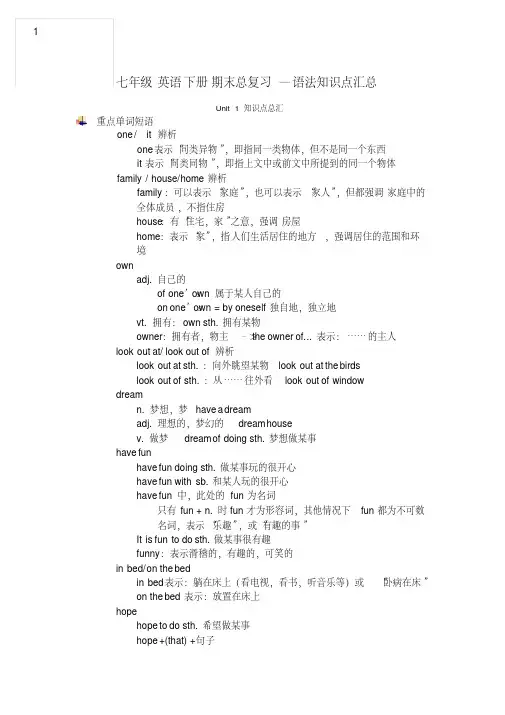
七年级英语下册期末总复习—语法知识点汇总Unit1知识点总汇重点单词短语one/it辨析one表示“同类异物”,即指同一类物体,但不是同一个东西it表示“同类同物”,即指上文中或前文中所提到的同一个物体family/house/home辨析family:可以表示“家庭”,也可以表示“家人”,但都强调家庭中的全体成员,不指住房house:有“住宅,家”之意,强调房屋home:表示“家”,指人们生活居住的地方,强调居住的范围和环境ownadj.自己的own属于某人自己的of one’son one’sown=by oneself独自地,独立地vt.拥有:own sth.拥有某物owner:拥有者,物主–>the owner of...表示:……的主人look out at/look out of辨析look out at sth.:向外眺望某物look out at the birdslook out of sth.:从……往外看look out of windowdreamn.梦想,梦have adreamadj.理想的,梦幻的dreamhousev.做梦dreamof doing sth.梦想做某事have funhave fun doing sth.做某事玩的很开心have fun with sb.和某人玩的很开心have fun中,此处的fun为名词只有fun+n.时fun才为形容词,其他情况下fun都为不可数名词,表示“乐趣”,或“有趣的事”It is fun to do sth.做某事很有趣funny:表示滑稽的,有趣的,可笑的in bed/on the bedin bed表示:躺在床上(看电视,看书,听音乐等)或“卧病在床”on the bed表示:放置在床上hopehope to do sth.希望做某事hope+(that)+句子期末复习:有实力的,没在怕的!注意:没有hopesb.to do sth.这种用法!!inviteinvite sb.to do sth.邀请某人做某事invitation:n.邀请,请柬重点句型Would you like to live in a palace?would like=want表示“想要”would like sth.想要某物would like to do sth.想做某事would like sb.to do sth.想要某人做某事would like疑问句的回答肯定回答:Yes,please.Yes,I’dl ike to.否定回答:No,thanks.Sorry,I prefer to do sth.Sorry,I prefer sth.I sharea bedroomwith my sister.share(sth.)with sb.和(某人)分享某物I live in a flat in the centreof Moscow.in the centreof:在……的中心live:不及物动词,表示居住在……地方时,需要用介词live in a flatlive on the secondfloor当后面的地方为“地点副词时”,如here,there,where,则live后面不需要加介词注意:当有place的情况下,live后面一般也不需要添加介词It is a wonderful place to live.He is always thefirst to come to school in our class.序数词前面需要加定冠词the此句也可以转换为:He always comesto school in our classfirst.The bathroomis the best place to chat and watch TV.the bestplace:最好的地方形容词最高级前面需要加定冠词thethe worst thing:最糟糕的事the largestpopulation:最多的人口chat with sb.和某人聊天Francehasan areaof over260,000squaremiles.has/havean areaof:有……大的规模in area:在面积上,在规模上in size:在大小,尺寸上over=more than(一般出现在任务型阅读或者句型转换中)square:adj.平方的squaremetres/milesadj.方形的,方的squarefacen.广场Tian’anmen Square Red Square常用电话用语Who is that speaking?This is....speaking.Who is that?我是某某,你是谁?Hold on,please.请稍等XX,you arewanted.某某,有人找你接电话Can I take a messagefor you?我能替你捎个口信吗?takea messagefor sb.给某人捎个口信(一般指接电话人说)leavea messageto sb.给某人留个口信(一般指打电话人说)Can you ask him to call me back?你能告诉他给我回电话吗?重点语法基数词基数词表顺序:单数名词+基数词ClassTwo;GradeOne(前后另个单词首字母必须大写),就可以替换为the+序数词+单数名词表示数量时,当有具体数量时,在billion/million/thousand/hundred和“of”后不加“s”当表示泛指数量时,则前面不需要有具体数量,但后面需要添加“s”,如:hundredsof;thousandsof;millions of和“of”in one’s+基数词的复数形式:在某人几十岁的时候in my twenties在我20几岁的时候基数词+连字符+单数名词:表示形容词30-minute walk;2400-metrerace;1200-word composition 序数词序数词的写法:基数词变序数词的口诀一二三特殊记,th从四起八加h,九去e,ve要用f替整十基数变序数,先把ty变tie要是遇到几十几,前半基数后半序注意:第四(the fourth)第四十(the fortieth)第一百(the onehundredth)序数词表示第几时,前面需要使用限定词(形容词性物主代词或定冠词the)序数词表顺序:the+序数词+单数名词the first class(第一节课)a+序数词/the+序数词a+序数词表示:再一次,又一次a secondone(再来一个)the+序数词表示:第几次the secondone(第二个)序数词作副词:I always come to school first.分数分数的表达:序数词本身也可以表示几分之一的意思,所以在表达几分之几的时候,可以理解为有多少个几分之一,如:2/3则为两个1/3,即:two thirds或two-thirds注意:在解决分数问题时,一定要注意以分数后面的名词的可数不可数,来判断谓语动词到底是否使用三单形式。
译林版牛津初中英语七年级下册全册Unites1-8期末复习各单元知识点及语法归纳
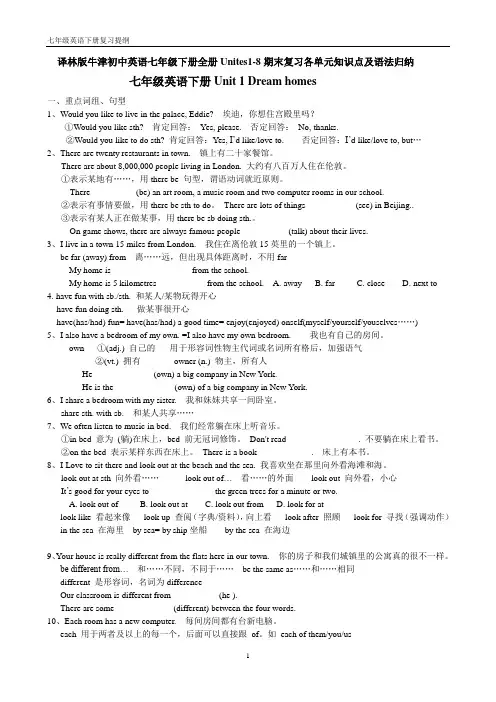
译林版牛津初中英语七年级下册全册Unites1-8期末复习各单元知识点及语法归纳七年级英语下册Unit 1 Dream homes一、重点词组、句型1、Would you like to live in the palace, Eddie? 埃迪,你想住宫殿里吗?①Would you like sth? 肯定回答:Yes, please. 否定回答:No, thanks.②Would you like to do sth? 肯定回答:Yes, I’d like/love to. 否定回答:I’d like/love to, but…2、There are twenty restaurants in town. 镇上有二十家餐馆。
There are about 8,000,000 people living in London. 大约有八百万人住在伦敦。
①表示某地有……,用there be 句型,谓语动词就近原则。
There __________(be) an art room, a music room and two computer rooms in our school.②表示有事情要做,用there be sth to do。
There are lots of things ___________(see) in Beijing..③表示有某人正在做某事,用there be sb doing sth.。
On game shows, there are always famous people___________(talk) about their lives.3、I live in a town 15 miles from London. 我住在离伦敦15英里的一个镇上。
be far (away) from 离……远,但出现具体距离时,不用farMy home is __________________from the school.My home is 5 kilometres ___________from the school. A. away B. far C. close D. next to 4. have fun with sb./sth. 和某人/某物玩得开心have fun doing sth. 做某事很开心have(has/had) fun= have(has/had) a good time= enjoy(enjoyed) onself(myself/yourself/youselves……)5、I also have a bedroom of my own. =I also have my own bedroom. 我也有自己的房间。
牛津译林版七年级下册英语全册知识点汇编

牛津译林版七年级下册英语全册知识点汇编Unit1重点短语1.live in a palace 住在宫殿里2.next to / beside a restaurant 在饭馆隔壁3.the biggest one 最大的一个4.would like to do sth 想要做某事5. the capital of France法国的首都French 法语Frenchman 法国人-Frenchmen(复数)Germany 德国-German德国人-Germans (复数)6.look out at the beach and the sea 看外面的海滩和海7.see the sea and the beach from the bedroom windows 从卧室窗户看大海和海滩8.on the beach / balcony 在海滩上/阳台上9.live with my family in a wooden house 和我的家人住在一个木头的房子里10.live in a small town 住在一个小城镇里11.over a river 在河面上12.the second child of my family 家中的第二个孩子13.be beautiful and quiet 美丽又安静14.It rains a lot 天经常下雨15.in a small town near London 在伦敦附近的小镇里16.in the centre of Moscow 在莫斯科中心17.on the fifth of June 在6月5日18.in a flat 在公寓里on a busy street 在繁忙的街道上19.share sth with sb 与某人分享/合用某物20.be busy with sth忙于(做)某事21.be friendly to sb 对某人友好22.sleep in the garden 睡在花园里23.the best place to grow flowers 种花的最好地方24.cook meals 做/ 烧饭25.in most homes 在大多数家庭tell sb about sth 告诉某人有关某事26.on the ninth floor 在第9层( On which floor does he live? )27.chat with friends on the balcony 和朋友在阳台上聊天28.on a quiet street 在一条安静的街道上29.sit between you and me 坐在我和你之间30.on / over the phone = by phone 通过电话31.two hundred students 200名学生hundreds of students 数百名学生Two hundred of the students are from America 学生中有200名来自美国31.arrive on Sunday 在星期天到达32.can't wait to do sth 迫不及待的做某事33.have a free day 休息/休假一天34.be tired after the long plane journey from London to Beijing从伦敦到北京的长途飞机旅行后劳累了35.Don't worry 别担心36.sound great /good 听起来很棒e first = win the first prize (in an English exam)得第一名38.make a video of 拍……的录像watch the video 看录像与……相同39.be different from …… 与……不同be the same as …… 40.your own bedroom 你自己的卧室41.call sb (up)打电话给某人42.homes in different countries 不同国家的家be free 有空43. take a message for sb 为某人捎个可信44.at least 至少45.fifty metres long 50米长an 800-metre-long river46.have a room with twelve showers and four baths 有一间有12个淋浴器和4个浴缸的房间47.have / take a shower 淋浴48.on the bedside table 在床头柜上coffee table 矮茶几。
译林牛津版七年级英语下册期末复习资料全套
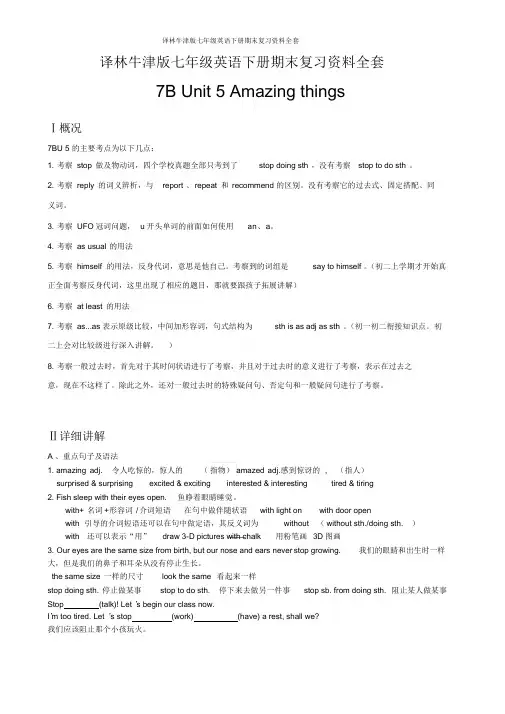
译林牛津版七年级英语下册期末复习资料全套7B Unit 5 Amazing thingsⅠ概况7BU 5 的主要考点为以下几点:1. 考察stop 做及物动词,四个学校真题全部只考到了stop doing sth ,没有考察stop to do sth 。
2. 考察reply 的词义辨析,与report 、repeat 和recommend 的区别。
没有考察它的过去式、固定搭配、同义词。
3. 考察UFO 冠词问题,u 开头单词的前面如何使用an、a。
4. 考察as usual 的用法5. 考察himself 的用法,反身代词,意思是他自己。
考察到的词组是say to himself 。
(初二上学期才开始真正全面考察反身代词,这里出现了相应的题目,那就要跟孩子拓展讲解)6. 考察at least 的用法7. 考察as...as 表示原级比较,中间加形容词,句式结构为sth is as adj as sth 。
(初一初二衔接知识点。
初二上会对比较级进行深入讲解。
)8. 考察一般过去时,首先对于其时间状语进行了考察,并且对于过去时的意义进行了考察,表示在过去之意,现在不这样了。
除此之外,还对一般过去时的特殊疑问句、否定句和一般疑问句进行了考察。
Ⅱ详细讲解A 、重点句子及语法1. amazing adj. 令人吃惊的,惊人的(指物)amazed adj.感到惊讶的, (指人)surprised & surprising excited & exciting interested & interesting tired & tiring2. Fish sleep with their eyes open. 鱼睁着眼睛睡觉。
with+ 名词+形容词/ 介词短语在句中做伴随状语with light on with door openwith 引导的介词短语还可以在句中做定语,其反义词为without (without sth./doing sth. )with 还可以表示“用”draw 3-D pictures with chalk 用粉笔画3D 图画3. Our eyes are the same size from birth, but our nose and ears never stop growing. 我们的眼睛和出生时一样大,但是我们的鼻子和耳朵从没有停止生长。
牛津译林版七年级英语下册全册重点知识点汇总
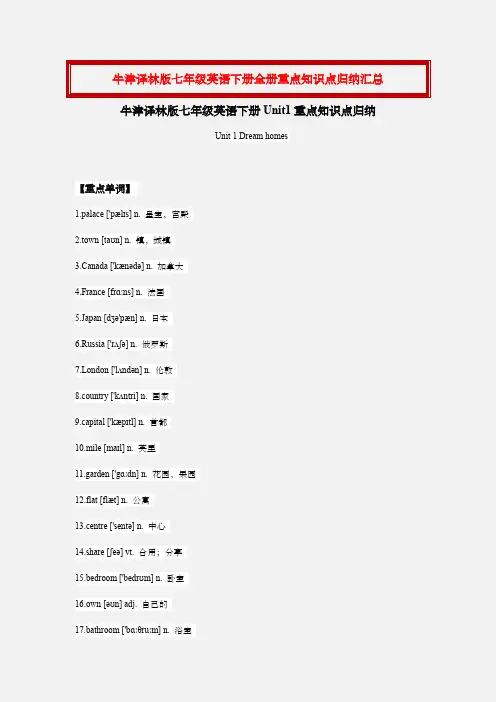
牛津译林版七年级英语下册全册重点知识点归纳汇总牛津译林版七年级英语下册Unit1重点知识点归纳Unit 1 Dream homes【重点单词】1.palace ['pælɪs] n. 皇室,宫殿2.town [taʊn] n. 镇,城镇3.Canada ['kænədə] n. 加拿大4.France [frɑːns] n. 法国5.Japan [dʒə'pæn] n. 日本6.Russia ['rʌʃə] n. 俄罗斯7.London ['lʌndən] n. 伦敦8.country ['kʌntri] n. 国家9.capital ['kæpɪtl] n. 首都e [maɪl] n. 英里11.garden ['gɑːdn] n. 花园,果园12.flat [flæt] n. 公寓13.centre ['sentə] n. 中心14.share [ʃeə] vt. 合用;分享15.bedroom ['bedrʊm] n. 卧室16.own [əʊn] adj. 自己的17.bathroom ['bɑːθruːm] n. 浴室18.balcony ['bælkəni] n. 阳台19.beach [biːtʃ] n. 海滩20.sea [siː] n. 海21.zero ['zɪərəʊ] num. 零22.hundred ['hʌndrəd] num. 百23.thousand ['θaʊzənd] num. 千lion ['mɪljən] num. 百万25.foot [fʊt] n. (pl. feet) 英尺26.square [skweə] adj. 平方的27.metre ['miːtə] n. 米,公尺28.area ['eərɪə] n. 面积29.over ['əʊvə] prep. 超过30.fork [fɔːk] n. 餐叉31.fridge [frɪdʒ] n. 冰箱32.knife [naɪf] n. (pl. knives)刀mp [læmp] n. 灯;台灯34.shower ['ʃaʊə] n. 淋浴35.sofa ['səʊfə] n. 沙发36.video ['vɪdɪəʊ] n. 录像37.may [meɪ] modal v. 可以;也许,可能38.message ['mesɪdʒ] n. 消息,音信39.double ['dʌbl] adj. 双的;两倍的40.study ['stʌdi] n. 书房41.machine [mə'ʃiːn] n. 机器42.field [fiːld] n. 田,地43.invite [ɪn'vaɪt] vt. 邀请44.stay [steɪ] vi. 停留,逗留【重点短语】1.be full of 充满2.of one’s own 某人自己的3.some day 某天4.take a message 传口信5.call sb. back 给某人回电话6.football field 足球场7.at the foot of 在……脚下8.washing machine 洗衣机9.dream homes 梦想家园10.live next to the restaurant 住在饭店隔壁11.the capital of Japan 日本的首都12.in the town/the city/the country 在镇上/市里/农村13.three students from different countries 来自不同国家的三个学生14.a flat in the center of Moscow 莫斯科中心的一套公寓15.have fun with my dog 和我的狗玩得高兴16.have fun (in) doing sth. 做某事很愉快17.share a bedroom with sb. 与某人共享一个卧室18.have my own room 有我自己的房间19.look out at the beach 眺望海滩20.cook meals 煮饭21.have an area of… 有……的面积22.make a video 制作一个视频23.send sb. sth. 把某物寄送给某人24.invite sb. to do sth. 邀请某人去做某事25.more than enough food 绰绰有余的食物【重点句型】1.Would you like to live in a palace?你愿意住在一个宫殿里吗?2.The capital of Japan is Tokyo.日本的首都是东京。
七年级英语下册期末总复习知识点总结牛津译林版
七年级英语下册期末总复习—语法知识点汇总Unit1知识点总汇重点单词短语●one/it辨析one表示“同类异物”,即指同一类物体,但不是同一个东西it表示“同类同物”,即指上文中或前文中所提到的同一个物体●family/house/home辨析family:可以表示“家庭”,也可以表示“家人”,但都强调家庭中的全体成员,不指住房house:有“住宅,家”之意,强调房屋home:表示“家”,指人们生活居住的地方,强调居住的范围和环境●ownadj.自己的✧of one’s own属于某人自己的✧on one’s own=by oneself独自地,独立地vt.拥有:own sth.拥有某物owner:拥有者,物主–>the owner of...表示:……的主人●look out at/look out of辨析look out at sth.:向外眺望某物look out at the birdslook out of sth.:从……往外看look out of window●dreamn.梦想,梦have a dreamadj.理想的,梦幻的dream housev.做梦dream of doing sth.梦想做某事●have funhave fun doing sth.做某事玩的很开心have fun with sb.和某人玩的很开心have fun中,此处的fun为名词✧只有fun+n.时fun才为形容词,其他情况下fun都为不可数名词,表示“乐趣”,或“有趣的事”It is fun to do sth.做某事很有趣funny:表示滑稽的,有趣的,可笑的●in bed/on the bedin bed表示:躺在床上(看电视,看书,听音乐等)或“卧病在床”on the bed表示:放置在床上●hopehope to do sth.希望做某事hope+(that)+句子invite sb.to do sth.邀请某人做某事invitation:n.邀请,请柬重点句型●Would you like to live in a palace?would like=want表示“想要”✧would like sth.想要某物✧would like to do sth.想做某事✧would like sb.to do sth.想要某人做某事would like疑问句的回答✧肯定回答:Yes,please.Yes,I’d like to.✧否定回答:No,thanks.Sorry,I prefer to do sth.Sorry,I prefer sth.●I share a bedroom with my sister.share(sth.)with sb.和(某人)分享某物●I live in a flat in the centre of Moscow.in the centre of:在……的中心live:不及物动词,表示居住在……地方时,需要用介词✧live in a flat✧live on the second floor✧当后面的地方为“地点副词时”,如here,there,where,则live后面不需要加介词✧注意:当有place的情况下,live后面一般也不需要添加介词It is a wonderful place to live.●He is always the first to come to school in our class.序数词前面需要加定冠词the此句也可以转换为:He always comes to school in our class first.●The bathroom is the best place to chat and watch TV.the best place:最好的地方✧形容词最高级前面需要加定冠词the✧the worst thing:最糟糕的事✧the largest population:最多的人口chat with sb.和某人聊天●France has an area of over260,000square miles.has/have an area of:有……大的规模✧in area:在面积上,在规模上✧in size:在大小,尺寸上over=more than(一般出现在任务型阅读或者句型转换中)square:adj.平方的square metres/miles✧adj.方形的,方的square face✧n.广场Tian’anmen Square Red Square●常用电话用语Who is that speaking?This is....speaking.Who is that?我是某某,你是谁?Hold on,please.请稍等XX,you are wanted.某某,有人找你接电话Can I take a message for you?我能替你捎个口信吗?✧take a message for sb.给某人捎个口信(一般指接电话人说)✧leave a message to sb.给某人留个口信(一般指打电话人说)Can you ask him to call me back?你能告诉他给我回电话吗?重点语法●基数词基数词表顺序:单数名词+基数词Class Two;Grade One(前后另个单词首字母必须大写),就可以替换为the+序数词+单数名词 表示数量时,当有具体数量时,在billion/million/thousand/hundred 后不加“s”和“of”当表示泛指数量时,则前面不需要有具体数量,但后面需要添加“s”和“of”,如:hundreds of;thousands of;millions ofin one’s+基数词的复数形式:在某人几十岁的时候in my twenties在我20几岁的时候基数词+连字符+单数名词:表示形容词30-minute walk;2400-metre race;1200-word composition●序数词序数词的写法:基数词变序数词的口诀✧一二三特殊记,th从四起✧八加h,九去e,ve要用f替✧整十基数变序数,先把ty变tie✧要是遇到几十几,前半基数后半序✧注意:第四(the fourth)第四十(the fortieth)第一百(the onehundredth)序数词表示第几时,前面需要使用限定词(形容词性物主代词或定冠词the)序数词表顺序:the+序数词+单数名词→the first class(第一节课) a+序数词/the+序数词✧a+序数词表示:再一次,又一次→a second one(再来一个)✧the+序数词表示:第几次→the second one(第二个)序数词作副词:I always come to school first.●分数分数的表达:序数词本身也可以表示几分之一的意思,所以在表达几分之几的时候,可以理解为有多少个几分之一,如:2/3则为两个1/3,即:two thirds或two-thirds注意:在解决分数问题时,一定要注意以分数后面的名词的可数不可数,来判断谓语动词到底是否使用三单形式。
精选-牛津译林版英语七年级下册期末知识点复习(无答案)-word文档
7B 期末复习1 地球2 同一的;相同的3 低语4 答复;回答5 离开6 吃惊的;惊讶的7 独自8 世纪;百年9 伸手够到10 出生;诞生11 足够地;充分地12 虚弱的13 失败14 通过15 她自己16 后部;背部17 脂肪18 发生19 奇怪20 木头21 向,朝22干燥的23 通常的;平常的24 激动的25 琢磨26 到达;击中27 拾起28能力29 座位30甚至31 付费32 募集33 救助34 独自35 相信36 发送37 能够,能38 笔记本39 勇敢的40 火柴41 学期42 小提琴43 女士44 推荐45 老鼠,耗子46 喂养47 充分地48 湿的49麻烦50 文章51 握住一、重点语法1用括号内所给动词的正确形式补全对话。
A: Last summer, I (1) (visit) my aunt in Singapore with my family. We (2) (live) in her house for some days.B: Did you have fun there?A: Yes. We (3) (have) a great time!B: What (4) (do) you do there?A:Well, we (5) (see) many interesting things. We (6) (go) to the bird park one day. There (7) (be) lots of birds there. We also (8) (go) to some shopping centres. We (9) (buy) some new clothes. In the evening, I often (10) (read) books with my aunt.答案:1. visited 2. lived 3. had 4. did 5. saw 6. went 7. were 8. went 9. bought 10. read2、写出下列动词的过去式sit________ reply_________ say_________ hear_________ see___________ ride_____________stand________ fall__________ hit____________ get___________ go_________ put____________become__________ forget___________ send___________ pay__________ cost____________ spend__________take__________ burn___________ nod_________ lose___________ hold_________ fed________ teach_________hide_______ build___________ fight________ keep________ grow________ bring_________ buy________2、我们学过哪些情态动词?还记得他们的意思和用法吗?完成下面的练习一. 用can, could, can’t和couldn’t填空。
期末总复习语法归纳牛津译林版英语七年级下册
7B期末总复习:语法归纳【举一反三】1. There are days in a week.A. the sevenB. seventhC. the seventhD. seven2. —David, how old is your father this year?—_______. And we will have a special party for his _____ birthday next weekend.A. Fortieth; fortyB. Forty; fortyC. Forty; fortiethD. Fortieth; fortieth3. Now, please turn to Page______ and look at the_______ picture.A.Fifth;five B.Five;fifth C.Fifth;fifth D.Five;five4. Today is Jack's birthday. He is ________ years old now.A.fourteenth B.fourteen C.the fourteenth D.the fourteen5. He is ________ and he has an ________ sister.A.ten-year-old; eight years old B.ten years old; eight-year-oldC.ten year old; eight-years-old D.ten-year-old; eight-year-old6. All of us study in a building with ____ floors and our classroom is on the _____ floor. A.fifth, three B.fifth, third C.five, third D.five, three7. --How old is your sister?-- _______. We had a special party for her _______birthday last Sunday.A.Nine;ninthB.Nine;nineC.Ninth;nineD.Ninth;ninth8. --People in our town planted _______trees on Tree Planting Day.--Good job! Everyone can do something to make our town greener.B.hundred of D.hundreds of三、一般将来时(will/shall)一般将来时表示将要发生的动作或情况,它常常由助动词、情态动词和动词来构成。
译林牛津版英语七年级下册期末复习点
Western "西方的" 作形容词,而western 意,为“西 部的,西面的” Why not do sth. ?= Why don't we/you do sth. "为什么我们/你们不做某事呢" 表建议 Why not go for a walk with us. =Why dont you go for a walk with us? miss "错过" 是动词 miss sth. "错过某事" I miss the bus. 我错过了公车了。 miss doing sth. “错过做某事” 但如果是Miss 的时候,表示"未婚女士或小姐" miss 还可以作“想念” 也是动词 I miss you very much. 我非常想你了。
LOREM IPSUM DOLOR
a lot of =lots of + 名词(可数或不可数名词) “许多 的....” give sb. some ideas "给某人一些好建议" 13. be coming=will come "即将到来" Let's +V原形 "让我们去做..." wait a munite=wait a moment “等一会” enough "足够的,充足的" enough+名词 (可数名 词或不可数名词) 形容词+enough (修饰形容词时把enough 放后面) be+ adj. + enough for sb. + to do sth. “对某人来说... 足够...可以做某事” It is old enough for him to go to school. 对他来说他 足够大了,可以上学了
知识点梳理牛津译林版七年级英语下册
新教材七年级下册知识点梳理7B Unit One知识点一、词形转换wood n.– wooden adj.child n.–children pron.quiet adj.—quietly adv.quite adv.相当地≠ quiet adj.安静的print v.–printer n.worry v.担心–worried adj.担心的little—less—least many/much –more—mostown(adj./v.)→ owner (n.)Britain n.不列颠—British adj.不列颠的France n.法国–French n.法语 adj.法国的Japan n.日本—Japanese n. adj.日本的Russia n.俄罗斯—Russian n.俄语、俄罗斯人 adj.俄罗斯的二、单词研究1.国家、人民、语言2.The capital of the USA is Washington D.C.the capital of ……e.g. Nanjing is the capital of Jiangsu Province.The capital of China is Beijing.3. own(adj.自己的/v.拥有)→ owner (n.)主人I have my own bedroom. = I have a bedroom of my own.e.g. I see with my own eyes.Who’s the owner of this pen?= Who owns this pen?4. fun n.乐趣,不可数名词I always have fun with my dog there.It’s great fun.5. most(1) most+名词; adj.“大多数的”:most homesMost girl students like wearing skirts.(2)most of + the / (形)物主代词(his/ their) /指示代词(these/ those) + pl./〖u〗most of + us/you/themMost of the students would like to stay.I spend most of my free time playing football.Most of them think English is very important.(3) adv.“最”:like sth mostI like playing basketball most.6. beside = next toI’d like to live next to a restaurant.There is a football field behind my house and a swimming pool beside it.三、词组学习1.I’d like to live next to a restaurant.① would like sth.= want sthwould like to do sth = want to do sthWould you like some water?= Do you want some water? Yes,please./ No, thanks. Would you like to go with us? Yes, I’d love/ like to. Good idea. All right. / I’d like to, but …② next to =besidee.g. Tom’s house is next t o mine.Jack wants to sit next to me.2. Learn about homes in different countries.① learn about学习有关…的知识I want to learn more about the world.② learn from向…学习We should help each other and learn from each other.③ different → same;be different from→be the same asin different classes in the same classIt’s really different from the flats in Beijing.④be different frome.g. Your pen is different from mine.City life is very different from Country life.⑤ different(adj.)→ difference(n.)the difference between…and…e.g. There are many differences between English and Chinese Names.3.We sit on the big floor cushions and look out at the beach and the sea.look out (of…)at … =see … from …Look out ! =Be careful! = Take care!当心/小心e.g. Don’t look out of the window in class.look at / look around / look for / look like / look forward to / look after / look up4. I share a bedroom with my sister.share sth with sbe.g. The boy shared his toy with other childrenshare in sthe.g. We should share in our sorrows as well as joys.5.Simon wrote down the meaning of some of the words.①write + n. +down=write down +n. write it /them downe.g. Can you write down the words on your book ?= Can you write the words on your book?OK, I’ll write them down.②meaning (n.)→ mean(v.)e.g. What’s the meaning of “quick?= What does “quick” mean?6. ask sb to do sth叫某人做某事Can you ask him to call me back?否定结构有:ask sb not to do sth类似的结构有:tell sb to do sth7. be full of…充满…Your garden is full of flowers.The room is full of smoke.My grandmother visited my home with a basket full of vegetables.8. have an area of… = … in area(size)Red Square in Moscow is about 91,000 square metres in size.France has an area of over 260,000 square miles. = France is 260,000 square miles in area.四、语法归纳(一)Cardinal numbersA.基数词的写法:⑴“几十几”十位和个位之间用“—”。