
初中英语人教版八年级下册Unit 1 What's the matter?教案
Unit 1 What’s the matter?Section A 1 (1a – 2d)教学目标:1语言目标:描述健康问题的词汇,及如何根据别人的健康问题提建议。
2 技能目标:能听懂谈论健康问题的对话材料;能根据别人的健康问题提建议;能写出重点单词和重点句型,并能描述怎样对待健康问题。
3 情感目标:通过开展扮演病人等活动,培养学生关心他人身体健康的品质。
通过本课的阅读,培养学生处理紧急事件的基本能力,树立紧急事件时互相帮助的精神。
教学重点:短语:have a stomachache, have a cold, lie down, take one’s temperature, go to a doctor,get off, to one’s surprise, agree to do sth., get into trouble, fall down, be used to,run out (of), cut off , get out of, be in control of , keep on (doing sth.), give up句子:1 What’s the matter? I have a stomachache. You shouldn’t eat so much next time.2 What’s the matter with Ben?He hurt himself. He has a sore back.He should lie down and rest.3 Do you have a fever? Yes, I do. No, I don’t.I don’t know.4 Does he have a toothache? Yes, he does.He should see a dentist and get an X-ray.5 What should she do? She should take her temperature.6 Should I put some medicine on it? Yes, you should No, you shouldn’t.教学难点:掌握情态动词should \shouldn’t. 的用法学习have的用法教学过程Step 1 Warming up and new words1. Look at a picture and learn the parts of the body.2. New words and phrases.Step 2 Presentation1a Look at the picture. Write the correct letter [a-m] for each part of the body.___arm ___ back ___ ear ___ eye ___ foot ___hand ___ head ___ leg ___ mouth___ neck ___nose ___ stomach ___ toothKeys: h e g i h a j l c d m k fStep 3 Listening1b Listen and look at the picture. Then number the names 1-5Listen to the conversations again and fill in the blanks.Conversation 1Nurse: What’s the matter, Sarah?Girl: I ___________.Conversation 2Nurse: What’s the matter, David?Boy: I _________________.Conversation 3Nurse: What’s the matter, Ben?Boy: I _________________.Conversation 4Nurse: What’s the matter, Nancy?Girl: I _________________.Conversation 5Betty: What’s the matter, Judy?Ann: She __________________.Keys: have a coldgot a stomachachehave a sore backhave a toothachehas a sore throatStep 4 Speaking1c Look at the pictures. What are the students’ problems? Make conversations.ExamplesA: What’s the matter with Judy?B: She talked too much yesterday and didn’t drink enough water.She has a very sore throat now.A: What’s the matter with Sarah?B: She didn’t take care of herself on the weekend. She was playing with her friends at the park yesterday. Then it got windy, but she didn’t put on her jacket.Now she has a cold.Step 5 Guessing gamesGuess what has happened to the students by using the important sentences.Step 6 Listening2a Listen and number the pictures [1-5] in the order you hear them.Keys: 2 4 3 1 52b Listen again. Match the problems with the advice.1 fever a lie down and rest2 stomachache b drink some hot tea3 cough and sore throat c see a dentist and get an X-ray4 toothache d take your temperature5 cut myself e put some medicine on itKeys: d a b c eStep 7 Speaking2c Make conversations using the information in 2a and 2bA: What’s the matter?B: My head feels very hot.A: Maybe you have a fever.B: What should I do?A: You should take your temperature.Step 8 Role–play1. Imagine you are the school doctor. A few students have health problems. Role-playa conversation between the doctor and the students.2d Role –play the conversation2. Answer the questions.1) What’s the matter with Lisa?2) Did she have a fever?3) What did she do the night before?4) What does she need to do?5) What should she do for now?6) What should she do if things don’t get better?Keys: She has a headache and can’t move her neck.No, she didn’t.She played computer games all weekend.She needs to take breaks away from the computer.She should lie down and rest.She should go to a doctor.Step 9 Language points and summary1. What’s the matter?What’s the matter? 与What’s wrong? 同义,均意为“怎么了?”,常用来询问疾病、事故伤害等。
如果表示某人怎么了,应该用What’s the matter with sb.? 或What’s wrong with sb.?如:What’s the matter / What’s wrong with the old man?What’s the matter? 的答语通常有以下几种:①“sb.+have / get / catch a(n)+疾病名称”表示患某种疾病。
如:I have / get / catch a cold.②“sb.+be / feel +某些形容词”表示某人感到不适。
如:I am / feel sick.③“身体部位+be / feel+某些形容词”表示某部位感到不适。
如:My head is / feels hot.④“身体部位+hurt”表示某部位痛。
如:My stomach hurts.⑤“sb.+get+某些动词的过去分词形式”表示受伤。
如:He got sunburned yesterday.⑥“sb.+hurt / cut+具体部位/ 反身代词”表示伤害。
如:He hurt his arm in the accident.I cut myself when cooking.【链接】用来询问疾病、不适或突发情况时,还可用以下句型:What’s the trouble (with ...)?What happened (to ...)?Is there anything wrong (with ...)?【运用】根据括号内的要求完成下列各题。
(1)—__________________________________________________________?—My brother has a cough.(写出问句)(2) —What happened to him?—He ___________(切着自己) cutting the tomatoes. (根据汉语提示补全答语) 2. I have a cold.have a cold伤风, 感冒, 是固定词组表示身体不适的常用词组还有:have a bad cold 重感冒have a fever 发烧have a headache 头痛have a stomachache 肚子痛, 胃痛have a toothache 牙痛Summary1. 牙疼have a toothache2. 胃疼have a stomachache3. 背疼have a backache4. 头疼have a headache5. 喉咙疼have a sore throat6. 发烧have a fever7. 感冒have a cold8. 躺下并且休息lie down and rest9. 喝热蜂蜜茶drink hot tea with honey10. 喝大量水drink lots of water11. 看牙医see a dentist12. 量体温take one’s temperature13. 看医生go to a doctorStep 10 Exercises根据上下文意思填空。
人教版初二(下)英语unit1 what's the matter知识点讲解与练习
八年级下册英语Unit 1 what’s the matter?词汇篇学生通过本讲学习,能够掌握本单元的重点词汇句型,并在综合能力上有一定的拓展。
1.matter的用法(1)名词:事情,问题What’s the matter? =what’s wrong (with you)? =what’s the trouble怎么啦?出什么事啦?(2)动词:有重大影响,有重要性如:What does it matter?2.疾病的表达法have a cold/a fever/ a toothache/ a stomachache3.take 的固定搭配take one’s temperature/ take breaks/ take risks/take some medicine/take off/ take care of/take away 4.surprise的用法1.做名词:to one’s surprise 使。
惊讶的,出乎。
意料2.做动词:surprise sb使某人吃惊3.做形容词:surprising, surprised的用法5.get的用法get off下车/get on上车/get into陷入,参与6.be used to sth/doing sth 习惯于做某事be used to do sth 被用作去做某事used to do sth 习惯于做某事7.out of的固定搭配look out of 向。
外看/ get out of从。
出来/ run out of用光基础演练1.---What’s wrong ______you?---I fell off the bike and hurt my leg.A. ofB. withC. forD. by2.Tom and Jenny enjoyed _________playing computer games.A. himselfB. herselfC. ourselvesD. themselves3. Sally became interested ___________science and wanted to be a scientist.A. forB. inC. throughD. at4. ---I had a __________.---You’d better go to see a dentist.A. headacheB. feverC. coldD. toothache5. I didn’t _________my temperature, but I knew I had a fever.A. giveB. setC. takeD. show二、根据汉语意思翻译句子。
初中英语人教版八年级下册Unit1-What's-the-matter
Unit1 What’s the matter?Teaching Aims:Knowledge Aims:1.Students learn the following new words:Stomach, neck, foot(feet), matter, have a cold, have a fever, stomachache, sore throat, headache, toothache2. Students learn the following target language:What’s the matter?I have a stomachache./toothache./backache/headache.I have a sore back./I have a sore throat./I have a sore leg.He/She has a sore throat.What should I/she/he do?You/He/She should...Ability Aims:Enable the students to talk about health problems and give advice using the target language.Improve the students listening and speaking skills.Emotional Aims:Let students know the importance of keeping healthy.Make students learn to care about others.Teaching Key Points:Learn the body parts;Learn how to talk about health: use three ways to describe health problems.Learn how to give advice to different health problems.Teaching Difficult Points:Learn the body parts and talk about various health problems.Teaching Methods:1.Listening and speaking practice.2.Autonomous and cooperative approachTeaching Aids:PPT, Blackboard, a toyTeaching Procedure:Step1 Warming-up and lead-inGreeting:T: Well, nice to see you again! Here comes a question: Do you like watching TV? What’s your favorite TV show?<Invite some students to give their answers.>T: I like the news the best because from the news we can know what’s happening in the world. So, now lets watch the news.<Play the radio about Liu Xiang’s retirement on April7th, 2015.The teacher asks: Who is the guy? What happened to Liu Xiang? Why did he retire?>T: Liu Xiang retired because of his leg. So health is really important to Liu Xiang aswell as to us. In this class we are going to talk about health problems and give advice. Step2 While-taskTask 1 Can you name the body parts? the body parts.(1)T: We have learned the word before class. Now I want to have a check. There isa Mickey Mouse. Can you name her body parts?<Invite two students to name Mickey’s body parts.>(2)Show a cartoon picture and ask the students to tell his body parts one by one.Give the students 30seconds to read these words and keep in mind.Read all the words after the teacher and touch their body parts as they read.2.Game Time: Touch your …(1)Two students as a group, one say and one touch.(2)Five students as a group, one say and four touch.3.PracticeWork on Section A 1a students say one by one.Check the answers(Students in group1 tell the answers one by one and the rest of the students read the words together)Task 2 What’s the matter? Say different illnesses1.T: Well, different parts of the body may have different illnesses, for example ... (1) Show some pictures with different illnesses and ask the students to tell what these illnesses are : have a cold; have a fever; have a headache; have a sore back; have a sore throat; have a stomachache; have a toothache.(2) Read these words after the teacher and then read by themselves to keep in mind.2.T: These are all about illnesses, but how to ask about the illness, we can say:What's the matter?/ What's the matter with you?/What's wrong?/What's wrong with you?/What's your trouble?/What's up?(Invite the Ss to read these sentences) (1)Teach the three ways of having a problem by making dialogues with the students. And at the same time, show some pictures about these illnesses.Eg: A: What’s the matter? B: I have a...(have a+疾病;have a+部位+ache; have+sore+身体部位)(2)Pair workT: Good, just now we have learned how to ask about your illness and how toanswer it. Now let’s make conversation with “What’s the matter?” and “I havea...” OK?<Invites some pairs to make their conversations in front of the class.>T: This time let’s do it one by one in your group. The first one asks the second one until to the last one. Let’s see which group is the first one to finish.<Invite the winner to show their result.>3.Listening practiceListen to the sound and check the answers:312544.Practice what’s the matter with he/she?(1)Ask three students: What’s the matter with you? Then ask the rest of the students: What’s the matter with he/she?(2)Look at some pictures to make conversationsThe boys ask “What’s the matter with he/she?” and the girls answer “He/She hasa...”(3) Game timeOne student mimes (模拟)an illness. One student guesses and the rest of the students ask: What's the matter with he/she?Task3 Give some advice(1)T: If someone has an illness we ask: What’s the matter?” And sometimes we alsogive some advice. How to five advice? We need one word: should.Show the PPT and explain it.(2)Teach some advice to five different illnesses by making dialogues.(3)Pair work: Invite some students to make conversations.(4)Game time: Who is the best patient(病人) and who is the best doctor?Make conversations between a doctor and some patient to see who is the best. Step3 PracticeDo some exercise for consolidation.Step4 SummaryT: During this class, we learned how to ask about illness and how to give advice.Let’s have a look. (Show the PPT to see what have learned.)T: Finally there are two sentences for you, “An apple a day keeps the doctor away.He who has good health is young, and he is rich who owes nothing.” I wish all of you happy and healthy everyday and keep away from illness. Thank you!。
人教新目标八年级英语下册教案Unit1Whatsthemat教案
Unit1 What’s the matter?复习课教学设计一、设计背景初中英语升学考试所涉及的知识面广,因而复习时需要扎扎实实打好基础,对课本的复习可以说是以“地毯式”搜捕的方式进行的。
教师要在有限的时间内完成如此大容量的复习任务,就必须要想方设法提高复习效率,让学生的复习取得事半功倍的效果。
我在复习中采用“知识递进式”复习法,用话题带动词句的使用,注重知识的综合运用。
二、设计理念本课是以“problems and advice”为话题的复习课,课堂上把主动权交给学生,以听说训练为主线,通过看、听、说、写等一系列教学活动,让学生运用所学知识来完成单词拼写、即时翻译短语、小组合作翻译句子,定时背诵语篇。
使学生获得最基本的英语听、说、读、写能力,并在教学中充分激发学生强烈的学习愿望。
在注重学生知识能力发展的同时,注重提高学生的人格修养,学会关心别人,帮助别人,达到培养学生互助的德育教育的目的。
三、教学目标设计用具体、明确、可操作的行为语言,描述本课的知识、技能、能力、方法、情感、态度、价值观等方面的教学目标。
Objectives: By the end of the session, most students will be better able to acquire the required information. This will be achieved by: 1.Knowledge Objectives:1)Be able to master the pronunciation, meaning and spellingof the names of diseases: fever, sore throat, sore back; stomachache, headache, toothache, cold, cough; 2) Be able tolearn the e某pressions of giving advice: lie down and rest, drink hot tea with honey, see a dentist, take this medicine;3) Be able to talk about health problems by using “What’s the matter? I have a?” and give advice by using “Youshould?You shouldn’t?” 2. Ability Objectives:1) Be able to talk about one’s health problems and give advice fluently; 2) Be able to role play doctor and patient; 3. Moral Objectives:1) Improve the cooperative spirit through pair work and role playing 2) Care more about yourself and your family members’ health. 四、教学重点难点设计由于本节课的话题是谈论健康,根据教学大纲的要求,学生需掌握有关疾病的单词,并能针对疾病提出合理的建议。
八年级下册英语Unit 1 What's the matter 教案
Unit 1: What’s the matter?Section A (1a-2d)Teaching aims(教学目标)1.Talk about health, problems and accidents. 2.Give advice.Language points(语言点)1.Words: parts of the body2.Sentences:I have a headache. You should go to bed.He has a stomachache.He shouldn’t go to bed.She has a toothache.She should see a dentist.Difficult points: How to talk about health problems and give advice.Teaching steps(教学步骤)1. Warm-up and review(课堂热身和复习)(1)New term greetings (新学期问候)T: Nice to see you again, everyone! All of you look so well. Did you enjoy your winter vacation?Ss: Yes.T: Can you tell me something interesting you did during the winter vacation?(老师可以鼓励学生给出尽可能多的答案)T: Oh. What an interesting vacation! I am sure you enjoyed yourselves very much, but I was ill during the holiday. Today, we’ll talk about “Unit 1: What’s the matter?”T: First, let’s review the parts of the body.Have Ss look at the picture and teach the new words.T:Let’s play a Bingo game.T: Let’s play a guessing game.教学设计说明:复习身体部位并通过游戏巩固,为完成1a服务。
八级英语下册UnitWhat'sthematter全单元教案新版人教新目标版
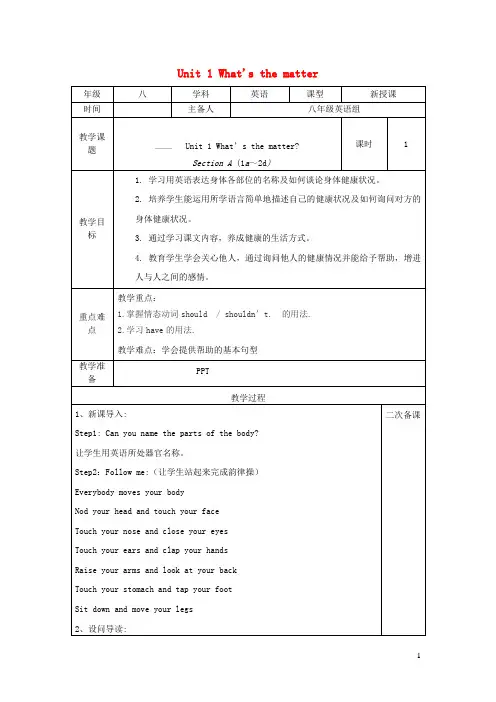
Unit 1 What's the matter年级八学科英语课型新授课时间主备人八年级英语组教学课题Unit 1 What’s the matter?Section A (1a~2d)课时 1教学目标1. 学习用英语表达身体各部位的名称及如何谈论身体健康状况。
2. 培养学生能运用所学语言简单地描述自己的健康状况及如何询问对方的身体健康状况。
3. 通过学习课文内容,养成健康的生活方式。
4. 教育学生学会关心他人,通过询问他人的健康情况并能给予帮助,增进人与人之间的感情。
重点难点教学重点:1.掌握情态动词should / shouldn’t.的用法.2.学习have的用法.教学难点:学会提供帮助的基本句型教学准备PPT教学过程1、新课导入:Step1: Can you name the parts of the body?让学生用英语所处器官名称。
Step2:Follow me:(让学生站起来完成韵律操)Everybody moves your bodyNod your head and touch your faceTouch your nose and close your eyesTouch your ears and clap your handsRaise your arms and look at your backTouch your stomach and tap your footSit down and move your legs2、设问导读:二次备课4. 如果你的头和脖子明天仍然疼的话,请去看医生。
五.拓展探究Homework: Make up a conversation between a doctor and a patient.课堂小结本课通过身体器官韵律操导入课时内容,激发学生的学习兴趣,提高课堂教学的效率,同时针对学生日常生活中的常见症状,让学生在列举过程中掌握患病方式的三种表达方式。
人教版八年级英语下册Unit1What’sthematter(16课时)教学设计

2.增强学生的健康意识,使其认识到健康的重要性,养成良好的生活习惯。
3.培养学生积极向上的心态,面对困难和挫折时,能够保持乐观,寻求帮助。
4.通过学习英语,拓宽学生的国际视野,使其了解并尊重不同文化背景下的健康观念。
5.鼓励学生参与课堂活动,增强自信心,培养合作精神。
3.加强词汇教学,通过游戏、竞赛等形式,帮助学生记忆和巩固词汇。
4.设计多样化的听力练习,提高学生的听力水平,培养其英语语感。
5.关注学生的情感态度,引导他们正确面对健康问题,培养积极的心态。
三、教学重难点和教学设想
(一)教学重难点
1.词汇和短语:本章节的重点词汇和短语涉及描述健康问题的各个方面,如身体部位、症状等。这些词汇和短语的掌握对于学生能够流畅地表达和交流至关重要。
3.听力训练:利用课外时间,观看英语原声视频,如健康主题的TED演讲或医生与患者的对话,提高听力水平,并记录下新学到的表达方式。
4.口语作业:与同学组成小组,进行角色扮演,录制一段关于健康问题的对话视频,要求每个成员都有发言机会,并在视频中加入适当的身体语言。
5.写作练习:写一篇关于“如何保持健康生活方式”的短文,至少80词,使用本节课学习的词汇和句型,表达个人观点。
3.学生分享:鼓励学生分享自己在生活中遇到的健康问题及解决方法,激发学生兴趣,为新课学习做好铺垫。
(二)讲授新知
1.教学内容:教师针对本节课的重点词汇、短语和句型进行讲解,如:“What’s the matter?” “I have a toothache/too much homework.” “You should/need to…”等。
人教版八年级英语下Unit1What’sthematter(SectionA3a4c)说课稿
5.联系生活:将教学内容与学生的生活实际相结合,让学生感受到英语学习的实际意义,提高他们的学习兴趣。
三、教学方法与手段
(一)教学策略
我将采用任务型教学法、情境教学法和合作学习法作为主要教学方法。任务型教学法通过设计真实、有意义的任务,让学生在完成任务的过程中习得语言知识,提高语言运用能力。情境教学法则是通过模拟生活情境,让学生在情境中感知、体验和运用语言,增强学习的现实意义。合作学习法则强调学生之间的互动和协作,通过小组讨论、角色扮演等活动,促进学生之间的交流与合作,共同完成学习任务。选择这些方法的理论依据主要是交际语言学习理论、建构主义学习理论和人本主义学习理论,这些理论强调学习者的主动参与、意义建构和情感因素在学习过程中的重要性。
(三)互动方式
为了促进学生的参与和合作,我计划设计以下师生互动和生生互动环节:
1.师生互动:通过提问、回答、示范等方式,引导学生积极参与课堂讨论,及时给予反馈和鼓励,建立良好的师生互动关系。
2.生生互动:组织学生进行小组活动,如角色扮演、小组讨论、共同完成任务等,鼓励学生相互交流、相互学习,提高合作能力。
(三)学习动机
为了激发学生的学习兴趣和动机,我将采取以下策略或活动:
1.创设情境:设计有趣的情境,如医生就诊、朋友关心等,让学生在真实语境中运用所学知识;
2.小组合作:组织学生进行小组讨论、角色扮演等活动,提高他们的参与度和合作意识;
3.激励评价:对学生的表现给予及时、积极的评价,关注每个学生的进步,提高他们的自信心;
1.生活情境:通过展示一位学生在体育课上受伤的视频,引发学生对健康问题的关注,进而引出本节课的主题“What’s the matter?”。
人教版八年级英语下册《Unit 1 Unit 1 What’s the matter?》教案.doc
《Unit 1 Unit 1 What’s the matter?》教案教学目标:1语言目标:描述健康问题的词汇,及如何根据别人的健康问题提建议。
2 技能目标:能听懂谈论健康问题的对话材料;能根据别人的健康问题提建议;能写出重点单词和重点句型,并能描述怎样对待健康问题。
3 情感目标:通过开展扮演病人等活动,培养学生关心他人身体健康的品质。
通过本课的阅读,培养学生处理紧急事件的基本能力,树立紧急事件时互相帮助的精神。
Section A 1 (1a – 2d)Step 1 Warming up and new words1.Look at a picture and learn the parts of the body.2.New words and phrases.Step 2 Presentation1a Look at the picture. Write the correct letter [a-m] for each part of the body.___arm ___ back ___ ear ___ eye ___ foot___hand ___ head ___ leg ___ mouth___ neck ___nose ___ stomach ___ toothStep 3 Listening1b Listen and look at the picture. Then number the names 1-5Listen to the conversations again and fill in the blanks.Conversation 1Nurse: What’s the matter, Sarah?Girl: I ___________.Conversation 2Nurse: What’s the matter, David?Boy: I _________________.Conversation 3Nurse: What’s the matter, Ben?Boy: I _________________.Conversation 4Nurse: What’s the matter, Nancy?Girl: I _________________.Conversation 5Betty: What’s the matter, Judy?Ann: She __________________.Step 4 Speaking1c Look at the pictures. What are the students’ problems? Make conversati ons.ExamplesA: What’s the matter with Judy?B: She talked too much yesterday and didn’t drink enough water.She has a very sore throat now.A: What’s the matter with Sarah?B: She didn’t take care of herself on the weekend. She was p laying withher friends at the park yesterday. Then it got windy, but she didn’t puton her jacket. Now she has a cold.Step 5 Guessing gamesGuess what has happened to the students by using the important sentenc es. Step 6 Listening2a Listen and number the pictures [1-5] in the order you hear them.2b Listen again. Match the problems with the advice.Step 7 Speaking2c Make conversations using the information in 2a and 2bA: What’s the matter?B: My head feels very hot.A: Maybe you have a fever.B: What should I do?A: You should take your temperature.Step 8 Role–playImagine you are the school doctor. A few students have health problems.Role-play a conversation between the doctor and the students.2d Role –play the conversationStep 9 Language points and summary1. What’s the matter?这是人们特别是医生和护士询问病人病情时最常用的问句, 意思是“怎么了?”其后通常与介词with连用。
What's the matter?教学设计
人教版初中英语八年级下册Unit 1 What’s the matter?微课教学设计(左雨潇)教学过程内容画面时间一、导入Step 1 Warming upand new words1.Watch a video andlearn some parts ofthe body.2. Look at a boy andpoint out other partsof the body.1分50秒二、正课Step 2 Presentation1.Play a game tomemorize the words.Look at the form, thenfill in the blanks.1分钟2.Look at somepictures and learn thewords of disease.3.MakeconversationsA:what’s the matter?/what’s wrong?B:I have.../I get hurt.1分20秒三、练习Step 3 Consolidationnguage points2.Summary3.practice2分25秒四、结尾Step4 Extension1.Learn to prevent thecoronavirus fromdeveloping.20秒2.Play a video andgive studentsconfidence to win thewar(coronavirus).3.Homework 40秒教学反思我对此次微课进行了充分的设计,从词汇到短语再到对话,由浅入深,层层递进。
中间设计了对知识点的总结和整堂课的总结,穿插了小游戏和相应的练习旨在让学生对所学知识有所巩固。
本堂课也有许多不足之处,在引课和词汇教授的环节花费时间过长,对八年级学生来说有些单词在过去已经学习过,因此可以减少教授单词的时间,将更多的时间用于后面的习题部分,让学生对于所学的知识能够有更加清晰的记忆。
人教版八年级下册英语Unit1(第一单元)优秀教案
Unit 1 What's the matter?第一课时Section A (1a2d)【教学目标】1.重点单词:matter,back,sore,throat,stomachache,foot,neck,stomach,fever,lie,rest,cough,Xray,toothache,headache2 重点短语:have a sore throat,have a stomachache,have a cold,lie down,take one's temperature,have a fever,go to a doctor3 重点句式:—What's the matter?—She talked too much yesterday and didn't drink enough water.She has a very sore throat now.You should drink some hot tea with honey.It doesn't sound like you have a fever.You need to take breaks away from the computer.I think I sat in the same way for too long without moving.If your head and neck still hurt tomorrow,then go to a doctor.【学习重点】1 重点短语和句型2 询问对方身体状况的句型及答语【学习难点】询问对方身体状况的句型及答语【自主学习】一、预习课本P12新单词并背诵,完成下面的汉译英。
1 问题____________ 2.背部____________3 疼痛的____________ 4.嗓子____________5 胃痛____________ 6.脚____________7 脖子____________ 8.胃____________9 发烧____________ 10.平躺____________11 休息____________ 12.咳嗽____________13 X光____________ 14.牙疼____________15 头疼____________二、认真预习1a2d找出下列短语和句型。