
外研版高中英语必修二:Unit5SectionⅡBeijingOpera
高中英语学习材料(灿若寒星*制作整理)Section ⅡBeijing Opera & Experiment in FolkⅠ.单词拼写1.Marriage has completely ________ her.She is no longer what she used to be.答案:transformed2.The singer made her first ________ in a concert in Boston.答案:appearance3.The ________ of the killer is still unknown.答案:identity4.Quality education doesn't only ________ knowledge and ability.答案:combine5.Napoleon was a great ________,who is admired by many people.答案:general6.It's dangerous. You'd better put on your gas ________ (面罩).答案:mask7.Two of the candidates must be ________ (女性的).答案:female8.The red lines on the map ________ (代表) railways.答案:represent9.Your brother is a man of many ________ (才能).答案:talents10.I can lend you a spare ________ (钥匙) to the store until you get one cut.答案:keyⅡ.单项填空1.Ambassador Albright will ________ the United States at the ceremony.A.represent B.be on behalf ofC.present D.A or B解析:考查词义辨析。
句意:Albright大使将代表美国出席典礼。
represent“代表”;be on behalf of“代表,为了……的利益”;present“出现;赠送;提出”,故A和B都符合题意,所以选D。
答案:D2.Keep ourselves and our hearts open ________ we can experience the great joy that friendship can bring.A.so that B.even thoughC.as if D.ever since解析:句意:让我们打开心扉以便体验友谊带给我们的巨大快乐。
so that“以便”;even though“即使,虽然”;as if“好像”;ever since“从那时到现在”,故选A。
答案:A3.As we all know, the love of money is the ________ of all evils.A.base B.endC.root D.need解析:考查名词辨析。
句意:众所周知,爱钱是万恶之源。
从后面的of all evils可知爱钱是“罪恶的根源”,所以要用root。
故选C。
答案:C4.According to the art dealer, the painting ________ to go for at least a million dollars.A.is expected B.expectsC.expected D.is expecting解析:句意:据这个书画商所说,这幅画预计卖到至少一百万美元。
be expected to“预计做某事”。
故选A。
答案:A5.It ________ we had stayed together for a couple of weeks ________ I found we had a lot in common.A.was until; whenB.was until; thatC.wasn't until; whenD.wasn't until; that解析:考查连词用法。
句意:直到我们一起相处了几周后,我才发现我们有好多的共同点。
此处考查句型It is/was not until+被强调部分+that+其他部分,本题强调we had stayed together for a couple of weeks.故选D项。
答案:D6.If I don't get a pay rise, I'll ________.A.stop B.quitC.pause D.quilt解析:句意:如果我没涨工资,我就辞职。
stop“停止”;quit“辞职”;pause“暂停”;quilt“缝被子”,故选B。
答案:B7.The Gregs have ________ their garage ________ a guest room.A.translated; into B.traded; withC.transformed; into D.tried; with解析:句意:格雷格家把他们的车库改成了客房。
transform ...into“把……改变成……”,符合句意。
translate ...into“将……翻译为”;trade ...with“与……交易……”;try“尝试,努力”,搭配错误。
答案:C8.Time will never come back once it passes, so please ________ it.A.love B.saveC.treasure D.waste解析:句意:时间一去不复返,因此请珍惜时间。
love“爱”;save“节省,节约”;treasure“珍惜”;waste“浪费”。
由句意可知treasure为最佳答案。
答案:C9.She hasn't much feeling for the ________ of nature.A.joy B.pleasureC.beauty D.present解析:句意:她对大自然的美缺少鉴赏力。
分析句子结构可知,此处应填入beauty“美”,为抽象概念,是不可数名词。
joy“高兴,乐事”;pleasure“愉快,乐事”;present“礼物,赠品”。
答案:C10.How men first invented words is unknown.________,the beginning of language is a mystery.A.In other words B.In a wordC.In words D.In conclusion解析:句意:没有人知道人类起初是怎样发明文字的,也就是说,语言的起源是个谜。
in other words“换句话说”,符合句意。
in a word“总之”;in words“用语言”;in conclusion“最后,总之”。
答案:AⅢ.完形填空In the depths of my memory, many things I did with my father still live. These things have come to represent, in fact, what I call __1__ and love.I don't remember my father ever getting into a swimming pool. But he did __2__ the water. Any kind of __3__ride seemed to give him pleasure. __4__ he loved to fish; sometimes he took me along.But I never really liked being on the water, the way my father __5__. I liked being at the water, moving through it, __6__ it all around me. I was not a strong __7__,or one who learned to swim early, for I had my __8__. But I loved being in the swimming pool close to my father's office and __9__ those summer days with my father, who __10__ come by on a break. I needed him to see what I could do. My father would stand there in his suit, the __11__ person not in swimsuit.After swimming, I would go __12__ his office and sit on the wooden chair in front of his big desk, where he let me __13__ anything I found in his top desk drawer. Sometimes, if I was left alone at his desk __14__ he worked in the lab, an assistant or a student might come in and tell me perhaps I shouldn't be playing with his __15__. But my father always __16__ and said easily, “Oh, no, it's __17__.” Sometimes he handed me coins and told me to get __18__ an ice cream ...A poet once said, “We look at life once, in childhood; the rest is __19__.” And I think it is not onlyw hat we “look at once, in childhood” that determines our memories, __20__ the person who, in that childhood, looks at us.语篇解读:本文讲述了作者在孩提时代与父亲之间的一些故事。
北师版英语必修2 Unit 5 lesson 2 Beijing Opera 3
Unit 5 Lesson 2 Beijing Operaword是一个十分常用的单词,其含义丰富,搭配能力强。
为了便于同学们全面掌握其用法,现将其常见用法归纳如下。
一、word的基本含义1.(指用声音或用书面形式表达的)词.作可数名词用。
如:The story is told in words and pictures. 讲这个故事的时候配有图片。
It's known that the words in the dictionary are arranged in alphabetical order. 众所周知,词典中的词是按字母顺序排列的。
2.(指人说出的)话;语言.作可数名词用。
如:He didn't say a word about his son's bad manners.他对他儿子无礼貌的行为一句话都没说。
I don't believe a word of his report. 他的报告我一句话都不相信。
You must show your support by deeds, not by words. 你必须用行动支持,不能空口说白话。
3.消息;信息.通常只能用单数,且不能用冠词修饰。
如:Please send me word that you arrive in Paris safely. 请把你平安到达巴黎的消息告诉我。
Word came that the bird flu had been controlled all over China. 有消息说,中国所有地区的禽流感都得到了控制。
二、word构成的习惯搭配1. be as good as one's word 守信用。
如:You will find that Yang Wei is as good as her word. 你会发现杨维这个人很守信用。
2. address a few words to sb. 对某人讲几句话.如:Are you free now? I'd like to address a few words to you. 你现在有空吗?我有几句话对你说。
Unit 5 Rhythm Lesson 2 Beijing Opera 导学案 1-北师大必修2精品
Unit 5 Lesson 2 Beijing Opera导学案 1Learning aims1.To use general knowledge to think of possible answer before listening.2. To take notes and write down key words when listen to the interview.3. To practice asking for,giving and refusing permission.课前预习Task I: 词汇学习--根据语境,写出划线单词的意思,并背会。
1. What are the main instruments played in Beijing?( )2. She is in a carriage. ( )3. Many body movements can represent actions. ( )4. In other words,every action and movement in Beijing Opera is important.( )5. In general,her work has been good,but this essay is dreadful. ( )6.Dan are the female roles while sheng refer to the male roles in Beijing Opera.Task II: Do Exercise 1-3 on Page 24.课堂学习I .Listen for general informationWhat are mentioned about Beijing Opera?2. Listen for details能力提升词汇学习Notice some useful phrases in the listening text and give the meanings1.中国的国粹_________________________2. 在18世纪晚期__________________3. 换言之______________4. 在…中起到重要作用________________5. 把…联合起来________________6.请求许可______________________课后巩固空间1. 这个表演者实际上是两边各带着一面旗子走路。
北师大高中英语必修二Unit-5-Lesson-2-Beijing-Opera
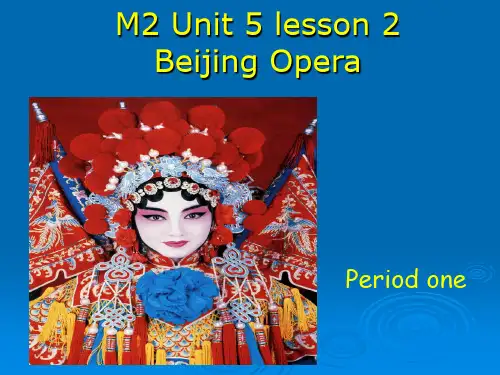
Warm Up Background Knowledge
Vocabulary (10 min)
Listening (10 min)
Retelling ( 12 min)
Consolidation ( 5 min)
Listening
pictures (3 min)
questions (5 min)
5 Listening Strategies(p24)
No.2 Use your general knowledge to think of possible answers. Wh-quewtions What skills…? Where was …performed? Why…music/singing…?
sheng
dan
jing
clown
What do you know about Beijing Opera? Work in pairs and choose the right answers.
1. When did Beijing Opera start? a) the late 18th century b) the late 19th century c) the late 20th century
Listen and use the strategies!
1. What skills do Beijing Opera actors need to have ?
Acting, talking, singing, music dancing and acrobatics.
On open-air stages, in markets, streets, teahouses or temple courtyards.
高中英语Unit5RhythmLesson2BeijingOpera教案1北师大版必修2
Unit 5 Rhythm Lesson 2 Beijing OperaTeaching aims:1.To practise using general knowledge to think of possible answers beforelistening.2.To practise getting the general idea when listening for the first time.3.To practise identifying key words to listen for.4.To practise asking for, giving and refusing permission.Teaching material:Lesson2, Unit 5, Module 2Teaching aid: A multimedia computerTeaching procedures:Stage 1 Lead-in■ In pairs, students look at the photographs and guess the possible answers to the questions, using their background knowledge.■ Check the answers with the class.■ Introduce more about Beijing Opera:1.Beijing Opera dates back to the 18th century.2.It is a combination of acting, talking, singing, music, dancing and acrobatics.3.The costumes are always in bright colour.Stage 2 Before you start■ Students study the words and the definitions in pairs and guess the possible definition for each word or phrase.■ Check the answers as a class and make sure students understand all the new words.Stage 3 Look and judge1.When did Beijing Opera start?2. How many main roles are there in Beijing Opera?3. What are the main instruments played in it?4. Match the main roles with their names:sheng male roles with brightly painted facesdan female rolesjing clown roleschou male rolesStage 4 Find out the definition■ Students study the words and the definitions in pairs and guess the possible definition for each word or phrase.■ Check the answers as a class and make sure students understand all the new words. Step 5 ListeningUse the Strategies :Listen & answer the questions.1.What skills do Beijing Opera actors need to have?2. Where was Beijing Opera performed at the beginning?3. Why does it have very loud music and a piercing singing style?4. Why do performers wear brightly coloured costumes?Step 6 TapescriptStage 7 ReadingRead the last part of the programme and answer the questions:1.What does the stage look like in Beijing Opera?2.How do symbols play an important role in Beijing Opera?Stage 8 Useful ExpressionsStage 9 Listening■ Students listen to the dialogue and make notes about Li Ming and Zhu Meiling. ■ Play the dialogue two or three times if necessary.■ Students can compare answers in pairs before checking answers as a class.Step 10 Function FileStep 11 SummaryStage 12 AssignmentHave you ever seen any shows? Write a passage to describe one unforgettable show you have ever seen.。
高中英语 Unit5 Lesson2 Beijing Opera教高一英语教案
Unit5 Lesson2 Beijing OperaⅠ.Analysis of the teaching material1.Status and FunctionThis is a listening lesson. It plays a very important part in the English teaching of this unit. By studying this part, it can help the students to improve their listening speaking ability and help them to learn more about our traditional culture—Beijing Opera.2.Teaching important points ﹠difficult pointsImportant points:1) Help the students learn more knowledge about Beijing Opera.2) Improve the Ss’listening and speaking ability.Difficult points:1) How to motivate the students’ interest in Beijing Opera.2) How to help the students master the listening strategies.Ⅱ Analysis of the students1.The Ss know a little about Beijing Opera, but not very much. And even some studentsare not interested in Beijing Opera.2.They don’t often use English to express themselves and communicate with others.3.Some Ss are not active in the class, because they are afraid of making mistakes. Ⅲ Teaching aims:1.Knowledge aim: Help the students learn more knowledge about Beijing Opera.2.Ability aim: 1) Improve the Ss’ listening and speaking ability. 2)To retellsomething about Beijing Opera3.Emotional aim: Help the Ss to develop their love to our traditional culture. Ⅳ Teaching ﹠ Learning methods1.Multimedia computer assisted instructionmunicative approach3.Student-centered teaching method4.Activity-based teaching methods5.Task-based learning methodsⅤ Teaching aids:1.Multimedia2.The blackboardTeaching procedures。
Module 2 Unit 5 Lesson 2 Beijing Opera 听力文本
Module 2 Unit 5 Lesson 2 Beijing Opera 听力文本Module 2 Unit 5 Lesson 2 Beijing Opera(Listening tapescript)Exercise 4Presenter: Welcome to What’s Your Rhythm. In today’s programme, we’re going to discuss Beijing Opera. But first, we have Professor Shang Xiaoming, to introduce us to the topic. We have also invited to the studio two high school students who want to know more about Beijing Opera. Professor Shang, what is Beijing Opera and when did it start?Prof. Shang: Beijing Opera is a national treasure of China. The art started in the late 18th century and it combines acting, talking, singing, music, dancing and acrobatics. Actors play one of four roles: sheng, male roles; dan, female roles; chou, clown roles and jing roles with brightly-painted face masks. Each role has its own singing and acting styles.Presenter: Professor Shang, could you tell us something about the style of the music and singing in Beijing Opera?Prof. Shang: Yes, certainly. In the early days, Beijing Opera was most often performed on open-air stages in markets, streets, teahouses or outside temples. The music had to be played loudly and the performers had to sing with sharp voices, in order to be heard over the crowds. Slowly, this kind of singing became a special style of Beijing Opera.Student 1: Professor Shang, the costumes in Beijing Opera are often very bright. Why is this?Prof. Shang: That’s a good question. As I mentioned just now, Beijing Opera was often performed on open-air stages and the stages were lit only by oil lamps. If the costumes weren’t in bright colours, the crowds wouldn’t be able to see them clearly.Exercise 61Mum: Yes, what is it? … I’m in a bit of a hurry.Li Ming: You know my classmate Yang Pufang.Mum: Is he the boy whose father is a doctor?Li Ming: Yes, that’s the one. Well, Pufang’s going to have a birthday party this Saturday afternoon. Is it OK if I go?Mum: But your grandpa and grandma are coming to stay with us this weekend.Li Ming: Please Mum. The party’s a special occasion and everyone’s going t o it.Mum: Oh, all right … I’ll let you go, but I need you to be back by 8 o’clock at the latest.Li Ming: Thanks, Mum. And I was thinking … can I go to the cinema with Pufang on Sunday? There’s a really good cartoon showing.Mum: What about your grandpa a nd grandma? Who’s going to help me look after them if you go?Li Ming: Oh, Mum. Please let me go to the cinema.Mum: You can go to Pufang’s birthday party but you can’t go to the cinema. I’m sorry, but I’m going to need your help this Sunday. That’s my fin al word!Li Ming: OK.2Meiling: Excuse me, Miss Wang?Miss Wang: Yes, Meiling.Meiling: Would it be all right if I handed in my project next week?Miss Wang: But you’ve had an extra week already.Meiling: Well, I’ve been ill all week and haven’t been able to do the work.Miss Wang: Are you better now?Meiling: Yes, much better. Thank you.Miss Wang: OK, you can give me your project first thing on Monday morning.Meiling: Thank you, Miss Wang. There’s one more thing.Miss Wang: Yes?Meiling: Could I write up the project in Chinese?Miss Wang: No, I’m afraid you can’t. You must use English like all the other students.Meiling: OK.。
Beijing Opera 教案 (Module2 Unit5 lesson 2)
Beijing Opera 教案(Module2 Unit5 lesson 2)1. Teaching content(Beijing Normal University version ) Module2 Unit5 Lesson2 Beijing Opera.2. Teaching methodsThis lesson is characterized by listening and speaking, together with word supplement. In the teaching process , use the following teaching methods: combination of listening and speaking , heuristic teaching, task-based approach.Through personal activities, pair work and group activities, Students conduct listening and speaking training.To enhance the attractiveness of the classroom, using multi-media teaching, producing Powerpoint courseware to show the whole teaching processes, students have a better learning interest. Guide students to downloaded from the Internet some articles about Beijing Opera, Cantonese Opera to appreciate and for comparison3. Teaching objectives1). Language knowledgeMaster, understand, use the following new words and phrases: combine, treasure, mask, acrobatics, costume, male, female, clown, symbol, represent, play an important role, with a flag on each side, an army of thousands.2). Language skills①Listening: using prediction, grasping main idea and key words, understand English interview programs.②Speaking: talk about some topics of Beijing Opera, such as: the history, the roles and the skills needed, the singing styles, the costumes, etc.③Reading: collect and read some articles about the Beijing Opera and Cantonese Opera both in English and Chinese and tell the differences and similarities between the two.④Writing: write an English introduction to Beijing Opera(150words).3). Emotional goalsThrough the teaching of Beijing Opera, get students to understand and love Chinese cultural treasures; enable students to exchange success and joy in using English; get students to learn to cooperate and help each other.4). Learning StrategyBefore listening , predict the answers in the hearing process using the previous knowledge; while listening, try to seize the key words and understand the main idea; post listening, communicate with each other using the information obtained and write something about it.5). Cultural awarenessEnable students to understand Beijing Opera is one of China's national essence, we should take it as a cultural window to promote understanding of China by foreigners.4. Important and difficult points in teaching1). Teaching focususing prediction, grasping main idea and key words, understand English interview programs; talk about some topics of Beijing Opera, such as: the history, the roles and the skills needed, the singing styles, the costumes, etc.2). Teaching difficultiesStudents are not very familiar with the topic of Beijing Opera , they have difficulty in understanding listening materials.5. Teaching proceduresBefore ListeningStep 1 Word studyI.Study some new words by showing some pictures:treasure、acrobatics、mask、costume)Example:T:What can you see in these pictures? What about picture 1?Ss:Two pandas.T: What’s in picture 2 ?Ss: China.T: Yes. It is a vase, which is made of china. What is picture 3 about?Ss: Gongfu/Wushu.T: Do you think all these things important?Ss: yes.T: They are of great value. They are the national treasure of China.II. Match the following words with their meanings. Then use the words to complete the sentences:1).combine a). the clothes worn in a play or film2).treasure b).mix two or more things3).mask c).something with special value4).acrobatics d).movements of one’s body in a skilful way5).costume e).something that covers one’s face1.This golden ring is a real___________.2.My mother sewed my ____________ for the school play.3.I love watching ___________ but it looks very difficult!4.The first step in making a cake is to _________ the milk and butter.5.The singer wore a__________ that was made of wood.Step 2 Leading-inThe teacher asks the students if they have watched Beijing Opera and if they can talk about it. Show a video about Beijing Opera to the students. While watching it, ask them to pay attention to the music, the voice of singing, the costumes, etc. Have a talk about Beijing Opera.Say today we’re going to listen to an interview about Beijing Opera. After listening, we’ll know much about it.Step 3 PredictionPredict the answers to the following questions according to your general knowledge:1.When did Beijing Opera start?A. the late 18th century.B. the late 19th century.C. the late 20th century.2.How many main roles are there in Beijing Opera?3.Which of the followings is true according to the passage.A. The costumes in Beijing Opera were black and dark.B. Dan is male roles.C. In the old times, Peking Opera was performed mostly on open-air stages.ListeningStep 1 Listening for the main idea.Listen to the TV programme and check your predictions.Step 2 Listening for details.I. Listen to the first part and do the following exercises.1.Fill in the blanks:Beijing Opera is a national ________ of China. The art started in the _______ century and it combines acting, _______, singing, music, dancing and _________.(Show a video about acrobatics in Beijing Opera to interest the students.)2. Match the main roles with their names.sheng male roles with brightly painted facesdan female rolesjing clown roleschou male roles(Show some pictures about the main roles in Beijing Opera. Ask the Ss )which picture is the role of sheng\ dan\ jing \ chou?What role do they each have, male or female role?What is used to cover jing’s face?What do we call chou in English?Sheng-male roleDan-female roleJing-male role with a maskChou- clown roleII. Listen to the second part and answer the questions.1. Where was Beijing Opera performed at the beginning?2. Why does it have very loud music and a sharp singing style?3. Why do performers wear brightly coloured costumes?III. Listen to the last part and finish the following exercises:1. Match each meaning with the picture on Page 24:They are in the city. Pic.1She is in a carriage. Pic. 2They are in their new bedroom. Pic.3She is on a horse. Pic.42. Listen to the last part of the programme and fill in the blanks:The stage design of Beijing Opera is usually very _______.When a lady is riding in a carriage, the performer actually walks _______________ .Four generals and four soldiers represent _________________.IV. Finish the information spider and do a summary:Beijing OperaHistoryMain rolesSkills neededCostumesSinging stylesStep 3 Speaking in groups:Group 1—history, main roles, skillsGroup 2—singing styles, costumeSuppose your partner is a foreigner. He/ She is interested in Beijing Opera. Have a talk about Beijing Opera in pairs.Example:A: Hi, Lihua. I have been in China for 3 months. But I can’t understand Beijing Opera very well. Can you tell me sth. about it?B: Of course,Beijing Opera is a national treasure.A:When did it start?B:…Post Listening1. Surf the internet for the information about Cantonese Opera and the compare it with Beijing Opera.2. Writing: Write a composition about Beijing Opera.3. Finish the listening diary。
英语必修2课件_teacher,Book 2 Unit 5 lesson 2 Beijing
Teaching planBook 2 Unit 5 lesson 2 Beijing Opera (Lesson 2 is designed in 2 periods)ObjectivesSs will be able to know something about Beijing OperaSs will be able to learn some useful words related to Beijing OperaSs will be able to learn some strategies of Listening for understandingSs will be able to retell something about Beijing Opera.Ss will be able to act out a role play using permission , informal or formalThis lesson is divided into 2 periodsTeaching ProcessPeriod 11)Warm upLook at the four pictures on p 24 While listening to a piece of Beijing Opera.Ask Ss questions: How many …? What do you think of …? Can you name some famous actors and actresses? Do you think people enjoy watching Beijing Opera? Why or why not?...Ss will finish up the Ex.1 1)-3) on p24 , text book and then get the keys on screen or blackboard.The Ss will look at some pictures about Beijing Opera masks and match the main roles with their names. And they will finish up the Ex.1 4) on p24Ss will finish up Ex2 on p 24 meanwhile the teacher will say “Look at the pictures and try to guess where they are. Pay attention to the costumes the actors and actresses wear and the stage designs.” Match each statement with a picture. And the keys will be given on the screen.2) Learn new words with pictures on screen and then Ss finish up the Ex.3 on p 243) Learn Listening Strategies on p24. There are the Strategies on the screen·Before listening, read the questions.·Use your general knowledge to think of possible answers.·Listen and identify key words to help you answer the questions·The first time you listen, try to get the general idea and take notes.·The second time you listen, listen carefully and try to note down the answers.The teacher will show “One Listening strategy by one example”4)Ex.4 on p25 Listen to the first and second part of a TV program. Use the strategies to answer the questions. What skills do Beijing Opera actors need to have ? The skills are ____ _______ _____ …Where was Beijing Opera performed at the beginning ? Places ____ ,_____,________...Why does it have very loud music and a sharp singing style? Because ___,____...Why do performers wear brightly colored costumes? Because ________________.....The Ss will get a handout and finish filling in the blanks.5)Ex.5 on p 25 Listen and read the last part of the program. Then answer the questions the Ss will finish up “filling in the blanks”What does the stage look like in Beijing Opera?How do symbols play an important role in Beijing Opera?6)Retell something about Beijing Opera. SS are individualized with assignment in groups.Period 21)Sum up the useful words for doing permission2) Learn useful words of permission3) Act out a situational play in group or class. SS are individualized in groups.4)Homework:Write an essay on Beijing Opera.Murmur the Beijing Opera in Chinese and EnglishOr fill in the blanks of the Beijing Opera in English。
2019-2020年高中英语必修2Unit5lesson2BeijingOpera2
2019-2020年高中英语必修2Unit5lesson2BeijingOpera2教学目的:练习学生的听力技能,能抓住关键词。
练习口语请求和拒绝的表达方式。
努力提高学生的语言输出能力-说语言技能:speaking, reading, writing语言知识:有关京剧的历史,文化。
教学辅助设施:幻灯片,微机教学过程:Ⅰ. Warm upShow pictures of Beijing OperaT: What kind of music is it?S:T: Yes, it is our cultural treasure—Beijing Opera. How much do you know it?S:T: introduce (Peking opera, the best-known Chinese Opera, was developed during the Qing dynasty (1644-1911). It is a dramatic form that includes dance, theater, music, and skilled performance. Character types depend on vocal styles. Performers wear dramatic make up or masks.)T: Can you name some famous actors and actresses? Who do you know ae the best performers in China?S: Cheng Yanqiu, Mang Lianliang, Qiu Shengrong ,Mei Lanfang and so on.T: show a slide of Mei Lanfang ( introduce Mei Lanfang)T: What role do they play in Beijing Opera?S: guide students to say out “sheng”, “dan”, “jing”, “chou”, “mask”ⅡListeningT: We have some knowledge about Beijing Opera, Now we do the exercise 1 before doing it first guess their answers.It is necessary to listen to the tape twice.Show students a chart about Beijing Opera’s structure1 / 2Do the exercise 2 and 3Do the exercise 4Read through the Strategies with the class and see if they know how to use any of these Strategies already.Students listen to the cassette and get the general idea. Play the cassette.Do the exercise 5, 6 and 7The teacher can draw a conclusion:Besides Beijing Opera, there are still other National Treasures in China. They serve as a window of China. And through this window, foreigners are able to understand Chinese culture better.ⅢSpeakingPractice your oral EnglishSuppose Smith e from America. He is interested in Beijing Opera. As his interpreter you are introduce Beijing Opera to him. .Do the exercise 9ⅣWritingWrite a position to introduce Beijing Opera its history and value,including Characters, scenes, costumes and skills needed. You can add some details, such as some names of play and famous artists.温馨提示:最好仔细阅读后才下载使用,万分感谢!。
Unit 5 Section Ⅱ Beijing Opera & Experiment in Folk
C.Kong Xiangdong won awards across the world and
finally became the youngest winner in Moscow's
Tchaikovsky National Competition. D.Kong Xiangdong first transformed his music in his Dream Tour Concert. 答案:(1)~(5) CBCAC
Unit 5 Rhythm
Section Ⅱ Beijing Opera & Experiment in Folk
新课导学 自主探究 板块 语言点一 单词集释 板块 语言点二 短语荟萃 板块 语言点三 句型解构 板块 语法 讲座
Step 1
Step 2
Step 3
识 记 . 掌 握
理 解 . 拓 展
B.He shaved off all his hair.
C.He created something new. D.He played Chinese folk music instead of classical music.
(2)What made Kong Xiangdong successful on the piano?
A.根据英文释义和首字母提示写出下列单词
1. male belonging to the sex that does not give birth to babies 2. female 3. treasure being a woman or a girl a collection of valuable things such as gold, silver and jewellery 4. combine to come together to form a single