
牛津译林版六年级上册英语全册语法知识点详解(unit1)
一、一般过去时的用法
(三)过去式变形规则 3. 其他动词。 (4)以“辅元辅”结尾的动词,双写这个辅音字母再加ed。如: stop→stopped、drop→dropped (5)不规则变化。如: go→went、see→saw、bring→brought、catch→caught、 sleep→slept、make→made、p)标志词 6. once(曾经);once upon a time(从前) eg: Once upon a time, the king liked new clothes. 7. last+一段时间(night/week/month/ year等) eg: We went shopping last Saturday. 8. ago(two days ago);long long ago eg: We had a picnic a week ago. 9. One day eg: One day, he got lost in the forest. 10.in +2020年以前的年份。 eg: Lily lived in Beijing in 2016.
二、现在进行时的用法
(四)注意事项 1. 根据主语单复数选用合适的be动词: 单数用is,复数用are 2. 动词ing的规则需牢记: (1)一般在动词后加ing。如:work→working、read→reading (2)以不发音的e结尾的动词,去掉e,再加ing。如:smile→smiling、write→writing。 (3)以重读闭音节结尾的且词尾只有一个辅音字母的,双写这个辅音字母加ing。常见的有: sit→sitting、stop→stopping、run→running、swim→swimming、shop →shopping。
跟着大鱼学语法,快速上分
牛津译林版六年级上册全册 语法知识点详解
Unit 1 Goldilocks and the three bears
目录
CONTENTS
01. 一般过去时的用法、标志词、变形规则 02. 现在进行时的用法 03. 感叹句 04. like用法 05. try on 、put on用法
二、现在进行时的用法
(三)标志词 1. now;right now(现在) eg:We are playing games now. 2. look!Listen! eg:Look!The kite is flying in the sky. 3. these days(这些天)。 eg:I am learning English these days.
三、感叹句
(一)由what引导
1. what+a/an+形容词+可数名词单数(+主语、谓语) eg:What a beautiful house (it is)!
2. what+形容词+可数名词复数/不可数名词(+主语、谓语) eg:What beautiful houses (they are)!
What nice weather (it is)!
三、感叹句
(二)由how引导
1. How+形容词(副词)+主语+谓语! eg: How beautiful the house is! 2. How+主语+谓语! eg:How time flies!
(三)区别
what引导的感叹句修饰的是名词,要考虑名词单复数变化,主语和谓语可省略; how引导的感叹句直接修饰主语,且主语和谓语不可省略。
一、一般过去时的用法
(二)标志词 3. just now(刚刚) eg: Your father went out just now. 4. then(那时);just then(就在那时) eg: Just then, the old man helped him. 5. that day(那天) eg: My mother made a cake for me that day.
一、一般过去时的用法
(一)含义 一般过去时是指过去某个时间发生的动作或存在的状态。 如:1. Long long ago, there was a king.
2. One day, two men visited the king. (二)标志词 1. yesterday; the day before yesterday(前天) eg: I went to the park yesterday. 2. this morning eg: She got up late this morning.
四、like用法
1. like+ 动词ing eg:He likes playing football. 2. like + the/this+名词单数(特指表示喜欢这一个) eg:He likes the bear. 3. like +名词复数(表示喜欢这一类) eg:He likes bears.
二、现在进行时的用法
(一)现在进行时的含义 1.表示说话时正在进行或发生的动作。 Eg: He is doing his homework now. 2.表示即将发生的动作。能这样用的动词有come、go、 leave等表示位置移动的动词。 Eg: The train is coming.(火车就要来了。) (二)现在进行时的结构和表达方式 表现为:“be动词+ 动词ing”
一、一般过去时的用法
(三)过去式变形规则 1. be动词:am was; is was; are were 2. 助动词:do did ;does did 3. 其他动词。 (1)一般直接加ed。如:work→worked, look→looked (2)以e结尾的动词直接加d。如:like→liked,live→lived smile→smiled、move→moved (3)以辅音字母加y结尾的动词,先变y为ied。如: try→tried、study→studied、carry→carried
六年级上册英语第一单元译林版知识点(一)
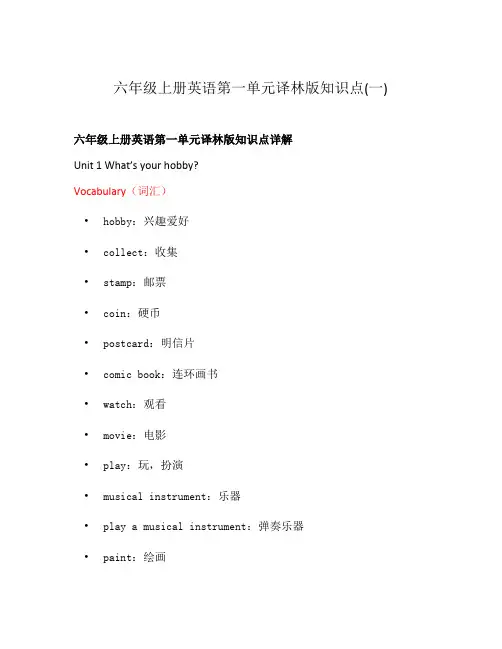
六年级上册英语第一单元译林版知识点(一)六年级上册英语第一单元译林版知识点详解Unit 1 What’s your hobby?Vocabulary(词汇)•hobby:兴趣爱好•collect:收集•stamp:邮票•coin:硬币•postcard:明信片•comic book:连环画书•watch:观看•movie:电影•play:玩,扮演•musical instrument:乐器•play a musical instrument:弹奏乐器•paint:绘画•dance:跳舞•swim:游泳•read:阅读•book:书籍•magazine:杂志•newspaper:报纸•photograph:照片•take photographs:拍照片•write:写作•letter:信Grammar(语法)Present Simple Tense(现在简单时)•表示经常性、习惯性或普遍性的动作或状态。
–I collect stamps.(我收集邮票。
)–He plays soccer every Saturday.(他每个星期六踢足球。
)Auxiliary Verb “Do”(助动词“Do”)•在疑问句和否定句中使用助动词“do”。
–Do you collect coins?(你收集硬币吗?)–She doesn’t swim.(她不游泳。
)Speaking(口语)•介绍自己的爱好和频率。
–A: What’s your hobby?(你的爱好是什么?)–B: I collect stamps.(我收集邮票。
)–A: How often do you collect stamps?(你多久收集一次邮票?)–B: I collect stamps once a week.(我每周收集一次邮票。
)Writing(写作)•介绍自己的爱好和频率。
–My HobbyMy hobby is collecting stamps. I collect stamps from different countries. I have a bigcollection of stamps. I also enjoy watching moviesand reading books in my free time.How often do I collect stamps? Well, I usually collect stamps once a week. Sometimes I canfind rare stamps in the market. It’s very exciting!I think collecting stamps is interestingand relaxing. It helps me learn about differentcultures and countries.What’s your hobby?Listening and Reading(听力和阅读)•听力和阅读练习,包括关于爱好的对话和文章。
译林版六年级英语上册各单元知识点归类整理(第一学期期末复习资料重点归纳)

Unit 1 The king’s new clothes一、重点词组1. 两个男人 two men2.一天 one day3.拜访国王 visit the king4.为你做新衣服make new clothes for you5.向国王展示他的新衣服 show the king his new clothes6.愚蠢的人 foolish people7.试穿这些神奇的衣服 try on these magic clothes8.聪明人 clever people9.穿着他的新衣服 in his new clothes10.步行穿过这个城市 walk through the city11.在街上 in the street12.看着国王look at the king13.指着他们 point at them14.嘲笑他laugh at him15.很合身 fit well16.玩一个游戏play a game17.讲故事 tell a story/tell stories18.在山上on the mountain19.说下一句话 say the next sentence20. 一位老人an old man21.住在这个房子里 live in the house22. 给这个小男孩讲一个故事tell the little boy a story23.认真思考 think hard24. 又得重新开始这个故事了have to start the story again25.从她那得到一张卡片 get a card from her26.在四点半 at half past four27.一个美国牛仔 an American cowboy28.穿着牛仔裤 wear jeans29.一个苏格兰男士 a Scottish man30.穿一条苏格兰短裙 wear a kilt31.住在两座山后 live behind two mountains32. 对他的家人说 say to his family33.努力工作 work hard34.累却快乐着 be tired but happy35. 在森林里 in the forest36.一些动物 some animals二、重点句子1.多么漂亮的衣服啊! What beautiful clothes!2.国王没有穿任何衣服。
Unit1Theking'snewclothes知识点(素材)译林版英语六年级上册

1.the king’s new clothes国王的新衣2.walk through the city步行穿过城市
3.make new clothes for you为你制作新衣4.point at the king指着国王
5.show the king his new clothes向国王展示他的新衣6.try on试穿
B.构成:a.主+be(was/were)+其他
b.主+实义动词过去式+其他
C.动词过去式的变化规律:1.直接+ed played worked
2.以不发音e结尾+d liked loved
3.辅元辅双写+ed stopped
4.辅+y变为i+ed studied carried
go – went come – came
六年级上册英语Unit 1
教学目标:
1.掌握并熟练运用语音、词汇及句型
2.了解牛仔裤的由来及苏格兰格裙
3.能描述过去发生的事情
一、重点词汇
long long ago很久以前magic有魔力的,神奇的clever聪明的foolish愚蠢的through穿过laugh大笑wear穿each每个sentence句子shout大叫quick迅速的,快的next下一个little小的,年幼的turn机会think想,思考hard努力地,费劲地child孩子turn into变成point指着
4).特殊疑问句及其肯定和否定回答
eg.a.What was there in front of the lion’s house?
There were some flowers.(对名词短语提问)
译林版英语六年级上册Unit 1单元知识
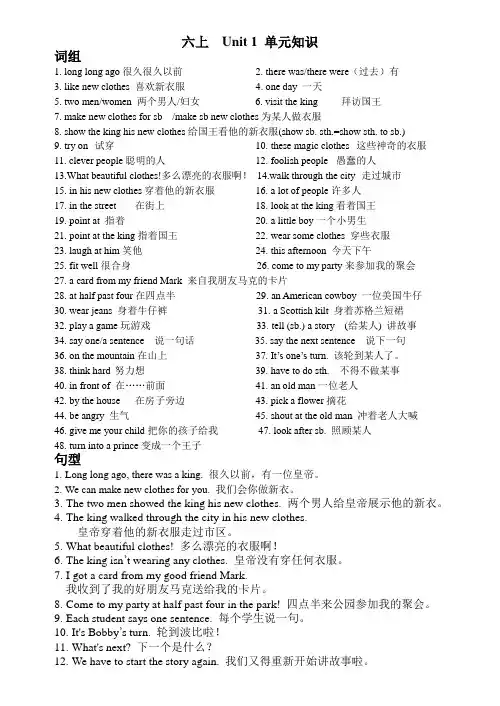
六上Unit 1 单元知识词组1. long long ago很久很久以前2. there was/there were(过去)有3. like new clothes 喜欢新衣服4. one day 一天5. two men/women 两个男人/妇女6. visit the king 拜访国王7. make new clothes for sb /make sb new clothes为某人做衣服8. show the king his new clothes给国王看他的新衣服(show sb. sth.=show sth. to sb.)9. try on 试穿10. these magic clothes 这些神奇的衣服11. clever people聪明的人12. foolish people 愚蠢的人13.What beautiful clothes!多么漂亮的衣服啊!14.walk through the city 走过城市15. in his new clothes穿着他的新衣服16. a lot of people许多人17. in the street 在街上18. look at the king看着国王19. point at 指着20. a little boy一个小男生21. point at the king指着国王22. wear some clothes 穿些衣服23. laugh at him笑他24. this afternoon 今天下午25. fit well很合身26. come to my party来参加我的聚会27. a card from my friend Mark 来自我朋友马克的卡片28. at half past four在四点半29. an American cowboy 一位美国牛仔30. wear jeans 身着牛仔裤31. a Scottish kilt 身着苏格兰短裙32. play a game玩游戏33. tell (sb.) a story (给某人) 讲故事34. say one/a sentence 说一句话35. say the next sentence 说下一句36. on the mountain在山上37. It’s one’s turn.该轮到某人了。
新译林版六年级上册英语知识点归纳总结

Unit 1 The king's new clothes1、一般过去时●一般过去时的概念一般过去时表示过去某个时间发生的动作或存在的状态。
●一般过去时的形式○1be动词的一般过去时形式be动词的一般过去时的构成是“主语+be(was/were)+其他”。
例如:I was ill yesterday. 我昨天生病了。
The boys were happy last weekend. 男孩们上周末很开心。
○2实义动词的一般过去时形式实义动词的一般过去时的构成是“主语+动词的过去式+其他”。
例如:She went shopping last Sunday. 她上周日去购物了。
I caught a big fish on the farm last weekend. 我上周末在农场抓了一条大鱼。
●一般过去时的句型○1肯定句:“主语+谓语动词的过去式+其他”。
例如:It was rainy yesterday. 昨天下雨了。
We had a picnic last week. 上周我们去野餐了。
○2否定句:“主语+was/were +not+ 其他”或者“主语+didn't+谓语动词原形+其他”。
例如:It wasn't rainy yesterday. 昨天没下雨。
We didn't have a picnic last week. 上周我们没有去野餐。
○3一般疑问句及回答:“Was/Were+主语+其他”或者“Did+主语+谓语动词原形+其他”,其肯定回答分别为“Yes,主语+did”或“Yes,主语+was/were”,否定回答分别为“No,主语+didn't”或“No,主语+wasn't/weren't”。
例如:—Was it rainy yesterday? 昨天下雨了吗?—Yes, it was. 是的,下雨了。
—Did you have a picnic last week? 你们上周去野餐了吗?—No, we didn't. 不,我们没有去。
译林版六上 Unit1语法总结
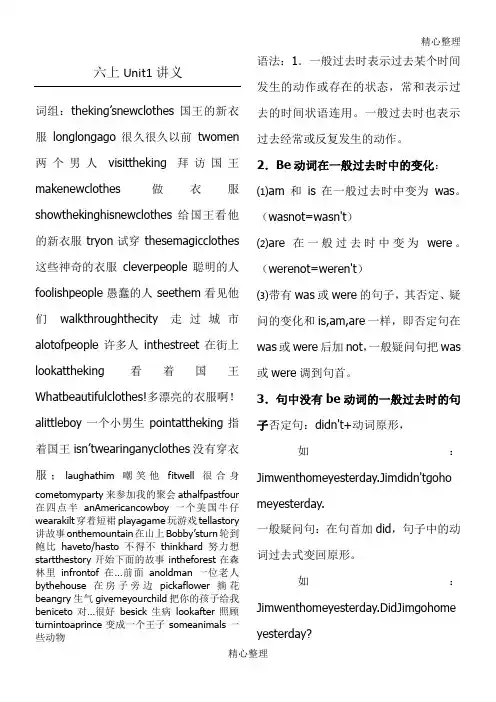
精心整理六上Unit1讲义词组:theking’snewclothes 国王的新衣服longlongago 很久很久以前twomen 两个男人visittheking 拜访国王makenewclothes做衣服们着国王服;在四点半anAmericancowboy 一个美国牛仔wearakilt 穿着短裙playagame 玩游戏tellastory 讲故事onthemountain 在山上Bobby’sturn 轮到鲍比haveto/hasto 不得不thinkhard 努力想startthestory 开始下面的故事intheforest 在森林里infrontof 在…前面anoldman 一位老人bythehouse 在房子旁边pickaflower 摘花beangry 生气givemeyourchild 把你的孩子给我beniceto 对…很好besick 生病lookafter 照顾turnintoaprince 变成一个王子someanimals 一些动物语法:1.一般过去时表示过去某个时间发生的动作或存在的状态,常和表示过去的时间状语连用。
一般过去时也表示过去经常或反复发生的动作。
2.Be 动词在一般过去时中的变化: ⑴am 和is 在一般过去时中变为was 。
were 。
疑was :一般疑问句:在句首加did ,句子中的动词过去式变回原形。
如:Jimwenthomeyesterday.DidJimgohome yesterday?特殊疑问句:⑴疑问词+一般疑问句?如:Jimwenthomeyesterday. DidJimgohomeyesterday?WhatdidJimdo yesterday?动词过去式变化规则:1.一般在动词末尾加-ed,如:23末尾4为i/Id//Id/is\am_____________do,does________ ____plant____________are_________ ___drink_____________play___________ go______________make________ take_____________dance__________ see___________eat___________ taste_____________worry__________ __draw____________put____________run____________kick___________pas s____________swim__________一、英汉互译。
牛津译林版小学英语六年级上册Unit1 The king's new clothes 知识点详解课件
表示习惯的动作 表示一时的喜欢
He like_w_a_l_k_in_g_ (walk) with his dag after dinner
make clothes for sb 为某人做衣服
我们能够为你做衣服。 We can make new clothes for you. can 是情态动词,后面动词变原形
show 展示 show sb sth = show sth to sb
两个男人给国王看了他的新衣服。
还可以怎么说
The two men showed the king his new clothes. The two men showed the new clothes to the king.
告诉,讲述
laugh
笑 ,大笑
magic clever foolish through
laugh wear
tell each
Words
1. like new clothes 喜欢新衣服
like v. 喜欢
【词组】 ①like doing sth. 喜欢做某事(习惯性喜爱) ②like to do sth. 愿意做某事(对具体某件事的渴望/一 时的打算)
in the forest
在……前面
in front of
摘花 pick a flower 每个学生 every student 在房子旁边 by the house
开始这个故事 start the story
走过城市
walk through the city
like doing like to do
变成一个王子
最后青蛙变成了王子。
At last,the frog turned into a prince.
译林版小学英语六年级上册全册知识点梳理
Unit 1 The king’s new clothes一、四会单词:magic 有魔力的,神奇的 clothes 衣服 clever 聪明的 foolish 愚蠢的through 穿过※laugh 笑,大笑 Shout 大叫 another 又一个each 每个 quick 迅速的,快的 think 想,思考 hard 努力地,费劲地next 下一个※turn 机会 sentence 句子※wear 穿※tell 告诉※little小的※child孩子二、四会词组:long long ago 很久以前 try on 试穿 point at 指着make new clothes for him 为他做新衣服 show sb. sth. = show sth. to sb. 向某人展示某物turn into 变成 make a sentence 造句in his new clothes 穿着他的新衣服tell sb. a story 给某物讲故事 live in 居住在 Be nice to ... 对...好 look after 照顾it is one’s turn 轮到某人了 have to 不得不 in front of 在...前面 walk by 路过think hard 努力地思考 shout at sb. 对某人大喊三.重点句型:1.Long long ago, there was a king. 很久很久以前,有一个国王;2.Two men visited the king. 两个男人来拜访国王;3.We can make new clothes for you. 我们可以为你做新衣服;4.The two men showed the king his new clothes. 这两个人向国王展示了他的新衣服;5.The king walked through the city in his new clothes. 国王穿着他的新衣服步行穿过城市;6.What beautiful clothes 多么漂亮的衣服四.语法:一般过去时一:一般过去时表示过去某一时候或某一段时间所发生了的事情或存在的状态;7.常与过去时间yesterday, this morning, just now, a moment ago, in May, last night / year / week, once upon a time, the other day, before …, when – clause, in the past连用;8.eg:Long long ago,there is a king. He liked new clothes.9.Long long ago 就是过去时的时间状语10.Beam,is,are的过去式有am,is---was are --- were不规则动词的过去式:laugh --- laughed live ---- livedLike ---- Liked look ---- looked一般过去时的基本结构:1.主语+bewas,were+宾语+其他Eg:He was a little boy.2.主语+动词的过去式+宾语+其他Eg: We brought some bread and honey to the park.Unit 2 What a day一.四会单词:※sunny 晴朗的※windy 有风的※cloudy 多云的※rainy 有雨的weather 天气※become 变成,变为honey 蜂蜜 drink 饮料※Sky 天空※bring 带来bread 面包※meet 遇见ant 蚂蚁 high 在高处※meet 遇见 know 知道cloud 云 rain 下雨lose 丢失 parrot 鹦鹉show 展览,展示 interesting 有趣的,有意思的二.重点词组:A parrot show 一场鹦鹉表演 fly kites/a kite 放风筝By bike = ride a bike 骑自行车 high in the sky 在高空中Rain all day 下了一整天的雨 well done 干得好Look sad 看起来伤心 fly away 飞走Fly high 飞得高 black clouds 乌云Become windy and cloudy 变得有风多云What happened 出什么事了climb up 爬上 hold onto 抓紧Watch a film看电影 do housework 做家务Have a picnic 野餐 on Monday morning 在星期一早上三.重点句型:1.What a day 多么糟糕的一天2.The weather became windy and cloudy. 天气变得多风且多云;3.What’s the matter with sb. = What’s wrong with sb. 某人怎么了/出什么事了四.语法:一般过去时二:不规则动词过去式:Becomebecame can could go went take tookBringbrought fly flew see saw lose lostClimb climbed happen happened find found wantwantedUnit 3 Holiday fun一.四会单词:※holiday 假日,假期 call 打电话 Bund 上海外滩star 星星※Excited 激动的※paper 纸※Ask 问※bottle 瓶子二.重点词组:Shanghai Museum 上海博物馆※Great Wall 长城※National Day 国庆节 Palace Museum 故宫Summer Palace 颐和园※At first 首先Tian‘anmen Square 天安门广场 a fashion show 一场时装秀※heavy rain 大雨 Come back to school 回到学校 the summer holiday 暑假※go well 进展顺利Pick some oranges 摘桔子 be excited about 对...感到兴奋Ask about 问关于...的情况 wear paper clothes 穿纸衣服 holiday fun 假期趣事It is time to do sth.= it is time for sth.到做某事的时间了二.重点句型:1.What did you/he do for the holiday 你/他假期做过什么2.He visited the Shanghai Museum. 他参观了上海博物馆;3.Did you go fishing 你去钓鱼了吗Yes, I did./ No, I didn’t.4.Where did you go for the holiday 你去哪儿度假的啊5.I saw many interesting things.我看到很多有趣的东西;6.How was your holiday 你的假期过得怎么样7.We picked some oranges and went fishing.我们摘了很多橘子和去钓鱼;三.语法一般过去时三不规则动词过去式Catchcaught dodid eatate getgotWearwore havehadUnit 4 Then and now一.四会单词:radio 收音机※ago ……以前use 用※watch观看telephone 电话※office 办公室※newspaper 报纸※news 新闻※e-book 电子书※with 用anywhere 随处,到处※yesterday 昨天televisionTV电视二.重点词组:read e-book 读电子书 listen to the radio 听收音机go on 继续 on the Internet 在网上Buy things from shops 从商店买东西do many things 做很多事 work hard 努力工作make friends 交朋友 all over the world 全世界do shopping 购物 look out of 朝……外看spell 拼读,拼写 make a sentence 造句then and now 过去和现在 wait for 等待mobile phone 移动电话,手机 get angry 变得生气三.重点句型1.He used the telephone at home and in the office to call people.他在家在办公室都是用座机给人们打电话;2.Mike’s grandpa listened to the radio and read newspapers for news.麦克的爷爷通过听收音机和看报纸获取新闻;3.She bought things from shops. 他从商店买东西;4.Now she has e-friends from all over the world.现在他有来自世界各地的朋友;4..What day is today今天是星期几四.语法一般过去时四不规则动词过去式:Can could get gotRead read 同音异形本课主要是一般过去时时态讲解的总结Unit 5 Signs一.四会单词:※sign标识※careful 小心,当心※mean 意思是※floor 地面litter 乱扔垃圾 restaurant餐馆someone 某人 smoke 吸烟smell 闻到 outing 外出游玩※around 在...周围二.重点词组:No eating or drinking 禁止吃喝be careful 小心,当心No littering 禁止扔垃圾want to do sth 想要做某事No parking 禁止停车go in 进入No smoking 禁止吸烟take...into...把...带进...里Danger 有危险※at a shopping center 在购物中心Wet floor 小心地滑be on an outing 远足No feeding 禁止喂食 in the forest 在森林里No walking 禁止踩踏tired and hungry 又累又饿No climbing trees 禁止爬树 look for 寻找No shouting 禁止大喊 a sign on a tree 树上的标识No swimming 禁止游泳walk on 继续走路No picking flowers 禁止摘花No fishing 禁止钓鱼三.重点句型:1.What does this sign mean 这个标识是什么意思2.It means the floor is wet.3.It is time for lunch. 到吃午饭的时间了;4.Bobby gives Sam a banana. give sb. sth.= give sth. to sb.三.语法:What does it meanIt means the floor is wet.它的意思是地滑;It means you can’t eat or drink there. 意思是你不能在那里吃喝Unit 6 Keep our city clean 一.重点单词或词组※keep 保持※clean 干净的※make 使...变得※dirty 脏的 air空气 Smoke 烟※ground 地面 rubbish 垃圾 dead死的messy 乱的 bin垃圾桶 plant种植More更多 museum博物馆 throw扔Skin果皮 slip 滑倒 fall 摔倒二.重点词组Keep our city clean 保持城市清洁the pictures of our city 我们城市的图片Make the air dirty 使空气脏Take the bus and the metro to school 乘公交和地铁去学校Walk to school 步行去学校Move some factories away from 把一些工厂移走Put rubbish in the bin 把垃圾放入垃圾桶Throw...on the ground 把...放在地面上Plant more trees 种更多的树 walk home 步行回家Well done 干得好 live in the city 住在城市Banana skin 香蕉皮 Pick up 捡起来slip on 滑倒 Go to hospital 去医院三.语法:1.What makes the air dirty 什么使空气变脏Smoke makes the air dirty. 废气使空气变脏;2.What can we do to keep our city cleanWe can take the bus and the metro to school.Unit 7 Protect the Earth 一、四会单词:Protect地球 earth地球 save节约※useful有用的※Much很多 waste浪费reuse再利用 energy能源 Most 大部分coal煤炭※oil石油※drive 开车,驾车※Wood木头※other其他的 plastic塑料glass玻璃 Project课题 poster海报gate 大门二、重点词组Come from 来自 cut down 砍伐too many 太多 save water 节约用水drink water 喝水 use water用水Every day 每天 in many places在许多地方Much water 大量的水 waste water 浪费水Save energy 节约资源 on earth在地球上A lot of energy 许多能源 make tables制作桌子Too much太多 too many 太多Be bad for 对...有害 plastic bags 塑料袋Glass bottles玻璃瓶 do a project 做课题Make a poster 制作海报 on the trees 在树上At the school gate在学校大门口 protect the Earth 保护地球三、重点句型1.We use water/plastic/wood/...to... 我们使用水,塑料,木材做...2.We should/shouldn’t...我们应该、不应该...3.In many places, there is not much water.在许多地方,没有足够的水;4.Most of our energy comes from coal and oil. 我们的大部分能源来自煤和石油;5.We should not drive so much because cars use a lot of energy. 我们不应该开车太多,因为汽车要使用许多能源;6.Too much plastic is bad for the Earth.太多的塑料对地球有害;7.We should protect the Earth and keep it clean.我们应该保护地球,让它保持干净;四、语法1.We use water/plastic/wood/...to... 我们使用水,塑料,木材做...Should/shouldn’t 应该/不应该We should use paper bags and glass bottles./save trees.We should not drive too much.Unit 8 Chinese New Year一.四会单词:※Get 收到※food 食物※Rich 富裕的※plan 计划firecrackers 爆竹 fireworks烟花二.重点词组Hong Kong 香港on Chinese New Year’s Day 在春节这天Next week 下周Chinese New Year’s Eve 大年夜,除夕Red packet 红包 lion dance 舞狮Make some cakes 做一些蛋糕 have dinner with sb.与某人吃饭Get sth from sb. 收到某人某物 at Chinese New Year 在春节The most important festival 最重要的节日Cook dumplings 煮饺子 get the red packet 收到红包After dinner 晚饭后 talk about 谈论Watch fireworks 看烟花 in the kitchen 在厨房里三.重点句型1.Chinese New Year is coming.春节就要到了;2.Suhai gets an email from her e-friend Anna in Hong Kong.苏海收到了她来自香港的网友的邮件;3.On Chinese New Year’s Eve,we’re going to have dinner with my grandparents,my aunt and uncle and my cousin. 在除夕夜,我们将和我的爷爷奶奶,叔叔阿姨和表姐一起吃年夜饭;4.On Chinese New Year’s Day,my parents are going to give me red packets.在新年这天,我的父母将要给我红包;5.What are you going to do at Chinese New Year 你春节将要做什么四.语法一般将来时:Be going to 结构,后面接动词原形,表示“将要做某事”常常与时间状语:tomorrow,next week等;1.用来表示按照计划或安排要发生的动作,有“准备,打算”的意思;这种主观意图,一般已做过事先安排,故其实现的可能性较大,其主语常常是人;eg: We are going to have a class meeting this afternoon. 今天下午我们打算开班会2.表示根据现有情况、某种迹象,判断将要或即将发生的动作;此时不含有主观意图,只是表示说话人对客观事态发展的判断或推测,此时主语可以是人,也可以是物;eg: It is going to be Chinese New Year next week.3.Be coming 表示“即将到来”,也有将来之意Eg:Chinese New Year is coming. 春节即将来临;He is coming. 他马上就来;。
小学英语六年级 上册 (牛津译林版)Unit1 king's new clothes 知识点复习资料
6A Unit 1一、重点词汇1. king(名词):国王;(纸牌中的)老K;(国际象棋的)王;the king of England 英格兰国王the king and queen of Spain 西班牙国王和王后the king of diamonds 方片K the Monkey King 美猴王,孙悟空the Lion King狮子王queen(名词):女王;王后;皇后;(纸牌中的)王后(牌),Q(牌)the queen of spades 黑桃王后 a queen bee蜂王prince(名词):王子princess(名词):公主2. ago(副词):之前,以前常用于一般过去时a week ago 一周前ten days ago 十天前five years ago 五年前some time ago 不久前long long ago(副词短语):很久以前[近义短语] many years ago[解析] long long ago 是表示过去的时间状语,通常用在一般过去时态中,其句子的谓语动词要用过去式。
Long long ago, there lived a king. 很久以前有个国王。
3. was(be的第一和第三人称单数的过去式,即am,is的过去式):是;在Long long ago, there was a big house in the forest.很久以前,森林里有一幢大房子。
4. were(be的复数和第二人称单数的过去式,即are的过去式):是;在-Where were you last weekend? -I was in the country.上个周末你在哪儿?我在乡下。
5. magic(形容词):有魔力的,神奇的a magic baby 神奇宝贝 a magic boy 神奇小子a magic cube 魔方The old man has a magic wand. 那位老人有一根魔棒。
【新】译林版六年级上册英语 第1-8单元全册重点知识点归纳总结
六上 Unit1 单元知识一、词组1 皇帝的新衣the king’s new clothes2 很久以前 long long ago3 某一天 one day4 两个男子 two men5 拜访国王 visit the king6 为你做新衣服 make new clothes for you7 给国王看他的新衣show the king his new clothes8 试穿 try on9 这些魔法衣服 these magic clothes10 聪明的人 clever people11 愚蠢的人 foolish people12 穿着他的新衣 in his new clotheswear his new clothes13 许多人 a lot of people14 在街上 in the street15 看着国王 look at the king16 一个小男孩 a little boy17 指着国王 point at the king18 嘲笑他 laugh at him19 非常合身 fit well20 穿着黄色毛衣 wear yellow sweater21 在四点半 at half past four22 穿着牛仔裤 wear jeans23 讲故事 tell a story24 每个学生 each student25 下一句 the next sentence26 轮到波比了。
It is Bobby’s tur n.27 努力地想 think hard28 下一句是什么?What’s nex t?29 不得不重新开始讲故事have to start the story again30 在狮子的房子前面in front of the lion’s house31 在房子旁边散步 walk by the house32 对着老人大喊 shout at the old man33 把你的孩子给我 give me your childgive your child to me34 和狮子住在一起 live with the lion35 对她很好 be nice to her36 照顾他 look after him37 快点 be quick38 穿过城市 walk through the city39 在山上 on the mountain40 住在森林里 live in the forest41 愤怒的狮子 the angry lion42 生病了 be sick / be ill43 变成一个王子 turn into a prince△44一个苏格兰男士 a Scottish man△45 穿一条苏格兰裙 wear a kilt△46 一个美国牛仔 an American cowboy47 What beautiful clothes!多漂亮的衣服!48 make the clothes for me 为我做衣服49 come to my party 来参加我的聚会50 pick a flower 摘一朵花51 the old man’s child 老人的孩子52 say one sentence 说一个句子二、句型1. Long long ago, there was a king. 很久以前,有以为国王。