
人教版2017高中(必修四)英语unit5_Theme_parks_Readingppt课件
farm
knight
Camelot park to enter a world of fantasy about ancient England
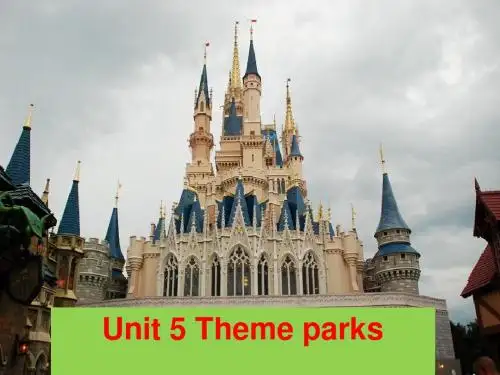
1. Disneyland can be found everywhere . Disneyland can be found in several parts of □ the world. 2. You can meet any cartoon character you like at Disney land . You can meet fairy tale or Disney cartoon □ characters at Disneyland.
• reading
preview---key words and expressions
• • • • • • •3.fantasy 4.attraction 5.unique 6.preserve 7.tourism 8.no wonder 9.be famous for 10.be modelled after
group 3
Camelot park
theme attractions
the ancient days and great deeds magic 1. Watching _________ shows with Merlin the wizard swords 2. seeing fighting with _________ or on horseback farm 3. visiting ______ area, if you like animals and learn about farms in ancient England
Pre-reading
What do you suppose a theme park is ?
It is a kind of amusement park which has a certain theme – that the whole park is based on.
Hong Kong Ocean Park
True False
× □
× □
3. Tourism develops where a Disneyland isTrue built. False
4. Dolly wood is in the mountains in the
theme
attractions
steam engine
bald eagles
roller coaster --- Thunderhead
If you want to have fun and learn about America’s historical southeastern culture
Hong Kong Disneyland
Disneyland
Camelot Park
Dollywood
2. Give the main idea of each paragraph:
Para. 1: Different kinds of theme parks. Disneyland. Dollywood
各种各样的 娱乐
幻想
吸引 独一无二的 保留,保护 旅游业 难怪 不足为奇 因…而闻名 根据…模仿
Warming up
Cooperative discussion: 1. What is a park? What is a park for?
2. What kind of activities do people do in a park?
Para. 2:
Para. 3:
Para. 4:
England’s Camelot Park
group 1
Disneyland
theme
1. Disney cartoon characters 2. fairy tales
pace attractions 1.You can travel through s___________ irate 2. Visiting a p__________ ship 3. Meeting your favorite artoon fairy tale or Disneyland c_________ xciting character 4. Also has many e_________ rides
tourism
With all these attractions, no wonder is increasing wherever there is a Disneyland
group 2
Dollywood
America’s traditional southeastern culture country 1. famous __________ music carpenters 2. seeing _________ and other craftsman make fashioned things in the old _________ way candy 3. visiting the _________ shop steam engine 4. riding on an ______ ________ old train preserve 5. seeing bald eagles in the p_________ length 6. Thunderhead which is famous for having the smallest most _________in the _________space
Disney c
artoon characters
sleeping beauty
fairy tales Cinderella’s carriage
Mermaid
pirate ship
swinging ship
Free-fall rides
These are all very a
ttractive
人教新课标高中英语必修4 unit5 theme parks-reading
A. Theme parks are more than amusement. D
B. Theme parks are places for people to amuse themselves.
C. Theme parks have a variety of things to see and do.
D. Theme parks have a certain idea.
2. According to the text, tourists can find Snow White and Mickey Mouse in __B__. A. World Waterpark B. Disneyland C. Central Park D. Camelot Park
paragraph.
There are various kinds of Para. 1 theme parks, with a different
park for almost everything.
Para. 2
Disneyland— the amusement park
fantasy
Para. 3 Dollywood—the traditional culture park England’s Camelot Park— the
5. If you want to see fighting with swords or on horseback, which park would you go? C A. Dollywood. B. Hyde Park. C. Camelot Park. D. Futuroscope.
Unit5《ThemeParks》课件17人教版必修4

Unit5《ThemeParks》课件17人教版必修4一、教学内容本节课我们将学习人教版必修4的Unit 5《Theme Parks》。
具体内容包括:1. Text A: Reading and Understanding “Roller Coasters, Spinning Teacups, and Tunnels of Love”,主要介绍主题公园的各类游乐设施及其特点。
2. Text B: Reading for Writing “Theme Parks: A Global Busines s”,探讨主题公园作为一个全球性行业的发展状况。
3. Grammar: Future Continuous Tense,学习将来进行时,用于描述将来某个时间正在进行的动作。
二、教学目标1. 让学生掌握主题公园相关词汇,如roller coaster、spinning teacups等,并能用英语描述各类游乐设施的特点。
2. 培养学生阅读理解能力,通过阅读文章了解主题公园的发展状况。
3. 学会使用将来进行时,描述将来某个时间正在进行的动作。
三、教学难点与重点1. 教学难点:将来进行时的用法,以及主题公园相关词汇的掌握。
2. 教学重点:阅读理解的训练,以及将来进行时的实际应用。
四、教具与学具准备1. 教师准备:PPT课件、黑板、粉笔。
2. 学生准备:教材、笔记本、彩色笔。
五、教学过程1. 导入:通过展示一组主题公园的图片,引发学生对主题公园的兴趣,同时引入新课。
2. 新课内容:Text A 阅读文章,讲解生词,分析文章结构,理解文章内容。
Text B 阅读文章,让学生了解主题公园的全球发展状况。
3. 例题讲解:讲解将来进行时的用法,并通过例题展示。
4. 随堂练习:让学生运用所学词汇和语法,进行口语练习和写作练习。
5. 小组讨论:分组讨论,让学生分享自己最喜欢的主题公园及原因。
六、板书设计1. Unit 5 Theme Parks2. 主题公园相关词汇:roller coaster、spinning teacups、tunnels of love等。
Unit5《ThemeParks》课件17人教版必修4

Unit5《ThemeParks》课件17人教版必修4一、教学内容1. Reading and Thinking: "A Visit to Disneyland"2. Discovering Useful Structures: Describing theme park experiences using "It's+adj./n. for sb. to do sth."3. Listening and Speaking: "My Dream Theme Park"二、教学目标1. 学生能够理解并运用关于主题公园的相关词汇和表达。
2. 学生能够用"It's+adj./n. for sb. to do sth."结构来描述主题公园的体验。
3. 学生能够通过听力练习,理解并讨论关于梦想中的主题公园的想法。
三、教学难点与重点教学难点:1. 掌握并灵活运用描述主题公园体验的句型结构。
2. 听力练习中,理解并准确获取信息。
教学重点:1. 主题公园相关词汇的学习和运用。
2. 使用"It's+adj./n. for sb. to do sth."结构进行表达。
四、教具与学具准备1. 课件(包括主题公园的图片、听力材料等)。
2. 学生分组活动所需的纸张和笔。
五、教学过程1. 导入:展示不同主题公园的图片,引导学生进行讨论,激发兴趣。
提问学生对主题公园的印象和经历。
2. 阅读与思考:让学生阅读"A Visit to Disneyland",并完成相关练习。
分析文章结构,提取关键信息。
3. 结构探索:引导学生学习和运用"It's+adj./n. for sb. to do sth."结构。
通过例句和练习,让学生掌握该结构的用法。
4. 听力与口语:播放听力材料,让学生回答相关问题。
人教版高中英语必修四 Unit 5 Theme parks Reading课件
have a walk
parks
have a picnic
play games
have fun
relax
What can we do in the park ?
What is a park for ?
Parks have many attractions. They provide people with a place to do various kinds of deeds to amuse hemselves and escape their busy lives for a while.
go on a __f_re_e_-_fa_l_l_drop
Para. 3 Dollywood
Park Theme Example of Activities
Name
Dolly wood
listen to_A_m_e_r_ic_a_n_c_o_u_n_tr_y_m_u_s_i,c
culture of the southeastern
Complete the table below.
Park name Disneyland Dollywood
Theme Example of Activities
travel…visit…meet …ride….
Listen to…see…ride.
Camelot
Watch…see….ride..
3. The title “Theme parks — fun and more than fun” means “People go there can get __A___”.
A. fun and something else
英语:unit_5《Theme_parks》阅读(新人教版必修4)

Yes,they do. Theme parks have a certain idea that the whole park is based on.
3. What’s the oldest theme park in the world ?
The oldest theme park in the world is Disneyland.
Theme: Walt Disney’s cartoon figures __________
marine, ocean parks, Include:________________ science parks, future parks _____________________
Other theme parks
Let’s go to the theme parks in the world.
Ocean Park in Hong Kong
sharks
dolphin
winged beauties
coral
First, say what is the theme of the whole passage. Then give the main idea in each paragraph.
Paragraph 2
Theme parks are different. They are very large and full of things to do, see and buy. They provide an active experience.
Paragraph 3
Theme parks have a certain idea (a certain theme) that the whole park is based on. One example is a sports park.
高中英语Unit 5 Theme parks 人教版必修四
Unit 5 Theme parksPart One: Teaching Design1.A sample lesson plan for reading(THEME PARKS ——FUN AND MORE THAN FUN)AimsTo help students develop their reading ability.To help students learn about Theme parks.ProceduresI. Warming upWarming up by discussingGood morning, class. Today we are going to visit theme parks. But first what do you think a theme park is? With a classmate discuss what you might do in a theme park.(For reference: A large Christmas party is being prepared at our Theme park. Visitors will find a dancing carnival, a European wedding, military band performances, classical Christmas plays and Christmas parades in the theme park. The 108-meter-tall Eiffel Tower will be lit up during the holidays with four types of lights.)Warming up by watching and listeningHi, every one. Today we are going to visit Theme parks. Look at the screen and listen to me telling you about them.This is the Universal's Islands of Adventure which was opened in 1999, making Universal Orlando the nation's second multi-gate theme park resort (after Walt Disney World). IoA was Universal's first non-studio theme park, and was intended to pay tribute to characters from books, comics, cartoons and legend, rather than movies.Of course, that hasn't stopped Universal and other studios from making films about almost every character represented in IoA over the past few years, rendering the park thematically indistinguishable from its sister, Universal Studios Florida.Warming up telling experiencesNice to see you again, boys and girls. As you have all travelled somewhere before I shall ask two of you at random to tell the class about their travel experiences.(For reference: Visiting Disney World was a childhood dream of mine, and I was able to realise it last year. I plan to keep going back, even given the overt commercialism. It is not a place I could live in, but it definitely has magic.One of the best parts was that I was able to interact with most of the Disney characters, even though their appearance and mannerisms varied from the Disney comic books I read.A few select pictures are included here, but my recommendation if you're taking a kid is to make sure they get some time with the characters. I can't think of anything cooler. )II. Pre-reading1. Looking and sayingWork in pairs. Look at the photos and theme parks and predict the contents of the text. When you are ready, join another pair and compare your predictions and the clues that helped you to make the predictions.(For reference: From the photos and title I guess that the text tells about Theme parks where yo u can joy yourselves and have fun with various activities…2. Talking and sharingWork in groups of four. Tell your group mates what you know about theme parks. Then the group leader is to stand up and share your group idea with the class.Boating LakePedaloe boats on ourboating lake with views ofMegafobia. Suitable for upto five people.(For reference: As you wander down Mainstreet USA in the Magic Kingdom Park of Walt Disney World, you might stop and take a peek in the Mainstreet Theatre. Here, Steamboat Willie shows how it all began depicting the first appearance of Mickey Mouse. At this point people usually stop for a bit, perhaps to rest from the hot Florida summer, laugh at Mickey's antics as he uses various animals as musical instruments (long before Beavis and Butthead were throwing cats in drying machines), and walk away amused and entertained.That was Walt Disney's primary goal. Today, people might consider the first cartoon featuring Mickey as art, along with a host of other creative works produced by people who work at Disney. Notable among them are Carl Barks and Don Rosa, whose works sell in the thousands. However, Walt Disney himself never thought that what he, and his employees, did was art: "I don't pretend to know anything about art. I make pictures for entertainment, and then the professors tell me what they mean." )III. Reading1. Reading aloud to the recordingNow please listen and read aloud to the recording of the text THEME PARKS ——FUN AND MORE THAN FUN. Pay attention to the pronunciation of each word and the pauses within each sentence. I will play the tape twice and you shall read aloud twice, too.2. Reading and underliningNext you are to read and underline all the useful expressions or collocations in the passage. Copy them to your notebook after class as homework.3. Reading to identify the topic sentence of each paragraphSkim the text and identify the topic sentence of each paragraph. You may find it either at thebeginning, the middle or the end of the paragraph.WaterfallA steep shoot sends youskipping across a shallowpool of water on a singlesledge. Beware, you mightget wet on this ride.(For reference: 1st paragraph: Parks provide people with a place to amuse themselves and to escape their busy lives for a while. 2nd paragraph: Many parks have been designed to provide entertainment. 3rd paragraph: Theme parks have a certain idea—a certain theme —that the whole park is based on. 4th paragraph: Some are history or culture theme parks. 5th paragraph: The oldest theme park in the world is Disneyland, built near Los Angeles, California in 1955. 6th paragraph: There are also science theme parks. )4. Reading and transferring informationRead the text again to complete the table.5. Reading and understanding difficult sentencesAs you have read the text times, you can surely tell which sentences are difficult to understand. Now put your questions concerning the difficult points to me the teacher.Closing down by doing exercisesTo end the lesson you are to do the comprehending exercisesNo. 1, 2 and 3 on page 34.Closing down by having a discussionDo you lake a theme park? Why or why not?(For reference: All over the world people seek stimulating experiences to take their mindaway from everyday troubles, and the United States is definitely no exception to this rule.Most of its residents have the money and time to entertain themselves as it pleases them --and visiting amusement parks certainly does please them. )Closing down by defining a theme parkWhat is a theme park? Define it in your own words.(For reference: How do theme parks differ from ordinary amusement parks? NationalAmusement Park History Association defines a theme park as "an amusement park inwhich the rides, attractions, shows and buildings revolve around a central theme or group of themes. Examples include the Disney parks, the Six Flags Parks and the Paramount parks." An amusement park, according to NAPHA, is "an entertainment facility featuring rides, games, food and sometimes shows." The World of Coasters’ glossary defines a theme park as "an amusement park which has one or more "themed" areas, with rides and attractions keyed to the theme of their location within the park. Disneyland, Knotts Berry Farm, and Busch Gardens Williamsburg are examples of theme parks." )2.A sample lesson plan for Learning about Language(Word formation)AimsTo help students learn about word formation.To help students discover and learn to use some useful words and expressions.To help students discover and learn to use some useful structures.ProceduresI. Warming upWarming up by discovering useful words and expressionsTurn to page 35 and do exercises No. 1, 2 ,3 and 4 first. Check your answers against your classmates’.II. Learning about Word formationThe basic part of any word is the root; to it, you can add a prefix at the beginning and/or a suffix at the end to change the meaning. For example, in the word "unflattering," the root issimply "flatter," while the prefix "un-" makes the word negative, and the suffix "-ing" changes it from a verb into an adjective (specifically, a participle).English itself does not use prefixes as heavily as it once did, but many English words come from Latin, which uses prefixes and suffixes (you can use the word affix to refer either to a prefix or a suffix) quite extensively. For example, the words "prefix," "suffix," and "affix" themselves are all formed from "fix" by the used of prefixes:∙"ad" (to) + "fix" (attached) = "affix"∙"pre" (before) + "fix" = "prefix"∙"sub" (under) + "fix" = "suffix"Note that both the "-d" of "ad" and the "-b" of "sub" change the last letter.Here are some of the most common Latin prefixes (for the meanings of the Latin roots, look up the words in a good dictionary):ab (away) abrupt, absent, absolvead (to) adverb, advertisment, afflictin (not) incapable, indecisive, intolerableinter (between, among) intercept, interdependent, interprovincialintra (within) intramural, intrapersonal, intraprovincialpre (before) prefabricate, preface preferpost (after) postpone, postscript, postwarsub (under) submarine, subscription, suspecttrans (across) transfer, transit, translateIII. Ready used materials for Word formation了解了英语构词法是迅速扩大词汇量的有效途径之一。
高中英语人教版必修四unit5_theme_parks__Readingppt课件
2. fun: enjoyment; pleasure (U) have fun: enjoy oneself 尽情地玩 for fun: for pleasure 为了娱乐 much / no fun 有趣/没趣 What fun! 多有趣!
It’s no fun spending the weekend doing nothing.
like the candy made in ancient England . □ □×
Visitors to Dollywood can taste candy
like the candy made in the American
South 150 years ago.
8. Camelot Park has the oldest roller coasteTrrue False
Where do you think they are?
Free-fall rides
Park Name
Dollyw ood
Theme
Example of Activities
listen to American country music, see culture of the traditional craftsmen and their work,
southeastern try some traditional candy, ride on an
USA
old steam engine, see bald eagles, ride
on thunderhead and other rides
Where do you think they are?
thunderhead
Unit5《ThemeParks》课件17人教版必修4
Unit5《ThemeParks》课件17人教版必修4一、教学内容本节课我们将学习人教版必修4 Unit 5《Theme Parks》的内容。
具体章节包括:1. Reading and Thinking: “Disneyland – the Happiest Place on Earth”;2. Discovering Useful Structures: Talking about theme park experiences;3. Listening and Speaking: “A Visit to a Theme Park”。
二、教学目标1. 学生能够理解并运用有关主题公园的词汇和表达方式。
2. 学生能够通过阅读和听力练习,获取有关迪士尼乐园的信息,提高阅读和听力技能。
3. 学生能够运用所学知识,描述自己在主题公园的经历,提高口语表达能力。
三、教学难点与重点教学难点:主题公园相关词汇和表达方式的理解与运用。
教学重点:提高阅读、听力、口语表达能力。
四、教具与学具准备1. 教师准备:PPT课件、录音机、磁带、单词卡片。
2. 学生准备:课本、练习本、字典。
五、教学过程1. 导入:通过展示迪士尼乐园的图片,引导学生谈论他们对主题公园的了解和喜爱程度。
2. 阅读与思考:学生阅读文章“Disneyland – the Happiest Place on Earth”,完成相应的阅读理解练习。
3. 语法结构:学习谈论主题公园经历的句型,如:“I visited…”,“I enjoyed… most”等。
4. 听力练习:学生听录音“A Visit to a Theme Park”,回答问题,提高听力技能。
5. 口语表达:学生分角色扮演,模拟在主题公园的经历,提高口语表达能力。
6. 小组活动:学生分组,用所学知识编写一段关于主题公园的对话,并进行展示。
六、板书设计1. Unit 5 Theme Parks2. 主要词汇:Disneyland, roller coaster, Ferris wheel, cotton candy, souvenir等。
《Theme parks》高中英语必修四Unit 5【2017人教版】
牵手课堂
• Tivoli Gardens
• Tivoli Gardens(蒂沃利公园)is a famous amusement park and pleasure garden in Copenhagen,Denmark.It is one of the oldest amusement parks in the world.
• 单句语法填空。
is swinging
• (1)Public opinion _______________(swing) against the government at present. As far as I am concerned, it is time for the officials to come out to make it clear.
• 单句语法填空。 • (1)The people on this list were chosveanriobuescause, in
__________(variety) ways, they bend the world to their will. • 解析:句意:我们把这些人列入了这个榜单,是因
(2) vary vi.& vt.变化;使不同,使多样化;改变 vary from sth.to sth.从……变化为…… vary in sth.在……方面不同 vary with sth.随着……的不同而变化
• ③The shopping﹣centre sells a variety of goods.
③What was the subject/topic of last night’s lecture? 昨晚讲座的题目是什么?(比用theme好) ④The theme of this year’s conference is “Ends and Means”. 今年会议的主题是“目的与手段”。(比用subject/topic好)
人教新课标英语必修4-Unit-5--Theme-Parks教案(重点单词讲解)
Unit 5 Theme ParksDate:_______________Teaching aims:1.Get the students to learn the new words and expressions in this unit.2.Let the students to get some information about parks and theme parks.3.Develop students’ ability in reading and speaking English.4.Get some knowledge about word-formation.Teaching difficult points:1.Learn to use the new words and expressions correctly.2.Retell the passage .3.Learn to guess the meaning of a new word by using the knowledge ofword-formation.Teaching important points:1.Remember the new words and expressions as many as possible.2.Get the general idea and try to retell the passage.3.Learn to use the new words and expressions correctly.4.Learn to use the knowledge of word-formation to remember new words. Teaching methods:1.Task-based teaching and learning.2.Cooperative learning.Ability aims:1.Learn to retell the passage according to their own notes.2.Get some knowledge about word-formation , try to use it to guess the meaning ofa new word.Emotion aims:1.Get some knowledge about parks and theme parks, and get to know that themeparks can offer us not only amusement, but also kinds of knowledge and exciting experiences.2.Develop students’ sense of cooperative learning.Teaching procedures:Step One: Leading-inHave a free talk about their experiences of parks.1.Have you ever been to any parks? What impressed you deeply in the park?2.Have you ever heard about Disneyland?Step Two: Warming upSB Book 4 Page 33.Step Three: Pre-readingWhat do you think a theme park is?Skim the passage on page 34 and try to check your ideas.Step Four: Reading1.Fast reading2.Intensive reading and notes-making.3.Retell the passage according to their own notes.Step Five: Homework.Try to finish the exercises of the unit in the students’ book.Postscript:_____________________________________________________________________ _____________________________________________________________________ _____________________________________________________________________Date:_______________Words and expressions:Teaching aims:1. Teach the new words and expressions.2. Let the students recite these new words.Teaching important point:To make the students have a full understanding of the words.Teaching difficult points:1. To improve the students’ ability.2. To enable the students to master the words.1. theme n(谈话、写作或乐曲的)主题,题目,主旋律theme park主题公园theme song主题歌The theme of our discussion today is “Asia in the1990s”.今天我们讨论的主题是二十世纪九十年代的亚洲。