
人教版高中英语必修2第4单元教案
教案设计
四、教学方法
1.自主学习:让学生课前预习,自主查找与本课时相关的内容。
2.合作探究:小组合作从网络上查找关于野生动植物的图片和资料,帮助他们熟悉话题以便于他们在学习过程中积极参与和主动探索。
3.结合多媒体技术,采用资源式、探究式的教学方法;注重交际活动,实施开放性讨论
五、教学过程
Step 1 Words preview
1._______far away in space or time
2. ___________to go down to a lower level
3. _________to do something to make a change
4. ________able to control events
5. _________打猎,猎取,搜寻
6. __________鉴赏,感激意识到
7. ____________保护…不受…伤害
8._________ 回答,响应
Step 2 Leading-in
1. Show a shot move about Wildlife Protection 成龙呼吁保护野生动物公益广告成龙
呼吁保护野生动物公益广告(英语)- 视频- 优酷视频- 在线观看
2. Have them in pairs discuss why they are endangered and show students some pictures. Step 3 Pre-reading
Show students some information about wildlife protection from the Internet and ask students to discuss the following questions in pairs,
1. What is wildlife protection about?
2. What endangered species do you know?
3. Why are they in danger of disappearing?
Step 4 Fast reading
1.Read the passage quickly, and finish the main idea .
Daisy took _____________to travel and talked with ____________ in her dream, which made her know _____________ of the wildlife protection.
2. Read quickly and silently, finish the true or false questions.
人教版新课标必修二第四单元
一、说教材
1、教材的地位及作用
本单元以保护动物为话题,旨在通过本单元的学习使学生了解很多动物已经灭绝或濒临灭绝,从而认识到保护动物的重要性和必要性。
并且通过探讨保护动物的措施和建议,引导学生发表自己的见解和看法,唤起学生保护动植物、维护生态平衡、保护我们家园的责任感。
本课Reading讲述的是一篇童话故事——Daisy乘坐飞毯跨越时空和藏羚羊、大象、猴子对话的神奇经历。
通过故事,帮助学生逐渐认识到保护野生动物的重要性,并了解该如何保护野生动物,号召人们热爱动物,保护动物,从我做起。
在本单元中,Reading前面的Warming up及pre-reading是该部分的铺垫,后面的listening, speaking等几部分都是Reading的延伸和扩展。
所以说Reading部分承载了本单元的主要信息,又集中了大量的有用词汇和语言结构,起到承上启下的作用。
(根据教学大纲及新课程的要求,确立了本课的教学目标及教学重难点。
)
2、教学目标
(1)认知目标
a、重点词汇和短语:wild, wildlife, protection, decrease, loss, reserve, hunt, zone, peace, respond,
distant, mercy, importance, powerful, affect, attention, appreciate, secure, die
out, in peace, in danger of, in relief, burst into laughter, protect…from…, pay
attention to
b、重点句式:Daisy had always longed to help endangered species of wildlife. (L.1)
I’m protecting my self from mosquitoes. (L.28)
No rainforest, no animals, no drugs. (L. 31)
But what an experience! (L.35)
(2)技能目标
•通过阅读,训练学生获取语篇信息、分析、处理、利用信息的能力;
•掌握猜测、略读、扫读的阅读技巧;
•掌握如何保护野生动物的知识;
•培养学生口头表达能力。
(3)情感目标
让学生学会如何保护野生动物,进一步意识到野生动物的生存环境日益恶化以及保护野生动物的行动刻不容缓。
3、教学重、难点
•让学生了解野生动物保护的知识;
•提高学生的阅读能力。
二、说学情
新课程强调“以人为本,以学生为主体”的教学思想。
那么作为一名合格的教师,了解学生是我们最基本的职责。
作为高中阶段的学生对周围的事物较为敏感,有自己的观点和看法,他们不满足于教科书上的知识,想获得更多的信息。
在英语学习上,他们不只是想把英语作为一门死记硬背的课程来学,更希望能学到知识性和趣味性兼有的内容,从英语学习中获得更多的知识和能力。
但是他们的词汇量是有限的,并且缺乏阅读技巧。
且从学生学习语言的规律来看,高一年级是学生的阅读能力提高的重要阶段。
而从以往普通班的教学来看,学生在阅读一篇300字以上的文章时,阅读速度较慢,有许多不好的习惯,如逐字阅读,朗读式阅读等等。
其次,他们的理解正确率往往低于70%。
三、说教法。
2020学年高中英语Unit4HistoryandTraditionsPeriodThree教案新人教版必修第二册
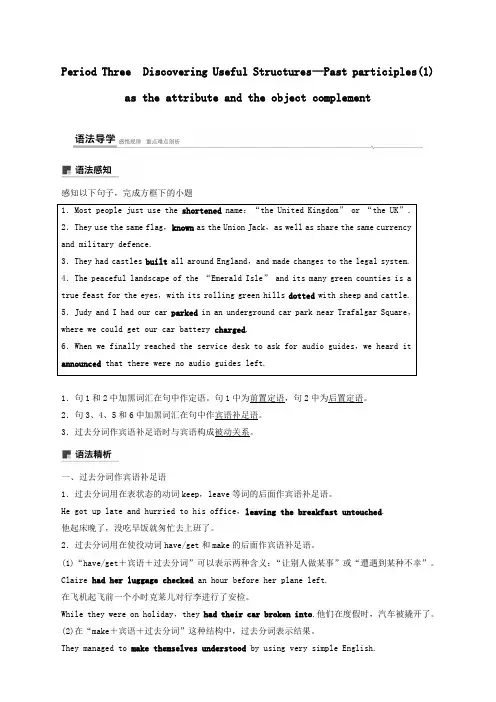
Period Three Discovering Useful Structures—Past participles(1) as the attribute and the object complement感知以下句子,完成方框下的小题1.Most people just use the shortened name:“the United Kingdom” or “the UK”.2.They use the same flag,known as the Union Jack,as well as share the same currencyand military defence.3.They had castles built all around England,and made changes to the legal system. 4.The peaceful landscape of the “Emerald Isle” and its many green counties is atrue feast for the eyes,with its rolling green hills dotted with sheep and cattle. 5.Judy and I had our car parked in an underground car park near Trafalgar Square,where we could get our car battery charged.6.When we finally reached the service desk to ask for audio guides,we heard it announced that there were no audio guides left.1.句1和2中加黑词汇在句中作定语。
高中英语人教版必修2Unit4单元教案正式版

Unit 4 Wildlife protectionThe First Period (Warming up & Talking)Teaching Procedures:Step One: Leading-in1.Show Ss the pictures of some rare animals.2.Ask Ss to guess their names and talk about them.Step Two: Warming up1.Ask the Ss to look through the words above the table on P25, and find out:Why did so many wild animals die out?(lack of food, bad environment and enemies, climate change, pollution…)2.Look at the table on P25, and work in pairs to retell the report, using completesentences.( The teac her may give an example of “pandas”).Example: pandaThe problem the pandas face in China is that they do not have enough food, because of the loss of bamboo growing areas. To solve this problem, China has set up a protection zone in Sichuan Province for the pandas. It is called Wolong Nature Reserve. Thanks to the effort, things have changed for the better. The number of pandas has risen from very few to around 50 after the growth of bamboo areas for the pandas.3. Ask some Ss to talk about Milu deer and South China tiger.Step Three: DiscussionAsk Ss to discuss the following questions in a small group.1)What other endangered species do you know?2)Why are they in danger of disappearing?3)Do you know of any wildlife that has disappeared?Answers: 1) antelope, bear, leopard [豹], whale, crocodile, elephant, golden monkey[金丝猴], giant salamander[娃娃鱼], Chinese Alligator[扬子鳄],dolphin, rhino…2) too much hunting, lack of food, bad environment, …3) dinosaurs, dodo, …Step Four: Language points1.as a result 结果;因此(放在句首或句中,用逗号与句子其它部分隔开,常用在有上下文表示原因的情况下)eg. He was lazy. As a result, he was late for school. 他懒。
高中英语必修二教案

高中英语必修二教案【篇一:人教新课标高一英语必修2_unit_1教案】unit 1cultural relicsi. 单元教学目标ii. 目标语言ii. 教材分析与教材重组1. 教材分析本单元以cultural relics为话题,旨在通过单元教学使学生了解世界文化遗产,学会描述它们的起源,发展和保护等方面的情况,复习并掌握定语从句,能就如何保护和处理世界文化遗产给出自己的观点。
1.1 warming up 热身部分提供了四幅图片,设计了三个问题让学生交流对于cultural relic的了解,并就此进行讨论。
这部分的目的是呈现本单元的中心话题“文化遗产”。
1.2 pre-reading 是reading的热身部分,提供了ambers的图片并就此此设计了两个问题。
这两个问题极易引起学生对amber的兴趣,并能引导学生对课文进行prediction。
1.3 reading是关于寻找丢失了的普鲁士国王威廉一世送给俄罗斯沙皇的那个琥珀房子的建立、转让、被毁、重建的整个历史。
设计这篇文章的目的是让学生了解什么是文化遗产以及讨论保护和重建文化从文化遗产的重要性和必要性。
1.4 comprehending既有知识性的问题,同时又跳出了课文,对文章进行整体评价,由易到难,有较好的梯度,全面考查学生对文章的理解。
exercise 1将人物及相关事件匹配,检验学生对文章细节的理解;exercise 2 将所给的问题与段落匹配,是段落大意理解题;exercise 3安排了对于重建lost cultural relics的意义进行讨论,使得学生能对本单元的主题进行较为深入的探讨。
1.5 learning about language 分discovering useful words and expressions 和discovering useful structures两部分。
其中第一部分的exercise 1着重训练对英语单词解释的理解。
高中英语必修第二册教案Unit 4 Information Technology—Viewing Workshop-北师大版(2019)
通过视听获取细节信息,并记录要点;从整体把握说话人的态度和立场,并通过讨论内化和应用语言。
能够说出两段视听材料中连接正反两方面论述主要观点的语言。
Step 5 Find out the “secret” ingredients
6) The market for printed books is dying.
获取视频中的基本观点。
学生能够说出视频中讲话人的立场和主要观点;学生能够完成活动2并筛选出正确信息。
2.表达关于纸质书是否将被电子书所取代的看法,并给出原因。
Step 3 Watch Part 1 again
1. With questions, watch Part 1 again.
2. Ss work in groups of four. Then copy the first five lines on the screen and discuss whether the speaker’s opinion changed when reading reversely.
通过小组分工合作交流及反复视听和操练,熟悉文章中出现的语言,从而更加清楚透彻地理解文章内容。
使语言学习从欣赏、发现,到学习、模拟,从而增强兴趣,提升英语素养。
学生能够创造性地仿写,体验语言学习的乐趣。
Unit 4 Information Technology
Viewing Workshop
教学目标
在本课结束时,学生能够:
1.获取两段视频谈论问题的基本观点;
2.表达关于纸质书是否将被电子书所取代的看法,并给出原因;
高中英语必修1-Unit4-Reading教案
Unit 4 Earthquakes: Reading——A night the earth didn’t sleep 教案课时:一课时课型:讲授课一、教材分析与学生分析:本课是高一必修1第4单元的阅读课型,本单元话题为“地震”,主要描写了1976年唐山大地震,各项语言活动也都是围绕地震展开。
Pre-reading 部分设置了两个开放性问题,目的是增加学生的生活常识,提高他们的应变能力。
这部分为接下来的阅读作了很好的铺垫,学生可通过参阅有关地震的书籍并运用一些生活常识来回答这两个问题。
Reading 部分是一篇新闻报道,介绍了唐山大地震前的预兆、地震造成的城市建筑和人畜损失以及地震后的救援情况。
通过本单元学习,掌握如何表达过去的事情,让学生对地震有更多认识,加强自我保护。
二、教学目标:(一) 知识目标:1.使学生了解自然灾害的相关词汇,并掌握复杂数字的表达法。
2.学习掌握与地震相关的词汇,如:shake,well,rise,smelly,pond,pipe,burst,canal,steam,ruin,injure,destroy,brick,dam,useless,steel,shock,quake,rescue,electricity,disaster,army,organize,bury,coal,mine,shelter,fresh,percent等,以及 right away, at an end, dig out, give out, thousands of以及一些优美句子的赏析。
3.熟练运用that, which, who, whose引导的定语从句(二) 技能目标:1.阅读技能的训练:让学生学会克服生词障碍,通过略读,归纳出文章的大意;通过细读,理清文章的总体框架与脉络,归纳出各部分的中心词;通过查读,捕捉文章的重要细节,培养学生获取、处理信息的能力。
2.让学生复述课文,分析、感悟作者的写作意图。
人教版高中英语必修二 Unit 4教案
教学内容一.Words1. affect v. 影响;侵袭,使感染 affection n. 喜爱;affected adj. 假装的;做作的;【拓展】be affected by被……侵袭;被……感动He was much affected by the sad news. 这个悲惨的消息使他非常难过。
辨析:effect与affecteffect用作名词时,意为“影响,效果”,常用于have an effect on结构中;用作动词时,表示“引起,使发生”。
affect用作动词,意为“影响”,常表示消极的影响。
用effect,affect的适当形式填空(1)New controls will e into effect next month.(2)Parents’ words and actions will affect children greatly.2. contain v. 包含,含有;容纳;控制,抑制 container n.容器;集装箱;货柜The stadium is big enough to contain 100 thousand audience. 这个体育场足够大能容纳10万名观众。
I could not contain my laughter. 我控制不住笑出了声。
This drink doesn’t contain any alcohol. 这种饮料不含任何酒精。
辨析:contain,include与holdcontain通常用来指某种容器中盛有某物,装有某物,还指某种物质中含有某成分或含有其他物质。
指作为组成部分而被“包含”或“容纳”在内。
include通常表示把某事物作为其中的一部分包含在内。
在句中常构成分词短语sth. included或including sth.。
hold通常指有能力容纳,相当于contain,seat。
The bottle contains olives. 瓶子里装着橄榄。
2019统编人教版高中英语必修第二册unit 4《History and traditions》全单元教案教学设计
【2019统编版】人教版高中英语必修第二册Unit 4《History andtraditions》全单元备课教案教学设计Unit 4 HISTORY AND TRADITIONSListening and Speaking【教学目标】1. 掌握本课的重要词汇与句式;2. 引导学生通过课内听力训练,提高听力技巧,锻炼听力水平。
【教学重难点】1. 本课时的重要词汇与句式;2. 引导学生通过课内听力训练,提高听力技巧,锻炼听力水平。
【教学过程】Step 1 Lead inLook at the photo on Page 37, and then get the Ss to ask and answer the questions.1. What do you know about the buildings in the photo?2. What traditions of that city/country do you know about?3. Why is it important to protect historic buildings and cultural traditions?Then have some Ss share their views on the questions.Step 2 Share views on historic sites1. Before listening, get the Ss to look at some photos of Qufu in Activity 1 on Page 38. And ask “What can you say about these places?”Get the Ss to discuss in groups, and then ask several volunteers to share their views with the class.2. Listen to a conversation between a British tourist and a Chinese student inFinally check the answers with the class.3. Listen again and decide whether these statements are true (T), false (F), or not mentioned (NM).(1) Listen and judge, and check the answers.1) Confucius said that learning without understanding leads to confusion.2) Xiao Kong is doing a research project on Confucius philosophy.3) As one of Confucius’ descendants, Xiao Kong’s name is recorded in the family tree.4) Dacheng Hall is the tallest building in Qufu.(2) Then go through the question as bellow, and choose the right answer.·Why do you think William said his hometown was similar to Qufu?A. There are famous halls in his hometown.B. There are no tall buildings in his hometown.C. Both places have a famous person who was born there.D. His hometown doesn’t allow other buildings to be more noticeable than the historic buildings.4. Activity 4(1) At first, go through the Understand idioms with the Ss.An idiom is an expression which means something different from the meaning of the individual words. Some idioms present an idea or paint a picture that gives a hint as to the meaning. Other idioms can only be understood from the context in which they appear.(2) Write down the English idioms that are used in the conversation. Explain their meanings and think about some Chinese equivalents.5. Discuss the questions in groups, and then get some Ss to share their answers.(1) What do you know about Confucius’ ideas on education? Think of two or three examples. What else do you know about Confucius and his philosophy?(2) Think about a historic site that you have visited, and give an introduction to its history and importance.Step 3 Pronunciation1. Read this part of the poem “If-” written by British poet Rudyard Kipling.Notice the linking sounds. Then mark the linking sounds after the modelIf you can make one heap of all your winningsAnd risk it on one turn of pitch-and-toss,And lose, and start again at your beginningsAnd never breathe a word about your loss;If you can force your heart and nerve and sinewTo serve your turn long after they are gone,And so hold on when there is nothing in youExcept the Will which says to them: "Hold on!"2. Repeat the poem after the recording.Step 4 Homework课后练习Unit 4 HISTORY AND TRADITIONSReading and Thinking【教学目标】1. 理解并熟练掌握本课的重要词汇与句式;2. 引导学生通过课内阅读,了解英国的历史,全面培养学生的阅读能力和技巧。
高中英语必修二第四单元教案 精华版
必修二Unit 4教案一.复习旧知灭绝动物大海牛于1768年灭绝;渡渡鸟于1681年灭绝;恐鸟于1800年左右灭绝;大海雀于1844年灭绝;开普(好望角)狮于1865年灭绝(生活最南端、最大的狮子亚种);阿特拉斯棕熊于1870年灭绝(唯一产于非洲的棕熊和熊类);南极狼于1875年灭绝(生活在地球最南端的犬科);美国缅因洲海鼬于1880年灭绝;……于20世纪90年代灭绝(区域性灭绝);亚欧水貂于1997年左右灭绝.据世界《红皮书》统计,20世纪有110个种和亚种的哺乳动物以及139种和亚种的鸟类在地球上消失了。
目前,世界上已有593种鸟、400多种兽、209种两栖爬行动物和20000多种高等植物濒于灭绝。
米长天蛾人(Mothman)是一种不明的奇异生物,又名黑天使,惟一的克星是上帝之网。
可以隐形,此时只有同伴相互可见,雌体较雄体强壮,每一具雌体都是雄体的启蒙者。
二.新课讲解1.As a result / as a result of区别as a result 作为状语来用,强调结果。
后面一般用逗号隔开。
as a result of + 名词(短语)/代词强调原因,意义相当于because of .Eg: He worked hard at his study. As a result, he passed the exam easily.As a result of his hard work, he passed the exam easily.2. Die outdie from 一般指除了疾病、情感、饥寒以外的原因而造成的死亡,指死于外因die of(内部因素)情感、疾病、饥寒死因die for为……而死,为……而献身,表示因事业或目的而死。
die out ①种类灭绝Elephants would die out soon if men were allowed to shoot.②逐渐消失Many old customs are dying out.③渐渐变小The fire died out in the enddie away 光、声音慢慢消失,风停下来He died from smoking/drinking……He hid behind the door until the footsteps had died away3. Reservevt. 1). 储备,保存;保留[(+for)]These seats are reserved for special guests. 这些座位是为特别的来宾保留的。
人教版高中英语必修二unit4学习教案
人教版高中英语必修二unit4学习教案一、教学内容二、教学目标1. 学生能够理解并掌握阅读材料中的生词和短语,如:oxygen, generate, climax等。
2. 学生能够运用一般现在时和一般过去时描述云的形成过程及特点。
3. 学生能够运用所学知识,进行有关天气和自然现象的讨论。
三、教学难点与重点1. 教学难点:一般现在时和一般过去时的运用,以及使用“It”作为形式主语的句子结构。
2. 教学重点:云的形成过程、特点以及与之相关的词汇和表达。
四、教具与学具准备1. 教师准备:PPT、黑板、粉笔、阅读材料。
2. 学生准备:课本、笔记本、字典。
五、教学过程1. 导入:通过展示一组有关天气和云的照片,引导学生讨论天气和云的特点。
2. 阅读与思考:学生阅读“A Day in the Clouds”一文,并完成相关练习,教师进行讲解。
3. 例题讲解:讲解一般现在时和一般过去时的运用,以及使用“It”作为形式主语的句子结构。
4. 随堂练习:学生完成Discovering Useful Structures部分的相关练习,教师进行点评。
5. 小组讨论:学生分组讨论,运用所学知识描述云的形成过程及特点。
六、板书设计1. Unit 4 A Day in the Clouds2. 词汇:oxygen, generate, climax等3. 句子结构:一般现在时、一般过去时,使用“It”作为形式主语七、作业设计1. 作业题目:根据课堂所学,写一篇关于云的形成过程及特点的短文。
2. 答案要求:使用一般现在时和一般过去时,不少于100词。
八、课后反思及拓展延伸1. 教师反思:关注学生在课堂上的参与程度,调整教学方法和节奏,以提高教学效果。
2. 拓展延伸:鼓励学生关注天气变化,观察云的形态,提高英语实际应用能力。
重点和难点解析1. 教学难点:一般现在时和一般过去时的运用,以及使用“It”作为形式主语的句子结构。
2. 例题讲解:讲解一般现在时和一般过去时的运用,以及使用“It”作为形式主语的句子结构。
高中英语人教版必修四单元教案:Unit4BodyLanguage
Unit 4 Body LanguagePart One: Teaching DesignTeaching goals1. Target Languagea. 重点词汇和短语重点词汇和短语misunderstand, similar, facial, expression, agreement, yawn, chest, gesture, adult, punishb. 重点句型或交际用语重点句型或交际用语Act out the following meanings, please.Please guess what I mean.Please show the actions, using body language.Now it is your turn to show the action / gesture.Please use either spoken words or body language to express your ideas.Please use both spoken words and body language to express your ideas.2. Ability goalsa. Enable the students to understand what a certain gesture of the body language means in a given situation.b. Enable the students to act out some meanings, requirements, requests or situations given in the target language.c. Enable the students to express with the target language the meanings given in body language.3. Learning ability goalsa. Help the students learn how to express themselves in body language when needed.b. Help the students understand others when body language is being used.Teaching important pointsa. Teach the students how to understand body language used in different countries or cultures as well as in different occasions.b. Teach the students how to use body language in the most appropriate occasions. Teaching difficult pointsa. Enable the students to realize the importance of body language in communication so that little or no misunderstanding may occur.b. Let the students know that there is both positive body language and negative body language.Teaching methodsa. Individual work, pair work and group work.b. Acting out by imitation, mime or with gestures and body movement.Teaching aidsA computer, a projector and some pictures.Teaching procedures & waysThe first period reading(COMMUNICATION: NO PROBLEM?)AimsTo help students develop their reading ability.To help students learn about body language.ProceduresI. Warming upWarming up by actingLook at the list of interpretation on the right side of the chart. Perform the action or the nonverbal behaviour on the left side.Examples Of Body LanguageWarming up by defining—What is body language?II. Pre-reading1. Looking and sayingLook at the man in the picture below. What does he say to you by his body language?Basically, how the ...... do I know? Or, I don’t know nothin! The shoulders are hunched and the hands are open signifying a big question mark.2. Talking and sharingBody language is the quiet, secret and most powerful language of all!According to experts, our non-verbal language communicates about 50% of what we really mean (voice tonality contributes 38%) while words themselves contribute a mere 7%.Our bodies send out messages constantly and often we don't recognize that we're communicating a lot more than we realize.Our understanding and use of non-verbal cues in facial expression are familiar to us nearly from birthIII. Reading1. Reading aloud to the recordingNow please listen and read aloud to the recording of the text COMMUNICATION: NO PROBLEM?. Pay attention to the pronunciation of each word and the pauses within each sentence. I will play the tape twice and you shall read aloud twice, too.2. Reading and underliningNext you are to read and underline all the useful expressions or collocations in the passage. Copy them to your notebook after class as homework.3. Reading to identify the topic sentence of each paragraphNext you are to skim the text to identify the topic sentence of each paragraph.4. Reading and transferring informationRead the text again to complete the table. Where is he/ she from? What does he/ she do when he/ she meet someone at the airport for the first time?Name Country Action MeaningMr GarciaJulia SmithAhmed AzizMadame Coulon5. Reading and understanding difficult sentencesAs you have read the text times, you can surely tell which sentences are difficult to understand. Now put your questions concerning the difficult points to me the teacher.6. Reading and translatingNow it’s time to translate the text into Chinese, sentence by sentence. Who will be the first to d o it?IV. Closing downClosing down by doing exercisesTo end the lesson you are to do the comprehending exercises No. 1 and 2 on page 26 and 27.Closing down by checkingC heck some of the following basic non-verbal cues and you'll recognize that you already speak and translate much of the language.“I’m surprised!” I’m shocked!” “I’m sad!”The second period Learning about Language(The ~ing form as the Attribute & Adverbial)I. Warming upWarming up by discovering useful words and expressionsTurn to page 27 and do exercises No. 1, 2 ,3 and 4 first. Check your answers against your classmates’.II. Learning about grammar1. Reading and thinkingTurn to page 25 and read with me the text of COMMUNICATION: NO PROBLEM? As you read along, pay attention to the uses of The ~ing form as the Attribute & Adverbial. (They are visitors coming from several countries. 作定语;Four people enter looking around in a curious way. 作状语;作状语; This is an exciting experience for you. 作定语; You stand watching and listening. 作状语;……)2. Doing exercises No. 1 and 2 on page 29Turn to page 29. Do exercises No. 1 and 2。