
牛津沪教中考英语第一轮复习八年级上册unit5-6词汇释义完形语法填空阅读理解综合练习(含答案)
牛津沪教深圳版八年级上册Unit 5-6综合练习一. 从下面每小题的A、B、C、D四个选项中选出可以替换划线部分的最佳选项。
【】1.Up to now, we have been to five countries.A、So farB、Very farC、In the pastD、In the future 【】2.What do you think of educational exchanges?A、What about thinking ofB、How about to thinkC、How do you likeD、How do you know【】3.Doing shopping is great fun.A、Go shoppingB、Going shoppingC、Going shopD、Go to shop 【】4. The fantastic tour made us excited.A、interestingB、boringC、wonderfulD、tiring【】5. I'm glad to meet you.A、happyB、sadC、unhappyD、angry【】6. We are sure that you can make it.A、catchB、succeedC、failD、go【】7. It's bad to laugh at the blind old man.A、make jokes aboutB、thank forC、help withD、learn from 【】8. The basket is full of flowers. How beautiful!A、is along withB、is filled withC、is friendly toD、is connected to 【】9. He has dreamed of becoming a captain since his childhood.A、when he was a childB、before he went to schoolC、since he was a childD、after he grew up【】10. She entered the secret room in the end.A、by the endB、at firstC、finalD、at last【】11.When we got to the house,we were welcomed by the host.A、 passengerB、customerC、ownerD、player【】12.All the guest enjoyed themselves in Mr Green's restaurant.A、 visitorsB、driversC、doctorsD、speakers【】13.Mike decided to tour around the world by bike.A、 lookB、pushC、goD、travel【】14.Mary was nervous when she i ntroduced herself in front of her classmates.A、 talked something aboutB、took care ofC、taughtD、provided【】15.You have your own idea,but you should respect others' opinions.A、 agree toB、be careful aboutC、not care aboutD、tidy up【】16.In the end,we went home together.A、At lastB、In the beginningC、Just thenD、By the end of 【】17.Mr Brown’s classes are always full of laughter.We all like her very much.A、filled withB、made ofC、come fromD、a bit of【】18.The students went into the classroom when the bell rang.A、capturedB、leftC、walkedD、entered【】19.This is an empty box.You can put your books into it.A、a very big boxB、a box having nothing in itC、a very beautiful boxD、a box my parents bought for me【】20.It’s wrong to make jokes about the disabled.A、make use ofB、run out ofC、make fun ofD、run of二.根据句子意思,有所给单词的适当形式填空。
1.Failure is the mother of_____________ (succeed)2.The_____________ (host) are very friendly to us.3.We should_____________ (exchange) our opinions in order to understand each other better.4.The British boy spent one week_____________ (learn) how to use chopsticks.5.Hello! I'm new here. Let me_____________ (introduce) myself first.6.What's the matter? The baby keeps_____________ (cry).7.It's right_____________ (respect) the old people.8.He looks very_____________ (happily) today.9.I_____________ (be) to many countries already.10.How many friends have you_____________ (make) in London?11She said some things a little__________________(difference) from you.12I have a few questions______________(ask).13It will be very_______________(wind) tomorrow.14Hello! This is Tom_____________(speak).15Chinese and Japanese are ______________(Asia).16.Keep_____________ (quietly). Daddy is sleeping.17.They all like the story except_____________ (he).18.This_____________ (wood) horse was huge.19.She_____________ (understand) what I said and smiled to me.20.There is no_____________ (different) between the two sentences.21You are wrong. In fact he is very clever, not_____________ (fool).22.I can't find my bike. Who_____________ (steal) it?23.There are many trees along both_____________ (side) of the streets.24.The soldiers_____________ (success) in catching the thief just now.25.Jim often makes_____________ (joke) about his little brother.二. 语法填空Many people say dolphins are very intelligent. They seem to be able to think, understand, and learn things quickly. But are they clever like humans or more like cats or dogs? Scientists say dolphin intelligence is 1.____________ (similarly) to human intelligence in some ways. How?Like hum ans, every dolphin has a “name”. 2. ___________ (its) is a special whistle(哨声). Scientists think dolphins,like people,“talk”to each other about a lot of things,such 3. _____________ their age, their feelings, or finding food. And, like humans, dolphins use system of sounds and body language to 4.____________ (communication). But understanding their conversations is not easy for humans. No one “speaks dolphin” yet, 5.______________ some scientists are trying to learn.Dolphins are also social animals. They live in groups, and they often come to play games from different groups and have 6. ______________ (funny), just like people. In fact,7.______________ (play) together is something only intelligent animals do.Dolphins and humans both make plans to get something they want. In the seas of southern Brazil, dolphinsuse 8.______________ interesting way to get food. When fish are near a boat,dolphins signal (发信号) to the9.______________ (fisherman) to put their nets(网)in the water. And the men can catch a lot of fish. What isthe advantage for the dolphins? 10. _________________ do they help the men? The dolphins can get some of the fish.三. 完形填空Joanne is American. She has never been abroad, but she has a very __1_ life! Every morning she drinks a cup of black coffee from Italy and eats some melon (瓜) from Thailand for __2__.At 7.40 am, she usually __3_ to work in her Japanese car. On the way to the company, she often listens to some Austrian music. If there is a __4__ she knows, she usually sing s along with the music.Joanne is a __5__ designer. She loves her job very much. She uses silk to make clothes which are sold all around the world. Recently she has put some __6__ for her clothes on the Internet __7__ they can sell better.When she gets home after __8__, she spends about forty minutes taking her dog for a walk and then cooks dinner. She likes to __9__ Chinese food. After dinner, she likes to watch Korean films on her DVD player.On Saturday afternoon, Joanne goes out with her friend Lucy. Usually, they go to an Indian dance class together. After that, they have a French __10__ in a restaurant.【】1、A、healthy B、ordinary C、international【】2、A、supper B、breakfast C、lunch【】3、A、drives B、walks C、rides【】4、A、car B、song C、company【】5、A、garden B、kitchen C、dress【】6、A、advertisements B、excuses C、requests【】7、A、as if B、in case C、so that【】8、A、school B、work C、supper【】9、A、have B、sell C、cook【】10、A、dance B、meal C、decision四. 阅读理解ALittle Mike’s grandmother died weeks ago. He missed her very much. One afternoon Mike went to the city park where his grandmother used to go. There he saw an old lady. She looked very kind. She was sitting there, watching pigeons(鸽子). Little Mike went up and sat next to her. He took out his food and drinks and gave some to her. She smiled at him.Her smile was very sweet and Mike wanted to see it again. She seemed to understand him, so once again she smiled. Mike was very happy.They sat there all the afternoon, eating and talking. As it was dark, Mike got up to leave. Before he left, he hugged the old lady and she gave him her sweetest smile.When Mike got home, his mother was surprised by the happy look on his face. “ I met an old lady in the park. Her smile was like the smile I used to see on Grandmother’s face.”The old lady also returned to her home happily. She told her son she had food and drinks with a little boy. “ He was as lovely as Bill.” She said. Her so n was surprised, because he had never been so happy since Bill, her grandson, died weeks ago.【】1.Little Mike went to the park and ________.A、played with pigeonsB、fed pigeonsC、met an old ladyD、saw a friend of his grandmother’s【】2.The old lady’s smile showed ________.A、she hated to meet the boyB、she wanted to get some drinksC、she missed her sonD、she liked the little boy【】3.Mike felt very happy because ________.A、he gave the old lady some food and drinksB、the old lady’s smile was like his grandmother’s smileC、he met his grandmother in the city parkD、he saw many lovely pigeons in the park【】4.Mike and the old lady ________.A、were good to each other(相互)B、knew each other wellC、often met in the parkD、did nothing that afternoon【】5.What do we learn from the story?A、When one feels unhappy, he must go to a park.B、Old people are always kind and happyC、Children should be polite to old people .D、When people get on well, they feel happyBOnce upon a time there was a monster( 怪物 ). He was very ugly ( 丑陋的 ), and had no friends. No one wanted to talk to him. Even other monsters thought he was ugly. He lived alone and was very unhappy because he was so lonely.“I wish I had a friend.” he said to himself every day. “One friend would be enough. Someone totalk to.” “Dear Editor( 编辑).” he wrote. “ I am an ugly monster. How can I find a friend?”“Dear Monster.” the Editor replied. “ Advertise(登广告)for a friend in this magazine.” The monsterwrote an advertisement.“M onster wants a friend, male or female. I have two heads, four arms, six legs and three tails. I have one blue eye, one green eye and one brown eye. Smoke comes out of my noses. But I am really a kind monster and will be a good friend to someone. If you wou ld like to meet me, please stand outside Blake’s Store at 6 p.m. on Friday, May 22nd. Write to me at Box 45. Everybody’s Magazine.”A few days later he went to the magazine. “Do you have any letters for Box 45?” he asked. The Editor looked in Box45. “Yes, there is one.” she said, and gave it to him.The monster opened the letter, and read, “Dear Monster, I think a person’s character (品质 ) is more important than his appearance(外貌). I will wait outside Blake’s Store on Friday. Please carry a flower so that I will recognize you. Yours sincerely, Alice Green. ”【】1.Why was the monster unhappy?A、He was so lonely.B、He was ugly.C、He had two heads.D、He had three tails.【】2.What did the monster advertise for?A、A magazineB、A friendC、An editorD、A male monster【】3.How did the monster describe himself in the advertisement?A、BadB、LonelyC、KindD、Different【】4.Which one isn’t mentioned(提到) about the monster’s appearance?A、He has two heads.B、He has six legs.C、He has one blue eyeD、He has a big mouth.【】5.The ending(结局) of story may be ___________.A、Alice will not meet the monsterB、Alice will meet the monsterC、The monster will not go to meet AliceD、The monster will be afraid to meet Alice.参考答案一.1-5 ACBBA 6-10 BABCA11-15 CADAA 16-20 AADBC二.1.success 2.hosts 3.change 4.learning 5.introduce6.crying7.to respect8.happy9.has been 10.made11.differences12.to ask 13.windy 14.speaking n16.quiet 17.him 18.wooden 19.understood 20.difference21.foolish 22.stole 23.sides 24.succeed 25.jokes三.1.similar 2.It 3.as municate 5.but6.fun7. Playing8.an9.fishermen 10.why 四.1-5ABABC 6-10ACBCB五.CDBAD ABDDB。
人教版.英语第一轮词汇复习 八年级(上) Units 5~6。

21. foreign(adj.)外国的 →_f_o_re_i_g_n_e_r (n.)外国人 32次 22. able(adj.)能够 →_u_n_a_b_l_e__ (adj.)未能;无法 →_a_b_i_li_ty___ (n.)能力;才能 →_d_is_a_b_l_e__ (v.)使失去能力;使残废 →_d_is_a_b_l_e_d_ (adj.)残疾的 9 次
形容词
18. main(adj.)主要的;最重要的 →_m__a_in_l_y__ (adv.)主要地;总体上;大致 7 次 19. common(adj.) 普通的;常见的 →_u_n_c_o_m__m_o_n___ (adj.)不普通的 ★_h_a_v_e_._.._in__c_o_m__m_o_n_ 有相同特征;(想法、兴趣等方面)相同 20. simple(adj.)简单的;易做的 →_s_im__p_l_er__ (比较级)更简单的 →_s_im__p_l_es_t_ (最高级)最简单的 →_s_im__p_l_y__ (adv.)仅仅;只;不过 6 次
7. When I was at primary school, I walked to school with my mum. Now I go to school by bus __o_n___ my own. [译林牛津八 (下)Unit 1 P17] 8. I completely lost myself ____in____ this wonderful book that I didn't hear someone calling me.
13. become(v.)→_b_e_c_a_m__e_ (过去式) →_b_e_c_o_m__e_ (过去分词)开始变得;变成 30次 14. lose(v.)→___l_o_s_t __ (过去式/过去分词)失去;丢失 8 次 ★_lo_s_e_o_n__es_e_l_f_in__ 沉迷于,专心于 15. send(v.)→___s_e_n_t__ (过去式/过去分词)邮寄;发送 6 次 ★_s_en__d_s_b_._s_th__. _______ =send sth. to sb.把某物寄/送给某人 ★_s_en__d_s_b_._/s_t_h_. _to__s_p_. __ 送某人/某物到某处
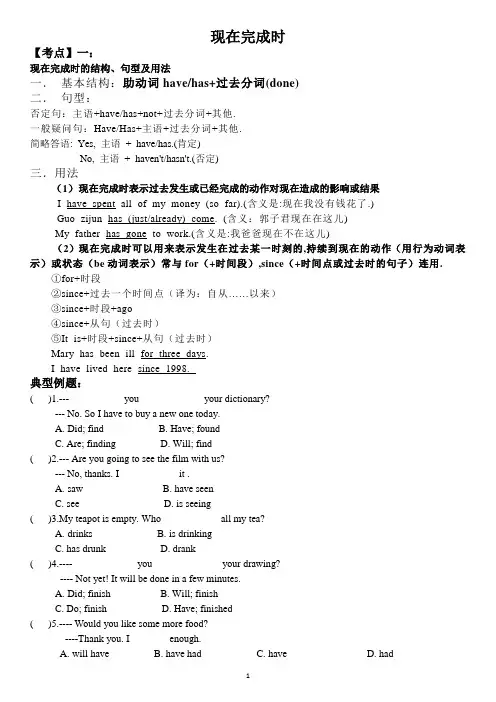
沪教牛津八年级上册unit5+6语法现在完成时
现在完成时【考点】一:现在完成时的结构、句型及用法一.基本结构:助动词have/has+过去分词(done)二.句型:否定句:主语+have/has+not+过去分词+其他.一般疑问句:Have/Has+主语+过去分词+其他.简略答语: Yes, 主语+ have/has.(肯定)No, 主语+ haven't/hasn't.(否定)三.用法(1)现在完成时表示过去发生或已经完成的动作对现在造成的影响或结果I have spent all of my money (so far).(含义是:现在我没有钱花了.)Guo zijun has (just/already) come. (含义:郭子君现在在这儿)My father has gone to work.(含义是:我爸爸现在不在这儿)(2)现在完成时可以用来表示发生在过去某一时刻的,持续到现在的动作(用行为动词表示)或状态(be动词表示)常与for(+时间段),since(+时间点或过去时的句子)连用.①for+时段②since+过去一个时间点(译为:自从……以来)③since+时段+ago④since+从句(过去时)⑤It is+时段+since+从句(过去时)Mary has been ill for three days.I have lived here since 1998.典型例题:( )1.--- __________ you ____________ your dictionary?--- No. So I have to buy a new one today.A.Did; findB. Have; foundC. Are; findingD. Will; find( )2.--- Are you going to see the film with us?--- No, thanks. I ___________ it .A.sawB. have seenC. seeD. is seeing( )3.My teapot is empty. Who ___________ all my tea?A.drinksB. is drinkingC. has drunkD. drank( )4.---- ____________ you _____________ your drawing?---- Not yet! It will be done in a few minutes.A.Did; finishB. Will; finishC. Do; finishD. Have; finished( )5.---- Would you like some more food?----Thank you. I _______ enough.A.will haveB. have hadC. haveD. had( )6.—How do you like Beijing, Mr. Black?—Oh,I _______ such a beautiful city.A.don't visit B.didn't visitC.haven't visited D.hadn't visited( )7.--- Where are you going for your holiday?--- Well, we _______ yet.A.haven't decidedB. hadn't decidedC. don't decideD. didn't decide( )8.--- Can you give me some information about Paris?--- Sorry, I________ to Paris, so I know nothing about it.A.don't travelB. won't travelC. haven't traveledD. hadn't traveled二、选择( )1.Sam ____________ Chinese since he came to China. He speaks good Chinese now.A. learnsB. learnedC. has learnedD. will learn( )2.--- Kelly, how long ______ you _______in this school?--- For three years. I'll graduate in July.A. have; studiedB. do; studyC. will; study( )3.My brother left school in 2005, and since then he _________in Beijing.A. livesB. livedC. will liveD. has lived( )4.--- Do you know the boy over there?--- Sure. I_______ him for years.A.knewB. will knowC. have knownD. known( )5.Rose came to Beijing in 2002. she ______ here for eight years.A.was livingB. liveC. will liveD. has lived【考点】二:现在完成时的标志1.现在完成时的含义之一是过去完成的动作对现在仍有影响,用以下四大标志词可以表达这种含义:* 以already, just和yet为标志He has already got her help.他已得到她的帮助。
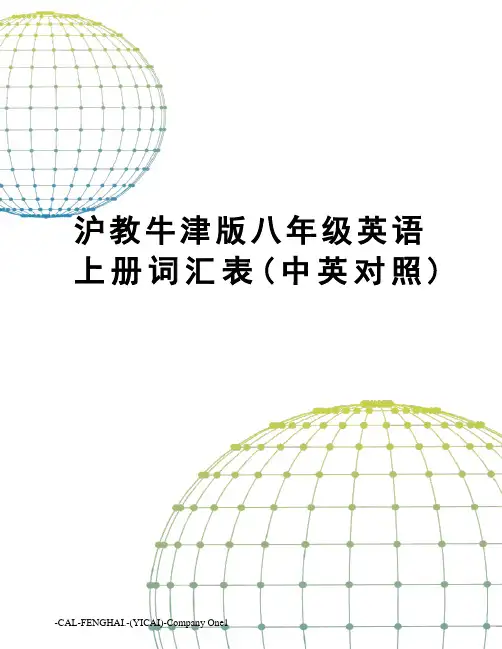
沪教牛津版八年级英语上册词汇表(中英对照)
localadj.
地方的
Britishadj.
英国的
gladadj.
高兴
guestn.
客人
chopstickn.
筷子
weekdayn.
工作日
tourv.
在……旅游
fantasticadj.
极好的
experiencen.
(一次)经历
*t’ai chin.
太极
alreadyadv.
已经
introducev.
操作
railwayn.
铁路系统
companyn.
公司
pricen.
价格
totaln.
总额
inchn.
英寸
sellv.
出售
popularadj.
受喜爱的
work as
从事…….工作
(be)unaware of
没注意到;
depend on
依靠
In addition
除…..以外
grand total
总计
look forward to
话题
winnern.
优胜者
advisev.
建议
severaldet.
几个
opinionn.
意见
wholeadj.
全部的
suggestionn.
建议
communicatev.
沟通
wheneverconj.
在任何….时候
richadj.
富有的
pooradj.
贫穷的
hidev.
隐藏
attackv.
攻击
shyadj.
午夜
emptyadห้องสมุดไป่ตู้.
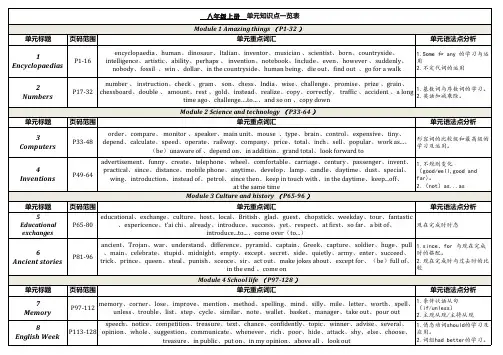
沪教牛津版英语八年级上册知识点一览表
现在完成时时态
introduce...to...、come over(to...)
6 Ancient stories
单元标题
P81-96
ancient、Trojan、war、understand、difference、pyramid、captain、Greek、capture、soldier、huge、pull 1.since、for 与现在完成
1.条件状语从句 (if/unless) 2.主现从现/主将从现
speech、notice、competition、treasure、text、chance、confidently、topic、winner、advise、several、 1.情态动词should的学习及
P113-128 opinion、whole、suggestion、communicate、whenever、rich、poor、hide、attack、shy、else、choose、
Educational exchanges
P49-64
advertisement、funny、create、telephone、wheel、comfortable、carriage、century、passenger、invent、 1.不规则变化 practical、since、distance、mobile phone、anytime、develop、lamp、candle、daytime、dust、special、 (good/well,good and
P17-32
chessboard、double 、 amount、rest 、gold、instead、realize、copy、correctly、 traffic 、accident 、a long
牛津上海版英语八上各单元知识梳理

牛津上海版英语八上各单元知识梳理Unit 1 Penfriends ⅠWords: 1. penfriend 笔友pen pal2. magazine 杂志 a literary magazine 文学杂志women’s magazine 妇女杂志→n. magazinist 期刊编辑3. hobby 业余爱好4. chess 国际象棋chessman 棋子(pl. chessmen) chessboard 棋盘5. own 拥有own up 承认错误owner 所有者物主业主6. good/well—better---best7. architect 建筑师architecture 建筑学8. nearby adv. 在附近不远adj. 附近的邻近的9. keen adj. 热心的渴望的敏锐的灵敏的Keenly adv.敏锐地keenness n. 敏锐10. ambition 雄心抱负be full of ambition 野心勃勃ambitious adj. 有雄心的11. enclose 附上ⅡPhrases 1. at the end 在………的末端2. be keen on 热心于做热衷于………3. play chess 下象棋4. twelve years old5. a boy called Tom 一个名叫Tom 的男孩a boy named Tom a boy with the name Tom6. best wishes 最好的祝愿7. by +交通工具= take +a/an +交通工具8. tell sb. about sth. 告诉某人关于某事tell sb. to do sth. 告诉某人做某事tell sb. not to do sth. 告诉某人别做某事9. enjoy doing sth. 喜欢做某事like doing sth. mind /practice/finish/10. speak /tell /say/talk say 说述说speak 说话发言电话来时用speaking talk 说谈话of/about tell 告诉讲述ⅢSentence 1. make it +adj. for sb. to do sth. it 形式宾语2. sth. +be+ to do 动词不定式做表语3. I hope you will write to me soon . 我希望你尽快给我回信hope 有可能实现的愿望wish 不大可能实现的愿望hope to do 希望做某事wish sb. to do 希望某人做……..ⅣGrammar Ⅰquestion words (疑问词) what、who(whom) / whose/which/when/where/how/why how many/much/long/far/soon/fast/often/ how many timesⅡ冠词 1.不定冠词a/an的用法“不见“原因”(发元音)别施“恩”(an)特殊案例:前需要加a 的:university a usual book Europe 欧洲European 欧洲人one-day trip 需要加an 的:unhappy + n. uncle unusual + n.2. 定冠词the的用法特指双方熟悉,上文已经提起。
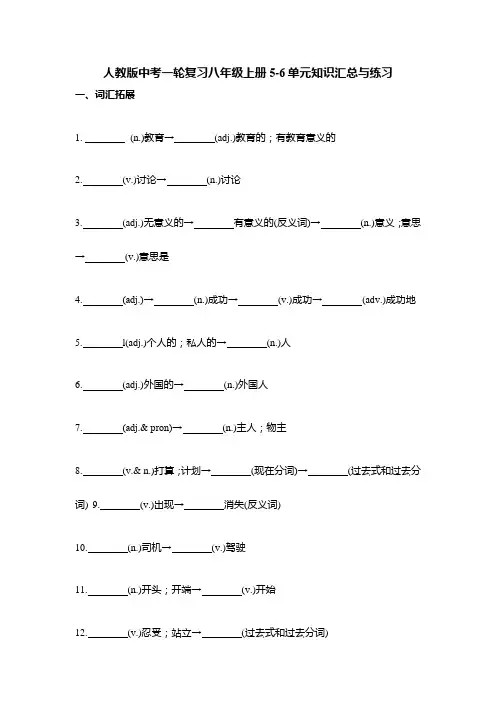
中考英语一轮复习八年级上册Unit5-6单元+词汇扩展及短语
人教版中考一轮复习八年级上册5-6单元知识汇总与练习一、词汇拓展1.(n.)教育→(adj.)教育的;有教育意义的2. (v.)讨论→(n.)讨论3. (adj.)无意义的→有意义的(反义词)→(n.)意义;意思→(v.)意思是4. (adj.)→(n.)成功→(v.)成功→(adv.)成功地5. l(adj.)个人的;私人的→(n.)人6. (adj.)外国的→(n.)外国人7. (adj.& pron)→(n.)主人;物主8. (v.& n.)打算;计划→(现在分词)→(过去式和过去分词) 9. (v.)出现→消失(反义词)10. (n.)司机→(v.)驾驶11. (n.)开头;开端→(v.)开始12. (v.)忍受;站立→(过去式和过去分词)13. (n.)药;医学→(adj.)医疗的;医学的答案cation(n.)教育→educational(adj.)教育的;有教育意义的2.discuss(v.)讨论→discussion(n.)讨论3.meaningless(adj.)无意义的→meaningful有意义的(反义词)→meaning(n.)意义;意思→mean(v.)意思是4.successful(adj.)→success(n.)成功→succeed(v.)成功→successfully(adv.)成功地5.personal(adj.)个人的;私人的→person(n.)人6.foreign(adj.)外国的→foreigner(n.)外国人7.own(adj.& pron)→owner(n.)主人;物主8.plan(v.& n.)打算;计划→planning(现在分词)→planned(过去式和过去分词)9.appear(v.)出现→disappear 消失(反义词)10.driver(n.)司机→drive(v.)驾驶11.beginning(n.)开头;开端→begin(v.)开始12.stand(v.)忍受;站立→stood(过去式和过去分词)13.medicine(n.)药;医学→medical(adj.)医疗的;医学的二、一般将来时一般将来时由“助动词shall(第一人称),will(第二、三人称)+ 动词原形”构成。
沪教牛津版英语8A U5-6 知识要点小结
8A U6U5知识要点小结姓名:________ 班级:__________一、重点单词(词性变化)cational(adj.)有关教育的,有教育意义的-- education(n.) --educate(v.)教育2.culture(n.)文化--cultural (adj.) 文化的3. exchange n. 交流,互访– change v. 改变4. British(adj.)英国的-- Britain(n.) 英国5. experience(n.) 经历【C】经验【U】-- experienced(adj.)有经验的6. tour(v.)在...旅游-- tourist(n.)游客7. introduce(v.) 介绍-- introduction (n.)介绍书;说明书8. punish v. 处罚,惩罚– punishment n. 惩罚9. different (adj.) 不同的--- difference (n.)差别10. celebrate v. 庆祝--- celebration(n.)庆祝– celebrated adj. 著名的11.quiet adj.安静的--- quietly(adv.)安静地12. secret n.秘密adj.秘密的--- secretly(adv.)13. enter v. 进入;输入---entrance(n.)入口14. steal ---stole(过去式) ---stolen(过去分词)v. 偷15. Greek n.希腊人adj.希腊的--- Greece n.希腊16. main adj.主要的--- mainly(adv.)主要地,大体上17. understand --- understood(过去式)---understood(过去分词)- understanding n.了解【U】二、同义词(同义词组)1. fantastic(极好的,了不起的)= excellent, wonderful2. at first(起初,首先)= in the beginning3. one another(互相)= each other4.huge = very big ,not small, not tiny很大5. weekday = from Monday to Friday 工作日6. be full of = be filled with 充满7. succeed=make it; achieve sth.获得成功8. stupid = foolish = silly adj. 笨的,傻的9. empty --(同义词)have nothing (反义词)full10. pull --(反义词)push11. ancient = very old, from a long time ago 古代的12. captain = the leader of a group of people 首领,机长,船长,上尉13. main = the most important 主要的14. except = apart from; not including 除...之15. secret=not seen or known by others only a few people know 秘密的16. enter=come into / go into进来17. glad = happy / pleased adj. 高兴,愉悦三、重点短语1. so far 到目前为止2. come on 加油,加把劲3. sb spend money/time on sth 花费钱/时间做某sb spend money/ time (in) doing sth 花费钱/时间做某事4. at the weekend 在周末on weekdays在工作日5. can’t wait to do sth 迫不及待做某事can’t help doing sth 忍不住做某事66. a bit of +不可数名词小量;一点儿7. introduce.....to.... 使初次了解;尝试8. keep doing sth 一直/反复做9. punish sb. for sth. / doing sth. 因(做了某事)而惩罚某人10. try to do sth 尽力做某事try doing sth 尝试着做某事11. by midnight到午夜时12. pull...into把...拖入13. come over (to....) (通常远距离地)从...到....14. It takes/took sb some time/ money to do sth 花时间/金钱做某事15. act out 将......表演出来;16. be asleep睡着的;17. except for 除...之外;18. by fighting通过打斗;19. climb out of 从什么...爬出来;20. succeed in doing sth.成功做某事;21. on the other side of 在另一边22.play tricks on sb.捉弄某人;make jokes about sb. 开某人玩笑;make fun of sb.取笑,嘲笑某人laugh at sb.嘲笑某人;。
沪教牛津版八年级上册英语词汇与词组总复习
in the railway 在铁路
price
advertisement
n. 广告
advertise v. 做广告
funny
adj.滑稽的,好笑的
make fun of 取笑 developing country 发展中国家 developed country 发达国家 practicable adj. 能实行 的, 行得通的 since then 自那以来 in the distance 在远处
number instructions gram accident chess India wise
n. 数字 n. 指示,命令 n. 克 n. (交通)事故 n. 象棋 n. 印度 adj.有智慧的 a large amount of+不可 数名词 大量的„ play chess 下象棋 Indian n. 印度人 adj. 印度的 kilogram n.千克
沪教牛津版初中英语八年级上册总复习 词汇与词组部分
一、词汇知多少?
单词 human dinosaur inventor musician scientist countryside intelligence ability nobody dollar 释义 adj. 人的 n. 恐龙 n. 发明家 n. 音乐家 n. 科学家 n. 乡村,农村 n. 智慧 n. 才能,能力 pron. 没有人 n. 美元 invent v. 发明 music n. 音乐 science n. 科学 in the countryside 在 农村 intelligent adj.聪明的, 有智力的 able adj. 能干的 be able to 能够 拓展 human being 人 单词 born perhaps invention notebook include even however suddenly win 释义 v. 出生 adv. 可能,大概 n. 发明(物) n. 笔记本 v. 包括,包含 adv. 甚至 adv. 然而 adv. 突然,忽然 v. 获胜,赢 win-won-won including+物 物+included 类似活用:create 拓展 be born 出生于
沪教牛津版初二上册英语知识点总结全册含习题和答案
沪教牛津版八年级上册英语知识点总结全册(广州地区)Unit 1 Encyclopedias (4)✧ 单词 (4)✧ 短语 (5)✧ 重点句型 (5)✧ 课文翻译 (5)✧ 知识点解析 (7)✧ 习题 (12)Unit 2 Numbers (16)✧ 单词 (16)✧ 短语 (17)✧ 重点句型 (17)✧ 课文翻译 (17)✧ 知识点解析 (18)✧ 习题 (35)Unit 3 Computers (37)✧ 单词 (37)✧ 短语 (37)✧ 重点句型 (38)✧ 课文翻译 (38)✧ 知识点解析 (39)✧ 习题 (46)Unit4 Inventions (50)✧ 单词 (50)✧ 短语 (51)✧ 重点句型 (51)✧ 课文翻译 (52)✧ 知识点解析 (53)✧ 习题 (56)Unit5 Educational exchange (59)✧ 单词 (59)✧ 短语 (59)✧ 重点句型 (60)✧ 课文翻译 (61)✧ 知识点解析 (62)✧ 习题 (70)Unit 6 Ancient stories (73)✧ 单词 (73)✧ 短语 (74)✧ 重点句型 (74)✧ 课文翻译 (75)✧ 知识点解析 (76)✧ 习题 (81)Unit 7 Memory (86)✧ 单词 (86)✧ 短语 (87)✧ 重点句型 (88)✧ 课文翻译 (88)✧ 知识点解析 (89)✧ 习题 (96)Unit 8 English Week (100)✧ 单词 (100)✧ 短语 (101)✧ 重点句型 (101)✧ 课文翻译 (101)✧ 知识点解析 (103)✧ 习题 (107)每单元必考语法点预览Unit 1 some与any的用法& 复合不定代词somebody, anybody, nobody等的用法Unit 2基数词及数字的表达& 序数词Unit 3形容词的比较级与最高级Unit 4 good, bad, far & (not) as…as…Unit 5现在完成时& already, yet, ever, neverUnit 6 现在完成时中since, for & 现在完成时与一般过去时的区别Unit 7(真实性)条件状语从句& if…not 与unlessUnit 8情态动词should, had betterUnit 1 Encyclopedias 单词✧短语1.in the countryside 在乡村,在农村11.for example 例如2.human being 人12.next to 紧挨着3.die out 灭绝,消失13.look up 查阅4.find out 了解,弄清14.live on Earth 生活在地球上5.go for a walk 去散步15.an Italian painter 一位意大利画家6.be born 出生ed to do sth 过去常常做某事7.more than 多于,超过17.at the end of 在…末尾8.just like 正如,正像18.in the centre 在中心9.how long 多久e out of…从…出来10.would like 想要20.be famous for 以…而闻名✧重点句型1.Some dinosaurs were as small as chickens. 有的恐龙和鸡一样小。
牛津沪教版英语八年级上册Unit 5复习学案
4 / 19
牛津沪教版英语八年级上册 Unit 5 复习学案
A postman is someone who delivers mail.邮递员是送邮件的人。 【友情提示】mail 无复数,泛指各种邮件。
17. real adj. 实际存在的,真实的 e. g. That is a real cat, not a toy. 那是一只真猫,不是玩具猫。 That old woman's a real dragon! 那老妇人确实是个凶恶的家伙! 【指点迷津】 (1) real 暗指某事物是真实的或货真价实的,或指看上去或宣称与事实吻合的东西。 e. g. Don’t lose the bracelet;it's made of real gold. 别把手镯丢了,那是真金做的。 (2) true 暗指与事实、现实或事物的真实状态相一致。 e. g. He’s your father. It's true. 他是你父亲。这是真的。
1 / 19
牛津沪教版英语八年级上册 Unit 5 复习学案
【知识拓展】gentleness n. 温顺,亲切,柔和 gently adv. 轻轻地,逐渐地
5. harmful adj. 有害的 e. g. The new drug has no harmful side-effects. 这种新药物没有副作用。
e. g. Typhoons blew fiercely.台风猛烈地刮着。
7. skeleton n. 骨骼,骼髅
e. g. Tommy is so thin that he looks like a skeleton. 汤姆如此瘦,以致看上去瘦骨嶙峋。
A long illness made a skeleton out of him. 长期的疾病使他骨瘦如柴。