
Unit1 Great scientists reading
Reading:
John Snow Defeats “King Cholera”
Match the main idea of each part.
Part1 (Para. 1) Part2 (Para. 2) Part3 (Para. 3-6)
A. Study of the outbreak in 1854 B. Prevention of Cholera and John Snow defeated “King Cholera” C. Introduction of two theories D. Introduction of John Snow and Cholera
著名的医生。2003年,他致力ቤተ መጻሕፍቲ ባይዱ照料那些得了 非典的普通老百姓。非典在当时是致命的疾病 因为人们既不知道它的病源,也不知道它的治 疗方法。钟南山下定决心面对这个挑战,解决 这个问题。他认真调查这种“怪病”,最终非 典得到了缓解,并被击败了。 2.你对钟南山的评价。
Words: cure defeat attend expert victim responsible Phrases: expose… to the deadly disease face the challenge look into slow down become inspired Sentence patterns: 1.The Attributive Clause(定语从句) 2.过去分词作定语
A. Stephen Hawking
B. Archimedes C. Thomas Edison
5. Who invented the earliest instrument to tell people where earthquakes happened?
A. Charles Darwin
B. Zhang Heng
Para.4
1) Many of the deaths were near the water pump. 2) Some houses had no deaths. Why? 1 death Result : It seemed that the water was to blame.
2 death … 5 death
10. Who defeated the infectious disease “Cholera” in the 19th century?
A. John Snow
B. Humphrey Davy
C. Gregor Mendel
John Snow is a well-known physician in the 19th century in London and he defeated “King Cholera”. cholera is a kind of deadly disease caused by drinking dirty water and it caused a lot of deaths in old times and it was very difficult to defeat.
1,2,…30,…40: numbers of houses
Para.5 How did he analyse (分析) the result? looked into the source of the John Snow___________
water for these two streets. He found that it come from the river polluted _______ by the immediately dirty water from London. He ___________ told the astonished __________ people in Broad handle Street to remove the __________ from the pump _______ so that it could not be used. Soon slowed down afterwards the disease ____________. He had shown that cholera was spread ______ by germs and not a cloud of gas.
suspect
He needed evidence.
Part3(para.3-6)
Para.3
1. To get evidence, what did John Snow do in 1854? 1) He was ready to begin his enquiry. 2) He began to gather information. 2. How did John find out the cause of cholera? by drawing a map.
Born on Oct20,1936, Zhong Nanshan is a famous doctor in China. In 2003, he was devoted to attending ordinary people exposed to SARS, which was the deadly disease of its day because neither its cause nor its cure was understood. However, he was determined to face the challenge and solve this problem. He looked into the strange disease carefully. At last, SARS slowed down and was defeated. As far as I’m concerned, he is a man who is careful, brave and responsible. Thanks to him, many lives have been saved in China. Therefore, all of us should show respect for him.
Unit 1 Great Scientists
As we know, there are various scientists both at home and abroad. They were devoted to their work. They made great contributions to developing the world.
A. Stephen Hawking
B. Archimedes
C. Copernicus
Stephen Hawking
expert 专家) on the He is an ______( theory about black holes, who likes challenge facing the____________( 挑战) and solving problems.
A. Marie Curie
B. Gregor Mendel
C. Charles Darwin
3.Who invented the first steam engine?
A. Thomas Newcomen B. Archimedes
C. Thomas Edison
4.Who invented the way of giving electricity to everybody in large cities?
9. Who did a great contribution to defeating SARS?
A. Zhong Nanshan B. Stephen Hawking C. Qian Xuesheng
Zhong Nanshan
He made great contributions to defeating 击败)SARS. He was a doctor ________( attended 照顾)and _______( cured who_______( 治 exposed to 得 愈 )thousands of patients_________( 了)SARS. =who were exposed to
A. Marie Curie
B. Zhang Heng
C. Newton
Marie Curie
was devoted to She was a scientist who____________
(致力于)discovering radium.
8.Who put forward a theory about black holes?
Part4 (Para.7) What was John Snow’s suggestion? He suggested that the source of all the water supplies be examined.
What qualities did John Snow have? John Snow was a person who was…
Para.6 1)At the same place, he found supporting evidence from two other deaths that were linked to the Broad Street outbreak. F
In another part of London 2) Both she and her daughter died of cholera after drinking the water. T 3) John Snow had no doubt that T polluted water carried the virus.
高中英语Unit1 Great scientists文章 哥白尼人教版必修五
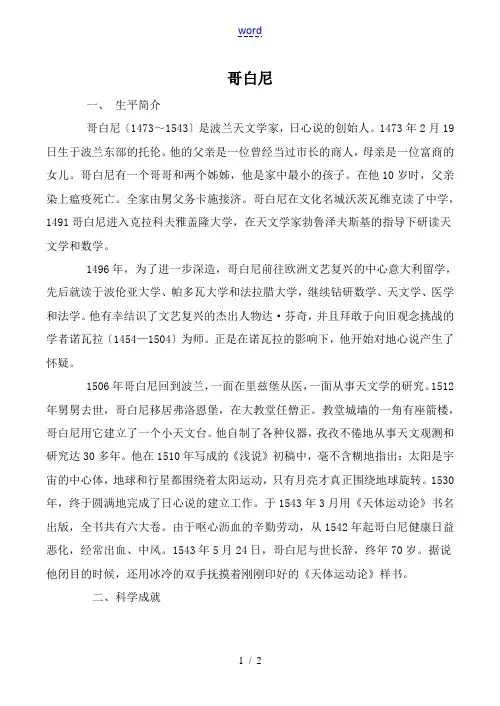
哥白尼一、生平简介哥白尼〔1473~1543〕是波兰天文学家,日心说的创始人。
1473年2月19日生于波兰东部的托伦。
他的父亲是一位曾经当过市长的商人,母亲是一位富商的女儿。
哥白尼有一个哥哥和两个姊姊,他是家中最小的孩子。
在他10岁时,父亲染上瘟疫死亡。
全家由舅父务卡施接济。
哥白尼在文化名城沃茨瓦维克读了中学,1491哥白尼进入克拉科夫雅盖隆大学,在天文学家勃鲁泽夫斯基的指导下研读天文学和数学。
1496年,为了进一步深造,哥白尼前往欧洲文艺复兴的中心意大利留学,先后就读于波伦亚大学、帕多瓦大学和法拉腊大学,继续钻研数学、天文学、医学和法学。
他有幸结识了文艺复兴的杰出人物达·芬奇,并且拜敢于向旧观念挑战的学者诺瓦拉〔1454—1504〕为师。
正是在诺瓦拉的影响下,他开始对地心说产生了怀疑。
1506年哥白尼回到波兰,一面在里兹堡从医,一面从事天文学的研究。
1512年舅舅去世,哥白尼移居弗洛恩堡,在大教堂任僧正。
教堂城墙的一角有座箭楼,哥白尼用它建立了一个小天文台。
他自制了各种仪器,孜孜不倦地从事天文观测和研究达30多年。
他在1510年写成的《浅说》初稿中,毫不含糊地指出:太阳是宇宙的中心体,地球和行星都围绕着太阳运动,只有月亮才真正围绕地球旋转。
1530年,终于圆满地完成了日心说的建立工作。
于1543年3月用《天体运动论》书名出版,全书共有六大卷。
由于呕心沥血的辛勤劳动,从1542年起哥白尼健康日益恶化,经常出血、中风。
1543年5月24日,哥白尼与世长辞,终年70岁。
据说他闭目的时候,还用冰冷的双手抚摸着刚刚印好的《天体运动论》样书。
二、科学成就哥白尼在科学上最大的成就是创立了以太阳为中心的地动学说〔日心说〕,否定了在西方统治达一千多年的以地球为中心的地静学说〔地心说〕。
哥白尼创立的日心说,即名著《天体运行论》的发表,不但是天文学上的一次伟大革命,推动了天文学研究的飞速发展,而且引起了人类宇宙观的重大革新,沉重地打击了封建神权的统治,“从此自然科学便开始从神学中解放出来〞三、趣闻轶事1.人小志大哥白尼从小受到良好的学校教育,喜欢观察天象。
人教必修5 Unit 1 Great Scientists John Snow Defeats “King Cholera”
A woman and her daughter who lived far away but drank find supporting evidence two __________ Para 6 What other deaths analyse the results extra evidence did he find? the water also died.
Many thousands of terrified people died of cholera.
What method did he use? pub
ManyA deaths happened here. map of Broad
No deaths happened here
?
St worked in the pub had been given free beer and so had not drunk the water from the pump.
It seemed the water from the pump was to blame.
Further thinking :
1. Do you think John Snow would have solved this problem without the map? Give your reasons.
Father of Modern Genetics
Guess
Who? When? Where?
What?
John Snow Defeats “King Cholera”
Prediction: The passage mainly tells us how he gathered information, analyzed the valuable ___________________________________________ ____________________________________________. clue, found out the cause of cholera and defeated it
高二英语必修五unit1知识点
absorb one’s attention 吸引某人的注意力
be absorbed in sth.
专心于某事
be absorbed by/into 被……吞并;为……所吸收
Clever children absorb knowledge easily. He is absorbed in his business.
3、难点
过去分词作定语,表语
一、重要词汇拓展
1.science n.科学 →scientific adj.科学的→ scientist n.科学家 2. announce v.宣布 →announcement n.宣布→ announcer n.广播员,告知者 3. instruct v..指导,命令 →instruction n.指导,指示→ instructive adj.有益的,教育性的 4. enthusiastic adj.热心的,热情的 →enthusiasm n.狂热,热心→ enthusiast n.热心家,狂热者 5. valuable adj.有价值的 →value n. 价值 → value v. 估价, 评价
3. Neither its cause nor its cure was understood. ▲cure vt.&n. 治愈,治疗法;常用于cure sb. of ...结构中。
【易混辨析】
treat和cure
(1) treat强调治疗过程。 treat还可作“对待;看待;款待;请客”讲。 treat sb for sth 医治某人……病 treat...as...把……看作/视为…… treat sb to...请某人……
▲ be exposed to 暴露于……
高手过招
2020_2021高中英语Unit1Greatscientists阅读理解科技篇题型专项突破新人教版
题型专项突破-Unit1阅读理解(科技篇)一、阅读理解阅读下列短文,从各题所给的四个选项(A、B、C和D)中,选出最佳选项。
1.The year is 1947. Thirteen-year-old Carl Sagan is standing outside a small house in the eastern city of Brooklyn, New York. It is dark. He is looking up at the sky. After a few minutes, he finds the spot for which he has been searching. It is a light red color in the night sky. Carl is looking at the planet Mars.Carl has just finished reading a book by American writer Edgar Rice Burroughs called A Princess of Mars, in which the man who travels to Mars can make the trip by looking at the planet for several minutes. He then is transported there by a strange force.Carl Sagan stands watching the red planet. After a while, young Carl realizes this will not happen. He turns to enter his home. But in his mind he says, “Some day it will be possible to travel to Mars.”It should be no surprise to learn that Carl Sagan studied the stars and planets when he grew older. He did this at the University of Chicago. Later he taught astronomy(天文学) at Harvard University and Cornell University. In the 1950s, Mr. Sagan helped design mechanical devices for use on some of the first space flights.He spent much of his life helping make space travel possible far out in the universe. He died in December, 1996. However, much of the work he did during his life helped make it possible for the American Pathfinder vehicle to land on Mars. It landed onJuly 4, 1997. It soon began sending back to Earth lots of information and thousands of pictures about the red planet.Carl Sagan's family say he would have been extremely happy about the new information from Mars.(1) What did little Carl Sagan intend to do while staring at a light red spot in the sky?A. To bee a scientist of Astronomy.B. To be sent to Mars by a strange force.C. To make sure of the position of Mars.D. To decide how to arrive at Mars.(2) It is implied in the last paragraph that .A. Carl Sagan didn't have the chance to go to MarsB. Carl's family felt sad at the news about the travelC. Carl Sagan did much for American space scienceD. Pathfinder was able to send back information from Mars soon(3) The story was written to .A. introduce Carl SaganB. explain space scienceC. record the travel of Pathfinder to MarsD. advertise a book A Princess of Mars(4) It can be inferred that .A. Pathfinder landed on Mars successfullyB. Carl Sagan began to watch Mars when 13C. the book A Princess of Mars may tell about travel from the Earth to MarsD. Carl Sagan was extremely happy to get information from Mars2.Unlike chemists and physicists, who usually do their experiments using machines, biologists and medical researchers have to use living things like rats. But there are three Nobel prize-winning scientists who actually chose to experiment on themselves —all in the name of science, reported The Telegraph.(1) The passage is mainly about .A. some dangerous experiments that Nobel prize winners did on themselvesB. difficulties that scientists went through in order to make important discoveriesC. the reasons why some scientists chose to experiment on themselvesD. three Nobel prize winners who did experiments on themselves(2) Which of the following is TRUE according to the article?A. Forssmann's experiment ended in failure.B. Forssmann managed to do his experiment on different kinds of animals.C. Barry Marshall succeeded by drinking some Helicobacter pylori.D. Barry Marshall's experiment on himself confirmed that most doctors' belief about gastritis was correct.(3) From the text, we can conclude that Ralph Steinman .A. discovered a new type of cancer cell called the dendritic cellB. tried different therapies containing the dendritic cell on himselfC. knew that he himself would have cancer and die from itD. believed that he was better than doctors at treating cancer3.Critics of cloning often repeat the question related to the controversial(有争议的) science “Just because we can, does it mean we should?”The closer we e to being able to clone a human, the hotter the debate over it grows. For all the good things cloning may achieve, opponents say that it will do just as much harm. Another question is how to govern cloning process.There is federal official law banning cloning in the United States, but several states have passed their own laws to ban the practice.The US Food and Drugs Administration (FDA), has also said that anyone in the United States attempting human cloning must first get its permission. In Japan, human cloning is a crime that is punished by up to 10 years in prison.While laws are to ban cloning at this time, some scientists believe that the technology is not ready to be tested on humans. Ian Wilmut, one of the co-creators of Dolly, has even said that human cloning projects would be an irresponsible crime. Cloning technology is still in its early stages, and nearly 98% percent of cloning efforts end in failure. The embryos are either not suitable for implanting into the uterus(子宫) or they die shortly after birth.The clones that do survive end up suffering from deadly or problematic genetic abnormalities(畸形). Some clones have been born with faulty heart, lung problems and blood vessel problems. One of the most famous cases was a cloned sheep that was born with malformed arteries (畸形动脉) leading to the lungs.Opponents of cloning will point out that we can enthanize(安乐死) these faulty clones of other animals, but they ask what if a human clone is born with these same problems. Advocates of cloning respond that it is now easier to pick out faulty embryos even before they are implanted into the mother. The debate over human cloning is just beginning, but as science advances, it could be the biggest moral dilemma of the 21st century.(1) Which word in the text is the opposite of the underlined word “opponents”?A. Critics.B. Advocates.C. Scientists.D. Co-creators.(2) The writer writes this passage mainly to .A. support passing laws to ban human cloningB. list problems with human cloningC. introduce critics' ideas about human cloningD. state the debate over human cloning(3) Which of the following will Ian Wilmut probably NOT agree with?A. Cloning technology is in its early stages.B. Human cloning should be made illegal.C. Very few cloning efforts are successful.D. Cloning technology is ready to be tested on humans.二、短文7选51.Many people think that they have to accept whatever life throws at them. They'll say, "This is my fate. I cannot change it. "(1) You don't have to suffer needlessly. Your fate depends on you, not on any other outside factors.We want to be happy and live our life to the fullest, but we have to do our share of making the effort to live the life of our dreams.(2) You just don't sit around and wait for a million dollars to fall from the sky. You have to get off the couch, get your eyes off the TV screen, get your hands off the phone (unless it contributes to your success), and get your mind and body to work! Don't expect your luck to change, unless you do something about it. If your life is not meant the way you want it to be, don't just say, "Our time will e." or "(3) " Don't expect your luck to change, unless you do something about it. If something goes wrong, don't just regard it as a temporary setback; but use it as feedback. Learn yourlesson, make the most of the situation, and do something to solve the problem. It's not enough to think positive; you also have to act positive.If someone's life is in trouble, do you just hope and pray that things will turn out fine? Of course not! (4)So it is with your own life. It is not enough to hope for the best, but you have to DO your best. In other words, don't just stand (or sit) there. (5)A. I think so.B. Of course not.C. You'd better let it be.D. Things will get better someday.E. Do something to improve your life.F. Remember that you harvest what you sow.G. You've got to do anything you can to save the person.题型专项突破-Unit1阅读理解(科技篇)答案一、阅读理解阅读下列短文,从各题所给的四个选项(A、B、C和D)中,选出最佳选项。
高中英语必修五《unit1 Great Scientists》示范说课稿
《unit1 Great Scientists》说课稿各位评委老师,上午好!我是号考生,我今天说课的题目是《unit1 Great Scientists》。
我主要从教材分析、教学方法与策略、教学过程、板书设计等几个步骤向大家详细地讲解我对这节课的安排。
一.说教材1. 教材内容本节课是人教课标版必修5第一单元的第一课时的Reading部分,是该单元的主要内容,它介绍了英国著名医生John Snow是如何通过考察、分析、探究的科学方法,发现并控制“霍乱”这种传染病的。
通过阅读课文,使学生感悟科学家的周密观察、勇于探索、认真分析的科学精神,使学生了解科学方发现的全过程具有其科学的严密性。
2. 教学目标结合单元教学要求和本课特点,充分考虑学生的年龄特点、认知水平,遂将本课的教学目标确定为:知识目标1) Get students to learn the useful new words and expressions in this part.2) Let students learn about some great scientists and their contribution.3) Have students read the passage and know about John Snow and how he defeated “King Cholera”.能力目标1) Develop students’ reading ability and let them learn different reading skills.2) Enable students to talk about great scientists and tell their stories.情感目标1) Let students learn from great scientists, stimulate their love and respect for them and develop their moral qualities.2) Develop student’s sense of cooperative learning.3. 教学重点因为本组教材的重点了解项目是“John Snow 破解King Cholera难题”,所以确定本课的教学重点是:1) Let students learn about some great scientists and their contributions.2) Get students to read the passage and know about John Snow and how he defeated “ King Cholera”.3) Have students learn different reading skills.4.教学难点考虑到学生拓展阅读能力,语言输出能力等方面还需进一步努力,所以将本课的教学难点确定为:1) Develop students’ reading ability.2) Enable students to talk about great scientists and tell their stories.3) Let students learn how to organize scientific research.二.说教法和学法1. 教学方法引导学生独立思考,合作学习,进行师生、生生互动的“任务型”教学,设计了许多易于操作的任务型活动。
新人教版高中英语必修5 Unit1_Great_Scientists (1)

3. Why is there no death at No. 20 and 21 Broad Street as well as at No. 8 and 9 Cambridge Street? These families had not drunk the water from the Broad Street pump.
Nobody knew the cause of the serious disease of cholera
Unit 1 Great Scientists
Period 1 Warming up & Pre-reading Period 2 Reading Comprehension Period 3 Reading & Listening Period 4 Learning about Language Period 5 Grammar Past Participle Period 6 Listening Period 7 Reading and Writing
It begins in the stomach and a severe case can lead to death without immediate treatment.
And the victims died very quickly from a loss of liquid after severe vomiting(呕吐) and diarrhea(腹泻).
Come on!
Skimming Who was the great scientist in the passage and what was the deadly disease of its day?
book 5 Unit 1Great scientists人教版
Unit 1Great scientists 人教版·必修⑤ The topic(教学课题):How to organize scientific research & Contributions of scientistsThe background(教案背景):The analysis of the teaching material(教材分析):Science affects us all. Our material comfort and lifestyle depend on advances. The first aim of this unit is to help us understand how science has become so important in our lives by examining some key scientific findings and famous scientists. It does this through several different scientific subjects, astronomy, the classification of plants and animals and mathematics. It is hoped at the end of this unit that the students will understand that here is more to science than chemistry, physics and biology.A second aim is to introduce students scientific experiment. Advances in science are made following certain rules: experiment must follow a particular procedure so that other scientists can check the findings by doing the experiment the same way and getting the same results. This is the safeguard for the accuracy of scientific results. These stages are introduced in the pre-reading while the reading passage is written as if it were stages in such an experiment. In this way the stage can be identified practically as well as theoretically.Teaching methods(教学方法):talking; group work; self-learning;The teaching progress(教学过程)Step Ⅰ leading-inShow the question in Warming-up to introduce some great scientists in the world.1. A rchimedes,阿基米德(公元前287年—公元前212年),古希腊哲学家、数学家、物理学家。
新人教版高中英语必修5《Unit 1 Great scientists 》精品
三、本单元教学建议
热身(Warming up)部分在学生课前预习的基础上,教 师可利用图片资料引入,也可以让学生讲述某位科学家的 故事或成就让其他学生来猜测,但讲述内容不宜过长。
读前(Pre-reading)部分建议呈现有关SARS和AIDS宣传 图片或视频资料,引导学生关注疾病与健康,然后再引出 cholera。可以分若干个讨论小组讨论如何进行科学研究, 让学生了解科学观点的形成过程。
.
三、本单元教学建议
语言学习(Learning about language)部分Exercise 1是用所 给词的正确形式填空。教师应确定学生了解这些词的意思 和用法。Exercise 2是一个拓展练习,要求学生掌握make+ 名词,在意义上等于这个名词的动词形式,例如:make a speech=speak。Exercise 3进一步训练动词make的用法。教 师 还 可 以 鼓 励 学 生 回 忆 更 多 的 有 关 于 make 的 用 法 。 Discovering useful structures是语法知识教学,教师可引导 学生在Reading中找到更多过去分词作定语和表语的用法。 Exercise 1、2&3帮助学生感知过去分词作定语和表语,并 逐步过渡到巩固和运用这种语言现象。
.
学习策略 :
通过周密观察、认真分析等、自助、自悟能力,以培 养学生调控策略;利用网络等媒体获取相关知 识来提高资源策略;通过交流表达观点来提高 运用交际策略的能力。
文化意识:
了解许多中外科学家的事迹及他们的贡献,扩 大知识面;以知识武装头脑,以文化陶冶情操。
.
Warming Up:
There are some great scientific achievements that have changed the world. Can you name some of them? What kind of role do they play in the field of science ? Do these achievements have anything in common? Match the inventions with their inventors below before you answer all these questions.
高中英语 Unit 1 Great Scientists Section Ⅰ Pre-reading
Section ⅠPrereading (Warming Up & Reading)课前预习自测约翰·斯诺战胜“霍乱王”约翰·斯诺是伦敦一位著名的医生——他的确医术精湛,因而成为照料维多利亚女王的私人医生。
但他一想到要帮助那些得了霍乱的普通百姓时,他就感到很振奋。
霍乱在当时是最致命的疾病,人们既不知道它的病源,也不了解它的治疗方法。
每次暴发霍乱时,就有大批惊恐的老百姓病死。
约翰·斯诺想面对这个挑战,解决这个问题。
他知道,在找到病源之前,霍乱疫情是无法控制的。
斯诺对霍乱致人死地的两种推测都很感兴趣。
一种看法是霍乱病毒在空气中繁殖着,像一股危险的气体到处漂浮,直到找到病毒的受害者为止。
第二种看法是人们在吃饭的时候把这种病毒引入体内的。
病从胃里发作而迅速殃及全身,患者就会很快地死去。
斯诺推测第二种说法是正确的,但是他需要证据。
因此,在1854年伦敦再次暴发霍乱的时候,约翰·斯诺着手准备对此进行调研。
当霍乱在贫民区迅速蔓延的时候,约翰·斯洛就开始收集资料。
他发现特别在两条街道上霍乱流行得很严重,在10天之内就死去了500多人。
他决心要查明其原因。
首先,他在一X地图上标明了所有死者住过的地方。
这提供了一条说明霍乱起因的很有价值的线索。
许多死者是住在宽街的水泵附近(特别是这条街上16、37、38、40号)。
他发现有些住宅(如宽街上20号和21号以及剑桥街上的8号和9号)却无人死亡。
他以前没预料到这种情况,所有他决定深入调查。
他发现,这些人都在剑桥街7号的酒馆里打工,而酒馆为他们免费提供啤酒喝,因此他们没有喝从宽街水泵抽上来的水。
看来水是罪魁祸首。
接下来,约翰·斯诺调查了这两条街的水源情况。
他发现,水是从河里来的,而河水被伦敦排出的脏水污染了。
他马上叫宽街上惊慌失措的老百姓拆掉水泵的把手。
这样,水泵就用不成了。
不久,疫情就开始得到缓解。
Unit 1 Great Scientists Reading 课件-高中英语人教新课标必修五
People absorbed it with their meals.
2023/1/25
(3) aiming to kill or destroy 意在杀死的; 不共戴天的: a deadly enemy 不共戴天的敌人 2)deadly adv. (1) very 极度; 非常; 十分 deadly serious 十分认真 (2) like death 死一般地
John Snow was a well-known _d_o_c_to_r_ in London in the _1_9_th__ century. He wanted to find the _c_a_u_s_e_ of cholera in order to _d_e_fe_a_t_ it. In 1854 when a cholera _b_r_o_k_e_ out, he began to gather information.
He _m__a_r_k_e_d__ on a map where all the dead people had lived and he found that many people who had drunk the dirty water from the _p_u_m__p_ died. So he decided that the polluted water carried cholera. He suggested that the _s_o_u_r_ce__ of all water supply be _e_x_a_m__in_e_d__ and new methods of _d_e_a_l_in__g_ with polluted water be found. Finally, “King Cholera” was defeated.