
八年级英语上册 Unit 9 Can you come to my party Section A(Grammar Focus-3c)课件
can 用于表示“能,会 ________”,如: 汤姆会骑马。Tom ___________________ can ride a horse.
Can you…? 表达 “邀请或建议 ____________”, Sure, I’d love to. 答语:同意用 _________________ Sorry, I can’t. I … 不同意用 __________________________ 或 I’m afraid not. I have to … __________________________ 如:恐怕不行,我要去探望我的姑姑。 __________________________________ I’m afraid not. I have to visit my aunt.
Accepting:______________________________ Sure, I’d love to.
1. invite 邀请
invite作及物动词,意为“邀请,招待”。常用结
构为:invite sb. to do sth.,invite sb.+副词或介词短
语,表示“邀请某人做某事”,“邀请某人去某地”。
Refusing: _________________________________ No, I can’t. I must finish my homework.
4. Inviting: ( would like to / come to my birthday party)
Would you like to come to my birthday party? ______________________________________
B: I’m not sure. I might______________ practice the violin.
2. A: What are you planning to do after school? I might watch TV. B: I don’t know. ____________________
Can you come to my 来自arty?Unit 9
Grammar Focus-3c
Section A
Can she come to the party?
Yes,she can.
Can he go to the baseball game?
No,he can’t. He has to study.
3b
Complete the sentences below. Use the words in brackets to help you.
1. Inviting: (can / play tennis)
______________________________________ Can you come to play tennis?
3c
Write down everything you have to do next week. Choose a day and time to have a party. Then invite classmates to your party.
Can you come to my party?
D. Invite
4. —Hi,Linda!Can you come to my house this afternoon?We can watch videos at home. —____ I have to do my homework. A.Sorry,I have no time. B.When can I go to your house? C.What kind of videos? D.Sure,I'd love to.
I invite my friends to__________, ______ would like to come. But _____can’t. He/She has to_______. ______can’t go, either. He/She must_________.
一、单项填空。 1. They didn't go to bed ____ they finished the work. A.when B.while C.until D.after
homework to do. __________________________________________
3. Inviting: (can/hang out with us tonight)
Reason: (must)
____________________________________ Can you hang out with us tonight?
3. A: When will you finish the science homework?
B: ____________________________________ On the weekend. 4. A: Who are you going to the movies with? My cousin. B:____________________________________ 5. A: Are you free to come to my place on Saturday? No. I might visit my grandparents . B: ____________________________________
They've invited us to stay for the weekend. 他们已 邀请我们留下来度周末。 Who have you invited to your house for your
birthday party? 你请了谁到家里来参加你的生日晚会?
2. accept 接受
(1) accept意为“接受”,如接受礼物、邀请、好意、
(3)accept与receive的意义及用法辨析:
receive 只表示“(被动地)收到”这一事实; accept 多了一层主观上“某种程度或完全赞同”的意 思。 I was on vacation last week and didn't receive your fax.上星期五我正在度假,没收到你的传真。 If you accept, please let me know.如果你接受的话, 请通知我。 表示“受到教育;惩罚;支持”时,只能用receive; 表示“接受某条件”时,只能用 accept。 She would not receive Mrs. Read. 她不愿接见里德 夫人。 Finally they accepted our terms.最后他们接受了我
Accepting:________________________ Sure, that sounds great.
2. Inviting: (would like to/ go to the movies) Reason:(might have to) Would you like to go to the movies? ______________________________ Refusing :______________________________ I’m afraid not. I have too much
3. refuse 拒绝 (1)refuse 意为“拒绝”,refuse的主语一般为人。 He made her an offer in this room, and she refused him.他在这间屋子里向她求婚,但她拒绝了。 (2)refuse to do sth.意为“拒绝做某事”。 I refuse to answer that question.我拒绝回答那个问 题。
批评、建议、接纳为成员等等,指主动地“接受”。
She offered him a lift and he accepted (it).她请他坐
她的车,他就领情了。 (2) accept主要用作及物动词,其宾语可为名词、代词 或动名词,也可接动词不定式。 It is generally accepted that the best way to success is hard work.人们普遍认为,成功最好的方式是努力。
Complete the answers with might 3a and one of the phrases in the box.
watch TV on the weekend my cousin visit my grandparents practice the violin
1. A: What are you going to do on Saturday?
二、句型转换。 1. I have to study for a test this evening. (改为否定句 ) don’t have to I ______ ______ ______ study for a test this evening. 2. They can go to the concert. (改为一般疑问句) Can they ______ go to the concert? ______ 3. —Can Mary go to your birthday party? (作否定 回答) Sorry / No she ______. can’t — ___________,
Sure, I’d love to. Sorry, I must study for a math test. Sure. That sounds great. I’m afraid not. I have the flu. No, he can’t. He has to help his parents. No, she’s not available. She must go to the doctor. No, they’re not free. They might have to meet their friends.
新人教版八年级英语上册Unit_9_Can_you_come_to_my_party?__Section_A-1
Sure, Joe. Thanks for asking.
2d Role-play the conversation.
Jeff: Hey, Nick, can you come to my house on
Saturday? My cousin Sam from Xi’an is
going to be here.
Sure, Joe. Thanks for asking.
Hey, Tom. Can you go to the movies on Saturday?
I’m sorry, I’m not available. I have to take part in the football match
That’s too bad. Maybe another time.
2a. Listen and circle can or can’t.
1. Jeff can/ can’t go to the party.
2. Mary can/ can’t go to the party. 3. May can/ can’t go to the party.
4. Mei Ling can/ can’t go to the party.
Jeff: That’s really too bad! Oh, but Sam isn’t
leaving until next Wednesday. Can you
hang out with us on Monday night?
Nick: Sure! Catch you on Monday!
Language points
Sure, I’d love to. I’m sorry, I can’t. I have to…
人教版英语八年级上册Unit 9《Can you come to my party》教学设计

人教版英语八年级上册Unit 9《Can you come to my party》教学设计一. 教材分析人教版英语八年级上册Unit 9主要讲述了关于邀请别人参加聚会的情境。
通过本单元的学习,学生能够掌握与聚会相关的词汇和表达方式,学会如何礼貌地邀请别人,并能够用英语进行简单的交流。
本单元的核心句型是“Can you come to my party?”,以及回答“Yes, I can.”和“No, I can’t.”。
二. 学情分析八年级的学生已经具备了一定的英语基础,能够听懂并运用简单的英语进行交流。
他们对学习英语有浓厚的兴趣,并且愿意积极参与课堂活动。
然而,部分学生可能在口语表达和听力方面还存在一定的困难,需要教师的引导和帮助。
三. 教学目标1.知识目标:学生能够掌握与聚会相关的词汇和表达方式,学会如何礼貌地邀请别人,并能够用英语进行简单的交流。
2.能力目标:学生能够听懂并运用核心句型“Can you come to my party?”进行交流,提高口语表达能力。
3.情感目标:学生能够在课堂上积极参与,培养合作意识和团队精神。
四. 教学重难点1.重点:学生能够听懂并运用核心句型“Can you come to my party?”进行交流。
2.难点:学生能够正确使用情态动词“can”来表达自己的能力。
五. 教学方法1.情境教学法:通过创设真实的聚会情境,激发学生的学习兴趣,提高他们的口语表达能力。
2.交际法:通过小组讨论和角色扮演等方式,培养学生的合作意识和团队精神。
3.任务型教学法:通过完成各种任务,引导学生主动参与学习过程,提高他们的自主学习能力。
六. 教学准备1.教学材料:教材、多媒体课件、录音机、磁带或音频文件。
2.教学环境:教室布置成聚会场景,悬挂气球、彩带等装饰物。
七. 教学过程1.导入(5分钟)教师以提问的方式引导学生回顾已学过的与聚会相关的词汇,如“birthday party”、“house party”等。
八年级英语上册 Unit 9 Can you come to my party?单元知识归纳

Unit 9 Can you come to my party?a课文翻译Section A 2dJeff:Hey,Nick,can you come to my house on Saturday?My cousin Sam from Xi'an is going to be here.Nick:Oh,Sam!I remember we went bike riding together last fall when he visited you.Jeff:Yes,that's right.Nick:I'd love to come,but I'm afraid I can't. I have an exam on Monday so I must prepare for it.Jeff:That's really too bad!①Oh,but Sam isn't leaving until next Wednesday.②Can you hang out with us on Monday night?Nick:Sure!③Catch you on Monday!杰夫:嘿,尼克,星期六你能来我家吗?我来自西安的表弟萨姆打算到这儿。
尼克:哦,萨姆!我记得去年秋天他来看你时,我们一起骑自行车旅行过。
杰夫:是的,很对。
尼克:我想去,但是恐怕不行。
星期一我有一次考试,所以我必须为此而准备。
杰夫:那真是太糟糕了!哦,但是萨姆直到下周三才要离开。
你可以在周一晚上和我们去闲逛吗?尼克:当然可以了!周一见你们!知识详解1.—Jenny,can you come to my party on Saturday afternoon?詹妮,星期六下午你能来参加我的聚会吗?—Sure,I'd love to.当然,我很愿意。
【解读】本句是一般疑问句。
新人教版八年级英语上册复习短语笔记资料Unit 9 Can you come to my party
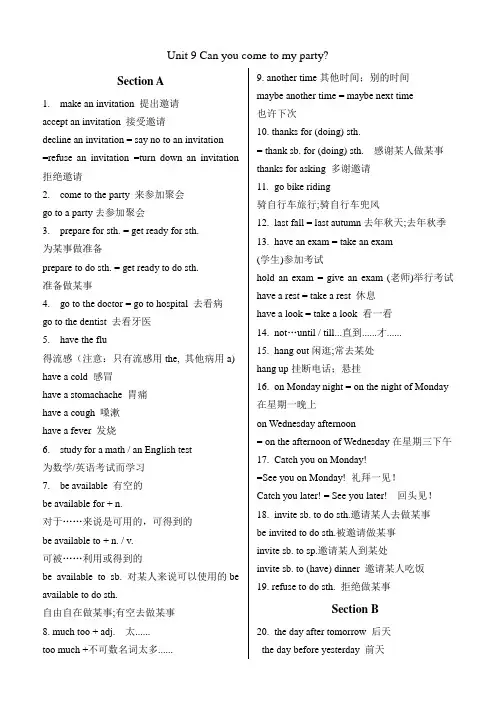
Unit 9 Can you come to my party?Section A1. make an invitation 提出邀请accept an invitation 接受邀请decline an invitation = say no to an invitation=refuse an invitation =turn down an invitation 拒绝邀请2. come to the party 来参加聚会go to a party去参加聚会3. prepare for sth. = get ready for sth.为某事做准备prepare to do sth. = get ready to do sth.准备做某事4. go to the doctor = go to hospital 去看病go to the dentist 去看牙医5. have the flu得流感(注意:只有流感用the, 其他病用a) have a cold 感冒have a stomachache 胃痛have a cough 嗓漱have a fever 发烧6. study for a math / an English test为数学/英语考试而学习7. be available 有空的be available for + n.对于……来说是可用的,可得到的be available to + n. / v.可被……利用或得到的be available to sb. 对某人来说可以使用的be available to do sth.自由自在做某事;有空去做某事8. much too + adj. 太......too much +不可数名词太多...... 9. another time其他时间;别的时间maybe another time = maybe next time也许下次10. thanks for (doing) sth.= thank sb. for (doing) sth. 感谢某人做某事thanks for asking 多谢邀请11. go bike riding骑自行车旅行;骑自行车兜风12. last fall = last autumn去年秋天;去年秋季13. have an exam = take an exam(学生)参加考试hold an exam = give an exam (老师)举行考试have a rest = take a rest 休息have a look = take a look 看一看14. not…until / till...直到......才......15. hang out闲逛;常去某处hang up挂断电话;悬挂16. on Monday night = on the night of Monday 在星期一晚上on Wednesday afternoon= on the afternoon of Wednesday在星期三下午17. Catch you on Monday!=See you on Monday! 礼拜一见!Catch you later! = See you later! 回头见!18. invite sb. to do sth.邀请某人去做某事be invited to do sth.被邀请做某事invite sb. to sp.邀请某人到某处invite sb. to (have) dinner 邀请某人吃饭19. refuse to do sth. 拒绝做某事Section B20. the day after tomorrow 后天the day before yesterday 前天the year before last year 前年last year 去年this year 今年next year 明年the year after next year 后年21. have a piano lesson 上钢琴课22. on weekdays = from Monday to Friday在工作日on weekends 在周末this weekend这个周末last weekend上个周末next weekend下个周末23. look after = take care of 照顾;照料look after sb. well = take good care of sb.好好照顾;好好照料24. help sb. with sth. = help sb. (to) do sth.帮助某人做某事with one ’ s help = with the help of sb.在某人的帮助之下help out (with sth.)帮助摆脱困境/克服困难help sb. out帮助某人解决问题或摆脱困境25. see sb. do sth.看到某人做了某事(强调看见某人做过某事)see sb. doing sth.看到某人正在做某事(强调看见某人正在做某事)26. take a trip = go on / for a trip 去旅行take a trip to sp. = go to sp. for a trip到某地去旅行27. at the end of... 在......的末端;在......的尽头at the end of this month 在这个月月底at the end of the road 在路的尽头28. be glad / happy to do sth.很高兴做某事29. by +时间点到......为止by now到现在为止by this Friday到这个星期五之前为止30. be surprised 感到惊讶be surprised at sth.对某事感到很惊讶be surprised to do sth.惊讶地做某事31. think of想出;想起;认为think about考虑;思考think over好好考虑;深思熟虑32. bring sb. / sth. to sp. 带某人/某物到某地33. so that 为了;以便34. look forward to doing sth.期待做某事;盼望做某事35. hear from sb. = get / receive a letter from sb. 收到某人的来信hear about / of sth. / sb. 听说某事/某人36. plan a housewarming party策划一个乔迁聚会plan a party for sb.为某人策划一个聚会have a surprise party办一场惊喜聚会;开惊喜聚会at the party在聚会上37. make it成功;胜利(表示通过努力或经历困难后取得成功、完成某事)38. reply in writing以书面的形式进行回复reply to these letters回复这些来信reply to the question=make a reply to the question=answer the question 回答问题39. go to a concert去听音乐会give a concert开音乐会40. go to the movies = go to see a film=go to the cinema 去看电影。
八年级英语上册 Unit 9 Can you come to my party(第3课时)说课稿
八年级英语上册 Unit 9 Can you come to my party(第3课时)说课稿一. 教材分析《八年级英语上册》Unit 9 “Can you come to my party?” 是人教版新目标英语的重要单元,主要围绕邀请和聚会主题展开。
本节课为该单元的第三课时,主要教学内容为对话和任务型活动。
通过本节课的学习,学生将能够运用所学知识进行日常邀请交流,提高英语口语表达能力。
二. 学情分析八年级的学生已经掌握了基本的英语语法和词汇,具备一定的听说读写能力。
但是,对于某些交际用语和表达方式还不够熟练,需要通过课堂学习和实践来提高。
此外,学生的学习兴趣和积极性也是影响教学效果的重要因素。
三. 说教学目标1.知识目标:学生能够掌握并运用日常邀请和聚会相关的词汇和表达方式。
2.能力目标:学生能够听懂、会说、会读、会写关于邀请和聚会的句子。
3.情感目标:学生能够积极参与课堂活动,提高团队合作和交际能力。
四. 说教学重难点1.重点:学生能够掌握并运用日常邀请和聚会相关的词汇和表达方式。
2.难点:学生能够正确使用情态动词“can” 来表达邀请和回答。
五. 说教学方法与手段本节课采用任务型教学法,结合情境教学法和分组合作学习法。
通过设定各种真实的交际情境,引导学生积极参与课堂活动,提高口语表达能力。
同时,利用多媒体教学手段,如PPT、视频等,增加课堂趣味性和互动性。
六. 说教学过程1.热身活动(5分钟):通过播放一段关于聚会的视频,引导学生谈论自己参加过的聚会,激发学生的学习兴趣。
2.呈现新课(10分钟):教师通过展示一组关于邀请和聚会的图片,引导学生猜测图片中的人物在说什么,引出本节课的主题。
接着,教师呈现本节课的主要词汇和句型,如“Can you come to my party?” 和“I can’t comebecause…” 等。
3.操练活动(10分钟):学生两人一组,进行角色扮演,模拟邀请和回答的场景,巩固所学知识。
Unit9Can you come to my party 词汇及情态动词讲解-人教版八年级英语上册

1. —____________ I try on those shoes in the window?
—_______________. They are just on show.
A. Could; Yes, you can
B. Can; Sorry, you couldn’t
number.
—Sure. Here it is.
A. Can
B. Need
C. Might
D. Must
Must提问时的否定回答
—Must I go home now? —Yes, you must.
needn’t. No, you
don’t have to. Must提问时否定回答 用 needn’t 或 don’t/doesn’t have to.
Unit 9 Can you come to my party?
词汇及情态动词讲解
词汇 练习 语法 综合练习
目录
1. invite v. 邀请 invitation n. 邀请 invite sb. to do sth. 邀请某人做某事
Eg: Hehua invites us to watch the soap opera. Guo invited Qin to drink, but he turned him down..
Task 2 单选
( ) 1.Julie didn't leave office _____the police arrived.
A. however B. whenever C. while D. until
( ) 2.My friend invited me _____the art club, and I
八年级英语上册 Unit 9 Can you come to my party?(第2课时)教学设计
八年级英语上册 Unit 9 Can you come to my party?(第2课时)教学设计一. 教材分析八年级英语上册Unit 9 Can you come to my party?(第2课时)主要学习邀请他人参加派对的交际用语,以及如何表达是否能够参加派对的原因。
本节课的主要语言点是情态动词can的用法,以及一般现在时的肯定句和否定句。
同时,学生还将学习如何运用所学的语言知识进行实际生活中的邀请和回答。
二. 学情分析八年级的学生已经掌握了情态动词can的基本用法,对于一般现在时的肯定句和否定句也有了一定的了解。
但是,学生在实际运用中可能会遇到困难,例如如何正确表达原因,以及如何在实际生活中运用所学知识进行邀请和回答。
三. 教学目标1.能够正确使用情态动词can邀请他人参加派对,并能够表达是否能够参加派对的原因。
2.能够听懂、说出一般现在时的肯定句和否定句,并在实际情境中进行运用。
3.能够通过本节课的学习,提高实际生活中的交际能力。
四. 教学重难点1.重点:情态动词can的用法,一般现在时的肯定句和否定句。
2.难点:如何正确表达原因,以及在实际生活中运用所学知识进行邀请和回答。
五. 教学方法采用任务型教学法,通过创设真实的情境,让学生在实际交际中运用所学知识。
同时,采用分组合作的学习方式,鼓励学生相互交流、合作,提高学生的口语表达能力。
六. 教学准备1.教学PPT:包括本节课的主要内容、例句、练习等。
2.教学素材:包括派对邀请函、派对物品图片等。
3.录音设备:用于播放听力材料。
七. 教学过程1.导入(5分钟)通过播放一段派对场景的录音,引起学生的兴趣,然后提问:“Can you guess what’s happening?”,引导学生猜测并进行回答。
2.呈现(10分钟)呈现派对邀请函,引导学生观察并回答:“Who is the letter from?What is the letter about?”,然后展示派对物品图片,提问:“What things do we need for a party?”,帮助学生复习一般现在时的肯定句和否定句。
人教版英语八年级上册第九单元-Unit9-Can-you-come-to-my-party的知识点及练习题
Unit9 Can you come to my party?1、on Saturday afternoon在周六下午2、 prepare for为……做准备3、go to the doctor去看医生4、have the flu患感冒5、help my parents帮助我的父母6、come to the party来参加聚会7、another time其他时间8、 last fall去年秋天9、go to the party去聚会 10、hang out常去某处;泡在某处11、the day after tomorrow后天 12、the day before yesterday前天13、have a piano lesson上钢琴课 14、look after照看;照顾15、accept an invitaton接受邀请 16、turn down an invitation拒绝邀请17、take a trip去旅行 18、at the end of this month这个月末19、look forward to盼望;期待20the opening of………的开幕式/落成典礼21、reply in writing书面回复 22、go to the concert去听音乐会23、not…until直到……才 24、meet my friend会见我的朋友25、visit grandparents拜访祖父母 26、study for a test为考试学习27、have to不得不 28、too much homework太多作业29、do homework做家庭作业 30、go to the movies去看电影31、after school放学后 32、on the weekend在周末33、invite sb. to do sth.邀请某人做某事34、what引导的感叹句结构:What+a/an+adj.+可数名词单数(+主语+谓语)!35、What+adj.+名词复数/不可数名词(+主语+谓语)!36、help sb.(to)do sth.帮助某人做某事37、be sad to do sth.做某事很悲伤38、see sb. do sth. see sb.doing sth.39、the best way to do sth.做某事最好的方式40、have a surprise party for sb.为某人举办一个惊喜派对41、look forward to doing sth.期盼做某事42、reply to sth./sb.答复某事/某人43、What’s today?今天是什么日子? What’s the date today?What day is it today?44、情态动词can的用法Can you come to my party?Can you …?意为“你能…吗?”。
八年级上册unit9 can you come to my party
Unit 9 练习一、根据时态,填写动词的正确形式1、They often________(watch) movies on Monday2、Lily __________________(look after) his brother now3、My mother _________(go)to the doctor already二、情态动词填空能够_________ 否定形式________ 不得不_____________否定___________ 必修_________否定形式_________三、填空你能来参加我的party 吗?(两种句型)1)___________________________________?2)Would _____like to _____________________?肯定回答:当然,我愿意,谢谢你的邀请Sure, I’d _____, thank you ____ your invitation否定回答:抱歉,我不能。
我不得不照顾我的弟弟Sorry , I _____, I ________look after____________我很想去,但是我不得不去听音乐会也许其他时间吧I’d love ____, but I ___________________________ Maybe _______time四词组中英互译另外一个______(两者之间)______(三者之间)Go to the doctor____________________ go to the math lesson__________________ 照顾妈妈______________ 去听音乐会_________________________________帮妈妈做家务_____________________________________________________顺便来访________________________后天你能顺便来我家吗?Can you come _____ to my home the day _____ tomorrow?What’s today?_______________ what’s the date today?__________________期待look _____ to我期待去听音乐会I look ___________________________________________ Hear from________________ hang out____________________一个包正挂在墙上______________________________________________谢谢你的邀请Thank you _______ your ________谢谢你帮助我Than you ________ me这个书包怎么样?__________________________ this bag?。
人教版英语八年级上册Unit 9听力原文及翻译
Unit 9 Can you come to my party?Section A, 1bSun Ning:Hey, Ted. Can you come to my party on Saturday afternoon?你好,泰德。
周六下午你能来参加我的派对吗?Ted:I’m sorry. I can’t, Sun Ning. I have to help my parents.抱歉,我不行。
我要帮父母的忙。
Sun Ning:Too bad. How about you, Jenny? Can you come to my party?真遗憾。
珍妮,你呢?你能来我的派对吗?Jenny:I’d love to.乐意之至。
Sun Ning:Tim? What about you?提姆?你呢?Tim:When is it?派对什么时候?Sun Ning:Saturday afternoon.周六下午。
Tim:Oh, no, I can’t. I have to prepare for an exam.哦,不行,我要准备考试。
Sun Ning:What about you, Wilson?威尔森,你呢?Wilson:Sorry, I must go to the doctor.抱歉,我要去看医生。
Sun Ning:Anna, can you come?安娜,你能来吗?Anna:I can’t, Sun Ning. I might have to meet my friend.我不行,我可能要去见我朋友。
Kay:I can’t either, Sun Ning. I have the flu.我也不行,我得流感了。
Sun Ning:That’s too bad, Kay. Oh, maybe next time. What a small party!真是太可惜了,凯。
也许下次吧。
真是个小派对了!Section A, 2a, 2bConversation 1Anna:Hi, Jeff! Can you come to my party on Saturday?你好,杰夫!周六你能来我的派对吗?Jeff:I’m sorry, I’m not free. I might have to meet my friend on Saturday.抱歉,我没空。