
外研版七年级英语上册M6
外研版七年级英语上册M6---M8 检测题I 单项选择1. This is______ European snake and that is ______ African snake.A. a; anB. an; aC. a; a2. This is my first trip ______ Beijing.A. inB. toC. at3. Come in, please! Welcome ______ here.A. toB. /C. from4. These ______ come from Europe.A. wolfB. wolfsC. wolves5. ______ eats meat. It doesn’t eat grass.A. The zebraB. The tigerC. The kangaroo6. — Would you like ______ the zoo with us on Sunday?—Yes, I’d love to.A. visitB. to visitC. visiting7. Camels are the boats of the ______ .A. desertB. jungleC. grassland8. — Which animal lives in Arctic?— The ______ .A. tigerB. monkeyC. polar bear9. There are ______ books in our school library.A. thousands ofB. thousand ofC. two thousands10. The monkey comes from South America. It’s ______ .A. Southern AmericaB. Southern AmericanC. South American11. —______ the elephants African? —Yes, they ______.A. Are; areB. Do; doC. Is; is12. The tiger ______ grass.A. do esn’t eatB. doesn’t eatsC. don’t eat13. —______ the snake come from Asia? —Yes, it ______ .A. Does; doesB. Does; isC. Do; do14. —______ —That’s a good idea.A. Does he watch TV?B. Let’s go to the zoo!C. Where are my trainers?15. —Where are the twins(双胞胎)? —Look, ______ .A. are they thereB. there are theyC. there they are16. Lingling, have dinner and then do your homework.A. firstB. nextC. thenD. finally17. —Can you connect the mouse the computer?—Yes, I can.A. onB. inC. forD. to18 You can use the to click “save”to save the document.A. screenB. printerC. keyboardD. mouse19—do you have a class meeting?—Once a week.A. How oldB. How farC. How oftenD. How long20. I want to use the computer. Can you?A. turn on itB. turn it onC. turn it offD. turn off it21. My father computer games at home.A. sometimes playB. plays sometimesC. sometime playsD. sometimes plays22. Sally works very hard. Finally, she won the first place. 可代替画线部分的是:A. At the end ofB. At lastC. LuckilyD. To the end23. Jill and Bill their homework in the afternoon.A. doesn’tB. doesn’t doC. don’tD. don’t do24. —Tony often online?—Yes, he does.A. Does; goB. Do; goC. Does; goesD. Do; goes25. We can use a computer to search some information on the Internet.A. ofB. atC. fromD. for26 Would you like_______ my birthday party?A to comeB to come toC come toD comes to27 Don’t tell it to others . _____________.A They are secretB It’s secretC It’s a secretD They are secrets28 Mary _______ 4,900 yuan on the iPhone 4S.A takesB paysC costsD spends29 His grandparents often buy a present _____ him on his birthday.A forB onC t oD from30Tony has got________ magazines and CDs.A muchB lot ofC manyD a lot31 They usually watch football matches _______TV.A inB forC onD at32 There are two windows _______ the wall. There is one beautiful picture ________ it.A in; onB in; inC on; onD on; in33 My father buys an iPad _________ my birthday present.A forB asC withD to34 He often_________ my pen pals.A hears aboutB hears fromC hears ofD gets from35 David Beckham is a ________ football . He plays football well.A ChineseB greatC badD fat36 We would like to _________Tony to go to the basketball match.A makeB practiceC askD talk37 We have ________ at twelve o’clock in the school dinning hall.A breakfastB lunchC dinnerD class38 I have art at 9 00 in the morning. ? _____________?A What about youB How are youC What is your jobD How old are you39 I_______ go to school on Saturday. I stay at home.A notB am notC /D don’t40 We________ uniforms at school.A wearB dressC put onD dress up41. The little girl is afraid of ________ there alone.A goesB goingC goD went42 In the evening we ________ TV with our parents.A readB seeC lookD watch43 Although Bob isn’t rich enough, he always_______ money to the poor.A givingB is givingC givesD give44 —Happy birthday to you.—_______________.A Thank youB That’s all rightC Happy birthday to youD The same to you45 —Would you like to watch the magic show?—Yes,___________ .A that’s not a good ideaB I like to playC I don’t knowD I’d love to46. American children often use the Internet __________ their homework.A. doB. to donC. doingD. does47. ---What would you like for dinner?--- Some rice and _________, please.A.t wo meatsB. two pieces of meatsC. two pieces ofmeat48. Slow down. Let me ______ the document before closing the Windows.A. to saveB. savesC. save49. Let’s send _________birthday cards.A. herB. sheC. hers50. We should listen _______ the teacher carefully in class.A. atB. toC. onII. 单词拼写训练1. Look at this __________(大象). They are very tall.2. ______________(长颈鹿) have got long necks.3. Those girls are from 12 ______________(不同) countries.4. Tigers are my favourite _____________(动物).5. Can you see those lovely ___________(猴子) in the tree?6. A __________ (导游) takes us around the city.7. We have Chinese, English and _______(其他的) subjects.8. It’s _________(危险) to drive on the ice.9. Do pandas eat ___________(植物) and ________(树叶)?10. Many p_________ in China like to watch a football match on TV.11. The zebra is an A__________ animal.12. China is in A___________.13. England is a country of E________.14. Jack’s father u____________ goes to work by car.15. The man in front of me is tall and _______(强壮).16. The old man lives ___________(独自地).17. He always gets up very early to _______(抓住,赶上) the early bus.18. Monkeys eat meat, leaves, fruit and _______(甚至) eggs.19. It says:“Don’t walk on the ________(草)”20. The girl on the left of me comes from _________(澳大利亚).21. My uncle works for a big computer __________(公司).22. My brother and I __________(共同使用) the same bedroom.23. Can I get some __________(信息) on the Internet?24. It’s important to have lots of _____________(顾客).25. How do you go to Beidaihe for your holiday? ---By ______(火车).26. Our school is making a ________(计划) to building a dining hall.27. Lots of people love listening to _______(音乐).28. Remember to ________(检查) your number before taking a seat.29. It’s not difficult to book the train __________(票) on theInternet.30. She likes going shopping and _________(总是)buys expensive clothes.III. 英汉短语互译1. 一点儿水果__________________2. 一公斤……. __________________3. 并且,还__________________4. 全世界__________________5. 擅长做某事__________________6. 独自生活__________________7. 与某人共同使用(分享)某物_____________8. 上网_______________9. 制定旅行计划____________________________10. 在一家公司工作_______________11. 与顾客交谈______________________________12. 听音乐______________________13. 每个周五晚上__________________________14. 查看电子邮件______________________15. 查找信息__________________________16. a box of chocolates ______________________17. a cinema ticket ____________________18. a concert ticket ________________________19. a silk dress ________________________20. stay healthy ________________________。
七年级上册英语m6知识点外研版
七年级上册英语m6知识点外研版作为初中英语的一年级学生,七年级上册英语m6应该是我们比较关注的知识点之一。
下面我将结合外研版教材,为大家详细介绍一下七年级上册英语m6知识点。
一、单词单词是英语学习的基础,以下是七年级上册英语m6中出现的一些单词:1. Unit:单位2. Computer:电脑3. Keyboard:键盘4. Mouse:鼠标5. Screen:屏幕6. Tablet:平板电脑7. Cellphone:手机8. Headphones:耳机9. Printer:打印机10. Scanner:扫描仪二、句型除了单词外,句型也是英语学习的核心之一,以下是七年级上册英语m6中常用的句型:1. What’s your name?:你叫什么名字?2. How old are you?:你多大了?3. What’s this in English?:这个用英语怎么说?4. Let me see.:让我看看。
5. I’m sorry.:对不起。
6. No problem.:没问题。
7. Excuse me.:对不起。
8. Can you help me?:你能帮我吗?9. How do you spell it?:你怎么拼写它?10. Nice to meet you.:很高兴见到你。
三、语法语法是英语学习重中之重,以下是七年级上册英语m6中常见的语法问题:1. 名词单复数:名词变复数的方法是加s或es,除了特殊情况外(比如有些名词是以y结尾的,有些需要调整拼写)。
例:book-books(书),bus-buses(公交车),box-boxes(盒子),woman-women(女人),child-children(孩子)。
2. 代词:代词是替代名词的。
例:I(我),you(你),he(他),she(她),it(它),we(我们),they(他们/她们/它们)。
3. 冠词:冠词是指a/an和the。
外研版七上英语M6知识点讲解及习题
一.come from / be from 来自用法1.肯定句: be 随人称和数展开.I 用am;you用are; is 连着he,she, it; 单数is; 复数are否定句:be 动词后加not. am not ;is n’t ;are n’t一般疑问句:be 动词提前简略回答:Yes, ---+ be(am, is ,are ); No, ---+ be(am, is ,are) not.2.肯定句: 1. 第一人称(I ,we),第二人称(you) ,以及其他复数,用原形come2. 第三人称单数(he,she, it及其他单数),动词使用第三人称单数形式comes否定句:1. 动词原形come 前加don’t.2. 动词三单形式comes 前加do e s n’t , 并把三单comes 变原形come .一般疑问句:1.动词原形come句中,句首加do2.动词三单comes 句中,句首加does, 并把三单comes 变原形come简略回答:Yes,---+ do. No, ---+ don’t.Yes, --- +does No, ---+d o e s n’t.举例:1) Pandas come from China ._________ pandas ________ from China ?(一般疑问句)2) I come from China.I __________ ____________ sports. (否定句)3)John _____________ (come) from America .John ___________ ______________ from America.(否定句)4)Annie comes from England ._________ Annie __________ from England ? (一般疑问句)5) Lions ________ (are) from Africa .Lions _________ from Africa. ( 否定句)二. welcome 的用法welcome sb/ s t h 欢迎某人某物welcome to +地点欢迎来到.........__________ Jimmy as our teacher._________ ______________ Beijing, China.三.also/ too/ either 也1. 肯定句句首,句中用also2. 肯定句句末,用too.3. 否定句句末,用either.举例:I love you , ________________________.There are ______________________ many other animals in the zoo .I don’t like meat , ___________________________.四.shall 情态动词, 能,可以;后接动词原形,无人称与数的变化。
外研版七年级英语上册M6-Unit2课件
目录
• Course Introduction and Objectives • Listening section explanation • Oral expression training • Improving reading comprehension
Background
This unit is designed to provide students with an understanding of the diversity of festivals and how they are celebrated around the world. It aims to broaden their cultural horizons and foster respect and appreciation for different traditions and customs.
02 03
Activity content
Design role-playing scenarios based on real-life situations, such as shopping, traveling, and making appointments. Assign roles to students and guide them to practice speaking and listening skills through role-playing.
Students will be able to describe and compare festivals from different cultures, as well as express their own opinions and experiences related to festivals.
七年级上册英语外研版m6知识点
七年级上册英语外研版m6知识点在七年级上册英语中,M6是重要的知识点之一。
本文将详细介绍M6的内容,帮助学生更好地掌握这部分知识。
M6的主要内容包括:1. 表示喜好或不喜好的句型例如:I like swimming.(我喜欢游泳。
)She doesn't like cheese.(她不喜欢奶酪。
)2. 表示现在正在进行的动作例如:I am reading a book.(我正在看书。
)He is listening to music.(他正在听音乐。
)3. 物主代词的用法例如:This is my backpack.(这是我的背包。
)That is her pencil case.(那是她的铅笔盒。
)4. 数字的读法和写法例如:38 thirty-eight92 ninety-two5. 表示要求和禁止的句型例如:Please don't talk in class.(请不要在课堂上讲话。
)You mustn't smoke here.(你不能在这里吸烟。
)6. 时间状语的用法例如:I usually get up at 6 o'clock.(我通常六点起床。
)She always eats breakfast at 7:30.(她总是七点半吃早饭。
)7. 一般现在时的肯定、否定和疑问句例如:Do you like pizza?(你喜欢比萨吗?)I don't like coffee.(我不喜欢咖啡。
)He likes playing basketball.(他喜欢打篮球。
)8. 形容词的比较级和最高级例如:This book is more interesting than that one.(这本书比那本书更有趣。
)Chinese is the most difficult subject.(语文是最难的科目。
)以上就是M6的全部内容。
学生可以通过重复练习和应用这些知识点,逐渐掌握它们,提高英语水平。
外研版英语七年级上册 M6U1
Listen to the conversation and answer the questions.
1. Where is the zoo? 2. What is Lingling’s favourite animal? 3. What's the panda’s name? 4. What animals do Tony and Lingling see in the zoo?
They're cute. Shall we go and see them?
Guide:Yes, let's go. Can you see Lingling? Tony:She's in front of you! Guide:No, Lingling the panda! Lingling:Which is Lingling the panda? Guide:She's the black and white animal over there. Look!
animals, such as bears, zebras, giraffes and pandas. They
come from many different countries and they eat different
来自
food. Here are the lions.
Tony:Do lions eat meat?
monkey
It has a long nose and two big ears. What is it?
elephant
It’s the king of the forest. What is it?
tiger
It has a long neck(脖 子). What is it?
外研社七年级英语上册module6知识点总结
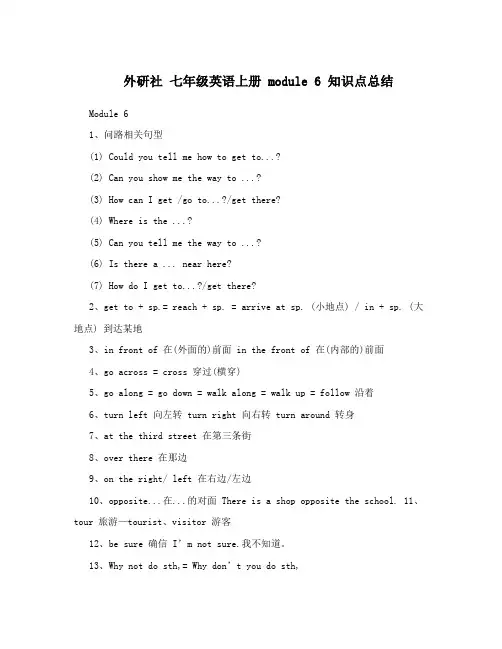
外研社七年级英语上册 module 6 知识点总结Module 61、问路相关句型(1) Could you tell me how to get to...?(2) Can you show me the way to ...?(3) How can I get /go to...?/get there?(4) Where is the ...?(5) Can you tell me the way to ...?(6) Is there a ... near here?(7) How do I get to...?/get there?2、get to + sp.= reach + sp. = arrive at sp. (小地点) / in + sp. (大地点) 到达某地3、in front of 在(外面的)前面 in the front of 在(内部的)前面4、go across = cross 穿过(横穿)5、go along = go down = walk along = walk up = follow 沿着6、turn left 向左转 turn right 向右转 turn around 转身7、at the third street 在第三条街8、over there 在那边9、on the right/ left 在右边/左边10、opposite...在...的对面 There is a shop opposite the school. 11、tour 旅游—tourist、visitor 游客12、be sure 确信I’m not sure.我不知道。
13、Why not do sth,= W hy don’t you do sth,an underground station 一个地铁站 14、15、take + 冠词(a、the)交通工具 to + 地点 = go to + 地点 by 交通工具 He takes a bus to school. = He goes to school by bus. 16、Thanksa lot. = Thanks very much.17、(in) the middle /centre of (在)...的中心 Tom sits in the middleof the classroom. 18、walk along ... to 沿着...到 Walk along the street to the park. 19、above 在...之上 (位置上高于,两者不接触) The plane is flying above the clouds. above表示位置高于某人或某物。
最新外研版七年级上册英语-M6教案
Module 6 A trip to the zoo一、学习目标:1. 重点单词:bear, elephant, giraffe, lion, monkey, panda, tiger, zebra, zoo, guide, animal, such, as, come, different, country, other, dangerous, ugh, also, plant, look, tall, leaf (pl. leaves), sure, bamboo, cute, shall, them, which, over, funny, call, Africa, Asia, Europe, little, only, about, kilo (= kilogram ), people, African, grass, large, usually, alone, strong, catch, even2. 重点短语:such as, come from, look at, over there, a little, all over the world, as well as,be good at, many kinds of3.重点句子:1.—That’s a giraffe.— Yes, and there are some giraffes2.—Do lions eat meat?—Yes, they do.3.—Does it eat meat?—No, it doesn’t. It eats plants.4.—Do pandas eat plants and leaves?—Sure. They love bamboo.5. Shall we go an d…?6. That’s very funny.7. It doesn’t eat meat.8. The tiger lives in Asia.二、重点及难点:Present simple questions.三、教学设计:Unit 1 Does it eat meat?ⅠTeaching modelListening and speakingⅡTeaching methodInteractive approachⅢTeaching aims1. To find specific information in the listening.2. To recognize the third person singular endings –s.3. To ask and answer questions about animals.4. To enable students to talk about animals.ⅣTeaching ObjectivesKey vocabulary: bear, elephant, giraffe, lion, monkey, panda, tiger, zebra, zoo, guide, animal, such, as, come, different, country, other,dangerous, ugh, also, plant, look, tall, leaf (pl. leaves), sure,bamboo, cute, shall, them, which, over, funny, callKey structures:1.—That’s a giraffe. — Yes, and there are some giraffes2.—Do lions eat meat? —Yes, they do.3.—Does it eat meat? —No, it doesn’t. It eats plants.4.—Do pandas eat plants and leaves? —Sure. They love bamboo.5. Shall we go and…?6. That’s very funny.ⅤTeaching aidsTape recorder , OHP , video , a clockⅥTeaching StepsStep 1 Warming-up1. Lead inT: Hello, boys and girls!Ss: Hello, Mr. Zhang.T: Today, we are going to learn Module 6 A trip to the zoo. Have you been to the zoo?Ss: Yes.T: Do you know Beijing zoo?S1: Yes, I went there last year. I saw many animals…S2:…T: OK. Today I’ll take you to visit Beijing zoo. Are you happy?Ss: Yes.T: Please look at the screen and get to know some information about Beijing Zoo.Ss: …(Look at the screen and try to know some information about it.)2. Show some pictures to ask and answer: What can you see?Beijing ZooGuide Map of Beijing Zoo3. Call back the answer from the whole class and check the answer.Step 2 Practice1. Show some pictures of the animals.2. Introduce the new words.3. Look at the pictures. Ask and answer: What can you see?bear n. 熊elephant n. 大象giraffe n. 长颈鹿lion n. 狮子monkey n. 猴子panda n. 熊猫zebra n. 斑马tiger n. 老虎plant n. 植物animal n. 动物leaf—leaves n. 叶子bamboo n. 竹子4. Call back the answers from the whole class and check the answer .5. Read the words.Step 3 Work in pairs1. Look at the picture. What can you see?bear elephant giraffe lion monkey pandatiger zebra zoo2. Listen and check ( √) the words in Activity 1 you hear.bear elephant giraffe lion monkey panda tigerzebra zooKeys: giraffe, monkey, panda, zoo3. Now work in pairs and say what you can see.—That’s a giraffe.—Yes, and there are some giraffesStep 4 Listen and read.1. Ask the students to read the conversation silently.2. Play the recording and ask the students to listen and read the conversation.3. Read the conversation.4. Act it out.5. Ask the students to complete the table in Activity 3.Animals Things they eatLionsBearsElephantsPandas6. Call back the answer from the whole class and check the answer. Keys: 1. meat 2. meat, plants 3. plants 4. bambooStep 5 Underline the correct words.1. Ask the students to read through the passage.There are (1) other / many animals from different (2 ) country / countries in Beijing Zoo, (3) such / which as bears, giraffes and pandas. The lions are (4) funny / dangerous because they eat meat. The bears eat meat too, but also (5) plants / leaves. Elephants are (6) different / cute. They’re (7) tall / white and eat (8) plants/ meat. Pandas are black and white and eat (9) bamboo / other animals. The (10) panda’s/ guide’s name is Lingling.2. Underline the correct words.3. Call back the answer from the whole class and check the answer.Keys: 1. many 2. countries 3. such 4. dangerous 5. plants 6. different 7. tall 8. plants 9. bamboo 10. panda’sStep 6 Language points1. The zoo has many kinds of animals, such as bears, zebras, giraffes and pandas.such adj. 这样的;如此的可修饰名词,修饰可数名词单数时要置于a / an 之前。
外研版七年级上册英语M6 Unit 2 The tiger lives in Asia
Module6Atriptothezoo
Unit2 ThetigerlivesinAsia.
提示:点击 进入习题
基础巩固练
1 alone
6 large
2 strong
7 only
3 catches
8 leaves
4 kilos
9 Europe
5 grass
10 even
答案呈现
11 A 12 B 13 B 14 A 15 C
livein, begoodat, alittle, aswellas, manykindsof 23. Thereis____a_l_i_tt_le____time. Let’sgooutfordinner.
livein, begoodat, alittle, aswellas, manykindsof
B. Their favourite food is meat.
C. Does it eat leaves?
Theyusuallyeat30kilosofba D. I want to go to the
mbooaday.
zoo.
G. IsthezebrafromAsia?
E. Pandas and monkeys.
The_____38areverybig. Theyallhave_____39noses. Theirnosescan______40themeatanddrink. 38. A. zebrasB. elephants CB. monkeysD. tigers 39. A. shortB. smallC. longD. tall 40. A. giveB. helpC. getD. use
外研版七年级上册M6
主讲人:姜老师
目录
CONTENTS
01 词汇篇
02 语法篇
词汇篇
知识讲解
要点 1 a kind of 和many kinds of a kind of 一种 many kinds of 许多种
知识讲解
要点 2 such as 比如 I like fruit , such as apples , pears and bananas .
I think that you should say sorry to her.
我们下节课见啦!!
知识讲解
要点 3 different 形容词 不同的 be different from ……和……不同 His bag is different from mine.
知识讲解
要点 4 also和too的区别 also 副词 也…… (放在be,情态动词,助动词之后,行为动词之前) I am also a doctor. too 一般放在句末,且用逗号隔开。
I am a doctor, too.
知识讲解
要点 5 shall的用法 shall是情态动词,所以后面跟动词原形,而且shall一般只用于第一人称。 Shall we ……?
Shall we go out for dinner?
知识讲解
要点 6 called 形容词 叫做……的 (常后置作定语)
a little milk liБайду номын сангаасtle 几乎没有,极少(修饰不可数名词) There is little milk at home.
知识讲解
要点 9
as well as 并且,还,和
外研版七年级上册M6Unit_1_
倒装句。 主语在后面,主谓一致要 与后面的一致。 e.g. In the dining _____ the desks. A. is B.are C.be D.am
Does it eat meat?
含有实意动词Leabharlann 一般疑问句。11.in front of与 in the front of 在...的前面
also
句中,be/助动 词 情态动词之后, 实意动词之前. e.g. They also eat meat.
either
否定句句末. e.g. I don't have any eggs,eith er.
6.The tiger comes from Asia. Does the tiger come from Asia? Yes, it does.\No, it doesn’t.
kinds
of 有点;稍微(同a little)后接形容
词或副词。
2.different
adj.不同的;各式各样的;个别的;不平常 (后接可数名词复数或不可数名词)
[例]Do
you have something different?
你有什么与众不同的地方吗
be
different from 和...不同(反义:be same as 和...一样)注意:这两个短语使用不同的介词。 book is different from mine.
monkey
4. It is the biggest animal on land. It is kind. It can help people carry (搬动)heavy things
elephant
zebra
5. It is from Africa. It eats plants, grass and leaves, but it isn’t a horse.