
构词法之派生法
.
英语构词法
一、构词法之派生法的讲解
英语构词法主要有:合成法,转化法,派生法,混成法,截短法和词首字母缩略法。
派生Derivation
前缀
后缀
注意:-ese, -ian, -ist 既可以构成名词,又可以构成形容词。
-er 构成的名词,既有表示人的,又有表示物的。
二、课堂巩固练习
Ⅰ.Match the right words from the right column with the words on the left.
( ) 1. enrich A. trying to find jobs
( ) 2. semicircle B. remove, get rid of ice, frost
( ) 3. troublesome C. of, having, using imagination
( ) 4. sharpen D. make or become sharp
( ) 5. job-hunting E. half a circle
( ) 6. limitless F. causing trouble
( ) 7. imaginative G. make rich, improve in quality, flavour, etc.
( ) 8. defrost H. without limit
Ⅱ.Use the appropriate form of the words to fill in the blanks.
1. The mother didn’t know why her daughter was crying _______. (noise)
2. He was one of the best _______ in yesterday’s football m atch. (play)
3. Look! How ______ Kate is laughing! (happy)
4. It snowed _____ last night and now the streets are covered with snow. (heavy)
5. Edison was a great ______. During his life he had many ______. (invent)
6. More and more _____ have come to visit China over these years. (foreign)
7. We want _________ reasons for your failure to help. (satisfy)
8. Please give me some reference work. It will ______ my task. (simple)
9. The boy had the _______ of being half starved. (appear)
10. The police have _______ a plot against the President. (cover)
11. The doctor said that Mary’s mother needed an _______.(operate)
12. She hoped that her son would become a _______. (music)
13. Few ______ words made us excited. (speak)
.
14. The days on the moon get hotter than ______ water. (boil)
15. Thank you for your _________. (kind)
16. Many college students work while they are studying because they want to make some money for their college _____. (expensive)
17. Most international ______ letters are written in English, too. (busy)
18. The boy noticed an ______ mistake on his paper, but he decided not to say anything about it. (correct)
19. When in Rome, do as the _____ do. (Rome)
20. The teacher was pleased with her _______. (honest)
如有侵权请联系告知删除,感谢你们的配合!。
英语构词法 派生法
英语构词法派生法(前缀+词根、词根+后缀)(一) 后缀:许多名词、形容词、副词和动词是由词根加后缀构成的。
1.构成名词的常用后缀有:(1) -er, -or, -ist, -ee, -ian, -ese, -ant等用于构成表示人或物的名称。
例如:thinker, guesser, translator, teacher, conductor, physicist, dentist, employee, trainee, physician, Chinese, Japanese, Italian, assistant, applicant…(2) -ance, -ence, -(a)tion, -sion, -ics, -ing, -ity, -ment, -ness, -th, -ty, -ure, -ship等用于构成表示行为、性质、状态等的抽象名词。
例如:acceptance, assistance, dependence, confidence, repetition, preparation, discussion, division, physics, fabrics, building, wedding, reality, ability,settlement, argument, greatness, hardness, warmth, length, safety, penalty,failure, pressure, friendship, leadership…2.构成形容词的常用后缀有:-able, -ible, -al, -ful, -less, -ish, -ive, -ous, -an, -ic, -ly, -ant, -ent, -ary, -en等。
例如:available, suitable, responsible, permissible, natural, national, powerful, faithful, fearless, useless, selfish, childish, collective, decisive, famous, continuous, American, European, historic, scientific, friendly, lively, thirsty, noisy, significant, pleasant, dependent, consistent, secondary, imaginary, golden, wooden…3.构成副词的常用后缀有:-ly, -ward, -wise等。
构词法之派生法
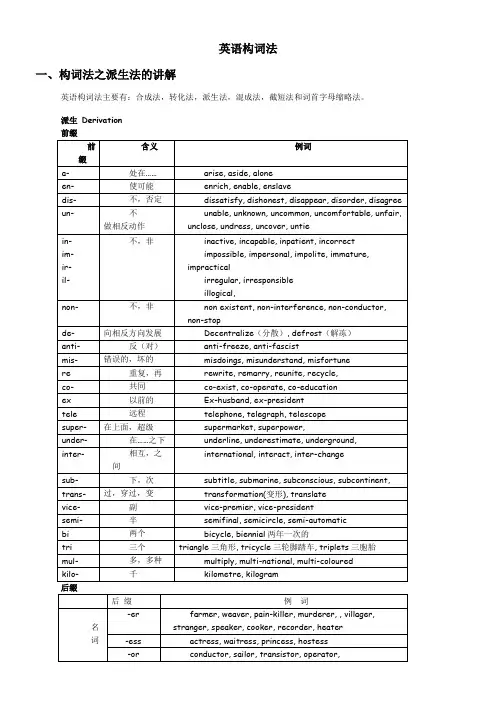
英语构词法一、构词法之派生法的讲解英语构词法主要有:合成法,转化法,派生法,混成法,截短法和词首字母缩略法。
派生 Derivation前缀后缀注意:-ese, -ian, -ist 既可以构成名词,又可以构成形容词。
二、课堂巩固练习Ⅰ.Match the right words from the right column with the words on the left.( ) 1. enrich A. trying to find jobs( ) 2. semicircle B. remove, get rid of ice, frost( ) 3. troublesome C. of, having, using imagination( ) 4. sharpen D. make or become sharp( ) 5. job-hunting E. half a circle( ) 6. limitless F. causing trouble( ) 7. imaginative G. make rich, improve in quality, flavour, etc.( ) 8. defrost H. without limitⅡ.Use the appropriate form of the words to fill in the blanks.1. The mother didn’t know why her daughter was crying _______. (noise)2. He was one of the best _______ in yesterday’s football match. (play)3. Look! How ______ Kate is laughing! (happy)4. It snowed _____ last night and now the streets are covered with snow. (heavy)5. Edison was a great ______. During his life he had many ______. (invent)6. More and more _____ have come to visit China over these years. (foreign)7. We want _________ reasons for your failure to help. (satisfy)8. Please give me some reference work. It will ______ my task. (simple)9. The boy had the _______ of being half starved. (appear)10. The police have _______ a plot against the President. (cover)11. The doctor said that Mary’s mother needed an _______.(operate)12. She hoped that her son would become a _______. (music)13. Few ______ words made us excited. (speak)14. The days on the moon get hotter than ______ water. (boil)15. Thank you for your _________. (kind)16. Many college students work while they are studying because they want to make some money for their college _____. (expensive)17. Most international ______ letters are written in English, too. (busy)18. The boy noticed an ______ mistake on his paper, but he decided not to say anything about it. (correct)19. When in Rome, do as the _____ do. (Rome)20. The teacher was pleased with her _______. (honest)。
英语构词法-派生法
·
• III.动词后缀
1. -fy (n./adj.→v.) 表示“使成为, 使……进入状态”。 如: beautify 美化 horrify 使恐怖 specify 指定 purify 净化
·
• 2. -is(z)e (adj./n.→v.)表示“使成 为,使……化”。如: memorize 记住 apologize 道 歉 realize实 现 modernize 使……现代化
·
• 5. -y (n.→adj.) funny 滑稽的 sunny 阳光明媚的 cloudy 多云的 wealthy 富有的
·
• 6. -ly (adj.→adv. / n.→adj.) nervously 紧张地 noisily 吵闹地 finally 最后 quietly 安静地 lovely 可爱的 friendly 友好的 fatherly 父亲般的 manly 有男子气概的
·
• 3. -ist表示“从事……者”。 如: chemist 化学家 journalist 记者 typist 打字员 scientist 科学家
·
• 4. -ness (adj.→n.)表示性质,状态。 如: business 商业 darkness 黑暗 weakness 虚弱
·
• 5. -ment (v.→n.) 表示方式,结果,状 态。 如: agreement 同意 disappointment 失望 announcement 宣布 treatment 疗法 employment 雇佣 encouragement 鼓励
• 7·. 其它形式:-ish, -ic, -ical, -ive, al(n.→adj.) foolish 愚蠢的 basic 基础的 scientific 科学的 medical 医药的 expensive 昂贵的 selfish 自私的 personal 个人的 educational 教育的 political政治的 progressive进步的
英语构词法-派生法

• 7. 其它形式:-ish, -ic, -ical, -ive, · al(n.→adj.) foolish 愚蠢的 basic 基础的 scientific 科学的 medical 医药的 expensive 昂贵的 selfish 自私的 personal 个人的 educational 教育的 political政治的 progressive进步的
• 1. “dis”- 表示意义相反,主要用在动词、 ·
名词或形容词前。如:
appear (v.出现) → disappear (v.消失),
• 再如: dislike不喜欢 discover 发现 disobey不遵从 disbelieve 不相信 dishonest(adj.)不诚实的 disadvantage (n.) 不利条件,缺点
·
• 6. -dom 表示状况,领域。 如: freedom 自由 wisdom 智慧 kingdom 王国
• 7. 其它形式:-th,-ty,-ence (ance) · death 死亡 length 长度 width 宽度 truth 事实 honesty 诚实 difficulty 困难 ability 能力 poverty 贫穷 importance 重要性 performance 表演 silence 沉默 difference 不同
·
• 3. re- 表示“重新,再”, 用在动词 前。如:
rebuild 重新建造 recycle 再循环 reconsider 重新考虑 review 复习
·
Ⅱ.后缀 (postfix; suffix)
·
• I.形容词后缀
1. -able (n./v.→adj.)表示“可以……的;显 示……性质”。 如: respectable 可敬的 eatable 可吃的 comfortable 舒服的 valuable 有价值的 fashionable 时髦的 loveable 可爱的
四种构词法

四种构词法构词法主要有四种:派生法、合成法、转换法和截短法。
一、派生法在一个词的词根的前面或后面加上某个词缀来产生新词,这种构词法称为派生法。
加在前面的词缀叫前缀,加在后面的词缀叫后缀。
(一)后缀:许多名词、形容词、副词和动词是由词根加后缀构成的。
1.构成名词的常用后缀有:(1)-er,-or,-ist,-ee,-ese,-ant等用于构成表示人或物的名称。
(2) -ance, -ence, -(a)tion, -sion, -ics, -ing, -ity, -ment, -ness, -th,-ty,-ure,-ship等用于构成表示行为、性质、状态等抽象名词。
2. 构成形容词的常用后缀有:-able, -ible, -al, -ful, -less, -ish, -ive, -ous, -an, -ary, -en等。
3. 构成副词的常用后缀有:-ly, -ward, -wise等。
4. 构成动词的常用后缀的有:-ise/ize, -en, -ify等。
(二)前缀:词根加前缀多数不改变词性,只引起词义的变化。
1. 表示相反意义的前缀有:un-, dis-, in-, im-, ir-, il-, de-等。
2. 表示其他意思的前缀有:re-(重新),mpost-(后的),fore-(先的)等。
二、合成法由两个或两个以上的词合成一个新词,这种构词法称为合成法(compounding)。
合成词之间有的要用连字符连接,有的直接连接在一起。
三、转换法在词行不变的情况下,一个单词由一种词性转换成另一种词性,称为转换(conversion)。
转换后的词义与转换前的词义通常有密切的联系,但有时差异也很大。
有些双音节的词转换后,重音要发生变化。
通常名词重音在前,动词重音在后,有时读音也有不同。
四、截短法即将单词缩写,词义和词性保持不变,主要有截头、去尾、截头去尾等形式。
关于合成法:合成名词:构成方式例词名词+名词weekend周末;名词+动词daybreak黎明;名词+动名词handwriting书法;名词+及物动词+er/or pain-killer止痛药;名词+介词+名词editor-in-chief总编辑;代词+名词she-wolf母狼;动词+名词typewriter打字机。
英语构词法-派生法
1. -fy (n./adj.→v.) 表示“使成为, 使……进入状态”。 如: beautify horrify specify purify
·
• 2. -is(z)e (adj./n.→v.)表示“使成 为,使……化”。如: memorize apologize realize modernize
•
irregular不规则的 illegal非法的
·
• 3. re- 表示“重新,再”, 用在动词 前。如:
rebuild 重新建造 recycle 再循环 reconsider 重新考虑 review 复习
·
Ⅱ.后缀 (postfix; suffix)
• I.形容词后缀
1. -able (n./v.→adj.)表示“可以……的;显 示……性质”。 如:
·
• II.名词后缀
1. -er 表示人或物。 如:
speaker passenger fire fighter owner
·
• 2. -or (v.→n.)表示人,置于动词之后。 如: competitor director editor operator
·
• 3. -ist表示“从事……者”。 如: chemist 化学家 journalist 记者 typist 打字员 scientist 科学家
·
finally quietl· 7. 其它形式:-ish, -ic, -ical, -ive, -al(n.→adj.)
foolish basic scientific medical expensive selfish personal progressive
派生法: Derivation 屈折变化: Inflection
英语构词法派生法
respectable comfortable valuable fashionable loveable
·
• 2. -ful (n./v.→adj.) 表示“充满……的” 如:
beautiful successful wonderful shameful hopeful
·
• 3. -less (n.→adj.) 表示“没有…… 的”。如:
派生法: Derivation 屈折变化: Inflection
Presenter : 田甜
派生法: derivation
·
• 派生法(derivation)是英语主要的构词法, 用以丰富扩大英语的词汇量。这方法是借 前缀(prefix)或后缀(postfix;suffix)之助, 制造出派生词(derivative words),主 要有名词、形容词和动词三种。
jobless homeless helpless
·• 4. -ous (n.→adj.)表示“具有……性质 的”。 如:
nervous famous dangerous poisonous humorous 幽默的
·
5. -y (n.→adj.)
funny sunny cloudy wealthy
·• 6. -ly (adj.→adv. / n.→adj.)
finally quietly lovely friendly manly
7·. 其它形式:-ish, -ic, -ical, -ive, -al(n.→adj.)
foolish basic scientific medical expensive selfish personal progressive
tall - tallest
语法小结:派生词构词法
语法小结:派生词构词法派生法,也叫前缀、后缀构词法,即由一个词根加上前缀或后缀构成另一个词的构词方法。
一、前缀添加在词根前的构词部分叫前缀,它多数情况下不改变原词的词性。
常见的有以下几种:1. im-, un-, in-, dis-等,表示否定。
如:possible (可能的)→impossible (不可能的), load (装载)→unload(卸货), correct (正确的)→incorrect (不正确的), like (喜欢)→dislike (不喜欢)2. re-,表示“重复”。
如:write (写) →rewrite(重写) 3. mid-,表示“在……中间”。
如:night (夜晚)→midnight(半夜)4. anti-,表示“反对,防止”。
如:war (战争)→antiwar(反战的)二、后缀添加在词根后的构词部分叫后缀,它多数情况下改变原词的词性。
常见的有以下几种:1. 名词后缀:-er, -or, -ist, -ship, -tion, -ment等。
如:sing(唱歌) →singer(歌手), act(表演) →actor(演员), science(科学) →scientist(科学家), friend(朋友) →friendship(友谊), describe(描述) →description(描述), enjoy(享受) →enjoyment(享受)2. 形容词后缀:-ful, -less, -able等。
如:peace(和平)→peaceful(平静的), care(小心)→careless(粗心的),believe(相信) →believable(可信的)3. 动词后缀:-en, -ize等。
如:strength(力量) →strengthen(加强), modern(现代的) →modernize(使现代化)4. 副词后缀:-ly等。
如:slow(慢的)→slowly(慢慢地)【秘笈】词根、前/后缀, 构词数量大。
三种英语基本构词法(派生、合成、转化)
英语基本构词方法一:派生法:在一个单词的前面或后面加上词缀构成新词的方法,称为派生法。
派生构词有三大要素: 词根, 前缀和后缀。
也有人称之为两大要素: 自由词素和粘附词素。
派生法的结构是:粘着词素+自由词素+粘着词素。
(一)英语词缀分成前缀和后缀两种。
前缀是加在词根或单词前面的部分。
它具有一定的含义。
同一词根或单词加上不同的前缀,即可构成不同的新词。
pre—(前):prewar (战前的) post—(后):postwar(战后的)im—(入):import (输入)前缀可以增加,改变或加强一个词根或单词的意义,也可以改变一个单词的词类。
如:增加意义:hemi-(半)→hemisphere(半球)改变意义:un-(不)→unhappy(不快乐的)加强意义:de-→describe(描写)改变词类:en-(使)→enlarge(扩大)前缀的意义主要有这几种:1)表示否定意义。
如:anti-: anticancer抗癌剂2)表示数目和数量。
如:multi-: multicolored五彩的3)表示时间、空间和程度。
如:a-: aboard在船上4)表示特殊意义。
如:auto-: autobiography自传后缀是加在词根或单词后面的部份。
后缀有四种,即:名词后缀、形容词后缀、动词后缀和副词后缀。
后缀不仅改变词的意义,而且使单词由一种词类转化成另一种词类。
1)名词后缀,它有许多种,如:表示人:-er: worker工人;teacher教师-ist: artist艺术家;chemist药剂师表示物:-or: tractor拖拉机;generator发电机-ant: disinfectant消毒剂; dependant依附物表示抽象名词: -hood: childhood童年;neighborhood邻居关系-ship: friendship友谊;horsemanship骑马术表示集合名词:-ry: peasantry农民总称;citizenry公民总称-age: mileage英里数;teenage十几岁的时期表示场所地点: -ery: piggery养猪场;greenery花房,温室-ern: saltern制盐场;cavern洞穴表示疾病: -oma: trachoma沙眼症; neuroma神经瘤-itis: bronchitis支气管炎;arthritis关节炎表示……学::-logy: zoology动物学;anthropology人类学-ics: electronics电子学;statistics统计学2)形容词后缀表示一种事物具有或属于某种性质或状态。
英语构词法中的派生法
英语构词法中的派生法派生法(derivation): 在词根前面加前缀或在词根后面加后缀,从而构成一个与原单词意义相近或相反的词。
前缀(prefix): 一般改变意义,不改变词性。
表示否定的:dis-, like---dislike, appear---disappear, agree---disagree,cover---discover,il-, legal---illegal, literate---illiterate;im-, possible---impossible, polite---impolite,mortal-immortal;in-, correct---incorrect, direct---indirect, complete---incomplete;ir-, regular-irregular, relative---irrelative,revocable---irrevocable, capable of being revoked; able to be cancelled, revoke: (transitive) to take back or withdraw; cancel; rescind ? to revoke a law2. (intransitive) cardsto break a rule of play by failing to follow suit when able to do so; renege,renege. (intransitive; often foll by on) to go back (on one's promise, etc)mis-,“错误,坏” take---mistake, understand---misunderstand, fortune---misfortune, lead---mislead, mischievous;mal-, “坏,恶的”function---malfunction, maladroit笨拙的(mal+adroit灵巧的) adjective 1. skilful or dexterous 2. quick in thought or reaction, malevolent恶意的(male+vol意志+ent→坏意志) 1. wishing or appearing to wish evil to others; malicious 2. astrology having an evil influence;non-,“不,非”’ fiction---non-fiction, non-cooperation, non-negotiable, non-stop直达的,non-profit, non-commercial;un-, “不,非”happy---unhappy, fair---unfair, like---unlike(不像),certain-uncertain,known-unknown,usual-unusual,important-unimportant, accessable---unaccessable, accountable---unaccountable, fold-unfold,前缀a-,① 加在单词或词根前面,表示”不,无,非”, acentric 无中心的(a+centric中心的) asocial 不好社交的(a+social好社交的) ;amoral 非道德性的(a+moral道德的;注意:immoral apolitical.不关政治的(a+political政治的) anemia 反常的(a+nomal正常的+ous)② 加在单词前,表示”在…,…的” ,asleep 睡着的(a+sleep睡觉),aside 在边上(a+side旁边),ahead 在前地(a+head头),alive 活的(a+live活) awash .泛滥的(a+wash冲洗),alike(相似的,一样的);前缀中的:anti-, “反对,抵抗, against,opposed to,opposite of,instead”,anti-war, antitrust, antibiotic, antioxidant,antibody, antigen, anti-semitic等;auto-, “自动的,self, personally, 表示自己”,automate, automation 自动化,autograph 亲笔,autoalarm 自动报警器,autocriticism 自我批评,autorotation自动旋转,autobiography 自传,autonomous [??'tɑ?n?m?s]a. 自治的;automatic, automatically, autonomy, automobile,automated, autopsy, autograph亲笔签名,手稿, automotive, ,autocrat 独裁者,autocracy,automata, automaton, autoclave, automaker, autoindex自动索引;co-, “共同”,coworker, collegiate, colleague, cooperate;en-, “使”,enlarge, encourage, enhance, enable, enact, enroll, encompass,inter-,“相互,between在---之间”,international, internet, interview, intercontinental洲际的,interchange, interfere, interrupt, interpose,mini-, “小”,minibus, ,miniskirt, miniature, minify, minimum, minimal最低限度的,pre-,“在---之前”,pre-school, pre-reading, preview,precede v. to go or be before (someone or something) in time, place, rank, etc, precedent. a. If there is a precedent for an action or event, it has happened before, and this can be regarded as an argument for doing it again.president, precedent. unprecedented.re-, “再,又,重复”, repeat, rewrite, retell, return, review, rebound, reflect, reclaimsub-,“在下面”,subway, subordinate, submarine, suburban(urban城区),subconscious,subscribe,super-“超,在---之上”,supermarket, superman, superstar, supersonic, superficial, supervise, supernatural,tele-,“远”,telephone, telescope, television, telecommunication, telegram,后缀(suffix): 通常使词由一种词类转化为另一种词类。