
译林牛津版八上英语 Unit 5 Wild animals Welcome to the unit教案
Unit 5 Wild animals
Teaching objectives 教学目标
1. Catch the main features about the animals
2. Read out your report and share it with others
3. W rite a report about the animals in danger
Language Focus
wild, free, dish, no way, pity, have/take pity on, die, in fact, dolphin, giant panda, squirrel, zebra, mean, be born, beginning, in the beginning, sadly, face, live…on, mainly, result, as a result, danger, in danger, action, take action, right away, reserve, law, none, at birth, closed, bat, bee, lost, get lost, the same…a s, save, stripe, quality, while, hunter, catch, wolf, thick, kill, human, yours sincerely, sorry, sell, pity, shame, act, illness, accept, report, tail, insect, slowly, daytime, otherwise, living
Grammar
may for possibility
verbs + to -infinitives
Emotional Focus
After introducing some wild animals which are in danger in the world, arouse the feelings of students to help and protect the poor animals.
Strategy Focus
Telling a story according to the pictures.
Using verbs + to –infinitives sentences.
教学过程
Welcome to the unit
Step 1 Lead-in
1) Play a game
Guess the name and features of the animals.
What
does it look
like? What can it do? W hat does it
eat?
Where does it
live?
What is it?
tail swim fish food in the water
run fast in the hutch colourful feathers bird foo d
look like a bear, black and white live only in China
2) Look at the pictures. Give the animal names of the pictures. Let some Ss give their answers
Step 2 Presentation
Dolphins live __ ___ __________, they can ______ fast. They can play tricks so they
are very ______. And they are ________ to people. They eat _____.
small, lovely, a long soft tail, red or black fur
live in the trees, love climbing trees
eat nuts (果仁)
look like a bear, black and white
lovely
live only in China
They are big. They have brown fur, they can ______ in the water and ______ trees.
an African wild horse
black and white stripes
big, strong, yellow fur with black stripes(条纹)
run fast, hunt animals
eat meat
in the wild(野外)
Step 3 Ask and answer.
1. Which is the biggest animal on land?
2. It’s a wild animal that has a long, soft tail and lives in the tree.
3. The animal lives only in Australia, and it has a pocket to carry its baby.
4. The animal with no legs lives in water, it’s friendly to people.
Step 4 Listening
Listen to the comic strip and complete the blanks.
Would you like to ___ __ ___ ____, Eddie?
No.
Why not? Wild animals are _____ and ______.
I don't think so. They may become dishes ___ ___ ____ any time.
So could you please not eat them?
No way!
Please ____ ____ ____ them, Eddie.
I may die ________ them. __ ____, these are not wild animals, Hobo.
Step 5 Exercises
Put the phrases into English:
1. 野生动物
2. 住在野外
3. 任何时候
4. 对它们有同情心
5. 事实上
Step 6 Liste n and answer.
1. Who like monkeys best?
2. What about Simon?
3. Does Peter like pandas best?
4. What wild animals does Millie like best?
Step 7 Group work
Discussion
What wild animals do you like best? Why?
Step 8 Homework
Write a passage about your favourite wild animals. 教学反思。
译林版英语八年级上册unit5教案

tail
swim
fish food
in the water
run fast
in the hutch
colourful feathers
bird food
look like a bear, black and white
live only in China
2)Look at the pictures. Give the animal names of the pictures.Let some Ss give their answers
学生活动
旁注
Step 1 Lead-in
1)Play a game
Guess the name and features of the animals.
What does it look like?
What can it do?
What does it eat?
Where does it live?
Have a guessing game
Complete the table
Look at the pictures and name
them
教师活动内容、方式
学生活动
旁注
2)A squirrel is ______________. It has a long soft ______ . It has red or black fur.
beginningn.开始,起初(动词begin的名词)
in the beginning等于at first,意思是“开始,起初”,与later(后来)相对。短语at the beginning (of)指开始的时间或地点。
牛津译林版八年级上册Unit5《Wildanimals》(Reading1)说课稿
牛津译林版八年级上册Unit 5《Wild animals》(Reading 1)说课稿一. 教材分析《牛津译林版八年级上册Unit 5 Wild animals(Reading 1)》主要讲述了关于野生动物的保护问题。
通过一篇关于非洲象的阅读材料,引导学生了解非洲象的生活习性以及目前面临的生存困境。
文章语言真实自然,富有感染力,能够激发学生的学习兴趣,同时培养学生的环保意识。
本节课的内容与学生的生活实际密切相关,易于引起学生的共鸣。
二. 学情分析八年级的学生已经具备了一定的英语基础,能够运用英语进行简单的交流。
但他们在阅读理解、词汇积累以及写作方面还存在一定的困难。
因此,在教学过程中,教师需要关注学生的个体差异,善于激发学生的学习兴趣,引导他们主动探究,提高他们的阅读理解能力和环保意识。
三. 说教学目标1.知识目标:学生能够掌握文章中的重点词汇和短语,理解文章的主要内容,了解非洲象的生活习性和目前面临的生存困境。
2.能力目标:学生能够运用所学知识进行阅读理解,提高自己的阅读能力;通过讨论和写作,提高自己的表达和交流能力。
3.情感目标:学生能够树立环保意识,关注野生动物的保护问题,养成关爱自然、保护动物的良好习惯。
四. 说教学重难点1.教学重点:学生能够掌握文章中的重点词汇和短语,理解文章的主要内容,了解非洲象的生活习性和目前面临的生存困境。
2.教学难点:学生能够运用所学知识进行阅读理解,提高自己的阅读能力;通过讨论和写作,提高自己的表达和交流能力。
五. 说教学方法与手段1.教学方法:采用任务型教学法,让学生在完成任务的过程中,提高自己的阅读理解能力和表达能力。
2.教学手段:利用多媒体课件、图片等辅助教学,激发学生的学习兴趣,提高课堂效果。
六. 说教学过程1.Pre-reading:教师通过展示一些关于野生动物的图片,引导学生谈论自己喜欢的动物,激发学生的学习兴趣。
2.While-reading:教师引导学生快速阅读文章,回答一些简单的问题,帮助学生理解文章大意。
新译林版八年级上册第五单元welcome
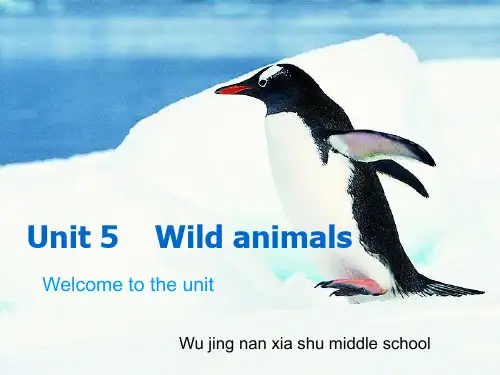
Welcome to the unit
Wu jing nan xia shu middle school
watch a video. Millie wants to be a volunteer(志愿者) of
the WSPA(世界动物保护协会). Do you want to work with her? Let’s do something and have a try!
to study English. 4.It is very important for us to e_x_e_r_c_is_e(exercise)
more often. 5.At the _b_e_g_in_n_i_n_g (begin) of the
21st century, many young people
Listen to its voice.
a wolf
It lives in the sea. It’s lovely and clever. It can help people who drop into the sea without care.
a dolphin
Listen to its voice.
A: Do you like animals? B: Yes, I do. A: What animal do you like best/least? B: …… A: Why? B: Because they …… (lovely, friendly, clever, helpful, strong and
Firstly, can you tell their names?
giant panda
牛津译林版8A Unit5 Wild animals Welcome to the unit课件(共34张PPT)
3. What wild animal does Peter like best? Why? Pandas. Because they look so cute.
4. What wild animal does Millie like best?
Pandas.
Listen and fill in the table
Welcome to the unit
Objectives To learn to say some wild
animals in English. To learn to talk about your favourite wild animals.
Words and expressions review
1. What wild animal does Kitty like best? Why? Monkeys. Because they’re so clever and funny.
2. What wild animal does Simon like best? Why? Lions. Because they’re strong and they can run very fast.
Favourite wild animals
Millie and her classmates are talking about their favourite wild animals. Listen to their conversation and answer the questions.
Some other animals
kangaroo
monkey
snake
rabbit
bird
elephant
牛津译林英语八(上)Unit 5 Wild animals welcome to the unit 公开课教学课件共52张PPT
— ______, I’ll be free then.
(2012浙江温州)
A. Sorry, I can’t B. Not at all
C. Thank you
D. Sure, I'd love to
2. Please have pity on them, Eddie. have pity on = take pity on 同情,怜悯 One should have pity on the beggar in the street. 一个人应该同情街上的乞讨者。
Human beings hunt them too much.
What do people kill them for?
fur & skin
tusk (象牙) meat
Step 7 Discussion:
1.Are the wild animals free and happy in the wild?
tiger(s)
Tigers are big and strong Tigers canrun fast. Tigers are the kings in the forest
dolphin(s)
live in the sea
can swim fast,play some tricks clever ,friendly to people
They cannot find enough food.
The forest has been destroyed (被毁). Their habitat (栖息地) is being threatened (受到威胁的).
They are killed by the environmental pollution (环境污染).
牛津译林版英语八上Unit5《Wildanimals》(integratedskills)说课稿

牛津译林版英语八上Unit 5《Wild animals》(integrated skills)说课稿一. 教材分析《牛津译林版英语八上Unit 5 Wild animals》主要介绍了一些野生动物,包括老虎、狮子、熊、猴子等。
本单元以动物为主题,通过学习动物的特点、生活习性以及保护动物的重要性,提高学生对野生动物的认识和关注。
本节课为单元的Integrated Skills部分,主要通过听力、口语、阅读和写作等多种形式,让学生综合运用本单元所学知识。
二. 学情分析八年级的学生已经具备了一定的英语基础,对于一些基本的词汇和句型能够熟练掌握。
但是,对于一些较为复杂的动物特点和保护动物的观点表达,还需要进一步引导和培养。
因此,在教学过程中,需要关注学生的个体差异,针对不同水平的学生给予适当的辅导和激励。
三. 说教学目标1.知识目标:学生能够掌握本节课所学的词汇和句型,了解各种野生动物的特点和生活习性。
2.能力目标:学生能够听懂、会说、会读、会写关于野生动物的短文,提高学生的综合语言运用能力。
3.情感目标:学生能够认识到保护动物的重要性,培养关爱动物的情感。
四. 说教学重难点1.重点:学生能够掌握本节课所学的词汇和句型,运用所学知识进行口语交流和写作表达。
2.难点:学生能够正确使用一般现在时描述动物的特点和生活习性,以及表达保护动物的观点。
五. 说教学方法与手段1.任务型教学法:通过设置各种任务,激发学生的学习兴趣,提高学生的参与度和积极性。
2.情境教学法:创设生动、真实的情境,帮助学生理解动物的特点和生活习性。
3.合作学习法:鼓励学生分组讨论、合作完成任务,培养学生的团队协作能力。
4.多媒体教学手段:利用多媒体课件和视频,丰富教学内容,提高学生的学习兴趣。
六. 说教学过程1.导入:通过展示一些野生动物的图片,引导学生谈论自己喜欢的动物,从而引入本节课的主题。
2.展示:教师通过多媒体课件,展示本节课所学的词汇和句型,让学生初步感知和理解。
牛津译林版英语八上Unit 5《Wild animals》(integrated skills)教学
牛津译林版英语八上Unit 5《Wild animals》(integrated skills)教学设计一. 教材分析牛津译林版英语八上Unit 5《Wild animals》(integrated skills)以野生动物为主题,通过介绍非洲、亚洲和北极地区的动物,让学生了解不同动物的生活习性和保护状况。
本单元包括阅读、听力、口语、写作和语法等多个方面的内容,旨在提高学生综合运用英语的能力。
二. 学情分析八年级的学生已经具备一定的英语基础,能够运用英语进行简单的交流。
但他们在口语表达、听力理解、阅读分析和写作技巧方面仍有待提高。
此外,学生对野生动物保护的认识有待加强。
三. 教学目标1.知识目标:学生能够掌握有关野生动物的词汇和表达方式,了解不同动物的生活习性和保护状况。
2.能力目标:学生能够运用英语进行听力、口语、阅读和写作练习,提高综合运用英语的能力。
3.情感目标:学生能够认识到保护野生动物的重要性,增强环保意识。
四. 教学重难点1.重点:野生动物相关词汇和表达方式的掌握,阅读和听力理解的提高。
2.难点:口语表达和写作技巧的运用,对野生动物保护意义的深入理解。
五. 教学方法1.任务型教学法:通过完成各种任务,激发学生的学习兴趣,提高学生的参与度。
2.情境教学法:创设真实的语境,让学生在实践中学习和运用英语。
3.合作学习法:鼓励学生分组讨论,培养学生的团队精神和沟通能力。
六. 教学准备1.教师准备:教材、教学课件、野生动物图片和视频、相关阅读材料。
2.学生准备:完成预习任务,了解野生动物的基本知识。
七. 教学过程1.导入(5分钟)利用图片和视频展示不同野生动物,引导学生谈论自己喜欢的动物,激发学生的学习兴趣。
2.呈现(10分钟)教师展示课文标题《Wild animals》,引导学生预测文章内容。
然后逐段呈现课文,让学生注意生词和短语。
3.操练(15分钟)学生分组进行角色扮演,模拟课文中的对话,巩固所学词汇和表达方式。
译林版八年级英语上册Unit5Wildanimals!(全章教案)
译林版八年级英语上册Unit 5 Wildanimals全章教案第1课时Comic strip and Welcome to the unit一、教学目标1. 95% students learn to master the new words and some sentence patterns;2. 90% students talk about wild animals from two aspects: characteristics and appearance;二、教学重点To let students talk about favourite animals and give reasons.三、教学难点To let students talk about favourite animals and give reasons.四、教学过程(一)Lead-in(W elcome to the unit)T: We know there are many lovely pets around us, such as dogs, cats, goldfish, rabbits, tortoises and so on. If you get one or two of them as pets, will you look after them well? I believe you can take good care of your pets. However, many other animals also need your care. They don’t live in our house. They are wild animals and some of them live in the wild. (Board-writing: wild) Would you like to go to the forest and visit them?S: Y es.T: We are strangers in the forest, so wild animals are shy and afraid to see us. Some of them hide(二)Presentation1. Present the names of wild animals(1) Show more pictures of wild animalsT: They are wild animals and they can’t speak like us. Can you help them introduce themselves? Y ou can make the self-introduction just like this. Hello! My name is … I am … I can …(2) Read the names of the wild animals after the teacherAsk the students to read these new words and phrases after the teacher for three times. Make sure all the students can read the names correctly. Then do Part A on page 57.(3) Finish Part A on page 57(4) Play a guessing gameT: Wild animals are our friends. It’s important to protect wild animals. Let’s check how much you know about wild animals. Let’s play a guessing game. Write the names on pieces of paper and then invite some students to choose and say something of the animals (To make it easier, ask the students to use the first person). The other students should listen carefully and guess what animal it is.Bear: I’m very big and strong. I like eating fish.Zebra: I look like a horse and can run fast. I have black-white stripes.Squirrel: I am small but lovely. I have a very big tail. I like eating nuts (坚果).Giant Panda: I am cute and I live in China. I hope that one day I can take a colour photo.Dolphin: I’m friendly and clever. I like playing balls and dancing in the sea. Who am I?Tiger: I’m the King of our forest. I’m dangerous. Don’t attack (攻击) me!2. Present the dialogue(1) Read the dialogue and answer the question.T: Millie and her classmates are talking about their favourite wild animals. Let’s listen to t heir conversation and then try to answer the question: What’s Simon’s favourite wild animal? (Play the recording of part B)S: He likes lions best.(2) Get the students to read the dialogue carefully and complete the table.(3) Get the students to read the dialogue together or in roles.(4)Get the students to make up dialogues.T: We have learned many kindsof wild animals. Can you tellme which wild animal you likebest and which one you likeleast? Then get the students totalk about their favourite wildanimals.(三)PracticeUse the following model tomake dialogue.A: Which animal do you like best?B: I like … best.A: Why?B: Because they are …A: Which animal do you like least?B: I like … least.A: Why?B: Because they are …(四)Lead-in(Comic strip)1. Look at the picture and answer the questionsT: Look at the picture. We all know him. He is our old friend Eddie. Is Eddie a wild animal?S: No. Because he doesn’t need to look for food in the wild.T: Well, Hobo and Eddie are talking about wild animals. Now let’s watch a short flash about their dialogue and try to answer the questions:(1) Will Eddie eat the wild animals? Why or why not?(2) Will Eddie eat the wild animal? Why or why not?2. Play the flash for them and then get some students to answer the question(五)Practice1. Play the tape again and get the students to read after it. Then ask them to fill in the blanks.T: Please listen to the tape again and repeat in groups, paying attention to the pronunciation and intonation.2.Work in pairs and read the dialogue in roles.(六)ConsolidationDivide the students into two groups: boy group and girl group. Boy group’s opinion: People can eat wild animals. Girl group’s opinion: People shouldn’t eat wild ani mals. They are given several minutes to prepare for the debate.(七)SummaryT: Wild animals are our friends. We shouldn’t eat or kill them. We should love and protect them. We should share the world with them!(八)Homework1. Finish some exercises of this period;2. Find more information about giant pandas;3. Preview Reading五、教学反思第2课时Reading(1)一、教学目标1. 95% students learn to get specific information by using the indicating words;2. 90% students to understand the understand the importance of protecting wild animals.二、教学重点To let students know the background of different wild animals in the world and talk about them 三、教学难点To let students know the background of different wild animals in the world and talk about them 四、教学过程(一)Lead-inEnjoy a video about Kungfu Panda II.T: Today, we’ll continue to learn about wild animals. First, let’s enjoy a video.T: As we can see, the panda in the film is very good at kungfu and it lives happily. But it is very difficult for real pandas to survive in the wild. They need our help, right? In fact, there are a lot of things that we can do to care about the pandas. We can join the WWF. We can design a leaflet to ask people to help the pandas. So, let’s think about how to design a leaflet. I am sure that you will know how to design it after learning this report on the baby panda Xi Wang.(二)Presentation1. Learn the new expressions(1) B rainstorm T: What do you know about giant pandas?(2) Present the new expressionsT: Most of you know that the giant pandas live mainly on bamboo. And you also know that the number of giant pandas is very small because they are facing serious problems. They are in danger. Shall we take action to protect them? (Show some pictures with the words: live mainly on, face serious problems, be in danger and take action right away.)T: In fact, there a re a lot of facts about giant pandas that you don’t know. In the arti cle, The Story of Xi Wang, you find them and think you will know how to protect them after reading it.2. Skim for the main idea of the whole text(1) Watch a video of the text and skim for the main idea of the articleT: First, let’s watch a video to get a general idea of the text.T: Can you find an easy way to get the main idea of the article quickly? (Group work)T: Sometimes, we can get the main idea of the whole article from the title, the pictures and the first and last paragraph.(2) Have a tryT: Let’s have a challenge to get the main idea of the text.3. Skim for the main idea of each paragraph(1) BrainstormT: The report is about the pandas, so let’s guess in what aspects we can introduce the pandas. We will use the mind map to help us. Here, I will give you a sample of the mind map.(2) Skim for the main ideas of paragraph 2 to 5T: All of you have thought of so many ideas. Now, let’s read paragraph 2-5 and find their main ideas to see whether you have made the right prediction.(3) Explain how to find out the main idea with the topic sentence.T: Here, I have a question for you. How did you find the main idea of paragraph 4? Can you circle the topic sentence?4. Understand the structure of the textT: So far, we have known how the report is organized. It is time for us to analyze the structure of the report. How many parts can the report be divided into? What are they? Please work in groups.5. Scanning for the specific information.(1) Finish the table.T: Boys and girls ,we have known the structure of this article and the main idea of each paragraph. Now, let’s get a close look at the article. First, let’s find out what the pandas eat and how much they weigh in different stages. Y ou can circle some useful words while looking for answers. Now, please listen to the tape and then finish the table.Information about Xiwang(2) DiscussionT: While looking for the answers, you may find some useful words that can help you quicklyfind the information you need. Can you circle them?(3) Scanning for the specific informationT: Next, let’s find out what problems the pandas face and what actions we can take. Y ou can circle some useful words while looking for answers.(4) Have a tryT: Let’s have a challenge to use the indicating words to find the answers.6.SummaryT: Now we have a better understanding of the text. Let’s review what we learnt.(三)Consolidation1. Retell the textT: Boys and girls, so far, we have learnt a lot of details about giant pandas. I think we can tell our friends or someone else about this lovely wild animal. Let’s retell the story. Here are some useful expressions for you.look like a white mouse weigh just 100 gramsat four months oldeightmonthslater not … any morein the beginninglook after herselfface serious problemsit is difficult for … to …live mainly on become smaller and smalleras a resultbe in danger take action2. Finish a leafletT: We need to take action to help them right now. Please design a leaflet to ask people to care about giant pandas. Here are some useful expressions.… be born in the beginning when … Sadly …for example …Also... in danger take action3.SummaryT: No buying, no killing!(五)Homework1. Search the internet to find out more ways to protect wild animals;2. Finish the paper.五、当堂检测The baby panda called Xi Wang weighed just 100 grams at______and looked______a white mouse.At four months old,she began to go outside for the ______time.Eight months later,she weighed______35kilograms.In the beginning, Xi Wang drank her mother’s milk.When she was six months old,she began to eat______.When she was 20 months old,she learnt to look after______.Sadly,giant pandas face serious problems in the________.For example,it is very difficult for pandas to have_______,and many baby pandas die when they are very young.Also,giant pandas live______on a special kind of bamboo.However,the bamboo_______are becoming smaller and smaller.As a result,pandas may not have a place to live or ______to eat.Giant pandas are now in _____.We should take action right away.We can help pandas have ______babies,build more panda reserves or make ______to protect pandas.There are now only about 1,600 pandas in the wild.If we do nothing,______there may be none left!Keys:1.birth 2.like 3.first 4.over 5.bamboo 6.herself 7.wild 8.babies9.mainly 10.forests 11.food 12.danger 13.more ws 15.soon六、教学反思第3课时Reading(2)一、教学目标1. 100% students can have a deeper understanding of the report;2. 90% student can use the new words and phrases properly;3. 85% students learn to rewrite the report in the perspective of Xi Wang.二、教学重点To let students have a deeper understanding of the report;三、教学难点To let students have a deeper understanding of the report;四、教学过程(一)Revision1. Have a revision of the basic information about giant pandasT: Hello, everyone! We have learnt a story about a baby panda called Xi Wang. In today’s lesson, we will have a revision of the story and learn something useful from the story. First, I want to know how much you know about Xi Wang. Please answer the following questions.(1) What did she look like when she was born?(2) What could she do when she was 4 months old?(3) What do pandas eat when they grow up?2. Have a revision of the problems that giant pandas face and the actions that we can take to protect them.(二)Practice1. ExercisesT: Now, let’s have a challenge to see whether you can use the new language points in exams.(1) Fill in the blanks with the correct forms of the words in the brackets.a. Although she _________ (bear) in America, she spent her childhood in China. (was bo rn)b. When the sun appeared in the east, the sky starts ________ (get) brighter and brighter. (toget)c. People in North China _________ (main) on wheat. (mainly)d. Sanjiangyuan is one of the biggest nature ________ (自然保护区) in the world. (reserves)e. We should not do something against the _________ (法律) in the protected areas. (laws)(2) Translate the following sentences into Englisha. 现在大多数野生动物都面临严重的问题。
牛津译林版英语八上Unit 5《Wild animals》(Welcome)教学设计
牛津译林版英语八上Unit 5《Wild animals》(Welcome)教学设计一. 教材分析牛津译林版英语八上Unit 5的主题是“Wild animals”,本节课的主要内容是让学生掌握关于野生动物的词汇和表达方式,同时通过讨论和思考,提高学生对动物保护的意识。
教材中包含了丰富的图片、词汇和对话,为教学提供了很好的素材。
二. 学情分析学生在进入八年级时已经具备了一定的英语基础,能够进行简单的英语交流。
但是,对于一些较为复杂的野生动物的词汇和表达方式可能还比较陌生。
因此,在教学过程中,需要引导学生逐步掌握新词汇,并通过实际操作和练习,提高学生的语言运用能力。
三. 教学目标1.知识目标:让学生掌握关于野生动物的词汇和表达方式,了解动物保护的重要性。
2.能力目标:通过讨论和思考,提高学生对动物保护的意识,培养学生运用英语进行交流的能力。
3.情感目标:培养学生热爱大自然,关爱野生动物的情感。
四. 教学重难点1.重点:让学生掌握关于野生动物的词汇和表达方式。
2.难点:如何引导学生通过实际操作和练习,运用所学知识进行交流和讨论。
五. 教学方法1.任务型教学法:通过设定各种任务,让学生在实际操作中运用所学知识。
2.情境教学法:通过创设各种情境,让学生在真实的环境中学习和使用英语。
3.小组合作学习:通过小组讨论和交流,提高学生的参与度和合作能力。
六. 教学准备1.教学课件:制作包含野生动物图片、词汇和对话的教学课件。
2.教学材料:准备与野生动物相关的故事、文章等阅读材料。
3.教学设备:多媒体投影仪、音响设备等。
七. 教学过程1.导入(5分钟)利用多媒体展示一些野生动物的图片,引导学生谈论这些动物的特点和生活习性。
2.呈现(10分钟)通过课件展示本节课的主要词汇和表达方式,如:tiger, lion, panda, giraffe等,同时呈现相应的句子,让学生跟读并进行模仿。
3.操练(10分钟)将学生分成小组,每组选择一种野生动物,用英语介绍这种动物的特点和生活习性。
牛津译林版八年级8A Unit5 Wild animals 单词、短语、句型默写
8A Unit 5 Wild animals第1课时Comic strip & Welcome to the unit 单词1.野生的adj.自然环境,野生状态n.2.自由的,不受束缚的adj.3.一道菜;盘,碟n.4.同情n.5.死vi.6.海豚n.7.大熊猫n.8.松鼠n.9.斑马n.短语1.野生动物2.随时成为餐桌上的菜3.同情,怜悯4.实际上,事实上5.动物世界之王6.看起来如此的可爱7.<口>不可能句型1.埃迪,你想生活在野外吗?2.没有它们,我会死的。
3.—基蒂,你最喜欢什么野生动物?—我最喜欢猴子。
第2课时Reading单词1.意界是,意味着vt.2.开始,起初n.3.令人遗憾地,不幸地;伤心地adv.4.面临;面对vt.5.主要地;大部分adv.6.结果n.7.危险n.8.行动;行为n.9.(动植物)保护区n.10.法律,法规n.11.没有一个(人或物)pron.短语1.叫她希望2.出生,出世3.看起来像一只白老鼠4.在4个月大的时候5.一开始6.学会照顾她自己7.面临严重的问题8.以食……为生9.变得越来越小10.因此11.处境危险12.采取行动13.立刻,马上14.建立更多的熊猫保护区15.立法保护熊猫16.出生时,诞生时句型1.希望刚出生时,只有100克重,看起来像只小白鼠。
2.当她6个月大的时候,她开始吃竹子。
3.不幸的是,大熊猫在野外面临严重的问题。
4.例如,大熊猫生孩子是非常困难的,而且许多小熊猫很小的时候就死了。
5.然而竹林变得越来越少。
6.因此,大熊猫可能无处生存,无以为食。
7.如果我们什么都不做,很快世界上就一只熊猫也不剩了!8.然而,我们坚信熊猫在,希望就在。
第3课时Grammar单词1.关闭的adj.2.蝙蝠n.3.蜜蜂n.4.迷路的,迷失的adj.5.储存,节省vt. & vi.短语1.闭着眼睛站着2.对野生动物有特别的了解3.算出简单的数学题4.在它们的嘴和耳朵的帮助下5.迷路6.与……同样句型1.那只大象正走进水里面。