
最新牛津译林初中八年级英语上册《Unit 8 Natural disasters Task Writing about a natural disaster》学案
《Unit 8 Natural disasters Task Writing about a natural disaster》课题
Unit 8 Task Writing about a natural disaster
学习目标知识目标单词:Nearly , sandstorm , warning
短:Share…with… ,snowstorm warning ,forget to b ring my
keys , continue to fall ,fall over ,
能力目标能够用第一人称写一篇自己所亲历的自然灾害的文章
情感目标
学习重点1.按事件发展的顺序列出有关自然灾害及对人类影响的事实性性信息。
2.通过事实性性信息画流程图来构思文章
学习难点写一篇有关自然灾害的文章
课前自学
列出重要的单词及短语,查资料解释其用法.
一.翻译下列短语.
share an umbrella with sb. 2.the noise of traf fic
3.慢慢地走
4.继续下(雪)
5.铲除雪
6.跃倒
7.snowstorm warning
8.forget to bring keys
9.暴风雪袭击北京 10.卷起裤子
二.词形转换.
1.Warn(名词)_________
2.forget(过去分词)______
3.bring (反义词)________
4.fall(过去式)________
课堂交流展示
展示一:在组内和班内展示课前自学的重要知识点.
展示二(1)阅读课本105页A部分的,然后对所发生的自然灾害按事件发展
的顺序进行排序。
H →___→ ____d →____→____→____→____→___→ m
→_____→_____→i
(2)以小组为单位,对Sandy所经历的暴风雪的信息进行提问。
如:h. when did the snowstorm hit Beijing?
……
d. Whom did Sandy share an umbrella with?
……
m. Where did Sandy live in for the whole night?
……
i. How did Sandy feel the snowstorm?
(3).根据事件的顺序把的笔记分成三部分,并完成下列表格。
综述暴风雪 h ____________
暴风雪中 ______ d __________
暴风雪后m __________ i
(4).完成B部分的流程图,并核对答案。
(5).快速阅读C部分,并用A部分的信息完成C部分的填空。
(6).小组合作,完成段落与其大意的搭配。
Para. _______ After the snowstorm
Para. _______ Introdu ce
Para. _______ During the snowstorm
课堂达标检测
一.写作
1.回忆曾经经历的或通过电视,报纸等所知道的自然灾害,把信息记录在笔记本上,并画一张类似B部分的流程图.然后再一篇文章。
(先打草稿,
后誊写作文,并在组内展示作文)
自然灾害 Natural Disast er :地震 earthquake ,雪崩 avalanche,泥石流 mudflow/landsli de ,超级火山爆发 supervolcano,洪水 flood,海啸 Tsunami暴风雪 blizzard ,干旱 Drought
飓风(台风)Hurricanes and Typhoons
冰雹 ice storm ,龙卷风 tornado ,森林大火 wildfire
(标题)_________________________
学习感悟:。
最新牛津译林版中学八年级英语上册 Unit 8 Natural disasters教案
Unit8 Natural disasters教学目标1.To learn some natural disasters and accidents2.To talk about some accidents3.To learn to write an article on natural disasters教学重点1.To learn some natural disasters and accidents2.To talk about some accidents教学难点To learn to write an article on natural disasters 教具准备 computer, ppt, pictures, tape recorder 教学过程(教师)学生活动Welcome to the unitStep1 Lead-in1.T: What natural disasters do you know?2.Ss work i n pairs and have a discussion学生讨论自己所知道的自然灾害Step2 Pr esentation1.Show Ss some pictures and some wordsthunder and lightening flood earthquake2. T: They’re called disasters.3. Show Ss some pictures and phrasesThe flood washed away the vi llagemop up the floor thousands of peoplea train accident coachThe car crashed into a tree storm catch a fire4 Ss read the words and phrases 学生看图片学习单词学生明吧理解disaster 的含义学生看图片学习短语学生读单词和短语Step3 Practice1.T: Sandy is reading some newspaper headli nes.Look at them. Which are abo ut naturaldisasters? Put a tick (√)in the correct boxes.2.Check the answers3.Listen and answerT: Sandy and Millie are chatting on line abo ut natur al disasters and accidents. Listen to their conversation and answer some questions(1) What happened to Vivien’s school?(2)When did it happen?4. Some language pointshear about = hear of with 的用法 cau ght fire5.Ss work in pairs and make up a new dialogue usingthe con versation as a model6. Play the tape and Ss read after it 学生完成Part A 部分学生核对答案学生听对话回答问题学生学习一些短语学生听录音跟读,练习语音语调Comic stripStep1 Presentation1.Listen to the conversation and answer questions(1)What’s the weather like?(2)What happened to Ho bo?(3)What was Hobo doing when it started to rain?(4)Did Hobo hear the rain?(5)Why doesn’t he want to go home alone?(6)What do you think of Hobo?2.Some language pointswake up 醒来wake sb. up 叫醒某人mop up 拖干,把......拖干fall from 从……掉下,落下学生听对话回答问题学生学习相关语言点Step 2 Practice1.Act the comic strip out2. Finish some exercises on the ppt 学生表演对话学生完成ppt上的相关练习Step3 Homework1.Write an article about the natural disaster2.Review the words and phrases and some languagepoints3. Preview reading教学反思。
最新牛津译林初中八年级英语上册 Unit 8 Natural disasters period 8教案

Unit 8 Natural disasters period 8教学目标1. To grasp some useful expressions about the snowstorm.2. To le arn to list notes to organize ideas for writing an article3. To write an article about natural disasters重点难点1. To grasp some useful expressions about the s nowstorm.2. To learn to list notes to organize ideas for writing an article3. To write an article about natural disasters教学过程教师复备Step 1 Lead-in1. Guess what kind of natural dis aster it is according to the sounds and pictures.2.Learn the new words.Read the words and finish exercises.Step 2.Rresentation1.Know about the context.2.Talk about the pictures. Learn some useful words and expressions.3.Help Sandy finish the articl e using the notes in Part A.4.Check the answers in class. R ead it fluently.Step 3Writing structure1.Think about the writing structure.Introduction: Para. 1:During the s nowstorm: Para. 2---3:After the snowstorm: Para. 4:2.Pairs work: talk about what should be written abo ut in each part.Step 4 Practice1.Chooses a topic to write aboutLet’s choose a topic to write.2. Finish the notes.3. Show the notes in class.4.Finish the article.5.Change the article with the partner and correct the article. Step5: Homework1. Recite the useful expressions.2. Complete some exercises.3. Find more useful expressions.教学反思。
最新牛津译林初中八年级英语上册 Unit 8 Natural disasters Reading I教案
Unit 8 Natural disastersComic strip and welcome to the unitTeaching Aims:1. To learn the new words and phrases2. To meet the past continuous tense3. Talk about s ome natural disaster.Step 1 Presentation1. Show some pictures to learn some words.2. Then read aloud the new words.disaster mop up earthquake thousands of accident coach crash flood wash away village lightning storm thunder catch fire Step 2 Do some exercises.Do Part A on page 93.Check the answers.Step 3 PresentationShow some pictures to present comic strip.Step 4 Listen and answer1. Listen to the tape and answer the follow questions.1) What’s the weather like?2) What happened to Hobo?3) What was Hobo doing when it started to rain?4) Did Hobo hear the rain?5) Why doesn’t he want to go home alone?6) What do you think of Hobo?2. Read the d ialogue in pairs.3. Act it out.Step 6 Listening1. Listen to part B and answer the following question.1) What happened to Vivien’s school?2) When did it happen?2. Read after the recorder.3. Pratice in pairs.4. Act it out.5. Make their own dialogue.Step 7 Explanation1. wake up 醒过wake sb. up 叫醒某人e.g. I wake up at six every morning!我每天早上六点钟醒来。
最新牛津译林版八年级上册英语Unit 8 Natural disasters (Reading 1)公开课课件
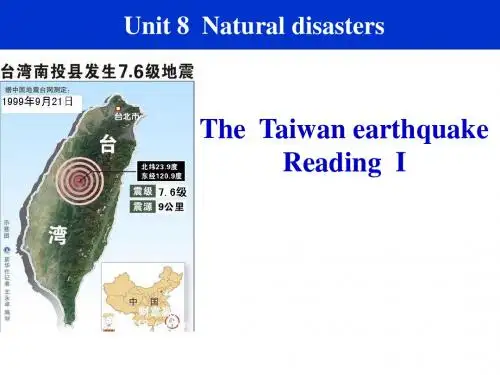
The Taiwan earthquake Reading I
Teaching objectives
By the end of the lesson, students should be able to: 1. Knowledge objectives (1)develop a general understanding of the text. (2)infer the main idea of the text from some pictures and titles. (3)use some proper words to introduce a natural disaster. 2. Ability objectives improve reading skills of skimming and scanning. 3. Moral objectives learn how to face a natural disaster.
Ⅱ Pre-reading 3
4) It was dark and silent around me. make no sound at all
The earthquake hit Yangzhou last summer
Mr Ding’s story
I was sick in hospital last summer. I was lying in bed when earthquake happened, my wife was looking after me, my daughter was watching TV at home with her grandparents. At that time I felt a slight shake, I heard the people outside scream in fear. I saw the people in the street run in all directions through the window. At first I was very nervous , my heart was beating fast . But after a short while, I found everything was OK. I’m not afraid at all, my wife asked me to calm down, because we are still alive, we are safe.
最新译林牛津版英语八年级上册Unit8 Natural disasters公开课课件
when /while 和 as
书面表达P117
成千上万的
thousands of wash away
冲走
四面八方
in all directions
find one’s way out at first move away break down follow traffic rules the heavy snow hear the wind blowing
找到出路
首先
搬走
出故障,坏掉 遵守交通规则 大雪 听到风在吹
过去进行时 我们可以用过去进行时表示过去某一时刻正在进行时的 动作或过去某一阶段一直在进行的动作。 过去进行时的肯定结构是由“was/were+现在分词”构 成,否定结构是由“was/were + not现在分词” 有些动词通常不用于进行,主要有: 1,表示心理状态、情感动词,如love, hate, like, know 等。 2,部分连系动词,如seem, appear等。 3,感官动词,如see, hear, feel, smell, sound, taste等 4,短暂性动词,如decide, stop等。
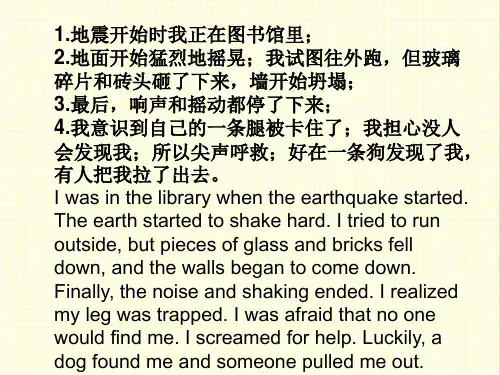
Hale Waihona Puke 1.上周三,暴风雪袭击了北京;放学后,贝蒂和她的 朋友艾米合撑一把伞,走向公交车站; 2.天气真是坏极了;突然,一阵大风从身后刮来,她 们在大风中弄丢了伞,她们俩几乎跌倒,只能在暴风 雪中慢慢地走向公交车站; 3.最后,她们上了一辆公交车回家了。 A snowstorm hit Beijing last Wednesday. After school, Betty shared an umbrella with her friend, Amy, and they walked to the bus stop. The weather was really terrible. Suddenly, a strong wind came from behind. They lost their umbrella in the wind and nearly fell over. They had to walk slowly through the storm to the bus stop. At last, they got on a bus and went home.
牛津译林版八年级上册Unit8《Naturaldisasters》(Grammar)说课稿
牛津译林版八年级上册Unit 8《Natural disasters》(Grammar)说课稿一. 教材分析《Natural disasters》是人教版牛津译林八年级上册的一篇课文,主要介绍了一些自然灾害的成因及应对方法。
通过本节课的学习,学生能够掌握一般现在时的被动语态,提高阅读理解能力,同时增强对自然灾害的防范意识。
二. 学情分析八年级的学生已经具备了一定的英语基础,对一般现在时态和被动语态有所了解。
但部分学生对英语阅读兴趣不高,且对于自然灾害相关知识了解有限。
因此,在教学过程中,需要关注学生的兴趣,引导学生主动参与课堂活动,提高他们的阅读理解能力。
三. 说教学目标1.知识目标:学生能够掌握一般现在时的被动语态,正确运用动词的过去式和被动式。
2.能力目标:学生能够阅读并理解关于自然灾害的英语文章,提高阅读理解能力。
3.情感目标:学生能够增强对自然灾害的防范意识,学会保护自己和他人。
四. 说教学重难点1.重点:学生能够掌握一般现在时的被动语态。
2.难点:学生能够运用一般现在时的被动语态描述自然灾害。
五. 说教学方法与手段1.教学方法:采用任务型教学法,让学生在完成任务的过程中,自然而然地掌握语言知识。
2.教学手段:利用多媒体课件、图片、视频等,激发学生的学习兴趣,提高课堂效果。
六. 说教学过程1.导入:展示一些自然灾害的图片,如地震、洪水等,引导学生谈论对这些灾害的了解和感受。
2.阅读理解:让学生阅读课文《Natural disasters》,回答相关问题,检测学生对文章内容的理解。
3.语法讲解:讲解一般现在时的被动语态,让学生通过例句和实践,掌握这一语法知识。
4.小组讨论:学生分成小组,讨论如何用英语描述一种自然灾害,以及如何防范。
5.展示与评价:每个小组选择一名代表,展示他们的讨论成果,其他同学和老师进行评价。
6.总结与反思:教师引导学生总结课堂所学,让学生反思自己在课堂上的表现,以及如何提高。
最新牛津译林版中学八年级英语上册 Unit 8 Natural disasters Reading 1教案
Unit 8 Natural disastersTeachingaims 1. To guess general meanings from keywords and context 2. To skim text for overall meanings and scan for detailsTeaching focus 1.To va lue students ’ ability of reading2.To educate students to be careful with disasters like fire .Difficult points To develop the ability to infer the general meaning from title and context.Teaching methodbased approach-Task Teaching proceduresThe seco nd preparing lessonsStep1.Revision1) Introduction:We learnt something about natura l disaster last time. What disaster have we learnt? 2) Students discuss in p airs. Step2.Presentation.Use students ’ answer to discuss an earthquake. For example:Where does it usually happen?How do people feel when it happens?Step3.Read the passage about “The Taiwan Earthquake ” pay attention to the following questions:When the earthquake happened, What was I doing? Why did people scream? Did the writer survive? Stpe4.Presentation.1) Read the passage themselves. 2) Repeat after the tape.3) Have diff iculties to explain. be trapped=be in trouble 陷入困 at first=at the begi nning 在开始a loud noise like thund er 像雷声一样的声音 in fear 恐惧be frightened 害怕in all directions 四面八方 run wildly 拼命地跑try one ’s best to do sth=do one ’s best to do sth 尽力做某事 pieces of glass 玻璃片 calm down 冷静下来 be over,结束 say to oneself 自言自语课 题 Reading 1总第 课时 备课时间 上课时间课 时Period 2 教 具A recordershout for help喊救命in a great hur ry急匆匆move away搬look at each other in fear恐惧地对看着do some shopping买东西 stay alive活着 go through my mind闪过头脑Sentences: I was doing my homework when it started.I didn’t know if anyone was around me.I didn’t know where I was.Some people screamed because they were very frightened.People were runn ing wildly while pieces of glass and brickswere falling down.They didn’t know where to go.Some people ran out of the shopping centre.I thought somebody could hear me but no one came for a longtime.I was trying to find my way out when I suddenly heared somenoise above me.Step5.Consolidation.1).Read the passage again.2).Give students some key words, and ask them to retell the story if time permitted.Step6.Home work:Teachingnotes。
牛津译林版八年级上册Unit8《Naturaldisasters》(Studyskills)说课稿
牛津译林版八年级上册Unit 8《Natural disasters》(Study skills)说课稿一. 教材分析《牛津译林版八年级上册Unit 8 Natural disasters》是一篇关于自然灾害的文章,通过介绍地震、台风、洪水等自然灾害,让学生了解自然灾害的特点以及如何应对。
本课内容与学生的生活息息相关,能够激发学生的学习兴趣。
文章语言简练,图文并茂,有助于学生理解和掌握知识。
二. 学情分析八年级的学生已经具备了一定的英语基础,能够进行简单的阅读和交流。
但学生在阅读长篇文章时,可能会遇到生词和语法障碍,影响阅读理解。
因此,在教学过程中,教师需要帮助学生克服这些困难,提高阅读理解能力。
三. 说教学目标1.知识目标:让学生掌握与自然灾害相关的词汇和表达方式,如earthquake、typhoon、flood等。
2.能力目标:培养学生阅读长篇文章的能力,提高学生的阅读理解水平。
3.情感目标:培养学生关爱生命,关注自然的意识,增强学生应对自然灾害的能力。
四. 说教学重难点1.重点:让学生掌握与自然灾害相关的词汇和表达方式。
2.难点:理解文章中涉及的复杂句子结构和语法现象。
五. 说教学方法与手段1.教学方法:采用任务型教学法,让学生在完成任务的过程中,掌握知识,提高能力。
2.教学手段:利用多媒体课件、图片、视频等辅助教学,增强学生的学习兴趣。
六. 说教学过程1.导入:通过展示自然灾害的图片,引导学生谈论自然灾害,激发学生的学习兴趣。
2.阅读理解:让学生阅读文章,回答相关问题,提高学生的阅读理解能力。
3.词汇学习:讲解文章中出现的生词和短语,让学生掌握与自然灾害相关的词汇。
4.语法讲解:分析文章中的复杂句子结构和语法现象,帮助学生理解。
5.小组讨论:让学生分小组讨论如何应对自然灾害,培养学生的合作意识。
6.总结:对本节课的内容进行总结,强化学生的记忆。
7.作业布置:让学生课后写一篇关于自然灾害的短文,提高学生的写作能力。
【最新】牛津译林版八年级英语上册Unit 8 Natural disasters 精品课件(共22张PPT)
14.被困 15.自言自语 16.脑海里闪过一阵恐惧 17.冷静,镇静 18.还活ቤተ መጻሕፍቲ ባይዱ 19.呼喊救命 20.找到出路 21.成千上万的 22.冲走 23.听说 24.着火 25.出故障 26.因为,由于
14. be trapped 15. say to oneself 16. a moment of fear go through one’s mind 17. calm down 18. be still alive 19. shout for help 20. find one’s way out 21. thousands of 22. wash away 23. hear about /hear of 24. catch fire be on fire 25. break down 26. because of
27. wait for a taxi
the Taiwan earthquake
It was about two o’clock in the early morning. Timmy was sleeping when the a slight shake 一阵轻微的震动). Then he earthquake started. At first, he felt______________( heard a loud noise like thunder. bombs under the ground 地下的炸弹). The earth Soon the real noise came, like________________________( started to shake. People ________________( screamed in fear 惊恐地尖叫). Some ran out of the building. He tried his best to run out too, but he couldn’t. Outside, people were running______________ in all directions (四面八方) while pieces of glass and bricks were falling down. Then the walls began to ____________( come down 坍塌) too. Finally, the noise and shaking ended. It was dark and silent around him. He couldn’t see anything at all, and he didn’t know if anyone else was near him. He ____________( felt nervous 感到 was trapped 困住了). A moment of 紧张) and his heart was beating fast. He knew he ___________( went through his mind 掠过脑海), but he told himself to__________( fear ____________________( calm down 冷静) since he was still alive. He _______________( shouted for help 呼救), but no one came . He started to pull himself slowly through the dark. Luckily, there was just enough space for him to move. Hours later, as he was trying to _________________( find his way out 找到出路), he suddenly heard some noise above him. He screamed for help. Then he heard shouts from excited people. They quickly moved _____________________( away the bricks 把砖块搬走). At last, he saw the bright daylight. He was safe.
牛津译林版八年级上册Unit 8《Natural disasters》(Task)说课稿
牛津译林版八年级上册Unit 8《Natural disasters》(Task)说课稿一. 教材分析《牛津译林版八年级上册Unit 8 Natural disasters》是围绕自然灾害展开的一篇文章。
本节课的主要内容是让学生通过阅读文章,了解自然灾害对人类生活的影响以及如何在自然灾害面前保护自己。
教材内容丰富,插图生动,激发了学生学习兴趣。
同时,本节课还设计了丰富的口语、写作和听力活动,帮助学生全面提高英语能力。
二. 学情分析八年级的学生已经具备了一定的英语基础,对于一些简单的自然灾害词汇和表达方式有所了解。
但他们在阅读长篇文章、理解复杂信息方面还存在一定的困难。
因此,在教学过程中,我需要关注学生的个体差异,调整教学策略,确保每个学生都能参与到课堂活动中来。
三. 说教学目标1.知识目标:学生能够掌握与自然灾害相关的词汇和表达方式,如earthquake、tsunami、hurricane等。
2.能力目标:学生能够通过阅读文章,理解自然灾害对人类生活的影响,提高阅读理解能力。
3.情感目标:培养学生关爱生命、珍惜生命的意识,以及面对自然灾害时的自我保护能力。
四. 说教学重难点1.重点:学生能够掌握与自然灾害相关的词汇和表达方式,理解文章内容。
2.难点:学生能够运用所学知识,就自然灾害话题进行口语交流和写作表达。
五. 说教学方法与手段1.任务型教学法:通过完成各种任务,激发学生的学习兴趣,提高学生的参与度。
2.情境教学法:创设生动的情境,让学生在真实的环境中学习英语。
3.交际式教学法:鼓励学生积极参与课堂交流,提高口语表达能力。
4.利用多媒体教学手段:通过播放视频、图片等,丰富教学内容,提高学生的学习兴趣。
六. 说教学过程1.导入:以一段关于自然灾害的视频导入,激发学生的学习兴趣。
2.阅读理解:学生阅读文章,回答相关问题,了解自然灾害对人类生活的影响。
3.词汇学习:学生通过小组合作,归纳总结文章中出现的自然灾害词汇。