
仁爱英语七年级下册Unit5 Topic1 SectionA
6. come on come on可独立成句,常用于命令,意为 “快;加油”。 e.g. Come on! We don’t have much time. 快点!我们时间不多了。
将下面的汉语句子翻译成英语。 快!给他打电话。 Come on!Call him.
5) Mary’s grandmother is sitting down by the door. 6) Jim stood by me in the morning. by意为“在……旁边”。
将下列英语句子翻译成汉语。 1. Teachers ask us to go to bed by 9:30. 老师要求我们九点半以前睡觉。 2. I go to work by bus every day.
3. for, it’s, supper, time, on, come (!) (.) Come on! It’s time for supper. 4. go, by, do, often, to, Shanghai, they, train (?) Do they often go to Shanghai by train?
写出下列句子的同义句。 (1) Mary takes a bus to the shop. Mary goes to the shop ________. by bus (2) Leo goes to the zoo by car. Leo _______________ to the zoo. drives a car (3) Would you like to walk to work? on foot Would you like to go to work ________?
5. Wei Hua, come, how, school, to, does, usually (?) How does Wei Hua usually come to school?
Write a short passage about your family’s means of transportation.
Ⅱ. 用适当的介词或副词完成下列各题。 on Jenny. It’s time to have 1. Come ____, classes. for lunch now. 2. It’s time ______ on foot. 3. Jim usually goes to school ______ at the gate. 4. You can see the man ______ 5. —Happy New Year, Mary! —The same ______ you! to
3. by prep. by表示的意思很多。请仔细观察下面的 例句,学习它的不同含义。 1) Steve goes to school by bus every day. 2) Betty went to Dalian by ship. by+交通工具”表示“乘坐……”; 3) Susan goes to work by 7 o’clock. 4) Brad has to go to bed by 10 o’clock. by表示“到某时之前”;
island like buy why fly
/ /
/ /
door dog desk
I. 请根据汉语意思完成下列各题。 1. The color of our school ____ gate (大门) is red. 2. Mr. Zhao ______ always (总是) goes to work by bike. 3. My aunt wants to go to Chengdu by ______ plane (飞机).
4. always adv. 总是;每次都是 e.g. There’s always somebody at home in the evenings. 晚上总有人在家。 大家想一下always和usually有什么区 别?
always和usually都是频度副词,是用来 表示动作频率的 。always表示的频度最 高,相当于all the time。如:Tom is always late for school. 汤姆上学总是迟 到。 usually意为“通常”,表示习惯性动作 或状态,很少有例外, 如:I usually watch TV on the weekend. 我通常在周 末看电视。
a. 在1中, how的意思是“ ___________”, 如何 , 怎么样 用来对 _____ 方式 进行提问。 b. 在2和例3中, 短语_________ how often 用来对频率 进行提问, 它的意思是 “ ________________” 多久一次 , 多频繁 。回答时通常用频 度副词sometimes, never, always等, 或 “ ____+ 单位时间”, 如: twice a day (一 次数 天两次), five times a year (一年五次)。
/ / / /
peach sea tea eat he sheep bed let pen best weather sweater heavy
/ / / /
great break steak age eight aim may they eight ear realize theater hear here cheer
on foot
by subway
How does your sister go to school?
She goes to school by bike.
How does your mother go to work? How …?
She goes to work by car.
…
1. Happy New Year! The same to you! 新年快乐!也祝你新年快乐! 2. How about you? = What about you? 你怎么样?
请根据括号内的要求完成下列各题。 1. I usually go to work by bus. (对划线部 分提问) _______ go to work? How do you usually __ 2. He goes swimming once a week. (对划 线部分提问) go swimming? _____________ How often does he __
Ⅲ. 请根据所给标点将下列单词组合成完 整的句子,注意字母大小写。 1. goes, by, work, bike, to, often, mother, my (.) My mother often goes to work by bike. 2. looks, nice, coat, new, your, very (.) Your new coat looks very nice.
gate n. 门
subway n. 地铁
on foot 步行
plane n. 飞机 train n. 火车
ship n. 船;舰
boat n. 小船
Look at the pictures and know how people and students go to school or work. by bike by bus by car
几个词都不是表示交通工具的名词, 但 我们也可以用它们来表达某种交通方 式, 如: by sea = by ship, by air = by plane, by land, on foot。
温馨提示: (1) 下面这两种表达方式可以相互转换 e.g. Sally likes to take a ship to Tianjin. = Sally likes to go to Tianjin by ship. (2) 表示“步行”的动词为walk,介词短 语为on foot。 e.g. I walk to school. = I go to school on foot.
3. —_________ How often do you play soccer after
school? (请根据答句将问句补充完整)
—I seldom play soccer after school.
4. Mr. Zhang goes to work in a car. (对
划线部分提问)
我每天坐公交车去上班。 3. He put his hat by the chair. 他把帽子放在了椅子旁边。 4. There’s a tall tree by the river. 河边有棵大树。
交通方式通常有以下两种表达方法: (1) 介词by+表示交通工具的名词。此时表 示交通工具的名词要用单数形式,且 其前不用任何修饰词。 e.g. I go to school by bike / bus / car.
5. how 观察下列句子, 将结论部分补充完整。 1. —How do you go to school? —I go school by bus. 2. —How often does he ride to school? —Sometimes. 3. —How often do they have ball games? —They have ball games four times a week.
(2) 动词+表示交通工具的名词。这些动词 有take, ride, drive等,此时表示交通工 具的名词前可加修饰词。 e.g. I will take the subway home. Sam rides a / his bike to school.
(3) sea (海), air (空气), land (陆地), foot这
七年级英语(仁爱版)下册 Unit-5-Topic-1 知识点总结语言点归纳
知识点七年级英语(仁爱版)下册Unit-5-Topic-1语言点归纳Unit 5 Topic 1I 重点词汇和短语gate, by, always, plane, train, ship, boat, Ms., grandmother, group, weekday, early, bird, catch, seldom, walk, never, sometimes, ride, park, watch, TV, homework, life, American, or, few, day, rest, play, basketball, swim, ball, game, read, listen, library, once, twice, week, every, must, first, music, begin, while, wall, bed.the same to, come on, on foot, by plane, know about, for a while, watch TV, do (one’s) homework, have lunch, at school, have a rest, be different from, go swimming, listen to, go to bed, go to school, have classes.II 语言点Section A1. a) ---Happy New Year! ---- The same to you! / You, too. 新年快乐!也祝你新年快乐!b) ----Happy birthday! -----Thank you! 生日快乐!谢谢!2. How about you? = What about you? 你怎么样?3. Oh, your new bike looks very nice! 哦,你的新自行车看起来很好看。
仁爱版英语七年级下册 Unit5 Topic1 Section A 教案设计
4.Are ableto understand and follow simple written instructions regarding learning activities;
3.情感目标
Cultivate a spirit of friendship and mutual assistance;
e.g.
A: Happy New Year!
B: The same to you. Nice to see you again.
A: Nice to see you, too.
B: Do you go to school by bike?
A: Yes. What about you? How do you often go to school?
②frequencyadverb:always,noun:gate, preposition:by
③new phrases:come on, on foot
2.Ss can be used the sentences flexibly in real situations:
①—How do you usually come to school?
5.Try to read the words in 3b. Circle the words with the sound /i:/ or /e/ individually. Then listen to the tape and check the answersin pairs.
Ⅴ.Make a report and conversation:(10 minutes)
仁爱英语七年级下册Unit5_(Topic1-3)导学案合集(已经修改过的)

仁爱英语七年级下册Unit5导学案Unit5 Topic1 Section A一、学习目标:1、知识与技能:A:学习并掌握本节课生词:gate---boat . 通过预习达到会读、识记要求,上课时要求把听写本准备好,做好听写的准备。
只要你肯下决心并付诸行动,你一定会赢在起跑线上的!B:学习频度副词:如usually(通常),你在P1 还能够找到两个,试一试:____________(经常);______________(总是)C:学习交通方式的表达法:骑自行车:by bike ;你来试一试:乘火车_________乘飞机______________乘地铁_______________乘轮船_______________乘小船___________乘公交_____________乘小轿车___________ 骑自行车_______________ 特别注意!:步行_______________ (可以参考课本P2)以上词组要求熟背,课堂上个人,小组进行竞赛展示,期望你是最棒的!更期望你是小组的骄傲!D:能够用一般现在时谈论交通方式,尝试翻译:I usually come to school by subway . _______________________________康康总是乘公共汽车回家。
______________________________________?2、过程与方法课前做好预习,预习中做好预测,标出不会的内容,寻求同桌、小组帮忙,聆听别人的见解,专注于老师的总结。
3、情感态度价值观:随着社会经济的发展,人们的生活水平和生活质量越来越高,各种交通工具开始进入人们的日常生活,我们要学会珍惜,学会感恩,更要学会创造!交通安全时时刻刻要牢记!他总是步行回家。
__________________________________________.1、频度副词2、交通方式3、对交通方式的一般现在时谈论三、知识链接:1、默写下列单词:自行车_______ 公交车_______ 小轿车______ 火车______飞机______ _轮船________ 小船_______ 地铁_______ 脚_______2、写出下列动词的单三形式A. come _______ look_______ work_______ live _______B. guess_______ teach_______ dress_______ watch______ catch_______C. try _______study _______carry_______ fly _______D. go _______do _______have_______ be _______3、补全对话:A: Nice to see you again ! B: ________________________!A: Your new bike looks very new !B:___________________!A: Happy birthday !B:_________________!A: Happy New Year ! B:___________________!四、学习内容:Step1 : Read 1a . 理解并翻译下列词组或句子1.at the school gate2.Happy New Year ! The same to you !3.look very nice .4.by bike by subway by bus5.How about ….? = _______________?6.It’s time for class !=___________________!7.It’s time _____ sth = It’s time ____ _____ sth .8.It’s time ____sb ____ sth . – It’s time ___ sb ___ ____ sth .五、学习小结:1.交通工具的表达法:by +______________.2.对交通工具的提问用:_____+_______________________________?3. 当节日属于大家共同拥有时,面对别人的祝贺我们应该说:_____________!当节日属于你个人拥有时,面对别人的祝贺你应该说:_____________!六、达标检测:(一)根据句意和首字母提示完成句子1. My mother o_______ goes to work by bus .2.They a_______ play games after school .3. They are brothers , they look the s________.4. It’s a long way , you must go there by t_______.(二) 单项选择题1.Happy New Year ! ________! A.Thank you ! B. You are right ! C. The same to you !2.-- ___ do you usually have lunch ?-- At school . A. When B. Where C. How3. --How are you going to the Summer Palace ? ---We are going there ____ bike .A. forB. atC. by4. --_____ do you usually go to your office ? --By bus . A. How often B. What time C.. How5. It’s five o’clock . It’s _____ go home . A. time to B. time for C. time to go to6. Kangkang’s new shoes look _______. A. happy B. well C. nice7. --______________ ? ---It’s half past six.A. What’s the o’clockB. What’s the time is.C. What time is it8.--Hi, Li Ming , your book is very interesting (有趣). --- _____________.A.Thank you .B. Don’t say so !C. That’s right9. I usually take the subway to school . __________? I usually go to school by bus .A. How are youB. How do youC..How about you(三)对划线部分提问1. Jane usually goes to school by subway . _____________________________________2. They always go to work by bus. ____________________________________________Unit5 Topic1 Section B一、学习目标:1、知识与技能:A:学习并掌握本节课生词:weekday --- movie要求:熟读、识记会默写,在上课时,把听写本准备好,上课听写,再创一个辉煌100分!B:学习频度副词:通常经常总是有时很少从来都不C:学习交通方式的动词词组表达法:乘火车:take a train . 你来试一试:乘飞机______ 乘轮船_________乘小船________乘公交________乘小轿车___________★★★步行:walk ;骑自行车ride a /one’s bike ;乘地铁take the subway2、过程与方法注意上一节课和本节课的联系;熟读课文,做好预习;借助资料或别人理解课文,不懂之处做好标注,课堂认真听讲。
七下仁爱版英语u5t1sa课文
七下仁爱版英语u5t1sa课文In the seventh grade Ren'ai edition English textbook, unit 5, text 1, the story revolves around the theme of friendship and kindness. The text tells the story of a young girl named Amy who moves to a new school and is initially lonely and struggling to make friends. However, with the help of her kind and caring classmates, she eventually finds a sense of belonging and friendship.From the perspective of the protagonist, Amy, the story highlights the feelings of loneliness and insecurity that often accompany moving to a new environment. Amy's initial struggles to fit in and make friends are relatable to many students who have experienced similar challenges. However, as the story unfolds, Amy's experiences also demonstrate the power of kindness and compassion in overcoming adversity. Her classmates' willingness to reach out and include her serves as a heartwarming reminder of the impact of small acts of kindness.From the perspective of Amy's classmates, the text emphasizes the importance of empathy and inclusion. Amy's classmates demonstrate compassion and understanding by reaching out to her and making an effort to include her in their activities. Their actions showcase the positive impact of extending a hand of friendship to those in need. This perspective serves as a reminder to readers of the value of being inclusive and considerate towards others, especially those who may be feeling isolated or alone.From the perspective of the broader school community, the text highlights the significance of creating a welcoming and supportive environment for all students. The positive and inclusive atmosphere fostered by Amy's classmates reflects the collective effort of the school community to prioritize kindness and empathy. This perspective underscores the importance of promoting a culture of acceptance and understanding within educational settings, where students feel valued and supported.From a societal perspective, the text underscores the universal need for connection and belonging. Amy'sexperiences resonate with the broader human experience of seeking acceptance and friendship. The story serves as a reminder of the fundamental human desire for meaningful connections and the profound impact of kindness infostering a sense of community and belonging.In conclusion, the text from the seventh grade Ren'ai edition English textbook, unit 5, text 1, offers a poignant exploration of the themes of friendship and kindness from multiple perspectives. Through the experiences of the protagonist, Amy, and her classmates, the story underscores the significance of empathy, inclusion, and the positive impact of small acts of kindness. Furthermore, the text serves as a powerful reminder of the universal human need for connection and belonging, highlighting the transformative power of compassion and understanding in creating a supportive and inclusive community.。
(完整版)仁爱英语七年级下Unit_5_Topic1_练习题

Unit 5 Topic 1 SectionA 练习题一、单项选择1.Let’s meet ____ the school on foot.A. inB. toC. atD. for2.It ’s time ____ go to bed.A. oftenB. forC.onD.to3.Allen gets to New York ___.A. by the planeB. on planeC.by planeD.in plane4.It ’s time ____ supper.A. atB. forC. toD. on5. — _____ you often come to school on your bike?— ______ Yes, I _____.A. Do,doB. Are, areC.Does, doesD.Is, is6.— How do you usually come to school?— I usually come to school ____ foot.A. InB. byC. withD.on7. She looks_____. Ask her to help you.A. oldB. sorryC.wellD. kind8.— ____ do you usually go to school?— By bike.A.WhatB.WhenC.HowD.Which9.— Happy New Year!— ________ !A.Thank youB. Not at allC. The same to youD.You are welcome10. My bool is interesting._____ yours?A.What isB.Whose isC.How aboutD.What is like二、句型变换1.Tom usually drives to work. ( 变同义句 )Tom usually _____ ___________ ____________.2.我们中有五人骑自行车上学。
仁爱英语七年级下五单元topic1 知识点
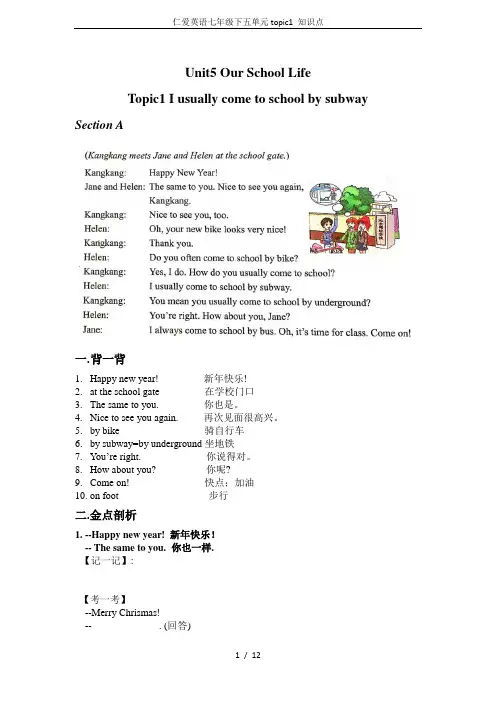
Unit5 Our School LifeTopic1 I usually come to school by subway Section A一.背一背1.Happy new year! 新年快乐!2.at the school gate 在学校门口3.The same to you. 你也是。
4.Nice to see you again. 再次见面很高兴。
5.by bike 骑自行车6.by subway=by underground坐地铁7.You’re right. 你说得对。
8.How about you? 你呢?e on! 快点;加油10.on foot 步行二.金点剖析1. --Happy new year! 新年快乐!-- The same to you. 你也一样.【记一记】:【考一考】--Merry Chrismas!-- _____________. (回答)2. Oh, your new bike looks very nice! 你的新车看起来很漂亮!【记一记】:拓展:look ____ 看look ____ 看上去像look ____ 照看【考一考】1. Ann’s mother is not at home. So Ann has to _________ her sister.2.Jim _______ his father. They both(都) have small eyes.3. Please _______ the photo! It’s wonderful.4. Your dress _____ very nice. May I have a look?A. watchB.seesC. looksD. shows3.--How do you usually come to school? 你平时怎么去上学?-- I usually come to school by subway.【记一记】:注意:① by,on, in 引导的短语在句中只能作状语,与go,come,get等连用。
仁爱英语七年级下课文翻译Unit5 Topic1
仁爱英语七年级下课文翻译U n i t5T o p i c1-CAL-FENGHAI.-(YICAI)-Company One1Unit5 Topic1A(康康在学校门口遇到了简和海伦)新年快乐!也祝你新年快乐!康康,很高兴又见到你。
我也很高兴见到你们。
哇,你的新自行车看起来真漂亮!谢谢。
你经常骑自行车来学校吗?是的。
你通常怎样来学校?我通常乘地铁来学校。
你的意思是你通常乘地铁来学校吗?你说的对。
你呢,简?我总是乘公共汽车来学校。
噢,上课时间到了。
快点儿!B麦克,你平日通常几点起床?我总是六点左右起床。
早起的鸟儿有虫吃。
你通常怎样来上学?我通常步行来学校,但是有时候骑自行车。
你呢?我很少步行来学校。
我经常坐地铁来。
莎莉,你呢我从来不乘地铁来上学。
我总是乘公共汽车来。
C简的一天简通常6点20分起床。
7点时,她和父母一起吃早饭。
7点半乘公共汽车去上学。
8点开始上课。
她上午上四节课。
她12点10分在学校吃午饭。
下午上两节课。
放学后,她经常和同学踢足球。
5点15分,她乘地铁回家。
她5点30分到家,7点吃晚饭。
晚饭过后,她经常先做作业,然后再看一会儿电视。
她大约9点45分上床睡觉。
D采访者:孩子们,晚上好!请欢迎我们的新朋友迈克尔,他来自美国。
迈克尔,你好!迈克尔:你好!采访者:我们想了解美国学生的学校生活。
他们通常怎样去上学?迈克尔:嗯,很多学生通常乘黄色的校车或步行去学校。
采访者:他们通常在哪里吃午餐?迈克尔:一般在学校吃。
然后下午1点开始上课。
采访者:那么学校几点放学?迈克尔:大约3点。
采访者:业余时间他们干什么?迈克尔:他们经常打篮球、踢足球。
采访者:哦,很遗憾我们没有更多时间(交流)了。
很高兴和你聊天。
谢谢。
Unit5 Topic2A你好,简!我是迈克尔。
你现在在做什么?猜猜!你在做作业吗?不,没有。
你在看电视吗?是的,我在看电视。
你呢?我在做卡片,但是很无聊。
你想去打篮球吗?好主意!一会儿见。
仁爱英语七年级下Unit 5 Topic 1 Section A.B
1a Look, listen and say.
1.—Happy New Year! —The same to you. 2.—Do you often come to school by bike? —Yes, I do.
3.—How do you usually come to school? —I usually come to school by subway. 4.—It’s time for class.
2a. Study the example to understand the two ways of expressing the same meaning. Then fill in the blanks.
1a. Look, listen and say.
H: get up, on weekdays M: 6:00 H: early bird; how, go to school M: usually, on foot H: seldom, walk; often, by subway S: never, by subway; always, take a bus
for 4.—It’s time ___class.
We learn: 1. some words: gate, plane, train, ship, boat, by, always 2. some phrases: come on, on foot, by bike/car/bus/train/subway/plane/boat 3. some sentences: How do you usually come to school? I usually come to school by subway. We can: talk about the means of transportation. e.g. I often go to school by bike/bus.
仁爱版七年级英语下册第五单元教案Topic1
Unit5 Topic1 SectionA精品教案I. Material analysis本话题是第五单元的第一个话题,主要围绕交通方式、日常活动的频度等展开。
将主要复习一般现在时态,学习谈论交通方式和日常活动频度的句型“How do you usually/often…?, “I usually/often … by…”, “How often do you…?”, “Three times a week.”等。
本课的主要活动是1a和3a。
通过人物对话呈现主要内容,结合“图片与句子匹配”、“图片与短语匹配”等活动,复习有关新年问候,学习和操练日常交通方式等的表达法。
同时还通过听说活动,帮助学生了解字母e和d 以及字母组合ea/ee/ei/dge的发音规则,训练他们进行单词拼读的能力。
因为本课是本话题的第一课时,学生对于交通方式的英语表达才刚开始接触,因此可能出现用英语表达交通方式的不流畅,教师应该在教学活动中创造机会,引导学生在活动中反复操练进而巩固关于交通方式的英语表达。
II. Teaching aims1.Knowledge aims能根据已学语音、音标及发音规则,正确朗读下列词汇并在实际的对话操练中加以应用:gate, by, subway, underground, always, come on, on foot等;学生在小组合作活动中,能掌握字母e和d以及字母组合ea/ee/ei/dge的发音并通过单词拼读进一步熟悉发音规则;能正确使用how来询问日常的交通方式,并能正确使用表示交通方式的介词by;能就询问和表达交通方式的话题进行交流与对话操练,如:(1)—How do you usually come to school?—I usually/often… by…(2)Do you often come to school by bike?(3)I usually come to school by subway/by bus/on foot.2.Skill aims能听懂有关表达交通方式的简单对话或叙述;能根据图文就交通方式进行交流;能理解并执行有关学习活动简单的书面指令;能正确写出黑体单词和词组;能写出表达交通方式的简单句子。
Unit 5 Topic 1 Section A(29页)仁爱版七年级下册英语课件
02 新 课 讲 授
What are these?
bike
car
What are these?
subway/underground
bus
What are these?
boat
ship
骑自行车 by bike
(1) look“看起来,好像”,是系动词,后加形容词。 e.g. She looks very beautiful. 她看起来很漂亮。 (2) look 用作行为动词,表示“看”,当后面要跟宾语时,必须要跟介词at。 (3) look 还可以做名词,表示“外貌,长相”。 (4) 与look有关的短语: look at… =have a look at…看一看 look like 看起来像 look the same 看起来一样
I usually come to school by subway.
04 当 堂 检 测
一、根据句意及汉语提示,完成句子 1. Let’s meet at the school gate (大门口). 2. Look at that nice boat (小船). That’s my uncle’s. 3. Mr. Ge often goes to Canada by plane (飞机). 4. Do you usually come to Jinan by train (火车)? 5. Jim wants to go to Shanghai from Chongqing by ship (轮船).
Enjoy the பைடு நூலகம்ideo
Listen again and answer the questions.