
2016新人教版八年级英语_上全册教案
八年级上册英语教案(go for it!)任教学校:任教班级:科任教师:2016年9月Unit 1 Where did you go on vacation?Period One: Section A (1a-2d)一、教学目标:1. 语言知识目标:1) 能掌握以下单词:anyone, anywhere, wonderful, quite a few, most, something, nothing, everyone, of course, myself, yourself能掌握以下句型:①—Where did you go on vacation? —I went to the mountains.②—Where did Tina to on vacation? —She went to the beach.③—Did you go with anyone? —Yes, I did./No, I didn’t.2) 能了解以下语法:复合不定代词someone, anyone, something, anything等的用法。
yourself, myself等反身代词的用法。
3) 一般过去时态的特殊疑问句,一般疑问句及其肯定、否定回答。
2. 情感态度价值观目标:学会用一般过去时进行信息交流,培养学生的环保意识,热爱大自然。
二、教学重难点1. 教学重点:1) 用所学的功能语言交流假期去了什么旅行。
2) 掌握本课时出现的新词汇。
2. 教学难点:1) 复合不定代词someone, anyone, something, anything等的用法。
2) yourself, myself等反身代词的用法。
三、教学用具:录音机,多媒体,幻灯片,课本四、教学过程:I. Lead-in1. 看动画片来进入本课时的主题谈论上周末做了些什么事情,谈论过去发生的事情。
II. Presentation1. Show some pictures on the big screen. Let Ss read the expressions.2. Focus attention on the picture. Ask: What can you see? Say: Each picture showssomething a person did in the past. Name each activity and ask students to repeat:Stayed at home, Went to mountains, went to New York City 6. Went to the beach,visited my uncle, visited museums, went to summer camp3. Now, please match each phrase with one of the pictures next to the name of theactivity,point to the sample answer.4. Check the answers. Answers: 1. f 2. b 3. g 4. e5. c6. a7. dIII. Listening1. Point to the picture on the screen.Say: Look at the picture A. Where did Tina go on vacation? She went to mountains.Ask: What did the person do in each picture?2. Play the recording the first time.3. Play the recording a second time.Say: There are three conversations. The people talk about what did on vacation. Listen to the recording and write numbers of the names in the right boxes of the picture.4. Check the answers.IV. Pair work1. Point out the sample conversation. Ask two Ss to read the conversation to the class.2. Now work with a partner. Make your own conversation about the people in the picture.3. Ss work in pairs. As they talk, move around the classroom and give any help they need.4. Let some pairs act out their conversations.V. Listening1. Tell Ss they will hear a conversation about three students’ conversations. Listen for the first time and fill in the chart. Then listen again and check Yes, or No.2. Let Ss read the phrases in the chart of 2b.3. Play the recording the first time. Ss listen and fill in the chart.4. Play the recording a second time for the Ss to check “Yes, I did.”or “No, I didn’t. ”5. Check the answers with the Ss.VI. Pair work1. Let two Ss read the conversation between Grace, Kevin and Julie.2. Let Ss work in pairs and try to role-play the conversation.3. Ask some pairs to act out their conversations.VII. Role-play1. First let Ss read the conversation and match the people and places they went.2. Let Ss act out the conversations in pairs.3. Some explanations in 2d.VIII. Homework:用英语询问你的一位好朋友,她假期去了哪里?看到了什么?并将此对话写在作业上。
A: Where did you go…?B: I went to…A: Did you see…B: Yes, I did. / No, I didn’t.课后反思:Period Two: Section A (Grammar focus-3c)一、教学目标:1. 语言知识目标:1) 复习所学的重难点句型及句式结构。
2) 总结学习anyone, someone, everyone, something, anything, nothing等不定代词的用法。
3) 练习运用所学的句型及句式结构。
2. 情感态度价值观目标:学会用一般过去时进行信息交流,培养学生的环保意识,热爱大自然。
二、教学重难点1. 教学重点:1) 用所学的功能语言交流假期去了什么旅行。
2) 复习运用本课时出现的新词汇。
2. 教学难点:1) 复合不定代词someone, anyone, something, anything等的用法。
2) 阅读填空能力的提高。
三、教学用具录音机,多媒体,幻灯片,课本四、教学过程Ⅰ. Warming- up and revision1. Free talk: Ask Ss the questions: Where did you go on vacation?Ss try to answer the questions.2. Review the usage of “复合不定代词”Ⅱ. Grammar focus.1. 学生阅读Grammar Focus中的句子,然后做填空练习。
1. 你去了什么地方去度假?______ ______ you go on ___________?2. 我去了纽约市。
I _______ _______ New York City.… (其余试题见课件部分)3. 学生们完成填空试题后,可以打开课本检查答案,对错误的句子,单独进行强化记忆。
Ⅲ. Try to Find复合不定代词总结:1. some, any, no, every与-one, -thing可以组成八个不定代词。
2. 带some的复合不定代词常用于肯定句中;带any的复合不定代词常用于否定句或一般疑问句中3. 当形容词修饰不定代词时,应放在其后面。
4. 由some, any, no, every构成的复合不定代词作主语时,都作单数看待,其谓语动词用单数第三人称形式。
5. 除no one以外,其他复合不定代词都写成一个词。
Ⅳ. PracticeWork on 3a:1. Let Ss look at the conversation in 3a. First let one student read the words in the box.2. Tell Ss to read the conversation and fill in the blanks.Explanation : 反身代词Work on 3b:Tell Ss to fill in the blanks in the e-mail message with the words in the box.Ⅴ. Group work1. Work on 3c: Ask your group questions about their vacation. Then tell the class your results.2. Fill in the blanks according to the answers.3. Try to make a report in each group. Then let one student read the report to the class.(最后,可以经学生们评议来推举最有能力的小组)Ⅵ. Homework1. 背诵Grammar focus 部分。
2016秋人教版8年级英语上册Unit 1 教案

Unit 1 Where did you go on vacation ?第|一课时Section A (1a~2d)【学习目标】1.学生学会关于假期去旅行的一些常用词汇与句型,并学会复合不定代词的用法.2.通过与学生交流假期去哪里旅行的话题,提升学生的语言交际能力.3.学生会用一般过去时态进行信息交流,形成环保意识,热爱大自然.【学习重点】学生能用所学的功能语言交流假期去了什么地方旅行.【学习难点】学习复合不定代词someone ,anyone ,something ,anything等的用法.Learning action tips: leading in by showing PPT about the students ,holiday trip.Topics:Did you have a good time during the vacation ?Yes ,I did. Did you go anywhereinteresting with your parents ?Can you tell us where you went on vacation ?……Review the past tense.Task 1Learning action tips: Preview the words on Page2 in the word list. Students read the words by phonetic symbols, then underline new words in the text and mark the Chinese meaning. At last finish the task in 1a.【知识链接】1.复合不定代词有:某人someone任何人anyone没有人no one每个人everyone某事something任何事anything没有东西nothing一切everything2.anyone与any one的区别anyone通常指人,侧重于个体,后面不带of;any one既指人,又指物,侧重于整体,后面可接of .情景导入生成问题1.T:Did you have a good time during the vacation?S:________________________________________________________________________ 2.T:Where did you go on vacation?S:________________________________________________________________________ 自学互研生成能力Task 1Let's read the new words and the phrases.1.I can read.(我会读)anyone ,anywhere ,wonderful ,quite a few ,most2.I can write.(我会写)翻译以下短语:(1)待在家里stay__at__home(2)去纽约城go__to__New__York__City(3)去夏令营go__to__summer__camp(4)与某人一起去go__with__someone(5)buy something special买特殊的东西(6)遇见有趣的人meet__someone__interesting(7)study for tests为考试学习3.I can summarize.(我会总结)Did you buy anything special ?其中anything 是不定代词.复合不定代词用法小结:(1)带some的复合不定代词常用于肯定句中;带any的复合不定代词常用于否认句或疑问句中.(2)当形容词修饰不定代词时,应放在其后面.(3)复合不定代词作主语时,都作单数看待,其谓语动词用第三人称单数形式.(1)I did something interesting last summer.去年夏天我做了有趣的事情.(2)Did you go anywhere cool on vacation ?假期你去凉爽的地方了吗?(3)在那里我没见到人.I didn ,t see anyone there.Task 2Let's listen to the tape and finish 1b ,2a ,2b.Task 3Let's make conversations and interview.1.I can practice.(我会练)A:Grace ,where did you go on vacation?B:I went to (1)Central__Park((中|央)公园).A:Oh ,really ?Did you go with anyone?B:No.No__one(没有人)was here. Everyone was on vacation.A:Did you buy (3)anything__special(特殊的东西)?B:bought nothing.【导练】( C )Did you see ______ in the dining room?A.someone B.some oneC.anyone D.any oneTask 2Learning action tips:1.Students turn to Page1 and listen to the tape, finish the listening task in 1b. Students listen to the tape again and repeat.2.Students turn to Page2 and listen to the tape, finish the listening tasks in 2a and 2b. Then students listen again and repeat.【Method coach】听录音时,要求学生注意用笔标记:(1)断句:"|〞(2)语调:升调降调(3)重读单词:△(4)不会认读的单词:____模仿纯粹的语音语调,朗读听力材料,培养学生的语言交际能力.Task 3Learning action tips:Students read aloud the dialogue in 1c, 2c and 2d, make dialogues andhave a conversation practice with "-Where did you go on vacation? -I went to…〞. Then interview classmates and have a report.【备注】2.I can make conversations.(我会编对话)你能结合课文1c ,2c及2d的内容编写对话来介绍自己假期活动的情况吗?运用句型Where did you go on vacation ?Did you go with anyone?A:Lily ,where__did__you__go__on__vacation?B:I__went__to__the__beach.A:Sounds__great !Did__you__go__with__anyone?B:Yes ,I__went__there__with__Li__Lei.3.I can interview and report.(我会采访和汇报)Oral report:In our group/ class, Wang Yang went to the countryside with her mother on Hui went to the mountains with his classmates on had a good Ma Shiyi didn ,t go anywhere on vacation. She had to stay at home and look after her sick grandma.交流展示生成新知Preshow:Show in groups. (Time: six minutes)Task 1:First read the words and phrases in groups ,then read together and sum up the usage of the words in groups ,mark the difficult words in pronunciation and understanding(students can ask teacher for help).At last ,write them on the blackboard.Task 3:First discuss and check the answers of Task 3 in groups, then discuss and set scenes to perform the dialogues ,interview classmates about the holiday activities. At last ,write them on the blackboard.Promotion show: Class show. (Time:sixteen minutes)Task 1: can read.(1)Read together ,pay attention to the pronunciation of "wonderful〞;(2) Consolidate the words by word games.2.I can write.(1)Translate the phrases into English or Chinese by answering quickly;(2)Read together;(3)Spot test:consolidate the usage of the phrases by making sentences.3.I can summarize.(1)Sum up the usage of the Compound Indefinite Pronoun with the phrases in "I can write〞;(2)Spot test:consolidate the usage of the Compound Indefinite Pronoun with the exercises ,then check the answers by answering quickly and explain.Task 3: can practice.(1)Choose some students to translate the key sentences in Task 3;(2)Read together.2.I can make conversations.(1)Make dialogues according to the task;(2)Set scenes to perform the dialogues;(3)Question students randomly according to the dialogues.3.I can interview and report.(1)Interview students with the structure "Where did you go on vacation ?〞,show them on the blackboard in diagram;(2)Report the holiday activities in oral.当堂演练达成目标根据句意和汉语提示填写单词.1.This question is very easy.Everyone(每个人)can answer it.2.Did you go anywhere(任何地方)quiet?3.Huangguoshu Waterfall was very wonderful(绝|妙的).4.Tony has a few(一些)story books.5.Most(大多数)of the students in our class like sports.课后反思查漏补缺收获:________________________________________________________________________ 存在困惑:________________________________________________________________________第二课时Section A (Grammar Focus~3c)【学习目标】1.学生能学会关于假期去旅行的一些常用词汇与句型,并学会归纳总结反身代词的用法.2.通过与学生交流假期去哪里旅行的话题,提升学生的阅读填空能力.3.学生会用一般过去时态进行信息交流,提升学生热爱大自然的意识.【学习重点】用所学的功能语言,与学生交流假期去了什么地方旅行.【学习难点】学习反身代词myself ,yourself等的用法以及提高学生阅读填空的能力.Learning action tips:Revise the contents learned to practice students' listening.Teacher:Now, please listen to me carefully and answer my went to Qingdao last went there with my was my first time to go there ,so everything was really I bought something for my friends ,but I didn ,t buy anything for myself.Task 1Learning action tips:1.Preview the words on Page3 in the word list. Students read the words by phonetic symbols,then underline new words in the text and mark the Chinese meaning.2.Students read and translate the sentences in Grammar Focus on Page3.【Method coach】▲The only problem was that there was nothing much to do in the evening but read.唯一的问题是晚上除了看书没有什么事可做.此句中that there was…是表语从句.There be do意为 "有……要做〞.but read意为 "除了读书〞.nothing意为 "没有任何东西〞,是否认词 .相当于not…anything .情景导入生成问题1.T:Where did I go last vacation?S:________________________________________________________________________ 2.T:Did I go there with anyone?S:________________________________________________________________________ 3.T:Did I buy anything for myself?S:________________________________________________________________________ 自学互研生成能力Task 1Let's read the new words and the phrases.1.I can read.(我会读)something ,nothing ,everyone ,of course ,myself ,yourself ,hen ,pig ,seem ,bored ,diary2.I can write.(我会写)翻译以下短语和句子:(1)当然of__course(2)在乡下in__the__countryside(3)记日记keep__a__diary(4)买东西给某人buy__sth.__for__sb./buy__sb.__sth.(5)没有人在这儿. No__one__was__here.(6)大家都去度假了. Everyone__was__on__vacation.(7)我给我爸爸买了些东西 . I__bought__something__for__my__father.(8)每样东西尝起来都很好 . Everything__tasted__really__good.(9)大家都玩得很快乐吗?Did__everyone__have__a__good__time?(10)唯一的问题就是在晚上没有什么事情可做,只能读书.The__only__problem__was__that__there__was__nothing__much__to__do__in__the__evening__but__read.3.I can use.(我会用)(1)buy sb.sth.=buy sb.为某人买某物(2)quite a few+可数名词的复数(3)①seem to do sth./be②seem+adj.(形)③It seems that…似乎/好似……,有时可与seem to do sth.相互转换.(1)Mom bought Lucy a storybook.(同义句)Mom bought a storybook for__Lucy.(2)There are quite__a__few__cars (相当多的汽车)in the street.(3)He seems tired__/__to__be__tired(累;疲倦).Task 2Make conversations and make a survey according to 3c.1.I can practice.(我会练)A:Did you do (1)anything__fun on your vacation ,Alice?B:Yes ,I went to (2)Sanya(三亚).A:How do you like it?B:Well ,it is my (3)first__time(第|一次)there ,so everything was really(4)interesting.A:Did you (5)buy anything (6)for yourself(为你自己买了东西)?B:(7)Nothing ,but I bought (8)something for my parents.2.I can try.(我会试)Finish the task 3a and 3b on Page 3.【导练】Jack is new here ,so we don ,t know anything about him.(改为同义句)Jack is new here ,so we know __nothing__ about him.Task 2Learning action tips:1.Finish the task in 3a. Students read the dialogue in 3a and imitate them, have a dialogue practice with " -Did you do anything interesting on your vacation? -Yes, I went to…〞.2.Students finish the e-mail in 3b with compound indefinite pronoun. And check the answer.3.Students finish the survey form in 3c according to their own actual situation;discuss ingroups and make the dialogue;ask 2-3 pairs to have a test in class.【Method coach】反身代词还有:他自己himself她自己herself我们自己ourselves你们自己yourselves它自己itself他们自己themselves※固定短语:enjoy oneself玩得开心teach oneself自学for oneself为自己【备注】3.I can make conversations.(我会编对话)结合所学句型及教材3c的内容,谈论关于假期的一些活动,并编写对话.A:How__was__your__last__vacation ,John ?B:It__was____wonderful!A:Did__you__do__anything__interesting ?B:Yes ,I__ate__something__delicious__at__a__restaurant.4.I can summarize.(我会总结)myself(我自己) ,yourself(你自己)是反身代词.表示 "某人自己〞的词叫反身代词.误区扫描:(1)Don ,t worry. We ,re old enough to look after ourselves.(做介词的宾语)(2)The young man learned himself kungfu.(做动词的宾语)(3)Miss Yang herself is not here.(做同位语)(4)The mother elephant itself looked for the baby elephant.(做同位语)交流展示生成新知Preshow:Show in groups. (Time: six minutes)Task 1:First read the words and phrases in groups ,then read together and sum up the usage of the words in groups ,mark the difficult words in pronunciation and understanding(students can ask teacher for help).At last ,write them on the blackboard.Task 2:First discuss and check the answers of Task 2 in groups ,use the phrases we learnt to talk something about the holidays and make a survey about the holiday activities. At last ,write them on the blackboard.Promotion show: Class show. (Time:sixteen minutes)Task 1: can read.(1)Read together ,pay attention to the pronunciation of "bored〞;(2)Consolidate the words by word games.2.I can write.(1)Translate the phrases into English or Chinese by answering quickly;(2)Read together;(3)Spot test:consolidate the usage of the phrases by making sentences.3.I can use. (1)Explain the usage of the key words with the phrases in " I can write〞;(2) Spot test:consolidate the usage of the words or phrases with the exercises ,then check the answers by answering quickly and explain.Task 2:can practice.(1)Choose some students to translate the key sentences in Task 2;(2)Read together.2.I can try.(1)Finish 3a ,3b according to the task;(2)Explain the answers and sum up the methods;(3)Use the material in the textbook to talk and show in groups according to students', actual situation.3.I can make conversations.(1)Make dialogues according to the task;(2)Set scenes to perform the dialogues;(3)Question students randomly according to the dialogues.4.I can summarize.(1)Sum up the usage of reflexive pronouns ,show them on theblackboard and read together;(2)Finish the exercises and focus on explaining the usage of reflexive pronouns.当堂演练达成目标根据句意及首|字母提示填写单词.1.Everyone was very happy there.2.There was nothing but silence in the room.3.-Did you see anyone interesting ? -Of course.4.My aunt fed many baby pigs on her farm last year.5.Hens can lay eggs(下蛋).课后反思查漏补缺收获:________________________________________________________________________ 存在困惑:________________________________________________________________________第三课时Section B (1a~1e)【学习目标】1.学生学会读6个形容词(delicious ,expensive ,exciting ,cheap ,terrible ,boring) ,学会用Where did…?What did…?How was…/How were…?Did she/he…?句型来进行问答.2.通过听力训练,提高学生的综合听说能力.3.继续用一般过去时与学生进行信息交流,使学生形成热爱大自然的意识.【学习重点】用所学的功能语言,与学生交流假期去了什么地方旅行.【学习难点】听力训练,提高学生的综合听说能力.Learning action tips:Now let ,s have a will give you the Chinese meaning, please write them in English…Teacher communicates with students freely and describes things with adj. correctly.Learning action tips:1.Finish the task in 1a.Teacher:Look at the six are you say out their meanings ?And can you match the words with the pictures?2.First students finish the task in 1b. Then discuss in groups and show their results in class. Teacher checks the answers.Teacher:Work in pairs to write the correct words in the blanks ,and then give your answers to the class.【Method coach】▲正确区分以下单词的用法:interest使感兴趣interested对……感兴趣interesting有趣的excite使兴奋excited感到兴奋exciting兴奋的我还知道relax ,relaxed ,relaxing情景导入生成问题1.T:一本有趣的书.S:________________________________________________________________________ 2.T:这个女孩很漂亮 .S:________________________________________________________________________ 自学互研生成能力Task 1Let's read the new words and the phrases.1.I can read.(我会读)delicious ,expensive ,exciting ,cheap ,terrible ,boring2.I can write.(我会写)翻译以下短语:(1)去香港go__to__Hong__Kong(2)做特别的事情do__something__special(3)一个娱乐公园a__fun__park(4)给我最|好的朋友买东西buy__something__for__my__best__friend(5)美味的食物delicious__food3.I can use.(我会用)请辨析以下三个单词.(1)bore:动词,意为 "使厌烦〞,后直接接宾语.(2)bored:形容词,意为 "感到厌烦的,无聊的〞,主语为人.(3)boring:形容词,意为 "令人无聊的,乏味的〞,修饰物.(1)The video bored me(使我感到厌烦).(2)The book is very boring.I feel bored.Task 2Let ,s listen to the tape and finish 1c ,1d.Task 3Make conversations about your summer vacation.1.I can practice.(我会练)A:Where did Lisa (1)go__on__vacation(去度假)?B:She went to Hong Kong.(她去了香港)A:Did she do (2)anything__special(特殊的事情)there ?What was it?B:Yes__ ,she____went__to__a__fun__park.(是的,她去了一个有趣的公园.)A:Did she buy anything (3)for__herself(给她自己)?B:No ,she__didn ,t.But she bought something for her best friend.A:How was her vacation?B:Great.2.I can make conversations.(我会编对话)你能结合课文内容及1e的问题编写对话,来介绍自己假期的活动情况吗?运用句型Where did you go on vacation ?How was your vacation?A:Where did you go on vacation?B:I went to Hong Kong with my family.A:What did you buy for your brother?B:I bought…for him.A:How were the people there?B:They were friendly.A:How was your vacation?B:It was great /…Task 2Learning action tips:Listen to the tape and finish the task in 1c. Listen again, finish the task in 1d.Lisa is using some adjectives to talk about her fill in the chart with the adjectives.Students imitate the listening contents and practice the dialogue in role, ask a few pairs to act out.【Method coach】模仿纯粹的语音语调,朗读听力材料,培养学生的语言交际能力.Task 3Learning action tips: Read aloud the dialogue and make dialogues with the adj. in 1a ,1b andthe questions in 1e. (students use the sentences "Where did you go on vacation ? -I went to…〞and " -How was your vacation? -It was exciting〞.)【备注】3.I can summarize.(我会总结)(1)询问假期你做了什么的句型及答复:What did you do on vacation ?I had a picnic.(2)询问假期你去了哪里度假的句型及答复:Where did you go on vacation ?I went to the countryside.(3)询问那里的天气如何的句型及答复:How was the weather ?It was sunny.(4)询问那里的人们如何的句型及答复:How were the people ?They were very friendly.交流展示生成新知Preshow:Show in groups. (Time: six minutes)Task 1:First read the words and phrases in groups ,then read together and sum up the usage of the words in groups ,mark the difficult words in pronunciation and understanding(students can ask teacher for help).At last ,write them on the blackboard.Task 3:First discuss and check the answers of Task 3 in groups, then discuss and set scenesto perform the dialogues, introduce the holiday activities of their last ,write them on the blackboard.Promotion show: Class show. (Time:sixteen minutes)Task 1: can read.(1)Read together, pay attention to the pronunciation of "expensive〞"exciting〞;(2)Difference the meaning of the words by method coach;(3)Consolidate the words by word games.2.I can write.(1)Translate the phrases into English or Chinese by answering quickly;(2)Read together;(3)Spot test:consolidate the usage of the phrases by making sentences.3.I can use.(1)Distinguish the usage of "bore〞" bored 〞and " boring〞with the similar words in method coach;(2) Spot test:consolidate the usage of "bore〞"bored〞and "boring〞, then check the answers by answering quickly and explain.Task 3: can practice.(1)Choose some students to translate the key sentences in Task 3;(2)Read together.2.I can make conversations.(1)Make dialogues according to the task;(2)Set scenes to perform the dialogues;(3)Question students randomly according to the dialogues.3.I can summarize.(1)Sum up the sentences about asking holiday activities and answer ,then show them on the blackboard;(2)Explain in class by spotting test;(3)Read together.当堂演练达成目标按要求完成以下各句 ,每空一词.1.It was hot__and__sunny yesterday.(对画线局部提问)How was the weather yesterday?2.Tom and his family were on vacation in Qingdao.(对画线局部提问)Where were Tom and his family on vacation?3.My father bought something for me.(改为否认句)My father didn ,t buy anything for me.4.The basketball game was boring.(对画线局部提问)How was the basketball game?5.I stayed at home all weekend.(改为一般疑问句)Did you stay at home all weekend?课后反思查漏补缺收获:________________________________________________________________________ 存在困惑:________________________________________________________________________第四课时Section B (2a~2e)【学习目标】1.学生能掌握本课的核心重点单词和短语,读懂游记.2.学生会运用一般过去时,口头描述自己的旅游经历.3.学生能通过开展小组活动学习,掌握阅读方法,提升阅读技能.【学习重点】学会并掌握阅读技巧,区分feel like与would like及want的用法和because与because of 的区别.【学习难点】通过阅读训练和交流,了解如何描述旅游经历Learning action tips:Teacher:Hello ,everyone! Do you like traveling ?Have you ever been to Malaysia ?Do you know Penang Hill ?Jane went to Malaysia with her had a good time on the first day ,but the next day is terrible for you want to know what happened to them ?OK ,let ,s read Jane ,s diary entries to see what happened to them on earth.Task 1Learning action tips:Preview the words on Page5-6 in the word list. Students read the words by phonetic symbols, then underline new words in 2b and mark the Chinese meaning.【Method coach】▲feel like与would likefeel like doing sth.=would like to do sth.=want to do sth.想要做某事▲feel like的用法(1) "feel like+从句〞意为 "觉得好似是……〞.如:I feel like I'm walking through the history.我感觉好似是徜徉在历史的长河中.(2) "feel like+动名词〞意为 "想做……〞.【导练】I don ,t feel like walking (walk)today.▲because与because of的区别because of意为 "因为〞,后接名词;because意为 "因为〞,后接句子.情景导入生成问题1.T:What do people usually do on vacation?S:________________________________________________________________________ 2.T:What activities do you find enjoyable?S:________________________________________________________________________ 自学互研生成能力Task 1Let's read the new words and the phrases.1.I can read.(我会读)enjoyable ,activity ,decide ,try ,bird ,bicycle ,building ,trader ,wonder ,difference ,top ,wait ,u mbrella ,wet ,below ,enough ,hungry ,as ,hill2.I can write.(我会写)翻译以下短语:(1)去海滩go__to__the__beach(2)骑自行车去…ride__bicycle__to…(3)中国商人the__Chinese__traders(4)喜欢在镇上四处走走enjoy__walking__around__the__town(5)走到山顶walk__up__to__the__top(6)开始下小雨start__raining__a__little3.I can understand.(我会理解)请尝试翻译以下课文中的句子.(特别注意画线局部的单词)(1)我们决定去我们旅馆附近的海滩.We__decided__to__go__to__the__beach__near__our__hotel.(2)我感觉我就像一只小鸟 .I__felt__like__I__was__a__bird.(3)我想知道过去的生活是什么样子的.I__wonder__what__life__was__like__here__in__the__past.(4)我真的很喜欢围绕着小镇散步.I__really__enjoyed__walking__around__the__town.(5)多么与众不同的一天呀!What__a__difference__a__day__makes!(6)天开始下小雨.It__started__raining__a__little.你还有不太懂的句子吗?请把它们写下来,并在组内讨论时翻译成中文.________________________________________________________________________ Task 2Read 2b and get the main idea of the passage.1.Fast reading.(快读)(1)The general idea of the diary entries is about ____.A.activities Jane did B.Jane ,s father and sister C.how to keep a diary【答案】__A__【导练】(1)He didn ,t go to school because he was ill.(2)He didn ,t go to school because__of his illness.Task 2Learning action tips:1.Fast reading.①Students read the passage quickly, know the main idea well and finish the task in 2b ,2c. ②Students try to translate the harder sentences in the passage.2.Careful reading.①Students read the passage carefully, then finish the form and answer the questions after reading. ②Finish the task in 2d.3.Retell. Students sort out the main points and try filling the blanks with the correct form ofthe given words and retell the story.【Method coach】▲enough的用法enough作形容词,意为 "充足的,足够的,充分的〞,位于所修饰的名词前后均可.当enough作副词时,意为 "足够地,充足地〞.它修饰形容词或副词时应位于该形容词或副词的后面.【导练】(1)You have enough__time(足够的时间)to get there on time.(2)The house isn ,t big__enough(足够大)for usTask 3Learning action tips:Know the main idea in 2e according to the contents in 2c and the given words in the brackets, and fill in the blanks with the given words according to diary ,discuss in groups and check the answers.Teacher:Well ,on Tuesday Jane didn ,t have a great imagine Jane went to Penang Hill againand had a great fill in the blanks in her diary entry with the correct forms of the verbs in brackets.(2)请写出2b两个问题的答案.①Did Jane have a good time on Monday ?Yes ,she__did.②What about on Tuesday ?It__was__terrible.2.Careful reading.(细读)(2)Read the second diary and answer the following questions.①Why did they decide to take the train to the top of the hill?②How long did they wait for the train ?Why did they wait so long?③Could they see anything below ?Why?【答案】①Because it started raining a little.②They waited over an hour for the there were too many people.③No ,they couldn , the weather was bad.(3)完成教材2d的任务.让学生读课文,然后利用所获取的信息完成对话.最|后邀请几个学生给出答案.3.I can retell.(我会复述)你能写下文章的要点,并根据它们进行复述吗?大胆挑战一下自我吧!________________________________________________________________________ ________________________________________________________________________ Task 3Finish 2e.结合第二篇日记的内容,利用所给的单词了解2e的大意,根据日记的陈述用所给单词的适当形式填空,小组内讨论.并邀请2-3组同学给出答案并订正.交流展示生成新知Preshow:Show in groups. (Time: six minutes)Task1:First read the words and phrases in groups ,then read together and sum up the usage of the words in groups ,mark the difficult words in pronunciation and understanding(students can ask teacher for help).At last ,write them on the blackboard.Task2:First discuss and check the answers of Task 2 in groups, use different methods to understand the text ,then discuss and translate the key sentences and paragraphs in last ,write them on the blackboard.Promotion show: Class show. (Time:sixteen minutes)当堂演练达成目标根据句意及首|字母提示填写单词.1.Do you often ride your bicycle to school?2.Look! There are some birds singing in the tree.3.We should try our best to finish the work on time.4.You can see lots of beautiful things on the top of the mountain.5.I ,ll have five days off ,so I decide to go to Hainan on vacation.课后反思查漏补缺收获:________________________________________________________________________ 存在困惑:________________________________________________________________________第五课时Section B (3a~Self Check)【学习目标】1.学生能询问或谈论假期去某地旅行的经历.2.学生能够综合运用一般过去时态,写一篇谈论假期旅行经历的作文.3.学生明白在旅行时应注意环保.【学习重点】学生能综合运用所学的重难点词汇来完成相关任务 .【学习难点】学生能运用英语根据相关提示来记录自己某次旅行的经历Learning action tips:Teacher:Have you ever been to Beijing ?There are many famous places ,such as Tian ,anmen Square ,the Great Wall ,Beijing Hutong and so please tell us something about your trip to visit the famous places in Beijing.Task 1Learning action tips:Preview the words on Page7 in the word list. Students read the words by phonetic symbols, then underline new words in 2b and mark the Chinese meaning.【Method coach】▲so…that…与such…that…的用法"如此……以至|于……〞的结构:so+形容词+a/an+可数名词单数+that从句such(+a/an)+形容词+名词+that从句Task 2Learning action tips:1.Students imitate and make the dialogue according to the questions in 3b on Page7 and the dialogue in 4 on Page8. Create scenes to practice the dialogue with "where〞/ "how〞/ "what〞/ "who〞/ "when〞,and interview and ask students randomly.2.Students read three pictures and words in the box in 3a on Page7.3.Students read diary and choose the right words to fill the right places. Then ask 2-3students to read the diary ,pay attention to the pronunciation. Check the answers.情景导入生成问题1.T:Have you ever been to Beijing?S:________________________________________________________________________ 2.T:Can you tell us something about your trip to visit the famous places in Beijing?S:________________________________________________________________________ 自学互研生成能力Task 1Let's read the new words and the phrases.1.I can read.(我会读)Tian ,anmen Square ,the Palace Museum ,duck ,dislike2.I can write.(我会写)翻译以下短语和句子.(1)学到一些重要的东西learn__something__important(2)在购物中|心in__the__shopping__center(3)查明find__out(4)继续go__on(5)升起来come__up(6)你感觉这次旅行怎么样?How__did__you__feel__about__the__trip?(7)你不喜欢某些东西吗?Did__you__dislike__anything?(8)我没有从马来西亚带回来一些东西.I__didn ,t__bring__back__anything__from__Malaysia.(9)我的同学告诉我要坚持,所以我继续走下去.My__classmates__told__me__to__keep__going ,so__I__went__on.(10)每一个人都冲动地跳了起来.Everyone__jumped__up__and__down__in__excitement.3.I can summarize.(我会总结)so…that的用法:(1)so+形容词/副词+that从句.(2)so+形容词+a/an+可数名词单数+that从句.She is such a lovely girl that everyone likes her .She is so lovely a girl that everyone likes her.Task 2Make conversations and write an article.1.I can make conversations.(我会编对话)A:Hi ,Tom !You look happy.B:Yeah ,I had a great time last weekend.A:Oh ?(1)Where__did__you__go__last__weekend?B:I went to the mountains.A:Who did you go with?B:(2)With__my__parents.A:(3)How__was__the__weather?B:It was cold but sunny.A:(4)What__did__you__do__there?B:I went hiking ,and went to see the sun rising(日出).A:It was so exciting.(5)Were__there__too__many__people?B:Yes ,it was crowded.4.Change places and choose the right words to fill in the blanks. Then ask 1-2 students to read the diary, pay attention to the pronunciation. Check the answers.5.Finish the task in 3c. Students imitate Jean's diary and write a diary about the trip. Thenread them to their partners.【Method coach】▲由some ,any ,no ,every构成的复合不定代词(something,somebody/someone,anything,anybody/anyone,nothing,nobody/no one,everything,everybody/everyone)在句中作主语时,谓语动词用第三人称单数形式.形容词作定语修饰复合不定代词时,形容词要置于不定代词之后.【导练】这辆自行车出了毛病.There is something wrong with the bike.Task 3Learning action tips:1.Finish the task in 1, discuss it after that and choose right answers.2.Students read the passage quickly, know the main idea well and discuss to finish the task in2.3.First ask some students to read the passage and translate it. Teacher pays attention tostudents' pronunciation and translation and correct mistakes in time.【备注】。
最新2015-2016学年新目标人教版PEP初中八年级英语上册教案全册
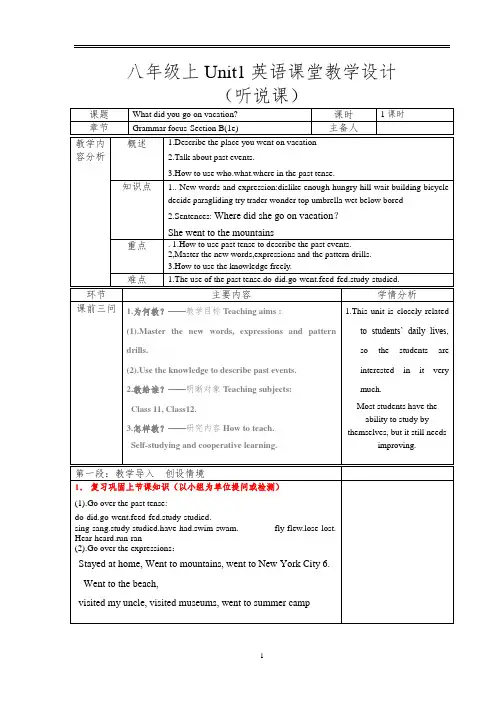
八年级上Unit1英语课堂教学设计(听说课)课题What did you go on vacation?课时1课时章节Grammar focus-Section B(1e)主备人教学内容分析概述 1.Describe the place you went on vacation2.Talk about past events.3.How to use who.what.where in the past tense.知识点 1.. New words and expression:dislike enough hungry hill wait building bicycle decide paragliding try trader wonder top umbrella wet below bored2.Sentences: Where did she go on vacation?She went to the mountains重点. 1.How to use past tense to describe the past events.2,Master the new words,expressions and the pattern drills.3.How to use the knowledge freely.难点 1.The use of the past tense.do-did.go-went.feed-fed.study-studied.环节主要内容学情分析课前三问 1.为何教?——教学目标Teaching aims :(1).Master the new words, expressions and patterndrills.(2).Use the knowledge to describe past events.2.教给谁?——明晰对象Teaching subjects:Class 11, Class12.3.怎样教?——研究内容How to teach.Self-studying and cooperative learning.1.This unit is closely relatedto students’ daily lives,so the students areinterested in it verymuch.Most students have theability to study by themselves, but it still needsimproving.第一段:教学导入创设情境1.复习巩固上节课知识(以小组为单位提问或检测)(1).Go over the past tense:do-did.go-went.feed-fed.study-studied.sing-sang.study-studied.have-had.swim-swam. fly-flew.lose-lost. Hear-heard.run-ran(2).Go over the expressions:Stayed at home, Went to mountains, went to New York City 6. Went to the beach,visited my uncle, visited museums, went to summer camp(3). Where did she go on vacation?2.新旧知识联系,导入新课(板书课题)Ask and answer: Where did you do on vacation? Lead ing in the new lessons:Where did you go on vacation ?Section A3.出示本节课学习主题和目标).New words ,expressions and sentences: anyone anywhere wonderful decide difference below.. Where did you go on vacation?I went to the mountains, I stayed at home ,I visited my uncle.(2).Use the knowledge describe the past event第二段:学习新知合作探究1.分组展示上节课布置的预习成果Master the following contents: (出示自学互助提纲)New words (自学互互查)1、anyone (教师点拨、释疑)2、most3.nothing4.decide5,paragliding6.building7,trader8,difference9.top10.below11.enough12,hungry13,hill14.dislike15.wetPast tensedo ,go ,camp ,study , feed ,tell ,stay, watch.Expressions1.待在家里2.去爬山3,去夏令营2.去海滩3.5.去参观博物馆4.去纽约市5.中央公园6.特别的东西7.有趣的事情8.为考试而学习9.和某人一块出去10.黄果树瀑布11.好久不见12.照一些照片13.大部分时间14.玩的愉快15.去购物16.在农村17.好像很无聊18.没有太多可以做的19.为你自己2.老师有针对性地讲解Sentences:Where did you go on vacation? I went --.1). Do exercise 1a. (学生先独立完成,然后师友互助)(2). Do 1b. (教师释疑)(3).Role play 1c.(4).Do 2a.(5).Listen and do 2b.(6). Do 2c. Make a dialogue . (Ask and answer)(7). Learn 2dListen to the tape and answer questions.Listen and repeat.Read together.Read by yourself and find out the main pointsRead again and find out the difficult pointsRecite the passageRole play the passage(8).Language points:anyone anything someone nobody something special everything3.设置课堂练习(组内讨论、说明,跨组质疑、评价)2. 我去了纽约市。
人教版八年级上册英语全册教案(完整版)教学设计含教学反思
人教版八年级上册英语全册教案(完整版)教学设计含教学反思Unit 1 Where did you go on vacation?Section A (1a-2d)知识目标单词anyone, anywhere, wonderful, few句型 1.—Where did you go on vacation?—I went to the mountains.2.—Did you go out with anyone? —No. Noone was here. Everyone was on vacation.3.—Did you buy anything special? —Yes, Ibought something for my father. /No, I boughtnothing.4.—How was the food? —Everything tastedreally good!5.—Did everyone have a good time? —Oh,yes. Everything was excellent.技能目标听:能听懂关于过去的假期和节日的对话。
说:能就假期及节日等话题进行交谈。
读:能够读懂并了解他人假期生活的情况及感受。
写:能写出假期日记。
1.学习一般过去时。
2.学会询问和表达关于假期的句型教学。
1.复合不定代词someone, anyone, something, anything等的用法。
2.yourself, myself等反身代词的用法。
Step 1通过情境设计来导入新课,调动学生的积极性。
Free talkGuide students to talk about their own vacation:Where did you go on vacation?Did you do something interesting?Step 2 用形象的方式让学生掌握新单词。
八年级上册英语教案人教版5篇

八年级上册英语教案人教版5篇八年级上册英语教案人教版篇1一、教材内容分析本课是人教版八年级上册英语第一单元第三个话题的第一课时,主要谈话讨论如何给别人提出建议,并给予适当的评论。
二、教学目标(知识,技能,过程与方法情感态度、价值观)1、知识与技能(1)掌握Why don’t you get her a scarf ? That’s too boring .这种句型,并认识新单词。
(2)运用新句型熟练的进行小组对话。
(3)进行听力练习。
2、过程与方法(1)能够通过师生说、两两说和自主听读体验交际式英语教学的一般过程,掌握英语说听的基本方法;(2)能够通过两两说和综合说体验合作学习的过程和方法;(3)能够仔细倾听老师和同学的发言,有语言表达和与同学交流的愿望。
(4)能够通过观看图片激发说话的欲望。
3、情感态度与价值观(1)培养学习英语的兴趣;(2)在学生两两交流和小组合作交流中,培养孩子合作意识和合作精神,能够相互配合完成一段通顺流畅的说话训练;(3)使学生学会礼貌待人。
三、学习者特征分析1、学生是八年级的学生。
2、学生已经学习了camera、hat,flowers 等物品的词。
3、学生对 great,interesting,boring 这些评论性的词非常熟悉。
4、学生好奇心强,对送什么礼物很感兴趣。
5、学生善于表现自己,乐于交际。
6、学生的听力能力不够强。
四、教学策略选择与设计1、谈话策略:运用谈话法引入新课。
2、自主听读策略:学生通过自主听读拓展材料,在完成课标要求的基础上训练听说能力,积累和丰富英语词汇和句式。
3、角色扮演法:让学生通过扮演不同角色,小组对话练习熟练地掌握重点句型。
五、教学环境及资源准备1多媒体教室。
2 本课教材,课件。
六、教学过程教学过程教师活动学生活动设计意图及资源准备Step1: Greeting Hello , cliass! How are you! Are you happy ... Greeting. 拉近教师和学生的距离。
新人教版八年级英语-上全册教案
八年级上册英语全册教案Unit 1 Where did you go on vacation?Period One: Section A (1a-2d)一、教学目标:1. 语言知识目标:1) 能掌握以下单词:anyone, anywhere, wonderful, quite a few, most, something, nothing, everyone, of course, myself, yourself能掌握以下句型:①—Where did you go on vacation? —I went to the mountains.②—Where did Tina to on vacation? —She went to the beach.③—Did you go with anyone? —Yes, I did./No, I didn’t.2) 能了解以下语法:复合不定代词someone, anyone, something, anything等的用法。
yourself, myself等反身代词的用法。
3) 一般过去时态的特殊疑问句,一般疑问句及其肯定、否定回答。
2. 情感态度价值观目标:学会用一般过去时进行信息交流,培养学生的环保意识,热爱大自然。
二、教学重难点1. 教学重点:1) 用所学的功能语言交流假期去了什么旅行。
2) 掌握本课时出现的新词汇。
2. 教学难点:1) 复合不定代词someone, anyone, something, anything等的用法。
2) yourself, myself等反身代词的用法。
三、教学用具:录音机,多媒体,幻灯片,课本四、教学过程:I. Lead-in1. 看动画片来进入本课时的主题谈论上周末做了些什么事情,谈论过去发生的事情。
II. Presentation1. Show some pictures on the big screen. Let Ss read the expressions.2. Focus attention on the picture. Ask: What can you see? Say: Each picture showssomething a person did in the past. Name each activity and ask students to repeat:Stayed at home, Went to mountains, went to New York City 6. Went to the beach,visited my uncle, visited museums, went to summer camp3. Now, please match each phrase with one of the pictures next to the name of theactivity,point to the sample answer.4. Check the answers. Answers: 1. f 2. b 3. g 4. e5. c6. a7. dIII. Listening1. Point to the picture on the screen.Say: Look at the picture A. Where did Tina go on vacation? She went to mountains.Ask: What did the person do in each picture?2. Play the recording the first time.3. Play the recording a second time.Say: There are three conversations. The people talk about what did on vacation. Listen to the recording and write numbers of the names in the right boxes of the picture.4. Check the answers.IV. Pair work1. Point out the sample conversation. Ask two Ss to read the conversation to the class.2. Now work with a partner. Make your own conversation about the people in the picture.3. Ss work in pairs. As they talk, move around the classroom and give any help they need.4. Let some pairs act out their conversations.V. Listening1. Tell Ss they will hear a conversation about three students’ conversations. Listen for the first time and fill in the chart. Then listen again and check Yes, or No.2. Let Ss read the phrases in the chart of 2b.3. Play the recording the first time. Ss listen and fill in the chart.4. Play the recording a second time for the Ss to check “Yes, I did.”or “No, I didn’t. ”5. Check the answers with the Ss.VI. Pair work1. Let two Ss read the conversation between Grace, Kevin and Julie.2. Let Ss work in pairs and try to role-play the conversation.3. Ask some pairs to act out their conversations.VII. Role-play1. First let Ss read the conversation and match the people and places they went.2. Let Ss act out the conversations in pairs.3. Some explanations in 2d.VIII. Homework:用英语询问你的一位好朋友,她假期去了哪里?看到了什么?并将此对话写在作业上。
人教版八年级英语上册精品教案全册完整版(1)
人教版八年级英语上册精品教案全册完整版一、教学内容Unit 1: How often do you exercise?(第一单元:你多久锻炼一次?)Section A: 1a2d(听说练习:谈论日常习惯)Section B: 3a4d(阅读理解:生活方式对健康的影响)Unit 2: What's the matter?(第二单元:你怎么了?)Section A: 1a2d(听说练习:描述身体不适及提出建议)Section B: 3a4d(阅读理解:不同文化下的健康观念)二、教学目标1. 让学生掌握与日常生活、健康习惯相关的词汇和表达方式。
2. 提高学生的听说能力,使他们能够运用所学知识进行情景对话。
3. 培养学生的阅读理解能力,使其能够通过阅读文章获取信息。
三、教学难点与重点1. 教学难点:时态的使用,尤其是一般现在时和一般过去时的区别。
2. 教学重点:词汇和句型的掌握,以及在实际情境中的运用。
四、教具与学具准备1. 教具:多媒体教学设备、黑板、粉笔2. 学具:课本、练习本、词汇卡片五、教学过程1. 导入:通过提问方式引导学生谈论日常锻炼习惯,激发兴趣。
2. 新课展示:a. 教学Unit 1 Section A:1a2d,引导学生学习词汇和句型,并进行角色扮演。
b. 教学Unit 1 Section B:3a4d,讲解阅读文章,指导学生完成练习。
c. 教学Unit 2 Section A:1a2d,学习描述身体不适的词汇和句型,进行角色扮演。
d. 教学Unit 2 Section B:3a4d,分析阅读文章,拓展学生知识面。
3. 随堂练习:针对每个课时,设计相应的练习题,检验学生学习效果。
六、板书设计1. 核心词汇:以表格形式呈现,包括中英文对照、词性、例句。
2. 重点句型:以对话形式展示,突出语法点。
3. 阅读文章框架:以思维导图形式呈现,便于学生理解和记忆。
七、作业设计1. 作业题目:a. 根据所学词汇,编写一段关于自己日常锻炼的对话。
人教版八年级英语上册教案全册完整版
人教版八年级英语上册教案全册完整版一、教学内容二、教学目标1. 掌握并运用一般过去时、频率副词、比较级和最高级等语法知识。
2. 提高学生的听说读写能力,特别是日常对话和描述事物的能力。
3. 培养学生的团队合作精神和跨文化交际意识。
三、教学难点与重点教学难点:一般过去时、比较级和最高级的运用,以及日常对话中的交际技巧。
教学重点:各单元词汇、语法和句型的掌握,以及听说读写能力的提高。
四、教具与学具准备教具:多媒体设备、PPT、黑板、卡片等。
学具:英语课本、练习册、笔记本、字典等。
五、教学过程1. 导入:通过展示与单元主题相关的图片、视频或实物,引发学生的兴趣,导入新课。
2. 新课内容展示:讲解各单元的词汇、语法、句型,结合实际情境进行例句演示。
3. 实践情景引入:设计角色扮演、小组讨论等实践活动,让学生在实际情境中运用所学知识。
4. 例题讲解:针对重难点,进行详细讲解,帮助学生理解。
5. 随堂练习:设计各种题型,如填空、选择、改错等,巩固所学知识。
六、板书设计板书内容主要包括各单元的词汇、语法、句型,以及重要知识点。
设计要求简洁明了,突出重点。
七、作业设计1. 作业题目:Unit 1: Write a short passage about your last vacation.Unit 2: Make a survey about your classmates' exercise habits.Unit 4: Design an advertisement for your favorite movie theater.Unit 5: Write a dialogue between you and your friend about a game show.Unit 6: Write a short essay about your future career plan.2. 答案:根据学生完成情况,给出相应答案。
八年级上册英语教案人教版全册
八年级上册英语教案人教版全册1. 背景八年级上册英语教案人教版全册是针对八年级学生的英语教学大纲,旨在提供全面而系统的英语教学内容。
本教案覆盖了上册所有单元,帮助学生提高听、说、读、写等英语技能。
2. 教学目标- 提高学生的英语听力和口语表达能力- 培养学生的阅读理解能力- 帮助学生掌握英语语法知识- 引导学生运用所学知识进行写作3. 教学内容本教案包含上册所有单元的教学内容,每个单元的教学内容都经过精心设计,结合了各种教学资源和活动,以便提高学生的研究兴趣和参与度。
4. 教学方法- 听力训练:通过听录音和跟读练,提高学生的听力理解能力。
- 口语练:通过小组讨论、角色扮演等活动,培养学生的口语表达能力。
- 阅读理解:通过阅读文章和回答问题,培养学生的阅读理解能力。
- 语法研究:通过解析语法规则和练题,帮助学生掌握英语语法知识。
- 写作训练:通过写作练和作文,引导学生用所学知识进行写作。
5. 教学评估教学过程中,可以通过听力测试、口语表达、阅读理解、语法练和写作评价等方式对学生的研究情况进行评估。
根据评估结果,及时调整教学方法和内容,以提高教学效果。
6. 教学资源为了支持教学活动,需要准备以下教学资源:- 教科书和课本:提供教学材料和练题- 录音机或电脑:播放课文录音和听力材料- 板书和投影仪:展示教学内容和示范演示- 练册和作业纸:进行口语和写作练- 多媒体资料:如图片、视频等,用于辅助教学效果7. 教学计划具体的教学计划可以按照每个单元进行安排,包括课前准备、教学活动和作业布置等内容。
可以根据实际教学情况进行调整,确保教学进度和效果。
8. 总结八年级上册英语教案人教版全册是一份全面而系统的教学指南,旨在提高学生的英语能力和综合素养。
通过精心设计的教学内容和活动,帮助学生掌握听、说、读、写的英语技能,并培养其全面发展。
以上是八年级上册英语教案人教版全册的简要概述,希望对您的教学工作有所帮助。
新人教版八年级上册英语教案(全册)
新人教版八年级上册英语教案(全册) Unit 1 School lifeLesson 1 Where's the post office?Teaching objectives- Learn and master the new words: post office, bookstore, hotel, cinema, restaurant- Learn and master the new sentence pattern: Where is the post office?- Train the students' listening and speaking ability.Key points and difficult points- Key points: The usage of new words and sentence pattern.Teaching methods- Demonstration method.- Task-based language teaching method.Teaching aids- Multimedia courseware.Teaching procedures1. Warm-up.2. New lesson.3. Listening practice.4. Speaking practice.5. Summary and homework.Unit 2 Personal informationLesson 1 My name's Gina.Teaching objectives- Learn and master the new words: name, family name, given name, spell- Learn and master the new sentence pattern: What's your name? My name is Gina.- Train the students' listening and speaking ability.Key points and difficult points- Key points: The usage of new words and sentence pattern.Teaching methods- Situational method.- Task-based language teaching method.Teaching aids- Multimedia courseware.Teaching procedures1. Warm-up.2. New lesson.3. Listening practice.4. Speaking practice.5. Summary and homework.Lesson 2 Where are they from?Teaching objectives- Learn and master the new words: country, Australia, England, China- Learn and master the new sentence pattern: Where are you from? I'm from Australia.- Train the students' listening and speaking ability.Key points and difficult points- Key points: The usage of new words and sentence pattern.- Difficult points: How to ask and answer questions about where people are from.Teaching methods- Situational method.- Task-based language teaching method.Teaching aids- Multimedia courseware.Teaching procedures1. Warm-up.2. New lesson.3. Listening practice.4. Speaking practice.5. Summary and homework. ......。
新人教版八年级英语-上全册教案
八年级上册英语全册教案Unit 1 Where did you go on vacation?Period One: Section A (1a-2d)一、教学目标:1. 语言知识目标:1) 能掌握以下单词:anyone, anywhere, wonderful, quite a few, most, something, nothing, everyone, of course, myself, yourself能掌握以下句型:①—Where did you go on vacation? —I went to the mountains.②—Where did Tina to on vacation? —She went to the beach.③—Did you go with anyone? —Yes, I did./No, I didn’t.2) 能了解以下语法:复合不定代词someone, anyone, something, anything等的用法。
yourself, myself等反身代词的用法。
3) 一般过去时态的特殊疑问句,一般疑问句及其肯定、否定回答。
2. 情感态度价值观目标:学会用一般过去时进行信息交流,培养学生的环保意识,热爱大自然。
二、教学重难点1. 教学重点:1) 用所学的功能语言交流假期去了什么旅行。
2) 掌握本课时出现的新词汇。
2. 教学难点:1) 复合不定代词someone, anyone, something, anything等的用法。
2) yourself, myself等反身代词的用法。
三、教学用具:录音机,多媒体,幻灯片,课本四、教学过程:I. Lead-in1. 看动画片来进入本课时的主题谈论上周末做了些什么事情,谈论过去发生的事情。
II. Presentation1. Show some pictures on the big screen. Let Ss read the expressions.2. Focus attention on the picture. Ask: What can you see? Say: Each picture showssomething a person did in the past. Name each activity and ask students to repeat:Stayed at home, Went to mountains, went to New York City 6. Went to the beach,visited my uncle, visited museums, went to summer camp3. Now, please match each phrase with one of the pictures next to the name of theactivity,point to the sample answer.4. Check the answers. Answers: 1. f 2. b 3. g 4. e5. c6. a7. dIII. Listening1. Point to the picture on the screen.Say: Look at the picture A. Where did Tina go on vacation? She went to mountains.Ask: What did the person do in each picture?2. Play the recording the first time.3. Play the recording a second time.Say: There are three conversations. The people talk about what did on vacation. Listen to the recording and write numbers of the names in the right boxes of the picture.4. Check the answers.IV. Pair work1. Point out the sample conversation. Ask two Ss to read the conversation to the class.2. Now work with a partner. Make your own conversation about the people in the picture.3. Ss work in pairs. As they talk, move around the classroom and give any help they need.4. Let some pairs act out their conversations.V. Listening1. Tell Ss they will hear a conversation about three students’ conversations. Listen for the first time and fill in the chart. Then listen again and check Yes, or No.2. Let Ss read the phrases in the chart of 2b.3. Play the recording the first time. Ss listen and fill in the chart.4. Play the recording a second time for the Ss to check ―Yes, I did.‖or ―No, I didn’t. ‖5. Check the answers with the Ss.VI. Pair work1. Let two Ss read the conversation between Grace, Kevin and Julie.2. Let Ss work in pairs and try to role-play the conversation.3. Ask some pairs to act out their conversations.VII. Role-play1. First let Ss read the conversation and match the people and places they went.2. Let Ss act out the conversations in pairs.3. Some explanations in 2d.VIII. Homework:用英语询问你的一位好朋友,她假期去了哪里?看到了什么?并将此对话写在作业上。