
深圳8年级下英语Unit 3 traditional skills 沪教
Unit 3 traditional skills(1)【课文】Wang Damin is a fisherman. Although he is over 65, he is very fit and still enjoys working.Damin uses cormorants to catch fish. Cormorants are large black birds. They are good at catching fish because they can swim well. They can dive down and stay under the water for up to two minutes.Damin usually sets off in the late afternoon and gets the cormorants ready for work. First, he ties a piece of grass around their necks to stop them from eating big fish. Then when Damin’s boat reaches the right pl ace in the river, he pushed them into the river. Damin uses several ways to attract fish. During the day, he jumps up and down on his boat. After dark, he hangs a light on a post at the front of the boat. The cormorants bring the fish back to the boat. The fish are then taken and thrown into a big basket by Damin. No nets are required for this type of fishing.Cormorant fishing was once practiced in lots of places in South-East China, and there were many fishermen in the area. But today, few young people are interested in it. In 50 years, perhaps there will be no more cormorant fishermen in the world.传统技能用鸟捕鱼王大民是一个渔民。
尽管他超过65岁了,但是他很健壮并且仍旧喜欢工作。
大民用鸬鹚抓鱼。
鸬鹚是黑色的大鸟。
它们擅长抓鱼,因为它们水性很好。
它们能下潜并在水下停留达两分钟。
大民通常在傍晚动身并让鸬鹚准备好工作。
首先,他在它们的脖子四周拴一片草,阻止它们吃掉大鱼。
然后,但大民的船到达河里适当的位置时,他把它们赶到河里。
大民用几种方式吸引鱼。
在白天,他在船上跳上跳下。
天黑后,他在船前面的杆上挂一盏灯。
这些鸬鹚把鱼带回船上。
然和大民取下鱼,并把它们扔进一个大篓子里。
这种捕鱼(方式)不需要网。
曾经中国东南部很多地方从事鸬鹚捕鱼业,并且这个地区有很多渔民。
但是如今,很少有年轻人对它感兴趣。
50年以后,或许世界上将不再有鸬鹚渔民了。
一、词性转换1.describe (v.) _______________(n.)2.dive (v.) ______________(gerund)3.require (v.) _____________(n.)4.luck (n.) _________ (adj.)= _____________________ adv.)5. hang (v.悬挂) ___________ (过去式)____________(过去分词)6. reach (v. )= ____________/ __________7. attract (v.) _________(n.)____________(adj.)二、根据句子意思,用所给单词的适当形式填空。
1、Look!A man is______________ (tie) a boat to a small tree over there.2、At last,the poor child______________ (appear) and we didn’t see him any more.3、The mixture of coke and champagne______________ (taste) strange.4、Modern fishing skills are now______________ (wide) used.5、Daming usually______________ (set)off in the late afternoon and gets the cormorants ready for work.6、After dark,a light is______________ (hang)on a post at the front of the boat.7、Although he is over 65,he is very fit and still enjoys_______________(work).8、Few young people in the minority show respect to their own______________ (traditional) and customs.9、He joined the______________ (fish)Club while she joined the Dancing Club.10、Cosplay_______________(attract) a lot of people every year in Shenzhen.11、It is ____________ (danger) to get off the bus when it doesn’t stop.12、CO2 is a kind of ____________ (harm) gas.13、I like films _____________ (well) than TV.14、Look! The desk is very ___________ (dirt).15、This is a ___________ (really) story.16、The _____________ (destruct) of the rainforests cause flooding.17、This bad habit creates massive _____________ (mountain) of rubbish.18、The damage to the ozone is _____________ (cause) by chemicals.19、These gases are produced by _____________ (burn) fuels.三、从下面每小题的A,B,C,D四个选项中选出可以替换画线部分的最佳选项。
【】1、The flower show attracts_many people.A、makes…comeB、makes…to become biggerC、makes…become popularD、makes…leave【】2、Now many women keep fit_with diet and exercise.A、youngB、healthy and strongC、weak and illD、beautiful【】3、Hang_the picture somewhere on the wall.A、put intoB、dropped fromC、took fromD、put on【】4、The floor requires_washing.A、makesB、sellsC、asksD、needs【】5、He did not stop until he reached_the door.A、arrivedB、returned fromC、got toD、left【】6、Mr Smith can run up_to_40 minutes.A、as fast asB、as slowly asC、as high asD、as long as【】7、Mr Yang will set_off_for Shenzhen tomorrow.A、goB、walkC、moveD、leave【】8、The man is over_50 years old.A、more thanB、less thanC、aboutD、above【】9、Jim got up late,so he had breakfast as quickly as possible.A、carefullyB、wellC、fastD、quietly【】10、Daming uses several_ways to attract fish.A、muchB、manyC、fewD、some四、语法填空。
It was a very hot day in summer. A gorilla wanted to eat an ice cream. So he walked into a town. When he got to the town. He looked for a store 1 (sell) ice creams. He soon found one, and walked in.The salesman looked 2 him and said. Yes? What do you want?I’d like an ice cr eam, please. Said the gorilla. He showed a ten-dollar bill 3 the salesman.The salesman thought to himself. An ice cream is only one dollar but a gorilla won’t know that. I’ll keep nine dollars and 4 (give) him one dollar change.He did this and went 5 (get) the gorilla an ice cream. The gorilla got the one-dollar bill. Looked at it, but said 6 (something).Soon the salesman came back and gave the gorilla 7 ice cream. Here you are, he said “one i ce cream. I hope that you 8 (like) it. Then he added, I don’t know gorilla eat ice creams too.I’m not9 (surprise). Said the gorilla. They can get 10 for a dollar in other stores.五、完形填空Billy is always careless. His mother often tells him to be 1 , but he finds it difficult to do so. Of course it brings him a lot of 2 .One night there was the biggest football match of the year on TV. The boy wouldn’t 3 it. He finished his supper quickly and sat in front of the 4 . He waited and waited at last the match began. And when it was 5 , it was a quarter past one at night. But the boy couldn’t fall asleep at first because his favourite team 6 . He felt very sorry for it. The next 7 his mother woke him up. “Look at the clock on the wall,” said his mother. “It is twenty past seven. 8 , or you’ll be late for school!”Five minutes later the boy rushed out of his 9 and sat at the table for breakfast.“Oh, look at your shoes!” his mother called out, “One is black and the other is brown. Go and change them.”Billy had to go to his bedroom. Soon he came out and said, “I don’t 10 it’s necessary to do that. The colours of the shoes in the bedroom are the same as these.”【】1、A、quiet B、hard C、careful D、polite【】2、A、luck B、trouble C、matter D、interest【】3、A、miss B、catch C、forget D、remember【】4、A、computer B、fridge C、telephone D、television【】5、A、over B、started C、lasted D、lifted【】6、A、won B、beat C、lost D、failed【】7、A、night B、morning C、afternoon D、evening【】8、A、Send for B、Stand up C、Sit down D、Hurry up【】9、A、bedroom B、classroom C、school D、window【】10、A、know B、understand C、think D、like六、阅读理解If you do not use your arms or your legs for some time, they become weak; when you start using them again, they slowly become strong again. Everybody knows that. Yet many people do not seem to know that memory works in the same way.When someone says that he has a good memory, he really means that he keeps his memory in practice by using it. When someone else says that his memory is poor, he really means that he does not give it enough chance to become strong.If a friend says that his arms and legs are weak, we know that it is his own fault (过错). But if he tells us that he has a poor memory, many of us think that his parents are to blame (受责备), and few of us know that it is just his own fault. Have you ever found that some people can’t read or write but usually they have better memories? This is because they cannot read or write them down in a little notebook. They have to remember days, names, songs and stories; so their memory is the whole time being exercised.So if you want to have a good memory, learn from the people: practice remembering.【】1、The main reason for one’s poor memory is that _________.A、his father or mother may have a poor memoryB、he does not use his arms or legs for some timeC、his memory is not often usedD、he can’t read or write【】2、If you do not use your arms or legs for some time, ______.A、you can’t use them any moreB、they will become strongerC、they become weak but they slowly become strong againD、they become weak and won’t become strong until you use them again【】3、Which of the following in NOT true?A、Don’t learn how to read and write if you want to have a better memory.B、Your memory, like your arms or legs, becomes weak if you don’t give it enough chance for practice.C、Your memory works in the same way as your arms or legs.D、A good memory comes from more practice.【】4、Some people can’t read or write, but they usually have better memories, because .A、they have saved much troubleB、they have saved much time to remember thingsC、they have to use their memories all the timeD、they can’t write everything in a little notebook【】5、The best title for this passage _________.A、Don’t Stop Using Your Arms Or LegsB、How To Have A Good MemoryC、Strong Arms And Good MemoryD、Learn From The PeopleUnit 3-2被动语态结构:be + 及物动词的过去分词(+ by)be +not+及物动词的过去分词(+by)(否定)1. be 有人称、数和时态的变化一、被动语态的构成形式1. 被动语态的基本时态变化被动语态通常为十种时态的被动形式, 被动语态由be+过去分词构成,be随时态的变化而变化。
沪教版(初中二年级)八年级英语下册:Unit 3 Traditional skills(Period 6)
B In pairs, talk about Wang’s work during a shadow puppet play.
Study skills
Read the introduction on page 46.
A Look at the poster and tick (√) the possible answers for each question.
Puppets
What actors do
Shadow puppet not as (9) ________ as before plays nowadays
A Read this newspaper article about shadow puppet plays and answer the questions below.
Read the article again and complete the table.
Shadow puppet plays • • • • • • • • made of (1) ______________ cut out in different (2) __________ painted in bright (3) __________ put on (4) __________ stand behind (5) _____________ with lights behind it (6) ________ the puppets close to the screen (7) ________ the puppets around do the (8) ________ of different characters
Make a poster for a shadow puppet play. Complete the notice below first and then design your poster using information from the notice.
牛津深圳版八年级英语下册Unit3Traditionalskills优质教案ListeningandSpeaking
堂
教
学
流
程
Prepare for listening→Listening→Speaking→summa ry
效
果
评
价
与
反
思
教法与学法指导
Group work. Self—study
教学环节
主要教学步骤或内容
学生主体活动
教师活动
设计意图
时间
分配
第二环节 观察操作、 探索归纳平移的作法
Step I: Prepare for the listening and speaking
Step II: Do the listening
第四环节 课时小结
StepⅥSum up
6.Know how to describe a person
e ppt to hel p the m sum up
6.Help them to cultivate the ability of summarizing.
第五环节 课后作业
Make a dialogue in written way to talk about how a cat help people
1.To move the obstacles of the listening and speaking
2.To train the students’ ability of catching the information of the listening materials
3.To develop the students’ abiliபைடு நூலகம்y of listening and speaki ng.
第三环节 课堂练习
年牛津深圳八年级英语下册《Unit 3 Traditional skills》教案:Words

课题Unit 3 Traditional skills 课型NEW WORDS备课时间1 period教材分析教学目标1.Students can master how to pronounce the new wordsand master the meanings of th e words .2.Students can use the new words to make newsentences.3.Train the students ability of cooperation教学重点The pronunciation and the usages of the new words: description ,describe , although, ready , reach, attract, require , simple, lovel y 教学难点description, although , attract, practice , health教学关键Let all the students can read the words and know the meaning ofthe new words教法与学法指导Use some pictures and games and PPT教学环节主要教学步骤或内容学生主体活动教师活动设计意图时间分配第一环节复习回顾平移的基本性质,引入课题Step one: Warming up.Freely talk: What traditionalskills do you have ?Talk about what kindsof traditional skillsyou know .1. Show somepictures aboutthe traditionalskills tointroduce sometraditionalskills fromChina.1.To arousethe interest andlead t hem toget into thewords of the newwords5第二环节观察操作、探索归纳平移的作法Step two: New words.Step three:Game time.2. Read the news wordsaccording to thesyllables and learnhow to pronounce it3.Play the game:Choose a number in anumber tabl e andanswer the related2.Play theMP3 of the newwords for themand lead them toread in a properway.3 Prepare anumber game, andshow it on pp tand give2.Let thestudents readthe wordscorrectly.3.To make themget familiarwith thepronunciation20Step four: Key wordslearning.Step five: have acompetitionquestions like : Tellthe Chines e meaning ofthe words , or Spellout the words ,or makea sentence with thewords: description,fisherman, net,although, fit , dive,ready , reach,attract, hang, post ,require , practice,tool ,scissors,pattern , health,luck , simple4. Work in groups tolearn the usage of thekey words5. match the new wordsand the pictures shownon the pptdifferentgroups marksaccording to thequestions theyanswer.4.Show the PPTof the meaningof the key wordsand let ss makemore sentenceswith the newwords :description ,describe ,although, ready ,reach, attract,require , simple,lovely5. check the wordsand give themmarks for thegroupsand the spellingof the newwords.4. Train thestudents’ability tocooperate. Letthe students indifferentlevels can takepart in theactivity.5.Provide thechances forstudents to showthemselves andpractice thespeakingability.第三环节课堂练习Step six: exercise1. use the correct forms ofthe words to fill in theblanks like :Can you give a__________(describe ) tothe park?6. Finish theexercise given onthe sheet.6.Collect themistakes in thestudents’exercise.6. To c heck thes tudents’le arningsituation .10第四环节课时小结step SevenHow many words do youmaster?Write them down in yoursheet7. Remembe r the wordsyou learn and spellthem out7.Give them apiece of paperto write thewords.7.To develop thestudents’ability of self–checking.5第五环节课后作业1.Dictatione the new words tomake sentences onyou r own or checkthem in adictionaryRead after the tapeand then use thephonetic symbols toremember the words3. make sentences1.Dictation2.correct themistakesStrengthen theremembering ofthe words andsee if they canuse the wordscorrectly课堂教学流程Read the new words --- Games and remember the new words ---- learn the usages of the new words -----Exercise----check how they master the new words效果评价与反思。
【最新】牛津深圳版八年级英语下册《Unit 3 Traditional skills》教案:Writing

课题Unit3 Traditional skills 课型Writing备课时间1 Period教材分析教学目标1.To know how t o write a passage to describe a person and introdu cea traditional skills教学重点Should contain the person’s age, build, height, his or her specialability教学难点to describe a person’s special skills教学关键know the person w ell and seize the special skills教法与学法指导Self-study, Cooperation, Group work.教学环节主要教学步骤或内容学生主体活动教师活动设计意图时间分配第一环节复习回顾平移的基本性质,引入课题StepⅠ:Free talk andpreparation for writing1. Talk with yourclassmates about theperson you want todescribe1. show someuseful words andphrases on thePPT to help themcommunicatewith theirpartner1.To arousetheir interestabout the class5第二环节观察操作、探索归纳平移的作法StepⅡ: Read the passage 3. Read the passageand find out someuseful sentences andphrases which canhelp you in yourwriting . Then answerthe questions below.3.help studentsto mark down theimportantpoints ab outthe Mr Chen.3.To train theirability toexpress as wellas improve theirspeakingability and toget ready forthe writing andtrain theirability tocooperate.10第三环节课堂练习Step III: WritingStep IV: Check the passage 4.Write apassage todescribe apersonaccording to thetips given . Tryto use thepassive voice inyour passage ..4.rem ind students topay attention totheir handwritingand check themistakes studentsmake4.To train thestudents’writing ability.15第四环节课时小结Step five Sum upH ow to organize the writing.5. sum up what youneed to cont ain inyour passage whenwri ting an animal youlove5.List thebeautifulsentences theywrite in thepassages5.Let them getfamiliar withthe writ ing.5第五环节课后作业1. Recite the passage which given as a sample .课堂教学流程Free talk and preparation →Read a sample passage →write a passage—Check the writhing.。
沪教版(牛津)八年级英语下册Unit 3 Traditional skills - Period 6 公开课PPT课件
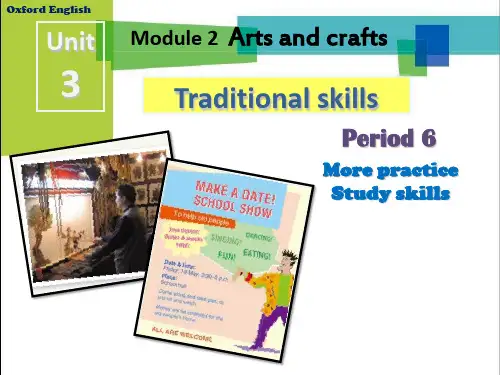
More practice
Read the article on page 45 and group the paragraphs by their general ideas.
Read the article again and complete the table.
Shadow puppet plays
Self-assessment
1. 抄写单词和短语:shadow,puppet;shadow puppet play,put on a play ,cut out,keep ... alive。
2. 设计并完成一份关于A shadow puppet play的 海报。
3. 选择性完成《综合练习册》第45至48页 Integration的练习。
• (6) ________ the puppets close to the screen What actors do
• (7) ________ the puppets around
• do the (8) ________ of different characters
Shadow puppet not as (9) ________ as before
Singing & school band!
Date & time: Tuesday, 4 May, 4 p.m.–5:30 p.m.
Place: School hall
Tickets: Students: free Parents: ¥20 each
Make a poster for a shadow puppet play. Complete the notice below first and then design your poster using information from the notice.
深圳广州沈阳沪教牛津版八下Unit 3 Traditional skills单元试卷(含答案)
沪教牛津版八年级下册单元素养测试卷Unit 3一、单项选择(共10小题,每小题1分,满分10分)1. American English is different __________ British English.A. fromB. inC. withD. at2. __________ the little boy said he wasn’t hungry, he ate two bowls of rice and a big apple.A. IfB. AlthoughC. BecauseD. Since3. The net is used __________ fish.A. catchB. to catchingC. to catchD. catching4. No ticket __________ for this art show, so you don’t need to pay any money.A. is requiredB. requiresC. was requiredD. required5. I stayed up last night, so I __________ the airport late this morning.A. arrived atB. gotC. reached toD. arrived in6. —What do you think of Mrs Black—Oh, she is a very kind woman. She is always ready __________ others.A. helpB. to helpC. helpingD. to helping7. Some school boys enjoy __________ bikes to go to school every day.A. rideB. to rideC. to ridingD. riding8. You have been working for a long time. Let’s stop __________ a rest.A. haveB. havingC. to havingD. to have9. —I’m going to take an educational exchange to England.—When will you __________A. set upB. set inC. set offD. set down10. —What does our English teacher look like—__________A. He is tall and thin.B. He likes playing the piano.C. He is very nice and patient.D. He doesn’t feel very well.二、语法选择(共10小题,每小题1分,满分10分)阅读下面短文,按照句子结构的语法性和上下文连贯的要求,从每题所给的四个选项中选出最佳选项。
新沪教版英语初二下册Units 3知识讲解1
沪教版初中英语二年级上册精编试题及知识点汇总学生姓名:班级:学号:Unit 3 Traditional skills词句精讲精练词汇精讲1. althoughalthough的意思相当于though,意为“尽管,虽然”,用来引导让步状语从句。
它所引导的从句不能与并列连词but; and; so等连用,但可以和yet; still等词连用。
例如:Although he lives alone, he doesn’t feel lonely.= He lives alone, but he doesn’t feel lonely.虽然他一个人住,但他并不感到孤独。
There is air all around us, although we cannot see it.虽然我们看不见空气,但空气却存在于我们的周围。
【拓展】although与though的辨析:(1) 用作连词,表示“虽然”,二者可以互换使用,但although比though更为正式。
例如:Though/Although it was raining, we still went there. 虽然下着雨,但我们还是去了那里。
(2) although一般不用作副词,而though可用作副词,且一般放在句末(不放在句首),意为“可是,不过”。
例如:It’s hard work; I enjoy it, though. 工作很辛苦,可是我很喜欢。
We all tried our best. We lost the game, though. 我们都尽力最大努力,但我们还是输了。
(3) 在as though(好像,仿佛),even though(即使,纵然)等固定短语中不能用although。
例如:He talks as though he knew everything. 他夸夸其谈,好像无所不知。
2. up toup to意为“到达(某数量、程度等)”;至多有。
沪教八下Unit 3 Traditional skills(B卷提升篇)(原卷版)
八年级下U3 Traditional skills(B卷提升篇)一、语法选择Canton Porcelain (广彩) has a history of more than 300 years, dating back to the QingDynasty. Canton Porcelain became popular around the world 1 its beautiful colors.Xu Enfu is known as a Canton Porcelain master. Xu Junru, his daughter, showed 2great love for it when she was a little girl. She enjoyed staying with her father while he 3 the porcelain painting. They think it's necessary 4 them to add modern patterns into their pieces. They mix modern techniques 5 a traditional feel. Cartoon patterns, such as Hello Kitty and Doraemon 6 on the plates. This idea wins children's hearts. Their works are so wonderful 7 they attract many foreigners. They decide8 this traditional skill to people around the world.A group of foreigners 9 to join this Canton Porcelain workshop held by GD Today. They were 10 to experience how to make Canton Porcelain.Mansha said, “It is my first time to paint on a plate or porcelain. It's difficult for me to do the black line." Foreigners had about just one hour to finish 11 patterns and colors for their own plates. Oxana challenged herself to paint the Canton Tower on 12 own to remember her time in Guangzhou. Simon painted a Chinese character 13 on the plate. It was a good idea that he made this plate for his grandma in U.K..14 you are interested in it, you can attend the training class on making Canton Porcelain. It is really good for you 15 it to your family and friends as a gift!1.A.because of B.because C.so D.as2.A.the B.an C./ D.a3.A.makes B.making C.made D.was making 4.A.with B.of C.for D.on5.A.into B.with C.up D.in6.A.can be painted B.can paint C.was painted D.painted7.A.as B.until C.till D.that 8.A.introduced B.introducing C.to introduce D.introduce 9.A.invited B.were invited C.are invited D.invite 10.A.luckily enough B.luck enough C.lucky enough D.enough luck 11.A.design B.designing C.to design D.designed 12.A.she B.he C.his D.her13.A.success B.successful C.successfully D.succeed14.A.If B.As C.Unless D.While15.A.to send B.send C.sending D.sent二、完形填空(共10分)Cormorant fishing has been used for hundreds of years already. People often see lights onbamboo rafts(竹筏) in the __16__, That will be the fishermen who use cormorants to__17__fish. The birds do fishing much better at night than they do in the daytime. Tourists alwayswant to know how these birds can fish for __18__. By getting a close look at the fishing, tourists who are __19__ can get the answer.Tourists get aboard on a big boat. It__20__ the bamboo rafts so that tourists can watch the performance __21__. With the order from the fishermen, the well-trained cormorants will dive into water for quite a long time. When they succeed in __22__ any fish, they will proudly swim back to the raft. The fisherman usually gives them some small fish to __23__ them. Of course, the birds also swallow the small fish during the catching. Sometimes they do get__24__ones, but with the grass tied around their__25__, they can not swallow these big fish they catch.After watching the process (过程) of fishing, tourists will surely get a lot of ideas about how the cormorants do fishing for fishermen.16. A. field B. river C. puddle D. garden17. A. sell B. cook C. catch D. kill18. A. farmers B. fishermen C. doctors D. students19. A. sad B. bored C. tired D. interested20. A. flies B. follows C. lies D. stands21. A. loudly B. angrily C. clearly D. quietly22. A. getting B. buying C. borrowing D. giving23. A. protect B. encourage C. follow D. forget24. A. weak B. lovely C. new D. big25. A. eyes B. necks C. heads D. legs三、阅读(共两节,满分45分) AChina is called the Kingdom of fans. Fans are everywhere in our daily life. But how muchdo you know about them?It is said that fans were first used to cool the air during the Shang Dynasty. At that time, they were made offeathers, bamboo or silk. Some of them were round, while others were square.Folding paper fans first became popular during the Song Dynasty. There were usually beautiful pictures on the fans. Some were mountains and rivers, others were flowers and animals. Many people, including Su Dongpo, a poet of the Song Dynasty, and Tang Bohu, a scholar of the Song Dynasty, even painted and wrote poems on fans. This made the fans into art works. Many rich and important people liked holding fans.Today, fans are popular gifts. During the 2008 Beijing Olympic Games, folding fans were given to leaders and officials from other countries, as well as audience members. While they were having their fans to get cool air, they were also experiencing Chinese culture.26. The fans were made of different materials except__________ during the Shang Dynasty.A. paperB. bambooC. silkD. feathers27. When did folding fans first become popular?A. The Shang dynasty.B. The Song Dynasty.C. Today.D. In 2008.28. What couldn't people see on fans in the Song Dynasty?A. MountainsB. AnimalsC. FlowersD. Audience29. Which of the following is TRUE according to the passage?A. Fans were first used to cool the air during the Song dynasty.B. Tang Bohu never wrote or painted on fans.C. Some fans were round, while others were square during the Shang Dynasty.D. Folding fans were only given to leaders and officials from China.30. What's the best title of this passage?A. The Development of FansB. The Shapes of FansC. When Fans Became PopularD. How Fans Became Art WorksBMore than 2,000 years ago, Emperor (皇帝) Wu's favourite wife of the Han Dynastydied of illness. The emperor missed her so much that he didn't want to do anything. One day,a minister (大臣) saw children playing with dolls. The shadows on the floor were interesting.The smart minister had an idea. He made a puppet of the emperor's favourite wife and painted it. As night fell, he asked the emperor to watch a puppet show behind a curtain. The emperor was very happy and became interested in it. In this way, puppet shows began.Shadow puppets were first made of paper, later from the hides of donkeys (驴皮). That's why their Chinesename is piying. Shadow puppet plays were very popular during the Tang and Song dynasties in many parts of China.Today, shadow puppet plays face extinction like other traditional art forms such as Nuo Drama. We should do something to protect them. Shadow puppet plays in Shaanxi are the most famous. The Academy Gate Cultural Street in Xi'an is a wonderful place for you to buy shadow puppets. There you can choose from hundreds of figures (人物) in different sizes and poses (姿势).31. What or who helped the minister have the idea of shadow puppets?A. His wife's painting.B. A movie behind a curtain.C. The shadows of some trees.D. Children playing with dolls.32. Why did the minister make a puppet show?A. To make the emperor happy.B. To remember Emperor Wu.C. To celebrate New Year.D. To make his life interesting.33. The underlined words "plays face extinction" mean "__________".A. will saveB. will disappearC. will beginD. will be popular34. What can visitors do in the Academy Gate Cultural Street in Xi'an?A. Make their own shadow puppets.B. Enjoy the delicious traditional food.C. Buy shadow puppets.D. Know more traditional art forms.35. Why did the writer write the passage?A. To let us enjoy shadow puppet plays.B. To show what shadow puppets were made of.C. To show how shadow puppets were made.D. To introduce an ancient Chinese art form.CHow would you like to build a time machine? Paper, sticks, glue and string are all you need. Put them together to build a kite. A kite connects you to the past.No one knows who flew the first kite. It was probably someone in China or perhaps Indonesia. Indonesia. Indonesian fishermen hung fishhooks on kites and sent them out to sea to catch fish. Starting 2,000years ago, Chinese farmers flew kites to welcome the New Year and bring good luck to Earth.In China, people also used kites during wartime. One Chinese story tells how soldiers put noise makers on kites and flew them at night over the enemy camp. The enemies were frightened by the noise and ran away.About 1,300 years ago, Chinese travelers took kites to Japan. Soon kites filled the skies there. Kites reached Thailand about 700 years ago. During floods, Thai farmers flew kites over their fields They hoped the kites woulddrive away the clouds and stop the rain. Over time, kites flew their way out of Asia. Today, kites are a passion all over the world. Kite fans meet at festivals in many parts of the world and have great fun.Over the years, Kites have also helped people understand the natural world. In 1749, for example, thermometers were tied to kites to measure temperatures. In 1906, cameras hanging from kites took pictures of San Francisco, California after an earthquake. The photos helped people plan what to do.Kites also helped inventors find out how to make airplanes. The Wright brothers studied how kites flew, which helped them make the first successful airplane.Since the ancient Chinese first set their kites into the air, people have loved flying kites. Kites give us ways to celebrate, relax and explore. So go fly a kite! Enjoy the feeling of wonder that kite flyers have felt for centuries.36. According to the passage, in which countries were kites used to make good wishes?A. China and Japan.B. China and Thailand.C. Japan and Indonesia.D. Thailand and Indonesia.37. According to the Chinese story, the army used kites to___________.A. make the enemies leave in fearB. celebrate victories during wartimeC. stop the enemies from sleeping wellD. carry soldiers to fight against the enemies38. The underlined word “passion” in Paragraph 4 means__________.A. strong loveB. useful machineC. happy dreamD. common treasure39. How does the writer develop Paragraph 5?A. By telling stories.B. By listing numbers.C. By comparing facts.D. By giving examples.40. What’s the purpose of this passage?A. To show people how to fly kites.B. To explain how kites are used in science.C. To introduce the roles of kites in history.D. To discuss the difference among kites worldwide.DTiger-head shoes and capsTiger-head shoes and caps are traditional Chinese handicrafts (手工艺品)used forchildren. In Chinese culture, tigers are thought as lucky and full of energy. People oftendecorate shoes and caps with lively tiger-head pictures hoping that their children will become as strong and healthy as tigers. Great care is needed to make the handicrafts. Materials are usually colourful cotton fabrics(棉布)and 97-year-old Jiang Weishi in Anhui Province is one of the people who can make these handicrafts. The skill is handed down in her family from generation (—代)to generation. Jiang started to learn the skill at the age of 15 and her products are very popular with local peopleHair embroidery(刺绣)Hair embroidery is one of the treasures of ancient Chinese embroidery art called a“unique skill of the world”,It is a kind of embroidery which uses human hair as athread instead of other materials. According to historical records, hair embroidery first appeared in Dongtai, Jiangsu Province, more than 1,300 years ago. Usually, hair embroidery requires more time and efforts to complete than other kinds of embroidery because higher skills are needed. Hair embroidery's designs are lively with many different kinds, including animals, plants, natural views and historical people.Fluffing cotton (弹棉花)Fluffing cotton is a traditional skill in China, even though it can hardly be seen inboth city and countryside now. It used to be very popular work. Workers fluffed cottonwith bowstrings (弹弓)and turned a pile of cotton into a quilt(被子).Now, many quilts are made of synthetic fibers (合成纤维),silk or feather down and are sold in supermarkets. With the invention of machines, this traditional skill has been slowly lost is probably gone forever.Peng Zhicheng, a 69-year-old man from Shuangfeng County, Hunan Province, has been fluffing cotton for about 50 years. He is probably the last generation who knows this traditional skill.41 Tiger-head shoes and caps are made for_______.A. old peopleB. womanC. childrenD. teenagers42 What material is the hair embroidery made of?A. Human hair.B. Cotton fabrics.C. Colourful threads.D. Silk.43 When did Peng Zhicheng begin to fluff cotton?A. At the age of 15.B. At the age of 19.C. At the age of 50.D. At the age of 69.44.Which of the following is true according to the passage?A. Jiang Weishi learned the skill of making tiger-head shoes and caps 15 years agoB. Hair embroidery appeared in Anhui Province more than 1,300 years ago.C. T he quilts we use now are mostly made by machines.D. Fluffing cotton is still very popular in the countryside.45.The passage is mainly about_______ in ChinaA. works of artB. historical peopleC. famous cities.D. traditional skills第二节阅读填空(共5小题;每小题1分,满分5分)Do you like traditional Chinese paper-cutting? Ding Xiang, a student at Nongsishi Middle School in Xinjiang, is really good at it. At the eighth National Excellent Talents Competition in 2015 in Beijing, the 15-year-old girl got the gold award for her paper-cutting skills.__46_____ The piece had two papers. One showed an ancient cave painting and the other was a Chinese-made spaceship. __47_____. Ding said she wanted to show three things with the piece: Chinas long history, Chinas rapid development, and her hope for the future of paper-cutting. __48____I was very surprised to get the award. Ding said in an interview with Yili Daily, a Xinjiang newspaper. “__49____” All the hard work had paid off. In two years, Dings skills had improved a lot, and she had the gold award to prove it.Ding said she had learned a lot from paper-cutting. “__5_0_____” Ding told Yili Daily. “I have become more confident, too. It is a great help in my studies. Also, I have learned a lot of history from the art.”A. I should thank paper-cutting for bringing me the award.B. The two papers showed great differences.C. At the competition, Ding cut a wonderful piece of work.D. I have learned to watch things carefully.E. This piece helped Ding walk away with the gold award.第一节单词拼写(共5小题,每小题1分,满分5分)Shadow puppets are made of hard leather. It is cut out in the 1 s_________ of a person. an animal or an object. Each puppet is painted in bright colours and put on a stick.2.D__________ a shadow puppet play, Wang stands behind a white screen with lights behind it. The audience sit in front of the screen. Wang and his friends hold the puppets very close to the screen so the audience can see the puppets’ shadows clearly. Then they move the puppets around and do the3.v________of the different characters.Shadow puppet plays are an 4.a________ Chinese art . Wang and his friends often work very hard for little money, but they do not mind. They want to keep this traditional art form 5 a__________.第二节完成句子。
深圳牛津八年级下Unit 03 traditional skills
dive v. 下潜 【搭】 dive down/into 下潜去… 【译】 You should dive into the sea to find a pearl.
欲寻珍珠就要潜入水中.
ready adj. 准备好的,现成的
V. 预备,准备好
【搭】 be/get ready for 为...做好准备 be ready to do sth 准备去做某事
【复】fishermen
net /net/ n. 网
【搭】 fishing net 渔网 【拓】 internet 互联网
inter- 表示“在一起,交互”之义
although /ɔːl'ðəʊ/ conj. 虽然 ,尽管
【同】= though 【考】though用来引导让步状语从句,不能和 but 同时出现 , 但可以用 yet 或 still。 【译】英语虐我千万遍,我待英语如初恋。
PART TWO
Vocabulary
词汇
d e s c r i p t i o n [dɪ'skrɪpʃ(ə)n] n.描述,描写;类型,说明书
【搭】detailed description 详细描述 brief description 简要说明 a description of sb./ sth 描述…
Fishing with birds
Wang Damin is a fisherman. Although he is over 65, he is very fit and still enjoys working. Damin uses cormorants to catch fish. Cormorants are large black birds. They are good at catching fish because they can swim well. They can dive down and stay under the water for up to two minutes.
沪教版八年级下英语教材第3单元Traditional skills总结
2. fishermanTraditional skillsDictation---牛津版八年级下 Module 1 Unit 3单词默写 (例:苹果n. apple )短语默写Words and phrases1. describe v. 描述;形容 describing; described; describeddescribe 为及物动词,意为“描述;形容” 例: Can you describe what you saw just now?你能描述一下你刚刚所看到的吗? 拓展:description n. 说明;形容 例:Your description is very clear.你的描述非常清晰。
n. 渔民1. 剪纸 3. 出发;动身 5. 天黑后 7. 一直;始终2. 到达;至多有 4. 起伏;上下波动 6. 不再;再也不1. 说明;形容 3. 渔民 5. 虽然;尽管 7. 下潜 9. 到达;抵达 11. 悬挂;吊 描述;形容 网健壮的;健康的 准备好 n.2. 4. 6. 8. v.吸引;使喜爱 柱;杆;桩 从事 剪刀 文字; 符号;人物 幸运 粗糙的 简单的10. 12. 14. 16. 18. 20. 22. 24. 需要;依靠 13. 15. 用具;器具 17. 图案 19. 健康 21. 婚礼 23. 大小 25. 有吸引力的构词方法:fish + er + manfisherman 为可数名词,其复数形式为 fishermen 拓展: fish v. 钓鱼 fishing n. 钓鱼 fisheryn. 渔场although 为连词,意为“虽然;尽管”,引导让步状语从句。
although 和 though 在用法上的考点为,不 能 与but 连用,但可以用 yet 戒 still 。
although 比 though 更为正式,且多用于句首。
例:Although I was only six, I can remember seeing it on TV.虽然当时我只有 6 岁,我还能记得在电视上看见过它。