
四级新题型
Reading ComprehensionHow to Build Team Spirit and Get and Get Best Sales Performance A)It is well-known fact that an organization can achieve a greatersuccess if a few people get united and work towards goal together. An ordinary team can perform better provided they are motivated. There are many instances, where a team approach has succeeded better compared to an organization which is riddled with politics and managers who only think about themselves. In fact this is a basic problem among Indians as they always tend to develop “Frog Syndrome”. The frog syndrome does not allow other colleagues to go up in the ladder, which leads the organization to become an ordinary organization. Today the biggest problem in India many companies are facing is how to develop team sprit among people. This is very crucial point for the organization to make difference in today’s highly competitive environment. How can we develop such things today Of course, there are many ways which are given below.Develop team mot individual onlyB)The role of manger is to ensure that the people become cohesive(有凝聚力的) and feel proud to be the member of the team. It is quite possible provided the manger himself is a team leader. He has to set the right target, create enthusiasm among the people, develop a positive attitude among the people and motivate them at the right time.If done, it is nothing succeeds like success.Right team spiritC)Right team sprit brings within the organization a vibrant feeling toan insider as well as outsider. There is always willingness to walk an extra mile among people to achieve the set objective. This leads to more congenial(令人愉快的) atmosphere within the organization. How many companies have succeeded in doing ht same Does it bring smiles to an ordinary person working in the organization If yes, that organization really can survive for a longer time.SMILE within the organizationD) A happy employee always tends to achieve better. Many companies tendto take care of external customer but tend to forget the internal customers. Hence, companies should do retrospective analysis on satisfaction level of the internal employee. But how many companies bother to do that A real smile can help the organization to achieve better sales.SMILE = Sell More In Less EffortE)How many people can bring smile on the face of a person Therefore, thereare few organizations which excel. However, this is possible provided the manger becomes a mentor.Manager should be a mentor to the peopleF)People always look towards a manager as mentor who can correct, guideand give constructive criticism. Manager should go where the colleagues working under him require him to go. He should help his colleagues during the need of the hour. Can a manager develop himself as a mentor so that people can rely on his advice A manger, if develop himself as a mentor, can definitely bring the team spirit among the people. But how many mangers can be mentor Many times a manger himself is a grumbler (爱牢骚的人) and creates a polluted environment within the organization as his personality may not to be fit to do a particular job. Therefore, a manager should analyze his own personality along with his colleagues’and ensure that his personality along with his colleagues’personality be suited to do the particular job.Application of sales grid(网) approaches will definitely help him to understand his own personality as well as his colleagues’. This analysis can help to take corrective action and will create greater sense of personality and motivation among the people. We must motivate ourselves to motivate others.G)This is possible provide a manger make the job more challenging, infact during the recent survey conducted by the author in India, the No. 1 motivator factor is job enrichment. How many mangers try to create innovations in their job functions of their colleagues and associates How many mangers remove the fear of instability How many managers ask themselves what new things or their teams have done If this is done regularly, the demotivation does not arise. Ordinary people can perform extraordinary things provided they bring the motivation and team spirit among the people. This is quite possible and a manger hasa role to play. He should be proactive(主动的) in building team spiritand take action.Recognize team destroyers and take corrective measuresH)There are certain people who because of the past experience can destroythe team spirit. Therefore, it is suggested that managers should identify “this grumbler”at right time and take corrective measures immediately. The cancerous cell should not be allowed to develop or proliferate(扩散). A proper counseling can help the manager to correct the situation. He should not develop a dual personality. For example, in the office the tap is leaking, however, he does not bother as he feels that it is the job of administration but when he goes home he makes sure that the leakage of the tap is corrected. The dichotomy(分裂) behavior of the person cannot help him to develop team spirit. The manager should develop fatherhood of a spastic(痉挛的) child who is very caring, understanding his child. He has to therefore correct him, mend him with hope that the future will be bright.Educate the colleague doing the work in positive mannerI)Managers must educate colleague with working. The recent study amongthe field force revealed that the field representatives like to havea leader who is good at product knowledge and selling skills. Duringthe visit of a leader if he ensures that he gives one or two new points to his colleagues, then the interaction between the two becomes more fruitful. For example, if a zonal manager visits his team he may take up the product training in the conference or during the field work followed by a written test of the same subject. This concept was tried by the author in one of his client’s companies wherein he noticed that the representative never used to respect his senior because of his lack of knowledge on the product. This process of inculcating(教授) habit of interactions between the two brought a better team spirit and respect for each other. This activity resulted into higher productivity of the area.46. One influence the analysis about a manager’s personality and hiscolleagues may have on them is that they will be more responsible and motivated.47. The “cancerous cell” in the passage refers to people who destroy the team spirit.48. For some Indian companies, the problem that needs to be solved urgentlyis how to build team spirit among staff.49. Companies should devote themselves to making their employees happybecause it can help them achieve better sales.50. Field representatives would like their manger having a good commandof product knowledge and selling skills, according to a recent study.51. Managers in India companies usually hinder the way of other colleagues career development.52. The manager develops himself as the team leader may increase thepossibility of the people feeling proud to be a member of a team.53. The most effective motivator factor in India workplace is job enrichment.54. A manager should not develop a dual personality because it is not goodfor the development of team spirit.55. It is difficult for many managers to become a mentor who can offerreliable advice to their colleagues at the right time.Translation中国人的生活多姿多彩,有很多有意思的民俗(folkways)。
四级笔试新题型模拟试题10答案与试题
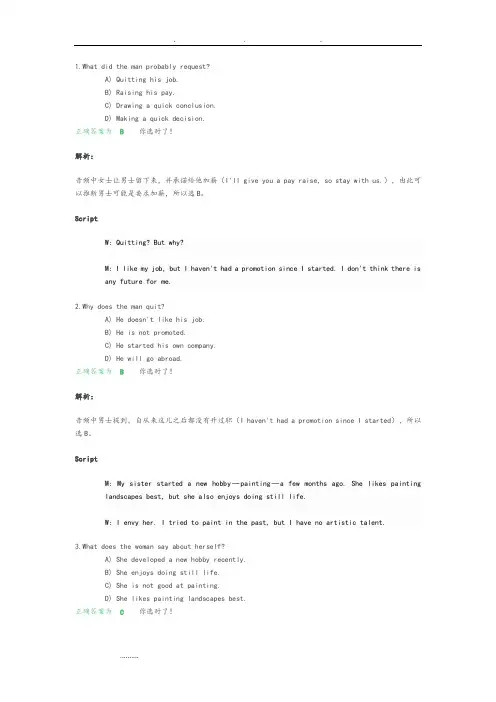
1.What did the man probably request?A) Quitting his job.B) Raising his pay.C) Drawing a quick conclusion.D) Making a quick decision.正确答案为B你选对了!解析:音频中女士让男士留下来,并承诺给他加薪(I'll give you a pay raise, so stay with us.),由此可以推断男士可能是要求加薪,所以选B。
ScriptW: Quitting? But why?M: I like my job, but I haven't had a promotion since I started. I don't think there is any future for me.2.Why does the man quit?A) He doesn't like his job.B) He is not promoted.C) He started his own company.D) He will go abroad.正确答案为B你选对了!解析:音频中男士提到,自从来这儿之后都没有升过职(I haven't had a promotion since I started),所以选B。
ScriptM: My sister started a new hobby—painting—a few months ago. She likes painting landscapes best, but she also enjoys doing still life.W: I envy her. I tried to paint in the past, but I have no artistic talent.3.What does the woman say about herself?A) She developed a new hobby recently.B) She enjoys doing still life.C) She is not good at painting.D) She likes painting landscapes best.正确答案为C你选对了!解析:音频中女士说自己没有绘画天分(I have no artistic talent),可以推断出她不擅长绘画,所以选C。
2023年大学_大学英语四、六级考试新题型调整的说明
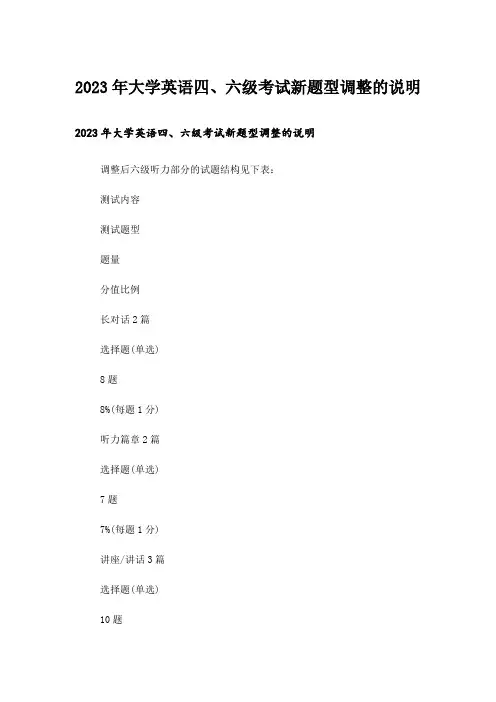
2023年大学英语四、六级考试新题型调整的说明2023年大学英语四、六级考试新题型调整的说明调整后六级听力部分的试题结构见下表:测试内容测试题型题量分值比例长对话2篇选择题(单选)8题8%(每题1分)听力篇章2篇选择题(单选)7题7%(每题1分)讲座/讲话3篇选择题(单选)10题20%(每题2分)1、六级听力之不变原来的长对话题型不变,依然是2篇。
但题目数量由7道题增至8题,依然每题1分;篇章听力题型不变,但题目数量由原来的3篇共10道题减少至2篇共7题,每题1分。
题型及难度没有变化,考生可参考旧题。
2、六级听力之变化短对话取消,听写取消。
增加讲座/讲话题型3篇共10道题,每题2分,是六级听力考试乃至全卷的关键。
下面我们就来详细解析一下新题型:Now listen to the following recording and answer questions 16 to 19.16. A) They investigate the retirement homes in America.B) They are on issues facing senior citizens in America.C) They describe the great pleasures of the golden years.D) They are filled with fond memories of his grandparents.17. A) The loss of the ability to take care of himself.B) The feeling of not being important any more.C) Being unable to find a good retirement home.D) Leaving the home he had lived in for 60 years.18. A) The loss of identity and self-worth.B) Fear of being replaced or discarded.C) Freedom from pressure and worldly cares.D) The possession of wealth and high respect.19. A) The urgency of pension reform.B) Medical care for senior citizens.C) Finding meaningful roles for the elderly in society.D) The development of public facilities for senior citizens.原文:Moderator:Hello Ladies and Gentleman, it gives me great pleasure to introduce our keynote speaker for todays session, Dr. Howard Miller. Dr. Miller, Professor of Sociology at Washington University, has written numerous articles and books on the issues facing older Americans in our graying society for the past 15 years. Dr. Miller:Dr. Miller: Thank you for that introduction. Today, Id like to preface my remarks with a story from my own life which I feel highlights the common concerns that bring us here together. Several years ago when my grandparents were well into their eighties, they were faced with the reality of no longer being able to adequately care for themselves. My grandfather spoke of his greatest fear, that of leaving the only home they had known for the past 60 years. Fighting back the tears, he spoke proudly of the fact that he had built their home from the ground up, and that he had pounded every nail and laid every brick in the process. The prospect of having to sell their home and give up their independence, and move into a retirement home was an extremely painful experience for them. It was,in my grandfathers own words, like having a limb cut off. He exclaimed in a forceful manner that he felt he wasnt important anymore.For them and some older Americans, their so-called “golden years”are at times not so pleasant, for this period can mean the decline of not only ones health but the loss of identity and self-worth. In many societies, this self-identity is closely related with our social status, occupation, material possessions, or independence. Furthermore, we often live in societies that value what is “new” or in fashion, and our own usage of words in the English language is often a sign of bad news for older Americans. I mean how would your family react if you came home tonight exclaiming, “Hey, come to the living room and see the OLD black and white TV I brought!” Unfortunately, the word “old” calls to mind images of the need to replace or discard.Now, many of the lectures given at this conference have focused on the issues of pension reform, medical care, and the development of public facilities for senior citizens. And while these are vital issues that must be addressed, Id like to focus my comments on an important issue that will affect the overall success of the other programs mentioned. This has to do with changing our perspectives on what it means to be a part of this group, and finding meaningful roles the elderly can play and should play in our societies.First of all, Id like to talk about . . .16. What does the introduction say about Dr. Howard Millers articles and books?17. What is the greatest fear of Dr. Millers grandfather?18. What does Dr. Miller say the “golden years” can often mean?19. What is the focus of Dr. Millers speech?解:这是一篇关于老龄化社会,老年人的晚年生活等问题的演讲。
2023四级题型

2023四级题型
2023年四级考试的题型通常包括以下几种:
1. 听力理解:听取对话或短文后回答问题。
可能涉及日常生活、校园生活、社会活动等各个方面。
2. 阅读理解:阅读一篇短文后回答相关问题,也可能涉及填空、匹配等形式的题目。
文章主要以英语课本中的文章为主题,内容涵盖科技、教育、环境、旅游等多个领域。
3. 完形填空:阅读一篇文章,在文中有若干个空白处,需要从给出的选项中选择最佳答案来填写空白处,使整篇文章逻辑通顺。
4. 语法和词汇:测试考生对英语语法和词汇的掌握程度,如语法错误改正、词义辨析等题目。
5. 写作:写一篇短文,通常包括图表描述、观点阐述等类型的题目。
请注意,以上仅是一般情况下的四级考试题型,具体的
题型可能会根据考试形式和大纲的变化而有所调整。
建议你在备考过程中参考最新的官方考试大纲和真题,以获得更准确的信息和指导。
cet4英语四级新题型
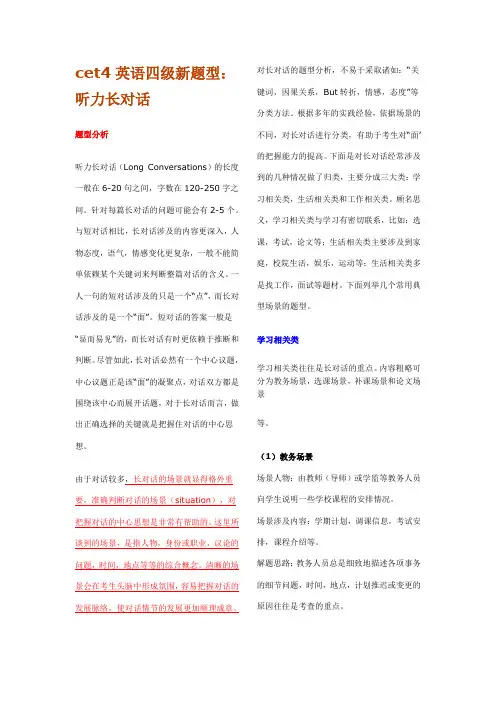
cet4英语四级新题型:听力长对话题型分析听力长对话(Long Conversations)的长度一般在6-20句之间,字数在120-250字之间。
针对每篇长对话的问题可能会有2-5个。
与短对话相比,长对话涉及的内容更深入,人物态度,语气,情感变化更复杂,一般不能简单依赖某个关键词来判断整篇对话的含义。
一人一句的短对话涉及的只是一个“点”,而长对话涉及的是一个“面”。
短对话的答案一般是“显而易见”的,而长对话有时更依赖于推断和判断。
尽管如此,长对话必然有一个中心议题,中心议题正是该“面”的凝聚点,对话双方都是围绕该中心而展开话题,对于长对话而言,做出正确选择的关键就是把握住对话的中心思想。
由于对话较多,长对话的场景就显得格外重要,准确判断对话的场景(situation),对把握对话的中心思想是非常有帮助的。
这里所谈到的场景,是指人物,身份或职业,议论的问题,时间,地点等等的综合概念。
清晰的场景会在考生头脑中形成氛围,容易把握对话的发展脉络,使对话情节的发展更加顺理成章。
对长对话的题型分析,不易于采取诸如:“关键词,因果关系,But转折,情感,态度”等分类方法。
根据多年的实践经验,依据场景的不同,对长对话进行分类,有助于考生对“面’的把握能力的提高。
下面是对长对话经常涉及到的几种情况做了归类,主要分成三大类:学习相关类,生活相关类和工作相关类。
顾名思义,学习相关类与学习有密切联系,比如:选课,考试,论文等;生活相关类主要涉及到家庭,校院生活,娱乐,运动等;生活相关类多是找工作,面试等题材。
下面列举几个常用典型场景的题型。
学习相关类学习相关类往往是长对话的重点。
内容粗略可分为教务场景,选课场景,补课场景和论文场景等。
(1)教务场景场景人物:由教师(导师)或学监等教务人员向学生说明一些学校课程的安排情况。
场景涉及内容:学期计划,调课信息,考试安排,课程介绍等。
解题思路:教务人员总是细致地描述各项事务的细节问题,时间,地点,计划推迟或变更的原因往往是考查的重点。
大学英语四级新题型考试指南答案

大学英语四级新题型考试指南答案全文共3篇示例,供读者参考篇1Guide to New Types of Questions in College English Test Band 4IntroductionThe College English Test Band 4 (CET-4) is a standardized English proficiency test in China. It is widely used as a requirement for graduation and employment. In recent years, the test has undergone some changes in its format, including the introduction of new types of questions. This guide aims to provide examinees with an overview of these new question types and some strategies to tackle them effectively.New Types of Questions1. Multiple-choice questions with more than one correct answer: In these questions, examinees are required to select all the correct answers from a list of options. This type of question tests not only the examinee’s understanding of the content but also their ability to distinguish between correct and incorrect information.2. Sentence completion questions: These questions require examinees to complete a sentence with an appropriate word or phrase. Examinees should pay attention to the context of the sentence and choose the most suitable option that fits the meaning.3. Reading comprehension questions with multiple answers: Instead of selecting one correct answer, examinees are required to choose more than one answer that best matches the information presented in the text. This type of question assesses the examin ee’s ability to comprehend and analyze information.4. Short answer questions: Examinees are asked to provide brief responses to questions based on the reading passage. This type of question requires examinees to demonstrate their understanding of the text and their ability to articulate their thoughts concisely.5. Matching questions: In these questions, examinees are required to match items from two columns based on their relationships or similarities. Examinees should carefully consider the connections between the items before making their choices.Strategies for Tackling New Types of Questions1. Read the instructions carefully: Make sure to read the instructions for each question type thoroughly to understand what is expected of you. Pay attention to the number of correct answers required and the format of the response.2. Skim the text: Before answering the questions, take a few minutes to skim through the reading passage to get an overview of the content. This will help you identify key information and main ideas that will guide your answers.3. Eliminate wrong choices: If you are unsure about a question, try to eliminate the options that are clearly incorrect. This will increase your chances of selecting the correct answer from the remaining choices.4. Use context clues: When completing sentences or answering questions, use context clues from the text to guide your choice of words or phrases. Pay attention to the surrounding text to determine the most suitable answer.5. Practice regularly: Familiarize yourself with the new question types by practicing sample questions and past papers. This will help you become more comfortable with the format and improve your performance on test day.ConclusionThe introduction of new types of questions in the CET-4 test requires examinees to adapt their test-taking strategies accordingly. By familiarizing themselves with the new question types and practicing regularly, examinees can enhance their performance and achieve better results. Remember to approach each question with a clear understanding of the instructions and use effective strategies to tackle them confidently. Good luck with your preparation for the CET-4 test!篇2College English Core 4 New Question Type Exam Guide and AnswersWith the continuous development and innovation in education, the College English Core 4 (CET-4) exam has also introduced new question types to better assess students' English proficiency. In this guide, we will discuss the new question types that you may encounter in the CET-4 exam, and provide sample answers to help you better prepare for the test.1. Multiple-choice ClozeIn the multiple-choice cloze question, you will be presented with a passage where several words are missing. Your task is to choose the correct word from the given options to fill in theblanks. To excel in this question type, pay attention to the context and the overall meaning of the passage. Here is a sample question:Example:In today's fast-paced world, it is important to ___________ stress and find ways to relax.A) induceB) reduceC) increaseD) maintainAnswer: B) reduce2. Reading Comprehension with Multiple QuestionsThis question type requires you to read a passage and answer multiple questions based on the information in the passage. Make sure to carefully read the questions before reading the passage to have a better understanding of what to look for. Here is a sample question:Example:According to the passage, what is the main cause of global warming?A) DeforestationB) Industrial pollutionC) Greenhouse gasesD) Ozone depletionAnswer: C) Greenhouse gases3. Sentence TransformationIn this question type, you will be given a sentence with a specific instruction on how to rewrite it. You must maintain the original meaning of the sentence while using the given word or phrase. Practice different sentence structures to excel in this question type. Here is a sample question:Example:The teacher asked the students to finish their homework by Friday.Transform the sentence using "have".Answer: The teacher insisted that the students have their homework finished by Friday.4. Error RecognitionIn the error recognition question, you will be presented with a sentence where one part contains an error. Your task is to identify the error and choose the correct option to correct it. Pay attention to grammar, spelling, and punctuation errors. Here is a sample question:Example:I have visit my grandparents last weekend.A) have visitB) myC) lastD) visitedAnswer: C) last5. Short Answer QuestionsIn this question type, you will be asked to provide a short answer to a question based on the information provided in the passage. Make sure to be concise and directly address the question. Here is a sample question:Example:What are the benefits of regular exercise?Answer: Regular exercise improves physical health, reduces stress, and boosts mood.By familiarizing yourself with these new question types and practicing with sample questions, you can better prepare for the CET-4 exam. Remember to manage your time effectively during the exam and stay calm and focused. Good luck!(Note: The sample questions and answers provided in this guide are for illustrative purposes only and may not reflect actual questions in the CET-4 exam.)篇3College English Test Band Four (CET-4) is one of the most important English proficiency exams in China. The test is widely recognized by universities and employers across the country. In recent years, a new test format has been introduced to better assess students' English skills. In this guide, we will discuss the new test format and provide answers to some commonly asked questions.The new test format for CET-4 consists of four sections: Listening, Reading, Writing, and Translation. Each sectionassesses different aspects of the test-taker's English proficiency. Here is a brief overview of each section:1. Listening: This section contains a series of recorded conversations, monologues, and lectures. Test-takers are required to listen carefully and answer multiple-choice questions based on the audio clips. This section tests the student's listening comprehension skills.2. Reading: In this section, test-takers are presented with a series of reading passages, including short articles, essays, and news reports. They must read the passages carefully and answer multiple-choice questions to test their reading comprehension skills.3. Writing: This section requires test-takers to write two short essays on given topics. They must demonstrate their ability to express ideas clearly and coherently, as well as their proficiency in grammar and vocabulary.4. Translation: In this section, test-takers are required to translate a short English passage into Chinese. This section tests the student's translation skills and their understanding of both languages.Now let's move on to some commonly asked questions about the new test format:Q: How should I prepare for the Listening section?A: To prepare for the Listening section, you should practice listening to English audio clips regularly. You can watch English movies, listen to English podcasts, and take online listening comprehension tests to improve your listening skills.Q: What can I do to improve my reading comprehension skills?A: To improve your reading comprehension skills, you should read English articles, books, and news reports regularly. Make note of new words and phrases that you encounter, and practice summarizing the main ideas of each passage.Q: How can I improve my writing skills for the Writing section?A: To improve your writing skills, you should practice writing essays on a variety of topics. Focus on organizing your ideas logically, using proper grammar and vocabulary, and supporting your arguments with examples and evidence.Q: How can I prepare for the Translation section?A: To prepare for the Translation section, you should practice translating English passages into Chinese and vice versa. Focus on maintaining the original meaning of the text while also using accurate grammar and vocabulary.In conclusion, the new test format for CET-4 is designed to better assess students' English skills and provide a more comprehensive evaluation of their proficiency. By following the tips and strategies outlined in this guide, you can improve your performance on the exam and achieve a high score. Good luck!。
大学英语四级新题型讲解

大学英语四级新题型讲解:总述:新样题的考试内容将包括写作(及翻译)、快速阅读及仔细阅读、听力、综合测试(完型填空或改错)等大四部分。
考试各部分测试内容、题型和所占比例如下表所示:需要提醒考生注意的是,新题型考试的整个过程也作了相应调整。
写作30分钟快速阅读15分钟听力35分钟仔细阅读25分钟完型填空15分钟翻译(汉译英)5分钟整个考试时间共长125分钟。
1)写作部分:包括短文写作(15%)和句子汉译英(5%),所占比重20%,占总分710分的142分。
根据考试大纲,题裁可能会涉及记叙文、说明文、议论文、应用文等,但是从近几年的考试特点来看,多种题裁的结合,尤其是应用文等形式的写作应该是考试的重点方向。
从过去几年的作文内容和新增设翻译(汉译英)部分来看,都充分体现了“侧重考查考生实际英语运用能力”,可以肯定地说,曾经一度流行的“三段论”模式不会再频繁出现。
2)听力部分:题量和比例,增加快速阅读理解测试大大增加,考试时间长度增加了15分钟(旧题型约为20分钟),占249分,充分体现了新教学大纲规定的“听读并重”的原则。
旧题型短对话8题,内容与难度与老题型相当。
新题型长对话2篇长对话,共7个问题。
旧题型短文听力:包括3篇短文多项选择题和一篇复合式听力(compound dictation)。
3)阅读部分:新四级在测试阅读能力方面手段丰富,主要表现在提醒的多样化,这就对考生的阅读能力提出了更高的要求。
这个部分不仅考查理解能力、快速阅读技巧、篇章综合把握能力。
一句话,难度大大提高,充分体现了考试大纲中所说的:阅读和运用想结合的特点。
内容包括:仔细阅读部分(careful reading)占25%。
这个部分由两个部分组成:旧题型多项选择题:从过去的4篇改为2篇。
新题型选词填空为:从一篇220字左右的文章中,留出10个单词的空格,从给出的15个备选单词中选出10个填入文章相应处,使文章意思通顺,表达正确。
这部分主要考察考生对词汇的认知和语法的理解。
英语四级新题型变化
变化一:听力比重提高 听力篇增加长对话淡化答题技巧
新题型中,听力的比重由20%上升到35%,阅读理解比重由40%下降到35%。所 以我个人认为,以前在四、六级考试中被公认的“得阅读者得天下”应改为“得 听力者得天下,得阅读者守天下”。
听力总共分为三个部分: 第一部分由八个小对话和两个长对话组成; 第二部分是三篇小文章; 第三部分为复合式听写。
• 即按照写作、快速阅读理解、听力理解、仔细阅 测试时间的长度也从原来的20分钟增加到了35分钟。
三篇(共10题,每篇3到4题,分值比例10%) 加快答题速度加强针对训练
读理解、完形填空和翻译的顺序进行测试。 4.写作可采用中英文互译法提高英语基本表达能力。
坚持每天听半小时英语,临考前增加听力练习时间。
• 考试流程变化(1):
• 熟悉规则这是成功的第一步,希望以下内容能够引起大家足够的重视! • 考试从9:10开始,首先做写作题,9:40结束,同时开始做快速阅读题。
三篇(共10题, 每篇3到4题,分 值比例10%)
部
分 第三部分 7个词汇听写 复合式听写 (7×1分) 3个句子听写
(3×1分)
8个小对话 2个长对话
三篇(共10题, 每篇3到4题,分 值比例10%)
8个词汇听写 (8×0.5分) 3个句子听写 (3×2分)
长对话出题模式类似于现行 托福考试中听力Part B,每 篇3至4题,共7题,分值比 例7% 保持不变
变化一:听力比重提高
听力篇增加长对话淡化答题技巧
新四级试题中看选项就能直接得出正确答案的题目越来越少。
从总题分型 比上例• 看不,变写增,加但作了是长句部对子话听。写分比重分分值数增大 占全卷的15%,新四级在对考生的
大学英语四级新题型新闻听力分析及策略探究
大学英语四级新题型新闻听力分析及策略探究2022年起,大学英语四级听力考试将加入新的题型——新闻听力。
这一改动不仅增加了听力难度,也提高了听力考试的实用性。
下面分析一下新闻听力的特点和考试策略。
一、新闻听力的特点1. 文体特点新闻听力的文体特点是新闻文体,一般包含以下内容:标题、导语、正文、后续报道、分析评论等。
听到新闻题材时需要抓住关键信息,构建对文章整体的理解。
2. 语言特点新闻语言通常精炼简洁,紧凑有力,表达清晰。
但是在报道不同主题的新闻时,语言难度也会存在差异,有些新闻语言难度会更高。
3. 速度特点新闻听力的速度相对较快,特别是在报道重要事件时,记者会尽量缩短语言,让信息尽快被听众掌握。
因此,用好听力缩写技巧是非常重要的。
二、新闻听力的考试策略1. 有意识地回顾新闻概要和问题在听新闻前,花一两分钟的时间读一下新闻标题、导语和问题,全面了解新闻的大致概况和考察焦点,能够很好地帮助建立一些必要的预期,提高理解能力和对信息的把握度。
2. 放慢听力速度新闻听力考试过程中,通常需要以较快的速度准确地听取新闻以获取重要的信息。
但是考虑到新闻的语言、难度、速度、气氛、情感等因素的影响,我们需要适当放慢自己的速度,便于更好更快地理解新闻内容,减少遗漏信息的可能性。
3. 重复信息在新闻听力中,重复的信息相对较多,因此应该尽可能利用这些信息来获取整个新闻的信息,特别是那些经常出现在新闻中的关键短语或词语,有助于加强记忆,易感性信息须特别重视。
4. 抓关键词结合新闻题目或问题,有意识地听取与问题相关或重要的单词并牢记,这些关键词通常能够帮助我们理解新闻或完成问题。
5. 分析结构和逻辑关系重要的新闻常常有结构或逻辑顺序的关联,因此通过分析文章的结构和逻辑关系,会帮助理解新闻,并在答题时更好的把握文章的主旨,准确回答问题。
1. 搜集大量新闻听力材料,并适当分时段进行调整,提高听力理解的能力。
2. 对于新闻听力难度较大的文章,可以结合其所涉及的话题和领域进行补充和拓展,加深对相关知识的了解和理解。
2023年8月英语专业四级改革样卷新题型
2023年8月英语专业四级改革新题型(样卷)PART 1 DICTATION [10 MIN]Listen to the following passage. Altogether the passage will be read to you four times. During the first reading, which will be done at normal speed, listen and try to understand the meaning. For the second and third readings, the passage will be read sentence by sentence, or phrase by phrase, with intervals of 15 seconds. The last reading will be done at normal speed again and during this time you should check your work. You will then be given 1 minute to check through your work once more.Please write the whole passage on ANSWER SHEET ONE.PART II LISTENING COMPREHENSION [20 MIN]SECTION A TALKIn this section you will hear a talk. You will hear the talk ONCE ONLY. While listening, you may look at ANSWER SHEET ONE and write NO MORE THAN THREE WORDS for each gap. Make sure the word(s) you fill in is (are) both grammatically and semantically acceptable. You may use the blank sheet for note-taking.You have THIRTY seconds to preview the gap-filling task.Now listen to the talk. When it is over, you will be given TWO minutes to complete your work.SECTION B CONVERSATIONSIn this section you will hear two conversations. At the end of each conversation, five questions will be asked about what was said. Both the conversation and the questions will be spoken ONCE ONLY. After each question there will be a ten-second pause. During the pause, youshould read the four choices of A, B, C and D, and mark the best answer to each question on ANSWER SHEET TWO.You have thirty seconds to preview the questions.Now, listen to the conversations.Conversation One.1. A. The return trip is too expensive.B . There is no technology to get people back.C. People don’t want to return.D. The return trip is too risky.2. A. Intelligence.B. Health.C. Skills.D. Calmness.3. A. The kind of people suitable for the trip.B. Interests and hobbies of the speakers.C. Recruitment of people for the trip.D. Preparation for the trip to Mars.…Conversation Two6. A. Going to the high street. B. Visiting everyday shops.C. Buying things like electrical goods.D. Visiting shops and buying online.7. A. 3%. B. 33%.C. 42%.D. 24%.8. A. They want to know more about pricing.B. They can return the product later.C. They want to see the real thing first.D. They can bargain for a lower shop price.…PART III LANGUAGE KNOWLEDGEThere are twenty sentences in this section. Beneath each sentence there are four words, phrases or statements marked A, B, C and D. Choose one word, phrase or statement that best completes the sentence.Mark your answers on ANSWER SHEET TWO.11.When you have finished with that book, don’t forget to put it back on the shelf, ______?A. don’t youB. do youC. will youD. won’t you12.Which of the following statements is INCORRECT?A. Only one out of six were present at the meeting.B. Ten dollars was stolen from the cash register.C. Either my sister or my brother is coming.D. Five miles seem like a long walk to me.13.It is not so much the language ______ the cultural background that makes the film difficult tounderstand.A. butB. norC. likeD. as14.There is no doubt ______ the committee has made the right decision on the housing project.A. whyB. thatC. whetherD. when15.If you explained the situation to your lawyer, he ______ able to advise you much better than Ican.A. will beB. wasC. would beD. were16.Which of the following is a stative verb (静态动词)?A. Drink.B. Close.C. Rain.D. Belong.17.Which of the following italicized parts indicates a subject-verb relation?A. The man has a large family to support.B. She had no wish to quarrel with her brother.C. He was the last guest to leave.D. Mary needs a friend to talk to.18.Which of the following is INCORRECT?A. Another two girls.B. Few words.C. This work.D. A bit of flowers.19.When one has good health, ______ should feel fortunate.A. youB. sheC. heD. we20.There ______ nothing more for discussion, the meeting came to an end half an hour earlier.A. to beB. to have beenC. beD. being21.Bottles from this region sell ______ at about $50 a case.A. entirelyB. totallyC. wholesaleD. together22.The product contains no ______ colours, flavours, or preservatives.A. fakeB. artificialC. falseD. wrong23.______ and business leaders were delighted at the decision to hold the national motor fair inthe city.A. CivilB. CivilizedC. CivilianD. Civic24.The city council is planning a huge road-building programme to ease congestion. Theunderlined part means ______.A. calmB. relieveC. comfortD. still25.His unfortunate appearance was offset by an attractive personality. The underlines part meansall the following EXCEPT ______.A. improvedB. made up forC. balancedD. compensated for26.The doctor said that the gash in his cheek required ten stitches. The underlined part means______.A.B.C.D.27.During the economic crisis, they had to cut back production and ______ workers.A. lay offB. lay intoC. lay downD. lay aside28.To mark its one hundredth anniversary, the university held a series of activities includingconferences, film shows, etc. The underlined part means ______.A. signifyB. celebrateC. symbolizeD. suggest29.His fertile mind keeps turning out new ideas. The underlined part means ______.A. abundantB. unbelievableC. productiveD. generative30.These issues were discussed at length during the meeting. The underlined part means ______.A. eventuallyB. subsequentlyC. lastlyD. fullyPART IV CLOZE [10 MIN]Decide which of the words given in the box below would best complete the passage if inserted in the corresponding blanks. The words can be used ONCE ONLY. Mark the letter for each word on ANSWER SHEET TWO.A. asB. aimlessC. botherD. fastE. flightsF. helplessG. labor-savingH. levels I. money-saving J. pause K. quite L. stand by M. standstillN. traffic O. trappedElectricity is such a part of our everyday lives and so much taken for granted nowadays that we rarely think twice when we switch on the light or turn on the TV set. At night, roads are brightly lit, enabling people and (31) ______ to move freely. Neon lighting used in advertising has become part of the character of every modern city. In the home, many (32) ______ devices are powered by electricity. Even when we turn off the bedside lamp and are (33) ______ asleep, electricity is still working for us, driving our refrigerators, heating our water, or keeping our rooms air-conditioned. Every day, trains and subways take us to and from work. We rarely (34) ______ to consider why or how they run—until something goes wrong.In the summer of 1959, something did go wrong with power-plant that provided New York with electricity. For a great many hours, life came almost to a (35) ______. Trains refused to move and the people in them sat in the dark, powerless to do anything; lifts stopped working, so that even if you were lucky enough not to be (36) ______ between two floors, you had the unpleasant task of finding your way down (37) ______of stairs.Famous streets like Broadway and Fifth Avenue in an instant becameas gloomy and uninviting (38) ______ the most remote back streets. People were afraid to leave their houses, for although the police had been ordered to (39) ______ in case of emergency. they were just as confused and (40) ______ as anybody else.PART V READING COMPREHENSION [35 MIN]SECTION A MULTIPLE-CHOICE QUESTIONSIn this section there are several passages followed by ten multiple-choice questions. For each question, there are four suggested answers marked A, B, C and D. Choose the one that you think is the best answer and mark your answers on ANSWER SHEET TWO.PASSAGE ONEInundated by more information than we can possibly hold in our heads, we’re increasingly handing off the job of remembering to search engines and smart phones. Google is even reportedly working on eyeglasses that could one day recognize faces and supply details about whoever you’re looking at. But new research shows that outsourcing our memory –and expecting that information will be continually and instantaneously available – is changing our cognitive habits. Research conducted by Betsy Sparrow, an assistant professor of psychology at Columbia University, has identified three new realities about how we process information in the Internet age. First, her experiments showed that when we don’t know the answer to a question, we now think about where we can find the nearest Web connection instead of the subject of the question itself. A second revelation is that when we expect to be able to find in formation again later on, we don’t remember it as well as when we think it might become unavailable. And then there is the researchers’ final observation: the expectation that we’ll he able to locate information down the line leads us to form a memory not of the fact itself but of where we’ll be able to find it.But this handoff comes with a downside. Skills like critical thinking and analysis must develop in the context of facts: we need something to think and reason about, after all. And these factsc an’t be Googled as we go; they need to be stored in the original hard drive, our long-term memory. Especially in the case of children, “factual knowledge must precede skill,” says Daniel Willingham, a professor of psychology, at the University of Virginia – meaning that the days of drilling the multiplication table and memorizing the names of the Presidents aren’t over quite yet. Adults, too, need to recruit a supply of stored knowledge in order to situate and evaluate new information they encounter. You ca n’t Google context.Last, there’s the possibility, increasingly terrifying to contemplate, that our machines will fail us. As Sparrow puts it, “The experience of losing our Internet connection becomes more and more like losing a friend.” If you’re going to keep your memory on your smart phone, better make sure it’s fully charged.41. Google’s eyeglasses are supposed to ____.A. improve our memoryB. function like memoryC. help us see faces betterD. work like smart phones42. Which of the following statements about Sparrow’s research is CORRECT?A. We remember people and things as much as before.B. We remember more Internet connections than before.C. We pay equal attention to location and content of information.D. We tend to remember location rather than the core of facts.43. What is the implied message of the author?A. Web connections aid our memory.B. People differ in what to remember.C. People keep memory on smart phones.D. People need to exercise their memory.PASSAGE TWOI was a second-year medical student at the university, and was on my second day of rounds at a nearby hospital. My university’s philosophy was to get students seeing patients early in their education. Nice idea, but it overlooked one detail: second-year students know next to nothing about medicine.Assigned to my team that day was an attending – a senior faculty member who was there mostly to make patients feel they weren’t in the hands of amateurs. Many attendings were researchers who didn’t have much recent hos pital experience. Mine was actually an arthritis specialist. Also along was a resident (the real boss, with a staggering mastery of medicine, at least to a rookie like myself). In addition there were two interns(住院实习医生). These guys were just as green as I was,but in a scarier way: they had recently graduated from the medical school, so they were technically MDs.I began the day at 6:30am. An intern and I did a quick check of our eight patients; later, we were to present our findings to the resident and then to the attending. I had three patients and the intern had the other five - piece of cake.But when I arrived in the room of 71-year-old Mr. Adams,he was sitting up in bed, sweating heavily and panting (喘气). He’d just had a hip operation and looked terrible. I listened to his lungs with my stethoscope, but they sounded clear. Next I checked the log of his vital signs and saw that his respiration and heart rate had been climbing, but his temperature was steady. It didn’t seem like heart failure, nor did it appear to be pneumonia. So I asked Mr. Adams what he thought was going on.“It’s really hot in here, Doc,” he replied.So I attributed his condition to the stuffy room and told him the rest of the team would return in a few hours. He smiled and feebly waved goodbye.At 8:40 am., during our team meeting, “Code Blue Room 307!” blared from the loudspeaker.I froze.That was Mr. Adams’s room.When we arrived, he was motionless.The autopsy (尸体解剖) later found Mr. Adams had suffered a massive pulmonary embolism (肺部栓塞). A blood clot had formed in his leg, worked its way to his lungs, and cut his breathing capacity in half. His symptoms had been textbook: heavy perspiration and shortness of breath despite clear lungs. The only thin g was: I hadn’t read that chapter in the textbook yet. And I was too scared, insecure, and proud to ask a real doctor for help.This mistake has haunted me for nearly 30 years, but what’s particularly frustrating is that the same medical education system persists. Who knows how many people have died or suffered harm at the hands of students as naïve as I, and how many more will?44. We learn that the author’s team members had _____.A. much practical experienceB. adequate knowledgeC. long been working thereD. some professional deficiency45. “His symptoms had been textbook” means that his symptoms were ______.A. part of the textbookB. no longer in the textbookC. recently included in the textbookD. explained in the textbook46. At the end of the passage, the author expresses ____ about the medical education systemA. optimismB. hesitationC. concernD. supportPASSAGE THREEThe war on smoking, now five decades old and counting, is one of the nation’s greatest public health success stories – but not for everyone.As a whole, the country has made amazing progress. In 1964, four in ten adults in the US smoked; today fewer than two in ten do. But some states – Kentucky, South Dakota and Alabama, to name just a few – seem to have missed the message that smoking is deadly.Their failure is the greatest disappointment in an effort to save lives that was started on Jan. 11, 1964, by the first Surgeon General’s Report on Smoking and Health. Its finding that smoking is a cause of lung cancer and other diseases was major news then. The hazards of smoking were just starting to emerge.The report led to cigarette warning labels, a ban on TV ads and eventually an anti-smoking movement that shifted the nation’s attitude on smoki ng. Then, smokers were cool. Today, many are outcasts, rejected by restaurants, bars, public buildings and even their own workplaces. Millions of lives have been saved.The formula for success is no longer guesswork: Adopt tough warning labels, air public service ads, fund smoking cessation programs and impose smoke-free laws. But the surest way to prevent smoking, particularly among price-sensitive teens, is to raise taxes. If you can stop them from smoking, you’ve won the war. Few people start smoking after turning 19.The real-life evidence of taxing power is powerful. The 10 states with the lowest adult smoking rates slap an average tax of $2.42 on every pack – three times the average tax in the states with the highest smoking rates.New York has the highest cigarette tax in the country, at $4.35 per pack, and just 12 percent of teens smoke, far below the national average of 18 percent. Compare that with Kentucky, where taxes are low (60 cents), smoking restrictions are weak and the teen smoking rate is double New York’s. Other low-tax states have similarly dismal records.Enemies of high tobacco taxes cling to the tired argument that they fall disproportionately on the poor. True, but so do the deadly effects of smoking – far worse than a tax. The effect of the taxes is amplified further when the revenue is used to fund initiatives that help smokers quit or persuade teens not to start.Anti-smoking forces have plenty to celebrate this week, having helped avoid 8 million premature deaths in the past 50 years. But as long as 3,000 adolescents and teens take their first puff each day, the war is not won.47. According to the context, “Their failure” refers to _____.A. those adults who continue to smokeB. those states that missed the messageC. findings of the reportD. hazards of smoking48. What is the passage mainly about?A. How to stage anti-smoking campaigns.B. The effects of the report on smoking and health.C. Tax as the surest path to cut smoking.D. The efforts to cut down on teenage smoking.PASSAGE FOURAttachment Parenting is not Indulgent Parenting. Attachment parents do not “spoil” their children. Spoiling is done when a child is given everything that they want regardless of what they need and regardless of what is practical. Indulgent parents give toys for tantrums(发脾气), ice cream for breakfast. Attachment parents don’t give their children everything that they want, they give their children everything that they need. Attachment parents believe that love and comfort are free and necessary. Not sweets or toys.Attachment Parenting is not “afraid of tears” parenting. Our kids cry. The difference is that we understand that tantrums and tears come from emotions and not manipulation. And our children understand this too. They cry and have tantrums sometimes, of course. But they do this because their emotions are so overwhelming that they need to get it out. They do not expect to be “rewarded” for their strong negative emotions; they simply expect that we will listen. We pick up our babies when they cry, and we respond to the tears of our older children because we believe firmly that comfort is free, love is free, and that when a child has need for comfort and love, it isour job to provide those things. We are not afraid of tears. We don’t avoid them. We hold our children through them and teach them that when they are hurt or frustrated we are here to comfort them and help them work through their emotions.Attachment Parenting is not Clingy Parenting. I do not cling to my children. In fact, I’m pretty free-range. As soon as they can move they usually move away from me and let me set up a chase as they crawl, run, skip and hop on their merry way to explore the world. Sure, I carry them and hug them and chase them and kiss them and rock them and sleep with them. But this is not me following them everywhere and pulling them back to me. This is me being a home base. The “attachment” comes from their being allowed to attach to us, not from us attaching to them like parental leeches.Attachment Parenting is not Selfish Parenting. It is also not selfless parenting. We are not doing it for us, and we are not doing it to torment ourselves,Attachment parenting is not Helicopter Parenting. I don’t hover. I supervise, I follow, I teach, I de monstrate, I explain. I don’t slap curious hands away, I show how to do things safely, I let my child do the things that my child wishes to do, first with help and then with supervision and finally with trust. I don’t insist that my 23 month old hold my ha nd when we walk on the sidewalk because I know that I can recall him with my voice because he trusts me to allow him to explore and he trusts me to explain when something is dangerous and to help him satisfy his curiosities safely.Most of the negative thi ngs that I hear about “attachment parents” are completely off-base and describe something that is entirely unlike Attachment Parenting. Attachment Parenting is child-centric and focuses on the needs of the child. Children need structure, rules, and boundaries. Attachment Parents simply believe that the child and the parent are allies, not adversaries, And that children are taught, not trained.49. According to the author, what should parents do when their kids cry?A. Providing comfort and love.B. Trying to stop kids crying.C. Holding them till they stop.D. Rewarding kids with toys.50. What does “free-range” mean according to the passage?A. Fond of providing a home base.B. Ready to play games with my kids.C. Curious to watch what games they play.D. Willing to give kids freedom of movement.SECTION B SHORT ANSWER QUESTIONSIn this section there are five short answer questions based on the passages in Section A. Answer the questions with NO more than TEN words in the space provided on ANSWER SHEET TWO.PASSAGE ONE51. According to the passage, what does “cognitive habits” refers to?PASSAGE TWO52. Why was the author doing rounds in a hospital?PASSAGE THREE53. What does “counting” mean in the context?54. What does the author think of raising tax on cigarettes?PASSAGE FOUR55. What does the passage mainly discuss?PART VI WRITING [45 MIN]Should we revive traditional Chinese characters or continue using simplified characters?This has been an intensely discussed question for years. The following are the supporters’and opponents’ opinions. Read carefully the opinions from both sides and write your response in about 200 words, in which you should first summarize briefly the opinions from both sides and give your view on the issue.Marks will be awarded for content relevance, content sufficiency, organization and language quality. Failure to follow the above instructions may result in a loss of marks.。
英语四级新题型分析
英语四级新题型分析
近年来,英语四级考试不断更新改革,引入了一些新题型,让考生
们备战考试时感到新鲜有趣。
本文将对英语四级新题型进行分析,帮
助考生更好地应对考试。
首先,值得注意的是阅读理解部分的变化。
在新题型中,阅读理解
不再只是简单地让考生理解文章内容,而是加入了一些推断、判断和
分析的要求。
考生需要通过文章理解作者的观点、态度等,进一步提
升阅读理解能力。
其次,听力部分也有了一些新的题型。
比如听力填空题,考生需要
根据听到的内容填写空缺处的单词或短语,这要求考生在听力过程中
能够快速捕捉信息,提高听力反应能力和准确度。
除此之外,写作部分也有了一些新题型。
比如翻译句子,考生不仅
需要准确翻译句子,还要对句子结构、语法等方面有一定的了解。
这
种题型旨在检验考生的语言功底和运用能力。
总的来说,英语四级新题型的引入旨在更全面地考察考生的英语能力,不仅要求考生具备良好的语言基础,还要求考生具备较强的分析、推断、应用能力。
因此,考生在备考过程中除了注重基础知识的积累,还要多做模拟题,熟悉新题型的要求,提高应试能力。
在这样一个竞争激烈的时代,英语成为了一门必备的基本能力。
通
过英语四级考试,不仅可以检验个人英语水平,还可以对学习过程进
行一次全面的检阅,提高自身的综合素质。
希望广大考生能够认真备考,真正掌握英语四级新题型,取得优异的成绩。