
人教版英语七下课件unit4-sectiona
话题四 谈论规则 1 相关词组(请大声朗读以下词汇,看谁读得更标准地 道) school rules, we must, we have to, we can, we can't, don't…please, it's very important, be late for class, eat in class, be on time, run in the hallways, wear the school uniform,be/keep quiet, listen to music, don't fight, in the library, in the dining hall, at home, in the classroom
(2)in time意为“及时”,指不迟到或在规定时间之前 或接近所规定的时间做某事。如: The ambulance arrives in time. 救护车及时到达。
【学以致用】 1. 根据汉语意思完成句子 ——妈妈,我必须今天完成作业吗? ——是的,你必须。/不,没有必要。
—Must I finish the homework today, Mom?
做某事”。 听见某人正在做某事,hear sb. do sth. 听见某人做了(常做)某 事。如:
(2)hear表示“听到”,强调听的结果。hear sb. doing sth.
Everyone is listening to the teacher carefully. 每
个人都在认真地听老师讲。
【讲解2】 on time 为固定短语,意为“准时;按时”。 如: We must arrive there on time. 我们必须按时到达 那里。
【辨析】on time 与 in time
(1)on time意为“按时;准时”,指按规定的时间或
指定的时间做某事。如:
The train arrives on time. 火车准时到达。
classroom clean.
—Oh, does everyone have to wear the school uniform? —Sure, we do.
B. 再将以上对话中的画线部分用其他的词汇或句子代替, 如用don't talk in class代替don't be late for class, be quiet代替be on time等,进行更多更有创意的问答练习(尽 量多运用你学过的相关词汇)。 3 情景说话
广东学导练
英语
七年级
下册
配人教(新目标)版
Unit 4
Don't eat in class.
Section A
课前预习
一、重点单词
1.
2.
rule
规则;规章
arrive 到达 hallway 走廊;过道 hall 大厅;礼堂
3.
4.
5.
6.
listen 听;倾听 fight 打架;战斗
7. 8.
其肯定回答为:Yes, 主语+ do/does; 否定回答为:No, 主语
+ don't/doesn't.
【讲解2】quiet是形容词,意为“安静的”,通常在句中作定语
修饰名词或在连系动词后面作表语。其反义词为noisy, 意为“
吵闹的”;其副词形式为quietly, 意为“安静地”。如:
Don't be noisy. You must be quiet. 不要吵。你必
Can you hear anything?你能听到什么吗?
【学以致用】 ( A ) 1. Jacky is singing. A. Listen!B. Hear! C. Listen toD. Listening
2. 我仔细听,但是什么也没有听到。(汉译英)
I listened carefully but heard nothing.
以下表格归纳了常见的图书馆规则和家规,除了表格中列
举的,你还能想到哪些规则呢?此外,在学校的餐厅、宿
舍有哪些规则呢?模仿表格下方的对话框架,先跟你的同
伴讨论,适当简要做笔记,然后报道给全班同学听。
Ask and answer like this: —What rules do we have in our school library? —We must take off our shoes before going inside. —Can we talk inside?
【3】Don't listen to music in class. 不要在上课时听音乐。
【知识点】listen to 的用法
【讲解】listen为不及物动词,其后接宾语时,要在宾语前
加介词to。listen to 意为“听;仔细听”,后接名词或代词作
宾语。如: Students should listen to the teachers carefully
—Yes, you. /No, you /h must . have to needn’t don’t
2. 用on time或in time填空 (1)Will you get home for dinner? in time (2)Please be. Be sure not to be late. on time
【讲解2】in class意为“在课堂上;上课时”。如: Don't talk loudly in class. 课堂上不要大声谈 论。
【拓展】after class意为“课后”,类似的表达还有:
after school放学后。如:
Let's talk about the singer after class. 让我
回答不用mustn’t,而要用needn‘t或don’t/doesn‘t have to。
如:
You must finish it today. 你今天一定要完成它。
—Must I come over tonight? 我今晚必须过来吗? —No,you needn't/don't have to. 不,你不必来。
sorry 抱歉的;难过的;惋惜的 outside adv. 在外面adj. 外面的 wear
9.
10. 11. 12. 13.
穿;戴
important 重要的
bring 带来;取来
unifrom 校服;制服 quiet 安静
二、重点短语 1. 准时 (be) on to class time
2. 不得不 have
【2】You must be on time. 你必须守时。
【知识点】must 的用法;on time 的用法
【讲解1】 must是情态动词,意为“必须;一定要”,后
面接动词原形,表示说话人的主观看法,即认为有责任或义
务去做某事,没有人称和数的变化。否定词mustn‘t是“禁
止;千万不要”的意思。由must引导的一般疑问句的否定
外向的). (根据句意及首字母提示完成单词 ) uiet
口语无忧
本单元的主要话题是谈论规则。没有规矩不能成方圆。 人是环境的产物,我们都需要在集体里生活,只要彼此和 谐相处才能与之共存。每一个集体都应该有规矩,否则人 人为所欲为就乱套了。在日常写作与中考中,这也是非常
常见的话题,所以同学们一定要把这个话题练习好。那么
【4】Don't fight. 不要打架。 【知识点】fight的用法 【讲解】fight为动词,意为“打架;争吵”。如: When the teacher came in, they were fighting. 当老师走进来时,他们正在打架。 【拓展】含fight的常见短语: fight for为……而战斗 fight against为反对……而战;与……做斗争 fight with与……打架、争吵 如:They are fighting for freedom. 他们在为自由而战。 We must fight against the enemy. 我们必须与敌人做斗 争。 Don't fight with him. 别跟他打架。
in class. 课堂上学生应该认真听老师讲。
【辨析】listen to 与 hear
(1)listen为不及物动词,后接宾语时,要加介词to,表示 听的动作,意为“(注意地)听;倾听”,常用于以下两种结构 中: ①listen to+名词或代词。
②listen to sb. do (doing) sth. 表示“听某人(正在)
们课后讨论那位歌手吧。
【学以致用】 ( D ) 1. on the grass, or it will “cry”. A. To walkB. Not to walk C. WalkD. Don't walk
2. 下次请不要迟到。(根据汉语意思完成句子)
Please late next time.be don’t
2
你问我答
A. 参考以上的相关词汇,跟你的伙伴一起谈谈班级的规则。 —Hi, I'm new in our class. Do we have rules in our class?
—Yes, we have a lot of rules.
—What are they? Tell me some of them, please. —OK. First, don't be late for class. This is very important. —I see. So we must be on time. Can we eat in class? —No, we can't. And we always have to keep our
人教版英语七下课件Unit_4_Don't_eat_in_class_Section_A新版义务教科书初一英语下册

3c.Makeupfivecoolrulesforyourdreamschool
.Shareyourruleswiththeclass.Yourclassmate svotefortheCoolestSchool!
1. Wecaneatinclass. 2. Wedon’thavetocometos
Whatelsedoyouhavetodo?
1.Don’tforgettoturnoffthelight whenyouleave. 2.Don’tdrawonthewall. 3.Don’twatchTVafterschool. 4.Don’tplayfootballinthestreet. 5.Youmustgetupearly. ……
• eatinclass • listentomusicoutside • wearhatsinschool • fightinclass • speakloudlyinthe library
GrammarFocus
Don’truninthehallways. Don’tfight.
Whataretherules?
Wecan’trulethecountrywithoutrules. 没有规章制度就不能治理好国家。
keeprules breakrules schoolrules classrules familyrules libraryrules diningrules
遵守规则 违反规则 校规 班规 家规 图书馆规则 就餐规则
Don’tlistentomusicintheclassroom.
点此播放动画视频
Don’truninthehallways.
Don’teatintheclassroom.
2019人教版七年级英语下册Unit4_Don't_eat_in_class课件PPT(年春)教育物理

Don’t talk in class.
Don’t talk with each other in class. Stop talking in class.
Don’t play cards in school.
Don’t smoke .It’s bad for your health.
Don’t sleep in class.
Don’t fight. We can’t fight with others.
Grammar
1. 祈使句是表示请求、命令、叮嘱、号召、 劝告等的句子; 通常省略主语you; 句中谓语 动词用动词原形; 句尾一般用降调; 祈使句的
开头是动词原形。
祈使句有肯定和否定两种: e.g. Look out! 小心!
Don’t wear hats in class. Don’t dance in the classroom.
Wear a uniform.
Don’t listen to music in the classroom.
Listen to music in the music room.
Homework
Can we eat in class? No, we can’t.
Don’t eat in the classroom.
arrive late for class Can we arrive late for class? No, we can’t.
Don’t arrive late for class.
• Think about the family rules.
FAMILY RULES
Don’t talk loudly on the phone.
人教版英语七年级下unit4SectionA1a--2d
We can’t_____
What else can’t we do at school?
•get up late. •play basketball in the classrooms. •talk to others in class. •ride a bike on campus •bring mobile phones to school. •break school things. …
Report
To make our school nicer, in our _____, we have to do following things: 1. Don’t_______________________________ 2. We can _____________________________ 3. We have to __________________________ But we don’t have to _____________________ we can’t _________________________, either. We should try to obey these rules and be a good student and make our school nicer!
Group work: Different places have different rules! Please make more rules to propose(倡议) students to help make our school nicer.
Class rules
dining hall rules
I think we should obey the school rules.
人教版初中英语七年级下册第14课时 《Unit 4 Section A 词汇学法指导课》 课件

核心 句型
We have to be quiet. You must be on time. We can’t eat in the classroom.
Do Chinese schools have so many rules?
William 威廉
William is a student from Eton College(伊顿公学).
••
Going to Eton College is a dream to many students. They have many school rules, but students all over the world dream to go there.
Eton College(伊顿公学) and its strict(严格的) rules
He is always unhappy because there are too many rules in his school.
[ruːl] 规则
Rules before class
What school rules do we have? arrive late for=be late for 迟到
Prepare paper sheet,pens, exercise book and notebook 准备好导学案、笔、练习本、笔记本等文具
Learning Objectives 学习目标
➢ 学习用祈使句表达校规的相关词汇及核心句型 ➢ 在情境中理解并学会借助固定搭配法、合成法、词缀
法、一词多义法科学记忆并扩充词汇量 ➢ 增强规则意识
hall way 走廊;过道 classroom 教室
举一反三:
词汇学法2:合成法
新版(人教版)七年级(下)英语Unit4课文详解
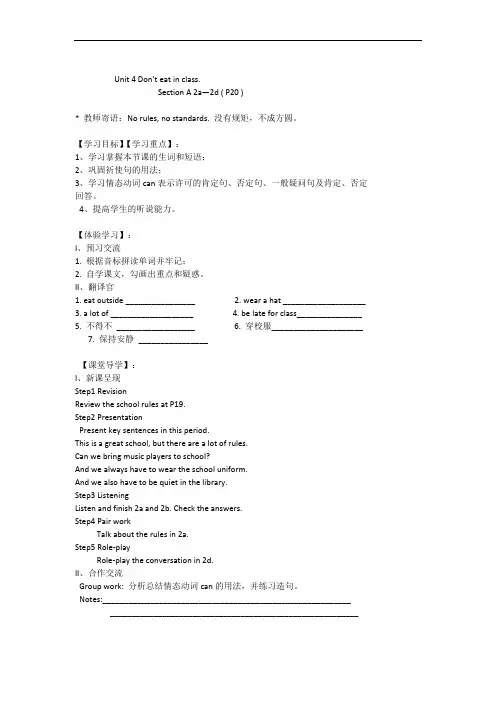
Unit 4 Don’t eat in class.Section A 2a—2d ( P20 )* 教师寄语:No rules, no standards. 没有规矩,不成方圆。
【学习目标】【学习重点】:1、学习掌握本节课的生词和短语;2、巩固祈使句的用法;3、学习情态动词can表示许可的肯定句、否定句、一般疑问句及肯定、否定回答。
4、提高学生的听说能力。
【体验学习】:I、预习交流1. 根据音标拼读单词并牢记;2. 自学课文,勾画出重点和疑惑。
II、翻译官1. eat outside ________________2. wear a hat ___________________3. a lot of ___________________4. be late for class_______________5. 不得不__________________6. 穿校服_____________________7. 保持安静________________【课堂导学】:I、新课呈现Step1 RevisionReview the school rules at P19.Step2 PresentationPresent key sentences in this period.This is a great school, but there are a lot of rules.Can we bring music players to school?And we always have to wear the school uniform.And we also have to be quiet in the library.Step3 ListeningListen and finish 2a and 2b. Check the answers.Step4 Pair workTalk about the rules in 2a.Step5 Role-playRole-play the conversation in 2d.II、合作交流Group work: 分析总结情态动词can的用法,并练习造句。
全国优质课一等奖人教新目标版英语七年级下册《Unit 4 SectionA 1a-2d》课件

What about Mike?
He's listening to music in class.
Hale Waihona Puke 1b Ask and answer.
5
Peter__2_____ Amy___3____Mike__4_____
3
4
Are Peter and Amy polite to the teacher?Why do you think so?
Unit4 Don't eat in class
Section A 1a-2d
What rules do you know?
No smoking!
No photos!
No eating! No drinking!
No walking!
No talking!
No fire!
No mobile phones!
No,we can't.
Yes,we can.
This rules says_“_D_o_n_'_t_e_a_t_i_n_t_h_e_c_l_a_s_sr_o_o_m__.Y__o_u_m__u_s_t_e_a_t_i_n_t_h_e_d__in_i_n_g_h_a_l_l_”.
Can we listen to music in class?
3
4
What rule is Peter breaking?
He's running in the hallway. What about Amy?Is it OK to eat in the classroom?
She's eating in the classroom.No,it isn't.
人教版英语七下 unit_4_SectionA&SectionB Don't eat in class
Selina
They’re fighting .
He is running in the hallways .
Grammar
祈使句 Example: 肯定祈使句
否定祈使句
Don’t sit down. Sit down. Don’t come in . Come in. Don’t eat at home. Eat at home. Listen to music outside. Don’t listen to music outside. 5. Do your homework at school. Don’t do your homework at school. 1. 2. 3. 4.
1.We can eat in class. 2. We don’t have to come to school every day. 3…….. At my dream school, we don’t have to come to school every day. we….
Translate them into English 1.看电视 watch TV 2.出去 go out 3.做作业 do one’s homework 4.看朋友 see friends 5.练吉他 practice the guitar 6.清洗餐具 do the dishes 7.帮助他的妈妈做早饭 help his mother make breakfast 8.打扫房间 clean the room 9.在上学的晚上 On school nights 10.在上学的日子 on school days 11.每个周六 every Saturday 12.晚饭后 after dinner
2021年人教版七年级英语下册Unit4 Section A-2优质课课件
3c Make up fschool. Share your rules with the class. Your classmates vote for the Coolest School!
We can walk out of the class anytime we want. We can wear what we want. We may have less homework and more free
Unit 4
Don’t eat in class.
Section A Period 2 (3a-3c)
Do you know the rules in these places?
hospital
meeting room
gas station
Look at the two girls. What are the differences between the two expressions?
I’m tired. I want to have a sit.
Can I sit here?
Yes, you can.
I don’t like school, but the rules let all of us go to school.
So I have to go to school.
3b Use the words to make questions about the rules. Then write answers according to your school.
Be quiet? Q: D__o_e_s_s_h_e_h_a_v_e__to__b_e_q__u_ie_t_i_n_t_h_e__li_b_r_a_r_y_?_ (she/have to/ in the library)? A: _Y_e_s_, _s_h_e_d_o_e_s_._______________________ Eat? Q: _D_o_e_s_h_e__h_a_v_e_t_o__ea_t__in__th__e_d_i_n_in_g__h_a_l_l?___ (he/have to/in the dining hall)? A: _Y_e_s_, _h_e_d_o_e_s_.________________________
人教7下Unit4SectionA(2d3c)教学设计
3.能够运用频率副词(always, usually, often, sometimes, rarely, never)描述日常活动的频率,如:She sometimes goes to the movies with her friends.
人教7下Unit4SectionA(2d3c)教学设计
一、教学目标
(一)知识与技能
在本章节的教学中,学生将通过学习人教版七年级下册Unit 4 Section A (2d-3c)的内容,掌握以下知识与技能:
1.能够听懂并准确说出与日常生活相关的动作短语,如:do homework, watch TV, play computer games等。
(2)教师提问,学生回答,巩固所学知识。
(3)布置课后作业,让学生在实践中继续巩固所学。
五、作业布置
针对本章节的教学内容,为了巩固学生对一般现在时和频率副词的理解与应用,特布置以下作业:
1.书面作业:
(1)完成课本练习册中与本节课相关的内容,强化对一般现在时和频率副词的掌握。
(2)运用一般现在时和频率副词,编写一段关于自己或家人日常活动的对话,要求不少于五句话。
1.增强学生对英语学习的兴趣和自信心,激发学生学习英语的内在动力。
2.培养学生的合作精神,让学生学会与他人共同完成任务,提高人际交往能力。
3.培养学生良好的学习习惯,如:认真听讲、积极参与、主动思考等。
4.培养学生对日常生活的观察和思考能力,使学生学会用英语表达自己的观点和感受。
5.增进学生对我国和其他国家文化差异的了解,培养学生的跨文化交际意识。
人教版初中英语七年级下册Unit4SectionA教材全解
人教版初中英语七年级下册Unit4SectionA教材全解Unit 4 Don’t eat in class.Unit 4 Section A教材全解1.Don’t arrive late for class.上课不要迟到.【重点注释】①这句是祈使句的否定形式(Don’t +行为动词原形+其他),用于表达命令、请求等.祈使句可以表达说话人的意愿、请求、叮嘱、号召、命令或建议,它的主语(听话人)通常省略,谓语动词用原形,句子末尾用感叹号或句号.例如:Don’t throw the ball like that。
不要那样扔球.②arrive late for与be late for同义,都表示“做某事迟到”.arrive late for侧重到达的时间晚,be late for侧重状态。
例如:Don’t arrive late for the meeting next time。
=Don't be late for the meeting next time.下次开会别迟到了。
③arrive不及物动词,意为“到达,抵达,来到”,不能直接跟名词作宾语,但可以接介词at或in,构成短语“arrive at/in+地点(at+小地方,arrive at the bus stop;in+大地方,arrive in Beijing)”,意为“到达……”;arrive后若是here,there,home 等地点副词,则不需要加in或at等介词(arrive here/there/home).例如:He arrives at the bus stop at 8 o’clock every morning。
他每天早晨8点到达公共汽车站.When did you arrive in Beijing?你什么时候到北京的?I arrive home at 4:00 in the afternoon.我下午4点钟到家。