
仁爱版英语八年级上册同步学案Unit3topic3SectionC+SectionD含答案
八上Unit3 Topic3 Section C What were you doing at this time yesterday? 学案Name:____________Section CThe little Match girl卖火柴的小女孩1. It was snowy and ________(黑暗的) on a new year’s Eve. 在一个又下雪又黑的除夕夜。
2. Many people were _______________________(团聚) in their warm homes. 很多人团聚在他们温暖的家里。
3. A poor little girl was ________(仍然) walking in the streets with no shoes. 一个可怜的小女孩仍然光着脚走在大街上。
4. There were some __________(match) in her hand. 她的手里有一些火柴。
★哭,喊,叫n.& v._________ [过去式__________] 低声地说____________________________5. “Matches, matches!” the little girl cried _____ a low voice. “卖火柴,卖火柴!”小女孩低声地哭诉着。
★听见,听到v._________ [过去式__________] pass by“经过”6. No one __________(hear) her when they were passing by. 路过的人们没有听到她的声音。
7. She didn’t __________(卖) any matches and no one gave her a __________(硬币).她一根火柴也没卖出去,也没有人给她一个硬币。
8. The wind blows ____________(strong). 风刮得很大/强烈。
9. The wind was blowing ____________(强烈地). 风呼呼地吹。
★fall down“坍塌,跌倒,落下”10. The snow was falling ______ on her hair. She was cold and _________(饥饿的).雪花飘落在她的头发上。
她又冷又饿。
11. Lights were ____________(shine) from every window. 每个窗户都透出光来了。
/灯光从每个窗户透出来。
★害怕的,恐怕adj.___________be afraid to do sth“害怕做某事”12. But the little girl was ____________(害怕的) to go home without __________(sell) one box of matches.但是没有卖出一盒火柴,小女孩不敢回家。
13.Because her father would ___________(打) her. 因为她的父亲会打她。
★warm up“暖和起来/热身”warm sb up“使某人暖和起来”14. “A burning match may warm ______(I) up.” she thought. “一根燃起来的火柴可能会让我暖和起来!”她想。
15. When the matches were ____________(burn), she saw a warm stove, a delicious roast goose and a beautiful Christmas tree. 当火柴正燃烧时,她看见了一个暖和的火炉、一个美味的烤鸭和一颗漂亮的圣诞树。
★消失,灭绝v._____________ 火焰n.___________ 出去,熄灭,过时(短语)____________________16. But all these ________________(消失) when the flames went out. 但是当火焰熄灭时,所有这一切都消失了。
17. “Grandmother!” cried the little girl, “Take me _______ you.”“奶奶!”小女孩哭着说:“带我走吧”。
18. Her grandmother __________(微笑) and held the girl in her arms. 她的奶奶笑着把她抱进了怀里。
★躺,躺下v._________ [动名词__________ ] 对抗,反对,靠着prep._____________ 死的,死亡的adj.__________19. ______ the morning of the new year, the girl was lying ____________(靠着) the wall, dead!20. When the cat knocked at the door, the mouse ________________________________.当猫敲门的时候,老鼠正在洗淋浴。
21. The mouse was ____________(饥饿的).★get out of...“从...出来”look for“寻找”22. When he got out of the bathroom to look for food, the cat ______________________(正在睡觉).★醒来,唤醒v.___________ [过去式___________ ] wake up“醒来,叫醒,唤醒”wake sb up“叫醒某人”23. When the cat _________________, the mouse was carrying his cat. 当猫醒来,老鼠正在搬运他的蛋糕。
24. The mouse and the cat chatted ____________(happy) while they were enjoying the moon.当老鼠和猫一起欣赏月亮时,他们聊得很开心。
参考答案1. dark2. getting together3. still4. matches★cry, cried, say in a low voice5. in★hear, heard6. heard7. sell, coin8. strongly9. strongly10. down, hungry11. shining★afraid12. afraid, selling13. hit14. me15. burning★disappear, flame, go out16. disappeared17. with18. smiled★lie, lying, against, dead19. On, against20. was taking a shower21. hungry22. was sleeping★wake, woke23. woke up24. happilySection DA short history of weekend周末简史1. Before 1800, many people ____________(花费) one day at church.在1800年以前,很多人们在教堂花一天的时间。
2. In England, people __________(称呼) it a “holy day”. 在英格兰,人们称它为“神圣的日子”。
3. _____ that day, they rested and prayed. 在那一天,他们休息和祈祷。
4.____________(然而), many workers played games and had fun on that day.然而,很多工人在那一天玩耍游戏,找乐子。
★“too...to...”意为“太...以至于不能...”5. You are too young to go to school. 你太小了,不能去上学。
6. They felt too ________(累) to work _____ Monday morning.在周一上午他们感觉很累,不能上班。
7. In the USA, workers called them “blue Mondays”. 在美国,工人们称之为“忧郁星期一”。
★回答问题__________________________ 解决问题______________________________ 8. To _________(解决) the problem of “blue Mondays”, the English made Saturday afternoon a holiday in 1874.为了解决“忧郁星期一”的问题,英国人在1874年把周六下午定为假日。
★stop to do sth停下来去做某事stop doing sth停止正在做的事9. At one o’clock, everyone stopped ____________(work). 在1点钟,所有人停止工作。
★the beginning of...“...的开始/开端”at the beginning of...“在...的开始/开端”10. This was the beginning of the idea of the _____________(周末) in England.这就是英格兰周末这一概念的开端。
11. By 1940, offices and ______________(工厂) in the USA were ___________(关闭的) all day on Saturdays.到了1940年,美国的办公室和工厂都在周六这一天全天停工。
12. And the _________________(两天的) weekend began. 两天的假期开始了。
参考答案1. spent2. called3. On4. However6. tired, on★answer the question, solve the problem8. solve9. working10. weekend11. factories, closed12. two-day。
Unit3Topic3SectionC(仁爱版八年级英语上册教案教学设计)
Unit3Topic3SectionC(仁爱版八年级英语上册教案教学设计)设计:谭莉审核:审批:学习目标:1.继续学习过去进行时。
2.了解周末的由来。
学习重点:目标1.学习疑点:目标1.学习方法:自主学习,合作探究。
课前准备1.19世纪早期_____________2.神圣的日子________________3.玩得高兴______________4.忧郁星期一________________5.停止做某事____________6.太......而不能.......____________7.过一个双休日周末_______________ 8.洗衣服_______________9.在......的开始_____________________知识点链接1. in the 1800s 在19世纪e.g. in the 1960s 在20世纪60年代 in the early1700s在18世纪早期 before 1800 在1800年以前2.blue Mondays 忧郁星期一 blue 除了有“蓝色”外,还有“沮丧”的意思。
3.stop doing sth 表示停止正在做的事情。
Stop to do sth表示停下正在做的事情而去做别的事情。
e.g. He stopped smoking .他停止吸烟。
He stopped to smoke.他停下手中的事情来吸烟。
4. too.....to......“太......而不能.....”。
当too前面用否定词如never 时表肯定。
e.g.He is too tired to walk on.他太累了不能继续走了。
It’s never too late to learn.活到老,学到老。
教学步骤Step1 目标揭示,学法指导。
Step2 展示课前准备。
Step3 将重点短语勾画到书上。
Step4看1a, 完成1b.Step5 合作学习1a.Step6 教师点拨1a.Step7 根据重点词组,逐段复述1a.Step8 合作学习2a,2b,注意过去进行时。
仁爱版八年级英语上册教案unit3 topic3

T opic 3 What were you doing fromseven to nine yesterday?Section AThe main activities are 1a and 2a. 本课主要活动是1a和2a.Ⅰ.Teaching aims and demands 教学目标1.Learn some useful words:shower, radio, duck, dig, hole2. Learn the Past Continuous Tense:(1) —What were you doing at this time yesterday?—I was taking a shower.(2) —What were you doing from seven to nine yesterday?—I was learning English.(3) —Were you playing on the computer?—Yes, I was./No, I wasn’t.(4) What was he/she doing at nine o’clock last Sunday morning?3. Go on learning some expressions on making a telephone call:(1) Hold the line, please.(2) I called you to go to the English corner but nobody answered.Ⅱ. Teaching aids 教具录音机/图片/幻灯片/玩具电话/课件/小黑板Ⅲ. Five-finger Teaching Plan 五指教学方案Step 1 Review 第一步复习(时间:15分钟)1. (通过师生问候,引出打电话用语。
)T: What day is it today?S1: It’s …T: What’s the date?S1: It’s …T: Whose birthday is today?S1: Sorry, I don’t know.S2: It’s my birthday today.T: Oh. Happy birthday. How are you going to spend your birthday? Could you tell me?S2: I’m going to have a birthday party at home this evening. I will invite my classmates and some of my good friends to my party.T: That’s a good idea. Are you going to invite them on the phone?(教师把话题引导到打电话上,为本节课的学习做铺垫。
重庆市仁爱版初中英语八年级上册Unit3 Topic3教案
【教学标题】八年级上册Unit3 Topic3【教学目标】1、通过练习进一步掌握感叹句结构,能运用解题技巧解感叹句相关题型2、复习并进一步掌握过去进行时态,熟悉并掌握该时态的时间状语3、能正确区分引导时间状语的连词when与while的区别,及until的用法【教学重点】1、when& while的区别:延续性动词(表示一段时间)【从句用进行时】when +短暂性动词(表示一个时间点)【从句用一般过去时或一般现在时】while + 延续性动词【从句用进行时】2、过去进行时的基本结构:was / were + v.-ing + 其他时间状语:at that time, at nine o’clock yesterday, from seven to nine last night, all day yesterday, at this time yesterday, at 8:15 this morning, the whole morning yesterday等。
【教学难点】please变形的不同词性及用法区别与常考结构:be pleased to do sth; be pleased with sb./sth. 【教学内容】※考点 1 when & while、until原文重现:The telephone rings while Jane is practicing the violin.On the plane from New York, Jim was playing computer games until they served the food.1.1 此处while = when 意为“当……的时候”,引导时间状语从句。
when 与while 区别延续性动词(表示一段时间)【从句用进行时】when +短暂性动词(表示一个时间点)【从句用一般过去时或一般现在时】延续性动词【从句用进行时】Eg. While / When I was having supper, someone knocked at the door.When you leave the room, please turn off the lights.1.2until “直至;直到”(主句用延续性动词)not ... until ... “到……时候才”(主句用短暂性动词)【过手练习】1. Tom was watching TV _______ his father came back.A. whileB. asC. whenD. and2. Now many young people _______ go to bed _______ ten o'clock every night.A. don't; untilB. not; untilC. didn't; untilD. /; until3. Newton was playing under an apple tree _______ an apple fell onto his head.A. whenB. whileC. afterD. before※考点 2 pleasant/agree原文重现:I think classical music is pleasant.I don’t agree. I agree with you.2.1pleasant 形容词“令人愉快的,舒适的”辨别:please 动词,“请;使高兴”pleasant 形容词,作定语时,意为“令人愉快的”,一般用来修饰事物;作表语时,句子的主语一般是事物。
仁爱版八年级上册(新)学案:Unit 3 Topic 3 Secti
Unit 3 Topic 3 Section B每日一语:Reading makes a full man. 读书长见识。
一、学习目标进一步学习过去进行时的表达;学会使用陈述个人观点的交际用语。
二、学习方法与过程1. 先复习本节课生词和短语(P135)再预习课文短语(P73、74)2. 预习与导学(8分钟)1)单词与短语互译与记忆:so-so______ pleasant_________ Harry Potter _____________ cute______ disagree _________ collect stamps___________ 同意某人的看法________有用的____ 勇敢的_______ 看电影______________2)英汉互译(要求学生补充句子之后朗读熟记):a. 昨天晚上这时候我在看一部有趣的电影。
__________________ an interesting movie ________________.b. 难道这音乐不是很令人愉快吗?_______ the music ____________ ?c. 我不这样认为。
__________________________.d. 我同意你的意见。
________________________________.e. He enjoys the music of the movie. ____________________________.f. You are quite right. ________________.3. 合作探究:课本1a,1b. (8分钟)1)学生自读1a,理解其大意,创设情境感知其中表示同意和不同意、陈述的个人意见交际用语。
并学习对话中的过去进行时的句子。
2)听录音,完成1b判断题。
再放录音1a,学生边听边跟读,检验1b答案。
3)两人一组熟读1a,表演对话。
活动一:课本2a,2b. 运用所学同意和不同意、陈述个人观点等交际功能的基本表达法。
仁爱英语八年级上册Unit 3 Topic 3 教学设计
Unit 3 Topic 3 教学设计双城市金城二中谢尚娜一、教学设计理念在设计本课时,重点突出我校“生本教育”的课堂模式。
运用任务型语言教学模式,通过训练逐渐培养学生对语言的综合运用的能力。
与此同时,在课堂中关注学生的学习方式的转变,课堂以学生为主体,以任务为主线,重视体验参与,教师起到“设计者、研究者、促进者、协调者”的作用。
在教学中,突出课堂教学的有效性,注重听说读写的实用性,通过交际活动,逐步培养运用英语语言进行交际的习惯,从而形成积极的学习态度,促进语言实际运用能力的提高。
在课堂上,还要关注学生课堂的思维含量,通过设置有梯度的任务和小组合作学习的形式,进行有步骤有层次的训练,最终达到“动态生成”的目标。
二、本课的教学内容分析1)教材分析:本单元是《仁爱英语》八年级上册的第三单元话题三的内容。
它的中心话题是过去进行时的学习和应用。
本课是一节以语法为学习主线,以任务为语言教学模式的起始课,主要教学内容是过去进行时。
通过教学任务来整体感知过去进行时用法和语言环境。
引导学生初步学会用过去进行时表达意思。
2)教学目标知识目标:初步感知过去进行时态,进一步培养听、说、读、写的能力。
能力目标:通过听力练习,锻炼英语听力理解能力;通过口语操练,锻炼学生说的能力和交际能力。
情感态度:以自主和合作相结合的学习方式,鼓励学生在小组中协作,共同完成学习的任务,逐步形成“团队”意识。
3)教学重点和难点教学重点:过去进行时基本形式及用法。
教学难点:①在对话和阅读中整体感知过去进行时语境。
②创设情景,设计话题,在交际活动掌握语法项目。
三、学情分析:学生在七年级已经基本掌握了现在进行时的用法,初步掌握现在进行时的结构和特征,已经熟练掌握了现在分词,为这一节课的学习做好了铺垫。
但是学生在实际交际中,运用was/were v+ing 这一基本结构以及由它变化出来的否定句、一般疑问句和特殊疑问句很容易出现错误。
因此在课堂中应该设置有梯度的任务,通过有效的交际训练,来达到教学目标。
Unit3 Topic3 仁爱版英语八年级上册同步教案
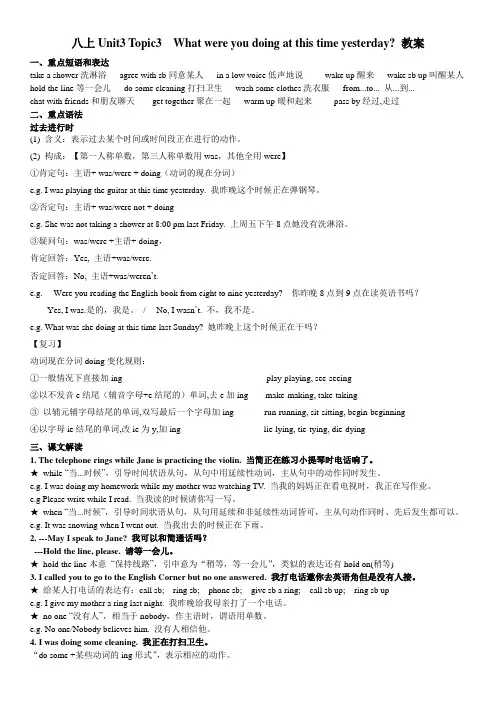
八上Unit3 Topic3 What were you doing at this time yesterday? 教案一、重点短语和表达take a shower洗淋浴agree with sb同意某人in a low voice低声地说wake up醒来wake sb up叫醒某人hold the line等一会儿do some cleaning打扫卫生wash some clothes洗衣服from...to... 从...到...chat with friends和朋友聊天get together聚在一起warm up暖和起来pass by经过,走过二、重点语法过去进行时(1) 含义:表示过去某个时间或时间段正在进行的动作。
(2) 构成:【第一人称单数,第三人称单数用was,其他全用were】①肯定句:主语+ was/were + doing(动词的现在分词)e.g. I was playing the guitar at this time yesterday. 我昨晚这个时候正在弹钢琴。
②否定句:主语+ was/were not + doinge.g. She was not taking a shower at 8:00 pm last Friday. 上周五下午8点她没有洗淋浴。
③疑问句:was/were +主语+ doing,肯定回答:Yes, 主语+was/were.否定回答:No, 主语+was/weren’t.e.g. ---Were you reading the English book from eight to nine yesterday? 你昨晚8点到9点在读英语书吗?---Yes, I was.是的,我是。
/ ---No, I wasn’t. 不,我不是。
e.g. What was she doing at this time last Sunday? 她昨晚上这个时候正在干吗?【复习】动词现在分词doing变化规则:①一般情况下直接加ing play-playing, see-seeing②以不发音e结尾(辅音字母+e结尾的)单词,去e加ing make-making, take-taking③以辅元辅字母结尾的单词,双写最后一个字母加ing run-running, sit-sitting, begin-beginning④以字母ie结尾的单词,改ie为y,加ing lie-lying, tie-tying, die-dying三、课文解读1.The telephone rings while Jane is practicing the violin. 当简正在练习小提琴时电话响了。
仁爱版英语八年级上册同步学案Unit3topic3SectionC+SectionD含答案
八上Unit3 Topic3 Section C What were you doing at this time yesterday? 学案Name:____________Section CThe little Match girl卖火柴的小女孩1. It was snowy and ________(黑暗的) on a new year’s Eve. 在一个又下雪又黑的除夕夜。
2. Many people were _______________________(团聚) in their warm homes. 很多人团聚在他们温暖的家里。
3. A poor little girl was ________(仍然) walking in the streets with no shoes. 一个可怜的小女孩仍然光着脚走在大街上。
4. There were some __________(match) in her hand. 她的手里有一些火柴。
★哭,喊,叫n.& v._________ [过去式__________] 低声地说____________________________5. “Matches, matches!” the little girl cried _____ a low voice. “卖火柴,卖火柴!”小女孩低声地哭诉着。
★听见,听到v._________ [过去式__________] pass by“经过”6. No one __________(hear) her when they were passing by. 路过的人们没有听到她的声音。
7. She didn’t __________(卖) any matches and no one gave her a __________(硬币).她一根火柴也没卖出去,也没有人给她一个硬币。
8. The wind blows ____________(strong). 风刮得很大/强烈。
Unit3 Topic3 Section C学案 仁爱版八年级上册英语
初二上英语导学案备课人:审核人:备课内容:Unit3Topic3班级:姓名:Section CI.学习目标1.Learn someuseful phrases and a word:too… to …, stop doing sth., factory2. Go on learning the past continuous tense:Kangkang had a happy day last Sunday. At 6:30 in the morning, he was running …3. Learn about the origin of the two-day weekend.4. Talk about weekend activities.II.课前预习汉译英:1.度过一天____________2.在教堂____________3.在十九世纪早期___________4.太……而不能……_________5.叫它“神圣的一天”____________6.停止做某事____________7.到1930年____________III.导学过程1、用提问的方式引入新课,介绍星期天的来历。
2、读课文,找出那些动词的过去式,再读课文,找出a holy day发生的时间,地点,人物,做什么。
再读课文,找出周末休假变化的三个阶段。
然后复述课文。
3、解决学生疑难问题,完成1b,在文中找出重点短语。
4、提问,引出过去进行时,再完成2a2b,写一个片段,最后说唱3部分。
5、完成Section C的课堂检测,然后小结谈学习反思。
IV.Exercises .(课堂检测100分)一、单项选择。
1、- Do you think the movie is wonderful?- No, I don’t think so. ____A. I think it’sgreat.B. I like it very much.C. I think it’s just so-so.D. He is very handsome.2、You must sto _______,my father is sleeping.A.talkB.talking C.to talk D.talks3、I felt _____ tired _____go further.A.too,toB.to,tooC.so ;thatD.enough .to4、What ________ you ______this time yesterday?A.were;doB.were;doingC.was;doingD.are;doing二、完成下面的填空题。
Unit3+Topic3+Section+C+教案 仁爱版英语八年级上册+
初中英语仁爱版八年级上册Unit 3 Our HobbiesTopic 3 What were you doing at this time yesterday?Section C【Teaching aims】知识与能力:1. 能根据音标拼读、拼写、理解下列生词:dark, match等。
2. 能用过去进行时讲述发生在过去的事情,并能给出自己的看法。
核心素养:1. 能听懂本课文本材料以及跟课文水平相当的故事。
2. 能读懂相应水平的童话故事以及文章,并能正确模仿本课课文,编写一个简单的小故事。
3. 能通过课文的学习,珍惜现在的生活,努力学习。
【Teaching key points and difficult points】Key points:1. 复习was/were+doing的形式。
2. 综合运用过去进行时和一般过去时。
Difficult points:综合运用过去进行时和一般过去时。
【Teaching method】Situational language learning, task-based language teaching, group discussion teaching.【Teaching procedures】Lead in:1. Get students ready for learning.2. Show the pictures, ask students to ask and answer.A: What were you doing at this time yesterday?B: I was washing some clothes. What about you?A: I was doing some cleaning.Presentation:1. Ask students to look at the pictures of 2 on page 76 one by one. Fill in the blanks.2. Check the answers and remind students not to forget the “be”.3. Encourage students to make a short story according to the 4 pictures.4. Ask some volunteers to tell the story in class.5. Finish 1a. Show the covers of the four fairy stories in 1a on the screen together. Give a question of “Can you guess the stories according to the pictures?”6. Match the four pictures with the titles of stories.7. Encourage students to choose one picture from the four. Ask students to tell the story about the picture.8. Listen to the passage in 1a. Learn the new words: match, stove, goose, geese, sell, beat, burn, disappear.9. Provide students 2 minutes to read and remember the new words. Consolidation:1. Show 1b to students. Ask students to observe the table carefully. Teach students, “When we tell a story or describe something, we should consider the order.”2. Ask students to read the story quickly. Underline the sentences which can help them fill in the table in 1b. Complete the table.3. Invite students to share their answers.4. Ask students to watch the video of 1a, then answer the three questions. Practice:1. Finish 1c. Show the pictures in 1c one by one. Provide students 1 minute to read Paragraph 1 and write down the key phrases under Picture 1.2. Show Picture 2, 3 ... to students one by one.3. Provide students 2 minutes. Invite students to retell the story. In order to make the task easier, each student retells a picture.4. Ask students to put the pictures together and rewrite the passage.5. Go through the language points.6. Do the exercises.Summary:Summarize what the students learned today:The Little Match Girl, past continuous, some new words.Homework:1. Read 1a.2. Read a story and share the story in the next class.3. Prepare for Section D.【Blackboard design 】Unit 3 Our HobbiesTopic 3 What were you doing at this time yesterday?【Teaching reflection 】这个年龄段的学生对故事感兴趣,鼓励学生在课前多搜集与故事相关的信息,更好理解英语故事。
仁爱版英语八年级上册Unit-3-Topic-3-section-C教案
自学内容:课本1a
自学方法:看影片
自学时间:8分钟
自学要求:看影片后回答问题并划出下列短语,猜测汉语意思
自学指导3
自学内容:课本1a
自学方法:精读
自学时间:5分钟
自学要求:朗读1a,完成1b
自学检测3
完成课本76页1b
自学指导4
自学内容:课本2
自学方法:自学
自学时间:5分钟
自学要求:通过画出1a中出现的过去进行时,进一部学习过去进行时,并完成2
3.在春节,所有家庭团团圆圆,快快乐乐。
In Spring Festival, all families________ ________ and have a good time.
4.“请安静!你爸爸在睡觉。”妈妈低声对我说。
“Be quiet, please!Your dad is sleeping now.”My mother said to me________ a low________.
三、评价任务
1、针对目标1,通过学习P75-76生词,让学生,能熟练说出、写出生词,并能熟练做题。
2、针对目标2,通过学习1a,让学生能够说出、写出1a知识点,并能熟练做题
3、针对目标3,通过课本上的例句,能正确完成相关练习题。
四、教学过程
学习目 标
教学活动
评价要点
要点归纳
目标1:学习并能说出、写出P75-76生词,并能熟练做题
仁爱版英语八年级上册Unit-3-Topic-3-section-C教案
修改人: 赵敏
基于“课程标准、中招视野、两类结构”
八(上)Unit3 Topic3 SectionC教案设计
(新授课)
一、学习目标确定的依据: