
外研版高中英语选修七课后导练Module5 Ethnic Culture教学素材
课后导练典题例证【例1】(2006山东高考)After he retired from office,Rogers_________painting for a while,but soon lost interest.A.took upB.saved upC.kept upD.drew up提示:take up“拿起;开始从事;专注于;继续”;save up“储蓄;贮存”;keep up“不低落;维持,继续”;draw up“草拟;写;部署”。
句意:Rogers退休以后,他专注于画画一段时间,但很快就失去了兴趣。
答案:A【例2】(2006广东高考)No matter how frequently_________,the works of Beethoven still attract people all over the world.A.performedB.performingC.to be performedD.being performed提示:动词-ed短语作状语,表示被动,即表示贝多芬的作品是“被演奏”。
performing是动词-ing形式,表示主动。
另外根据frequently这个词,to be preformed(将被演奏)和being performed(正在被演奏)都不对,应该选performed。
答案:A【例3】(2006山东德州检测)—May I speak to your manager Mr.Williams at five o’clock this afternoon?—Sorry.Mr.Williams_________ to a conference long before then.A.will have goneB.had goneC.would have goneD.has gone提示:此题考查将来完成时。
long before then要求用将来完成时。
would have gone是虚拟语气,表示与过去事实相反的猜测,所以不能用在此处。
答案:A【例4】(2005上海高考) _________ into use in April 2000,the hotline was meant for residents reporting water and heating supply breakdowns.A.PutB.PuttingC.Having putD.Being put提示:主句主语the hotline 与put into use 之间构成逻辑上的被动关系,表示动作已经完成并带有被动含义时,往往会用动词ed形式作时间状语。
答案:A【例5】 (经典回放) _________time,he’ll make a first-class tennis player.A..Having givenB.To giveC.GivingD.Given提示:given time作条件状语,相当于条件状语从句if he was given time。
句意为“如果给他时间,他会成为一流的网球运动员”。
答案:D触类旁通短语动词的选择主要还是靠平时的积累。
在平时的学习中要善于积累,特别是同一动词接不同的介词或副词;或者不同的动词接同一介词或副词。
在让步状语从句中如果从句的主语和主句主语一致,并且从句中含有be动词,那么可以把从句的主语和be动词省去。
本题就相当于把the works of Beethoven和are省去。
使用正确时态,关键要看事件的时间背景以及与其他事件的时间顺序。
另外,一些时间状语固定与哪些时态连用也已经约定俗成了,所以对于时态的掌握要求做到规则心中有数,灵活于语境中。
过去分词作状语时,表示一个被动的动作先发生,即过去分词表示被动或完成。
过去分词作状语时,要求与句子的主语在逻辑上存在被动的关系。
有一种情况例外,那就是动词与主句的主语之间根本没有任何的逻辑关系。
基础达标Ⅰ.单词拼写1.She _________ (继承) all her mo ther’s beauty.2.There was an_________ (尴尬的) silence,when no one knew what to say.3.The apartment is well _________ (家具齐全).4.This bridge over the river has a steel _________ (结构).5.His car was broken,so he must find a_________ (汽车修理厂)as soon as possible.6.Though she has a lot of _________ (珠宝),she doesn’t live a happy life.7.Jim is so l after injuring his leg that he has great difficulty in walking.8.The nation wants peace;only an m want(s)the war to continue.9.Yunnan has varied l ,from mountains and lakes to rainforests.10.Don’t count your chickens before they are h .答案:1.inherited 2.awkward 3.furnished 4.framework 5.garage 6.jewellery me ndscapes 10.hatchedⅡ.用方框中短语的正确形式填空seen from above has a population of passed from father to son set off make a gesture think over come across its peak covered with snow adapte to in the style of1.The Bai ethnic group_________ (有人口)around two million.2.The old town is on the side of a mountain and opposite it is the 5500 meter Yulong Xueshan Mountain, _________ (山峰覆盖着积雪).3.The houses are _________ (以……的风格)traditional Chinese architecture.4. _________ (从上面看),the old town is a maze of canals,little bridges and tiny cobbled streets that tourists get lost in.5. _________ (从父亲传到儿子),the music has not changed for eight centuries.6.What time are you planning to_________tomorrow?7.He_________to me.8.She_________ herself quickly_________the new climate.9.I’d like more time to_________things_________.10.I_________an old school friend in Oxford Street this morning.答案:1.has a population of 2.its peak covered with snow 3.in the style of 4.Seen from above 5.Passed from father to son 6.set off 7.made a gesture 8.adapted;to 9.think;over 10.came across能力提升Ⅲ.词汇辨析1.run away/run after/run out of(1)We’ve_________ _________ _________petrol.What a bore!(2)He_________ _________from home at the age of thirteen.(3)If you_________ _________two hares,you will catch neither.2.particularly/especially/specially(1)Be_________careful when driving at night.(2)I made this_________ for your birthday.(3)I love the country, _________in spring.答案:1.(1) run out of (2)ran away (3)run after2.(1)particularly (2)specially (3)especiallyⅣ.阅读表达An allowance is an import tool for teaching children how to make plans for the use of money,save and make their own decisions.Children remember and learn from mistakes when their own dollars are lost or spent foolishly.How large an allowance is suitable?Experts say there is not right amount.Actual amounts differ from region to region,and from family to family.To set a suitable allowance for your child,work up a weekly plan.Allow for entertainment costs such as movies or fast food.Next,include everyday expenses such as lunch money,bus fare,scho ol supplies.“If you make the child responsible for these bills,” says Josephine Swanson,a consumer specialist,“he or she will learn to plan for necessary costs.”Finally,add some extra money to make saving possible,if you can keep your child’s allowance in line with that of his friends.A child whose buying power falls away below his peers can feel left out.It can be touch,but don’t excuse your children when they make a mistake with their allowance.When Brooke Stephens was ten and growing up in Jacksonville,her mother gave her 5 dollars a week,1.75 of which was for bus fare and lunch.“If you lose your money,” Brooke’s mother told her,“You walk home.”One week that girl spent all her allowance in a candy store,then she called home for a ride.“Mom made me walk home,” recalls Stephens,now a financial planner in Brooklyn.“At first I was angry.But I finally realized that_________ .”Experts advise that an allowance should not be tied directly to a child’s daily housework at home. Children should help around the house not because they get paid for it but because they share responsibilities as members of a family.You might,however,pay a child for doing extra jobs at home.That can develop his or her earlier habits.1.What is the best title of the passage?(Please answer within 10 words)______________________________________________________________________________ 2.If a child is given an allowance,please infer what he or she can do?(Please answer within 30 words)______________________________________________________________________________ 3.Which phrase in the passage can be replaced by the following one:his friends.______________________________________________________________________________ 4.Please fill in the blank with proper words or phrases to complete the sentence.(Please answer within 10 words.)______________________________________________________________________________ 5.Please translate the underlined sentence into Chinese.______________________________________________________________________________ 答案:1.How to teach a child about money2.He or she may feel responsible and careful about money.3.his peers4.she was trying to teach me an important lesson5.专家建议零用钱不该与孩子在家干的日常家务活直接联系起来。
外研版高中英语选修七海政学校Module 5Ethnic Culture教案外研社选修七
张全利内容page 58 Reading and vocabulary课型任务阅读课多媒体电教课知识目的:1.learn the key words in the passage.2.learn some useful phrases and structures了解,理解重点单词,词组和句型能力目的:1.improve the ability of reading comprehension, fast readingCareful reading, and further comprehension提高阅读方面的各种能力,快速,细节理解和深层理解情感目标:了解不同的民族,尤其是云南的风景和文化,热爱祖国的丰富的民族文化。
教学过程:1.激情导入。
利用我国的民族多和多姿多彩的节日导入云南这个主题2.通过云南丰富的地貌和珍稀动植物唤起学生去云南的渴望3.正式进入阅读本文“Simon Wakefield’s Yunnan Diary”速读,培养宏观把握文章的能力4.查读带着文章中的问题读,根据需要调整阅读速度5.细读对文章深层次的理解在阅读过程中根据文字表面意思对其深层含义作出正确合理的推断6.重点句型理解7.朗读课文,强化理解和读说的能力8讨论通过本课,了解中国的云南,理解民族文化,热爱祖国的美丽山河,保护不同的文化遗产9.家庭作业。
完成有关课文的填空,朗读课文板书设计:重点单词,词组❖varied❖canal❖cobbled❖run❖inherit❖property❖be astonished by wake up to❖get lost in run through❖have the custom of doing sth in use❖put together put a spell on教学反思:适当缩短导入的内容,以便给后面的内容增加时间,较好完成教学任务。
高中英语 课后导练(Module5 Ethnic Culture)教学素材(外研版选修7)

课后导练典题例证【例1】(2006山东高考)After he retired from office,Rogers_________painting for a while,but soon lost interest.A.took upB.saved upC.kept up提示:take up“拿起;开始从事;专注于;继续”;save up“储蓄;贮存”;keep up“不低落;维持,继续”;draw up“草拟;写;部署”。
句意:Rogers退休以后,他专注于画画一段时间,但很快就失去了兴趣。
答案:A【例2】(2006广东高考)No matter how frequently_________,the works of Beethoven still attract people all over the world.A.performedC.to be performed提示:动词-ed短语作状语,表示被动,即表示贝多芬的作品是“被演奏”。
performing是动词-ing形式,表示主动。
另外根据frequently这个词,to be preformed(将被演奏)和being performed(正在被演奏)都不对,应该选。
答案:A【例3】(2006山东德州检测)—May I speak to your manager Mr.Williams at five o’clock—Sorry.Mr.Williams_________ to a conference long before then.A.will have goneC.would have gone提示:此题考查将来完成时。
long before then要求用将来完成时。
would have gone是虚拟语气,表示与过去事实相反的猜测,所以不能用在此处。
答案:A【例4】(2005上海高考) _________ into use in April 2000,the hotline was meant for residents reporting watA.PutB.PuttingC.Having put提示:主句主语the hotline 与put into use 之间构成逻辑上的被动关系,表示动作已经完成并带有被动含义时,往往会用动词形式作时间状语。
外研版高中英语选修7《Module 5 Ethnic Culture》(Section 2)word教案
Module 5 Ethnic CultureSection 2 The Analysis of the Difficult Sentences from Module 5 Ethnic Culture 1.The old town is on the side of a mountain and opposite it is the 5500-metre Yulong Xueshan Mountain, its peak covered with snow.古城依山而建,对面是海拔5500米的玉龙雪山,山峰被积雪覆盖。
its peak covered with snow独立主格结构作伴随状语。
可以看作是省略了with的独立主格结构。
以下就这一结构举些例子来说明。
1) (with)+n.+n. The workforce is made up of 400 workers, (with) most of them women.2) (with)+n.+adj. The street wet and slippery, we had to ride our bikes slowly and carefully.3) (with)+n.+adv. The meeting over, we returned to the classroom.4) (with)+n.+prep.-phrase The old man sat on the chair, with a pipe in his mouth/pipe in mouth. (当介词后的名词表示身体的某个部位时,可省略修饰成分)5) (with)+n.+to do/to be done (表示将来动作) The sports meeting to be held next week, we must get ready for it.6) (with)+n.+doing/being done(表示正在进行)/having done(强调动作已经完成)It being sunny, the children went to the park.Time permitting, we’ll visit the park.The guests having left, she began to clean the room.7) (with)+n.+done/having been done(被动关系,强调动作完成后的状态) Her glasses著居民仅占澳大利亚人口总数的1.5%多一点。
外研版高中英语选修7《Module 5 Ethnic Culture》(Section 3)word教案
Module 5 Ethnic CultureSection 3 Words and Expressions from Module 5 Ethnic Cultureethnic adj.1 of a national or racial group of people:A question on ethnic origin was included in the census.The factory’s workforce reflects the ethnic mix from which it draws its labour. Conflicts between the different ethnic groups in the country exploded into civil war.2 from a different race or interesting because characteristic of an ethnic group which is very different from those that are common in western culture:ethnic foodethnic costumediverse adj.varied or different:Students from countries as diverse as Colombia and Lithuania use Cambridge textbooks when they learn English.New York is a very culturally/ethnically diverse city.people from diverse culturesMy interests are very diverse.native adj.1 [before noun] relating to or describing someone's country or place of birth or someone who was born in a particular country or place:She returned to live and work in her native Japan.She’s a native Cali fornian.2 describes plants and animals which grow naturally in a place, and have not been brought there from somewhere else:Henderson Island in the Pacific has more than 55 species of native flowering plants. The horse is not native to America - it was introduced by the Spanish.3 [before noun] relating to the first people to live in an area:The Aborigines are the native inhabitants of Australia.the native populationnative customs and traditions4 your native language/tongue the first language that you learn:French is his native tongue.5 [before noun] A native ability or characteristic is one that a person or thing has naturally and is part of their basic character:his native witvaried adj.containing or changing between several different things or types:a varied group of peoplea lengthy and varied careerWith its varied climate, the country attracts both winter and summer sports enthusiasts.run v.1 [I or T] to (cause to) operate:Keep clear of the machines while they’re running.The government took desperate measures to keep the economy running.Do you know how to run this sort of machinery?The mechanic asked me to run (= switch on and allow to work) the engine for a minute. They had the new computer system up and running (= working) within an hour. We’ve run the computer program, but nothing happens.We’re running (= doing) an experiment.2 [T] to be in control of:He’s been running a restaurant/his own company since he left school.The local college runs (= provides) a course in self-defence.a well-run/badly-run organization/business/course3 [T] If you run a car, you own one, drive it and pay for the costs:I can’t afford to run a car.4 [T] to organize the way you live or work:Some people run their lives according to the movements of the stars.inherit v.to receive money, a house, etc. from someone after they have died:Who will inherit the house when he dies?All her children will inherit equally.She inherited a fortune from her father.policies inherited from the previous administrationcustom n.a way of behaving or a belief which has been established for a long time:a local/ancient custom[+ to infinitive] In my country, it’s the custom (for women) to get married in white. splash v.1 [I or T; usually + adverb or preposition] If a liquid splashes or if you splasha liquid, it falls on or hits sth. or someone:Water was splashing from a hole in the roof.Unfortunately some paint splashed onto the rug.She splashed her face with cold water.She poured a large gin and splashed soda into it from a siphon.2 [I usually + adverb or preposition] to move in water so that drops of it go in all directions:The kids were splashing (about/around) in the shallow end of the swimming pool. farmn.1an area of land, together with house and buildings, used for growing crops and/or keeping animals as a business:a dairy/arable farmfarm animalsfresh farm producefarm workers2 a place where a particular type of animal is raised in large numbers to be sold:a sheep/fish/mink farmv. to use land for growing crops and/or raising animals as a business:The Stamfords have farmed this land for over a hundred years.lame adj.(especially of animals) not able to walk correctly because of physical injury to or weakness in the legs or feetThe horse went lame.firm adj.1 well fixed in place or position:The bridge provided a firm platform for the bungee jumpers.2 fixed at the same level or opinion and not changing:The government remains firm in its opposition to tax reform.rigid adj.stiff or fixed; not able to be bent, moved, changed or persuaded:a rigid steel and concrete structureI was rigid with (= stiff and unable to move because of) fear.DISAPPROVING We were disappointed that they insisted on such a rigid interpretation of the rules.fasten v.1 to (cause sth. to) become firmly fixed together, or in position, or closed: Make sure your seat belt is securely fastened.This shirt fastens at the back.2 fasten sth. on/to/together, etc. to fix one thing to another:I fastened the sticker to the windscreen.fold v.1 [I or T] to bend sth., especially paper or cloth, so that one part of it lies on the other part, or to be able to be bent in this way:I folded the letter (in half) and put it in an envelope.He had a neatly folded handkerchief in his jacket pocket.Will you help me to fold (up) the sheets?2 [T] to wrap:She folded her baby in a blanket.He folded his arms around her.3 fold your arms to bring your arms close to your chest and hold them together4 [T] to move a part of your body into a position where it is close to your body: She sat with her legs folded under her.adjust v.1to change sth. slightly, especially to make it more correct, effective, or suitable: If the chair is too high you can adjust it to suit you.As a teacher you have to adjust your methods to suit the needs of slower children.2 to arrange your clothing to make yourself look tidy:She adjusted her skirt, took a deep breath and walked into the room.furnish v.1 to provide with furniture; to put furniture in:They’ve furnished the room very simply.2 to provide someone with sth.:Furnished with maps, a compass and sandwiches, they set off for a day’s hiking. awkward adj.difficult to use, do, or deal with:It’s an awkward corner to drive round, so take it slowly.Some of the questions were rather awkward.It was an awkward ascent, but we reached the top eventually.[+ to infinitive] My car’s quite awkward to drive.He’s an awkward customer (= a difficult person to deal with).pierce v.1 [I + adverb or preposition; T] to go into or through sth., making a hole in it using a sharp point:The needle pierces the fabric four times a second.I couldn’t wear these earrings because my ears aren’t pierced.The gun fires a shell capable of piercing the armour of an enemy tank.The hole they drilled pierces 6 km into the earth’s crust.2[T] (of a light, sound, etc.) to suddenly be seen or heard, despite darkness, noise, etc:A few rays of sunlight pierced the smoke.piercing adj.1 going through or into sth.:Troops have been issued with new armour-piercing anti-tank grenades. FIGURATIVE We shivered in the piercing wind.2 describes a sound that is high, loud and unpleasant:piercing screams3 a piercing criticism/question/remark, etc. a criticism/question/remark, etc. which is unpleasant or uncomfortable because it is strong or it makes you think about or discuss something which you would prefer not to:She hadn’t really meant to lie, but their piercing questions had forced her to.4 piercing eyes/look/gaze/glance, etc. used to describe when a person looks very carefully at someone or sth., especially when they are trying to discover sth., often making people feel uncomfortable:Sherlock Holmes gave him a piercing glance.FIGURATIVE He looked straight at me with his piercing blue eyes.。
外研版选修七module 5《ethnic culture》优秀教案(重点资料).doc
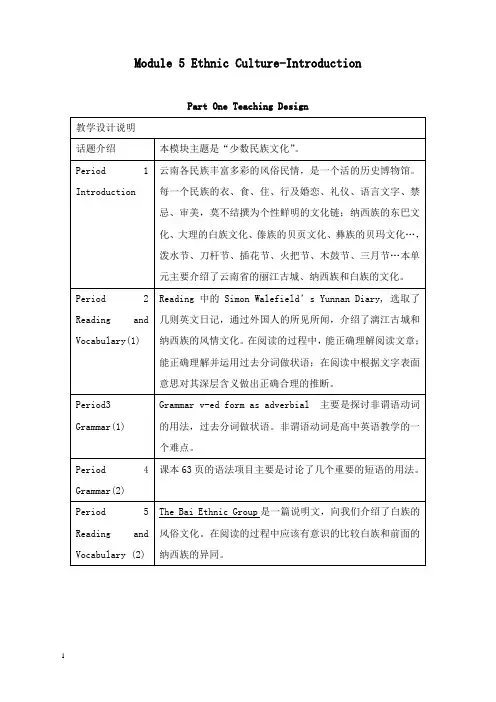
Module 5 Ethnic CultureI.教学内容分析本模块以少数民族的文化为话题,介绍了我国云南省境内纳西族和白族的风情文化以及北美和澳大利亚的土著文化。
通过本模块学习,学生要学会写介绍有关少数民族的文章。
Introduction部分通过学习和复习一些描述少数民族风情、服装和地理位置等信息的词汇,学会简介云南省及其境内少数民族的概况,为本模块的学习奠定基础。
Reading and Vocabulary(1)部分选取了西蒙•韦克菲尔德的四则英文日记,通过一位外国朋友在云南旅游的所见所闻,介绍了丽江古城以及纳西族的风情文化。
让学生完成相关词汇的练习;学会归纳文章的主旨大意;并围绕文章内容,进行听、说、读、写等各项活动。
Grammar(1)部分通过观察课文中的例句,要求学生掌握过去分词短语作状语及其与状语从句的转换。
Speaking部分是阅读课文后所展开的一项活动,要求学生总结从阅读课文汲取的有关丽江和纳西族人的信息,展开讨论,在口头表达中熟练运用虚拟语气。
Listening and Vocabulary部分听取一段关于西双版纳、泼水节的对话,培养学生准确获取有效信息、完成相关练习的能力。
Grammar(2)部分的短语来自Listening and Vocabulary,让学生通过回顾录音内容,正确理解短语的意义,然后通过练习进一步巩固。
Everyday English部分选取听力材料中和主题文段相关的常见的和典型的英语习惯用语组成对话,通过补全对话的形式使学生熟练掌握这几个表达。
Speaking and Function 部分通过复习听力材料中的短语,要求学生正确运用常见的表示询问更多信息的口语表达法。
Reading and Vocabulary(2)部分是一篇介绍白族文化的文章,通过快速阅读,培养学生捕捉重点信息,把握细节信息的能力,并为本模块的写作做好铺垫。
Writing部分通过阅读课文中提供的有关信息,模仿Reading and Vocabulary(2)有关描写白族文化的写作结构,写一篇介绍少数民族—基诺族的文章。
最新外研版高中英语选修7《module 5 ethnic culture》introduction教案.doc
Module 5 Ethnic Culture-Introduction Part One Teaching DesignPeriod 1 Introduction■Goals●To learn something about the Yunnan Province●To master the new words in the introduction●To practise talking about ethnic culture■ProceduresStep 1: Warming up by a discussionIn this module, we will talk about ethnic culture. As we all know, there are so many minorities, for example, the province of Yunnan is one home to many ethnic minorities. How much do you know about Yunnan Province?“Yunnan” this word refers to “the South of Clouds”, it sounds beautiful and it is really a beautiful place. Let me tell you something about this wonderful land.Yunnan, located in the Southwest China, has a vast territory, magnificent mountains and rivers, and abundant natural resources. With an area of 390,000 square kilometers, Yunnan is the eighth largest province in China. It is an inland province, with Guizhou Province and Guangxi Zhuang Autonomous Region in the east, Tibet Autonomous Region in the northwest, and the Qinghai-Tibet Plateau in the southwest. Outside China, Yunnan borders on Burma in the west; Vietnam and Laos in the south. With a long borderline, is the main passageway connecting China with the Southeast Asian nations.In Yunnan, there are more than 6000 rivers which belong to 6 river-systems and 37 lakes with an area of over 1 square kilometer can be seen here, boasting a large number of plateau lakes. For example, the Dianchi Lake was called the bright pearl of Plateau. There are 700 hot springs as well, all of which attract lots of friends all over the world.According to our Chinese culture, a perfect place should consist of both the waterscape and the mountain. Yunnan’s mountains are also famous, including the Yulong Xueshan Mountain in Lijiang, which was regarded as one of the key scenic spots at state level. The mountains and rivers in Yunnan are both very superb landscape.Besides the landscape here, the climate in Yunnan is pleasant. As we all know Kunming is called the Spring City that’s because it’s always warm as in spring. The feature of Yunnan Climate is that it has little difference in the seasonal temperature but considerable difference of temperature in a day. In general, the weather is favorable throughout the year, cool in summer and warm in winter, which makes Yunnan a favorable resort all the year round.Step 2: Reading the information in the boxOpen your textbooks, and turn to page 57. Let’s look at Activity 1. Work in pairs. Say what you know about the province of Yunnan. Use the words in the box and the fact file to help you.Name Yunnan(meaning beautiful clouds in the south)Location most south-western provinceGeography everything from mountains and lakes to rainforestsSize 394,000 square kilometersPopulation about 42 million in 2003Read through the words in the box together and repeat them chorally and individually.Read through the fact file individually and try to understand everything. Now boys and girls, do it please.Step 3: Describing what the Dai girl is wearing in the picture.Rare animalsgolden monkey, Asian elephant Plantshome to half of all China ’s plant species People home to 25 ethnic minorities, most diverse region ofChinaCapital cityKunming Naturalwonders Stone Forest, Tiger Leaping Gorge, first bend of Yangtze River。
外研版高中英语选修7《Module 5 Ethnic Culture》(Reading and Vocabulary)word教案(2)
Period 5Readingand Vocabulary (2)
■
●To get some idea about the Bai ethnic group
●To draw out useful information from the text
■Procedures
The Nanzhao regime lasted for 250 years. During that period of time, while maintaining a good relationship with the central government, the rulers cruelly oppressed the slaves and mercilessly plundered other ethnic nationalities through warfare. Productivity was thus seriously harmed. This caused slave rebellions and uprisings. Nanzhao’s power came to an end in the year 902. Then a regime based on a feudal lord system, known as theKingdomofDali, was established. The kingdom adopted a series of measures such as abolishing exorbitant taxes and removing conservative ministers. As a result, social productivity was restored.
高二英语外研版选修7教案:Module5 EthnicCulture 2
英语:Module 5《Ethnic Culture》英文教案(2)(外研版选修7)Period 3 Listening and Vocabulary, Grammar (2), Everyday English Teaching Goals:1. To enable Ss to know some skills of listening.2. To study some daily expressions.3. To learn to use some phrasal verbs.Teaching procedures:Step 1. RevisionCheck the answers to the exercises of Reading, Vocabulary and Grammar in the Workbook.Step 2. Listening and Vocabulary1. Pre-listening(1) Ask Ss to talk about the life of the Dai people in Xishuangbanna in the pictures below.The bamboo house built off the ground The New Year Water-Splashing Festival(2) Ask Ss to match the words with their definition.①bucket (a) large juicy tropical fruit with sweet yellow flesh②pineapple (b) round container of metal or plastic, with a handle, for holdingwater, milk, etc.③rainforest (c) to put a liquid on something in a rough and noisy way④religion (d) a forest in a tropical region of the world where it rains a lot.⑤splash (e) a belief in or worship of God or godsSuggested Answers:① b ② a ③ d ④e ⑤ c(3) Ask Ss to do Activity 1 on page 62 and check the answers in pairs.2. While-listening(1) Ask Ss to listen to the tape and number the topics given in Activity 2 in the order they are mentioned.(2) Ask Ss to listen to the tape again and pay attention to the detail. Then ask them to choose the correct answers to Activity 3 on page 62.(3) Ask Ss to listen to the tape a third time and fill in the missing words.Jacky: Is Xishuangbanna as wonderful as every one says it is?Simon: Yes, It’s amazing. The thing is, it’s still very undeveloped- you know, it’s got mountains, rice fields, little villages deep in tropical rainforests…Jacky: It sounds beautiful.Simon: It is. It’s also got all kinds of flowers and animals- tiger, elephants…Jacky: Did you see any?Simon: (laughing) I didn’t ①any tigers, but I did see some wild elephants.Jacky: Amazing! ②Simon: There are a lot of different ethnic groups, but the Dai people ③one-third of the population.Jacky: Oh yes, the Dai people. I’ve ④them. Tell me something about them.Simon: Well, their language is similar to the Thai language. That’s not surprising since Xishuangbannan shares a border with Thailand.Jacky: Do they still wear traditional costume?Simon: Yes, a lot of them do. ⑤, they think it’s more attractive than modern clothes. I think it is too, actually. It’s very colorful. The men wear white or blue trousers, and the women wear brightly-colored blouses and skirts with silver belts. In fact, I bought one of the belts for my girlfriend. ⑥, do you think she’ll like it?Jacky: Oh, that’s very pretty. She’ll adore it. So, ⑦about your trip. ⑧.Simon: Well, ⑨the thing that’s most different is the houses, which are made of bamboo and built off the ground.Jacky: Ah, so the people live…Simon: They live above the ground, and they keep pigs and chickens in the area beneath thehouse.Jacky: Sounds like a good idea.Simon: It’s very picturesque. They grow fruit all round their houses- pineapples, for example. A Dai family ⑩in their house for a week. It was a great experience and surprisingly comfortable. We were in a village called Ganlanba, about an hour away from Jinghong. Jacky: I’m (11) ! But (12) _?Simon: No, because the wind blows through the bamboo, so it’s always quite cool. Actually, we were lucky enough to be there for the Water-Splashing Festival.Jacky: Is that a New Year Festival?Simon: Yes. People carry round buckets of water and splash it all around them, and every one gets very wet. The water’s supposed to wash away the old year and bring in the new. The wetter you get, the more luck you’ll receive, so they say. I got so wet, I had to change all my clothes! Twice!Jacky: (13) the food?Simon: It can be very good. There’s a kind of black rice dish that’s quite (14) ! And at a lot of the restaurants there’s traditional dancing, with Dai women playing on large elephant drums. It can be quite hard to hear yourself speak!Jacky: I’d love to go there.Simon: Well, I’m definitely going back next year. I really (15) the place. Why don’t you come with me?Jacky: Maybe I will. I’ll (16) . It does sound very lovely.Suggested Answers:①come across ②What are the local people like? ③make up ④heard of⑤Apparently ⑥What do you reckon ⑦go on ⑧I’m fascinated ⑨I guess⑩put us up (11) green with envy (12) doesn’t it get very hot in summer(13) What about (14) tasty (15) fell for (16) think it overStep 3. Grammar (2)1. Ask Ss to work in pairs to do activity 1 on Page 63 and check the answers.2. Ask Ss to make sentences with these phrasal verbs.3. Ask Ss to do Activity 2 then discuss with their partners.Step 4. Everyday English1. Ask Ss to read through the words and phrases in the box in Everyday English and make sure of their meanings..2. Ask Ss to finish the activities individually, and then check the answers.3. Ask Ss to read the dialogue with a partner.Step 6. Homework1.Ask Ss to preview The Bai Ethnic Group on page 65.2. Ask Ss to do the Grammar activities in the Workbook.。
外研版高中英语选修七Module5EthnicCultureReadingPractice学案2
外研版高中英语选修七Module5EthnicCultureReadingPractice学案2Module 5《Ethnic Culture》Reading PracticeI. Pre-reading1. Ask Ss to look at the title of the passage and finish Activity1.2.Ask Ss to read some extracts from the passage to conclude what the passage is about .______________________________________________________________________________________________________________________ II. While- reading1. Read the passage quickly and check if they guess is right2. Do Activity3 and decide what the writer’s intention is.3. Read the passage again and find the words to match with theirdefinitions.①to cry loudly in pain, anger and sadness ____________②to move forward by jumping on one foot ____________③ a long weapon like a stick with one sharp end ___________④stiff, hard or difficult to bend or move ___________⑤to provide furniture for a room or house ___________⑥a woman whose husband has died and who has not married again_________⑦not comfortable, relaxed or confident __________⑧to make a hole in something _________4. Ask Ss to read the passage again to find the information and write them5. Retell the story with the key words above.6. Do Activitities 4~6 individually, and then check the answers with a partner.III. Language study1. 找出文中的倒装句。
Ethnic Culture教学设计
自主探索总结,分组讨论研究,借鉴他人学习方法。
四、课堂教学过程
时间
教学步骤
教师活动
学生活动
教学目的
第1-3分钟
每日课前报告
老师请本班两位少数民族同学介绍本民族的生活区域、生活习俗、文化活动等。
两学生(回族、蒙古族各一人)从不同的角度,以图片,照片,PPT等手段向同学们展示各自民族的特点和迷人之处。
学生自由作答,并根据自身掌握的知识简单介绍各景点和个民族的知识。
通过美丽的风光图片使学生对云南的自然风光有了更直观的认识。同时,西双版纳热带雨林、玉龙雪山、白族、纳西族将在下面的阅读材料中出现,在此做一个感性的铺垫。
第12-17分钟
听音理解
PPT展示阅读材料中的六福图片,播放课文录音。明确图文匹配任务。
教师导入教学内容,为任务呈现做准备。作为文科学生,对基本的地理知识掌握较好,学生在教师引导下激活自己的已有知识,准备学习新知识,并激活学习新知识的兴趣,以便完成任务。
第8-11分钟
导入
教师使用PPT向学生展示云南风景及少数民族图片:西双版纳热带雨林,石林、虎跳峡、玉龙雪山、滇池;傣族、黎族、白族、纳西族。
教学是教师依据教材内容,精心设计情境,通过一定的外部教学条件,引导、激发和推动学生求知、探索、学习。教学设计就是要把学生怎样学习、学习什么、教师怎样引导学生学习放在首位。本课时所要学习的内容是外研版第七册第五模块的阅读材料。本模块的主题是少数民族文化。课文选取了几则外国游客的英文日记,通过一个外国人的所见所闻向人们介绍了我国云南省丽江古城的自然和人文景观以及纳西少数民族的风情文化。本课的教授对象为高中二年级的文科学生。学生对教材内容所涉及的云南省的概况、少数民族的分布等情况了解甚多。所以课堂设计以学生已有知识为切入点展开对阅读材料的理解与学习。