
人教版高中英语必修一Unit3《Traveljournal》listening课件
3. Listen again and complete the passage below.
The Mekong is the most important river in Laos. It even _a_p_p_e_a_r_s on the national _f_la_g_ of the country. Laotian people use the river for _w_a_s_h_in__g, _f_is_h_i_n_g_ and _tr_a_n_s_p_o_r_t_in_g_ goods and the people around the country. They call the Mekong
see some
passers-by
beautiful
Whathappened?
sceneries
get lost
meet some thing dangerous
1. Before you listen, read the exersises on P23 and predict what the listening is about.
1. Which border of Laos is made by the Mekong River? The western border of Laos.
2. What did Wang Kun and his sister see when they cycled across the plains? They saw how mountains covered in trees.
3. Which is the best season to travel to Laos? Why? Autumn is the best season to travel in Laos because it is cool and dry.
4. What did the river sound like? The river sounded like a man singing in a low voice.
1. Listen and tick the words you hear.
□ Laos □ Tibet □ Vientiane □ Vietnam □ plains □ border
□ village □ candles □ lights □ truck □ ducks □ chickens
2. Listen to the tape again and answer the questions.
river. 2. The fishermen used to catch fish. 3. They sold the fish to make
money.
Life along the river now 1. Some villages have disappeared. 2.2. New dams have been built. 3.3. Some people have moved to the
While-listening 1. Listen and write the main idea
in one sentence. Wang Kun and Wang Wei met an old man fishing by the river in Laos, and they talked about the life on the river and the changes.
2. Listen to the tape and tick the statement which tells the main idea of the dialogue.
A A girl from Laos told Wang Kun about how Laotians use the Mekong River.
towns and work there.
After-listening
Discuss the following questions in pairs. 1. How did Wang Kun and Wang Wei 2. greet the old man when they met
him 3. on the river bank? 2. What did they talk about?
“thes_e_a__ of Laos, you can visit temples, but in Tibet people call it “the water of _r_o_c_k_s__”. If you follow the river in Laos, you can visit temples, caves and a _w__a_te_r_f_a_ll_. At night, you can sleep in some small _v_il_la_g_e_s_ by the river.
Pre-listening Work in pairs to list the ways that people use large and important rivers. • transporting goods and people • connections between towns and cities • fishing • water for personal use and
高中英语课件
(madeofdingshangtuwen)
Listening P23
Can you imagine at happened when Wang
Kun and Wang Wei travelled down the
Mekong river?
chatting with the
…….
B A girl told Wang Kun about what they would see along the Mekong River.
C A girl from Laos told Wang Kun about how important and beautiful the Mekong is.
5. How did they go to Vientiane after lunch? After lunch they went to Vientiane by bus.
Listening Task P58
Life on the river has changed with the coming of dams to make electricity. People have been moved from their homes. As a result, some of the old ways of life by the river have changed.
for cooking
Talk about what kind of things might happen to change this life with your partner.
• pollution of water supply • decline in fish supplies • silting up the river
Look at the picture on the book and discuss the questions with your partner. 1. Is the photo a modern one or was it
taken many years ago? How do you know? 2. What information can you get from the passage?
3. Do people like the change of lifestyle? What about the old man’s attitude?
4. Why does the man prefer the old way of life?
5. Can you think of anything similar in China?
2. Listen again and fill in the information on the chart.
Life along the river Life along the river
in the past
now
1
1
2
2
3
3
Answers:
Life along the river in the past 1. There were many small villages by the
Listening P55
Wang Kun and Wang Wei continues their journey through Laos. Discuss what you know about Laos and go over the exercises on the book before listening.
人教版新课标高中一年级必修一Unit3Traveljourna含答案解析及听力mp3
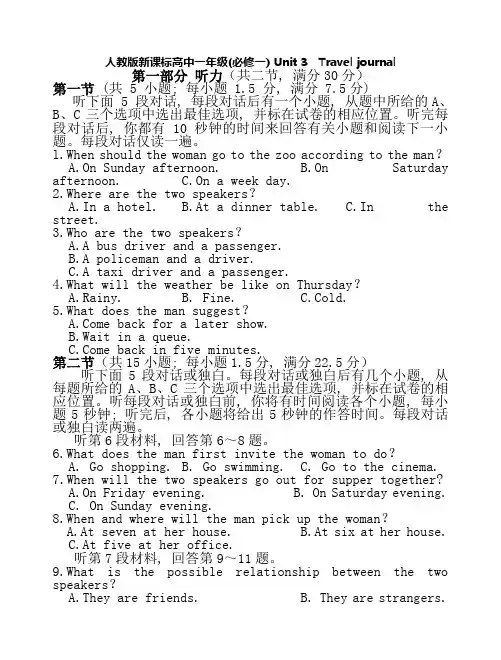
人教版新课标高中一年级(必修一) Unit 3 Travel journal第一部分听力(共二节, 满分30分)第一节 (共 5 小题; 每小题 1.5 分, 满分 7.5分)听下面 5 段对话, 每段对话后有一个小题, 从题中所给的A、B、C三个选项中选出最佳选项, 并标在试卷的相应位置。
听完每段对话后, 你都有 10 秒钟的时间来回答有关小题和阅读下一小题。
每段对话仅读一遍。
l.When should the woman go to the zoo according to the man?A.On Sunday afternoon.B.On Saturday afternoon.C.On a week day.2.Where are the two speakers?A.In a hotel.B.At a dinner table.C.In the street.3.Who are the two speakers?A.A bus driver and a passenger.B.A policeman and a driver.C.A taxi driver and a passenger.4.What will the weather be like on Thursday?A.Rainy.B. Fine.C.Cold.5.What does the man suggest?e back for a later show.B.Wait in a queue.e back in five minutes.第二节(共15小题; 每小题1.5分, 满分22.5分)听下面5段对话或独白。
每段对话或独白后有几个小题, 从每题所给的A、B、C三个选项中选出最佳选项, 并标在试卷的相应位置。
听每段对话或独白前, 你将有时间阅读各个小题, 每小题5秒钟; 听完后, 各小题将给出5秒钟的作答时间。
每段对话或独白读两遍。
人教版高中英语 必修一 Unit3 《Travel journal---Reading》课件(共
Transport Advantages
bus
very cheap, efficient for short journeys, timely
longer than the train
Disadvantages or plane, no meals,
uncomfortable
Transport Advantages
Where and How
They have the idea to _c_y_c_le__a_lo_n__g_the Mekong River from _w__h_e_r_e_ it _b_e_g__in_s to _w__h_e_r_e_ it _e_n_d_s_.
Read paragraph 1 and answer the questions.
1. What was Wang Kun and Wang Wei’s idea of a
good trip?
Their idea was to take a long bike trip.
2. Who planned the trip to the Mekong?
Wang Wei did.
Read paragraph 2 and answer the questions. 3. Where is the source of the Mekong
Disadvantages slow, dangerous,
seasick
Transport Advantages
airplane
faቤተ መጻሕፍቲ ባይዱt, time-saving, comfortable
Expensive,
Disadvantages Airports are far from
人教版高中英语 必修一 Unit3 《Travel journal---Reading》 课件 (共43张PPT)
Transport Advantages disadvantages
1. very cheap 1. takes longer
bus 2. efficient for
than the train
short journeys or airplane
3. goes to small 2. does not
When are you leaving? How are you going to …? WhenБайду номын сангаасare you arriving in/at …? Where are you staying? How long are you staying in …? When are you coming back?
Many people live beside a river. How do they make use of it in their daily life?
The world has many great rivers. If you could follow the route of only one of them, which one would you choose? Why?
The Mekong River is called _L_a_n_c_a_n_g__R_i_v_er_ in China. It goes through __M__y_a_n_m__a_r__ _L_a_o_s_, _T_h_a_i_la_n__d_, C__a_m__b_o_d_ia_, _V__ie_t_n_a_m__ and pours into the _S_o_u_t_h_C__h_in__a_S_e_a__.
Wang Kun and _h_is_ _s_is_t_er_ Wang Wei are dreaming about _ta_k_i_n_g__a_g_r_e_a_t_b_i_k_e_t_r_ip_.
人教版高中英语必修一Unit3《Traveljournal》Reading(II)

Onceyouunderstandtherule,youwillhavenodifficulty. 一旦明白了这条规则,你就再也没有困难了。 Whatwillwedooncethemoneyisusedup? 钱一旦用完,我们该怎么办? Onceprinted,thisdictionarywillbeverypopular! 一旦出版,这本词典将会非常畅销!
【拓展】bear/keep...inmind记住 have...inmind考虑;打算 call/bringsth.tomind回忆起某事 fixone’smindupon把注意力集中在……
4.Finally,Ihadtogivein.(P18) 最后,我只好让步了。 Hegaveintohisboss. 他向他的老板屈服了。 Theherowouldratherdiethangiveintotheenemy. 这位英雄面对敌人宁死不屈。 Themothergaveinandboughtatoyforherchild. 妈妈做出让步,给孩子买了个玩具。
Idon’tcareabouttheprice,solongasthecarisingoodcondition. 我不在乎价格,只要这辆车性能好。 Shedoesn’tcareaboutwhatotherpeoplesay;shejustthinksshei sright. 她不关心别人说什么;她只认为自己是正确的。
4.Onceshehasmadeuphermind,nothingcanchangeit.(P18) 她一旦下了决心,什么事情也不能使它改变。 本句是一个复合句,once是连词,引导_条__件__状__语__从句,意为 “_一___旦__…__…__就__…__…___”,once引导的从句常用一般现在时或现 在完成时代替将来时态。
人教版高中英语 必修一 Unit3 《Travel journal---Reading》 课件 (共37张PPT)

I think I am just a person with great
determination.
Language points
Q2: Is Wang Wei a stubborn girl? Why?
Yes. She insisted that she (s_h_o__u_ld_)_o_r_g_a_n_i_z_e the trip properly. Once she has __m_a_d_e_u_p__h_e_r_m_i_n_d_, nothing can change it.
xlj
Paragraph 3: Preparation
What can they see along the Mekong?
xlj
glacier
waterfall
plain
valley
rapids
delta
Paragraph 3: Prepห้องสมุดไป่ตู้ration
What can you see along the Mekong?
River flow through?
Myanmar
Laos
Thailand
Cambodia Vietnam
a
Predict What’s the reading about?
Journey down the Mekong
Part1 The dream and the plan
Skimming
Decide which is the main idea of the passage
英语:Unit3《Travel journal》教案(1)(新人教版必修1)

英语:Unit3《Travel journal》教案(1)(新人教版必修1)Step1.Revision1.Check the homework exercises .2.Dictate some new words and useful expressions of Unit3.Step2. New wordsLet the students pronounce the words .Get the students read out the words .Explain some of the words .1). quake : vi. 震动, 颤抖n. 震动, 地震There were four major quakes in this century.本世纪有四次大的地震。
2).right away : immediately, instantly, straightaway, straight off, directly,now, at once, forthwith, in real time, like a shotEg: He is ill; you should call in the doctor right away.他病了,你应该立即请大夫来。
The storm will blow over right away. 暴风雨很快就会平息。
If war breaks out, we shall be called up right away.如果战争爆发,我们将立即被征召服役。
I want it typed right away, please. 请立刻把它打印出来。
3).as if : I felt as if my heart would burst with joy.我觉得自己高兴得心花怒放。
It looks as if she's gone away for a few days.好像她已出去好几天了。
人教版高中英语 必修一 Unit3 《Travel journal---Reading》 课件 (共43张PPT)
Read the passage again and answer the following questions.
1. What can you see when you travel along the Mekong? You can see the source glacier, rapids, hills, valleys, waterfalls and plains.
towns/cities
provide meals
train
1. cheaper than the airplane
2. journey ends in the center of the town/city
1. takes longer than the airplane
2. does not provide meals
mountain bike first. 2. Dao Wei and Yu Hang lived close to
the Lancang River.
3. The Lancang River flows into the Mekong River.
4. Wang Wei became interested in cycling under her cousin’s influence.
on foot by bike by bus by train by ship/sea by plane/air
Which kind of transport do you prefer to use: bus or train? Think about the advantages and disadvantages of each form of transport and fill in the chart.
人教版高中英语高一上学期必修一 unit3 travel journal reading(共23张PPT)
Timing & Occurrence1. Ever sin来自e middle school
2. Two years ago
Dreaming about a bike trip
Wang Wei bought an expensive mountain bike
3. Last year
Wang Wei visited their cousins and got them interested in cycling.
4. After graduation
A chance to take a bike trip.
5. Now
Planning for the bike trip.
My name is Wang Kun.Ever since middle school, my sister Wang Wei and I have dreamed about taking a great bike trip.Two years ago she bought an expensive mountain bike and then she persuaded me to buy st year, she visited our cousins, Dao Wei and Yu Hang at their college in Kunming.They are Dai and grew up in western Yunnan Province near the Lancang River, the Chinese part of the river that is called the Mekong River in other countries.
Journey travel, trip Down the Mekong
人教版高中英语 必修一 Unit3 《Travel journal---Reading)(共34
1.How many people are there in the story? Who are they?
Four. They are Wang Kun, Wang Wei, Dao Wei and Yu Hang.
Homework:
Finish the exercises on the workbook from 56 to 57.
2. Who are Dao Wei and Yu Hang? They are Wang Kun’s cousins who are at
a college in Kunming. 3. What was their dream?
Their dream was to take a great bike trip.
▪ When are you leaving? ▪ How are you going to…? ▪ How long are you staying ? ▪ When are you arriving in /at…? ▪ Where are you staying? ▪ When are you coming back?
and sister.
T
▪ 2.Both Dao Wei and Yu Hang are dai
and they grew up in eastern Yunnan
province. F ▪ 3.The source of Mekong is in Qinghai
province . T
▪ 4.Finally Wang Kun agreed with his
人教版必修1 unit3 Travel journal P5 Listening exercise
_A_u_t_u_m__n_ is the best time to travel here. The weather was so _c_o_o_l and _d_r_y_ that it was very pleasant to ride _a_lo_n__g_si_d_e_ the river. On our _th__ir_d_ night we slept in a small village on little pieces of _w_o_o_d_. The village had no l_i_g_h_ts_. In a few houses, however, we could see candles. It was very _q_u_i_e_t_. On the small road near the village, we heard only one _t_ru__ck__ all night.
WK: Wow! Can we sleep by the river? G: Yes, of course you can. There are many small _v_il_la_g_e_s_ along the river. You can stay there if you _w__is_h_.
M: There are many different kinds of animals and plants _a_s_ _w_e_l_l _a_s_ temples, caves and a waterfall. It’s a _p_r_o_te_c_t_e_d_ area so you can tell that it’s very _s_p_e_c_ia_l_.
However, the river _s_o_u_n_d_e_d_ like a man singing in a _lo_w__ voice. The next morning we made an early _s_ta_r_t_ and travelled quite far before _l_u_n_c_h_. Along the way, strange buses _c_a_ll_e_d_ tuk-tuks _p_a_ss_e_d_ us. For lunch we ate a special _n_o_o_d_le_ s_o_u_p__. After lunch we were _t_ir_e_d_ so we put our bikes on a _b_u_s_ going to Vientiane – the _ca_p__it_a_l of Laos. A cage of chickens _s_a_n_g_ to us all the way!