
phrasal verb
else arrive and register at a hotel We will get the hotel keys when we check in.
call someone back
return a phone call
or airport leave a hotel You have to check out of the hotel before 11:00 AM. check look at carefully, investigate look at Check out the crazy hair on that guy! The company checks out all new employees.
bring something up
start talking about a subject
My mother walks out of the room when my father brings up sports. He drank so much that he brought his dinner up in the toilet. catch up get to the same point as someone You'll have to run faster than that if you want to catch up with Marty. not care for someone/something not like (formal)
blow up
explode
The racing car blew up after it crashed into the fence.
blow something up break down
add air stop functioning (vehicle, machine)
We have to blow 50 balloons up for the party. Our car broke down at the side of the highway in the snowstorm.
ask around
ask many people the same question
I asked around but nobody has seen my wallet.
break in
force entry to a building
break into something add up to something equal Your purchases add up to $205.32.
Verb ask someone out
Meaning invite on a date
Example Brian asked Judy out to dinner and a movie. break something down divide into smaller parts
her that her son had died. Our teacher broke the final project down into three separate parts. Somebody broke in last night and stole our stereo. The firemen had to break into the room to rescue the children. break something in wear something a few times so that it doesn't look/feel new break in interrupt The TV station broke in to report the news of the president's death. break up end a relationship break up start laughing (informal) break out escape My boyfriend and I broke up before I moved to America. The kids just broke up as soon as the clown started talking. The prisoners broke out of jail when the guards weren't looking. I need to break these shoes in before we run next week.
call someone up
phone
Give me your phone number and I will call you up when we are in town.
calm down
relax after being angry
You are still mad. You need to calm down before you drive the car. I don't care for his behaviour.
come from somewhere count on
originate in rely on
cut someone off
take out of a will
ห้องสมุดไป่ตู้
My grandparents cut my father off when he remarried.
drop in/by/over
come without an appointment
The bus driver got angry when that car cut in.
come apart
separate
The top and bottom come apart if you pull hard enough.
come down with something come forward
I might drop in/by/over for tea some time this week. I have to drop my sister off at work before I come over.
call on someone
visit someone
We called on you last night but you weren't home.
bring someone down bring someone up
make unhappy raise a child
This sad music is bringing me down. My grandparents brought me up after my parents died.
bring something up
vomit
call around
phone many different places/people
We called around but we weren't able to find the car part we needed. check in I called the company back but the offices were closed for the weekend. check out
enter forcibly
back something up
reverse
You'll have to back up your car so that I can get out.
back someone up
support
My wife backed me up over my decision to quit my job.
The woman came forward with her husband's finger prints.
The doctors cut off his leg because it was severely injured. The phone company cut off our phone because we didn't pay the bill.
clean something up
tidy, clean
Please clean up your bedroom before you go outside.
come across something
find unexpectedly
I came across these old photos when I was tidying the closet. cut in pull in too closely in front of another vehicle cut in start operating (of an engine or electrical device) cut something off remove with something sharp The art of origami comes from Asia. I am counting on you to make dinner while I cut something off stop providing
am out. Please cross out your old address and write your new one. My doctor wants me to cut back on sweets and fatty foods. We had to cut the old tree in our yard down after the storm. Your father cut in while I was dancing with your uncle.
(完整版)phrasalverbs雅思动词词组搭配

dosomeone/somethingover
beat up, ransack (Br。E。, informal)
He's lucky to be alive。 His shop wasdone overby a street gang.
dosomethingover
do again (N。Amer。)
My teacher wants me todomy essayoverbecause she doesn’t like my topic.
do away withsomething
discard
It’s time todo away withall of these old tax records.
The companychecks outall new employees。
check outsomeone/something
look at (informal)
Check outthe crazy hair on that guy!
cheer up
become happier
Shecheered upwhen she heard the good news。
start talking about a subject
My mother walks out of the room when my fatherbrings upsports.
bringsomethingup
vomit
He drank so much that hebroughthis dinnerupin the toilet。
catch up
phrasal verbs

return a phone call
call something off
cancel
call on someone
ask for an answer or opinion
call on someone
visit someone
call someone up
phone
calm down
relax after being angry
force entry to a building
break into
something
enter forcibly
break something in
wear something a few times so that it doesn't look/feel new
break in
interrupt
keep
continue doing not tell
stop from someone/something entering keep something continue at the up same rate fail to support let someone down or help, disappoint let someone in allow to enter
leave a hotel
check out
look at investigate
someone/something carefully,
check out
look at
someone/something (informal)
cheer up
become happier
cheer someone up make happier
Phrasal Verb 雅思必备动词短语 by BinG
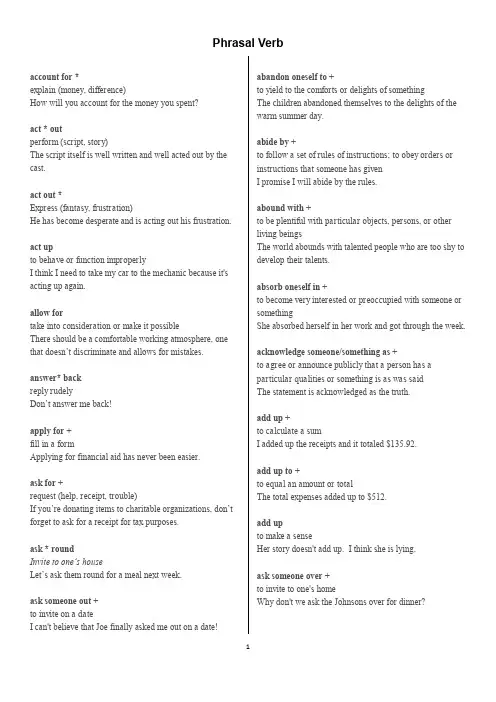
Phrasal Verbaccount for *explain (money, difference)How will you account for the money you spent?act * outperform (script, story)The script itself is well written and well acted out by the cast.act out *Express (fantasy, frustration)He has become desperate and is acting out his frustration.act upto behave or function improperlyI think I need to take my car to the mechanic because it's acting up again.allow fortake into consideration or make it possibleThere should be a comfortable working atmosphere, one that doesn’t discriminate and allows for mistakes.answer* backreply rudelyDon’t answer me back!apply for +fill in a formApplying for financial aid has never been easier.ask for +request (help, receipt, trouble)If you’re donating items to charitable organizations, don’t forget to ask for a receipt for tax purposes.ask * roundInvite to one’s houseLet’s ask them round for a meal next week.ask someone out +to invite on a dateI can't believe that Joe finally asked me out on a date! abandon oneself to +to yield to the comforts or delights of somethingThe children abandoned themselves to the delights of the warm summer day.abide by +to follow a set of rules of instructions; to obey orders or instructions that someone has givenI promise I will abide by the rules.abound with +to be plentiful with particular objects, persons, or other living beingsThe world abounds with talented people who are too shy to develop their talents.absorb oneself in +to become very interested or preoccupied with someone or somethingShe absorbed herself in her work and got through the week.acknowledge someone/something as +to agree or announce publicly that a person has a particular qualities or something is as was saidThe statement is acknowledged as the truth.add up +to calculate a sumI added up the receipts and it totaled $135.92.add up to +to equal an amount or totalThe total expenses added up to $512.add upto make a senseHer story doesn't add up. I think she is lying.ask someone over +to invite to one's homeWhy don't we ask the Johnsons over for dinner?back downstop defending your opinion in a debateJane never backs down. She always wins arguments.back outnot keep (a promise, agreement, deal)Sam backed out at the last second.back out of +not keep (a promise, agreement, deal)Sam backed out of the agreement at the last second.back up +give supportYou need examples to back up your opinion.back upmove backwards, reverseCould you back up a little so I can open this drawer.bawl someone outcriticize, reprimand (inf.)She bawled him out for arriving late.bear down on +biteThe soldier had to bear down on the leather strap while the doctor removed a bullet from the soldier's arm.bear down on +take strong measures againstThe U.S.A. is bearing down on drug traffickers.bear on +have to do withThis information may bear on this case.bear upwithstandI didn't think he would bear up so well in that situation.bear up under +withstandHow did he bear up under such extreme pressure. bear with +be patientPlease bear with me while I fill out the paperwork.blow invisit unexpectedly (inf.)My cousin blew in unexpectedly with his entire family.blow overpass without creating a problemAll this negative publicity will blow over in a couple of weeks.blow up +make explode; destroy using explosivesThe terrorists blew the bridge up.blow upexplodeThe bomb blew up before they could defuse it.blow upsuddenly become very angryWhen Joan heard the news, she blew up and rushed out of the room.break something downanalyze in detailWe need to break this problem down in order to solve.break downstop working properlyThe truck broke down in the desert.break downbecome mentally illShe broke down after her husband died.break something inwear or use something new until it is comfortableI need to break these shoes in before I go hiking.break ininterruptWhile we were discussing the situation, Terri broke in to give her opinion.break inenter a place unlawfullyThe burglar broke in between midnight and 3 AM.break in on +interrupt (a conversation)Jane broke in on the conversation and told us to get back to work.break into +enter a house unlawfullyThe burglar broke into the house between midnight and 3 AM.break into +interrupt (a conversation)Jane broke into the conversation and told us what she knew.break something offend somethingSally broke her engagement to John offbreak outappear violentlyViolent protests broke out in response to the military coup.break out +use something extravagant for celebrationHe broke out the champagne to celebrate his promotion.break out of +escapeThe murderer broke out of the prison.break something upbreak into piecesI broke the cracker up into pieces and put it in the soup.break something up +disperse (a crowd), stop (a fight)The police broke the demonstration up before it got out of control. break upend a relationshipSam and Diane broke up again. What a rocky relationship.bring about +cause to happenDemocracy brought about great change in the lives of the people.bring something along +bring withWhen we go to the forest, bring your wildlife guide along.bring someone aroundchange someone's mind, convince someoneShe doesn't want to go, but we'll eventually bring her around.bring something awaylearn or gain (from an experience)My trip across the Sahara was difficult, but I brought a new appreciation for life away from the experience.bring off +succeed at something difficult or unexpectedYou robbed the bank! I can't believe you brought that off.bring on +cause somethingI can't believe she got so angry. What brought that on?bring out +highlight, stressYour new shirt brings out the color of your eyes.bring over +bring to someone's houseWhen you visit me, why don't you bring over your son.bring torevive consciousnessWe used smelling salts to bring her to after she fainted.bring up +mentionI didn't want to bring up the fact that she was unemployed.bring up +raise ( a child)Sam was brought up in South Carolina.brush off +ignore something or someone (inf.)Mary brushed her ex-boyfriend off at the party.burn * down +destroy by setting fire toThe children burned the house down while playing with matches.burn downburn until completely gone (building)Two buildings burnt down in the fire.burn upbe hotI am burning up in here - open the window.burn upconsume by fireThe papers were burned up in the fire.burn up +destroy by fireHe burnt up the files.buy out +buy the shares of a company or the shares the other person owns of a businessPacific Inc. was bought out by a company from Oregon.buy up +purchase the entire supply of somethingWe bought up all the beer in the store. call for +require (as in a recipe)This recipe calls for milk, not water.call * off +cancel somethingThey called the picnic off because of the rain.call * off +order to stop (an invasion, guard dogs)He called off the dogs when he saw it was his neighbor.call on +visitMark called on Naomi while he was in town.call on +invite someone to speak in a meeting or a classroom Professor Tanker called on Tim to answer the question.call * up +telephoneI called Sam up to see if he wanted to go to the movies.calm * down +make someone relaxYou can calm the baby down by rocking her gently.care for +nurse someone or somethingHe cared for the bird until its wing healed.care for +like someone or somethingI don't care for sour cream on my potato.carry on +continue (a conversation, a game)Please, carry on. I didn't mean to interrupt you.carry on with +continueI want you to carry on with the project while I am out of town.carry on about +continue in an annoying wayHe kept carrying on about how much money he makes.carry * out +complete and/or accomplish somethingThe secret agent carried out his orders exactly as planned.carry * over +continue on a subsequent day, page, etc.The meeting carried over into lunch time.catch onslowly start to understand (inf.)He caught on after a few minutes.catch upmake up for lost timeI will never catch up. I am too behind in my work.catch up with +speed up to be at the same place as a person or thing in front of youI had to run to catch up with the others.catch up on +become up-to-dateI need to catch up on world events. I haven't seen the news in ages.check backreturn to see if everything is OKWe will check back tomorrow to make sure the project is finished.check on +make sure something is OKLet's check on the baby again before we go to sleep.check for +try to findThey checked for termites before they bought the house.check inenter a hospital, hotel etc.They need to check in before noon. check into +enter a hospital, hotel etc.They checked into the hotel at 11:00 AM.check into +investigate, look for (often through a service)We are checking into discount flights to London.check by +go to a place to see if everything is OKWe need to check by the office to see if the documents are ready.check * off +make a mark next to (an item on a list)Check each name off the list.check * out +investigate, take a look atHe checked out the new restaurant down the street.check outleave a hotel, hospitalIt's already eleven. We need to check out.check out of +leave a hotel, hospitalWe checked out of the hotel before ten.check * over +closely examine the condition of somethingHe checked over the old car to see if it was worth buying.check up on +investigate someone or somethingThe police are checking up on the bomb threats.check * throughsend luggage through (to a destination)Your luggage will be checked through to Paris.check with +ask a person for confirmationHe needs to check with his parents before he goes.cheer * upmake someone feel cheerfulThe party really cheered me up.cheer upbecome cheerfulCheer up. Everything will be all right.chew * up +chew into small piecesThe dog chewed up my shoe.chop * down +fell/cut ( a tree)The lumberjack chopped the tree down.chop * up +chop/cut into small bitsHe chopped the meat up into little pieces.clean * up +tidySusan cleaned the mess up before she left.clear outleave ( inf.)Everybody clear out! We're closed.clear * up +tidySusan cleared up the mess before she left.close * down +close a place permanentlyThe corner market closed down because they didn't have many customers.close downclose permanentlyThe bar was closed down because they served alcohol to minors.close in on +approach and threatenThe rebels were closing in on the capital, so the government called in the army. close * up +close temporarilyThey are closing the ski resort up for the summer.close upclose temporarilyThe ski resort is closing up for the summer.come aboutoccur / happenHow did you idea for the book come about.come across +discover by accidentThey came across some lost Mayan ruins in the jungle.come across +initially seem or have the appearanceHe comes across as rather rude, but he isn't.come alongaccompany someoneIf you want, you can come along.come along with +accompanySam came along with us to the beach.come alongprogressHow's the research paper coming along.come along with +progressHow are you coming along with the research paper.come awayleave a place with a particular feeling or impressionI came away from the meeting feeling like the presentation was a success.come backreturnWhat time are you coming back?come by +get, receiveHow did you come by that new Mercedes?come byvisit a person at their houseI'll come by later this afternoon.come down with +become sick withHe came down with the flu.come into +inheritHe came into a large sum of money when his aunt died.come off +fall off, break offThe handle came off the suitcase when I picked it up.come outappearI didn't see the car at first. It came out of nowhere.come outreveal you are homosexualSam finally came out last month.come outturn out, end upThe pictures came out great.come out with +produce and distribute a productMicrosoft is coming out with a new video game system next month.come overvisit someone at their houseWhy don't you come over after work for dinner.come toregain consciousnessDon't worry! She faints all the time. She always comes to after a few minutes. come throughdo what is needed or expectedTerry really came through for us in the end.come up to +approach; to equalThe job offer didn't come up to her expectations.come up with +produce or create (an idea, a plan)She came up with a great proposal for the new advertising campaign.come with +include (an accessory)The computer system doesn't come with a printer.count * in +includeDid you count expenses in?count on +depend/rely onYou can really count on Sarah.count * out +excludeYou can count James out. He hates playing poker.count * up +addCount the change up and see how much we have.cross * out +draw a line through something, eliminateWhy did you cross my name out on the list?cut downdecrease the amount ofYou eat too much fat. You need to cut down.cut down on +decrease the amount ofYou need to cut down on your fat intake.cut ininterruptShe suddenly cut in and delivered the newscut in on +interruptShe cut in on the conversation and delivered the news.cut * offinterrupt someone while they were speakingShe cut him off before he said something he would regret later.cut * off +sever ( with a knife)His finger was accidentally cut off in an industrial accident.cut * out +removeHe cut the bone out of the steak.cut * outstop an actionCut it out! You're bothering me.cut * up +cut into small piecesHe cut the beef up and put the pieces in the soup.iron * outeliminateWe need to have a meeting this week in order to iron out the distribution problems. eat awaygradually destroy, erodeThe heavy rains ate away at the sandstone cliffs.eat * up +devourKen ate the cookies up.eat ineat inside the homeWe usually eat in instead of going out for dinner.eat outeat outside the homeThey eat out once a week.jack up +to raiseWe need to jack up the car before we change the tire.joke aroundto be humorousMike is always joking around at work.jump inenter a conversationFeel free to jump in at any moment while we are talking.jump to +make a quick, poorly thought out decisionYou shouldn't jump to conclusions.face up to +acknowledge something difficult or embarrassingI'll never be able to face up to my colleagues after getting so drunk last night at the work party.fall back on +be able to use in case of emergencyYuki can fall back on her degree in biology if she doesn't succeed in her acting career.fall behindgo slower than scheduled, lagHurry up or you will fall behind!fall behind in +go slower than scheduled, lagCheryl has missed several days of school and now she is falling behind in her homework.fall offdecreaseInterest in the project fell off when they realized it wouldn't be profitable.fill * out +complete (an application)I filled out an application to rent the apartment last week.fill outmature, get breastsNow that you're filling out honey, we need to get you a bra.fall out with +have an argument withI had a falling out with my sister last month and we haven't talked to each other since.fall throughfail to happenUnfortunately, my trip to Indonesia fell through because I couldn't save enough money.find outdiscoverVicky's parents are going to be so mad when they find out she got a tattoo.feel * up +gropeShe sued her boss for sexual harassment after he felt her up. feel up to +have the energy to do somethingI don't feel up to going out tonight because I need to work.figure on +expectWhere do you figure on living when you move to the U.S?figure * out +solve something, understandI finally figured the joke out. Now I understand why everybody was laughing.figure * up +calculateI need to figure my expenses up before I give you an estimate.fill * in +completeDon't forget to fill in all the blanks on the application.fill insubstituteWho is going to fill in while you're gone?fill in for +substitute forMiguel filled in for me at the meeting yesterday because I was sick.fill * up +fill to the topFill the car up with unleaded gas, please.fix * up +repair, renovate, remodelMy neighbors are fixing their house up.find out +discoverYou will never find out all my secrets!get * across +cause to be understoodIt's difficult to get humor across in another language.get aheadmake progressI can't get ahead even though I work two jobs.get ahead of +surpassYou need to work overtime in order to get ahead of schedule.get alonghave a good relationshipDo you and your sister get along?get along with +have a good relationshipGiovanna doesn't get along with her two brothers.get around +avoid someone or somethingSome people get around paying taxes by hiring a good accountant.get aroundgo many placesIt's easy to get around town with public transportation.get awayescapeThe bank robbers got away.get in +enter ( a car, a small boat)Get in the front seat. You will have more leg room.get inenterGet in. I will give you a ride to schoolget away with +do something against the rules or illegal and not get caught or punishedMy sister gets away with everything! get by on +survive with minimal resourcesIt's nearly impossible to get by on making minimum wage.get bysurvive without having the things you need or wantI lost my job, so I am having a hard time getting by this year.get by with +manage withYou don't need a computer. You can get by with the typewriter.get down to +get serious about a topicEnough small talk. Let's get down to business.get * off +send (a package)I finally got my sister's birthday present off yesterday.get * offremove ( a spider from your shirt)Can you get this spider off my shirt?get off +leave (a bus, plane, train, boat)We need to get off the bus at the next stop.get offleaveIt's dangerous to sit on the roof. Get off!get offidiomatic phrase - How does he justify saying that?! Where does he get off saying that?!get * onput on (clothes)You should get your jacket on because it's going to be cold.get onenter (a bus, train), mount (a horse, a bike)The train is leaving. Quick, get on!get on +enter (a bus, train), mount ( a horse, a bike)Get on my bike and I will give you a ride home.get onhave a good relationshipNatasha doesn't get on with her co-workers.get on with +have a good relationshipDo you get on with your neighbors?get on with +continue an activityNow that the police have left, let's get on with the party!get out of +exit (a small boat, car, an enclosed area)I fell into the water when I tried to get out of the canoe.get over +recover (a cold, a disease, an ex-boyfriend/ex-girlfriend) Jennifer still hasn't gotten over her breakup with Peter.give * back +return something you borrowedWhen are you going to give that book back to your teacher?get through +completeWe will never get through all of these boxes by 9:00 PM.get through +penetrateWe need a stronger drill to get through this wall.get throughpenetrateThe door was jammed, so we couldn't get through.get through (with) +finishHave you gotten through with your homework yet? get through to +make contactIt's hard to get through to Janet because her telephone line is always busy.get uprise (from sitting position or a bed)What time did you get up this morning?get * upcause someone to rise (from a sitting position or a lying position)Ahmed got Abdul up at 5:30 in the morning by turning the music up really loud.give * away +give something without asking for anything in exchange Why did Nancy give all of her furniture away?give * away +betray (a secret)We are having a surprise party for Susan next Saturday, so don't give our surprise away by acting suspicious.give instop tryingNever give in! You can do it!give off +release (a smell, light)That white flower gives off a beautiful smell.give * out +distributeI earn extra money by giving out brochures on the street.give outbecome very tired (inf.)I hope this car doesn't give out in the middle of the desert.give * up +surrender somethingThe police told the thief to give his gun up.give upsurrenderNever give up learning English!go awayleaveI yelled at the dogs to make them go away.go backreturnWhen are you going back to your house?go by +go past, go close to, visit quicklyWe go by the coffee shop everyday.go back on +not keep (one's word, a promise)Don't trust him. He always goes back on his promises.go downdecreaseThe cost of flight tickets is going down.go for +try to achieveOur team is going for the gold medal in the Olympics.go foridiomatic phrase - I am craving pepperoni pizza.I could go for pepperoni pizza.go in for +participate ( inf.)Are you going to go in for soccer this year at school?go into +discuss in detailI really don't want to go into that now.go through +examine in detail, study carefullyI need to have my lawyer go through this contract before I sign it. go offexplodeThe bomb could go off at any moment.go offbegin, start (used with signals, alarms, warning sounds) The alarm clock went off at 6:00 AM.go offstop (said of a machine)The DVD player goes off automatically if you are not using it.go offbecome angryMaria went off last night after I told her about losing her bike.go oncontinuePlease, go on. Don't let me interrupt you.go onhappenThis place is a mess! What went on here last night?go on with +continue ( a plan, a conversation)I think we should go on with the meeting and stop wasting time.go outstop burning ( a fire)The fire went out after three days.go outtake part in social activities (usually at night)They love to go out every Saturday night.go over +reviewDo you usually go over your notes before class?go overbe well received, succeedThat didn't go over well.go through +endure; experience challenges, difficulties or traumas She has gone through so much in her life.go through with +continue or proceed despite difficulties or fearsI have decided to go through with the operation.go with +match (clothing)That shirt doesn't go with those pants.go with +accompany a personI am going with Alejandro to the party.go with +have a boyfriend/girlfriendI am going with Yuri.go without +abstain from something you want or needA person can go without water for three days.grow undergo out of businessThe restaurant went under after it lost its liquor license.grow upmatureYour brother needs to grow up and start thinking about his future. hand * back +returnIs the teacher going to hand back our tests today?hand * down +pronounce formallyThe president is going to hand his decision down on health care tonight.hand * down +give as an inheritanceWhen my clothes got too small for me as a child, I handed them down to my sister.hand * in +submitI have to hand in an offer by March 12.hand * out +distributeWe should hand the concert fliers out at school.hand * over +relinquish control ofHand your car keys over. You're too drunk to drive.hang around +stay in a place for fun ( inf.)Maria and Salvador usually hang around the beach after school.hang aroundstay in a place for funThose guys just hang around all day.hang * up +suspend (clothes on a hanger)You can hang your jacket up in the front closet.hang upput down the telephone receiverDon't hang up. I'm going to change phones.hang out +stay in a place for fun (inf.)Let's go hang out at the mall tonight.hang outstay in a place for funWhat are you doing? - - I'm just hanging out.have * on +wearDo you have your hiking boots on?have * overinvite guests to your homeWhy don't we have Mr. and Mrs. Jones over for dinner tonight.hear from +receive news from (a letter, an e-mail)Have you heard from Steve lately?hear of +know about something or somebodyHave you heard of chocolate covered ants?hit on +find on accidentI hit on the idea while watching the Simpsons show.hit on +flirt withJay's friend Marc was trying to hit on my sister last night.hold * back +restrainThe police held the demonstrators back while the politicians entered the building.hold backnot allow to advance in schoolThe teacher held Frank back a year, so he couldn't enter fifth grade.hold * off +restrainMr. Johnson held the dog off while we crossed the yard.hold ontell someone to wait on the telephoneHold on a minute. I'll get Carol. hold ongrasp tightlyHold on tight! The roller coaster is about to take off.hold on to +grasp tightlyMake sure you hold on to the hand rail as you walk down the stairs.hold off on +delayWe should hold off on making dinner until your parents arrive.hold outnot give in, continue to resistStop holding out and tell us where you found all of these old records.hold out against +not give in, resistThey held out against enemy attack.hold * up +delay (a flight, traffic);The accident held traffic up for an hour.hold * up +rob (a bank, a person) with a weaponFive men held the bank up yesterday.quiet * down +be quiet, or cause to be quietThe neighbors told us to quiet down last night or they would call the police.。
phrasal verbs 的类型及使用方法

phrasal verbs 的类型及使用方法【摘要】Phrasal verbs are combinations of verbs and particles that have different meanings from their individual parts. They are an essential part of English language learning, as they are commonly used in everyday speech and writing. In this article, we will explore the different types of phrasal verbs, such as transitive, intransitive, separable, and inseparable, along with examples of each type. We will also discuss how to use phrasal verbs effectively, including tips on how to remember and practice using them in context. Additionally, we will highlight the importance of phrasal verbs in communication and provide strategies for improving phrasal verb skills. By understanding the types and usage of phrasal verbs, learners can enhance their language proficiency and better communicate in English.【关键词】引言、phrasal verbs、重要性、透明分割、类型、例子、使用方法、有效使用、注意事项、应用价值、提高技能、总结1. 引言1.1 什么是phrasal verbsFor example, the phrasal verb "make up" can mean "to create" (e.g. He made up a story), or "to reconcile" (e.g. They made up after their argument). The particles "up" in this case changes the meaning of "make", making it a new expression altogether.1.2 phrasal verbs的重要性Moreover, phrasal verbs are often used in idiomatic expressions, helping to convey cultural nuances and nuances that may not be easily translated. Understanding and using phrasal verbs correctly can greatly enhance one's language skills and improve their overall communication abilities.2. 正文2.1 透明分割phrasal verbs的类型Phrasal verbs are commonly used expressions in English that consist of a verb followed by one or more particles, typically a preposition or adverb. They can often have meanings that are different from the individual words they are made up of, making them an important aspect of the English language.2.2 常见类型的例子Phrasal verbs are commonly used in English and come in many different types. Some common types of phrasal verbs include:By understanding the different types of phrasal verbs, you can improve your understanding and use of them in everyday speech. Practice using phrasal verbs in context to become more comfortable with their usage and remember to pay attention to the specific meaning of each phrasal verb. With practice and dedication, you can master the use of phrasal verbs and enhance your English language skills.2.3 phrasal verbs的使用方法Phrasal verbs are a unique aspect of the English language that can be quite challenging for learners. However, with the right strategies and practice, you can effectively incorporate them into your vocabulary and improve your overall language skills.2.4 如何有效使用phrasal verbs1. 熟悉常见的phrasal verbs:由于phrasal verbs有很多不同的搭配方式,建议学习者先掌握一些常见的phrasal verbs,比如"take off", "put up with", "look forward to"等等。
phrasal verbs类型

Phrasal Verbs(短语动词)1. 什么是短语动词短语动词(Phrasal Verbs)是由动词与一个或多个副词或介词组合而成的词组。
它们的意思往往与各个组成部分的字面意思不同,需要通过上下文来理解。
例如,“look up”表示查阅,而不是单纯的“看上去”和“向上看”的意思。
2. 短语动词的分类2.1 及物短语动词及物短语动词(Transitive Phrasal Verbs)后面可以跟一个宾语,宾语通常位于动词和副词或介词之间。
例如,“take off the jacket”(脱下夹克)中,“jacket”是宾语。
2.2 不及物短语动词不及物短语动词(Intransitive Phrasal Verbs)后面没有宾语,只能使用主语或上下文来理解意思。
例如,“wake up”(醒来)中,没有直接宾语。
2.3 及物/不及物短语动词有些短语动词既可以作及物动词,也可以作不及物动词,意思略有差异。
例如,“turn off”可表示关闭(及物动词),也可表示离开(不及物动词)。
3. 短语动词的衍生形式短语动词还可以衍生出其他形式,如名词、形容词和副词等。
常见的衍生形式有:3.1 名词短语动词可以通过添加后缀或改变词性来衍生出名词。
例如,“break up”(分手)可改为名词“breakup”(分手)。
3.2 形容词短语动词可以通过添加后缀或改变词性来衍生出形容词。
例如,“break down”(故障)可改为形容词“broken-down”(破烂的)。
3.3 副词短语动词可以通过添加后缀或改变词性来衍生出副词。
例如,“bring in”(引进)可改为副词“inward”(向内地)。
4. 短语动词的用法4.1 不分割的短语动词有些短语动词在使用时不能分割,即动词和副词/介词必须紧密结合,不能中间插入宾语。
例如,“put off”(推迟)不能写作“put the meeting off”。
4.2 可以分割的短语动词有些短语动词在使用时可以分割,宾语可以放在动词和副词/介词之间。
phrasal verbs

Phrasal verbs*formation:短语动词是由副词或介词与动词构成的,有时也会由副词和介词与动词构成.★1.The price of petrol may go up (= increase上升) again next week.2.He fell over (= fell to the ground摔倒) when he was running for the bus.3.She’s promised to find out (= learn/discover找到) the name of that new hotel.4.If you don't understand the meaning, you can look it up(= find the meaning in a book – in this case a dictionary查字典).5.He doesn’t get on with (= have a good relationship with 相处融洽) his parents. (verb + adv + prep)*Meaning: ①有时短语动词的词义与其基础动词词义较接近,副词只是加强了基础动词的词义如:stand up, wake up, save up, hurry up, sit down, lie down 和send off (e.g. a letter).②其他情况下,副词增加了完成动词从事的动作的词义,例如: drink up (=finish your drink)eat up (= finish eating)③然而多数情况下,短语动词的词义与基础动词是不同的, 例如: go up不是go的意思; look after也不同于look, 更有别于look up.一个副词或介词看来可以很大程度的改变一个动词的词义.如:1.It took her a long time to get over (= get better / recover from 恢复) her illness.Get over: 克服;恢复;熬过2.He told me to carry on (= continue继续走) as far as the traffic lights. Sth.\doing3.I persuaded my wife to give up (= stop戒掉) smoking.4.I can't make any sandwiches because we've run out of bread. (=the bread is finished / all used, so we have no bread 面包吃完了)5.In the end my next-door neighbor had to come and put out (=extinguish/stop把火熄灭) the fire.*Multiple meaning:许多短语动词不只有一个意思,因而当你遇到你知道的短语时要当心,或是查一查字典.在下列标有下划线的例子中,动词短语比括号中的解释在使用时要自然得多.take offIt was hot so I decided to take off (= remove 脱下) my jacket.I am always nervous when the plane takes off (= leaves the ground 起飞).get throughI don’t think I’ll get through (= finish 完成) this report before five o'clock.I think she’ll get through (= pass 通过) the exam.pick upI picked up the rubbish (= took it from the ground or a low place拾起) and put it in the bin.I had to go to the shop to pick up (= collect取) my photos.go off爆炸;消失;响起;进行;变质;熄灭My alarm clock didn’t go off (= ring响) this morning.The bomb could go off (= explode爆炸) at any minute.The fish will go off (= go bad变坏) if you don't put it in the fridge.*Grammar:intransitive verbs(vi.)有些短语动词是不及物的, 不需要有直接宾语.1.The children are growing up. (= getting older and more mature成长)2.The doctor told me to lie down(躺下) on the bed.3.Don’t wait out there. Please come in. (= enter进来)4.I’m going to stay in (= stay at home待在家) this evening. Stay in不出门;固定…位置上不动;(火焰等)继续燃烧stay in a job在这些动词中, 你无需在动词和副词之间加进任何词.*Grammar: transitive verbs(vt.) 许多短语动词是及物的, 需要有一个直接宾语. 在这些词中, 你可以将宾语放在动词和副词之间:Put on your shoes. Turn on the TV.Put your shoes on. Turn the TV on.如果宾语是个代词, 它必须放在动词和副词之间.Put them on. [NOT Put on them]Turn it on. [NOT Turn on it]*Style: formal or informal有些短语动词可以同样用语口语和书面语中.这是因为没有更简单的表达该短语动词的方式.1.I always wake up (起床) early, even at weekends.2.The car broke down (= went wrong; stopped working 坏了) on themotorway.3.The plane couldn't take off (起飞) because of bad weather.4.Thieves broke into (= entered by force and illegally 破门而入) thehouse and took money, credit cards and all my jewellery.但是多数短语动词是非正式的. 常用于口语中, 而在书面语中会有一个更正式的且具有同等意义的词.1.We had to make up a story. (= invent/create from our imagination编造)2.I can usually get by on about £200 a week. (= manage 勉强过活)3.You can leave out questio n 7. (= omit, i.e. you don‘t need to doquestion 7排除, 省略)4.They‘ve got a problem and they asked me to sort it out. (= resolve (it) / find a solution / do something about it 解决)vt.整理;选出;解决;惩罚;分类Sort out things you want to keep and throw everything else away。
phrasal verbs例子
Phrasal Verbs例子Phrasal verbs是英语中的一种特殊用法,由一动词加上一个或多个介词、副词构成,有着独特的意义。
这种用法常常让学习者产生困惑,因此我们将通过一些例子来帮助大家更好地理解和掌握phrasal verbs。
一、动词+介词1. Look after- 例句:I need to look after my little brother this evening.2. Put off- 例句:I'm going to put off our meeting until next week.3. Come across- 例句:I came across an interesting book at the library.4. Get on- 例句:How are you getting on with your new job?5. Take off- 例句:The plane took off right on schedule.二、动词+副词1. Break down- 例句:My car broke down on the way to work this morning.2. Go on- 例句:The party went on until midnight.3. Run out- 例句:We ran out of milk, so I need to go to the store.4. Look up- 例句:If you don't know the meaning of a word, you should look it up in the dictionary.5. Set off- 例句:We'll set off for our vacation at 6 AM tomorrow.以上是一些常用的phrasal verbs的例子,通过这些例子我们可以了解到phrasal verbs的用法和意义。
动词短语与短语动词区别
短语动词与动词短语区别区别:英语中短语动词与动词短语是不相同的两个概念。
短语动词是英语习语的一个重要类别,而动词短语是一种自由词组。
从词汇学的角度看,它们分属于两个不同的范畴:词类和短语。
从结构看短语动词是由动词加上小品词生成的,而动词短语则是由转换生成语法学派提出的动词加上其他词类构成的短语结构。
短语动词(Phrasal verb)又称“动词词组”,它们是由一个动词和其它词类在一起构成的固定搭配,即由动词加介词、副词或其他词构成的词组,其作用和动词差不多。
有些短语动词相当于及物动词,有些则相当于不及物动词。
因此我们可以把它们看作一个整体,像一般实义动词一样使用。
不同于介词短语,介词和其他代词或名词搭配形成介词短语。
英语中一些常用动词常可以与某些介词、副词或其他词构成意义不同的习语(idioms)。
这些组合一般只作为一个整体使用,因此被称为短语动词。
本章分四小节:1)Verb + Preposition;2)Verb + Adverb;3)Verb + Noun/Pronoun + Preposition ;4)Verb + Adverb + Preposition动词+介词1 动词+介词(Verb + preposition)这类短语动词的宾语不论是名词还是人称代词,都要放在短语动词的后面。
"不及物动词+介词"具有原来的字面含义a),或一种或者多种引申的意义b)。
a)系列中动词作其伴生词面意义,与介词有固定关系,属于介词动词,而b)系列中,动词和介词在一起构成一个习惯性的,常常是比喻性的语义单位,属于短语动词,b)系列中的动词一般都允许有相应的被动态。
例如:动词+副词2 动词+副词(Verb + adverb)这类短语动词,有的相当于一个及物动词。
--Trains stop here in order to pick up passengers only. 必须注意,本组短语动词一般都可以构成被动语态。
phrasal verb
在英语中,有动词和小品词(up, down, in, out, on, off, over, away)构成的动词短语很多,有时很难猜出它们的意义,笔者收集了常见的动词短语, 通过分析小品词的意义,对这一类的短语进行分类,找出它们的规律,以便更好地掌握它们, 注意有些短语意义很接近, 这要结合例句和上下文掌握它们的用法。
1. up1) 向上(toward or into a higher position)lift ~ 举起 climb ~ 爬上 come ~ 上升 get ~ 起来 stand ~ 站起来 pick ~ 检起 draw ~ 升起 grow ~ 长大 hand ~ 拖起put ~ 举起 send ~ 使上升 rise ~ 升起 look ~ 抬起头 zip ~ 拉上 hold ~ 举起 pile ~ 堆起 dig ~ 挖出 take ~ 拿起build ~ 树立 set ~ 建立2) 完成,结束(expressing completeness and finality) finish ~ 完成 drink ~ 喝干 eat ~ 吃光 burn ~ 烧光 wash ~ 洗净 use ~ 用光 fill ~ 装满 pay ~ 付清 settle ~ 解决lick ~ 甜净 sum ~ 总结, open ~ 透露 end ~ 结束 let ~ 中止, 减少 draw ~ 停止 close ~ 停止,关闭 swallow ~ 吞没beat ~ 痛打 cover ~ 掩盖 break ~ 结束,分解 wind ~ 结束3) 离开,消灭(expressing separation and destroy)break ~ 拆开,驱散cut ~ 切碎 split ~ 分裂 divide ~ 分割smash ~ 捣毁 blow ~ 炸毁 wither ~ 枯死 tear ~ 撕碎 give ~ 放弃 fold ~ 垮台 dry ~ 枯竭,干涸crack ~ 撞坏 clutter ~ 使散乱 litter ~ 乱丢杂物4) 增加,变强(to a state of greater activity, force, strength, power and degree.(1). mount ~ 增加pick ~ 振作,加快pluck ~ 振作 turn ~ 开打,开大, 出现 shake ~ 震惊 steam ~ 使发怒 stir ~ 激起,搅起ease ~ 放松 warm ~ 兴奋 speak ~ 大声说 heat ~ 变热total ~ 加总 tense ~ 紧张 gather ~ 收集 speed ~ 加速screw ~ 振作 build ~ 增大 show ~ 显现 cheer ~ 振作起来stir ~ 刺激 work ~ 激动,刺激(2). 用在带"-en"后缀的动词后(used after the verbs with suffix of -en)brighten ~ 发亮 fatten ~ 发胖 freshen ~使新鲜 harden ~变硬 sharpen ~ 变快 smarten ~ 变精明strengthen ~ 加强sweeten ~ 变甜 tighten ~ 使紧密 toughen ~ 使强壮soften ~ 变软5). 变好,改善( as to be better and proper)bring ~ 抚育check ~ 核对 clear ~ 清理,晴天clean ~ 整理 do ~ 整理patch ~ 修理 polish ~ 擦亮, 改进light ~ 点亮 tune ~ 调整 tidy ~ 整理 rub ~ 擦亮 train ~ 训练,培养 make ~ 化装, 和解, 弥补buy ~ 囤积 figure ~ 计算 fix ~ 修理,整理take ~ 从事6) 关住,锁紧,固定住(firmly, tightly and closely) shut ~ 关闭 lock ~ 锁住 tie ~ 栓住 chain ~ 锁住 nail ~ 钉住 fasten ~ 系住 pin ~ 钉住 bind ~ 装订 bar ~ 关住 block ~ 堵塞 choke ~ 堵塞 save ~ 存起来 store ~ 贮藏 stock ~ 储存 cover ~ 掩盖 wrap ~ 包住 lay ~ 储存 hold ~ 延误keep ~ 坚持7) 向说话人的方向(to the place where the speaker is)go ~ run ~ rush ~ drive ~ walk ~ catch ~ swim ~ march ~ come ~2. down1) 向下的位置(to or into a lower position)cast ~ 扔下 cut ~砍倒 get ~ 下来 hand ~ 传下来 knock ~ 撞倒 lay ~ 放下 let ~ 放下 pour ~ 倾盆而下 pull ~ 拉下 set ~ 放下 sit ~ 坐下 step ~ 走下来 throw ~ 扔下 turn ~ 拆下 take ~ 取下 blow ~ 吹倒 bring ~ 打倒 hang ~ 垂下 sink ~ 沉落 slip ~ 失足 squat ~ 蹲下 swallow ~ 吞下 stoop ~ 伏身 splash ~ 飞溅而下 touch ~ 降落 bend ~ 弯下 bow ~ 鞠躬 kneel ~ 跪下 lie ~ 躺下 strip ~ 脱下2) 减少(强度,量和体积)(a decrease in intensity, amount, bulk) dwindle ~ 减少 die ~ 变弱,逐渐停止go ~ 平静下来 mark ~ 削减 hold ~ 压低 burn ~ (火)减弱, 烧坏slow ~ 慢下来 burn ~ 烧掉 wash ~ 冲淡 clean ~ 弄干净rub ~ 擦干净 bring ~ 降低 keep ~ 缩减 trim ~ 裁减 water ~ 冲淡 thin ~ 减少 run ~ 用光衰弱 wear ~ 削减,磨损come ~ 下跌 knock ~ 降价3) 停止,减弱(to a state of less activity, force, strength and power)close ~ 关闭 drop ~ 突然停止 break ~ 坏了,中止run ~ 停止 settle ~ 平静下来 cool ~ 冷静下来 turn ~ 拒绝 die ~ 停止 lay ~ 失望 put ~ 镇压 4) 紧紧地,牢牢地(firmly, tightly) fasten ~ 系牢 chain ~ 链住,栓住clamp ~ 夹住nail ~ 钉住 pin ~ 扣牢 hammer ~ 钉上 tie ~ 栓住 bind ~ 捆绑 draw ~ 停下来 5) 写下,记下(on paper or in writing) write ~ 写下 copy ~ 抄下 note ~ 记下 take ~ 记下 put ~ 记下 get ~ 记下 have ~ 写下3 on1) 继续(continuously)carry ~ drive ~ fight ~ hold ~ keep ~ live ~ sleep ~ sing ~ walk ~ go ~ hurry ~ move ~ read ~ follow ~ struggle ~ insist ~ 坚持2) 连上,固定住,(in or into a state of being connected) act ~ 对…起作用catch ~ 抓牢 come ~ 跟随 count ~ 依赖draw ~ 带上,穿上fasten ~ 纠缠,抓牢fit ~ 固定 get ~ 接近 paste ~ 粘住 turn ~ 打开 switch ~ 打开 pin ~ 钉住 put ~ 穿上 try ~ 试穿 pull ~ 穿上 hang ~ 不挂断 build ~ 建立于 leave ~ 留住 take ~ 穿下 rely ~ 依靠 depend ~ 依靠3) 向前,向上(forward, onward)add ~ 加上 mark ~ 标上 paint ~ 漆上 press ~ 向前 pass ~ 传递 send ~ 转送 stamp ~ 盖章于 get ~ 上车 hand ~ 传送4) 开始某活动(in or into an active operation)work ~ 从事 fall ~ 攻击 hit ~ 突然向起 bring ~ 引起 get ~ 取得进展 look ~ 旁观, 观看call ~ 拜访 figure ~ 打算,希望 fix ~ 决心 get ~ 进步, 友好相处pick ~ 批评 plan ~ 打算 decide ~ 决定 reflect ~ 思考, 反思remark ~ 评论,议论settle ~ 决定 spur ~ 鼓励 urge ~ 督促4. off1) 离开(indicating departure)blow ~ 吹掉 drive ~ 击退get ~ 下车,动身lift ~ 离开地面 make ~ 逃走 move ~ 离去pack ~ 打发走 see ~ 送行 ship ~ 运往 start ~ 动身 send ~ 送行,解雇call ~ 叫走 let ~ 放出 take ~ 起飞 touch ~ 发射 give ~ 发出 clear ~ 走开 carry ~ 夺走2) 去掉,断开(indicating removal or disconnection)cut ~ 切断 tear ~ 扯掉 take ~ 拿走 chip ~ 切下 come ~ 脱落 cross ~ 除去 drop ~ 跌落 fall ~ 脱落 flick ~ 弹掉peel ~ 剥掉 pull ~ 撕开 rub ~ 擦掉 scrape ~ 挂去 shave ~ 剃去 wash ~ 洗掉 shake ~ 抖落 throw ~ 扔开 rip ~ 扯开turn ~ 关掉 strip ~ 脱去 switch ~ 关掉 take ~ 脱掉 shut ~ 关掉 wear ~ 磨损 go ~ 爆炸 break ~ 中断3) 完成,停止(indicating completion)finish ~ 结束 pay ~ 付清 break ~ 停止,中断send ~ 结束leave ~ 停止 pass ~ 终止,停止sign ~ 停止播音 wear ~ 消失, write ~ 注销,购销bring ~ 完成 call ~ 取消 lay ~ 停止, 解雇4) 着地(down to the ground)fall ~ 落下 jump ~ 跳下 knock ~ 击倒 slip ~ 滑倒5. in1) 进入,向里(into, inside, indoors)barge ~ 闯入 beat ~ 打进 break ~ 闯入,插嘴breathe ~ 吸入 burst ~ 闯入,打断drop ~ 偶然拜访 fall ~ 跌入 get ~ 插入,收进 knock ~ 打入 lead ~ 导入 let ~ 进入,嵌入 move ~ 迁入 step ~ 走进 settle ~ 迁入 smuggle ~ 偷偷运进cut ~ 插嘴 call ~ 来访 draw ~ (火车)进站intervene ~ 介入involve ~ 卷入2) 包围,关闭(to be surrounded, or enclosed)close ~ 包围,封闭lock ~ 禁闭 shut ~ 关进 wall ~ 围住3) 加入,记入(to be added, or included)book ~ 登记 check ~ 签到 count ~ 记入 fill ~ 填入 hand ~ 交上 take ~ 吸收 send ~ 呈交6. out1) 向外(away from the inside, outside)keep ~ 使在外 take ~ 拿出 put ~ 放出,伸出come ~ 长出,bring ~拿出 bar ~关在外 breathe ~ 呼吸出 eat ~ 出去吃get ~ 弄出 go ~ 出去 lay ~ 摆开,展示lock ~ 关在外面 look ~ 向外看 move ~ 搬出 point ~指出 pour ~ 诉说 pull ~ 拉出 ship ~ 运出 stick ~伸出 spit ~ 吐出 beat ~ 敲出 knock ~ 敲出 dine ~ 外出吃饭 drive ~ 驾车外出 leak ~ 漏出 draw ~ 拉出 see ~ 送出门去 draw ~ 出站 let ~ 放出, 释放2) 结束,消失,取消(to or at an end, not to be there or not to exist)burn ~ 烧尽,烧断clear ~ 清除 dust ~ 清除 fade ~ 消失 put ~ 扑灭 run ~ 用完 use ~ 耗尽 give ~ 耗尽 comb ~ 淘汰kick ~ 逐出 wipe ~ 消灭 die ~ 灭绝 rub ~ 擦掉 blot ~ 除去 blow ~ 吹熄 bleach ~ 漂白 carry ~ 完成,执行leave ~ 省去 see ~ 完成 go ~ 熄灭 come ~ 罢工,结果cut ~ 删去,停止hold ~ 坚持到底 sell ~ 买完 tire ~ 筋疲力尽 wear ~ 磨损3) 大声(in a loud voice, aloud)sing ~ cry ~ shout ~ call ~ ,喊,申斥 spell ~ speak ~ scream ~ read ~ yell ~ sob ~ burst ~ 咆哮4) 分发,传开(to a number of people or in all directions) give ~ 分发 spread ~ 传开 set ~ 出发 hand ~ 分发 share ~ 分配 divide ~ 分配 call ~ 出动 start ~ 出发 send ~ 发送break ~ 爆发,逃脱serve ~ 分发口粮 drop ~ 离开,退出5) 搞清,弄明白(in or into notice and clearness)find ~ 找出 figure ~ 算出,解决make ~ 弄清 count ~ 点清come ~ 出版,出现catch ~ 看出 carry ~ 完成, bear ~ 证明 bring ~ 发表,说出fill ~ 使完全, 添满write ~ 写出7. over1) 向下(downwards from an upright position)knock ~ 撞倒 turn ~ 翻转 fall ~ 脸朝下跌倒trip ~ 拌倒bend ~ 伏身 look ~ 从…上面看2) 自始至终,通过, 重复(from beginning to end, through, again and again) look ~ 调查 think ~ 考虑 see ~ 查看 run ~ 匆匆看 talk ~ 商量 call ~ 点名 read ~ 读一遍 go ~ 复习 do ~ 重复 glance ~ 浏览 skip ~ 略过 ponder ~ 思考3) 向上,向外,(indicating motion upwards or outwards) run ~ 溢出 spill ~ 溢出 boil ~ 因沸溢出 throw ~ 呕吐4) 经过(from one side to the other, across a space or distance) jump ~ climb ~come ~go ~swim ~pass ~ walk ~move ~ fly ~run ~5)结束,完成(finished, at an end)get ~ 结束,熬过 stand ~ 延期stop ~ 逗留hang ~ 延期throw ~ 抛弃go ~ 看完 leave ~ 剩下6)转变,改变(indicating transference and change)hand ~ 移交take ~ 接管buy ~ 收买come ~ 过来get ~ 战胜,克服 gain ~ 争取过来win ~ 争取过来 switch ~ 转交turn ~ 变动,交付 make ~ 移交7)由于 (because of)cry ~ 因…哭laugh ~ 笑…fuss ~ 因…着急8. away1)离开(to a distance, to another place)go ~ 走开run ~ 跑开walk ~ 走开ride ~ 开走move ~ 移开take ~ 拿走carry ~ 运走clear ~ 收走draw ~ 拉走get ~ 逃走,离开 put ~ 收起来break ~ 逃脱come ~ 离开keep ~ 不准接近2)减少,减弱(indicating loss, lessening, weakening)burn ~ 烧尽brush ~ 刷掉die ~ 消失drain ~ 流走melt ~ 融化pass ~ 消失rub ~ 擦掉wash ~ 冲走wipe ~ 擦掉boil ~ 汽化3) ( indicating separation, apart)cut ~ 切掉give ~ 赠送put ~ 抛弃,收起。
Take-on一词多义
Take on1. PHRASAL VERB 承担,接受(尤指艰巨工作或重大责任) Ifyou take on a job or responsibility, especially a difficult one, youaccept it.•No other organisation was able or willing to take on the job...没有任何别的组织有能力或愿意承担此项工作。
•Don't take on more responsibilities than you can handle.不要承担过多的责任。
2. PHRASAL VERB 呈现,显出(新面貌或新特点) Ifsomething takes on a new appearance or quality, it developsthat appearance or quality.•Believing he had only a year to live, his writing took on a feverish intensity.由于以为自己只剩一年的活头,他的文字开始变得激情澎湃。
3. PHRASAL VERB (公共汽车、船舶等)上(客),装(货),补充(燃料) If a vehicle such as a bus or ship takes on passengers, goods, or fuel, it stops in order to allow them to get on or to be loaded on.•This is a brief stop to take on passengers and water.这是一次短暂停靠,上上客,加加水。
4. PHRASAL VERB 雇用;录用 If you take someone on, youemploy them to do a job.•He's spoken to a publishing firm. They're going to take him on...他和一家出版公司谈过了,他们打算雇用他。