
仁爱版英语七年级下册Unit 5 Topic 1 Section C优质课课件
go to bed
go swimming
read books in the library
listen to music
play basketball
play soccer
Listen carefully and complete the table.
gets home
does her homework goes to bed
Read the passage and answer the questions.
(1)When do the classes begin?
Classes begin at eight.
(2)How many classes does she have in the morning?
Wang Junfeng do his homework go to the park
A: What does Wang Junfeng usually do after school? A:__________________________________________ B: He usually does his homework, but he doesn’t B:__________________________________________ _____________ go to the park.
She takes the subway home.
Work in groups of three. Discuss the following pictures and retell the passage in 1a.
Talk with your partner about your day with the help of 1a. Then report it to the class. • I usually get up at … in the morning. At … o’clock I have breakfast … … is my partner. He/She usually gets up at … in the morning …
Ellen listen to music watch TV
A: What does Ellen usually do after school? A:__________________________________________ B:______________________________________________ B: She usually listens to music, but she doesn’t watch TV.
Time 6:20 a.m. 7:00 a.m. 7:30 a.m. 12:10 p.m. after school 5:30 p.m. after dinner 9:45 p.m. Activity gets up has breakfast goes to school has lunch plays soccer
Make up new conversations with the words or phrases in the box.
Activity: meet friends watch TV listen to music read books cook go to the zoo play soccer Frequency: once a week twice a week three times a week very often every day seldom never Example: A: Do you often read books in the library? B: Yes, I do. / No, I don’t. A: How often do you come to the library? B: Three times a week.
Pair Work
Hai Qing play soccer play basketball
A:_________________________________________ What does Hai Qing usually do after school? He usually plays soccer, but he doesn’t play basketball. B:______________________________________________
Wen Wei go swimming go fishing
A:__________________________________________ What does Wen Wei usually do after school? B: He usually goes swimming, but he doesn’t go fishing. B:____________________________________________
Tell the time.
8:00
• eight o’clock • nine o five
9:05
10:15 11:30 12:45 17:50
ቤተ መጻሕፍቲ ባይዱ
• ten fifteen / a quarter past ten
• eleven thirty / half past eleven
• twelve forty-five/ a quarter to one
She has four classes in the morning.
(3)Where does she have lunch?
She has lunch at school. She plays soccer after school.
(5) How does she go home?
在学校
(4)When does she play soccer with her classmates? 放学后
初中英语七年级下unit5 Topic1 Section C教案 仁爱版
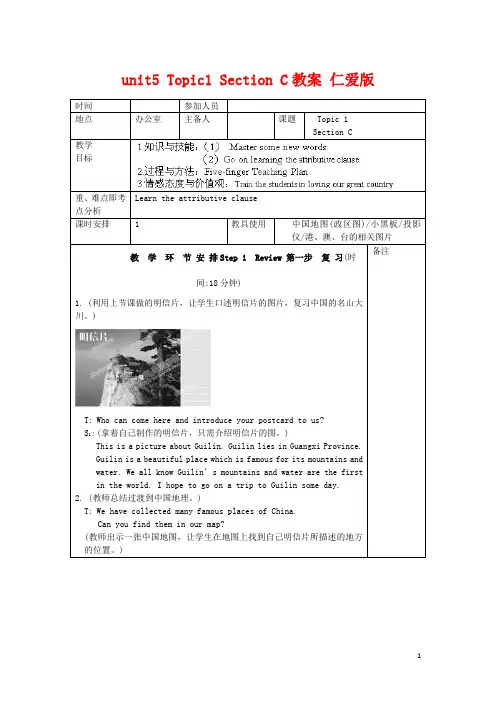
unit5 Topic1 Section C教案仁爱版Section CLearn the attributive clause教学环节安排Step 1 Review 第一步复习(时间:18分钟)1. (利用上节课做的明信片,让学生口述明信片的图片,复习中国的名山大川。
)T: Who can come here and introduce your postcard to us?S1: (拿着自己制作的明信片,只需介绍明信片的图。
)This is a picture about Guilin. Guilin lies in Guangxi Province.Guilin is a beautiful place which is famous for its mountains and water. We all know Guilin’s mountains and water are the first in the world. I hope to go on a trip to Guilin some day.2. (教师总结过渡到中国地理。
)T: We have collected many famous places of China.Can you find them in our map?(教师出示一张中国地图,让学生在地图上找到自己明信片所描述的地方的位置。
)S3: Guilin is in the south of China.S4: Mount Hong is in . It’s in the northeast of China.3. (教师总结,过渡到香港、澳门、台湾。
)(1)There are some places that have been conquered by othercountries. Can you tell me what places they are?S5: Hong Kong.S6: Macao.S7: Taiwan.Hong Kong 香港Macao 澳门Taiwan 台湾(2)(教师出示中国政区图,指出香港、澳门和台湾的地理位置。
仁爱英语七年级下册Unit5_Topic1_SectionA_优教精品课件

二、句型转换 1. It’s time for breakfast.(同义句转换) It’s time __to____ _h_a_v_e__ breakfast. 2. They go home by subway.(同义句转换) They go home ___b_y__u_n_d_e_r_g_ro_u_n_d_. 3. My sister goes to school by train.(对画线部分提问) _H__o_w__ _d_o_e_s__ your sister go to school?
D. She goes to school by subway.
Choose correct answers according to 1b.
A. by bus B. by bike C. on foot D. by subway/ underground
Kangkang comes to school ___B____. Jane comes to school ___A____. Helen comes to school ___D____. Michael comes to school____C____.
Homework
1. 登录“优教 同步学习网”完成 SectionA随 堂练习。 2. Review the means of transportation. 3. Read the sounds and words in 3a. 4. Memorize the new words.
2.—_D_o_ you often come to school _b_y_ bike? —Yes, I do.
3.—_H_o_w_ do you usually come to school? —I usually come to school _b_y_ subway.
仁爱版英语七年级下册Unit5_Topic1_SectionC精品教案

Unit5 Topic1 SectionC精品教案I. Material analysis本节课是第五单元话题一的第三课时,主要活动是1a和2。
通过介绍Jane 的一天,进一步学习用一般现在时的第三人称单数表达日常活动,巩固有关交通方式和频率的表达。
还将通过用方框中的单词和短语编对话的方式练习一般现在时的一般疑问句及其肯定和否定回答,复习日常活动和频度副词seldom和never 等。
同时学习对频率提问的句型“How often...?”和表示具体频率的副词,如once a week, twice a week, three times a week等。
语音部分主要是复习本话题所学字母及字母组合发音规律以及句子的升降调。
但是,在本课中,由于学生词汇、语法积累的不同,在将阅读输入信息转化为口头的输出时可能会出现语言组织或语法运用的障碍。
因此教师可结合图片展示、借助关键词、优生示范等活动,帮助培养学生说和复述课文的能力。
II. Teaching aims1.Knowledge aims能根据已学语音、音标及发音规则,正确朗读和拼写下列词汇:begin, at school, after, bed, basketball, swim, listen, music, library, week, once, twice在Section A和Section B的语法基础上,能熟练运用usually, often, always 等频度副词和两种交通方式的表达,能用一般现在时第三人称单数表达日常活动,能对频率进行提问与回答;在Section A已学的语音基础上,能结合图片和音标拼写单词,并能尝试结合语音发音规律拼读新单词,并了解句子的重音和升降调;能结合话题,运用“谈论日常生活、询问和回答某项活动的频度”等交际功能的用法,进行口头和笔头的信息输出,如:(1)I usually get up at ... in the morning.(2)At ... o’clock I have breakfast...(3)—How often do you come to the library?—Three times a week.2.Skill aims能听懂有关表达日常生活的叙述;能听懂简单的课堂用语,并作出反应;能根据图文就交通方式和日常活动的频度等进行交流;能在阅读训练中进行读前猜测、读中验证的活动;能根据图文理解相关话题,抓住大意和具体信息并根据要求进行学习活动;能准确写出黑体单词和词组;能写出表达交通方式和频度的简单句子。
Unit 5 Topic 1 Section B(22页)仁爱版七年级下册英语课件

Read 1a again and fill in the blanks.
Helen: Michael,what time do you usually _g_e_t _u_p__?(起床) Michael: I always get up _a_t about six o'clock. Helen: The early bird catches the worm. _H_o_w_do you usually come to school? Michael: I usually come to schoolo_n__fo_o_t, but _so_m__e_ti_m_e_sby bike. How about you ? Helen: I _s_e_l_d_o_m_ walk to school . I _o_f_t_en___ come by subway. What about you Sally? Sally: I _n_e_v_e_r _come to school by subway. I _a_lw__ay_s_ take a bus.
Hale Waihona Puke Activity watch TV in Frequency the afternoon
always
usually
often
sometimes
seldom
never
√
play soccer on Sundays
√
see a movie √
课堂总结
We learn: 1. some words: weekday, early, bird, catch, seldom, walk, never, ride, park, watch 2. some phrases: take a bus/car, do one’s homework watch TV, see a movie, play soccer 3. some sentences: The early bird catches the worm. I never come to school by subway.
Unit5 Topic1 Section C(仁爱版七年级下册)教学设计方案
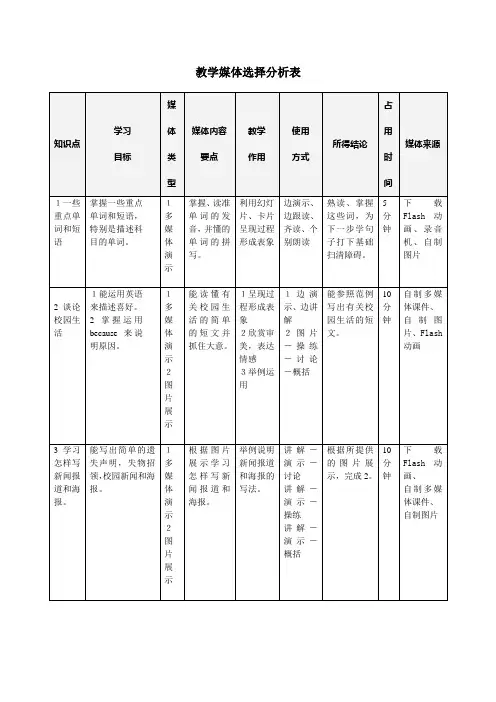
1多媒体演示
掌握、读准单词的发音,并懂的单词的拼写。
利用幻灯片、卡片呈现过程形成表象
边演示、边跟读、齐读、个别朗读
熟读、掌握这些词,为下一步学句子打下基础扫清障碍。
5分钟
下载Flash动画、录音机、自制图片
2谈论校园生活
1能运用英语来描述喜好。
2掌握运用because来说明原因。
1.根据幻灯片的内容和提示词完成1b和2.
2.根据自己的校园生活进行模仿照句.
利用幻灯片与提示词.在发扬个性学习的基础上,仍然注重全体学生的知识整体学习。创设一个平等、和谐的学习气氛。
面向全体,分层次布置作业
指导者,是学生明确课后的任务
根据任务,认真完成,并掌握本课学习内容
通过这样的作业让每个学生都有收获,争取让每一个孩,书写能力得到提高,从而达到激励全体学生努力学习兴趣.
英语
教学对象
七年级(8)
提供者Βιβλιοθήκη 课时1课时一、教材内容分析
1.一些重点单词和短语,例如:friendly, other,new, attention, between, stamp, world, Saturday, night, place, program, from…to…等等。2.运用英语来描述自己喜欢和不喜欢的科目,并阐明原因。3.模仿1a讲述自己的校园生活。4.本课中包含听、说、读、写四个部分,在说和听的基础上,注重培养学生听与写的能力。
创设一个平等和谐的学习气面向全体分层次布置作指导者是学生明确课后的任务根据任务认真完成并掌握本课学习内容通过这样的作业让每个学生都有收获争取让每一个孩书写能力得到提高从而达到激励全体学生努力学习兴趣
教学媒体选择分析表
仁爱版英语七年级下册 Unit 5 Topic1 Sectin C 课后练习

Unit5 topic1第3课时section C一、翻译下列词组。
1.踢足球2.打篮球3.去游泳4.去钓鱼5.听音乐6.看电视7.做他的家庭作业8.去公园二、根据句意及首字母提示完成句子。
1.A___breakfast,my parents usually go to work by bus every day.2.-How often does your sister go to the library to read books?——She goes there t a week .3. Classes b at eight.4.—Do you often read books in the l____? -Yes , I do .5.Ellen likes listening to m____very much.三、根据汉语提示完成句子。
(每空一词)。
1. Many Chinese students have lunch (在学校).2._______(放学后), he often plays football with her classmates.3. (多久一次)do you go to the zoo? ——Seldom.4.I play soccer (每周一次).5.She (上床睡觉)at about nine.四、句型转换。
1.Lucy doesn't very often go to the library.(改为同义句)Lucy______ to the library.2.He usually watches TV in the evening.(对画线部分提问)_____ _____he usually_____in the evening?3. The classes finish at about four o'clock in the afternoon.(对画线部分提问)_____ _____ _____ the classes finish in the afternoon?4.Wang Fang often goes to school by bike.(对画线部分提问)_____ _____ Wang Fang often go to school?5.They usually have supper at home.(对画线部分提问)_____ _____they usually have supper?五、单项选择。
仁爱版七年级英语下册教案Unit5Topic1SectionA新授课教案
四、教学过程
学习目标
教学活动
评价要点
要点归纳
学习目标一:
1.会读会写p1和p2的单词。
自学指导(一)
1、.自学内容:课本P2的新单词。
2、自学方法:先试读,同桌互相正音,提问。
3、自学时间:5分钟
(3)掌握一般现在时的用法。
1、教材分析:
本节课为该话题的第一节课,建议用2课时上完。掌握有关表达交通方式的句型。
2、中招考点:
询问对方交通方式和一般现在时的用法。
3、学情分析:
表达交通方式的句型及询问对方交通方式不难掌握,但用一般现在时来表示交通方式时,要注意谓语动词的形式。
二、学习目标:
1、会读会写P1-P2的单词及短语。
2、能运用交通方式句型进行日常交流。
3、熟读,能够说出1a的知识点,能够熟练做题。
三、评价任务
1、针对目标1学生自学新单词达到会读,读准,能拼写。
2、针对目标2学生能通过自学掌握询问交通方式句型,并能用这些句型进行相互问
候和做一些相关的题。
3、针对目标3学生通过学习1a的知识点,在老师强调及学生小组讨论的情况下总结
C.The same to you.
2.( )--- ______.
---Nice to meet you, too.
A. Thanks. B.Thank you.
C. Hi! D. Nice to meet you.
3.( )---Miss Wang your new skirt looks nice.
3、The same to you.也祝你······。用于别人向你祝福时对对方的回应,相当于You ,too!
最新仁爱版七年级英语下册Unit5 Topic1 SectionC优质课教案
Topic1 SectionC优质课教案一、整体设计思路和指导依据说明该部分通过一篇Jane’s Day,以图片和时间表相辅的方式,介绍了Jane的一天。
1.按照课程理念,在阅读教学中通过给学生搭支架,从阅读前,阅读中,阅读后三个环节来进行教学,并注重培养学生复述课文和仿写输出的能力。
2.教师方面,针对初一学生,读前巧妙运用游戏导入复习,激发学生学习热情;读中利用简单的文章结构图,帮助学生梳理文章脉络,为My Day的写作做准备;读后,让学生在图片的帮助下,复述Jane的一天,最后达到以读促说,以读促写的目的。
3.在教学中根据学生以及教学的具体需要,对本课教材合理整合,以达到最佳教学效果。
具体为Part 3和Part 2为读前内容,整合为日常活动和频度副词的一个学生Pair work对话。
1a作为主体读中内容,除了书本原本的表格活动,另增设5个问题让学生进行详细阅读。
1b和1c则作为读后内容。
其中1b的复述活动,以group work开展,并由组员上台复述,为1c作文的输出提供支架。
二、教材背景分析教学内容分析:1.本教材是义务教育教科书,北京市仁爱教育研究所编著,科学普及出版社出版,英语七年级下册Unit5 Topic 1SectionC。
2.本节课是第五单元话题一的第三课时,属于话题中的阅读教学部分。
主要活动是1a和2。
通过介绍Jane的一天,进一步学习用一般现在时的第三人称单数表达日常活动,巩固有关交通方式和频率的表达。
还将通过用方框中的单词和短语编对话的方式练习一般现在时的一般疑问句及其肯定和否定回答,复习日常活动和频度副词seldom和never等。
同时学习对频率提问的句型“How often..?”和表示具体频率的副词,如once a week, twice a week, three times a week等。
3.在本课中,由于学生词汇、语法积累的不同,在将阅读输入信息转化为口头的输出时可能会出现语言组织或语法运用的障碍。
Unit 5 Topic 1 教学内容整合仁爱七年级英语下册
Unit 5 Topic 1 I usually come to school by subway一、单词gate, by, subway, underground, always, plane, train, ship, boat, weekday, early, bird, catch, worm, sometimes, seldom, walk, never, ride, park, watch, TV, television, soccer, movie, begin, after, bed, basketball, swim, listen, music, library, week, once, twice 二、词组come on, on foot, watch TV, at school, listen to三、句型(1)—Happy New Year!—The same to you!(2)—How do you usually come to school?—I usually come to school by subway.(3)—What time do you usually get up on weekdays?—I always get up at about six o’clock.(4)I seldom walk to school. I often come by subway.(5)Li Xiang often rides a bike to school.(6)Maira sometimes takes the subway home.(7)—What does Han Qing usually do after school?—He usually plays soccer, but he doesn’t play basketball.(8)—How often do you come to the library?—Three times a week.四、功能句1.学会询问他人的日常交通方式。
仁爱版英语七年级下册Unit5Topic2period3市公开课一等奖省优质课获奖课件
5
2
4
1
3
Class is over. The students are in the classroom. ...
1. read English newspaper 2. write a letter
3. do one’s homework 4. talk
5. clean the blackboard at the back of the classroom
第7页
(In the gym) Three students are swimming in the swimming pool. What about the girls over there? Oh! They are dancing. But Helen isn’t dancing with them. She is playing pingpong with Ann.
Summary
1. Learn other new words and phrases: show sb. around, sit, write, at the back of, draw
2. Consolidate the present continuous tense. 3. Review the names of school buildings.
在图书馆 in the library 在操场上 on the playground 在电脑室 in the computer room 在食堂 in the dining hall 在办公室 in the teachers’ office 在游泳池 in the swimming pool
A: Is /Are … in the library?