
新人教版必修3新教材高中英语Unit1FestivalsandCelebrationsReadingandThinking课件
Festivals are becoming more and more
commercial.
Festivals are an important part of society.
1. congratulate vt. 向(某人)道贺; (因某事)为自己感到 自豪
*You’ve passed your driving test? Congratulations! 你驾驶测验合格了? 祝贺! *Congratulations on your winning the prize! 祝贺你获 奖!
【语块积累】
(1)congratulate sb. (on sth. )
祝贺; 庆贺; 道喜
congratulate oneself (on/upon doing sth. )
(因做某事)为自己感到自豪
(2)congratulation n. 祝贺; 恭喜
congratulations on (doing) sth. 祝贺
Festivals are becoming more and more commercial, with businesses (7)_ta_k__in_g_ (take) advantage of the celebrations, though some people are against it. Anyhow, festivals are important because they reflect people’s wishes and (8)_b_e_li_e_f_s (belief) and we can relax during them.
Байду номын сангаас
2. When was the Egyptian harvest season?
A. Autumn.
B. Summer.
C. Winter.
D. Spring.
3. What’s the function of the examples in Paragraph 2? A. To show the harvest festival is the most important in Egypt and China. B. To show it is celebrated in almost all cultures. C. To show the ways people celebrate it have changed. D. To show all the people are grateful for the supply of crops.
With the (5) _d_e_v_e_lo_p_m__e_n_t (develop) of modern society, some traditions may fade away though they once played a (6)_si_g_n_i_fi_c_a_n_t (significance) role in festivals. At the same time, some may be established.
5. a leading _f_ig_u_r_e_(人物) in the community 6. bring great _jo_y_(高兴) to millions of people 7. express my deep _g_ra_t_i_tu_d__e(感激之情) 8. at _h_a_r_v_e_st_(收获)time 9. depend on _a_g_r_ic_u_l_tu__re_(农业) 10. the potato _cr_o_p_(作物)
3. 阅读主题活动 (1)Which festival is your favorite? Why? _T_h_e_S__p_ri_n_g__F_e_s_ti_v_a_l._B__e_ca_u_s_e__I_c_a_n_s_t_a_y_w__it_h__m_y_ _f_a_m_i_ly_,_r_e_l_a_x_m__y_se_l_f_a_n_d__e_n_jo_y__s_o_m_e__d_e_li_c_io_u_s__fo_o_d_._
2. 根据课文完成短文 Festivals around the world not only have (1)_a_
wide range of origins but also have different customs. However, the spirit of (2)_s_h_a_r_in_g_ (share) joy, gratitude, love or peace is common in them. Of all the (3)_t_r_a_d_it_io_n__al_ (tradition) festivals, the harvest festival can be found in almost every culture. It (4) _is__h_e_ld_ (hold) after all the crops have been gathered in.
*I would also like to congratulate him on his reelection as Secretary-General of the United Nations. 我还要祝贺他连任联合国秘书长。 *You can congratulate yourself on having done a good job. 你的工作做得很出色, 你应该为自己感到自豪。
4. In the last weeks of her life she simply _fa_d_e_d__a_w_a_y_ (变得虚弱). 5. Kelly loved her husband _in__s_p_it_e__o_f (尽管)the fact that he drank too much. 6. She _t_o_o_k_a_d_v_a_n_t_a_g_e_o_f_(利用) the children’s absence to tidy their rooms.
Ⅲ. 文本素养提升: 阅读技能综合运用 1. 根据课文语境与语句知识细致解构语句。
译文: 另外一个例子是万圣节, _它__逐__渐__变__成__了__令__孩__子__ _激__动__的__节__日__, _尽__管__它__起__源__于__宗__教__。
译文: _虽__然__一__些__人__认__为__节__日__不__应__该__商__业__化__, 但是一些 人认为_消__费__增__长__有__益__于__经__济__和__公__众__的__幸__福__。
4. Why have Chinese people in many big cities stopped lighting firecrackers? A. To protect the environment. B. To save money. C. To avoid injuries. D. To get rid of old customs.
(2)Can you give some advice about how to spend a meaningful festival? _F_i_r_st_,_I_t_h_i_n_k_w__e_s_h_o_u_l_d_d_o__s_o_m_e_t_h_i_n_g_f_o_r_o_u_r__fa_m__il_y_ _m__e_m_b_e_r_s_o_r__fr_i_e_n_d_s_d_u_r_i_n_g_t_h_e__fe_s_t_iv_a_l_. _F_o_r_e_x_a_m__p_le_,_ _w_e__ca_n__h_e_l_p_t_h_e_m__d_o__h_o_u_s_e_w_o_r_k_._B_e_s_i_d_e_s,_w__e_c_a_n_ _tr_a_v_e_l_w__it_h_t_h_e_m__, _w_h_i_c_h_c_a_n__n_o_t_o_n_l_y_i_m_p__ro_v_e_ _r_el_a_t_io_n_s_h_i_p_b__u_t _a_ls_o__en__ri_c_h__o_u_r_l_if_e_.
【阅读微技巧】
1. 关注每一段的第一句以及带有but, however
等转折词的句子。
速览每一 段, 寻找 每段的主 题句
2. 关注作者对节日的概括性语言。例如: Festivals are celebrated all around the world. Of all the traditional festivals, the harvest festival can be found in almost every culture.
Ⅱ. 根据汉语提示用本单元的短语完成句子 1. I do like her— _a_ft_e_r_a_l_l(毕竟), she is my sister. 2. We _d_r_e_s_s_ed__h_i_m__u_p_(装扮他) as a policeman. 3. There were 120 students whose ages _r_a_n_g_e_d_f_r_o_m_ _1_0_t_o_1_8_(包括从10岁到18岁之间).
Unit 1 Festivals and Celebrations Reading and Thinking
Ⅰ. 根据语境及汉语提示写出正确的单词 1. _m_a_r_c_h_(行进) 50 km every day 2. letters of _c_o_n_g_r_a_tu_l_a_t_io_n_(祝贺) 3. the daily _ra_n__g_e(范围) of temperature 4. the _o_r_ig_i_n_(起源)of life on earth
7. We don’t really _h_a_v_e__m_u_c_h_/_a__l_o_t _in__c_o_m_m__o_n_(有许 多相同点).
新人教版必修第三册Unit1FESTIVALSANDCELEBRATIONS教案
Unit 1 Festivals and CelebrationsListening and speaking & Listening and talking【教材分析】本板块的活动主题是"谈论节日活动”(Talk about festival activities),主要是从贴近学生日常生活的角度来切入“节日”主题。
学生会听到发生在三个国家不同节日场景下的简短对话,对话中的人们正在参与或将要亲历不同的庆祝活动。
随着全球化的进程加速,国际交流日益频繁,无论是国人走出国门还是外国友人访问中国,都已成为司空见惯的事情。
因此,该板块所选取的三个典型节日场景都是属于跨文化交际语境,不仅每组对话中的人物来自不同的文化背景,对话者的身份和关系也不尽相同。
【教学目标】1 ・Master the new words related to holiday: lantern, carnival, costume, di'ess (sb) up. march, congratulation, congiatiilate, riddle, ceiemony, samba, make-up, after all.2.To understand the ongin of major world festivals and the activities held to celebrate them and the significance of these activities;3.Improve listening comprehension and oral expression of the topic by listening and talking about traditional festivals around the world;4.Improv亡students,understanding of the topic by watching pictures and videos about different traditional festivals around the world;5.Review the common assimilation phenomenon in English phonetics, distinguish the assimilated phonemes in the natural language flow, and consciously use the assimilation skill ill oral expression・【教学重难点】Importance:1 ・ Guide students to pay attention to the attitude of the speaker in the process of listening, and identify the relationsliip beh\r een the characters;2.Inspire students to use topic words to descnbe the festival activities based on tliek backgiound knowledge.Difficulties:Ill the process of listening to the coixect understanding of the speaker^ attitude, accurately identify the relationship between the characters ・【课前准备】1 ・ To understand the origin of traditional festivals in the world, the celebration activities (customs) of these festivals and the meaning of these activities;2.Talk about holiday celebrations;3.Preview: understand the new words according to the context.【教学过程】Step 1 Lead-inTeachers talk about the world's traditional festivals, such as the Lantern Festival in Cliina,adults' day in foreign countries, carnivals and so on.Step 2 Watching and talkingActivity 11.Teacher lets Ss look at some pictures about festival activities. During talking about these activities, teacher can add some background knowledge about festivals・Questions:①What festivals do the pictures show us?②In wliich countiy do you tliiiik people celebrate each festival?(3)How do people celebrate each festival?2.Ask sb to choose some words or phrases fiom the box to celebrate each festival.3.Teacher can show students how to use these word blocks and leani to describe holiday activities ingroups. For example:On the Comiiig-of^Age Day, young girls in Japan would wear traditional costumes・ One of the most important activities during the Lanteni Festival is to guess riddles. During the Rio Caniival, you can watch wonderfiil samba dances・4.Tlie teacher asks students to report the results of the group lecture・ Ask these questions:QjWhat do people do to celebrate the Chinese Lanteni festival?②Who will celebrate Coniing-of^Age Day? What do they do to celebrate it?③What do you expect to see if you go to the Rio Carnival?5.Leani some words and plii'ases in the box.Step 3 ListeningActivity 21.Teacher asks sb to read "Listen for relationships”, Ill pairs, discuss how to identify relationships between people based on their tone and content・ The teacher can provide the following questions to inspire students to discuss・〔];What does a tour guide usually say to a tour group? Wliat expressions are frequently used?②What questions does an iiiten4ewer usually ask during an interview?③What would a reporter say or do if he/she wants to inten*iew a tourist?④How do fiiends usually talk?2.Some group representatives are invited to communicate and speak in class・3.Teacher plays the listening tape for students to listen to and write the order of the conversations next to the names of the festivals・4.Play the tape again, students match each conversation with the relationship betwzn the speakers.5.Check the answers with class・Activities 3-41.Teacher asks students to look at the tasks and requkements of activity 3. Then read the main ideas of the three dialogues. (Guide the stxidents to guess and fill in the words according to the context. Let the students analyze the English syntactic stmctiire based on the meaning of the sentence and make reasonable inferences.)2.Teacher plays the tape for the second time. After listening to the tape, students discuss the answers in pail's・ Then the class communicates and checks the answers・3.Teachei' lets stxidents listen to the tape for the third time (Before the teacher plays the recording for the third time, the teacher should prepare the students to take notes and remind them to catch key words, especially phrasal verbs.).Step 4 SpeakingActivity 51.Lead the dialogue by asking questions・Let students understand how to discuss their favorite festivals and give tlieii* reasons ・E.g.,Conversation 1T: Which of the three festivals do you like best?SI: I tliiiik the Coniing・of-Age Day is the most interesting.T: Why is it your favourite?SI: Because I like to see women dressed up ill their colorfill traditional kimonos.Conversation 2T: Wliicli of the tlu'ee festivals attracts you most?S2: The Chinese Lantern Festival.T: I suppose you like yuanxig the sweet dumplings.S2: Not only that. I especially like guessing riddles and Pm good at it.2.Follow the example of the conversation in activity 5 and work in pairs to discuss your favorite holiday and explain why. After the discussion, the teacher asks some groups to show the dialogue.Step 5 ActingOne student plays the role of a journalist. The other tluee students play the roles of the characters in the listening dialogue. They are the Japanese gill attending the coming ceremony, the gill attending the Rio carnival, and the tourist visiting China. The following questions can be used ill the interview: is the puipose of tliis festival?②How do you usually celebrate this festival?③What do you like best about this festival?Step 6 Pronunciation1 ・ Help students recognize speech assimilation・(1)Teacher plays the recording of activity 1 and asks the students to pay attention to the pronmiciation changes of bold letters while listening.(2 ) Teacher organizes students to cany out activities in pairs: the teacher plays the recording, one person in the group reads after the words and phrases in activity 1, the other person compares the pronunciation of the recording with that of liis partner carefiilly, and points out the pronunciation problem of his/her partner if there is any difference・ Tlien switch roles, listen to the tape again and complete the same task.2. Let students imitate and read・(1)Teacher guides students to understand the requirements of activity 2. Before listening to the tape, the teachei' asks the question for students to think: “How does your pronunciation change while reading the sentences?^(2)Teacher plays the tape for the first time ・ The students read after the sentences ill activity ■ •(3)Teacher plays the tape for the second time, the students repeat the sentences again, and then discuss with their partners the differences between the pronunciation of the bold consonants in words and the prominciation in sentences, and describe the phonetic assimilation in the flow.(4)Teacher asks different students to read the six sentences of activity 2 and report the result of the discussion on phonetic assimilation・ Tlie teacher supplements and coixects the students' conclusion, explains it appropriately, and writes the assimilation pronunciation in these sentences on the blackboard or presents it to the students tluougli the comseware.Step 7 Listening and TalkingActivity 61.Leani the new words about the festivals・2.Look at the pictures and predict what festival Song Lin and Max are going to talk about・3.Listen and answer the questions.①What festival is Max talking about?②What did Max's mother cook?③What did Max do duiing the festival?@;What did Max and his family do during and after the dinner?⑤"Hiat was the best part of the Estival?4.Listen again and check the answers with class・Answers:〔[[Christmas expenences・②Roast turkey, mashed potatoes and Clmstmas pudding,・・・®He helped decorate the Clmstmas tree and put presents under it, then helped his mum prepare for the family dinner.(4}Durmg dinner they shared stories and told jokes, aftenvards they played games, opened theii' presents ・⑤The best part was opening their presents on Chi'istmas morning.5.Listen again and tick the phrases that Max or Song Lili uses・ Then check the answers with class.6.Have a com-ersation with the help of these questions:CL'Wiat is the recent festival you hav亡had?②How did you celebrate it?③How do you feel about the festival? Why?Step 8 Homework1)Read the passage again and understand the food culture from a cross-cultiual perspecth-e ・2)Remember the new words and leani the usages of them・【教学反思】1、通过本节内容学习,学生能否理解发生在三个国家不同节日场景下的简短对话, 对话中的人们正在参与或将要亲历不同的庆祝活动;2、通过本节内容学习,学生能否辨别对话中人物之间的关系;3、通过本节内容学习,学生能否拿握听力训练中的听力策略。
Unit 1 Festivals and Celebrations高中英语人教版必修第三册

respect n. 尊敬, 尊重;方面
v. 尊敬,尊重,仰 慕;遵守;不违背
respectability n. 名望,体面,得体
respectable adj. 值得尊敬的,体面 的,得体的;相当好的
respectful adj. 表示敬意的,恭敬的 respective adj. 各自的,分别的
satisfying/ satisfactory
adj. (感 到)……的 disappointed
excited interested relaxed surprised worried
pleased
satisfied
n.
disappointment excitement interest relaxation surprise worry
representation n. 表现,描绘
representative adj. 典型的;
;表现形式;有代理人,维护, 有代表性的; 由代表组成的
支持
n. 代表;销售代表,代销
人;典型人物,代表性人物
fancy adj.花哨的,精致的,昂贵的 v. 想要,想做;倾慕;自以为 n. 想象的事物,想象(力);想要,爱好
agriculture n. 农业;农学;农艺 agricultural adj. 农业的,与农业有关的 agriculturalist n. 农学家;农业技术员;农艺师
gather v. 聚集,集合;搜集;收割 gathering n. 聚集,聚会,集会;收集,采集
decoration n. 装饰,装潢;装饰品 decorate v. 装饰,装潢 decorative adj. 装饰性的,作装饰用的
faith n. 宗教信仰;信心;信任
高一英语新人教版必修三Unit1FESTIVALSANDCELEBRATIONS

Unit 1 Festivals and Celebrations交流用语1. 打电话用语:May I speak to Lily? —Hold on / Just a moment, please. —Sorry, he isn ’ tI in’ . ll r—ing her up later. 邀请:—I wonder if you are interested in... Would you like to go... with me? I ’ d like to invite you to g.o..不能去:I ’d love to, but I have to take care of my little brother. —Thank you so much./Don ’ t mention it./It ’ s a pleasure.2.节日话题:What ’ s your favorite holiday of the year?What festivals or celebrations do you enjoy in your city or town?*Do you like spending festivals with your family or with your friends?*What part of a festival do you like best —the music, the things to see, the visit or the food?*Festivals let us enjoy life, be proud of our customs and forget our daily life for a little while.词语辨析1. Discuss when they take place , what they celebrate and what people do at that time.辨析:take place, happen, break out, occur, come about 均表示“出现,发生” ,均为不及物动词,没有被动语态,不能直接跟宾语。
2024届高三英语人教版必修第三册Unit Festivals and Celebrations
customs
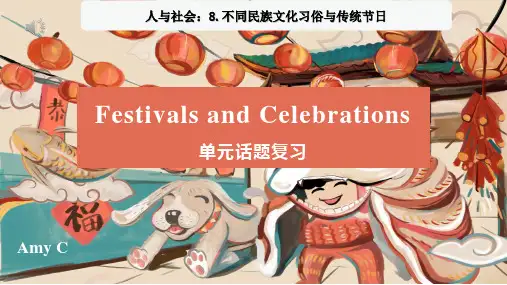
1. wear traditio3nal costumes 穿传统服饰 2. visit a la6ntern fair 参观一个灯笼博览会 3. guess lant5ern riddles 猜灯迷 4. admire the sh8inning moon 赏明月 5. enjoy deliciou1s moon cakes 品尝美味月饼 6. light firecrackers to dr4ive away the evil spirit 点燃鞭炮以驱走恶灵邪祟 7. eat tangyuan2/ yuanxiao 吃汤圆/元宵 8. make zongzi7/ dumplings 包粽子/饺子
festivals and celebrations
1. New Yea1r’s Day 元旦 2. the Lunar Ne2w Year’s Eve 除夕 3. the Spring Festival/ 3the Lunar New Year 春节 4. the Chinese La4ntern Festival 元宵节 5. the Qingming Festiva5l/Tomb Sweeping Day 清明节 6. the Dragon B6oat Festival 端午节 7. the Mid-Autu7mn Festival 中秋节 8. the Chongyang Festival/ t8he Double Ninth Festival 重阳节 9. the Laba9Festival 腊八节 10. the Naadam Festival 那达慕大会 11. the Rio Carnival 里约狂欢节 12. the Coming1-0of-Age Day 成人节
It is the best festival I’ve ever experienced because I can set off firecrackers and get pocket money from my parents and relatives as well.
新人教版必修三Unit1Festivalsandcelebrations课件

a festival of the dead(亡灵节)
Some Chinese traditional festivals
Festival of Lanterns Children’s Day
National Day
B
Easter Festival
B
Brainstorming
festivals of foreign countries
Thanksgiving Day
Easter
Christmas
Carnival
festivals
Father’s Day
Mother’s Day Valentine’s Day
all over the world.
Discussion :
1.Tell your friends your favorite festival and your reason .
2.Should we, Chinese students, celebrate western festivals like Christmas? Why or why not ?
6 Which of the following festivals is not celebrated in Japan? A Easter B. Oal D.
Mid-autumn Festival
7.What’s the main idea of the passage? Give one sentence to describe it.
Dragon Boat Festival
New Year’s Day
高一英语人教版必修三Unit1FestivalsAndCelebrations1
Listen and write the order of the conversations.
Chinese Lantern Festival Coming-of-Age Day Rio Carnival
Listen and find out
Listen and write the order of the conversations.
Listen and find out
Listen again and complete the sentences with the correct words.
3. In conversation 3, the people are enjoying the lantern show.
Listen and find out
Warming-up
Choose some words or phrases to describe each festival.
• wear traditional costumes • march along the streets • attend the ceremony
新人教高中英语必修3unit1Festivals-and-celebrations整单元教学设计
教学设计Book3Unit 1 Festivals and celebrations listening and speaking一、单元教学规划1. 单元主题本单元的主题是“节日与庆典”。
该单元从呈现不同节日和庆祝活动入手,引导学生思考人们为何要庆祝节日,通过回顾节日的产生、发展和变化,展示不同国家和民族各具特色的节日风俗、庆典仪式、欢聚活动以及特色食品等,启发学生思考和探究节日的丰富内涵。
节日是一个国家或民族在漫长的历史过程中形成和发展的文化现象,大多富有趣味性和人文性,有着深刻的精神内涵。
不同民族有不同的节日,但是不同的节日却反映了人们共同的美好愿望和追求。
学习不同国家和民族的节日,不仅能开阔学生的视野,增加文化积累,促进语言表达,同时还能增强学生的文化认同感,充分认识文化差异,培养学生的跨文化交际意识和能力,增进国际理解。
2. 单元主要内容分析单元开篇页、listening and talking、listening and speaking 以及video Time 这四个部分围绕国内外的传统节日尤其是中国的元宵节为主展开的听说看的材料内容,开篇页以辛弃疾的关于元宵节的诗歌以及元宵节火龙舞图片引入话题,listening and talking 谈论"节日活动”(talk about festival activities),listening and speaking 谈论“节日经历”(talk about festival experiences),video time 聚焦“元宵佳节”(focus on the Latern Festival),围绕节日主题展开听说训练,层层推进,逐层深入。
Reading and Thinking 部分的活动主题是“探究节日与庆典的缘由”(discover the reasons for festivals and celebrations),是听说板块主题内容的延续,从展示几个不同的节日场景过渡到探讨人们为何欢庆节日,对世界各地的人们庆祝节日的现象追根溯源,进而讨论节日的传承与发展变化,目的在于启发学生的深层思考,体会节日文化的内在实质,感悟世界各国人民共同的精神追求和美好愿望。
2024春高中英语Unit1FestivalsandCelebrations课件新人教版必修第三册
○句型精析
①Here are some centuries-old traditions shared by the Chinese community in order to promote blessings of health and wealth in the New Year.
分 析 : 该 句 为 简 单 句 , “Here are some centuries-old traditions”为倒装句,“shared by the Chinese community”为过去 分词短语作后置定语,“in order to…”为目的状语。
译文:人们相信饺子吃得越多,在新的一年里就会得到越 多的财富。
核心素养目标
【语言技能】 掌握动词-ing形式作定语和表语的用法; 运用英语和他人有效交流节日信息或描述节日的经历; 积极拓展课外学习资源,通过网络等多渠道获取更多关于 世界节日和文化的最新知识。
【素养提升】 加深对世界各地节日的了解,感知中外文化,尊重不同的 文化和习俗,坚定文化自信; 结合已有认知和经验,客观比较、分析中外节日文化的异 同,全面、正确认识了解世界各地节日的重要性; 能够发散思维,从多个视角认识世界,辩证思考影响文化 发展的多元因素。
·Making decorations. People will make red papercuts, Chinese characters or red lanterns that mean luck, happiness and blessing, and stick them onto doors and windows.
UNIT 1 FESTIVALS AND CELEBRATIONS
美文导入
素养解读:“节日”是永恒的话题,也是“人与社会”主 题语境下的一个重要部分。节日来自人们的生活和实际经历, 来自文化和人们的喜爱。本单元通过介绍节日的种类、节日的 由来、节日的作用、节日中人们的各种表现,以及人们庆祝节 日的方式和节日故事,加强学生对中国节日的理解和感悟,以 及对外国节日的了解,提高文化素养,进而增强跨国文化交流 意识。
Unit1FestivalsandCelebrationsReadingforWriting课件高中
3. Read the sentence patterns and use them to rewrite the opening paragraph.
• (那达慕大会)它主要有三大赛事:赛马,摔跤和射箭,每项 运动都动人心魄。
• It (The Naadam Festival) is represented by three events: horse racing, wrestling, and archery, which are all so exciting to watch! 元宵节(Lantern Festival)主要有三项活动:赏花灯,舞狮子,猜 灯谜,每项运动都十分有趣。
lunar calender,usually lasting for three days.
春节于每年农历正月初一开始,持续七天。
Spring Festival falls on the first day of the first month of the lunar calender, usually lasting for seven days.
—— para.1
opening para
1. When is the festival celebrated?
2.Where is the festival celebrated? The first sentence functions as
3.Major events of the festival.
4.underline the sentences that describe the writer’s feelings and emotions.
...and archery, which are all so wxciting to watch some amazing perfomances I was surprised to see... I was a little worried about... feeling really tired I can’ wait! ...was totally worth it
新教材人教版高中英语必修第三册:Unit 1 Festivals and Celebrations 优秀课件
新教材 高中英语 必修第三册 UNIT 1 FESTIVALS AND CELEBRATIONS
词汇三 ceremony n. 典礼;仪式
◆教材原句 attend the ceremony 出席典礼 ◆要点必记 hold a ceremony 举行典礼 opening ceremony 开幕式 closing ceremony 闭幕式 presentation ceremony 颁奖仪式 religious ceremony 宗教仪式 wedding ceremony 婚礼 graduation ceremony 毕业典礼
新教材 高中英语 必修第三册 UNIT 1 FESTIVALS AND CELEBRATIONS
单句语法填空
(1) He dressed up as a hunter for the party.
(2) She is usually dressed in
red,which makes her look more energetic.
新教材 高中英语 必修第三册 UNIT 1 FESTIVALS AND CELEBRATIONS
单句写作 (1) It is said that the old woman usually holds a ceremony ( 举行仪式)before she tells fortunes for others. wedding ceremony (婚礼)has come into fashion in his country. (3) He finally turned up at our graduation ceremony(毕业典礼)with some souvenirs in his hands. (4) To my delight,I was chosen from hundreds of applicants to attend_t_h_e_o_p__e_n_in_g__c_e_r_e_m_o_n_y (开幕式).